Middle of the Night by Riley Sager Summary, Characters and Themes
Middle of the Night is a suspense novel by Riley Sager about memory, guilt, grief, and the stories people build to survive what they cannot explain. At its center is Ethan Marsh, a man still marked by the childhood disappearance of his best friend, Billy Barringer, who vanished from a backyard tent during a summer sleepover in 1994.
Decades later, Ethan returns to his old home and finds himself pulled back into the mystery when strange signs begin appearing around the neighborhood. The novel mixes a cold-case investigation with suburban unease, buried family secrets, and a long search for the truth behind one terrible night.
Summary
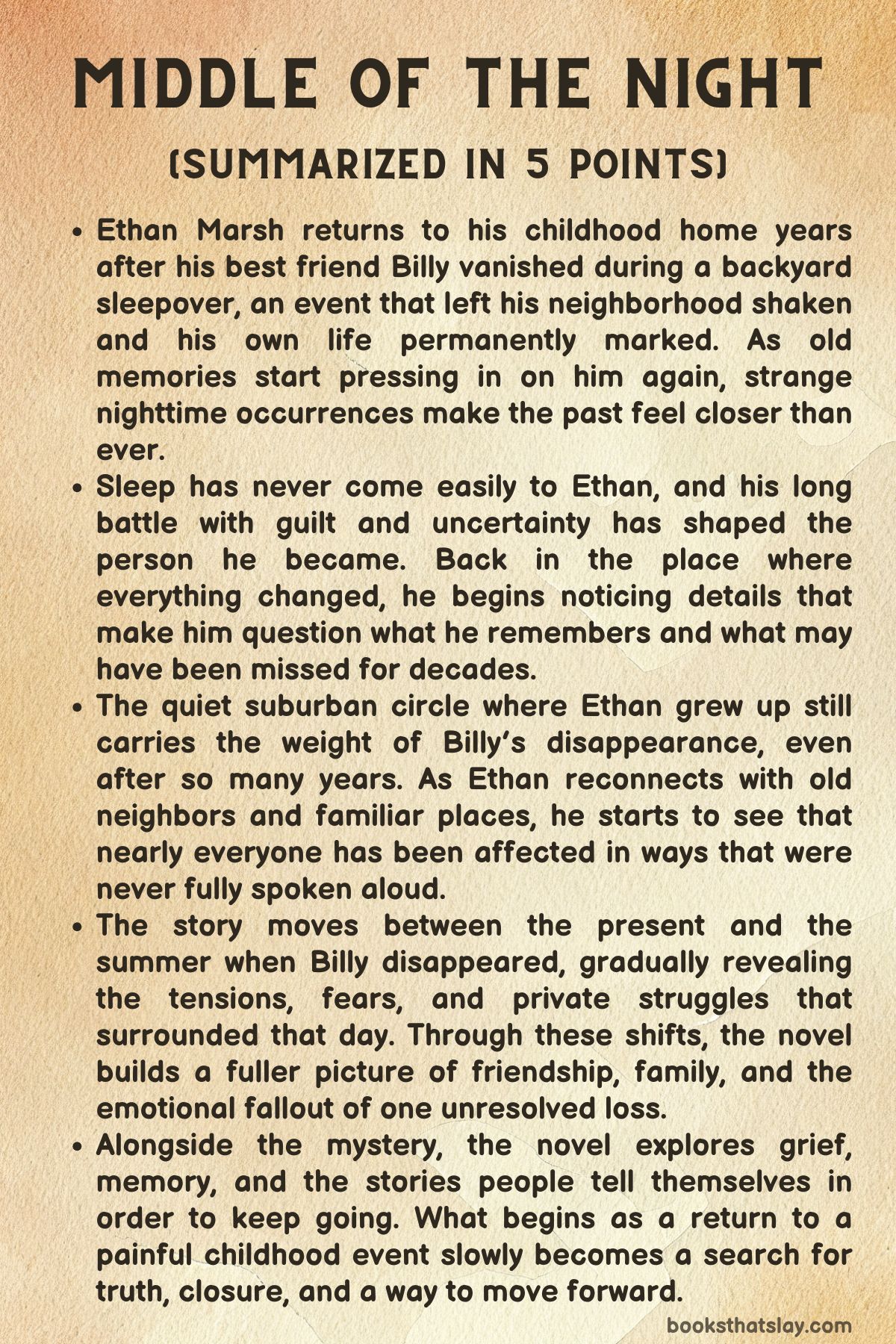
Ethan Marsh has lived for thirty years with one defining wound: when he was ten, his best friend Billy Barringer disappeared while sleeping beside him in a tent in Ethan’s backyard. Billy was simply gone by morning, leaving behind a slit in the tent and a neighborhood shattered by fear.
The case was never solved. Investigators searched every home, questioned every neighbor, and chased countless theories, but nothing explained how a child could vanish from a quiet suburban cul-de-sac without anyone seeing or hearing anything.
Ethan grew up under the weight of that mystery, carrying guilt that affected his sleep, his relationships, and the shape of his entire life.
Now forty, Ethan has moved back into his parents’ house after their retirement. The return puts him directly inside the place where everything started.
He still suffers from chronic insomnia and is haunted by the same nightmare each night, always circling back to the sound of something scratching at the tent. His life feels stalled, especially after the death of his wife Claudia, a loss he has barely allowed himself to face.
When strange things begin happening in the neighborhood, Ethan starts to think the past is no longer finished with him.
First, he notices lights flickering from house to house late at night, as if someone is moving through the circle of homes. Then baseballs begin appearing in his yard.
To anyone else they might seem harmless, but to Ethan they carry a private meaning. As boys, Billy had used a tossed baseball as a signal to call Ethan outside.
The baseballs feel less like coincidence and more like a message. Ethan begins to wonder whether someone is playing a cruel prank, or whether Billy, somehow, is trying to reach him.
As Ethan looks for answers, the old neighborhood comes back into view. He reconnects with Russ Chen, another childhood friend who now seems settled and successful.
He also reconnects with Ashley Wallace, his former babysitter, who has returned home to care for her aging father, Vance, and raise her young son Henry. Vance’s mind is failing, yet he insists he has seen Billy in the yard.
Ethan wants to dismiss this as confusion, but the claim unsettles him. He becomes increasingly sensitive to every odd event around Hemlock Circle.
Then the case changes completely. Detective Ragesh Patel, once a boy from the same neighborhood and now a police officer, tells Ethan that human remains have been found near the Hawthorne Institute, an abandoned property hidden in the woods not far from their homes.
Dental records confirm the remains are Billy’s. The discovery means Billy was murdered or died under suspicious circumstances, and it means the truth has been sitting close by all these years.
That news revives memories from the day before Billy vanished. Ethan, Billy, Russ, Ashley, and Ragesh had explored the woods and wandered onto the grounds of the Hawthorne Institute, a secretive estate linked to occult research and the wealthy Ezra Hawthorne.
As children, they saw the place as eerie and forbidden. They climbed through a gap in the wall, crossed the grounds, reached a waterfall, and eventually came to a mausoleum.
There, Billy was trapped behind a gate while the others ran from an approaching adult. Ethan, frightened and angry, left Billy behind in a moment he has regretted ever since.
In the present, Ethan becomes convinced the Hawthorne Institute is central to Billy’s death. He learns that his mother, Joyce, once worked there, a fact she kept hidden.
He also discovers that Fritz Van de Veer, an elderly neighbor, supervised operations at the institute. Ethan confronts him, suspecting some dark conspiracy.
But the truth is stranger and less grand than he imagined. The institute was secretive because Ezra Hawthorne and his circle were obsessed with speaking to the dead.
There were rituals, strange rules, and embarrassing eccentricities, but no evidence that Billy was killed to protect occult secrets. The revelation closes one path while opening another: Billy had known the place, had visited before, and had even formed a bond with Ezra and Fritz because of his interest in ghosts.
Billy’s fascination with ghosts matters more and more as Ethan recalls who Billy really was: lonely, imaginative, a little odd, but sincere in his longing to believe there was something beyond ordinary life. Ethan begins to think that Billy’s supposed haunting may be real.
His trail camera captures odd shadows near the woods. A message appears in his notebook in handwriting that is not his own.
It contains Billy’s old phrase, “Hakuna matata, dude,” words Billy had said the night they argued in the tent. Ethan is shaken, because the phrase connects directly to one of his most painful memories.
Before Billy disappeared, Ethan had lashed out in anger and told him he should die and become a ghost. He regretted it instantly, but those words have tormented him ever since.
Trying to force his memory to return, Ethan recreates the sleepover by setting up the same kind of tent in his backyard. With help from Detective Cassandra Palmer, who has become deeply invested in the case, he reenacts the sound that once woke him.
The effort works. Ethan suddenly remembers that Russ had come into the yard that night with a knife and sliced the tent, intending only to frighten the boys because he felt excluded and resentful.
Russ had lied by omission for decades, and his mother had hidden the knife to protect him. Ethan accuses Russ of murder, but Russ insists he never touched Billy beyond the prank.
At first, this seems like the answer. But the truth is still incomplete.
Soon after Russ is taken away, Henry disappears from Ethan’s yard. Trail camera footage shows a dark figure carrying him off.
Ethan and Ashley race into the woods and find Henry with Andy Barringer, Billy’s younger brother, now an adult still broken by what happened. Andy confesses that he has been the one staging the eerie signs around Ethan’s house.
He wanted Ethan to remember the truth. As a child, Andy had secretly watched the sleepover from the yard and heard Ethan’s cruel words to Billy.
Since then, Andy has suspected Ethan killed his brother.
At the waterfall, Andy demands a confession. Ethan, desperate to save Henry, is ready to take the blame for a crime he did not commit.
Before he can do so, Ashley stops him and admits the truth herself. On the night Billy disappeared, after attending a party and drinking, she drove home without a license.
Billy, having slipped out of the tent after hearing the cut and believing a ghost was calling him, ran through the woods toward the Hawthorne Institute. Ashley hit him with her car on the road.
He died instantly. Terrified, guilty, and unable to face what she had done, she hid his body in the water near the falls.
The neighborhood spent decades imagining kidnappers, killers, and conspiracies when the truth was a terrible accident followed by a cowardly choice.
Ashley’s confession devastates everyone. Andy finally gets the answer he has wanted his whole life.
Ethan is furious that so many lives were warped by a secret she kept. Henry, horrified by what he hears, stumbles and falls into the water.
Ethan dives in after him. Underwater, in the confusion and darkness, he feels another small hand guide him toward Henry.
When both Ethan and Henry surface alive, Henry says he saw another boy in the water who helped him. Ethan understands, at last, that Billy really was there.
A year later, Hemlock Circle has begun to heal. Ashley has gone to prison after confessing.
Ethan has taken custody of Henry, and the boy has become the family Ethan never expected to have. The neighborhood is changing, with old grief finally loosening its hold.
Ethan is no longer trapped in the same cycle of guilt and sleeplessness. The truth did not arrive in the form anyone imagined, but it brought release.
Billy was never forgotten, and in the end, Ethan is able to carry him not as an open wound, but as the memory of a friend who stayed with him until he found his way forward.
Characters
Ethan Marsh
Ethan Marsh is the emotional center of the novel and the character through whom the story’s deepest concerns about guilt, memory, grief, and arrested growth are explored. As a child, Ethan is sensitive, cautious, and eager to belong.
He wants friendship, approval, and safety, and these desires shape many of his choices. His bond with Billy is real, but it is also fragile because Ethan does not share Billy’s comfort with being different.
Where Billy embraces his oddness, Ethan fears it. That difference matters because Ethan’s greatest shame does not come only from Billy’s disappearance, but from the fact that his final words to Billy were cruel.
The adult Ethan is not simply haunted by a missing friend; he is haunted by the version of himself that failed Billy through fear, impatience, and emotional cowardice.
As an adult, Ethan’s life shows the long damage caused by unresolved trauma. His insomnia is not just a medical problem but a visible form of psychic punishment.
He cannot rest because his mind has never been able to settle the past. He has built his identity around absence, around the mystery of what happened, and around the suspicion that he should have done something differently.
This leaves him emotionally stranded. Even his marriage to Claudia, though loving, could not fully free him from the grip of childhood loss.
He avoids fatherhood because he cannot imagine loving a child without also imagining that child being taken away. He is intelligent and reflective, but he is also avoidant, and that avoidance helps explain why he clings so fiercely to supernatural possibilities.
For Ethan, the idea that Billy might be reaching out is not only frightening. It is also comforting, because it would mean the dead are not fully gone and forgiveness might still be possible.
What makes Ethan compelling is that he is not presented as either heroic or weak in any simple way. He is often passive, hesitant, and self-protective, especially as a child, yet he is also capable of loyalty, tenderness, and eventual moral courage.
His journey is not about becoming fearless. It is about becoming honest.
He must stop hiding from Claudia’s death, from Billy’s last night, from his own resentment and shame, and from the way grief has narrowed his life. By the end, he becomes a more complete person because he finally accepts the truth rather than the stories he has used to survive.
Taking Henry into his care gives Ethan the chance to become someone defined not by old failure, but by present love and responsibility. His arc is therefore one of painful release: he moves from being a man trapped inside memory to someone capable of building a future.
Billy Barringer
Billy Barringer is the story’s most important absence, but he is never reduced to a mere symbol of tragedy. He emerges as a vivid, vulnerable child whose imagination and emotional intensity shaped the lives of everyone around him.
Billy is unusual, dreamy, and deeply invested in ghosts, spirits, and hidden worlds. That fascination is not treated as a quirk for its own sake.
It grows out of his loneliness and from his longing to believe that the ignored and misunderstood are still seen by someone. In that sense, Billy’s interest in the supernatural reflects his own emotional reality.
He feels invisible among his peers and finds comfort in the thought that unseen things might still matter.
Billy’s character also reveals one of the novel’s most moving ideas: that childhood oddness can be both isolating and precious. He is a boy who does not fit neatly into the social world around him, but he is not ashamed of the parts of himself that make him different.
He wants connection, especially with Ethan, yet he does not completely reshape himself to earn approval. That gives him a quiet strength.
At the same time, he is still a child, which means his confidence is uneven. He is easily hurt, and Ethan’s betrayal at the institute and harsh words in the tent wound him deeply.
His forgiving phrase, “Hakuna matata, dude,” shows both his kindness and his emotional resilience. He tries to brush away hurt, but the reader can feel that the pain remains.
Billy also functions as the moral measure against which the other characters are tested. Ethan is judged by whether he stood by him.
Andy is defined by the lifelong grief of losing him. Mary Ellen’s anxiety is magnified through her protectiveness toward him.
Ashley’s secret becomes unbearable because it concerns not an abstract victim, but this very specific child. Even after death, Billy remains active in the story’s emotional structure.
The possibility of his ghost is meaningful because it fits the kind of boy he was: someone who wanted desperately to be recognized. When the ending suggests that Billy’s spirit truly helps save Henry, it feels earned not because it provides spectacle, but because it completes his emotional pattern.
He was always a boy reaching out, wanting someone to answer. In the end, he is finally answered.
Ashley Wallace
Ashley Wallace is one of the novel’s most layered characters because she exists at the intersection of regret, self-preservation, maternal instinct, and buried guilt. As a teenager, she is restless, ambitious, and determined not to let suburban life define her.
She looks at the adults around her and fears becoming trapped in disappointment or dependency. That ambition gives her an edge, but it also makes her sympathetic.
She wants movement, possibility, and escape. She is not cruel or careless in essence, yet she is still young enough to make impulsive decisions, and those decisions alter many lives.
In the present timeline, Ashley appears grounded and practical. She is caring for an elderly father, raising Henry, and trying to maintain order in a life shaped by sacrifice.
She comes across as more realistic than Ethan, less willing to indulge supernatural thinking or emotional fantasy. This makes her seem stabilizing at first.
She urges Ethan to face reality, especially regarding Claudia, and in many scenes she has the role of the person who keeps emotion from spilling into delusion. Yet this practical surface hides the central secret of her life.
Her realism is not just wisdom; it is also defense. She has survived by refusing to collapse under the weight of what she did.
She cannot let herself drift into magical explanations because she knows the truth is brutally material: a car, a road, a child, a moment of negligence, and then a choice to hide it.
Ashley’s confession redefines her entire character without making her suddenly unbelievable. The revelation is shocking, but it fits what the reader already knows about her capacity for suppression and compartmentalization.
She did not kill Billy with malice, but she did make a moral failure that extended far beyond the accident itself. Her silence allowed other people to suffer for decades.
At the same time, the novel does not flatten her into a monster. She is capable of love, devotion, and real pain.
Her relationship with Henry is sincere, and her grief over Billy is lasting. The tragedy of Ashley is that she becomes a person who lives responsibly in many areas of life while carrying one unforgivable private truth.
Her eventual confession is not redemptive in any simple sense, but it is humanly credible. She represents the unbearable cost of a single moment of fear.
Andy Barringer
Andy Barringer serves as one of the most powerful embodiments of unresolved grief in Middle of the Night. As Billy’s younger brother, he spends his childhood on the margins, watching older children live in a world he cannot yet join.
That distance matters because it shapes how he experiences Billy. Billy is not only a sibling; he is also a model, an object of longing, and a gateway to a life Andy cannot access.
When Billy disappears, Andy is left not just with loss, but with exclusion that can never be repaired. He never got to grow into an equal relationship with his brother.
He loses Billy while still in the position of the younger child looking in from the outside.
His memory of hearing Ethan’s angry words becomes the seed of an obsession. Because he is young, frightened, and lacking full context, Andy builds a suspicion that hardens over time.
He does not merely wonder whether Ethan hurt Billy; he organizes his grief around that belief. This is psychologically convincing because unresolved grief often seeks an image, a face, or a sentence to attach itself to.
Andy has one. He has a sound bite that becomes, in his mind, the hidden truth others missed.
By the time he reenters the present action, his actions are disturbing but emotionally intelligible. He stages the apparent haunting not simply to torment Ethan, but to force memory into the open.
He wants truth, but he is so damaged by grief that he uses fear and manipulation to get it.
Andy’s confrontation at the waterfall shows both his desperation and his emotional immaturity. Even as an adult, he is trapped in the logic of the child who never got an explanation.
Henry becomes a means to an end, which is terrible, yet the scene makes clear that Andy is less interested in harming the boy than in recreating terror in order to produce confession. That does not excuse him, but it reveals how profoundly loss has distorted him.
When Ashley confesses, Andy collapses because what he wanted was never revenge for its own sake. He wanted the end of uncertainty.
His character reveals how grief can become a lifelong identity when truth is withheld too long.
Russ Chen
Russ Chen is one of the story’s most effective examples of how small acts can have enormous consequences. As a child, Russ is burdened by the death of his older brother Johnny and by the feeling that he is always living in someone else’s shadow.
He wants belonging, approval, and masculine confidence, and these desires make him especially sensitive to rejection. When Billy and Ethan exclude him from the sleepover, his jealousy and hurt become intense enough to push him toward a reckless act.
He cuts the tent not because he means to kill, but because he wants to frighten and disrupt. The act is childish, angry, and stupid, yet it sets the final tragedy into motion.
Russ becomes one more person whose immaturity on that day contributed to irreversible loss.
As an adult, Russ appears stable and successful. He has a family, a business, and the outward markers of a life that has moved forward.
This contrast makes his secret more striking. He has lived for decades with the knowledge that he sliced the tent and concealed it.
Even if he did not kill Billy, he participated in the chain of events and chose silence. He is friendly with Ethan, but that friendship is ethically compromised by what he withholds.
His kindness in the present is therefore double-edged. It may be genuine, but it is also mixed with self-protection.
Russ is not written as purely deceptive or malicious. He is a believable adult who has convinced himself that what he did was limited, that it no longer matters in the same way, or that exposing it would only create more pain.
That kind of reasoning is morally weak but psychologically common. When Ethan accuses him, Russ finally admits the truth, and the scene shows that his guilt never fully disappeared.
His mother’s role in hiding the knife also reveals the family structure around him: he was protected, excused, and shielded. Russ is significant because he stands for a painful reality at the heart of the novel.
Catastrophe is not always caused by one grand villain. Sometimes it emerges from ordinary people making selfish or cowardly decisions and then living inside the silence that follows.
Mary Ellen Barringer
Mary Ellen Barringer is one of the most tragic parental figures in the story because her love for Billy is inseparable from fear. She is presented as a woman with overwhelming anxiety, someone whose instinct to protect easily slips into dread and fixation.
Her emotional world is defined by the anticipation of harm. She does not move through life with confidence but with vigilance, as though disaster is always waiting just outside the frame.
This makes her bond with Billy especially intense. She sees in him the same emotional sensitivity she recognizes in herself, which deepens her protectiveness but also increases her fear of what the world might do to him.
What makes Mary Ellen compelling is that her anxiety is not treated as a minor personality trait. It shapes her motherhood, her view of danger, and even the way others may interpret her after Billy’s disappearance.
She becomes a plausible suspect not because she is cruel, but because extreme fear can look unstable from the outside. The novel uses her to show how maternal love, when fused with unchecked anxiety, can become overwhelming and difficult for others to understand.
Yet she is never reduced to that suspicion. She is fundamentally a grieving mother whose worst fear came true in a way she could neither predict nor prevent.
Her memories about protecting a beloved doll as a child reveal an important psychological pattern. Mary Ellen copes with fear not by accepting uncertainty, but by trying to exert impossible control over what she loves.
The novel quietly suggests that such control cannot succeed. Love cannot eliminate danger.
In that sense, Mary Ellen becomes part of the book’s larger meditation on the limits of protection. She wanted to keep Billy safe from everything, but safety was never fully within anyone’s power.
Her grief therefore carries not only sorrow but also the torment of failed vigilance.
Joyce Marsh
Joyce Marsh is a deeply important figure because she represents the hidden inner life of suburban motherhood and the quiet dissatisfaction that often goes unnoticed by children. To Ethan, she was simply his mother, part of the background structure of home.
Only later does he realize that she had ambitions, humiliations, fears, and secrets that existed outside his understanding. Her brief job at the Hawthorne Institute matters not just because it creates plot revelations, but because it gave her a sense of self beyond domestic routine.
She liked earning money, leaving the house, and feeling that her life had motion and meaning. Losing that job wounds her pride and revives her sense of dependence.
Joyce’s secret about the institute is sustained by fear, but also by the habits of self-erasure common to her role. She learns to keep quiet, to absorb distress privately, and to maintain the household surface even while carrying disturbing knowledge.
Her encounter with the ritual at the institute is frightening, yet the lasting impact comes just as much from being silenced afterward. She internalizes the nondisclosure demand so completely that it survives for decades.
That shows how authority and intimidation can become part of a person’s private psychology.
As a mother, Joyce is loving but imperfect. She does not tell Ethan everything, partly to protect herself and partly because children often do not see what adults conceal in order to preserve normal life.
Her character adds social depth to the novel by revealing the gendered pressures of her environment. She lives among expectations about domesticity, emotional composure, and respectable silence.
Her sadness and frustration therefore have broader resonance. She is not a grand dramatic presence, but she is one of the clearest examples of how adult compromise and hidden pain shape the world children inhabit without fully understanding it.
Fred Marsh
Fred Marsh is a quieter character, but his steadiness gives him significance. He represents a more stable form of adulthood than many of the other parents in the story.
Ethan’s memories do not place him at the emotional center of the household in the same way his mother is, yet Fred’s presence matters because he embodies reliability and a certain practical decency. He is among the first people cleared by police after Billy’s disappearance, and in the present he reacts to Ethan’s painful questions with more understanding than outrage.
What stands out about Fred is his ability to recognize Ethan’s need for answers even when those questions are painful or offensive. When Ethan directly asks his parents whether one of them killed Billy, Fred does not respond only with wounded pride.
He sees the desperation beneath the accusation. That capacity for empathy makes him morally reassuring.
He is not glamorous or mysterious, but he is one of the few adults in the story who consistently seems grounded.
Fred also helps illuminate Joyce by contrast. Where she internalizes fear and secrecy, Fred seems more straightforward and emotionally legible.
This difference may explain part of the distance in their marriage during the past sections. He does not fully grasp what his wife has been carrying, and she does not fully share it.
Even so, he contributes to the sense that not all the older adults on Hemlock Circle are hiding monstrous truths. Some are simply ordinary people who did not see enough, ask enough, or understand enough at the time.
Claudia
Though Claudia appears mostly through Ethan’s memories, she plays a major role in understanding who he is. She represents the life Ethan might have built more fully if his grief had not remained so unresolved.
Their relationship seems loving, patient, and grounded in genuine affection. Claudia is not idealized into perfection, but she is remembered as someone who offered Ethan companionship and a measure of emotional refuge.
That matters because it shows he was capable of connection despite the scars of childhood.
At the same time, Claudia’s death reveals how Ethan processes pain by displacement. He speaks of missing her and even continues calling her phone as if contact were still possible.
For much of the narrative, his focus on Billy partially masks his inability to directly mourn Claudia. This makes her less a side character than a second axis of Ethan’s grief.
Billy is the childhood loss that shaped him, while Claudia is the adult loss that proves he never learned how to endure grief in a healthy way. Her death sends him back to his childhood home not only geographically but psychologically.
Claudia is also important because of what she reveals about Ethan’s fear of parenthood. Their disagreement over children is not merely a marital issue; it is a window into Ethan’s deepest wound.
He cannot bear the idea of loving a child and risking catastrophic loss. In this way, Claudia helps the reader see how trauma distorts future choices.
She is not present in the action, but her emotional presence is constant. She gives depth to Ethan’s loneliness and helps explain why the possibility of ghosts holds such power over him.
Henry Wallace
Henry Wallace serves as both a child character in his own right and as a mirror through which the adults’ failures become newly visible. He is serious, observant, and somewhat unusual, with interests that mark him as different from more conventionally social children.
In that respect, he resembles Billy. Ethan notices this, and the connection becomes important because Henry gives Ethan another chance to respond properly to a child who might otherwise be misunderstood or left alone.
Where Ethan once failed Billy in moments of social pressure and emotional confusion, he learns to meet Henry with reassurance and patience.
Henry is more than a symbolic replacement. He has his own emotional life, especially in relation to Ashley and Vance.
He is exposed to instability he cannot fully interpret, and when the truth about his mother comes out, his horror feels devastatingly real. The story does not treat him as merely a child to be rescued.
It also shows him as someone who must carry knowledge that will alter his identity and family life forever.
His eventual bond with Ethan is one of the novel’s most hopeful developments. Henry’s final use of “Dad” signals not just affection, but the creation of a family from the ruins of other broken histories.
Through Henry, the novel suggests that inheritance does not have to mean repeating old trauma. Care, trust, and belonging can be rebuilt.
He is therefore essential to the ending’s sense of renewal.
Vance Wallace
Vance Wallace is important because he complicates the line between delusion and truth. As an elderly man in mental decline, he is easy for others to dismiss.
When he says he has seen Billy, the natural assumption is that he is confused. Yet he is one of the few people who has actually perceived an important piece of reality.
He did see a Barringer boy; he simply meant Andy rather than Billy. This detail gives his character thematic weight.
The story repeatedly warns against dismissing people too quickly, especially when their speech is fragmented or their perceptions seem unreliable.
Vance’s deterioration also adds emotional texture to Ashley’s life. Caring for him is exhausting and sad, and his confusion often reopens old wounds.
He mistakenly identifies his daughter as her dead mother, wanders, and brings public embarrassment and private grief together in painful ways. Through him, the novel shows how memory can fail in one context even while preserving a stubborn clue in another.
He also reinforces the idea that truth often arrives in distorted form. Vance is not a detective or a hero, but he becomes one of the accidental witnesses whose testimony is misunderstood because of the condition of the speaker rather than the content of what is said.
That makes him quietly vital to the story’s design.
Ragesh Patel
Ragesh Patel occupies an interesting position because he belongs both to the past group of children and to the present machinery of law and explanation. As a boy, he is insecure, sometimes mocking, and eager to impress, especially around Ashley.
He is capable of cruelty, particularly toward Billy, and his behavior at the institute contributes to the day’s emotional damage. Yet he is also a child navigating his own confusion, including unresolved feelings related to Johnny Chen.
His younger self is flawed in believable ways: performative, cutting, and unsure of himself.
As an adult detective, Ragesh brings procedural authority to the story, but he is never detached from its emotional stakes. He knows these people, remembers parts of the past, and must investigate not strangers but the neighborhood that formed him.
This makes him more interesting than a standard detective figure. He is both insider and investigator.
He wants the truth, yet he also carries old loyalties and memories.
Ragesh also provides some of the novel’s realism amid escalating fear and supernatural suggestion. He is not immune to the eerie dimensions of the case, but he does not let himself be governed by them.
His presence grounds the narrative and helps prevent Ethan’s perspective from becoming the only interpretive framework. He represents the imperfect but necessary pressure of evidence, procedure, and adult accountability.
Cassandra Palmer
Detective Cassandra Palmer functions as a sharp counterbalance to Ethan’s emotional subjectivity. Unlike Ragesh, she is not shaped by childhood participation in the events, which gives her a colder and more analytical perspective.
She is fascinated by the case and understands its history deeply, but her investment is professional as well as personal. She is drawn to old mysteries and sees patterns others have missed.
Her theory that Billy knew and trusted the person who took him is one of the first major pushes toward the truth.
Cassandra is significant because she respects Ethan’s memories without surrendering to his supernatural suspicions. She is willing to entertain the emotional reality of what he is experiencing, but she keeps returning to motive, opportunity, and behavior.
This makes her both useful and slightly unsettling. She does not comfort Ethan; she studies him, challenges him, and at times seems to understand the narrative logic of the case better than he does.
Her role in helping Ethan recreate the tent scene is especially important. She becomes the instrument through which buried memory is recovered.
In a novel full of frightened parents, guilty witnesses, and damaged survivors, Cassandra represents disciplined attention. She is not the most emotionally rich character, but she is structurally essential because she helps convert feeling into recognition.
Fritz Van de Veer
Fritz Van de Veer is initially framed as a suspicious figure, and the novel uses that impression well. He is associated with secrecy, with the Hawthorne Institute, and with Joyce’s fear.
His bearing and history make him seem like someone who could be hiding something sinister. Yet when the truth emerges, Fritz turns out to be more eccentric than evil.
He belonged to a circle of people fascinated by the dead, ritual, and mystery, but he was not a murderer or mastermind.
This reversal matters because Fritz shows how easily secrecy invites projection. Since he knows things others do not, he becomes a natural vessel for suspicion.
But the secret he carries is less sensational than people imagine. He is part of a world of occult performance, intellectual oddity, and embarrassing ritual rather than hidden violence.
That does not make him innocent in every respect; his insistence on silence and control helped create the conditions for misunderstanding. Still, he is not the monstrous answer the characters hope or fear they have found.
Fritz also deepens the novel’s interest in belief. Unlike Ethan, who turns toward ghosts from grief, or Billy, who believes from longing, Fritz believes from fascination and ideology.
He wanted transcendence, mystery, and contact with the dead as part of a larger worldview. That gives him a distinct place among the believers in the story.
Ezra Hawthorne
Ezra Hawthorne is more of a legendary presence than a fully active character, but he shapes the atmosphere of the narrative in major ways. Wealthy, secretive, and obsessed with speaking to the dead, he becomes the center of neighborhood myth.
His institute stands as a place onto which fear, rumor, and fantasy can be projected. For the children, it is forbidden and thrilling.
For adults, it is suspicious and socially embarrassing. For Ethan in the present, it becomes a possible key to Billy’s death.
What makes Ezra interesting is that he is both less and more than the rumors around him. He is not the architect of the murder mystery, yet his world of rituals, NDAs, black clothing, and strange experiments creates the symbolic environment in which the mystery thrives.
He helped produce secrecy, and secrecy breeds narrative invention. His interest in ghosts also connects him unexpectedly to Billy, making him part of the story’s emotional history rather than just its Gothic backdrop.
Ezra embodies one of the novel’s central ironies. The place everyone suspects of hiding the grand evil is not where the worst act happened.
The real horror came from ordinary human fear and concealment, not ceremonial strangeness. Still, Ezra’s legacy matters because he gives the story its atmosphere of uncanny possibility and because his beliefs create one of the channels through which Billy’s longing for recognition was first affirmed.
Johnny Chen
Johnny Chen appears mainly through memory, but his influence on Russ and Ragesh is substantial. As Russ’s older brother, he leaves behind an absence that shapes Russ’s idea of masculinity, popularity, and worth.
Russ wants to imitate him, inhabit his space, and somehow replace what was lost, yet he can never do that successfully. Johnny’s death therefore helps explain Russ’s emotional volatility and craving for inclusion.
For Ragesh, Johnny carries a different significance. He is bound up with confusion, affection, and unresolved desire.
A remembered kiss and the emotional uncertainty around it leave Ragesh with a complicated form of grief that is more intimate and destabilizing than he openly admits. Through Johnny, the novel hints at forms of adolescence and desire that remain partly unspoken.
Johnny is also important because of his connection to the Hawthorne Institute. His presence in its photographs helps reveal that the institute was not merely some distant local oddity, but a place that had already touched the lives of these children before Billy’s death.
In that sense, Johnny is part of the buried network of relationships that the adult investigation slowly uncovers.
Misty Chen
Misty Chen plays a smaller but morally significant role. Her decision to hide the knife Russ used reveals the instinctive force of parental protection.
She is not covering up murder as she understands it, but she is still choosing concealment over truth. That choice fits one of the novel’s recurring patterns: adults trying to protect children or families in ways that ultimately deepen long-term harm.
Her act also reveals how quickly fear can become complicity. She sees enough to know that Russ did something dangerous, yet rather than confront the reality openly, she buries the evidence.
The image is literal and symbolic at once. She is burying not only a knife, but the possibility of accountability.
Though her role is brief, it reinforces the novel’s broader argument that silence is one of the most destructive forces in the story.
Themes
Guilt as a Force That Distorts an Entire Life
Guilt shapes the emotional structure of Middle of the Night far beyond the original event that caused it. Ethan does not simply remember Billy’s disappearance as a painful childhood tragedy; he carries it as a private moral failure that alters his sleep, his relationships, and his sense of who he is.
What makes this theme especially powerful is that guilt in the novel is rarely tied to a single clean act of wrongdoing. Instead, it grows out of hesitation, cruelty spoken in anger, silence, fear, and the inability to correct a terrible moment once it has passed.
Ethan’s guilt comes from surviving, from not knowing, from saying something unforgivable to Billy shortly before he vanished, and from the suspicion that he failed his friend when it mattered most. This means guilt becomes both emotional and existential.
It is not only about what he did or did not do. It is about how he has come to define himself ever since.
The novel also shows that guilt does not remain confined to one person. It spreads outward and settles into the lives of many characters in different forms.
Russ carries the burden of having slashed the tent, even though he did not directly kill Billy. His childish act of jealousy becomes part of the machinery of disaster, and his silence turns that one act into a lifelong weight.
Ashley bears the heaviest guilt of all because her responsibility is direct, yet even her guilt is divided into layers. There is the horror of the accident itself, but there is also the greater moral damage caused by her decision to hide the truth.
Her guilt becomes a quiet poison that shapes her adult life, her emotional defenses, and her relationship with her son. Andy, too, is transformed by guilt, though his is mixed with grief and suspicion.
He feels guilty for having watched, for having heard Ethan’s words, and for never being able to let go of the belief that he failed his brother by remaining powerless. The book therefore presents guilt not as a private emotion that fades with time, but as a durable force that reorganizes identity.
What gives this theme its depth is that guilt in the story is not always rational, but it is always influential. Ethan takes on blame for things outside his control while others hide blame that is truly theirs.
That imbalance keeps the truth buried for decades. The novel suggests that guilt, when left unspoken, becomes strangely creative: it produces nightmares, distorted memories, false theories, compulsive behavior, and emotional paralysis.
It can even make the supernatural seem plausible because the guilty mind wants signs, punishment, and contact with the dead. In the end, release becomes possible only when guilt is named correctly and assigned honestly.
Even then, the novel does not pretend confession erases pain. What it does suggest is that truth is the only thing that can stop guilt from endlessly reproducing itself inside the living.
Grief and the Difficulty of Letting the Dead Go
Grief in this novel is not presented as a single emotional response but as an entire way of living after loss. The story shows how different people preserve the dead inside themselves and how those acts of preservation can become loving, destructive, or both at once.
Ethan’s life is built around unresolved grief long before he admits it. His fixation on Billy’s disappearance appears, on the surface, to be about solving a cold case, but it is also about holding onto a relationship that ended without explanation.
Billy remains emotionally unfinished inside him. Because there was no clear ending, no body, and no truth, Ethan never learned how to mourn.
The grief hardened into insomnia, repetition, and obsession. What he experiences is not healing remembrance but emotional suspension.
Part of him is still the child in the backyard, waking to absence.
The novel becomes even richer on this theme because Billy is not Ethan’s only loss. Claudia’s death reveals how poorly Ethan has learned to grieve in adulthood as well.
He does not face her absence directly. Instead, he continues to speak to her through voicemails and emotional habits that blur memory and denial.
The return to his childhood home after Claudia’s death makes clear that his renewed focus on Billy is not accidental. One grief has reopened another.
This matters because it shows that unresolved mourning rarely stays in one sealed compartment. It echoes, attaches itself to new losses, and can turn a person toward the past whenever the present becomes too painful to bear.
Other characters show different versions of the same struggle. Andy has spent his life not simply missing Billy but being shaped by the absence of an older brother he was never allowed to fully know as an equal.
His grief becomes obsessive because it grows in the soil of uncertainty. Ashley’s grief is inseparable from guilt, which makes it especially corrosive.
She cannot publicly mourn Billy because that would bring her secret too close to speech. Instead, she carries private suffering that has no honest outlet.
Mary Ellen’s grief is the grief of a mother whose fear of loss has become reality, and that is one of the cruelest emotional turns in the book. Even the neighborhood as a whole becomes a grieving body.
Hemlock Circle is changed by Billy’s disappearance not just because a crime may have occurred there, but because everyone begins living under the shadow of a child who is no longer present.
The possibility of ghosts gives this theme a striking emotional form. The question is never only whether the supernatural exists.
It is whether the dead can still be felt, whether grief is a kind of haunting, and whether love itself keeps the lost nearby. Ethan wants Billy to be haunting him because that would mean absence is not total.
It would mean the dead are still reachable. The ending does not turn that idea into cheap comfort.
Instead, it suggests that the dead may remain meaningful without trapping the living forever. Grief does not disappear, but it can change shape.
Once truth is known, memory becomes less punishing and more sustaining. The dead are not erased, yet the living are finally allowed to move forward.
Childhood Innocence, Cruelty, and the Lasting Consequences of Small Decisions
One of the most unsettling aspects of the novel is the way it treats childhood not as a simple zone of innocence, but as a world where vulnerability and cruelty exist side by side. The children in the story are not evil, yet their actions matter in ways they cannot understand at the time.
Ethan, Billy, Russ, Andy, and the others live in a suburban environment that appears safe, but beneath that safety are jealousy, exclusion, shame, fear, and the intense social sensitivity that often shapes childhood behavior. The story refuses to sentimentalize these experiences.
Children are shown as capable of tenderness and imagination, but also of meanness, cowardice, and impulsive harm. This is what gives the central tragedy so much force.
The disaster does not grow out of grand villainy at first. It grows out of ordinary emotional failures among young people who do not yet understand the scale of consequence.
Ethan’s final argument with Billy is one of the clearest examples. In one sense, it is just a quarrel between two boys who feel misunderstood and hurt.
But the words Ethan throws at Billy become unforgettable because of what follows. The novel captures something painfully true here: childhood speech can be impulsive, but once spoken, it cannot be recalled, and when tragedy comes afterward, those words gain unbearable weight.
Russ’s act works similarly. He cuts the tent because he feels excluded and wants revenge in the shallow, immediate way children sometimes do.
He does not intend murder, yet the act becomes part of the causal chain leading to Billy’s death. The novel is deeply interested in this gap between intention and consequence.
Children do not fully grasp what their actions may trigger, but the adult world does not erase those consequences just because the original motive was childish.
Billy himself is central to this theme because he represents the child who does not fit and is therefore at once emotionally open and socially vulnerable. His belief in ghosts, his unusual manner, and his loneliness make him easy to underestimate.
Yet the novel never mocks him. Instead, it shows how children who are different often live closer to emotional truth than those trying hardest to appear normal.
Ethan’s discomfort with Billy’s difference reflects a broader childhood anxiety about belonging. That anxiety leads him to betray parts of himself as well as his friend.
The story is therefore not only about what happens to children, but about how children begin learning which selves are acceptable and which are risky.
What remains especially powerful is that adulthood in the novel is largely a long aftermath of childhood decisions. The past is not past because those early moments were never fully processed, corrected, or confessed.
The adults on Hemlock Circle are still living with the emotional logic of the children they once were. Ethan is still trying to apologize.
Andy is still trying to understand what he heard. Russ is still trapped in a moment of angry exclusion.
The novel suggests that childhood is not a harmless prelude to adult life. It is the stage on which identity, shame, fear, and loyalty first become active, and those early patterns can remain alive for decades if they are joined to trauma.
Truth, Secrecy, and the Stories People Create to Survive Uncertainty
Secrecy governs the emotional and narrative movement of Middle of the Night from beginning to end. The mystery survives for thirty years not simply because evidence is missing, but because nearly every important character withholds something.
Some hide facts out of fear, some out of guilt, some out of shame, and some because they believe silence is a form of protection. The result is that uncertainty does not remain empty.
It fills with speculation, suspicion, and stories. This is one of the novel’s sharpest insights: when truth is absent, people do not live in pure uncertainty for long.
They create explanations to make the pain bearable, even if those explanations are wrong.
Ethan is a prime example of this process. Because he cannot remember clearly and because no one ever found Billy, he spends years living inside theories.
He wonders whether an outsider crept into the neighborhood, whether someone on the block was secretly a monster, whether the Hawthorne Institute hid something murderous, and eventually whether Billy’s ghost is trying to communicate. These beliefs are not random.
Each one gives shape to what would otherwise remain an intolerable blank. The idea of haunting is especially revealing because it offers Ethan more than mystery.
It offers contact, meaning, and perhaps forgiveness. In that sense, supernatural explanation becomes one of the emotional stories people tell when ordinary reality feels too brutal or incomplete.
The same pattern appears throughout the community. The neighborhood turns Billy’s disappearance into a source of collective paranoia because silence invites suspicion.
The Hawthorne Institute becomes a natural container for fear because its secrecy is already real. Since Ezra Hawthorne and his circle hid their odd beliefs and rituals behind nondisclosure agreements and social distance, they become ideal targets for projection.
Yet the novel cleverly demonstrates that secretive appearance and actual guilt are not always the same thing. The institute is strange, but it is not the source of Billy’s death.
By contrast, Ashley’s secret is ordinary in origin and devastating in consequence. This contrast matters because it pushes against the expectation that truth will be grand, elaborate, or gothic.
The real secret is not the most theatrical one. It is the one a frightened person chose to bury.
Joyce, Misty, Russ, and Ashley all show how silence is often defended as necessary in the moment. Joyce keeps quiet about the institute because she has been intimidated and trained into secrecy.
Misty hides the knife because she wants to protect her son. Russ says nothing because he fears what his childish action might mean.
Ashley remains silent because confession would destroy her life and cannot undo Billy’s death. In each case, secrecy begins as a choice made under pressure, but with time it hardens into structure.
It shapes identities, relationships, and memory itself. People begin living around what cannot be said.
The novel’s final emotional effect depends on exposing the limits of secrecy. Hidden truth does not preserve innocence.
It prolongs damage. Every year that passes allows grief to deepen into obsession, suspicion, and self-punishment.
Once the truth emerges, it is not satisfying in a neat sense. It is painful, humiliating, and devastatingly human.
Yet only then can healing begin. The novel suggests that certainty can hurt, but uncertainty corrodes.
People may build stories to survive what they do not know, but those stories can never grant peace for long. Peace requires truth, however ordinary or terrible that truth may be.