Mistakes Were Made Summary, Characters and Themes
Mistakes Were Made by Lucy Score is a small-town romantic comedy about Zoey Moody, a literary agent whose carefully planned life has come apart, and Gage Bishop, a guarded lawyer with deep family wounds. Set in the chaotic, charming town of Story Lake, Pennsylvania, the book follows Zoey as she tries to rebuild her career, find stability, and decide where she truly belongs.
With an unruly eagle, town rivalries, found family, emotional setbacks, and a romance built on sparks and second chances, Mistakes Were Made is about learning that failure can sometimes lead straight to the life you needed. It’s the 2nd book of the Story Lake series.
Summary
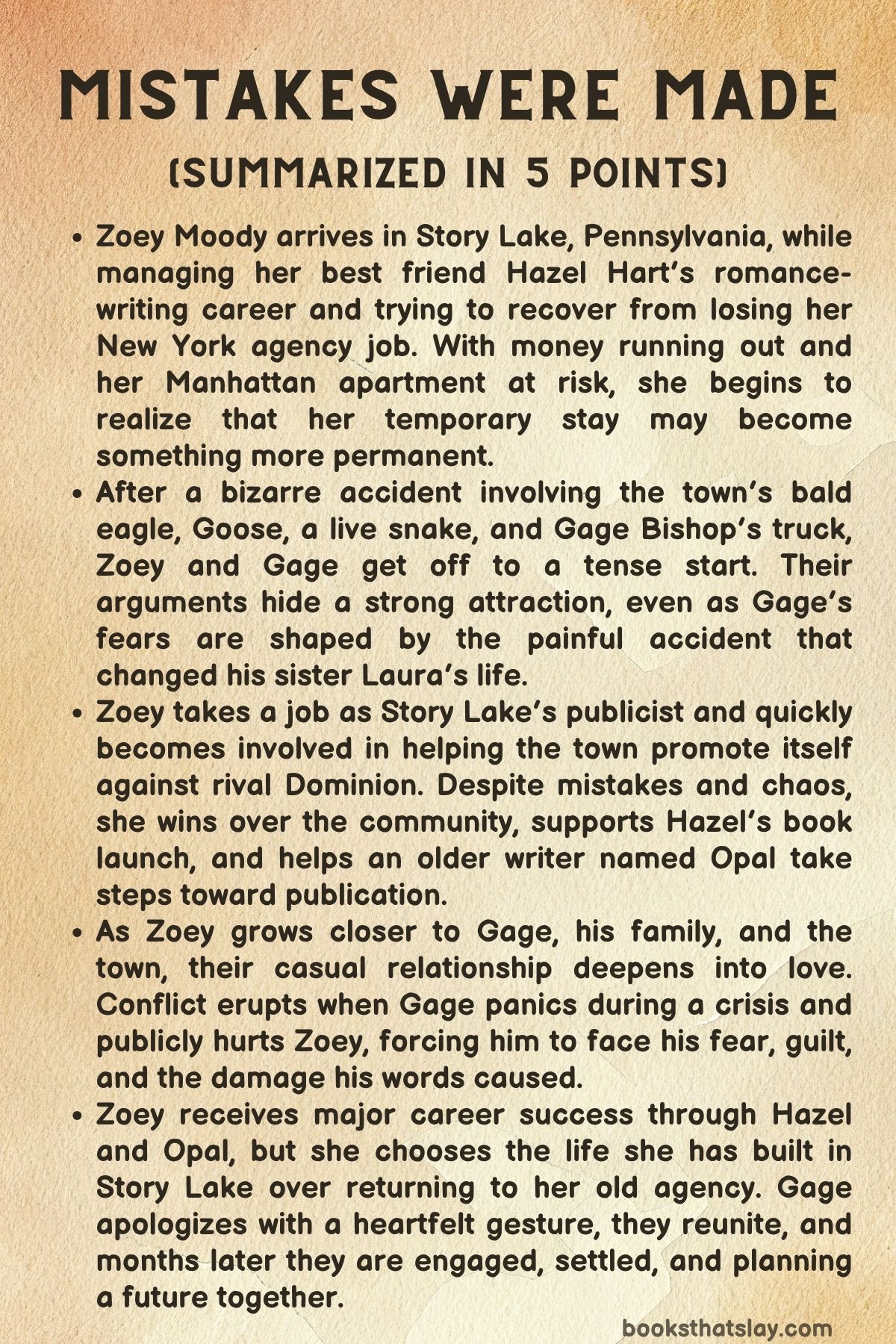
Zoey Moody arrives in Story Lake, Pennsylvania, with very little certainty about her future. She is staying there temporarily while managing Hazel Hart, her best friend and only remaining literary client.
Zoey once worked at a New York literary agency, but after being fired, her professional life has become shaky. Her personal life is no more stable.
She is living out of a messy hotel room, watching her savings disappear, and trying to convince herself that this small-town stop is only a temporary setback.
Her situation worsens when her cousin Inez contacts her with unexpected news. Inez has been subletting Zoey’s Manhattan apartment, but the building is going condo.
Zoey has only thirty days to either buy the apartment or give it up. Since she does not have the money to buy it, the city life she hoped to return to begins slipping away.
Story Lake, which was supposed to be a short pause in her life, may become the only place she can afford to stay.
Story Lake quickly proves that it is not a quiet refuge. While walking to the bookstore with Hazel, Zoey has a bizarre encounter with Goose, the town’s infamous bald eagle.
Goose drops a live snake on her, sending Zoey into a panic. She runs into the road and is struck by Gage Bishop’s truck.
Gage is a lawyer and part-time contractor, and the accident terrifies him for reasons Zoey does not yet understand. His sister Laura was previously injured in an accident that killed her husband, Miller, and left Laura using a wheelchair.
The sight of Zoey in danger brings all of Gage’s fear and grief back to the surface.
Zoey and Gage clash almost immediately. He sees her as chaotic and careless, while she sees him as judgmental and cold.
Their first impressions are rough, but the tension between them is not only anger. Beneath the irritation is a strong attraction neither of them wants to admit.
Their arguments become part of the rhythm of their connection, even as both try to keep emotional distance.
Zoey soon accepts a part-time job as Story Lake’s publicist. The job comes from Darius Oglethorpe, the town’s teenage mayor, who wants her to help Story Lake compete with its more polished neighboring town, Dominion.
Story Lake wants to attract visitors and present itself as welcoming, inclusive, and accessible. Zoey’s first major presentation does not go smoothly.
Instead of showing her planned slides, she accidentally displays old beach vacation photos of herself. Still, she recovers with humor and confidence, gives a passionate speech about the town’s potential, and wins over the locals.
As Zoey becomes more involved in town life, Gage offers her the renovated apartment above his law office. She accepts, and the move pulls her closer to the Bishop family and the Story Lake community.
During the move, Goose steals one of Zoey’s expensive bras, adding yet another strange chapter to her new life. The town may be messy and unpredictable, but it starts giving Zoey something she has not had in a long time: a place where people show up for her.
Gage continues trying to convince himself that Zoey is not right for him. He believes she is too scattered, too impulsive, and too temporary.
Zoey, meanwhile, assumes Gage disapproves of her and sees her as a problem to be managed. But the more time they spend together, the harder it becomes to maintain those defenses.
Their arguments soften into attraction, and their attraction eventually becomes physical. They begin a relationship they both try to label as casual, even though their feelings are becoming anything but casual.
Zoey throws herself into her work for the town. She organizes events, supports local businesses, deals with problems caused by Dominion’s sabotage, and helps Hazel prepare for her book launch.
She also notices Opal, an older woman in Hazel’s writing class, who has written manuscripts with real promise. Zoey’s instincts as an agent return, and she helps Opal move toward publication.
Through Hazel and Opal, Zoey begins to rebuild not only her career but also her belief in her own abilities.
Gage’s personal struggles grow more complicated when Laura asks him to represent Valerie, the woman responsible for the accident that killed Miller and changed Laura’s life. Gage is furious at first.
To him, Valerie represents the worst moment in his family’s history. But Laura wants closure, and Valerie is clearly destroyed by what happened.
Gage eventually agrees, not because it is easy, but because he loves his sister and understands that healing may require compassion as well as anger.
As Gage faces his family’s pain, his feelings for Zoey deepen. She becomes part of his daily life, part of his family’s world, and part of the future he has tried not to imagine.
Zoey also becomes attached to the Bishops, to Hazel’s success, to her work with Opal, to the town, and even to a dog named Buttercup. Still, she keeps telling herself that Story Lake is temporary.
Admitting otherwise would mean admitting she wants a life she never planned.
Zoey’s birthday exposes old wounds. Her parents visit and remind her, painfully, of how unseen and unwanted they often make her feel.
Their neglect and criticism leave Zoey feeling small, despite everything she has accomplished. Gage witnesses the damage they cause and tries to give her a better birthday afterward.
His care matters to her, but Zoey is still afraid to fully trust that she belongs anywhere.
Hazel’s book release weekend becomes a major success, showing how much Zoey has achieved professionally and how effective she can be when she believes in herself. But during a bonfire event, a crisis occurs, and Zoey reacts quickly to help.
Gage, frightened and overwhelmed, misreads the situation. Instead of recognizing her bravery, he publicly lashes out and calls her selfish and stupid.
His words humiliate and hurt her deeply. For Zoey, who already fears being seen as too much, too messy, and not enough, his reaction confirms her worst insecurities.
She ends their relationship and avoids him.
Gage soon realizes the damage he has done. He understands that fear made him cruel and that he hurt the woman he loves.
He tries to apologize, seeks advice, and prepares a gesture that can show Zoey he truly sees her. At the same time, Zoey receives the professional validation she once thought would solve everything.
Hazel’s book becomes a huge bestseller, Opal receives a major publishing deal, and Zoey is invited back to her old agency. The career path she once wanted opens again, but it no longer feels like the only answer.
Instead of returning to her former life, Zoey goes to Gage’s house. There, she finds that he has tried to create a place for her in his world.
He has installed a disco ball, moved many of her things into his home, organized her dream closet, and even recovered her stolen bra after Goose brings it back. More importantly, he tells her that he loves her and wants a real life with her.
Zoey accepts his apology, admits that she loves him too, and chooses the future they can build together.
Months later, Zoey stands as maid of honor at Hazel and Cam’s wedding. She and Gage are engaged and planning their own fall wedding on the Bishop farm.
Zoey’s career is thriving, and she has built both a home and an office with Gage. She is also managing her ADHD more successfully and accepting herself with more kindness.
Story Lake, once only a temporary stop, has become her home. By the end of Mistakes Were Made, Zoey has found love, family, purpose, and a place where her messy, energetic, loyal self is not only accepted but cherished.
Characters
Zoey Moody
Zoey Moody is the central emotional force of Mistakes Were Made, and her character is shaped by instability, ambition, insecurity, and a deep need to belong. At the beginning of the book, she appears chaotic because her life is falling apart in several directions at once: she has lost her job, her finances are weak, her living situation is temporary, and even her Manhattan apartment is no longer secure.
However, beneath that disorder is a capable, intelligent, and determined woman who refuses to stop trying. Zoey’s public mistakes, including her disastrous town meeting presentation, make her seem messy on the surface, but they also reveal her resilience.
She recovers quickly, connects with people honestly, and gradually proves that her creativity and emotional intelligence are real strengths.
Zoey’s greatest conflict is her belief that she is temporary everywhere. She treats Story Lake as a stopover because she is afraid of needing it too much.
Her neglectful parents have clearly damaged her sense of worth, making her feel as though love and approval must be earned through usefulness or success. This makes her professional achievements especially meaningful, because her work with Hazel, Opal, and the town shows that she is not simply lucky or scattered; she is genuinely talented.
Her relationship with Gage also forces her to confront the difference between being tolerated and being truly chosen. By the end of the story, Zoey becomes more grounded without losing her lively, unpredictable spirit.
Her growth lies in accepting that home is not only a place of professional success, but also a place where she is loved, protected, and allowed to be herself.
Gage Bishop
Gage Bishop is one of the most emotionally guarded characters in the book. He is responsible, practical, protective, and deeply attached to his family, but his sense of responsibility often turns into control.
His first clash with Zoey is not only caused by irritation; it is also triggered by trauma. The accident involving Laura and Miller has left him fearful of sudden danger and powerless loss, so when Zoey runs into the road and collides with his truck, he reacts from old pain as much as present anger.
This makes him appear harsh, but his harshness comes from fear rather than cruelty.
Gage’s relationship with Zoey challenges his need for order. He sees her as chaotic and unserious at first, yet he is drawn to the warmth, courage, and spontaneity that she brings into his life.
His emotional journey is not about becoming less responsible, but about learning that love cannot be managed like a legal case or construction project. His worst moment comes when he publicly lashes out at Zoey after misreading a crisis.
That scene exposes his deepest flaw: when frightened, he can wound the very person he wants to protect. His later apology and grand gesture matter because they show self-awareness rather than simple romance.
By choosing vulnerability, admitting love, and making space for Zoey in his home and future, Gage proves that he is capable of changing.
Hazel Hart
Hazel Hart is Zoey’s best friend, client, and one of the stabilizing emotional presences in the story. As a romance author, Hazel represents creativity, loyalty, and the kind of success that Zoey is fighting to protect and expand.
Her book launch gives Zoey a professional purpose, but Hazel is more than a career responsibility. She is part of Zoey’s chosen family and one of the people who sees Zoey’s value even when Zoey doubts herself.
Hazel’s presence helps reveal Zoey’s loyalty, because Zoey does not treat her client as a stepping stone; she genuinely wants Hazel to thrive.
Hazel also helps connect Zoey to Story Lake. Through Hazel’s writing class and book release events, Zoey becomes more involved with the town and its people.
Hazel’s eventual wedding to Cam reinforces the book’s larger theme of building a life through love, friendship, and community. She is not presented as a source of heavy conflict, but her importance lies in the way she anchors Zoey emotionally and professionally.
Hazel’s success is also Zoey’s success, and their bond shows how friendship can become a form of home.
Cam
Cam is important as Hazel’s romantic partner and as part of the wider Story Lake community that gradually surrounds Zoey. His role is quieter than Zoey’s or Gage’s, but he contributes to the sense of warmth and permanence that defines the town.
Through his relationship with Hazel, Cam represents steady love and commitment. Their wedding near the end of the book provides a joyful contrast to the uncertainty and emotional conflict that Zoey experiences earlier.
Cam also helps show that Story Lake is not simply a quirky setting, but a place where relationships deepen into lasting bonds. His presence supports the book’s romantic and communal atmosphere.
While he may not drive the central conflict, he contributes to the feeling that the town is full of people who are building meaningful lives together. His relationship with Hazel gives Zoey another example of love that is not temporary, careless, or conditional.
Darius Oglethorpe
Darius Oglethorpe, the teenage mayor of Story Lake, brings humor, originality, and youthful determination to the story. His position immediately makes the town feel unusual and memorable, but he is not simply a comic figure.
By hiring Zoey as the town’s publicist, he becomes the person who gives her an unexpected second chance. His decision helps push Zoey from temporary visitor into active participant in Story Lake’s future.
Darius represents the town’s unconventional spirit. He wants Story Lake to compete with Dominion and become known as inclusive, welcoming, and accessible, which shows that his leadership has sincere purpose behind its oddness.
His confidence in Zoey matters because it gives her a role at a time when she feels professionally and personally insecure. Through Darius, the story shows that opportunity can come from unexpected places and that leadership does not always look traditional.
Laura Bishop
Laura Bishop is one of the most emotionally significant characters in the Bishop family. Her accident changed the lives of everyone around her, leaving her in a wheelchair and causing the death of her husband, Miller.
However, Laura is not defined only by tragedy. Her request that Gage represent Valerie shows remarkable emotional courage.
Instead of remaining trapped in anger, Laura seeks closure, understanding, and perhaps a form of peace that others in her family are not yet ready to accept.
Laura’s character deepens Gage’s emotional arc. Through her, the reader sees why Gage is so protective and why sudden danger terrifies him.
At the same time, Laura’s strength challenges his anger. She has suffered the most directly, yet she is willing to face Valerie and the pain of the past.
This makes Laura a quiet but powerful figure in the book. She embodies grief, resilience, and the difficult choice to move forward without pretending that loss has disappeared.
Miller
Miller is mostly present through memory, but his absence strongly shapes the emotional world of the Bishop family. As Laura’s husband, his death is the central loss connected to the accident, and that loss continues to influence Gage’s fear, anger, and protectiveness.
Miller’s importance lies in how deeply he is mourned and how his death changed the family’s sense of safety.
Although Miller does not actively participate in the present action, he functions as a reminder that the past is never fully separate from the present. His death explains why Gage reacts so intensely to danger and why Valerie’s situation is so painful.
Miller’s role shows that a character does not need many scenes to have emotional weight. His absence becomes part of the book’s conflict, especially in the way it forces the living characters to decide whether they will remain frozen in grief or seek healing.
Valerie
Valerie is one of the most morally complicated characters in the story because she is connected to the accident that injured Laura and killed Miller. She could easily have been treated only as a source of pain, but the book presents her as devastated by what happened.
This makes her role more complex. She is not simply a villain; she is a person living with the consequences of a terrible event.
Valerie’s presence forces Gage to confront the limits of anger. His first instinct is fury, which is understandable because of what his family lost.
However, Laura’s request that he represent Valerie creates a difficult moral situation. Through Valerie, the story explores guilt, responsibility, forgiveness, and closure.
She matters because she prevents the past from being treated in simple terms. Her character shows that healing sometimes requires facing people and events that are painful rather than avoiding them.
Inez
Inez plays a small but important role in increasing the pressure on Zoey’s life. By telling Zoey that her Manhattan apartment building is going condo, she forces Zoey to realize that her old life may no longer be waiting for her.
This news pushes Zoey further into uncertainty and makes Story Lake feel less like a temporary inconvenience and more like a possible necessity.
Inez’s function in the book is mostly practical, but it has emotional consequences. The apartment represents Zoey’s connection to New York, independence, and the version of herself she thought she needed to recover.
When that security disappears, Zoey must rethink what success and stability actually mean. Inez therefore helps trigger one of Zoey’s major internal shifts, even though she is not central to the romance or town conflicts.
Opal
Opal is an older woman in Hazel’s writing class whose hidden talent becomes one of Zoey’s most meaningful professional discoveries. Through Opal, Zoey proves that she has a sharp eye for talent and a genuine passion for helping writers succeed.
Opal’s promising manuscripts give Zoey a chance to act not from desperation, but from instinct and skill. This matters because Zoey’s career has been shaken, and Opal becomes evidence that Zoey still belongs in the literary world.
Opal also adds depth to the book’s treatment of ambition and second chances. Her age makes her publishing opportunity especially meaningful because it suggests that creativity does not expire and that recognition can arrive later in life.
Zoey’s support of Opal is not selfish; it is generous and visionary. Opal’s success strengthens Zoey’s confidence and helps show that Zoey’s future does not have to be a return to her old agency.
She can build something new while still doing work she loves.
Zoey’s Parents
Zoey’s parents are important because they reveal the emotional wounds beneath Zoey’s humor and chaos. Their visit on her birthday shows how easily they make her feel unwanted, inadequate, and overlooked.
They are not physically central to the story, but their emotional impact is large. Their neglect helps explain why Zoey doubts her worth and why she struggles to believe that people might choose her permanently.
Their role is especially important in contrast to Gage and the Bishop family. Where Zoey’s parents make her feel like a burden or disappointment, the people in Story Lake gradually make her feel valued.
This contrast helps clarify Zoey’s emotional journey. She is not only finding romance; she is escaping an old pattern of conditional affection.
Her parents represent the life she has been trying to survive, while Story Lake represents the life she slowly learns to accept.
Goose
Goose, the notorious bald eagle of Story Lake, is one of the most memorable sources of chaos in Mistakes Were Made. His attack on Zoey with a live snake sets off her first major collision with Gage, both literally and emotionally.
Goose’s actions are absurd and comic, but they also serve an important narrative purpose. He represents the wild unpredictability of Story Lake, a place where Zoey cannot control everything and where her carefully planned life keeps being interrupted.
Goose also becomes part of the book’s playful personality. By stealing Zoey’s expensive bra and later returning it, he connects comedy with romance and community.
His behavior reflects the town’s larger energy: strange, inconvenient, intrusive, but ultimately lovable. Goose is not a human character, yet he helps shape Zoey’s experience of the town.
He is a symbol of the chaos she first resists and eventually embraces.
Buttercup
Buttercup, the dog Zoey eventually becomes attached to, represents Zoey’s growing ability to accept love and permanence. At first, Zoey keeps insisting that Story Lake is temporary, so attachment is dangerous.
Caring for Buttercup works against that belief. A pet requires emotional openness, daily responsibility, and a willingness to imagine a future, all of which Zoey is hesitant to claim.
Buttercup’s importance is gentle but meaningful. Through this bond, Zoey becomes less guarded about putting down roots.
Her attachment to Buttercup mirrors her attachment to Gage, the Bishops, and the town itself. Buttercup helps show that Zoey’s new life is not built through one grand decision alone, but through many small acts of care.
By accepting Buttercup into her heart, Zoey also accepts that she is no longer just passing through.
Themes
Finding Home Through Belonging
Zoey’s journey in Mistakes Were Made shows that home is not always the place a person plans to return to, but the place where they are gradually seen, accepted, and needed. At first, Story Lake feels like a temporary stop forced on her by professional failure, financial pressure, and the possible loss of her Manhattan apartment.
She sees herself as someone passing through, not someone who belongs. Yet the town slowly gives her what her old life did not: purpose, community, and emotional safety.
Her work as publicist allows her to use her talents in a way that directly helps people, while her relationships with Hazel, the Bishops, Opal, and even the town’s chaotic animals make her feel rooted. By the end, Zoey’s choice to stay is not a surrender of ambition but a redefinition of success.
She realizes that belonging is built through shared effort, loyalty, care, and the freedom to be fully herself.
Healing From Past Trauma
Gage’s emotional conflict is shaped by grief, guilt, and fear left behind by Laura’s accident and Miller’s death. His anger after Zoey’s road incident is not simply irritation; it comes from a wound that has never fully closed.
Because he has already seen how one sudden moment can destroy lives, he reacts strongly whenever danger, carelessness, or uncertainty appears near the people he loves. This explains both his protectiveness and his worst mistake when he publicly lashes out at Zoey.
His fear turns into cruelty because he has not yet learned how to separate the present from the past. Laura’s request that he represent Valerie forces him to face pain from a new angle, especially by recognizing that guilt and suffering exist on more than one side of tragedy.
Through this, the story presents healing as difficult and imperfect. Gage does not become whole by forgetting what happened; he grows by taking responsibility for how his pain affects others.
Self-Worth Beyond Rejection
Zoey’s character is deeply shaped by rejection from both her career and her family. Being fired from her agency leaves her financially unstable and professionally uncertain, while her parents’ visit reminds her of a longer emotional history of being undervalued.
Their treatment makes her feel inadequate at a moment when she should feel celebrated, showing how old wounds can weaken even the strongest people. Yet Zoey’s growth comes from learning that other people’s failure to appreciate her does not define her value.
Her success with Hazel’s launch, her support of Opal’s writing, and her effective work for Story Lake prove that she is talented, capable, and deeply important. More importantly, she begins to accept love and respect from people who see her clearly.
The offer from her old agency gives her outside validation, but her final choice shows that self-worth is not about returning to the place that once rejected her. It is about choosing the life where she is valued.
Love as Accountability and Acceptance
The romance between Zoey and Gage is built on attraction, conflict, misunderstanding, and emotional growth. Their early clashes reveal two people who are drawn to each other but guarded in different ways.
Zoey expects judgment because she has often been dismissed as chaotic or unserious, while Gage hides his fear behind control and criticism. Their relationship becomes meaningful because it does not allow either of them to remain unchanged.
Zoey learns that she can be loved without shrinking herself, and Gage learns that loving someone does not mean controlling every risk around them. His public outburst becomes a turning point because the story does not treat love as enough by itself.
He must apologize, reflect, seek advice, and make a sincere effort to repair the harm. His grand gesture matters because it is paired with accountability.
Their reunion shows love as a choice to accept someone fully while still taking responsibility for the ways one’s actions can wound them.