More or Less Maddy Summary, Characters and Themes
More or Less Maddy by Lisa Genova is a contemporary novel about a young woman learning to live with bipolar disorder while trying to build a life that feels like her own. Maddy Banks is smart, funny, and ambitious, but her moods swing between crushing lows and electrifying highs that hijack her judgment, relationships, and sense of identity.
As she cycles through college pressure, family expectations, love that doesn’t steady her, and a fierce pull toward stand-up comedy, Maddy has to figure out what stability actually means—and whether she can want a big life without losing herself in it.
Summary
Maddy Banks wakes up in a freezing hotel suite in Las Vegas, naked, disoriented, and unable to move. The room is wrecked: bedding on the floor, broken glass, a baby grand piano she can’t play, and lyrics scribbled across the wall from a night when she was certain she was about to create a Grammy-winning album.
Her phone is gone—she remembers throwing it into the Venetian canal because she believed she was being tracked. The details return in jagged pieces: she had shows at Planet Hollywood, drank heavily, used cocaine, stopped taking her medication because she left it back in New York, and pushed through nights without sleep because she felt unstoppable.
Now the energy has collapsed. In its place is a cruel, exhausted voice telling her she’s worthless.
She stares at the ceiling fan and thinks about how easy it would be not to exist.
The story steps back eighteen months to Connecticut, where Maddy sleeps through the day and wakes in the afternoon feeling hollow and detached. She’s drained from college finals and weeks of all-nighters, but what frightens her most is how empty she feels inside her own body.
Her mother, polished and controlling, pushes her to eat, shower, get a job, and show up for a physical. Maddy resents the pressure but can’t explain what’s wrong.
College has been lonely; she’s uncertain about her major, has few friends, and is still spinning from her on-and-off relationship with Adam, her boyfriend since high school.
At the doctor’s appointment, Maddy lies on the intake forms, answering like the “normal” person she thinks she’s supposed to be. A depression questionnaire appears, and she’s shaken by how accurately the darker questions describe her private thoughts.
Still, she marks safe answers, terrified of being examined too closely. The doctor dismisses her mood as typical and comments on her weight, then shifts into intrusive questions and a referral that leaves her feeling judged and small.
She walks out humiliated, angry, and more alone than before.
That summer, her family life feels like a performance at their country club. Her stepfather Phil fits smoothly into the wealthy routines, her siblings move through the world with more confidence, and her mother seems obsessed with appearances.
Maddy thinks about her father, who disappeared when she was four, and about how the family’s warmth changed after he left. She feels like she’s watching everyone else live a scripted life she never agreed to.
When she starts working at Starbucks, the structure helps. Early mornings, steady shifts, biking to work, and earning her own money give her something solid to hold onto.
She reconnects with Sofia, her former best friend, and their friendship begins to heal. Even when a customer humiliates her during a rush, Maddy finds she can keep going.
Sofia invites her to a comedy club in New York, and Maddy says yes, thrilled by the idea of being somewhere loud and alive.
Then Adam reappears, waiting for her after a shift. He’s charming, persistent, and perfectly skilled at stepping around her boundaries.
Their history pulls her back: he broke up with her before college, reunited with her, then ended it again in a casual text right before Valentine’s Day. Maddy knows she should protect herself, but she’s hungry for comfort and familiar attention.
When he kisses her, she kisses him back, and the cycle restarts.
Around the same time, Maddy’s mother forces her into a gynecologist appointment after finding evidence she’s sexually active. The exam is cold and humiliating, and Maddy chooses an arm implant just to get it over with.
That night she’s supposed to meet Sofia at the comedy club, but Adam appears in her bedroom and pushes her to stay with him instead. Maddy can feel herself folding even as she hates it, and she cancels on Sofia, choosing the easier surrender.
Back at NYU in the fall, Maddy feels isolated in her dorm. She naps constantly, drifts through classes, and watches her roommate function with a steadiness she can’t match.
When her sister Emily visits, she senses the loneliness immediately. Emily tries to help by introducing Maddy to a neighbor, Nina, dragging her into a social moment Maddy would never create on her own.
It helps a little, but the deeper heaviness remains.
One Friday, Maddy can’t get out of bed. Even showering feels impossible.
She tries to calculate how quickly she could move to make her single class, but her limbs feel pinned down. Outside, the city bumps into her like she’s invisible.
She turns around, goes back to the dorm, and collapses into self-loathing. In the bathroom, she trims a torn nail and, almost without deciding to, drags nail scissors across her forearm.
The cut shocks her—and then calms her. The sudden quiet in her mind feels like relief.
She realizes she has crossed into a new kind of coping that scares her, even as she craves it.
Soon she’s hiding scars under bracelets and long sleeves. She drinks more to numb the emptiness between cuts.
At Adam’s dorm parties, she smiles and performs “fine” while feeling nothing. Sex becomes another performance.
Then an email arrives: she’s on academic probation, her grades wrecked by missed classes and attendance penalties. Panic spikes into thoughts about dying, and she scrambles to the Student Health Center.
She gets a two-week extension, written excuses, and a prescription for Celexa. She feels insulted by what it implies, but she takes it anyway.
The medication flips a switch. Maddy suddenly has energy, focus, and confidence.
She catches up on schoolwork, speaks up in class, and feels brilliant. She makes ambitious plans—languages, travel, projects—sleeping only a couple hours a night without feeling tired.
Convinced she’s “better,” she stops taking Celexa. Her certainty expands into grand plans: she becomes obsessed with Taylor Swift, decides she’ll write Taylor’s authorized biography, and starts sending frantic messages to friends.
On a warm November day, she buys an extravagant designer blazer on her mother’s card and calls it a “fashion emergency.” She wanders into a comedy club, drinks, and becomes fixated on a comedian named Max. She flirts hard, kisses him, and follows him to the greenroom, ignoring the fact she has a boyfriend.
At Thanksgiving, Maddy shows up at home dressed in expensive purchases and vibrating with urgency. When her family confronts her spending and behavior, she lashes out—slapping her mother, grabbing a carving knife to force car keys back, and attempting to drive to Taylor Swift’s Rhode Island home.
She rams a vehicle in the garage, trying to clear a path, until police arrive. At the hospital, she’s restrained, furious, and convinced she must get to Taylor.
A doctor learns she recently stopped Celexa and sedates her. After days in the ER, she’s transferred to a private psychiatric hospital, Garrison, where time blurs under heavy medication.
Reality feels unreliable; visits from her mother and Emily appear and vanish like fragments of a dream.
After treatment, Maddy moves in with Emily and Emily’s fiancé Tim in New York. Life becomes a strict routine: work, home, sleep.
Her mother tracks her location and texts constantly, treating compliance as the price of safety. Maddy hates the surveillance but plays along, terrified of losing housing or being sent back into crisis management.
The new meds—lithium and quetiapine—help stabilize her mood but bring side effects that make her feel like a stranger in her own skin: fatigue, dizziness, acne, and weight gain. She wonders if stability is worth feeling dulled and uncomfortable.
One morning, she sits in Washington Square Park and watches NYU students move through the life she left behind. A homeless woman nearby screams at pigeons, sounding unwell and uncontained.
Maddy is shaken by the fear that this could be her if medication fails or if she quits. That image becomes a grim anchor that keeps her taking the pills even when she hates them.
At Starbucks, a coworker named Simone discovers Maddy is writing stand-up comedy. Simone insists she do an open mic, pushing her to start before she feels ready and giving her permission to be bad.
Maddy hides the comedy from Emily and her mother, scared they’ll label it a symptom instead of a dream. At her first open mic, she trembles and reads her set, bombing through most of it—until a few jokes land and she hears real laughter.
The sound feels like a door opening. She celebrates with Simone and breaks her promise to avoid alcohol, tasting both freedom and risk.
Maddy throws herself into comedy, writing constantly and performing multiple times a week. She spends time with Max—watching classic stand-up, smoking weed, sleeping together—while trying to build material.
When Max gets a chance to go on tour, Maddy assumes he’ll choose her as an opener, but he picks someone else and dismisses their relationship as nothing. Humiliated, she snaps at him and walks away.
Almost immediately, another comic offers her a spot in a women-in-comedy festival, and Maddy accepts, choosing her own momentum instead of waiting to be chosen.
Family tensions rise. Her mother tries to control her choices and frames comedy as danger.
Maddy begins lying to escape tracking, turning off location sharing to go to clubs. Emily confronts her, worried the secrecy signals relapse.
Maddy shows Emily her notebooks and performs a set in the living room. Emily laughs, and that laughter matters: it turns into conditional trust, a fragile agreement that comedy can exist as long as Maddy stays grounded.
Maddy spends time with her grandmother, who helps her talk about shame and fear. Maddy struggles with how to name her diagnosis—whether it’s something she has or something she is.
Her grandmother shares her own history of betrayal and the moment she chose a new life, telling Maddy that people who reject her for bipolar disorder aren’t her people. Maddy begins to accept that denial won’t protect her, and that she needs to build a life that can hold both her ambition and her illness.
Back in New York, she keeps a strict routine and sells nice clothes to fund stage time. When her mother catches her lying, the conflict explodes.
Her mother threatens to stop paying tuition if Maddy keeps doing comedy. Maddy refuses to give it up.
The ultimatum lands like both loss and liberation: she chooses comedy, even though it means stepping away from the safe, funded path.
Her first paid set at LOL Comedy—fifteen minutes for fifty dollars—goes well even with hecklers. She improvises, handles the room, and earns strong laughs.
The club offers her a recurring slot, and a festival booker invites her to a Planet Hollywood show in Vegas after another comic drops out. Maddy accepts, ecstatic and terrified by how big it feels.
In Vegas, after her shows, she can’t get more spots and starts spiraling. Paranoia creeps in; she becomes convinced she’s being followed.
She upgrades her hotel room, charges everything to a new credit card, and begins believing she’s destined for music stardom as well, even though she can’t play or write. She stops taking her medication again.
The high swells until it collapses into the frozen hotel-suite moment where the book began, with Maddy stuck under the weight of her crash.
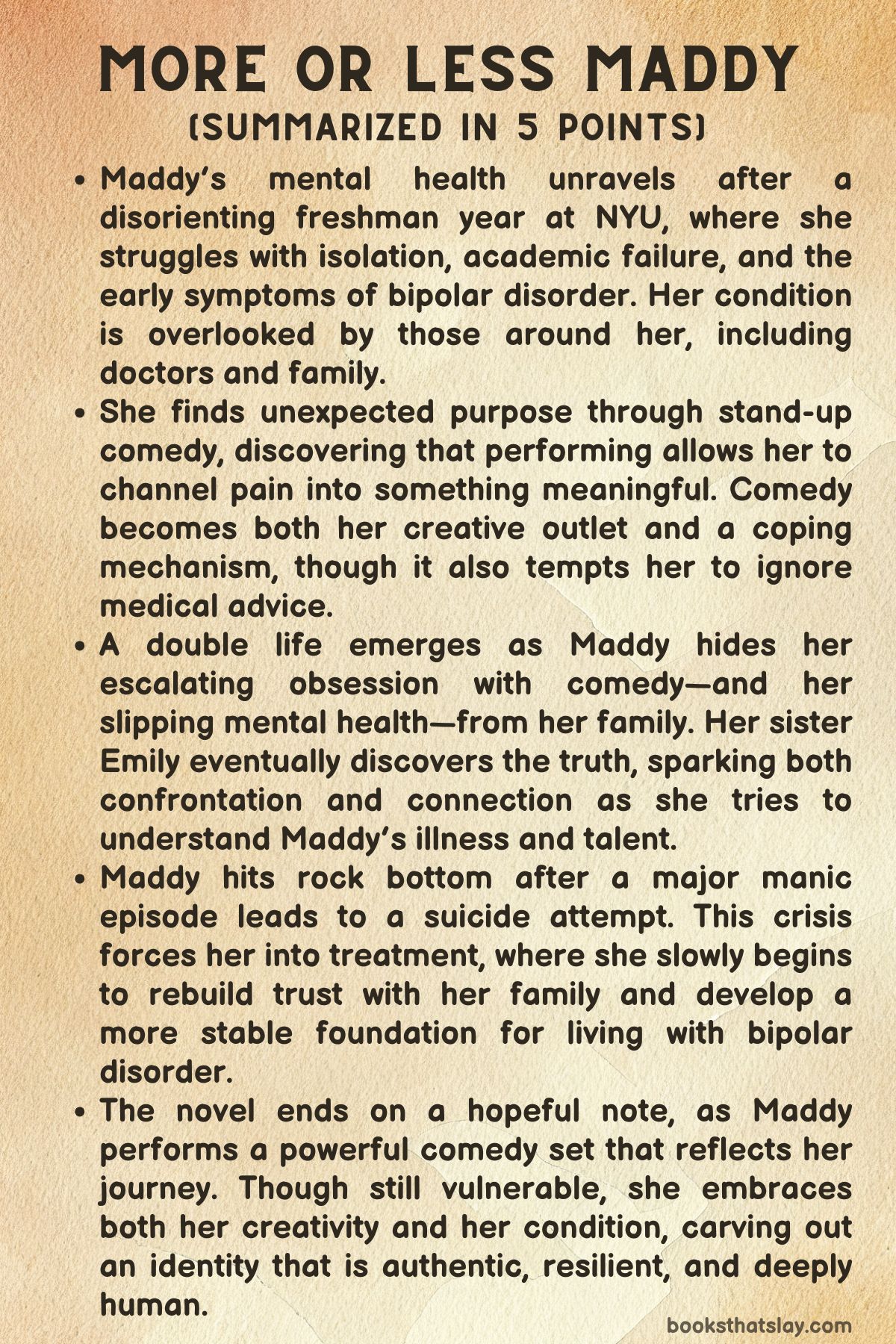
The final stretch shows Maddy months later, back in Connecticut and working steadily as a comedian. She performs at different venues, builds a routine around therapy and medication, and speaks openly onstage about bipolar disorder, her meds, and what happened in Vegas.
The audiences respond to her honesty and timing, and Maddy feels herself becoming more than her episodes. Her mother attends every show, clapping the longest, recording everything—not as surveillance now, but as support.
Sofia returns too, and Maddy wears Sofia’s friendship bracelet again. Adam reaches out once, but Maddy deletes the message.
Emily is exhausted with a new baby but happy, and Maddy keeps going—stable, funny, and clear-eyed—accepting bipolar disorder as something she lives with, not the sum of who she is, while she builds a life shaped by laughter and choice.
Characters
Maddy Banks
Maddy is the story’s emotional center, a young woman whose inner life swings between punishing depression, intoxicating mania, and the hard-earned middle ground of stability. At her lowest, she experiences her body as heavy and unresponsive, her mind as a courtroom where she is always guilty, and her future as something she cannot access; even ordinary tasks like showering, attending class, or walking a few blocks become unbearable, and self-harm appears not as spectacle but as a private technology for quieting pain.
When she flips into mania, her world turns hyper-meaningful and frictionless: sleep feels optional, talent feels inevitable, money becomes abstract, and her sense of destiny locks onto cultural icons and grand projects, like the conviction that she can write an album or author Taylor Swift’s biography without any of the usual prerequisites. What makes Maddy so human in More or Less Maddy is that she is not defined only by crisis—she is also someone who craves structure, responds to genuine encouragement, and learns through repetition and consequence.
Comedy becomes her clearest mirror: it can energize her and tempt impulsivity, but it also gives her craft, community, and a way to metabolize shame into connection. Over time, she moves from secrecy and denial to a more integrated self-understanding, learning to separate what she has from who she is, and building a life sturdy enough to hold ambition without letting it tip into self-destruction.
Emily
Emily functions as both an anchor and a boundary in Maddy’s life, embodying practical love that shows up even when it is inconvenient. She is the sister who notices what others miss—Maddy’s isolation, the absence of friends, the way “napping” is actually disappearing—and she responds with decisive action rather than vague reassurance, literally pulling Maddy into social contact when Maddy cannot initiate it herself.
As the story progresses, Emily becomes a kind of gatekeeper between Maddy and their mother’s control, first by providing a place to live and later by confronting the lies about comedy and medication. Her vigilance is not cruelty; it is fear informed by experience, and it reveals the exhausting position of loving someone whose stability can change quickly.
Emily’s own life—engagement, moving plans, pregnancy, and new motherhood—adds pressure to their relationship, because it forces limits on how much caretaking she can sustainably provide. Still, she is capable of being persuaded by evidence rather than panic: when Maddy performs for her in the living room and Emily genuinely laughs, Emily allows herself to believe that comedy can be more than a symptom.
Emily’s character shows how support is often messy and conditional, shaped by responsibility, fatigue, and the need to protect both the loved one and oneself.
Maddy’s Mother
Maddy’s mother is driven by image, certainty, and control, and she treats fear as a management problem that can be solved through monitoring and pressure. Her constant texts, medication reminders, and use of location tracking are framed as care, but they land on Maddy as surveillance that erodes trust and autonomy, making honesty feel dangerous and secrecy feel necessary.
She is also deeply invested in the life she believes her daughter should want—respectability, academic success, and the social scripts of country-club belonging—so Maddy’s uncertainty and difference are experienced as threat and embarrassment as much as concern. At multiple points, she minimizes or misreads Maddy’s suffering, pushing medical appointments that become humiliating rather than helpful, and later trying to control Maddy’s choices by tying financial support to obedience.
Yet she is not a flat villain; her intensity reveals genuine terror of losing her daughter, and her efforts to contain risk come from the understandable impulse to prevent another catastrophe. The most revealing shift is that she ultimately becomes Maddy’s most reliable audience, clapping the longest and recording every set, suggesting that her love, while often misdirected, is persistent—and that she is capable of changing the form of her support when she finally sees a path that keeps Maddy alive and moving forward.
Phil
Phil represents the comfortable structure of the life Maddy feels she is supposed to inhabit, and his presence highlights her alienation rather than resolving it. He is at ease in the country-club environment, indulging and settled, embodying a kind of affluent normalcy that offers predictable routines, status, and safety.
For Maddy, that comfort can feel like a wall: it underscores how disconnected she is from the values and aspirations that animate her household. Phil is not depicted as actively harmful, but his role in the family’s social world reinforces the expectations that suffocate Maddy—polite conversation, performance of wellness, and the assumption that stability is simply a matter of choosing the right habits.
His character functions as a contrast point: he shows how a family can look perfectly fine from the outside while someone inside is privately falling apart.
Jack
Jack brings a brash, competitive energy that fits the family’s outward-facing culture, and he often occupies the space of the “easy” child who performs confidence in a way Maddy cannot. His golf bragging and comfort in the country-club setting underline the differences between siblings: he can play the role the family rewards, while Maddy feels like she is failing at the basics.
Yet Jack is not simply an antagonist; later he offers moments of encouragement, especially when Maddy shares real progress in comedy, suggesting that beneath the surface swagger there is sibling pride and a desire to see her win. Jack’s function in the story is partly atmospheric—he helps define the family ecosystem of achievement and appearance—but he also serves as proof that support can come from unexpected corners, even if it is imperfectly expressed.
Adam
Adam is the most emotionally corrosive relationship in Maddy’s early life, not because he is overtly monstrous in every scene, but because he repeatedly reopens the wound he helped create. He is charming, persistent, and skilled at bypassing boundaries, showing up at the exact moment Maddy is vulnerable and making his attention feel like relief even when it costs her friendships and self-respect.
The on-again, off-again pattern—breakup, reunion, breakup again—trains Maddy to doubt her own instincts and to equate love with instability, which dovetails dangerously with her internal mood swings. Adam also embodies the particular loneliness of being with someone who does not truly see you: Maddy feels she must perform “fine” around him, and even intimacy becomes an act, with her faking enthusiasm while feeling hollow.
His presence intensifies her self-comparison and shame, because she measures herself against his apparent normalcy and productivity. Ultimately, Adam becomes a symbol of a past self that Maddy outgrows; the later moment when she deletes his text without engaging suggests a quiet but profound change—she no longer needs his attention to confirm her worth.
Sofia
Sofia represents a lost version of belonging that Maddy desperately needs but struggles to trust herself to keep. When they reconnect, Sofia’s sharper confidence contrasts with Maddy’s fragility, yet Sofia does not use that difference to dominate; instead, she offers invitations—like the comedy club outing—that reopen Maddy’s access to pleasure, possibility, and friendship.
Even when Maddy withdraws and feels unworthy, Sofia’s response is not punishment but a steady signal that connection is still available, expressed most powerfully through the card and the friendship bracelet. That bracelet becomes a physical emblem of unconditional regard, and Maddy’s relationship to it tracks her self-esteem: she wears it, removes it in shame, then returns to it when she can finally accept care without feeling like a fraud.
Sofia’s role is crucial because she provides support without control, affection without surveillance, and patience without enabling—an alternate model of love that helps Maddy imagine that her diagnosis does not make her unlovable.
Max
Max is a catalyst whose significance lies less in romance and more in what he reveals about Maddy’s hunger for recognition. During her manic phase, she fixates on him as a shortcut into a new identity—comedian, muse, destined star—and their connection is fueled by her intensity and his proximity to the world she wants.
Later, when she is more grounded, Max becomes both a gate and a lesson: he offers advice, validates her potential, and treats her disclosure of bipolar disorder with calm acceptance, which briefly feels like a rare kind of safety. But he also embodies the entertainment industry’s casual self-interest; he chooses another opener for the tour, reframes their relationship to minimize responsibility, and prioritizes his own freedom without much tenderness.
That betrayal stings, yet it also forces Maddy to separate her ambition from any single person’s approval. In that sense, Max functions as a transitional figure: he introduces her to the seriousness of comedy craft and the realities of its social ecosystem, while his rejection pushes her toward autonomy and toward opportunities she earns on her own terms.
Simone
Simone is the clearest voice of creative permission in Maddy’s life, the person who insists that readiness is a myth and that doing the work is what creates confidence. She meets Maddy not as a patient to be managed but as an artist-in-progress, and her encouragement is specific and practical—do the open mic, accept being bad, keep going—which gives Maddy a roadmap rather than a lecture.
Simone’s loud support in a mostly male room is more than kindness; it is a protective force that helps Maddy survive the humiliation of early performances long enough to experience the first real laugh, the moment that becomes addictive in the healthiest way. Simone also represents a form of friendship rooted in shared purpose rather than history, which matters for Maddy because it allows her to be new, not defined by past episodes or family narratives.
Simone is a stabilizing influence precisely because she ties Maddy’s identity to process—writing, performing, refining—rather than to mood.
Tim
Tim’s role is quieter, but his steadiness contributes to the environment that keeps Maddy functioning after hospitalization. In the Murray Hill apartment, routine is the unspoken treatment plan, and Tim’s consistent work hours and predictable presence help make that structure real.
He is not positioned as Maddy’s confidant, which is part of his function: he represents the ordinary adult world moving forward, a contrast to Maddy’s stalled or volatile experience of time. His support is largely indirect—providing a home base through his partnership with Emily—and that distance can be helpful, because it means Maddy is not constantly negotiating emotional intensity with everyone under the same roof.
Tim helps show that care networks often include people who contribute stability without being central characters in the emotional drama.
Manoush
Manoush serves as a mirror for Maddy’s self-judgment and a benchmark that intensifies Maddy’s feeling of inadequacy. As a studious roommate who appears driven and functional, she becomes the figure Maddy compares herself against when she cannot get out of bed, cannot keep up with coursework, and cannot make her life look “normal.” Even small details—how Manoush handles responsibilities, how she has a framework for getting accommodations—push Maddy to recognize both her struggles and the institutional systems she can access.
In that way, Manoush indirectly nudges Maddy toward seeking help, not through intimacy but through example. Her presence emphasizes a central tension: suffering can be invisible in shared spaces, and the proximity of someone who seems fine can make a struggling person feel even more broken.
Nina
Nina represents the possibility of friendship that isn’t earned through perfection, arriving through Emily’s intervention at a moment when Maddy cannot initiate connection herself. She is less developed than others, but her narrative purpose is important: she shows that Maddy’s isolation is not destiny, and that a single introduction can crack open a door Maddy could not find alone.
Nina’s presence also underscores how much Maddy needs community and how hard it is for her to build it when depression drains motivation and confidence. As a character, she symbolizes the “across-the-hall” lifeline—the small social chance that can matter disproportionately when someone is barely holding on.
Dr. Taber
Dr. Taber embodies the dismissiveness that often meets young women’s pain, and his interaction with Maddy becomes an early lesson that telling the truth can be risky. His comments about weight, the minimization of her mood as ordinary or hormonal, and the invasive turn toward gynecological concerns leave Maddy feeling humiliated rather than cared for, reinforcing her instinct to lie on forms and keep her suffering private.
He represents a system that can reduce complex emotional distress to superficial explanations, which is especially damaging for someone already convinced she is weak and undeserving of help. Dr. Taber is not just an unpleasant appointment; he is part of the story’s infrastructure of silence, one more reason Maddy learns to manage alone until she can’t.
Dr. Shapiro
Dr. Shapiro’s role highlights the loss of bodily agency Maddy experiences in the name of “being taken care of.” The appointment is driven by her mother’s suspicion and control, and the fact that the gynecologist is male amplifies Maddy’s sense of exposure, pain, and powerlessness. While the visit results in a concrete choice—the arm implant—it is remembered through the lens of violation and coercion rather than empowerment.
This encounter deepens Maddy’s resentment and reinforces the theme that adult authority often overrides her consent, pushing her further into secrecy and rebellion. Dr. Shapiro functions as another example of how interventions can be medically routine yet emotionally damaging when the patient has little voice in the process.
Dr. Weaver
Dr. Weaver exists in the story largely as a looming threat of escalation—someone the mother can involve if Maddy does not comply. Even without constant direct scenes, the name carries weight, representing the institutional power that can remove Maddy’s autonomy through treatment decisions, monitoring, or hospitalization.
The fear of Dr. Weaver helps explain why Maddy answers her mother’s texts politely, why she avoids confrontation even when furious, and why she hides choices that should be safe to share. As a character, Dr. Weaver symbolizes the double edge of psychiatric care: it can save a life, but the possibility of it being used as leverage can also create silence, mistrust, and strategic lying.
Gramma
Gramma is the story’s most emotionally honest mentor figure, offering Maddy a model of survival that includes both shame and release. Her warmth is practical—cookies, conversation—but her true gift is disclosure: she tells Maddy about enduring betrayal, absorbing humiliation, and contemplating suicide, then frames divorce as a “door” that opened into a new life.
This reframes Maddy’s crisis from a private defect into a human experience of suffering and choice, allowing Maddy to imagine that her diagnosis does not have to be a life sentence of shrinking. Gramma’s insistence that rejection is information—if someone can’t accept you, they aren’t right for you—directly counters Maddy’s terror that bipolar disorder makes her unlovable.
In More or Less Maddy, Gramma provides the language of dignity, helping Maddy move from denial toward acceptance and toward the idea that she can choose her own door.
Stella
Stella, as Maddy’s later roommate, represents a more ordinary peer world that continues regardless of Maddy’s internal storms. Her party invitation is small but telling: it is a casual bid for connection that Maddy cannot answer, not because she lacks opportunity, but because she lacks bandwidth.
Stella’s presence emphasizes how recovery is not only about symptom reduction but about rebuilding the ability to participate in everyday social life. Even in brief moments, Stella functions as a reminder that Maddy is still surrounded by people her age, and that the gap between proximity and connection can be enormous when someone is managing illness, shame, and secrecy.
Carl
Carl, the rude Starbucks regular, plays a sharp but brief role as an external stress test of Maddy’s fragility and her resilience. His public insult threatens to collapse her composure, and the fact that she keeps working anyway shows a version of strength that doesn’t feel heroic from the inside but is meaningful in practice.
Carl’s scene also highlights how service work can be both stabilizing and humiliating: it provides structure, income, and routine, while also exposing Maddy to casual cruelty. Carl represents the everyday indignities that can feel catastrophic when someone is already close to the edge, and the quiet victories involved in simply getting through a shift.
Leo
Leo appears as a timely counterweight to rejection and disappointment, offering Maddy an opportunity based on her presence and potential rather than on her relationship to someone else. Coming right after Max’s dismissal, Leo’s invitation to a women-in-comedy festival reframes the moment from humiliation to momentum, reminding Maddy that her career does not depend on a single gatekeeper’s affection.
His role is small but psychologically pivotal: he validates that Maddy’s talent can be seen independently, and that there are paths forward that do not require begging for inclusion. Leo’s function is to mark a turning point where Maddy begins choosing herself and saying yes to opportunities that align with her goals.
Audrey
Audrey, Emily’s baby, represents the future arriving—messy, demanding, and real—and her existence reshapes the family’s capacity and priorities. Even as a newborn without direct agency, Audrey changes the stakes: Emily’s life becomes fuller and more constrained, the family dynamic shifts, and Maddy’s potential homelessness becomes more concrete when Emily and Tim move.
Audrey also symbolizes continuity and hope, a reminder that life keeps expanding even after crises. Audrey’s presence underscores that recovery happens inside a moving world, where loved ones’ lives evolve, resources change, and Maddy must learn to build stability that does not depend on being the center of everyone’s attention.
Themes
Autonomy under surveillance and control
Maddy’s sense of self is constantly negotiated in the space between what she wants and what other people decide is “safe” for her, and that struggle becomes especially sharp once her diagnosis enters the family’s vocabulary. The most visible symbol is tracking: her mother’s constant texts, medication reminders, and reliance on Find My are presented as care, but they function like an external nervous system that Maddy is forced to live inside.
Even when she’s doing what the adults say they want—working a job, coming home, keeping a routine—she experiences the monitoring as an accusation that she cannot be trusted to run her own life. That pressure doesn’t simply make her angry; it trains her into secrecy.
She learns to manage her mother’s anxiety by lying, toggling location sharing on and off, and performing “normal” so she won’t lose housing or be dragged back into institutional care. The cost is that everyday independence becomes a covert operation rather than a healthy boundary.
What makes this theme more complicated is that Maddy’s need for freedom is not abstract; it is tied to dignity. Being forced into medical appointments, questioned about sex, and treated as a problem to be managed leaves her feeling reduced to a set of risks rather than a full person.
That reduction follows her into adulthood: Emily’s apartment is tidy and stable, but it also becomes a conditional space where Maddy’s belonging depends on compliance. When Maddy finally insists on comedy as her chosen path, the family frames it as a trigger rather than a calling, and money becomes leverage—tuition and housing as tools to control behavior.
Autonomy, then, is not only about “doing what you want,” but about who gets to define what counts as responsible. Over time, Maddy’s growth looks less like rebellion and more like learning how to hold agency without collapsing into denial.
By the end of More or Less Maddy, she is still accountable to treatment, but the direction of her life—work, performance, disclosure—belongs to her, not to the fear of the people watching her.
The whiplash of mood states and the problem of self-recognition
Maddy’s internal experience is marked by dramatic shifts that distort how she interprets reality, and the story keeps returning to the terrifying question of whether she can trust her own mind. Depression shows up not as sadness but as physical immobility and a deadened will: staying in bed, feeling her body become unbearably heavy, and measuring life in tasks that suddenly feel impossible, like showering or putting on shoes.
In that state, self-harm becomes less about spectacle and more about immediate relief—an abrupt quieting of mental pain that makes the action feel logical in the moment even when it horrifies her afterward. The narrative makes clear how quickly someone can move from “I’m fine” to “I want out,” and how easily academic pressures and social isolation can turn into a closed loop of shame.
Then the pendulum swings, and the danger flips shape. In the elevated state, Maddy’s ideas feel dazzlingly correct: she believes she is destined for a Grammy, a Netflix special, Taylor Swift’s biography, a life that makes ordinary limits seem like insults.
Sleep becomes unnecessary, spending becomes urgent, and consequences become abstract. What’s most unsettling is the confidence.
When energy surges, she interprets it as proof that medication was never needed, and stopping it feels like reclaiming her “real” self. This creates a trap where improvement can be misread as recovery rather than a symptom.
The book also highlights how outsiders respond to these shifts: some people dismiss her suffering as hormonal or normal stress, while others attempt to control her, which can push her further into secrecy and denial.
Self-recognition becomes the central difficulty: how does Maddy tell the difference between a meaningful desire and an episode that is hijacking her priorities? Comedy sits right at that fault line.
Performing can look like a healthy goal or a warning sign depending on who is judging it and from what emotional baseline. Maddy’s eventual stability does not come from eliminating intensity, but from developing a more realistic relationship with it—learning that feeling “phenomenal” is not automatically proof of wellness, and feeling awful after bombing is not automatically proof of relapse.
The long-term work is not simply mood management; it is building enough insight to notice when her brain is rewriting the rules, and enough humility to accept help before the rewriting becomes irreversible.
Shame, stigma, and the fight to separate identity from diagnosis
A constant pressure in Maddy’s life is the fear that being labeled will erase her as a person. Early on, she already feels judged for not fitting the expected script—uncertain major, few friends, not thriving in the polished world her mother values.
Once her mental health crises become visible, that feeling hardens into shame. She lies on forms, minimizes symptoms, and avoids honest answers because attention feels dangerous.
Even when she needs support, she anticipates being reduced to a stereotype: “dramatic,” “unstable,” “attention-seeking,” or “broken.” This anticipation shapes her choices as much as the illness does. She hides scars under bracelets and sleeves, not only to avoid questions, but to keep her pain from becoming gossip.
She hides comedy from Emily because she expects it to be dismissed as pathology rather than talent. The secrecy is self-protection, but it also isolates her, making recovery harder.
The most direct articulation of this theme arrives when she struggles with language: whether to say she has bipolar disorder or is bipolar. That grammatical difference carries moral weight.
Saying “is” can feel like surrendering personhood to a condition, while saying “has” makes room for complexity and change. Her grandmother’s story reinforces how shame can be inherited and normalized—how people swallow betrayal, humiliation, and suffering until it becomes identity.
Gramma’s “door” becomes a model for refusing that trap: a decision that shame does not get to be the organizing principle of a life. For Maddy, the equivalent door is accepting the diagnosis without letting it swallow everything else.
Disclosure becomes one of the book’s strongest counters to stigma. When Maddy tells Max the truth, his calm response punctures her expectation of rejection.
When she later jokes openly about bipolar disorder onstage, the audience’s warmth reframes the diagnosis as something speakable, not taboo. Comedy turns confession into connection without turning her into a tragedy.
Importantly, the story doesn’t suggest that openness fixes everything. Her mother still fears triggers, still uses control, still equates certain choices with relapse.
But by building a life where her diagnosis can be named without ending her future, Maddy shifts the axis of power. She stops living as if the label is a verdict and starts treating it as information.
That shift is not a motivational slogan; it is a hard-won psychological boundary that allows her to pursue love, work, and creativity without constantly asking whether she deserves to exist.
Creativity as both risk and lifeline
Comedy is the arena where Maddy’s vulnerability and ambition meet, and the book refuses to treat creativity as either pure medicine or pure danger. On one hand, the urge to perform can be entangled with elevated mood: racing ideas, grand plans, and the belief that success is inevitable.
The early manic period shows how artistic fantasies can balloon into delusion—lyrics on walls, a piano she can’t play, certainty that she will win a Grammy. Family members and clinicians therefore have understandable reasons to worry when Maddy becomes intensely focused on comedy, stays out late, and chases stage time.
From their perspective, the pattern resembles the beginning of past crises.
But the narrative also demonstrates that comedy gives Maddy something treatment alone cannot provide: a lived reason to stay. It structures her days through writing and practice, offers measurable growth through bombing and improving, and creates community that isn’t based on caretaking or surveillance.
Simone’s encouragement matters because it is specific and realistic—permission to be bad, permission to start before she feels ready. That advice helps Maddy build resilience, the ability to tolerate discomfort without concluding that she is doomed.
Even the open mic scene’s harshness becomes instructive. She learns that humiliation onstage is survivable and temporary, which indirectly challenges the catastrophic thinking that fuels both depression and impulsive choices.
The theme becomes most powerful when comedy turns into a tool for integration. Maddy doesn’t only use jokes to distract herself; she uses them to make meaning out of her experiences without sentimentalizing them.
When she performs material about medication, side effects, and past episodes, she’s not denying the illness. She’s placing it inside a narrative she controls, with timing and craft, rather than letting it exist as a family emergency that defines her.
This is why being “passed” at clubs and earning paid spots matters beyond career ambition: it provides evidence that her life can expand again. At the same time, comedy demands responsibility.
The late nights, alcohol temptations, and validation loops can destabilize her if she treats them as proof that she no longer needs medication. The book’s final movement suggests a mature compromise: creativity is not surrendered to fear, but it is supported by therapy, routine, and meds.
Comedy becomes a lifeline precisely because it is grounded in reality—earned laughs, consistent work, honest relationships—rather than powered by the false certainty of an episode.