Murder Will Out Summary, Characters and Themes
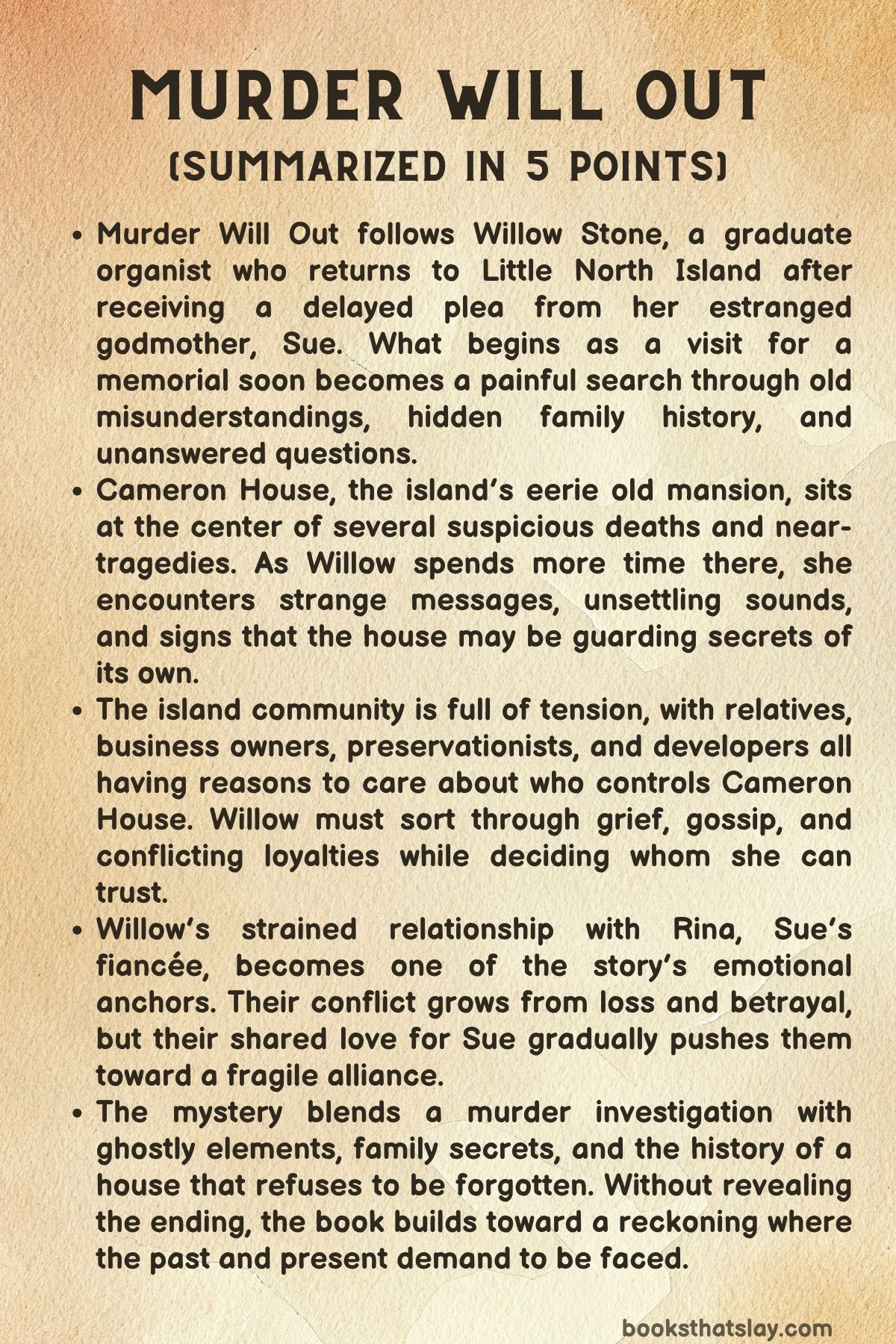
Murder Will Out by Jennifer K. Breedlove is a mystery about inheritance, old secrets, chosen family, and a house that refuses to stay silent. Set mainly on Little North Island, the story follows Willow Stone, a young organist who returns after receiving a delayed plea from her estranged godmother, Sue.
What begins as a memorial visit soon becomes a search for truth after several suspicious deaths and accidents circle Cameron House, an old mansion tied to generations of Cameron family history. The novel mixes a murder investigation with ghostly witnesses, buried identities, and the painful repair of broken bonds.
Summary
Murder Will Out begins at Cameron House, an old mansion on Little North Island, where ninety-nine-year-old Effie Cameron is murdered by a visitor. Effie refuses to help with an unnamed plan, and the visitor smothers her with a pillow, expecting her death to look natural.
Yet Cameron House seems aware of the crime. Whispers in the house accuse the killer, suggesting that the mansion holds more than old furniture and family history.
Months later, Willow Stone, a graduate organist in Chicago, receives a delayed letter from her estranged godmother, Susan Davis. Sue asks Willow to return urgently to Little North Island.
Willow has not seen Sue in fifteen years, since her parents suddenly ended her childhood visits to Sue’s cabin. When Willow searches for news, she learns Effie died and left Cameron House to Sue.
She also discovers that Sue has died after falling from the house’s widow’s walk on the eve of her wedding.
Willow travels to Little North for Sue’s memorial and rents Sue’s old cabin. She meets Rina Montalto, Sue’s grieving fiancée, who is angry because she believes Willow abandoned Sue.
Willow also encounters Geralt Talbot, Effie’s nephew, who believes Cameron House should pass to him as the last Cameron relative. Geralt is rude, bitter, and openly hostile, especially toward Rina.
At the memorial service, Willow plays the organ and notices several unusual people, including a mysterious man in black. After the service, she overhears Geralt arguing with an unknown man who suggests that Effie and Sue were removed so someone could benefit from Cameron House.
At the reception, Willow learns that Sue’s letters may have been blocked by Willow’s parents after Sue came out as gay. Willow realizes Sue did not abandon her.
The discovery leaves her shaken and ashamed. She also meets several islanders, including hotel owner Hank Ramsey, librarian Catherine, café owner Diana Reyes, Diana’s daughter Mac, Geralt’s young wife Naomi, and Naomi’s assistant Audra.
Tensions rise when Geralt trips Rina with his cane. Soon after, Geralt becomes violently ill, showing signs of poisoning.
He insists he is fine and drives to Cameron House.
Willow follows him and finds him in terrible condition. Inside Cameron House, she meets Joel Drummond, the man in black, who says he managed Effie’s and Sue’s affairs.
Geralt collapses and appears close to death. Willow hears strange whispers and sees signs that the house is haunted.
She runs to Sue’s cabin to charge her phone and call 911. When she returns, Joel is gone, Geralt is unconscious but alive, and officer Nick Tyler begins questioning her.
Willow notices that objects in the house have moved or vanished in impossible ways.
That evening, Rina, Diana, Mac, Catherine, and Effie’s corgi Finn gather at Sue’s cabin to support Willow. Over dinner, they discuss Geralt’s collapse and possible motives.
Geralt had many enemies. He raised rents, mistreated people, and stood in the way of others who wanted Cameron House.
Rina worries she may look guilty because she gave Geralt lemonade after publicly threatening him. Willow remembers the suspicious conversation she overheard but does not yet share it.
After the others leave, Willow finds Sue’s old Bach CD and a hardbound novel called Widow’s Walk by Abel R. Douglas, left for her by Rina. The music finally lets Willow grieve Sue.
During the night, she sees lights in Cameron House and a woman’s face in an upper window. The next day, Finn runs into the mansion, and Willow follows.
Inside, a typed message quoting Sir Walter Raleigh seems to challenge her to climb. She finds a hidden passage and reaches the widow’s walk, where she sees the broken railing and realizes Sue likely fell from there.
At the library, Catherine helps Willow understand the inheritance. Effie left Cameron House to Sue, but if Sue died without a spouse or child, the house would return to the Cameron line through Geralt.
If Geralt died, Naomi might inherit. Effie, Sue, and Geralt have all died or nearly died in a short period, which cannot be coincidence.
Willow searches historical records and finds an old photograph showing Joel Drummond, the same man she met. She also recognizes other people she has seen on the island.
They are ghosts.
At Cameron House, Joel and other spirits reveal that they are tied to the mansion. The ghosts survive as long as a living Cameron cares for the house.
Effie and Sue were searching for another Cameron heir, and Sue had called Willow back to help. Meanwhile, Naomi tells Willow that Geralt overdosed on lithium, though he was never prescribed it.
Naomi also reveals that Sue’s letter to Willow had been found unmailed in Rina’s desk, and Geralt had mailed it. Willow is furious and hurt.
Soon after, Patricia Ramsey crashes her vintage car and keeps saying the brakes failed.
Willow finally tells Rina, Diana, Mac, and Catherine about the conversation she overheard at the church. Rina is angry that Willow kept back information about Sue’s possible murder.
When Willow learns Rina hid Sue’s letter instead of mailing it, she accuses Rina of stealing her last chance to see Sue alive. Mac secretly removes lithium carbonate from Rina’s pottery shop and throws it in a dumpster, thinking she is protecting Rina.
The police later find it, and because Rina had access to lithium and had given Geralt a drink, she is arrested after Geralt dies.
Willow forgives Rina and promises to prove her innocence. She and the other women begin sorting through suspects.
Naomi may benefit if Geralt dies. Hank Ramsey claims to be a Cameron descendant and wants the property.
Patricia has ties to Hank and may have her own plan. Willow also discovers that Naomi has been having an affair with Hank.
When Hank and Naomi leave the Raven together, Nick and Willow notice leaking brake fluid near Hank’s car. Moments later, Hank’s Corvette crashes and explodes, killing them both.
Rina is released because Geralt’s poisoning happened over time, which weakens the case against her. Willow learns more about Sue’s past: Sue had once been married and had a daughter named Robin, who supposedly died young.
Naomi’s private investigator report reveals Sue was actually Peter Talbot’s daughter and the rightful Cameron heir. During a storm, Willow goes to Cameron House to search Sue’s hidden rooms.
There she realizes Audra DuBois may be Geralt’s illegitimate daughter and may have a claim through him. Before Willow can warn anyone, Audra attacks her, injects her, and ties her up.
Willow wakes inside Cameron House. Peter Talbot’s ghost tells her Geralt caused the crash that killed him, though Peter does not hate him for it.
Effie’s ghost urges Willow to fight. Willow frees herself and escapes, only to run into Patricia Ramsey, who forces her back inside at gunpoint.
Patricia and Audra reveal their scheme. Audra poisoned Geralt through his lemon water and kept poisoning him at the hospital.
Patricia helped with the larger plan and had even staged her own crash as a rehearsal for sabotaging Hank’s car. Willow realizes Patricia also murdered Effie.
When Effie’s ghost appears, Patricia breaks down. Audra shoots Patricia when she tries to quit.
Willow escapes through secret passages and finds Sue’s hidden compartment. Inside are birth certificates and photos proving that Robin had a baby who was adopted and renamed Willow Stone.
Willow is Sue’s granddaughter, Peter Talbot’s great-granddaughter, and the true Cameron heir. With the ghosts behind her, Willow claims Cameron House as her own and orders Audra out.
Audra attacks her and chases her to the widow’s walk. Geralt’s ghost knocks away Audra’s knife.
Audra falls through the broken railing and tries to pull Willow down with her, but Willow survives, and Audra dies.
Three days later, Willow returns to Cameron House, now legally and spiritually connected to it. She finds Annabel Cameron’s hidden typewriter and letters, proving Annabel wrote the Abel R. Douglas novels under a male name.
Catherine and Willow plan to investigate the real family history behind Widow’s Walk. Nick arrives and tells them Patricia survived and confessed.
The story ends with Willow, Rina, Diana, Mac, Catherine, and Nick moving toward lunch, truth, and a new future built from the secrets Cameron House finally revealed.
Characters
Willow Stone
Willow Stone is the central character of Murder Will Out, and her journey drives the emotional, investigative, and supernatural movement of the book. At the beginning, she is a graduate organist living in Chicago, separated from Little North Island and from her godmother Sue by fifteen years of silence.
That silence has shaped her deeply, because she believes Sue stopped reaching out or allowed their bond to fade. When Willow receives Sue’s delayed letter and learns of her death, she returns to Little North carrying grief, guilt, confusion, and a need for answers.
Her character is built around the painful discovery that the past she trusted was incomplete. The more she learns, the more she realizes that Sue never abandoned her, and that her parents’ rejection of Sue cut her off from one of the most important relationships of her childhood.
Willow is intelligent, sensitive, and observant, but she is not fearless. One of the most realistic parts of her character is that she often feels overwhelmed by what she sees in Cameron House.
She encounters ghosts, hidden rooms, strange messages, violent incidents, and suspicious islanders, yet she keeps returning because her emotional need for truth becomes stronger than her fear. Her courage is not the simple kind that comes from confidence; it comes from grief, loyalty, anger, and an increasing sense that Sue left her unfinished work.
Willow’s role in the story is also tied to inheritance, not only of property but of memory. She gradually inherits Sue’s love, Effie’s burden, Annabel’s history, and the responsibility of protecting Cameron House.
Willow’s emotional development is especially important in her relationship with Rina. At first, she is hurt and defensive because Rina blames her for abandoning Sue.
Later, Willow is devastated when she learns Rina hid Sue’s letter, because that single act stole Willow’s final chance to reconnect with Sue. Even so, Willow eventually chooses forgiveness.
When Rina is arrested, Willow calls her “my aunt,” which shows that Willow has begun to accept the family Sue wanted her to have. By the end of the book, Willow is no longer merely an outsider investigating a mystery.
She becomes the true Cameron heir, Sue’s granddaughter, and the living person capable of restoring the connection between the house, its ghosts, and its history.
Susan Davis
Susan Davis, often called Sue, is dead before Willow can reunite with her, but she remains one of the most emotionally powerful characters in the book. Sue’s presence is felt through memories, letters, music, objects, and the grief of the people who loved her.
She is Willow’s estranged godmother, Rina’s fiancée, Effie’s chosen heir, and eventually revealed to be a rightful Cameron descendant. Sue’s importance comes from the fact that she quietly connects nearly every major part of the story.
Her death is not just a loss; it is the event that pulls Willow back to Little North and opens the buried truth of Cameron House.
Sue is portrayed as loving, patient, and wounded. She never stopped caring for Willow, even after Willow’s parents cut off contact because Sue came out as gay.
This makes Sue a deeply tragic figure, because she spent years separated from someone she loved like family, while Willow believed the separation meant abandonment. Sue’s decision to summon Willow shows that she trusted her and believed she had a role to play in saving Cameron House.
Her relationship with Rina also reveals Sue’s need for companionship after a life marked by loss, including the death of her daughter Robin.
Sue’s character is also defined by secrecy and preparation. She knows more about Cameron House, its ghosts, and its bloodline than most people around her.
Her modern bedroom, designed in a way that keeps the ghosts out, suggests that she both cared for the house and understood its dangers. Her desk, with its hidden compartment containing the proof of Willow’s identity, shows that Sue was trying to preserve the truth even if she could not reveal it in time.
Although Sue dies before the story’s present action unfolds, her love and choices continue guiding Willow toward her identity, her inheritance, and her new family.
Effie Cameron
Effie Cameron is one of the oldest and most significant figures in the book, even though her murder occurs at the beginning. At ninety-nine, she represents the last visible remnant of the Cameron family’s long connection to Cameron House.
Her refusal to help the killer with an undisclosed plan shows that she is stubborn, principled, and protective of the house. She understands that Cameron House is not simply valuable property.
It is a living repository of family history, ghostly presence, and unresolved obligation.
Effie’s death is meant to look natural, but the house itself seems to resist that lie. This makes her murder the first sign that Cameron House is more than a setting.
Effie becomes part of the supernatural witness system that runs through the story. After death, her ghost continues to matter because she supports Willow, urges her to fight, and helps expose Patricia’s guilt.
Effie’s ghostly presence is not presented as distant or decorative; she remains emotionally invested in justice and in the survival of the house.
Effie is also important because of her decision to leave Cameron House to Sue. That choice disrupts the expectations of Geralt Talbot, developers, preservationists, and others who want control over the estate.
Her will sets the central conflict in motion because it threatens people who believe they can profit from the property. Effie’s loyalty to Sue and to the true Cameron line shows that she values moral inheritance over social expectation.
She is frail in age but strong in will, and her murder proves how dangerous that strength is to people who want the house for selfish reasons.
Rina Montalto
Rina Montalto is Sue’s fiancée and one of the most emotionally intense characters in the story. When Willow first meets her, Rina is hostile, grieving, and protective of Sue’s memory.
She believes Willow abandoned Sue, so her anger comes from loyalty as much as pain. Rina’s early harshness makes her difficult, but not cruel.
She is a woman mourning the person she loved and struggling to understand why someone so important to Sue seemed absent for fifteen years.
Rina’s character becomes more complicated when Willow learns that Rina hid Sue’s letter instead of mailing it. This mistake is devastating because it prevented Willow from returning in time and left Sue believing Willow may have rejected her.
Rina’s action comes from fear, insecurity, and perhaps a desire to protect the life she had with Sue from the return of someone who had once been central to Sue’s heart. The book does not excuse what she did, but it does make her regret believable.
Her apology at the beach and her later remorse show that she understands the damage she caused.
Rina’s arrest for Geralt’s murder turns her from an accuser into a vulnerable suspect. Because she publicly threatened Geralt, handed him lemonade, made the cups, and used lithium carbonate in pottery, she becomes an easy person to frame.
This part of her arc reveals how grief and anger can be weaponized against someone. Willow’s decision to forgive Rina while she is being taken away in handcuffs is a major emotional turning point.
Rina becomes not only Sue’s partner but also part of Willow’s chosen family. Her character represents love, guilt, grief, and the difficult work of earning forgiveness.
Geralt Talbot
Geralt Talbot is one of the most unpleasant and morally compromised characters in the book, but he is not written as a simple villain. He is Effie’s nephew, a possible heir to Cameron House, and a man widely disliked for his arrogance, greed, cruelty, and mistreatment of others.
He wants the estate and believes family connection gives him a right to it. His behavior toward Rina, his aggressive claim on the house, and his history of harming women make him an easy suspect and an easy person for others to hate.
Geralt’s collapse after the reception changes his role in the story. He begins as a threatening presence, but then becomes a victim of poisoning.
His symptoms reveal that someone has been slowly killing him with lithium, and his eventual death deepens the mystery surrounding Cameron House. The fact that Geralt may have benefited from Effie’s and Sue’s deaths makes him suspicious, but his own murder shows that he was also trapped in a larger scheme.
He is both morally guilty in many ways and still a victim of someone else’s calculated violence.
Geralt’s ghost adds surprising complexity near the end. Peter’s ghost reveals that Geralt was driving during the crash that killed him, yet Peter does not blame him.
Later, Geralt’s ghost protects Willow on the widow’s walk by knocking Audra’s knife away and pulling Willow back to safety. This does not erase Geralt’s cruelty, but it complicates him.
In life, he is selfish and destructive; in death, he performs one significant act of protection. His character shows that even deeply flawed people may carry guilt, fear, and unfinished loyalty beneath their worst behavior.
Naomi Talbot
Naomi Talbot is Geralt’s much younger wife, and she is surrounded by suspicion for much of the story. Because Geralt’s death could leave her with control of whatever he owned, she appears to have a clear motive.
Her beauty, youth, and secretive behavior make her seem manipulative, especially when Audra warns Willow that Naomi becomes whatever people want her to be. Naomi’s affair with Hank Ramsey further strengthens the suspicion that she may be involved in a plot to gain Cameron House.
Yet Naomi is not as simple as she first appears. She tells Willow that Geralt left debts rather than wealth, suggesting that his death may not benefit her in the way others assume.
Her private act of burying Geralt’s watch and a lock of his hair beside Peter’s grave reveals unexpected tenderness or at least a complicated attachment. She may be selfish, deceptive, and unfaithful, but she is not necessarily a murderer.
Her shock when Willow confronts her about murder feels genuine, which helps shift suspicion away from her.
Naomi’s death in the car explosion makes her another casualty of the larger conspiracy. She is caught in a dangerous web built by inheritance claims, greed, and manipulation.
Her affair with Hank makes her morally compromised, but not the mastermind. Naomi’s role in the book is to blur the line between guilt and suspicion.
She behaves badly enough to seem dangerous, yet she is ultimately more of a pawn and victim than the central villain.
Audra DuBois
Audra DuBois is one of the most dangerous characters in the book because she hides her ambition behind the role of Naomi’s assistant. For much of the story, she appears secondary, but the truth reveals that she has been deeply involved in the murders and attempted murders.
Willow eventually realizes that Audra may be Geralt’s illegitimate daughter, descended from Marianne Forrest, which gives her a personal link to the inheritance conflict. Her desire for recognition, revenge, and control drives her into violence.
Audra is calculating, patient, and ruthless. She poisons Geralt gradually through his lemon nutrient water and continues poisoning him even in the hospital.
She frames Rina by exploiting Rina’s access to ceramic-grade lithium carbonate and the emotional scene at the reception. Audra’s actions show careful planning, not impulsive rage.
She understands how suspicion works and uses other people’s flaws against them. Rina’s anger, Hank’s greed, Naomi’s secrecy, and Patricia’s resentment all become useful pieces in Audra’s scheme.
By the end, Audra reveals herself as the final active threat to Willow and Cameron House. She attacks Willow, ties her up, works with Patricia, and later pursues Willow to the widow’s walk with a knife.
Even when Willow tries to save her, Audra tries to drag Willow down with her. This final act shows the depth of Audra’s selfishness and bitterness.
She would rather destroy Willow than accept defeat. Her fall from the widow’s walk completes the pattern of violence surrounding the house and confirms her as one of the book’s central villains.
Patricia Ramsey
Patricia Ramsey is introduced as the regular church organist, and her tension with Willow first appears petty and personal. She is hostile, proud, and unsettled by Willow’s presence.
As the story unfolds, however, Patricia becomes far more significant. Her anger is not limited to professional jealousy.
She is connected to a larger plan involving Hank, Audra, false inheritance claims, and the attempt to control Cameron House.
Patricia is eventually revealed as Effie’s murderer. She smothered Effie with a pillow after Effie refused to cooperate with the plan.
This makes Patricia responsible for the first death in the story and establishes her as someone willing to kill a vulnerable old woman for gain. Her own car crash, which she claims was caused by failed brakes, is later revealed as part of a rehearsal for sabotaging Hank’s car.
This detail shows her coldness and her willingness to endanger herself in order to make a later murder seem believable.
Still, Patricia is not as fearless as Audra. When Effie’s ghost appears, Patricia breaks down.
Her terror suggests that she is not fully prepared to face the moral weight of what she has done. She tries to leave the plan behind, but Audra shoots her.
Patricia survives and later confesses, which makes her both villain and witness. She is greedy, resentful, and murderous, but in the end she is also frightened by the consequences of her own crimes.
Hank Ramsey
Hank Ramsey is a hotel owner and one of the most openly ambitious characters in the story. He is interested in development and valuable island property, which places him among those who see Cameron House less as a legacy than as an opportunity.
His connection to the suspicious church conversation makes him especially dangerous. When Willow hears him speak aggressively and later recognizes his voice, it becomes clear that Hank has been part of the conspiracy surrounding Effie, Sue, Geralt, and the house.
Hank’s false claim to Cameron descent reveals his greed and dishonesty. He tries to connect himself to Annabel Cameron’s son Douglas, but Catherine discovers that his lineage actually comes through Bruce Ramsey’s first wife, not Annabel.
This fraudulent claim shows that Hank is willing to manipulate history for profit. His affair with Naomi also suggests that he is opportunistic in personal relationships, using desire and ambition together.
Hank is threatening, but he is not the ultimate mastermind. His confrontation with Catherine and Willow reveals arrogance and menace, yet his later death in the sabotaged Corvette shows that he too is disposable to the more ruthless criminals.
Hank’s role in the book is that of a greedy conspirator who believes he can use false history to gain power, only to become a victim of the same violent scheme he helped advance.
Catherine
Catherine is one of Willow’s most important allies and one of the book’s clearest voices of reason. As someone connected to the library and historical research, she helps Willow understand the deeper significance of Cameron House, the Cameron line, and the documents that reveal the truth.
Catherine is thoughtful, intelligent, and steady. She does not rush to wild conclusions, but she is willing to consider murder, inheritance fraud, and supernatural hints when the evidence begins pointing in that direction.
Catherine’s strength lies in research and interpretation. She helps explain the legal and family implications of Effie’s will, Sue’s death, Geralt’s claim, and Naomi’s possible inheritance.
Later, she investigates Hank Ramsey’s supposed Cameron descent and exposes it as fraudulent. This makes her essential to dismantling the false story Hank uses to justify his claim.
Catherine’s knowledge gives the investigation structure, and her calm presence helps balance Willow’s fear and emotional intensity.
Catherine is also part of the circle of women who gather around Willow after the first traumatic events. Along with Diana, Mac, and Rina, she helps create a support system that contrasts with the greed and violence surrounding the house.
Her role is not only informational but moral. She believes in truth, history, and loyalty.
By the end, Catherine remains beside Willow as they begin planning to find Douglas’s widow and daughter, showing that her commitment extends beyond solving the murders into restoring lost history.
Diana Reyes
Diana Reyes, who runs the café, is one of the warmest and most grounding characters in the book. She provides food, shelter, conversation, and emotional steadiness at moments when Willow is frightened or grieving.
Her café becomes a place where the women gather to think through the mysteries, share suspicions, and support one another. Diana’s role may seem domestic on the surface, but she is central to the emotional community that forms around Willow.
Diana is practical and perceptive. She understands people well and often sees emotional truths that others avoid.
When Rina and Willow are in conflict, Diana urges Rina to face what she has done and follow Willow. This shows Diana’s moral clarity.
She does not allow grief to excuse harm, but she also believes reconciliation is possible. Her presence helps move relationships from accusation toward honesty.
Diana’s importance also comes from the way she contrasts with the corrupt characters. While Hank, Patricia, Audra, and others manipulate inheritance and history for personal gain, Diana offers care without calculation.
She feeds people, listens to them, and helps them think. In a story filled with hidden motives, Diana represents open-hearted loyalty and community.
Mackenzie Reyes
Mackenzie Reyes, often called Mac, is another member of Willow’s circle of allies. She is connected to Diana and helps Willow understand what happened during the years she was absent from Sue’s life.
Mac tells Willow that Sue came out as gay and that Willow’s parents cut Sue off, which is one of the first truths that breaks Willow’s old understanding of the past. Through Mac, Willow begins to see that the silence between her and Sue was imposed by others.
Mac is caring, but she is also impulsive. Her most important mistake comes when she secretly removes Rina’s lithium carbonate from the pottery shop and throws it into a dockside dumpster.
She thinks she is protecting Rina, but her action makes the evidence against Rina look worse. This moment shows how fear and loyalty can create danger when they are not guided by clear judgment.
Mac is not malicious; she is frightened for someone she cares about and acts too quickly.
Her breakdown and confession later reveal her honesty. Mac does not allow Rina to continue carrying suspicion for something Mac did.
This makes her flawed but fundamentally decent. She belongs to the group of characters whose mistakes come from love rather than greed.
Mac helps show that good people can still damage investigations and relationships when panic overrides trust.
Nick Tyler
Nick Tyler is the police officer who investigates the suspicious events surrounding Cameron House. He is cautious, skeptical, and sometimes frustrated by Willow because she keeps appearing near crime scenes and withholding parts of what she knows.
His role is important because he represents ordinary law and procedure in a story where ghosts, hidden passages, and ancestral secrets also shape the truth. Nick cannot simply accept Willow’s supernatural experiences, but he does recognize that something dangerous is happening.
Nick’s suspicion of Willow is understandable. She is present when Geralt collapses, repeatedly enters Cameron House, and seems connected to discoveries she cannot fully explain.
However, he is not portrayed as foolish or hostile without reason. He warns her not to interfere because he sees real risk.
At the same time, he provides information indirectly, such as confirming that Patricia’s brake lines were likely cut. This shows that he is observant and not entirely closed off to Willow’s concerns.
By the end of the book, Nick becomes more of an ally than an obstacle. He confirms that Patricia survived and confessed, and he invites Willow and the others to lunch.
This gesture suggests a softening in his relationship with Willow and an acceptance of the group that helped uncover the truth. Nick’s character gives the mystery a procedural counterweight, reminding the reader that justice must eventually move from ghostly revelation to human confession and evidence.
Joel Drummond
Joel Drummond first appears as the mysterious man in black, but he is later revealed to be one of the ghosts connected to Cameron House and the original historical society. His character carries an atmosphere of old grief, restraint, and duty.
When Willow first encounters him, he seems suspicious because he appears at crucial moments and then vanishes. Later, his true role becomes clearer: he is one of the dead who remain bound to the house and its survival.
Joel is a guardian figure, but not an all-powerful one. He explains that the ghosts are sustained by a living Cameron caring for the house.
This makes him both a source of knowledge and a figure of helplessness. He knows the stakes, but he cannot solve the problem alone.
His despair after Geralt’s death shows that the ghosts fear their time is ending. Joel’s sadness gives emotional depth to the supernatural side of the story, because the ghosts are not merely frightening presences; they are vulnerable remnants of memory.
Joel also helps Willow understand that Sue summoned her for a reason. Through him, Willow learns that the house’s survival depends on living connection, not just ownership.
His character represents historical memory trying to communicate across time. He bridges the world of the dead and the living, guiding Willow toward the truth without being able to force the outcome.
Dellie
Dellie is one of the ghosts of Cameron House and part of the original historical society. Though she is not as individually prominent as Joel, her presence helps establish that the house contains a community of the dead rather than a single haunting.
Dellie represents the many lives and stories preserved within Cameron House. She is part of the supernatural network that helps Willow understand the house’s past and its need for a living Cameron.
Dellie’s role is tied to witness and preservation. Like the other ghosts, she depends on the house being cared for and remembered.
Her existence shows that history in the story is not abstract. The past has faces, voices, loyalties, and fears.
Dellie helps make Cameron House feel like a place filled with generations of memory rather than an empty mansion.
Dot
Dot, like Dellie, is one of the ghosts associated with the original historical society. Her role adds to the sense that Cameron House is guarded by those who once cared about its history.
Dot helps reveal the truth about the ghosts and their dependence on a living Cameron. She belongs to the group of spirits who are not trying to harm Willow but to guide her, warn her, and preserve what remains of their world.
Dot’s significance lies in the collective nature of the haunting. The ghostly figures in the book are not random apparitions.
They are connected by duty, history, and place. Dot helps show that Cameron House is sustained by relationship: between the dead and the living, between the family and the building, and between memory and justice.
Finn
Finn, Effie’s corgi, is a small but meaningful character in the story. He offers comfort to Willow when she is frightened, grieving, and alone.
His presence softens the atmosphere of danger around Cameron House and Sue’s cabin. In a book full of secrets, betrayal, and death, Finn provides simple loyalty.
He does not judge, manipulate, or hide anything. He stays close, reacts instinctively, and helps Willow feel less isolated.
Finn also plays an active role by running into Cameron House, drawing Willow inside and pushing her toward discoveries she might not have made so soon. Animals in mystery stories often function as emotional anchors, and Finn does that here.
He connects Effie’s world, Sue’s cabin, and Willow’s new life on Little North. His loyalty makes him part of the family structure that Willow gradually inherits.
Annabel Cameron
Annabel Cameron is one of the most important historical figures in the book. Though she belongs to the past, her secret rooms, typewriter, locket, letters, and writings shape the present mystery.
She is connected to the hidden history of Cameron House and to the Abel R. Douglas novels. The later revelation that Annabel wrote those books under a male pseudonym adds a powerful layer to her character.
She is creative, intelligent, and constrained by the expectations of her time.
Annabel’s hidden spaces suggest a woman who needed privacy, secrecy, and control over her own story. Her use of a male pseudonym reveals both her talent and the limitations placed on women’s authorship.
Her novel Widow’s Walk becomes more than a fictional clue; it preserves real family history in disguised form. Through Annabel, the book explores how women’s stories are buried, renamed, or credited to men, only to resurface through careful reading and inheritance.
Annabel also seems to approve of Willow taking the album and locket, which makes her a quiet guide in the investigation. Her legacy helps Willow connect the fictional, historical, and genealogical clues.
Annabel is not merely a ghostly ancestor; she is a hidden author whose writing helps expose the truth. Her character deepens the book’s concern with memory, authorship, and the recovery of women’s erased histories.
Peter Talbot
Peter Talbot is Geralt’s brother and an important ghostly figure in the later part of the story. In life, he died in a crash while Geralt was driving, a fact that could have made him a figure of resentment or accusation.
Instead, Peter’s ghost tells Willow that he does not blame Geralt. This makes Peter one of the gentler and more forgiving presences in the story.
His attitude contrasts strongly with the bitterness and greed of the living conspirators.
Peter is also significant because of the family line. Sue is revealed to be his daughter, which makes Willow his great-granddaughter.
Through Peter, Willow’s identity connects to the Cameron inheritance. His presence helps transform the mystery from a property dispute into a family restoration.
He is part of the hidden lineage that others have tried to obscure or exploit.
Peter’s role is quiet but emotionally important. He gives context to Geralt’s guilt and to Willow’s ancestry.
He also helps humanize the Talbot side of the family, showing that not every member of that line is defined by Geralt’s cruelty. Peter represents forgiveness, lost possibility, and the family truth that finally allows Willow to claim her place.
Robin
Robin is Sue’s daughter and Willow’s mother by birth, though Willow does not know this for most of the story. Robin’s apparent death without issue is one of the false or incomplete stories hiding the truth of Willow’s identity.
The discovery that Robin had a baby who was adopted and renamed Willow Stone changes the entire meaning of Willow’s connection to Sue and Cameron House.
Robin is a tragic absent figure. She does not act in the present storyline, but her life and child are central to the inheritance mystery.
Through Robin, Sue is not only Willow’s godmother but her grandmother. This revelation recasts Sue’s love for Willow as deeper and more personal than Willow understood.
It also explains why Sue was so determined to reach her.
Robin’s character represents the missing generation between Sue and Willow. Her hidden child becomes the key to restoring the Cameron line.
Though little is shown of Robin directly, her existence carries enormous emotional weight because it turns Willow’s search for answers into a search for her own origin.
Marianne Forrest
Marianne Forrest is important because of her past connection to Geralt. She once accused Geralt of impregnating her, and this accusation becomes crucial when Willow realizes Audra DuBois may be Geralt’s illegitimate daughter.
Marianne’s role is mostly historical, but she represents one of the women harmed or dismissed by Geralt. Her story helps explain Audra’s possible claim and resentment.
Marianne’s significance lies in how the past returns through hidden bloodlines and unresolved injustice. If Audra descends from Marianne and Geralt, then Marianne’s accusation was not merely gossip or scandal; it was part of the buried truth that shapes the murders.
Marianne’s character also broadens the picture of Geralt’s mistreatment of women, showing that his cruelty had consequences beyond the immediate island community.
Bruce Ramsey
Bruce Ramsey is a background figure whose importance comes through genealogy. Catherine discovers that Hank’s actual descent runs through Bruce Ramsey’s first wife, not through Annabel Cameron.
This detail matters because it destroys Hank’s claim to Cameron House. Bruce is not a developed emotional presence in the same way Willow, Sue, Rina, or Geralt are, but he is part of the family-history machinery that determines who is lying and who has a legitimate connection.
Bruce’s role shows how the book uses records, marriages, names, and descent lines as investigative evidence. In a mystery built around inheritance, even background family figures become important because they can confirm or collapse a claim.
Themes
Inheritance, Belonging, and the Meaning of Home
Cameron House is not only a valuable property; it becomes the center of a struggle over identity, memory, and rightful belonging. Many characters see the mansion as a prize to claim, sell, control, or use for status, but Willow gradually learns that inheritance is not only legal ownership.
It is also responsibility. Effie and Sue try to protect the house because it holds generations of history, including pain, secrets, and unfinished stories.
Geralt, Hank, Naomi, Patricia, and Audra are drawn toward the house through greed, false claims, resentment, or ambition, while Willow is drawn through grief, confusion, and a need for truth. Her discovery that she is Sue’s granddaughter changes the idea of inheritance from a plot twist into an emotional restoration.
She is not an outsider after all; she is the person whose past was hidden from her. In Murder Will Out, home is shown as something deeper than a building.
It is a place where truth demands recognition and where belonging must be earned through care.
Grief, Forgiveness, and Chosen Family
Willow arrives carrying old hurt, believing Sue had abandoned her, only to learn that the separation was caused by silence, prejudice, and hidden letters. Her grief is complicated because she mourns not only Sue’s death but also the stolen years between them.
Rina’s grief is equally painful, shaped by guilt over the letter she failed to mail and anger at Willow’s absence. Their relationship begins with blame, but slowly moves toward honesty.
The women around Willow—Rina, Diana, Mac, and Catherine—create a circle of support that contrasts strongly with the greed and manipulation surrounding Cameron House. Food, conversation, shared suspicion, and emotional confrontation become ways of rebuilding trust.
Forgiveness does not come easily; Willow’s pain is real, and Rina’s mistake has lasting weight. Yet Willow’s decision to call Rina her aunt shows that family is not limited to blood or law.
It can be repaired through accountability, love, and the courage to stay present after harm has been done.
Truth Against Secrecy
The story is driven by buried truths struggling to surface. Effie’s murder is disguised as natural death, Sue’s fall is treated as an accident, Geralt’s poisoning is made to look like Rina’s crime, and Hank’s ancestry claim is built on deception.
Even Willow’s own identity has been hidden from her for most of her life. Secrecy gives dangerous people room to act, but truth keeps pressing forward through documents, old photographs, letters, hidden rooms, overheard conversations, and ghostly messages.
The supernatural elements do not replace investigation; instead, they push Willow toward evidence that human beings tried to conceal. The title Murder Will Out reflects this moral pattern: violence may be covered up for a time, but it cannot remain buried forever.
Patricia and Audra’s plans collapse because every lie depends on too many people staying silent. Willow’s search for truth becomes personal as well as criminal, because solving the murders also means recovering her stolen history and restoring Sue’s love to its rightful place in her life.
Greed, Power, and Moral Corruption
The fight over Cameron House exposes how greed can deform relationships and destroy moral judgment. Geralt wants control because he feels entitled to the Cameron legacy.
Hank invents a family claim to gain access to the estate. Patricia and Audra move beyond fraud into murder because they see people as obstacles.
Naomi’s role is more complicated, but her connection to Hank still shows how desire, manipulation, and ambition gather around wealth. The house’s financial and historical value attracts developers, heirs, schemers, and opportunists, turning inheritance into a dangerous contest.
Yet the story makes a clear distinction between wanting a home and wanting possession. Willow never begins with greed; she wants answers, connection, and justice.
That difference matters. Those who try to own Cameron House for profit or power are ultimately exposed, while Willow’s claim is rooted in truth, blood, memory, and protection.
The theme shows that corruption often begins when people believe property is worth more than human life.