My Blade Your Back Summary, Characters and Themes
My Blade Your Back by KM Moronova is a dark, military dystopian romance-thriller set inside the Dark Forces—an organization that turns people into weapons through drugs, conditioning, and disposable “squads.” The story follows Emery, who wakes with amnesia and a body trained for violence, and Mori, the feared soldier assigned beside her. As Emery tries to rebuild a sense of self, the system pushes her toward becoming something ruthless and controllable.
Between high-risk missions, brutal experiments, and betrayals at the top, Emery discovers that forgetting her past may have been the only mercy she was ever given. It’s the 2nd book in the Dark Forces series.
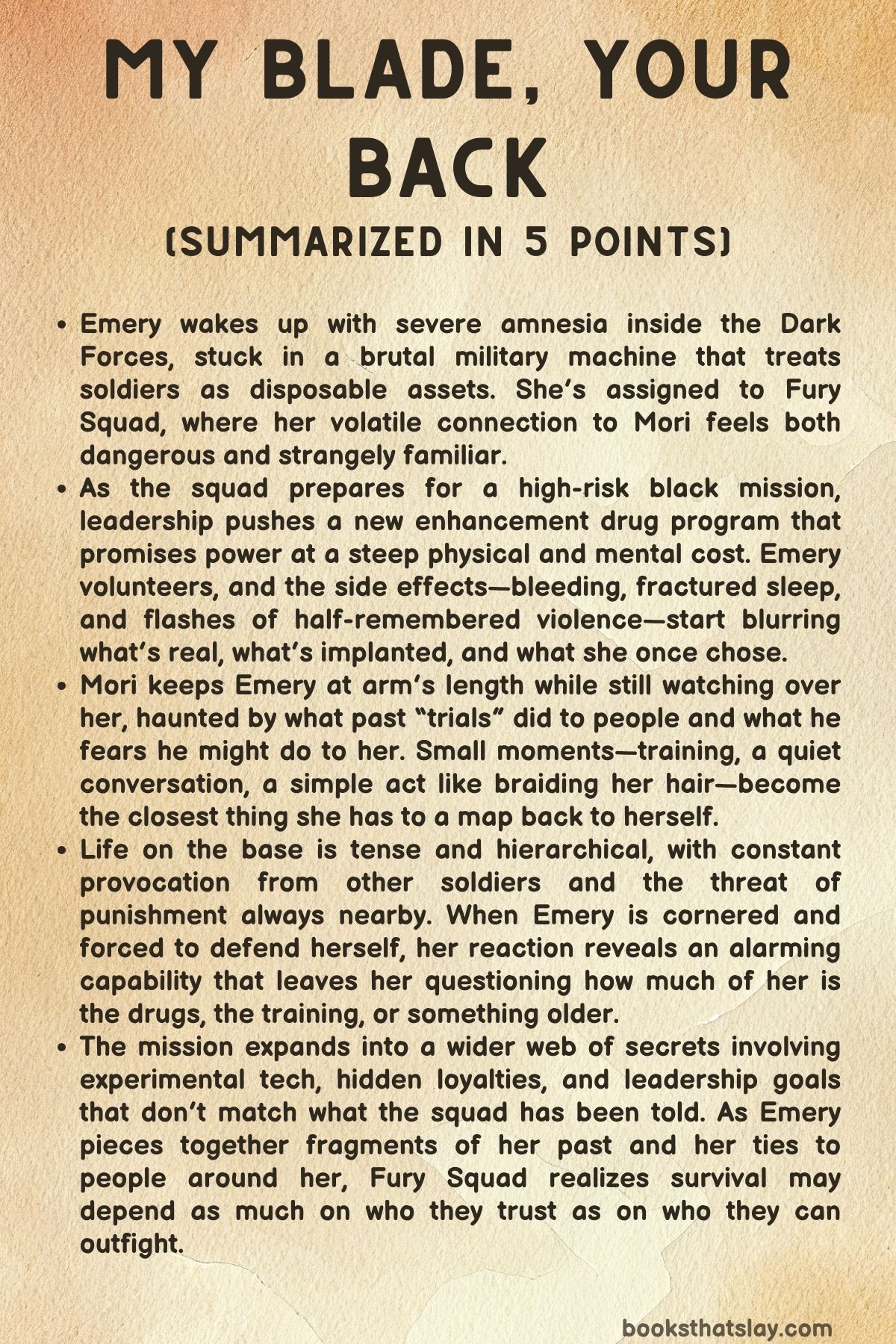
Summary
Thirty-five days after waking up with no memory, Emery is stationed with Fury Squad at a massive Dark Forces base in California. She doesn’t know her history, her crimes, or even the people who claim they fought beside her.
What she does know is that her body reacts like a trained fighter, her instincts are sharp, and the walls around her are built to make escape feel impossible. The base runs on hierarchy and cruelty: “upstairs” soldiers taunt and test the “lower” squads, punishments are routine, and the threat of being thrown into “the hole” hangs over everyone.
Emery learns quickly that she is seen as disposable—useful until she breaks.
Mori, infamous for killing previous squad mates during earlier trials, keeps his distance. He watches Emery spar and notices she’s different now: stronger in combat, less gentle in everything else.
The squad—Thomas, Gage, and Kayden—treat Mori like a walking hazard and tease him about Emery surviving near him. During training, Emery holds her own, even tricks Mori for a second with a deceptive move, but he overpowers her and humiliates her afterward.
He acts cold and hostile, yet Emery can’t ignore the pull she feels toward him, even when she hates how he treats her.
A briefing drags Fury Squad into a new level-black mission. General Nolan and Captain Hans Bridger assign them to infiltrate a hideout in the Great Basin connected to illegal goods and a secured thumb drive.
The job comes in two steps: retrieve intel, then shut the operation down once key assets are secured. The drive is locked behind doors that require a manual kill code, and the squad must escort Mikah, a gifted hacker, so she can disable security and access the system.
Lieutenant Erik insists he will accompany them and warns there is no margin for failure. Even the squad’s veterans sense it’s a near-suicidal setup.
Then Nolan drops the next pressure point: volunteers are needed to test a new enhancement drug series. Emery, feeling she has little to lose and desperate to be useful in a world that rewards usefulness, volunteers.
Mori reacts with visible alarm, but he can’t stop it. Nolan injects her and hands her pills with strict instructions—four every four hours while awake, more if injured.
Mori’s anger afterward isn’t only rage; it’s fear. He has seen these trials kill people, and he knows what the drugs can do to bodies and minds.
In a rare softer moment, Emery presses Mori for something—anything—about who she used to be. He finally tells her she always wore her hair braided and offers to show her how.
As he braids her hair, the act triggers a flicker of memory: her hands remembering the pattern, the sensation of familiarity returning without explanation. It’s one of the first times Emery feels like there might be a person behind the blank space in her mind.
Mori refuses to share his real name, keeping his walls up, but the connection between them is no longer deniable.
The drugs start showing their cost. Emery has disturbing dreams—one explicitly sexual involving Mori, another in a forest where a bloodied cadet accuses her of knowing what happened to him.
She wakes sweating, then suffers a nosebleed. Mori finds her and explains the bleeding is a sign her body is tolerating the drugs; others weren’t so lucky.
Their dynamic swings between conflict and closeness, and in the gym a moment of playful contact nearly turns into a kiss—until Mori stops himself and backs away, as if he’s afraid of what he wants.
On a day off, the squad sneaks into an “upstairs” tattoo spot run by Kate. Emery borrows one of Mori’s books and discovers he reads dark British poetry, a detail that makes him feel less like a rumor and more like a person.
Emery chooses a thin line tattoo down her spine, tied to intrusive visions of cutting someone open. Afterward, she wanders alone, and the same upstairs soldiers who harassed her before corner her in an alley.
Emery tries to leave, but they grab her hair, threaten her, and block every exit. When she fights back, it escalates fast.
One goes down brutally. The other draws a knife.
Emery doesn’t feel pain the way she expects to; the drug-fueled adrenaline takes over, and she kills both men with savage force. When she comes back to herself, it’s dark, the ground is a mess of blood and teeth, and she can’t account for how long she lost control.
Cameron finds her. He follows a trail of blood and pink hair to the alley and discovers Emery sitting in shock beside the bodies, dissociated and silent.
He strips off her bloodied hoodie, puts his own on her, and carries her back. Inside, he orders Gage to wash her up and get her into bed, insisting they control the story before Nolan or Erik can frame Emery as a runaway or a liability.
Later, Cameron disposes of evidence at sea and pays a contact with experimental pills, making it clear he’s protecting someone—Emery—at any cost.
Emery’s mind starts cracking open. She dreams of an affluent estate and her mother, then sees herself committing calculated killings under the guidance of a mentor named Reed.
She wakes with Mori behind her, steadying her through the panic. Mori confirms she did worse than she admits in the alley, and that she lost control.
Emery is terrified of what she might do next—what she might do to him. Mori leads her through hidden vents and tunnels to the ocean’s edge, where they speak honestly for a while: his insomnia, her side effects, and the growing certainty that their mission is designed to go wrong.
Mori admits he betrayed and killed the only person he ever loved, and Emery understands he carries guilt like a second skin.
Before the desert mission, the squad gears up at the Under base. Emery feels an intense, inexplicable familiarity there, like her body remembers what her mind can’t.
She meets Damian, who recognizes her instantly and is crushed that she doesn’t remember him. Nolan forces Emery and Mori into a black-walled medical room for a VR simulation meant to trigger responses and measure the drugs’ effects.
Inside, the battlefield blurs reality and memory: attackers include faces Emery recognizes but can’t place, and one looks like Mori while feeling like someone else from her erased past. Emery can’t bring herself to shoot certain targets; Mori kills without hesitation.
The test ends with Emery vomiting blood, and Nolan declares her stable, gloating about mass release.
In the desert hideout operation, tension inside Fury Squad rises. Emery grows suspicious of Mikah, only to learn Mikah already has access to Erik’s laptop.
Emery, angry and reckless, breaks formation and creates a dramatic diversion with pink smoke and planted explosives, setting off a chain reaction across the valley. She and Mori cut through guards under cover, and Emery takes gunfire without noticing until Mori sees her bleeding.
Then a call cracks over comms—“Wolf in the den”—signaling worst-case failure inside the fortress involving Erik or Mikah.
The truth behind the operation surfaces through captivity and chaos. Cameron, chained and tortured by Gregory Mavestelli’s men, refuses to talk until Emery is dragged in as leverage—beaten, injured, and with her pink hair cut and stained with blood.
Greg wants answers about why Nolan and Bridger came after his operation and what they wanted. Under threat, Cameron reveals enough to keep Emery alive: the flash drive, the bait, and the deeper family connection—Lieutenant Erik is tied to Greg by blood and identity.
Power cuts out, explosions hit, and Emery frees Cameron during the confusion. They argue about secrets, trackers, and what Fury really walked into, then Gage rescues them, and Cameron finds a stabilizing injection for Emery in Reed’s lab just before the building collapses to erase evidence.
The survivors fly to a remote base on Germany’s northern coast. Erik announces they’ll prepare for weeks to kill Mavestelli during a trade, then abruptly sends Mikah away.
Emery overhears Nolan and Erik discussing her as “Morphine,” warning she needs her next dose and implying the squad is about to be “cycled out.” Riøt Squad is stationed nearby—the hunters who eliminate soldiers. Emery, Cameron, Damian, and Wraith connect the dots: “earning cards” is a lie, and Fury is scheduled for execution.
Mikah confirms the worst before she leaves: squads don’t earn freedom; they’re replaced and killed, then written up as mission losses. She gives Emery an untraceable phone that displays tracker dots and instructions to contact “Jayce” if Mikah’s dot disappears.
The next morning, Mikah’s dot goes dark, and Emery sends the message: “Mikah’s light has gone out.”
The final strike against Greg becomes the final test of loyalty. Erik orders Cameron to execute his own squad after the mission, including Emery—Cameron’s lover and Greg’s daughter.
Cameron decides he will never do it. Fury drops from high altitude into chaos.
The assault goes wrong fast: Thomas is injured on landing, Cameron and Emery are separated from the main route, and explosions injure them both. Emery resets her own injuries and Cameron’s, but Cameron collapses from a gunshot wound and shock.
Erik orders Emery to keep moving. She refuses to abandon him completely, but pushes forward, swallowing more pills to stay functional.
In the target building, the squad captures a young guard who recognizes Emery as “Miss Mavestelli,” confirming her identity. They close in on Greg’s inner circle via a rope line to an adjacent building.
Then Cameron returns altered—Wraith has injected him with an untested black “Series X” syringe that restores his body while breaking his control. Cameron attacks, turns violent, and nearly kills Emery.
She fights him without wanting to kill him, using pink smoke to disorient him. For a moment he recognizes her, then snaps back and chokes her.
Emery stabs him with a broken blade shard but can’t finish him. Cameron chooses the only way he can stop himself: he injects morphine into his own heart to collapse.
Reed arrives—Greg’s right-hand man and Emery’s childhood friend, the mentor from her memories. He forces momentum, then saves Cameron with adrenaline.
Emery crosses to the adjacent building, where she, Gage, and Damian are captured and beaten. Greg taunts them and tries to force them into turning on one another—until Reed kills Greg instantly, using the moment to expose Erik’s betrayal.
Reed reveals Riøt Squad was waiting to execute Fury after the kill, and he provides a serum stolen from Erik to stop the black injection from killing Cameron.
With Thomas missing and Wraith barely alive, Reed sets the escape plan: fake the squad’s deaths, seal their trackers, and send Cameron to confront Erik alone. Cameron meets Erik and lies that he killed everyone, including Emery.
Erik celebrates and confirms the order. Cameron injects Erik with the black poison and kills him, ending the betrayal at its source.
Emery reunites with the survivors, and they disappear.
A year later, the group is alive in Madrid, operating underworld power: Emery and Cameron control what’s left of the Mavestelli empire, while Gage, Damian, Wraith, and Reed maintain connections and leverage. Nolan publicly reports Fury Squad dead and forms a new unit, unable to confirm whether Mori and Morphine truly died—only that the weapons he tried to discard are still out there, free and dangerous.
Characters
Emery “Morphine” Mavestelli
Emery is the story’s volatile center: a highly trained killer who wakes with amnesia and is forced to rebuild a sense of self while her body is chemically pushed toward peak violence. Her memory loss doesn’t erase her instincts—it sharpens the horror of them, because she can feel competence and appetite for brutality without understanding where they came from.
The enhancement regimen turns her into a living experiment, and the most frightening part for her isn’t pain or missions—it’s the gaps, the dissociation, and the realization that she can “lose time” inside cruelty and then return to herself surrounded by consequences. She craves truth with the desperation of someone trying to assemble a face from shattered glass: fragments of luxury, a mother, an estate, and a mentor-shaped presence that taught her “craft,” all clash with the soldier identity the Dark Forces insist is the only thing she is now.
Her relationships reveal how divided she remains: she is magnetized to Mori even when he wounds her with distance and insults, and she is bound to Cameron in a way that is intimate, dangerous, and morally compromising for both of them. By the end, Emery’s arc transforms survival into authorship—she stops being a weapon passed between men with agendas and becomes a leader who chooses what her power is for, even if that power was forged in blood long before she could remember it.
Mori
Mori functions as both shield and trigger for Emery: the man most likely to wake her memories and the man most terrified of what those memories will unleash in her and in himself. His outward cruelty is less a personality trait than a defensive structure—he insults, withdraws, and maintains a hostile distance because closeness has historically ended in death, betrayal, or uncontrollable violence.
Yet his tenderness slips through in telling ways: he notices the smallest differences in Emery’s habits, he offers practical warnings about the drugs, and the quiet intimacy of braiding her hair becomes a turning point that proves his care is real and embodied, not theoretical. Mori’s guilt runs deep enough to reshape his identity; he carries the weight of past trials, dead squadmates, and a love he claims he betrayed and killed, suggesting a history of being used by systems that reward survival at the expense of humanity.
He is also a mirror for Emery’s fear—he understands what it means to be chemically and institutionally shaped into something frightening, and his insomnia and vigilance make him feel like a man who never truly leaves the battlefield. Mori’s tragedy is that his instincts to protect often manifest as harm, but his importance is that he offers Emery something the Dark Forces never will: private truth, imperfect care, and moments of gentleness that let her feel human even when everything else is trying to turn her into a tool.
Cameron
Cameron is the story’s moral pressure point: a soldier ordered to become an executioner of his own people who chooses love and loyalty over command, even when that choice could get him killed. His devotion to Emery is not soft or clean—it is strategic, desperate, and sometimes complicit, as seen in the way he cleans evidence, lies to protect her, and navigates a world where “protecting” often requires violence or deception.
He is haunted by the possibility that Emery’s amnesia might reveal something he did to her in the past, and that fear underscores his complexity: he wants to be her safe place, but he’s not fully sure he deserves to be. Cameron’s body becomes another battleground when experimental injections and “death pill” reversals reshape his pain, stamina, and sanity; the black “Series X” escalation is especially telling because it externalizes what the Dark Forces demand of him—pure lethality stripped of conscience.
His near-murderous state forces the relationship with Emery into its harshest test: she must stop him without killing him, and he must accept that he is capable of destroying what he loves. Cameron’s eventual choice to deceive Erik and assassinate him is the culmination of his arc: he weaponizes the system’s assumptions, sacrifices any remaining innocence, and turns betrayal back on the betrayers to secure the squad’s survival.
Thomas
Thomas is the squad’s stabilizing presence and the voice that openly articulates the reality everyone else is trying to survive without naming: missions are designed to be suicidal, and the chain of command treats them as disposable. He pushes back when assignments are framed as routine despite impossible odds, signaling both leadership instincts and a strong protective reflex for his team.
His injury during the night drop and later disappearance function as a brutal reminder of how quickly competence and courage can be erased by circumstance in this world. Thomas also represents what the Dark Forces system tries to eliminate: continuity, accountability, and people who might keep others grounded rather than obedient.
Even in absence, his missing status raises the stakes emotionally and operationally, because it removes one of the few anchors the team has and forces the others to carry on with an open wound that never gets cleanly closed.
Gage
Gage is the squad’s practical heart—someone who may look like a typical fighter on the surface, but repeatedly proves he is built for loyalty, triage, and the unglamorous work of keeping people alive. He becomes essential when Emery returns bloodied and dissociated: he doesn’t moralize, he cleans her up, covers for her, and helps preserve the fragile boundary between “a mistake” and “an execution.” In combat, he is steady and responsive, someone others can rely on when plans collapse, and his willingness to move fast under pressure is what enables rescues and medical intervention to happen at all.
Gage also acts as a quiet measure of how deeply the system has corrupted normal ethics: his kindness has to be disguised as procedure, and his decency becomes a secret that could be punished if discovered. That tension makes him feel both approachable and tragic—he is the kind of person the Dark Forces can use for a long time precisely because he keeps functioning, even when everything around him should break him.
Kayden
Kayden occupies the role of the squad’s immediate alarm bell: he is observant enough to recognize when a situation has shifted into catastrophic territory and direct enough to name it in a way that forces action. His call of “Wolf in the den” is less about drama and more about clarity—an acknowledgment that something has entered the mission space that isn’t part of the plan, and that hesitation will get them killed.
Kayden’s presence strengthens the sense that Fury Squad isn’t only held together by romance or rivalry, but by battlefield communication and earned trust. He also highlights how little control they truly have; even the best warning comes after the trap has already begun to close.
Lieutenant Erik “Belerik”
Erik is the smiling knife of the hierarchy: a commander who performs competence and camaraderie while quietly arranging the squad’s disposal for political and personal advantage. His dual identity—Erik in the open, Belerik in the bloodline context—connects the military conspiracy to the criminal dynasty thread, making him both institutional villain and family-linked predator.
He uses promises of “earning freedom” as bait, exploiting hope as efficiently as any weapon, and his cruelty is most visible in moments when empathy would be the obvious human response, such as ordering Emery to continue the mission while Cameron collapses. Erik’s manipulation extends beyond tactics into long-game logistics: trackers, staged “earned cards,” and coordinated cleanup through hunter units reveal that he is not improvising—he’s operating a machine.
His downfall is fittingly personal: he is killed not as a faceless enemy, but as a man exposed mid-celebration, undone by the very betrayal he assumed only he could execute.
General Nolan
Nolan represents the coldest form of power in the story: leadership that treats bodies as inventory and trauma as data. His obsession is not victory in a traditional sense but control—control of enhancement drugs, control of squads, control of narratives about “heroic deaths,” and control of who is allowed to exist outside the Dark Forces.
He is gleeful in the clinical way he measures Emery’s suffering, calling her “stable” while she vomits blood, and that contrast shows his true nature: not merely ruthless, but fundamentally dehumanizing. Nolan’s public-facing image relies on secrecy and misinformation, and his use of replacement squads and staged reports reveals how deeply institutional the cruelty is—there is no reforming it from inside because the cruelty is the design.
Even when he cannot confirm deaths, he continues the machine, confident that uncertainty and fear will do the work of keeping survivors silent.
Captain Hans Bridger
Bridger functions as the professional enabler of the system, the officer who translates Nolan’s ambitions into mission architecture and makes atrocity sound like operational necessity. His assignments are structured to appear strategic while actually forcing exposure, casualties, and plausible deniability, particularly through “escort” framing that hides how disposable the squad is meant to be.
Bridger’s role also demonstrates how layered the corruption is: even if Nolan is the visionary of exploitation, Bridger is the administrator who ensures it runs smoothly. He is less emotionally prominent than Nolan, but that is the point—his menace is bureaucratic, the kind that can ruin lives without ever raising a voice.
Mikah
Mikah is the story’s intelligence engine: a hacker whose competence makes her valuable, but whose awareness makes her dangerous to the people in charge. She operates with the calm confidence of someone used to being treated as a tool, yet she never fully submits to that role; she steals access when needed, reads what others assume will stay hidden, and confirms the truth that the squad is being cycled toward execution.
Mikah’s morality is pragmatic rather than sentimental—she won’t pretend she’s purely virtuous, but she will hand over the one thing that can save people: actionable information. The untraceable phone and the instruction to contact Jayce if her dot disappears show how carefully she has planned for betrayal, including her own likely removal.
Her disappearance, marked by the dot going dark, turns her into a warning flare for the survivors: proof that truth-tellers don’t get pensions in this world—they get erased.
Kate
Kate’s tattoo station is a small but meaningful pocket of agency inside a system built on ownership of bodies. She represents the underground culture that soldiers create to remind themselves they still have choices, even if those choices are limited to ink and pain that they control.
For Emery, the tattoo becomes a symbolic act that connects bodily autonomy to intrusive visions of violence, suggesting that even self-expression is tangled with trauma and transformation. Kate’s role is brief, but thematically she matters: she is a civilian kind of rebel in a militarized hellscape, offering identity when everything else demands uniformity.
Damian
Damian is the embodiment of Emery’s lost past made painfully real: he recognizes her, carries emotional history she cannot access, and still chooses compassion over resentment. His devastation at being forgotten is human and raw, but he doesn’t weaponize it against her; instead, he offers a bridge back to herself without forcing her to cross it on his timeline.
Damian’s loyalty in missions and his connection to the Under Trials history place him in the “witness” role—someone who can validate what happened and confirm that Emery’s fear of herself is grounded in reality, not paranoia. He also strengthens the found-family dynamic among survivors, showing that relationships in this story aren’t only romantic; they are built from shared catastrophe and the refusal to abandon one another.
Wraith
Wraith is the antagonist-inside-the-team figure whose presence poisons the air the moment he arrives, because he is linked to the Under Trials and to the kind of survival that feels like betrayal to others. He is ruthless, effective, and willing to do terrible things for operational outcomes—breaching walls with heavy fire, pushing forward through chaos, and later making the fateful choice to inject Cameron with an untested substance.
Yet Wraith is not written as simple evil; his injuries, his willingness to eavesdrop and share what he hears, and his participation in the group’s survival planning suggest a man who is both threat and asset, shaped by the same machine that shaped everyone else. His injection of Cameron is a moral catastrophe, but it also reads as a desperate attempt to keep a soldier functional under impossible conditions, which is exactly how the Dark Forces justifies every atrocity.
Wraith’s role forces the survivors to confront an uncomfortable truth: sometimes the people you hate are still part of the only path out.
Gregory “Greg” Mavestelli
Greg is power in its most theatrical criminal form: charismatic, vicious, and obsessed with control through humiliation and fear. He uses captivity as performance, torturing Cameron not just to extract information but to establish dominance, and he treats Emery as both leverage and disappointment—valuable as a symbol, disposable as a person.
Greg’s shock at the Belerik revelation shows how even a crime boss can be blindsided by family secrets, and it underscores a key theme: legacy is a trap, and bloodlines don’t protect you—they complicate the ways you can be destroyed. Greg’s final moments also strip him of myth; for all his power plays, he dies quickly and decisively, reminding the reader that in this world, even kings fall in an instant when the knife is finally in the right hand.
Reed
Reed is the story’s most dangerous kind of protector: someone who can save lives while still being intimately fluent in cruelty. As Emery’s childhood friend and mentor figure, he connects her present to the version of herself she fears most—the one who killed with “craft,” guided rather than impulsive.
Reed’s loyalty is real, but it is not gentle; he forces motion when stopping would mean death, he orchestrates deception to fake deaths and neutralize trackers, and he uses Greg’s end as both liberation and strategic bait to expose Erik’s betrayal. His actions suggest someone who plays chess with bodies because that is the language he was taught, yet he directs that skill toward freeing the squad rather than feeding the system.
Reed is also a moral puzzle for Emery: he represents the part of her past that might explain her violence without excusing it, and his presence means she can never fully pretend she was only made by the Dark Forces—some of her darkness was cultivated earlier, closer to home.
Jayce
Jayce is a shadow contact, defined less by direct presence and more by the contingency he represents. The instruction to message him if Mikah’s signal goes dark frames him as part of an external safety net—proof that resistance exists beyond the squad, and that information can travel even when people cannot.
Jayce’s value is symbolic and strategic: he is a node in the network that might outlive any individual, a reminder that survival in this world depends on connections that the system doesn’t control.
Rogers
Rogers represents the everyday cruelty of the base: a soldier who feels entitled to degrade and harm someone lower in the hierarchy because the institution has taught him that some bodies are for use. His death at Emery’s hands is not just a plot event; it is the moment the enhancements and trauma converge into uncontrolled violence, and it marks the point where Emery can no longer pretend the drugs are only making her stronger.
Rogers is a catalyst—his aggression triggers the breakdown that forces the squad into coverups, moral compromises, and a deeper understanding of how quickly Emery can become lethal when cornered.
Ollie
Ollie is the escalation of the same predatory culture Rogers embodies, but with a sharper edge: he introduces a knife and pushes the encounter from harassment into a life-or-death threat. The fact that Emery barely feels pain and responds with overwhelming brutality turns Ollie into a grim measuring stick for what the enhancements are doing to her body and mind.
His death is also a psychological milestone: it is the point where Emery recognizes the terrifying efficiency of her own violence and fears the void between trigger and aftermath.
Themes
Identity Without Memory and the Fear of Who You Might Be
In My Blade Your Back, amnesia doesn’t function as a clean slate; it behaves like a void that other people rush to fill. Emery wakes without the story of herself, and the system around her treats that absence as both a liability and an opportunity.
What makes her situation tense is that she is surrounded by people who already “know” who she is, or claim to—Mori with his guarded familiarity, Damian with his grief and recognition, Nolan with his proprietary interest, and Cameron with his protective panic. Each of them carries a version of Emery, and those versions compete for control over the person she is becoming.
The result is not freedom but pressure: every interaction becomes a test where she can’t tell whether her reactions are genuinely hers or echoes of programming, past violence, or other people’s expectations. Her sense of self is also repeatedly reduced to function—fighter, asset, experiment—so even when she tries to ask basic questions about her past, the answers are offered in fragments, withheld, or redirected into mission utility.
The small detail of the braid matters because it shows identity returning through the body and habit rather than through official explanations. A simple gesture reopens a memory pathway in a way that the institution cannot fully manage, and that’s unsettling for everyone with a stake in her obedience.
Yet the memories that break through are not comforting: they include “craft” in killing, a mentor shaping her violence, and a life of wealth that clashes with her current disposability. That contradiction creates a specific kind of dread—she isn’t only trying to remember who she loved or where she came from; she is trying to measure whether her former self was someone she would hate.
The theme doesn’t ask whether memory defines identity in a philosophical way; it shows how memory loss becomes a weapon that isolates a person, makes them easier to steer, and forces them to confront a terrifying question without reliable evidence: if you can’t remember your limits, how do you trust yourself when power and aggression come so easily?
Institutional Control, Experimentation, and the Economics of Disposable Bodies
The Dark Forces structure in My Blade Your Back is built like a machine designed to grind people down while extracting performance. The base hierarchy—upstairs versus downstairs, squads treated as branded units, punishments like “the hole,” and the ever-present threat of Riøt as an internal execution tool—creates a culture where fear is ordinary and dignity is optional.
The enhancement pills are not portrayed as an unfortunate necessity; they are positioned as a deliberate business plan with human costs treated as rounding errors. Nolan’s behavior makes that plain: he frames drug trials as progress, minimizes deaths as compatibility failures, and speaks about mass release with the satisfaction of someone who has already decided the casualties are acceptable.
Emery’s volunteering is especially bitter because it isn’t framed as heroism; it reads like surrender to a system that has convinced her she has nothing worth protecting. That moment also shows how coercion can occur without a gun to the head.
When a person feels disposable, the system doesn’t need to force them—it only needs to offer them a way to stop caring. The theme also sharpens through surveillance: trackers, coded messages, receiver logs, and dots on an untraceable phone turn soldiers into moving data points that can be erased at will.
Even “earning cards” is exposed as a story used to keep squads compliant until they are no longer useful. The planned cycle—use, replace, execute, report as mission deaths—turns loyalty into a trap.
The institution’s violence is therefore not chaotic; it is administrative. It runs on protocols, plausible deniability, and controlled information.
That’s why Mikah’s removal hits as a warning, not a twist: once someone knows too much, their “services are concluded.” Against this, every act of private care becomes rebellious, whether it’s a braid, a hoodie placed over a shaking body, or a decision to hide evidence long enough to keep someone alive. The theme keeps returning to a grim arithmetic: power hoards choice for officers and extracts choice from soldiers, and the drugs are simply the most visible symbol of a system that treats people as test platforms before treating them as corpses.
Violence as Conditioning, Addiction, and a Language People Learn to Speak
The story repeatedly shows violence not as a single decision but as a state that can be triggered, escalated, and exploited. Emery’s alley incident is crucial because it reveals how quickly her body can cross a line once adrenaline and altered pain responses take over.
The lack of pain becomes a gateway to excess: she doesn’t register injury, doesn’t receive the natural feedback that usually forces restraint, and only “returns” when the damage is already done. Her shock afterward isn’t only moral horror; it is terror at the missing time and the sense that something inside her can take the wheel.
The pills intensify this theme by blurring the boundary between trained aggression and chemically amplified ferocity. Nosebleeds, vomiting blood, and compatibility talk turn bodily breakdown into routine maintenance, as if the body is simply paying for the privilege of being effective.
The VR simulation adds another layer: it’s not only training, it’s an engineered stress chamber meant to pull out the most lethal responses and measure them. Emery’s hesitation to shoot faces she recognizes suggests there is still a core of humanity that resists the program, but the simulation punishes that hesitation until rage becomes the only survivable option.
Mori’s contrast—killing without pause—shows what full conditioning can look like, and the cost of it is visible in his insomnia, his fear of repeating past trials, and his reliance on emotional distance as a safety measure. Cameron’s “Series X” episode pushes the theme into outright horror: a syringe restores mobility but replaces judgment with a killing impulse.
His love for Emery becomes the only weak point in that state, and even that is unstable. The most unsettling aspect is how violence becomes a form of communication.
“Wolf in the den” is not just a signal; it is a language of worst-case reality where the system expects betrayal as a normal variable. Pink smoke and explosions become Emery’s voice when she feels unheard or cornered, and her ability to “cause a scene” is literally assigned as a job.
Over time, the narrative suggests that in their world, tenderness is fragile and easily interrupted, while violence is reliable, rewarded, and immediately legible. The theme isn’t asking whether violence is bad in the abstract; it shows how environments can train people to rely on it the way others rely on speech, and how chemical enhancement can turn that reliance into something closer to dependency—because when the body learns it can survive only by going further, stopping starts to feel like the real danger.
Love, Attachment, and Protection as Defiance Under Total Surveillance
Affection in My Blade Your Back is never separated from risk. Relationships don’t grow in open space; they grow in corridors monitored by officers, within squads that can be wiped out on command, and under a drug regimen that changes mood, impulse, and capacity for restraint.
That’s why even small intimate acts carry weight. Mori braiding Emery’s hair isn’t romantic only because it’s gentle; it is dangerous because it breaks his own strategy of distance and admits a level of familiarity that could expose both of them.
His hostility after sparring reads less like cruelty for its own sake and more like a defensive mask designed to prevent closeness from becoming another fatal leverage point. Emery’s draw to him persists anyway, suggesting that desire can be both instinct and memory, a pull that survives even when the narrative of the past is missing.
Cameron’s attachment operates differently. He has information, guilt, and a clear fear of what the institution will do to her.
His response is practical protection—cover stories, removing evidence, physically carrying her away from a crime scene—yet those actions also show the moral compromises love can demand. The pier scene with sharks implies he is willing to make a mess disappear to keep her alive, which raises an uncomfortable question: in a world where the system kills people casually, what does “doing the right thing” even mean when the only available options are dirty?
Later, the theme tightens when Nolan orders Cameron to execute his own squad. The command forces love to reveal itself as a choice, not a feeling.
Cameron deciding he will choose Emery over everything is not presented as poetic; it is presented as treason, with consequences that could erase everyone. The narrative keeps showing that attachment in this setting is not soft—it is operational.
Emery staying behind to stop Cameron during his drug-induced state is love expressed as restraint, strategy, and refusal to let the system turn him into a weapon that kills her. Her inability to finish him is not weakness; it is the last barrier between them and complete dehumanization.
Even their alliances—Emery with Damian, Gage’s quiet help, Reed’s complicated loyalty—suggest that care becomes a network of refusal. Under surveillance and planned disposal, loyalty is not rewarded; it is punished.
That makes every act of protection a direct challenge to institutional power, because it asserts that a person’s life has value beyond usefulness.