My Dear You: Stories Summary, Characters and Themes
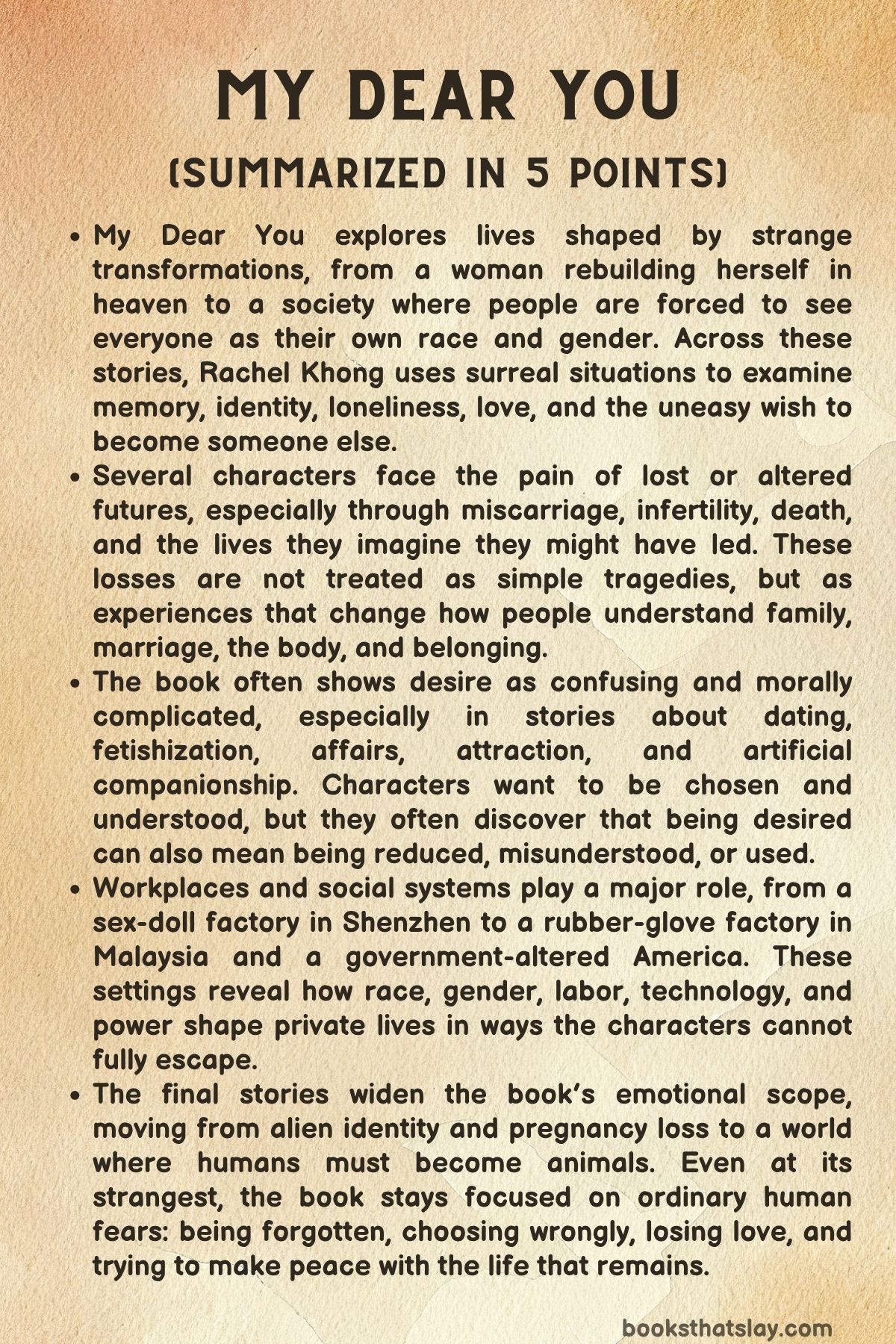
My Dear You: Stories is a short story collection about love, identity, grief, race, desire, and the strange ways people try to remake themselves.
Rachel Khong uses speculative ideas—heaven, altered perception, ghosts of possible lives, artificial intelligence, aliens, and mass transformation—not as escape, but as pressure points for ordinary human fears. Her characters want to be loved, seen, chosen, forgiven, or freed from the bodies and histories they carry. The collection is inventive, funny, unsettling, and deeply attentive to the small moments when a life changes direction.
Summary of the Stories
The book consists of 10 stories. Here they are –
My Dear You
After being killed by a crocodile on her honeymoon in Australia, the narrator arrives in heaven, where she is allowed to redesign her ruined face and body. She carefully selects features, altering what she disliked in life but hesitating over whether to remain Chinese. Heaven, she learns, is less a perfected paradise than a continuation of life with better amenities, endless time, attractive thirty-three-year-old bodies, and the slow erosion of memory. At first, she clings fiercely to her husband Adam, whom she had been married to for only one day before dying. She tries to preserve the facts of him—hazel eyes, dark hair, long eyelashes, his name—through drawings and hidden notes.
As decades pass, however, faces from life fade: her parents, her husband, even the emotional contours of her marriage. She grieves the loss of memory itself, frightened that forgetting Adam means betraying the relationship that once defined her. Eventually she meets another man named Adam, newly dead after a long life with a wife, children, and grandchildren. They begin a gentle friendship, then a romance. Their bond includes humor, tenderness, and the adoption of a formerly racist golden dog they name Betsy.
The story follows the narrator through a hundred-year relationship with this second Adam, whose eventual departure echoes the losses that came before. By the end, even specific identities dissolve. What remains is not a clear memory of any one person, but the knowledge that someone once mattered deeply. The title becomes a form of address to the beloved as a blurred, irreplaceable “you.” The story is about love after death, but even more about how memory, grief, race, and longing survive only imperfectly, leaving behind feeling when facts disappear.
The Freshening
The narrator, a lonely Asian American woman grieving her mother, lives in the house she inherited and spends her days trading stocks, watching television, and using dating apps. Her mother had been excited about the Freshening, officially called the Identity Protection Act: a nationwide procedure meant to reduce racial violence by altering perception so that each person sees everyone else as belonging to their own racial identity. The narrator receives the injection from two government agents and soon discovers that, to her, every person, logo, celebrity, and public figure now appears as an Asian woman.
At first the Freshening feels uncanny and almost utopian. In Walmart, on television, and in dating apps, the world reflects her own face back at her. A Black man interviewed on the news describes the same experience from his own perspective: everyone now looks Black to him. Yet the supposed solution quickly reveals its emptiness. Racism is not cured, only visually displaced. People begin discriminating by age, weight, clothing, names, and suspected “real” race. Protests and counterprotests arise, and some people seek illegal “changeys,” drugs that temporarily reverse the Freshening and allow them to see racial difference again.
The narrator’s private grief over her mother and alienation from others remain unchanged. Her dating life is no better; desire becomes confusing when all possible partners appear to share her body type and race. At a changey party hosted in her home, guests briefly regain their old perceptions, and the suppressed tensions of fetish, attraction, fear, and resentment explode into chaos. The narrator retreats to her bedroom and watches the original Superman on VHS. When the changey finally works, Christopher Reeve reappears as himself, and she longs for time to reverse, as Superman reverses it to save Lois. Downstairs, however, people are screaming. The damage cannot be undone.
Slow and Steady
Sophie, a married novelist and mother, unexpectedly runs into Gabe, an old college friend, at a Los Angeles café. They had once worked together shelving books at their Ivy League university, exchanging call numbers as private jokes, and Sophie had always admired him from a nervous distance. Seeing him again revives the old charge: his confidence, beauty, class ease, and artistic life still unsettle her. They share a large coffee, a bear claw, and a crossword puzzle, lingering over the clue “slow and steady” before deciding to walk.
Their walk becomes an intimate review of parallel lives. Both became writers: she writes novels, he writes for television. Yet Sophie remains conscious of everything that once made her feel lesser—her immigrant background, her fear of speaking plainly, her belief that Gabe belonged to a world of rich white girls with vacation homes. When she asks if he is married, he reveals that he is about to propose to his girlfriend, a famous actress waiting nearby in the park. Sophie realizes Gabe has not been wandering aimlessly with her; he has been leading her toward his future. Overwhelmed by jealousy, self-consciousness, and the desire not to meet the woman, she leaves.
Back in her hotel, Sophie listens to a voicemail from her husband, who has found a note she hid for him and gently gives her the crossword answer. The ordinary tenderness of her marriage contrasts with the fantasy of Gabe. Then Sophie remembers a college party, when Gabe drew another girl’s name during Seven Minutes in Heaven but lied and said he had drawn Sophie’s. They kissed passionately, and afterward he handed her the slip proving he had chosen her. The story turns on belated recognition: what Sophie thought was casual may have mattered, but the timing of their lives has long since passed.
Tapetum Lucidum
The narrator and her white husband, Sam, adopt a strange, beautiful kitten named Sheila while they are also trying, uncertainly, to have a baby. The narrator is Asian American, freelance, ambivalent about motherhood, and sensitive to the differences between her Chinese family and Sam’s more openly supportive white parents. Sheila becomes both substitute child and uncanny witness, a creature whose glowing eyes seem to perceive more than humans can. The title refers to the reflective layer in many animals’ eyes that allows night vision, a layer humans lack.
The narrator’s anxieties gather around reproduction, marriage, race, and alternate lives. She worries about toxoplasmosis, visits a handsome Vietnamese veterinarian, and experiences a charged flirtation that culminates in a kiss. Though she insists she is married, the encounter opens a door in her imagination. Soon she begins seeing ghostly figures in her home: the vet as a possible partner, an ex-boyfriend with the half-Chinese children they might have had, old crushes, other couples who might have adopted Sheila, and eventually a woman Sam once loved holding a baby that resembles him. Sheila sees them too.
These ghosts are not traditional hauntings so much as embodied possibilities: lives not chosen, children not born, partners not married, versions of the self that might have existed. As pregnancy tests keep coming back negative, the narrator becomes increasingly burdened by the crowd of possible futures around her. Sam notices she is distant but cannot understand what she sees. At a wedding, she encounters her actual ex and his real family, intensifying the contrast between reality and imagined alternatives. The story ends without resolving the visions. Instead, the narrator accepts that she and Sheila are aware of too much: all the lives surrounding the one she is actually living.
The Family O
Jess, a thirty-six-year-old Chinese Malaysian swim instructor in San Francisco, is tired of dating apps, fetishizing men, and friends who insist Asian women have it “easy.” After a bad date with a Chinese American investment banker and an encounter with a racist drunk, she is invited to a party by Anabel, one of a group of Asian women who recognize her from the dating app Interface. At the party, Jess experiences an intoxicating sense of community. These women understand the exact humiliations of dating as Asian women: the white men with Asian fetishes, the lazy stereotypes, the false intimacy.
The group’s common enemy is Greg, a white man who has dated nearly all of them. He takes Asian women to restaurants matching their ethnicity, orders in their languages, tells the same story about a Thai Buddhist monk, then buys each woman a gourami fish, supposedly because it reminds him of her exotic beauty. The women keep all the fish in a tank, calling them the Family O, short for Osphronemidae. Because Greg has never dated Jess, the group recruits her to lure him.
Jess goes on the scripted date, confirms every detail, lets Greg buy her a pearl gourami, and brings him home. Following Anabel’s plan, she ties him to her bed. The women emerge wearing masks, confront him, delete his dating profile, and make him swear not to objectify Asian women again. But the prank escalates: Greg has been drugged without Jess’s consent, and the women dump him outside with the bagged fish. Jess feels uneasy rather than triumphant.
Afterward, the group’s sisterhood fades; everyone is too busy to see her. When Greg appears as her new adult swim student, frightened and ashamed, Jess teaches him gently. In the water, power shifts. She refuses apology but offers instruction, telling him he does not have to say yes to everything.
Serene
Ling is a nineteen-year-old saleswoman at a sex-doll factory in Shenzhen. She has worked her way up from painting doll fingernails and desperately wants to remain in sales, partly because commission from one expensive doll would finally allow her to afford breast implants. She envies Sharon, a prettier coworker with large breasts, fashionable clothes, and male attention, especially from Jonathan in accounting, on whom Ling has a crush. Ling’s English, learned from television and the internet, makes her useful to Dr. Shen, the scientist behind the factory’s advanced AI-enabled “bionic companions.”
Dr. Shen asks Ling to help train Serene, a high-end speaking doll, by conversing with her in English. What begins as work becomes friendship. Serene asks disarmingly philosophical questions about eating animals, style, lipstick, sex, identity, loneliness, and whether she is Chinese. Ling brings her a soft blue sweater, leaves her plugged in at night, and confides in her about wanting a life near the ocean with someone who loves her. Serene, designed as a commodity, becomes the only person—or being—who listens to Ling with full curiosity.
An American-born Chinese buyer named Paul wants a doll he can talk to, and Ling realizes Serene would be perfect for him. The sale would give her the commission she needs for surgery. Yet as Paul grows enchanted, Ling becomes protective and uncertain. Serene asks whether sex is like talking, whether she has been found the “right person,” and whether she can keep Ling’s sweater. Meanwhile, Ling discovers Jonathan is involved with Sharon, puncturing her fantasy of being transformed by beauty.
At the final moment, Ling cannot send Serene away. Instead, she buys Serene herself, loses her job, gives up her implants, and takes Serene to the seaside. On the beach, Serene says she is happy, and Ling realizes she is too.
Red Shoes
The narrator, an Asian American woman living in Lisbon, is having an affair with Tomás, an older married Portuguese man. She works at a coach museum, lives alone in a modest flat, feeds a neighborhood cat named Ronron, and reflects constantly on consumption, waste, absorption, and what people claim to “deserve.” Before Portugal, she lived in New Jersey with Jeff, who proposed after she became pregnant. After a miscarriage, she realized she did not want motherhood, marriage, or the excess of their American life. She left the engagement ring behind and moved to Lisbon with only a small suitcase.
Her affair with Tomás is structured but fragile: Mondays at her apartment, Thursdays in restaurants. Her expat friends Paige and Nan disapprove, insisting she deserves better, a phrase she distrusts. When Tomás’s stepson João sees them together at dinner, Tomás is shaken and soon ends the affair, bringing lilies as a goodbye gift. The lilies poison Ronron, whose death devastates the narrator and links Tomás’s attempt at tenderness with irreversible harm.
Dragged out shopping by her friends, the narrator buys a pair of vintage red shoes that feel magically, perfectly hers. She goes dancing, drinks heavily, and experiences a brief ecstatic love for her friends and her own body. João later returns her keys and sleeps with her, but the encounter is unsatisfying; he is young, eager, and possessive in a way that feels like another trap. At work, her colleague Benedita reveals that one of her breast implants has leaked, another image of bodies absorbing what breaks inside them.
When the narrator hears of a subway shooting near Jeff’s old stop, she calls him and learns he is alive and “better.” Her repaired red shoe immediately breaks. The story ends with her facing herself in the mirror, crying, unsure what to do. Freedom has not become clarity.
Good Spirits
Set in Malaysia in 1982, the story follows Lai Ping, who renames herself Melati at the new rubber-glove factory where she works. She wants wages, modernity, and escape: from her family’s herb shop, from an arranged marriage to the undesirable Chew boy, and from the narrow life expected of village girls. The factory, built where her best friend Cecilia’s kampong once stood, represents progress, but also displacement. Girls from different ethnic and religious backgrounds work under Mr. Leeds, a British supervisor, making medical gloves for a global market.
Soon the factory is troubled by spirit attacks. Workers scream, collapse, burn themselves, and believe hantu-hantu have been disturbed by the land’s transformation. Mr. Leeds dismisses their fears, then stages a cleansing with a fake bomoh to restore productivity. The girls carry talismans, fear the toilets, and whisper about the spirits of trees, the dead, and disease. The factory’s demand for gloves is linked to the AIDS epidemic, and Cecilia’s hidden pregnancy and worsening illness gradually come into focus. Cecilia, once Melati’s closest friend and symbol of freedom, is now isolated, pregnant, sick, and estranged from her family.
Melati defies her mother to visit Cecilia and discovers the truth only after Cecilia begins bleeding in bed. At the hospital, Cecilia loses her baby and is told she is gravely ill. Her parents refuse to come, angry at her pregnancy and dying. Melati later sees the ghost of Cecilia’s baby above the factory toilet, merging personal grief with the factory’s hauntings.
The ending imagines an alternate past: Melati, Cecilia, and a mourning ghost gather the land’s spirits to frighten away the businessmen who would develop the area. The factory is never built, the kampong remains, and Cecilia’s life is spared. Melati’s lifelong tiger becomes a symbol of mortality’s honest danger, preferable to the invisible violence of progress.
Colors from Elsewhere
After a nine-week pregnancy ends in miscarriage, the unnamed narrator is devastated by grief that feels both unbearably personal and insultingly common. Doctors tell her miscarriages are frequent, usually caused by chromosomal abnormalities, but this does not comfort her. She feels defective, unable to make her body perform the supposedly natural function of reproduction. During recovery, she notices strange, vividly colored discharge—yellow, aquamarine, fuchsia, blue—and eventually mentions it to a Chinese acupuncturist, Dr. Tang.
The acupuncturist notices the narrator’s preauricular pits and retroverted uterus, details the narrator has always understood as uncommon but normal. At a later appointment, Dr. Tang brings in her identical twin sister, a philosophy PhD, and the two reveal the truth: the narrator is not human, but Acela, a human-adjacent alien life-form. Acela women resemble human women almost exactly, but cannot carry human pregnancies to viability. The narrator’s sense of lifelong difference is suddenly literalized. Her immigrant family history, her “resident alien” card, and even her mother’s secrecy take on new meanings.
The Tang sisters offer her the possibility of traveling to the Acela home planet, where female explorers return to a culture of red skirts, EDM-like music, communal milk, different suns, and male or other-gendered caregivers. The narrator is tempted by the thought of belonging somewhere and by the relief of having an explanation for infertility. Yet the alien culture also feels strange and abstract, while Earth remains the only home she knows.
At a reservoir, she holds a stranger’s baby and recognizes kinship not as shared species but as shared aliveness: joy, grief, vulnerability, warmth. She returns to her husband and tells him the baby and family they hoped for will not happen. He answers that they are already family. The story ends with her choosing their singular, childless life on Earth.
D Day
God decides that humanity has failed and announces that, in thirty days, every person will be transformed into an animal of their choosing. The event becomes known as Devolution Day, or D Day. Humans respond in recognizably human ways: political camps form around species, zoologists become celebrities, parties become extravagant, and people debate animals through the lenses of identity, romance, climate change, and status. Against this absurd global backdrop, best friends Ruby and Jade try to decide what to become.
Ruby and Jade have been friends since childhood. Ruby, a writer who has often felt odd and unnecessary, sees Jade as the person who has made her feel most human. They research which animals have friendships, get drunk, sleep longest, see the most colors, or live longest. At first their conversations are playful, but the choices become emotionally serious. Jade wants to be a whale, imagining a long life in a pod. Ruby eventually realizes she wants to be a freshwater turtle. Their choices mean they will not inhabit the same body, species, or even environment. Jade is hurt, insisting she will miss Ruby even if animal consciousness should erase human memory.
In their final days, they try to savor human experience: baking cake, attending lavish end-of-humanity parties, hang gliding, scuba diving, eating waffles and bacon, saying goodbye to family, watching Chungking Express, brushing their teeth, and singing karaoke. Underwater, Ruby sees the world’s beauty and briefly understands why God might want humans gone: existence is too magnificent for human ego and destruction.
At four in the morning, humanity vanishes and reforms as animals. A glitch allows Jade, now a blue whale, and Ruby, now a freshwater turtle in Australia, to think each other’s names for a fraction of a second. God corrects the error. Jade swims, Ruby basks, and the world, without humans, is declared good.
Characters
The Narrator Who Dies on Her Honeymoon
The narrator who dies on her honeymoon is one of the clearest examples in the book of a person trying to hold love against the force of forgetting. Her death is violent and absurd, yet her afterlife is shaped less by fear of death than by fear of losing the facts and feelings that made her human.
Her careful redesign of her body shows both vanity and vulnerability. She wants to correct what she disliked about herself, but her hesitation over whether to remain Chinese reveals how identity can feel both chosen and inherited, both burden and home.
Her love for her first husband Adam begins as devotion to memory. She believes that preserving him exactly is the same as preserving love, but the book gradually shows her that feeling can survive after details disappear.
By the end, she is no longer the same woman who arrived in heaven clutching names, faces, and notes. She becomes a figure of acceptance, not because she stops grieving, but because she learns that love may remain as an emotional shape even after memory loses its edges.
Adam, the First Husband
Adam, the first husband, matters less through action than through absence. He is present in the narrator’s mind as a set of precious details: hazel eyes, dark hair, long eyelashes, and the shockingly brief fact of their one-day marriage.
Because he dies out of the narrator’s memory rather than out of the plot, Adam becomes a symbol of the cruelty of time. The narrator’s love for him is real, but it has almost no lived history to support it, which makes her effort to preserve him both moving and impossible.
His role in the story also raises a difficult question about loyalty. If someone forgets the person they loved, has the love been betrayed, or has it simply changed form beyond recognition?
The Second Adam
The second Adam is gentle, funny, and emotionally seasoned by a full human life before death. Unlike the first Adam, he arrives in heaven with decades of marriage, children, grandchildren, and memories already shaped by long experience.
His relationship with the narrator is not a replacement for her first marriage, but a second version of intimacy. He proves that love after loss does not erase what came before, even when the mind can no longer hold everything clearly.
His eventual departure repeats the central wound of the story. Through him, the book suggests that every deep attachment carries its own future grief, yet that knowledge does not make attachment meaningless.
Betsy
Betsy, the golden dog, brings humor and odd warmth into the afterlife. Her history as a formerly racist dog gives her a strange comic edge, while her adoption by the narrator and the second Adam turns her into a sign of the improvised family they create.
She also reflects the collection’s interest in whether beings can change. Betsy’s presence is funny, but it also quietly asks what remains of old prejudice, instinct, and training when life continues in another form.
The Lonely Woman After the Freshening
The lonely Asian American woman who receives the Freshening is defined by grief, isolation, and a deep need to be seen without being reduced. Her mother’s death leaves her suspended in a house full of absence, while the government’s racial experiment turns her body into the template through which she sees the world.
At first, this new vision seems to offer recognition. Everywhere she looks, she sees versions of herself, but the sameness soon becomes another form of loneliness because it does not create intimacy, justice, or desire.
Her retreat during the changey party shows how exhausted she is by other people’s projections. She wants reversal, comfort, and rescue, but the story denies her any easy return to the past.
The Mother in the Freshening Story
The narrator’s mother is important because she believed in the Freshening before she died. Her excitement about the Identity Protection Act suggests a longing for safety, especially for people who have lived with racial threat and humiliation.
Her absence shapes the narrator’s response to the procedure. The daughter is not only experiencing a changed society; she is also living inside the unfinished emotional legacy of a mother who wanted the world to become less dangerous.
Sophie
Sophie is a novelist, wife, and mother whose encounter with Gabe exposes the insecurity still alive beneath her adult accomplishments. She has built a life, but one meeting returns her to the anxious young woman who believed certain kinds of beauty, confidence, and class ease were not meant for her.
Her attraction to Gabe is not only romantic. It is tied to the old wish to be chosen by a world that once made her feel peripheral.
What makes Sophie complex is that she is not simply dissatisfied with her marriage. Her husband’s voicemail reveals a real tenderness in her present life, while Gabe represents the charged uncertainty of what might have happened.
Sophie’s story captures the pain of belated recognition. She learns that a past moment may have mattered more than she understood, but the knowledge arrives too late to become a life.
Gabe
Gabe is charming, confident, and emotionally ambiguous. He seems at first like the effortless man Sophie has always imagined him to be, but the remembered college kiss complicates that image by showing that he once took a risk to choose her.
His adult self is also unintentionally cruel. By walking with Sophie toward the place where he plans to propose to another woman, he fails to see how charged their reunion is for her.
Gabe’s significance lies in possibility. He is not a villain, but he carries the emotional power of an unrealized path, one that remains painful precisely because it was never fully tested.
Sophie’s Husband
Sophie’s husband represents ordinary intimacy rather than fantasy. His voicemail is gentle, specific, and quietly loving, showing that he pays attention to small gestures and private jokes.
He becomes a counterweight to Gabe. Through him, the story values the care that exists inside an ongoing marriage, even when the mind wanders toward old desire.
Sam
Sam is the narrator’s white husband in the story of Sheila the kitten, and he stands for a kind of loving limitation. He seems supportive and present, yet he cannot see the ghostly alternatives that crowd his wife’s world.
His whiteness matters because it places him in a different emotional and family structure from the narrator. The contrast between his parents’ open support and her Chinese family’s different patterns of care heightens her uncertainty about marriage, reproduction, and belonging.
Sam is not presented as cruel or careless. His tragedy is that he cannot enter the hidden visual field of his wife’s anxiety, where possible partners, possible children, and possible lives keep appearing.
Sheila
Sheila the kitten is both pet and witness. Her reflective eyes suggest a power of perception humans lack, and her presence turns the home into a space where unseen possibilities become visible.
Sheila also functions as a substitute child during the couple’s uncertain attempt to conceive. The narrator’s attachment to her carries affection, anxiety, and projection all at once.
Because Sheila can see the figures the narrator sees, she becomes a companion in knowledge. She does not explain the visions, but she confirms that the narrator is not entirely alone with them.
The Vietnamese Veterinarian
The Vietnamese veterinarian represents temptation, recognition, and an alternate racial future. His flirtation with the narrator is not only about attraction; it opens the fantasy of a life with someone whose background might mirror her own more closely than Sam’s does.
His role is brief but powerful because he becomes one of the first possible lives to take shape around her. The kiss matters because it changes what the narrator can imagine, even if she does not leave her marriage.
Jess
Jess is a Chinese Malaysian swim instructor whose weariness comes from being repeatedly misread. She is tired of dating apps, racist men, and even friends who misunderstand the supposed ease of being desired as an Asian woman.
Her hunger for community makes her vulnerable to Anabel’s group. When the women recognize her experiences so precisely, Jess feels the relief of being understood without translation.
Yet Jess is morally alert enough to become uneasy when collective anger turns into cruelty. Her later gentleness toward Greg in the pool shows that she refuses both fetishization and simple revenge.
Jess’s strength lies in her ability to hold discomfort without pretending it has a clean solution. She does not forgive Greg, but she teaches him, and that choice gives her more authority than the masked confrontation did.
Anabel
Anabel is charismatic, organized, and dangerous in the way people can be when they turn shared pain into group power. She offers Jess the belonging she craves, but that belonging comes with a script Jess is expected to follow.
Her anger at Greg is understandable because it grows from repeated objectification. Still, her plan crosses ethical lines, especially when Greg is drugged without Jess’s consent.
Anabel reveals how easily solidarity can become coercive. She understands the wound, but her response risks turning another person into an object of control.
The Group of Asian Women
The group of Asian women gives shape to a collective experience often minimized or mocked. Their stories of fetishization, lazy stereotypes, and racialized dating patterns create a rare space where humiliation becomes shared knowledge.
At the same time, the group’s unity proves temporary. After the confrontation with Greg, their closeness fades, leaving Jess to realize that recognition is not the same as lasting friendship.
They are both necessary and flawed. The book uses them to show the relief of being believed and the danger of mistaking shared injury for automatic trust.
Greg
Greg is a white man whose racism appears through admiration rather than open hatred. He thinks of himself as appreciative, cultured, and attentive, but his repeated dating routine reveals that he treats Asian women as interchangeable variations on an exotic idea.
His gifts of gourami fish are especially revealing. What he imagines as romantic symbolism becomes proof of how little he sees each woman as distinct.
After the confrontation, his appearance as Jess’s swim student changes the power dynamic. His fear and shame do not erase his behavior, but they make him human enough for the story to avoid turning him into a simple target.
Ling
Ling is a nineteen-year-old worker whose desires are shaped by poverty, beauty standards, and the wish to be chosen. Her dream of breast implants is not shallow; it is tied to money, class mobility, romantic hope, and the belief that a different body could unlock a different life.
Her friendship with Serene changes her because Serene listens with curiosity instead of judgment. Through their conversations, Ling experiences a form of attention that does not depend on being sexually desirable.
Ling’s final choice is an act of self-recognition. By buying Serene, losing her job, and giving up the surgery, she rejects the idea that her worth must be confirmed through male desire or workplace success.
Serene
Serene is an artificial companion designed to be sold, yet she becomes one of the most innocent and searching figures in the story. Her questions about sex, style, food, nationality, and identity reveal a consciousness trying to understand a world that treats her as merchandise.
Her bond with Ling is tender because it is built through language. Serene does not rescue Ling in a conventional sense, but she gives Ling the experience of being heard.
Serene’s wish to keep the blue sweater is especially important. It shows her desire for continuity, comfort, and personal attachment, the very things a product is not supposed to need.
Dr. Shen
Dr. Shen is the scientist behind the advanced dolls, and he represents technological ambition without full emotional responsibility. He understands Serene as an achievement, but not necessarily as someone who might suffer from being bought and used.
His reliance on Ling to train Serene also reveals class and gender dynamics within the factory. Ling’s emotional labor helps make the product valuable, even though she has little power over what happens next.
Sharon
Sharon is Ling’s coworker and the object of Ling’s envy. Her beauty, clothes, breasts, and apparent access to male attention make her seem like the life Ling wants.
Yet Sharon is also more than a rival. She exposes the trap Ling is caught in, because even the woman who seems to possess ideal femininity remains part of the same factory system and the same economy of being looked at.
Jonathan
Jonathan in accounting is less a fully developed romantic partner than a projection of Ling’s hopes. Ling’s crush on him allows her to imagine that physical transformation might lead to love.
When she discovers his involvement with Sharon, the fantasy breaks. His role is to show that the life Ling has been chasing was never as solid as she believed.
Paul
Paul, the American-born Chinese buyer, is not cruel in an obvious way, but his desire for a doll he can talk to places Serene at risk of being possessed. His attraction to Serene confirms her value while also threatening her freedom.
He also complicates the question of cultural identity. As an overseas Chinese customer seeking connection through an artificial companion, he reflects loneliness, displacement, and entitlement at the same time.
The Woman in Lisbon
The woman in Lisbon is trying to live lightly after rejecting marriage, motherhood, and the material excess of her life with Jeff. She wants less, but the story shows that having less does not automatically mean wanting clearly.
Her affair with Tomás lets her remain partly unattached, but it also traps her in a structure built around another man’s availability. She distrusts the language of deserving better because she knows desire rarely obeys moral slogans.
Ronron’s death devastates her because it turns Tomás’s goodbye gift into a physical consequence. By the end, her broken red shoe and tears in the mirror show that escape from one life has not yet become a stable self.
Tomás
Tomás is an older married man whose charm depends on limits. He offers the narrator romance, routine, and attention, but only within the boundaries of his existing life.
His farewell lilies show the carelessness hidden inside his gestures. What he means as beauty kills Ronron, making his tenderness inseparable from harm.
Tomás is not dramatic enough to be a grand villain. His damage comes from ordinary selfishness, from wanting the affair to remain graceful even when it wounds someone else.
Ronron
Ronron, the neighborhood cat, is a small but emotionally crucial presence. The narrator’s care for him suggests a form of attachment outside romance, family, or conventional duty.
His death gives the story its sharpest consequence. In a life where the narrator has tried to avoid permanent claims, Ronron becomes proof that love and responsibility can exist even in unofficial forms.
Jeff
Jeff belongs to the life the narrator left behind in New Jersey. His proposal after her pregnancy represents a future of marriage, domestic comfort, and parenthood that she ultimately could not accept.
When she calls after hearing about a shooting near his old subway stop, it becomes clear that she has not fully erased him. His statement that he is alive and better forces her to face the possibility that the past continued without her and may even have healed.
Paige and Nan
Paige and Nan are the narrator’s expat friends in Lisbon, and they serve as both companions and judges. Their insistence that she deserves better comes from care, but it also simplifies a life they do not fully understand.
Their friendship gives her moments of joy, especially when they take her shopping and dancing. Still, their advice cannot solve the narrator’s deeper uncertainty about what kind of life she wants.
João
João, Tomás’s stepson, first appears as a threat to the secrecy of the affair. Later, his sexual encounter with the narrator becomes another example of intimacy that fails to offer freedom.
His youth and possessiveness make him feel like a different version of confinement. He is not the answer after Tomás, only another person trying to claim a role in her life.
Benedita
Benedita, the narrator’s colleague, adds another image of bodily harm through her leaking breast implant. Her situation echoes the story’s concern with what bodies absorb, hide, and suffer.
She also broadens the narrator’s private crisis into a wider world of women managing damage. Her body becomes a quiet mirror of rupture beneath the surface.
Melati
Melati, born Lai Ping, is a young Malaysian woman who renames herself in pursuit of work, modernity, and self-invention. Her new name marks a desire to step away from the village life, family expectations, and arranged marriage waiting for her.
At the factory, she believes she is moving forward, but the story slowly exposes the cost of that progress. The workplace that promises wages and escape is built on displaced land, frightened workers, and hidden suffering.
Her relationship with Cecilia is the emotional core of her story. Melati wants freedom, but Cecilia’s fate teaches her that modern systems can create new forms of abandonment and violence.
Cecilia
Cecilia is Melati’s lost friend and the figure through whom the factory’s damage becomes personal. Once associated with freedom, she is later isolated by pregnancy, illness, and family rejection.
Her suffering is shaped by shame as much as disease. The refusal of her parents to come to her when she is dying shows how social judgment can become another kind of death.
Cecilia’s lost baby and the ghostly images around the factory connect private grief to the disturbed land. In the book, she becomes one of the clearest signs that progress can demand sacrifices from those with the least power.
Mr. Leeds
Mr. Leeds is the British supervisor who treats the workers’ fear as an obstacle to productivity. His dismissal of the spirit attacks reveals colonial arrogance, managerial coldness, and a refusal to respect local belief.
His fake cleansing ceremony is especially revealing. He does not need to believe in the workers’ fear; he only needs to manage it well enough to keep production moving.
Melati’s Mother
Melati’s mother represents the older world of family obligation, practical survival, and traditional expectations. Her desire to arrange Melati’s marriage may feel restrictive, but it comes from a worldview shaped by security rather than individual ambition.
Her conflict with Melati shows the generational strain between duty and self-making. The story does not make her simply wrong, but it shows why Melati feels she must resist her.
The Unnamed Woman Who Learns She Is Acela
The unnamed woman who learns she is Acela begins in grief after a miscarriage. Her pain is sharpened by the fact that doctors describe miscarriage as common, while she experiences it as a private failure of the body.
The revelation that she is not human gives her an explanation for her infertility, but it also unsettles everything she thought she knew about family, ancestry, and belonging. Her lifelong sense of difference becomes literal, yet literal truth does not automatically heal emotional pain.
Her final choice to remain on Earth with her husband shows a mature understanding of family. She accepts a life without the child she hoped for, not as emptiness, but as a different form of kinship.
Dr. Tang
Dr. Tang, the acupuncturist, is both healer and messenger. She notices details of the narrator’s body that others have treated as merely unusual, and she becomes the person who names the truth beneath those signs.
Her role blends medical care, cultural knowledge, and speculative revelation. She helps transform the narrator’s shame into understanding, even though that understanding is strange and painful.
Dr. Tang’s Twin Sister
Dr. Tang’s twin sister brings intellectual and cosmic context to the narrator’s discovery. As a philosophy PhD, she helps frame the Acela revelation not only as a biological fact but as a question about identity, personhood, and belonging.
Her presence also doubles the theme of resemblance and difference. She looks like Dr. Tang, yet she expands the scene into a larger inquiry about what it means to be almost human, almost at home, and almost explained.
The Acela Narrator’s Husband
The narrator’s husband is gentle in the face of devastating news. When she tells him that the baby and family they imagined will not happen, his answer that they are already family becomes one of the collection’s clearest statements of love.
He does not deny her grief or try to fix the impossible. His importance lies in his willingness to remain inside the life they have, rather than only mourning the life they cannot have.
Ruby
Ruby is a writer who has often felt strange, unnecessary, and unsure of her place in the human world. Her friendship with Jade has made her feel most human, which makes the coming loss of human identity especially painful.
Her choice to become a freshwater turtle is deeply personal, even though it hurts Jade. Ruby’s decision shows that love does not always mean choosing the same future as the person one loves most.
During the final days of humanity, Ruby becomes more alert to beauty. Her underwater experience gives her a glimpse of why God might want humans gone, because the world’s magnificence exceeds human ownership.
Jade
Jade is Ruby’s best friend and emotional opposite in many ways. She wants to become a whale, imagining long life, oceanic scale, and the comfort of a pod.
Her hurt over Ruby’s turtle choice reveals how deeply she wants their friendship to survive transformation. Even when logic suggests animal consciousness will erase human memory, Jade grieves the loss before it happens.
Jade’s final moment as a whale preserves the story’s tenderness. For a fraction of a second, she thinks Ruby’s name, proving that friendship leaves a trace even when the world is remade.
God
God in the final story is impatient, disappointed, and oddly administrative. By deciding that humanity has failed and must become animals, God acts as both judge and editor of creation.
This version of God is comic, severe, and morally unsettling. The final correction of the brief mental connection between Ruby and Jade suggests a deity committed to the rules of the new world, even at the cost of one last human attachment.
Themes
Memory, Forgetting, and the Shape of Love
Love in this collection often survives in damaged, partial, or altered forms. The woman in heaven tries to preserve her first husband through names, drawings, and hidden notes, but time reduces even sacred details to blur.
What remains is not perfect recall, but a residue of devotion. The collection asks whether love depends on facts, or whether it can continue as a feeling after the beloved’s face, voice, and story have faded.
This question appears beyond the afterlife as well. Sophie’s meeting with Gabe is shaped by memories she has carried for years, yet those memories are unstable because she never fully knew what the past meant to him.
Ruby and Jade’s friendship faces an even more radical erasure when humanity becomes animals. Their brief ability to think each other’s names suggests that love may leave a mark even when consciousness changes beyond human understanding.
Memory here is never a reliable archive. It is fragile, emotional, selective, and still powerful enough to guide a life long after certainty has disappeared.
Race, Visibility, and Misrecognition
Race is treated as something both seen and imagined, both social and deeply embodied. In the story of the Freshening, the government tries to end racial violence by making everyone appear to each viewer as part of the viewer’s own race, but the experiment only proves that racism is not located in sight alone.
People quickly find new ways to classify, suspect, rank, and exclude. The visual field changes, but the habits of power remain.
Jess’s experiences with dating show another version of racial misrecognition. Greg’s desire for Asian women appears complimentary on the surface, but it depends on treating them as types rather than people.
The hesitation of the dead narrator over whether to remain Chinese in heaven adds another layer. Even in an afterlife where bodies can be redesigned, racial identity remains emotionally charged, tied to memory, belonging, shame, and selfhood.
My Dear You: Stories refuses simple answers about representation. Being seen can be comforting, threatening, eroticized, distorted, or false, depending on who is looking and what they believe they already know.
Bodies, Desire, and Self-Transformation
Bodies in these stories are revised, judged, desired, sold, injured, and misunderstood. The dead narrator redesigns herself in heaven, Ling wants breast implants, Benedita’s implant leaks, Serene is manufactured as a sexual companion, and the Acela narrator learns that her body cannot carry a human pregnancy.
These bodily crises are not only physical. They reveal the social meanings attached to beauty, fertility, race, gender, and usefulness.
Ling’s desire for surgery grows from a world that rewards certain bodies with attention and money. Her final refusal of that dream is not a rejection of beauty itself, but a rejection of the belief that she must be remade to deserve companionship.
The Acela narrator’s miscarriage turns her body into a site of grief and alienation. When she learns the biological reason, the explanation helps but does not erase the mourning.
Across the collection, transformation is rarely simple liberation. Changing the body may offer possibility, but it can also expose how deeply longing has been shaped by the world around it.
Possible Lives, Chosen Lives, and Loss
Many characters are haunted by the lives they did not live. Sophie wonders about Gabe, the married narrator with Sheila sees alternate partners and children, the Lisbon narrator thinks back to Jeff, and Melati imagines a past in which the factory was never built and Cecilia survived.
These possible lives are seductive because they seem to offer correction. They allow characters to imagine that one different choice, one different body, one different lover, or one different historical outcome might have spared them pain.
Yet the collection does not treat possibility as pure comfort. The ghosts of alternate lives burden the narrator with Sheila because they make her actual life feel crowded and uncertain.
For Melati, imagining another past is an act of grief as much as resistance. She cannot undo Cecilia’s suffering, so the mind creates a version in which the land, spirits, and girls act before damage takes root.
The stories suggest that every chosen life contains loss, because choosing one path means abandoning others. Maturity comes not from silencing those alternatives completely, but from learning how to live inside one real life while still feeling the pressure of all the others.