My Evil Mother Summary, Characters and Themes
My Evil Mother is a darkly funny, unsettling, and sharply observant story by Margaret Atwood about a daughter growing up under the influence of a mother who claims to be a witch. Set first in mid-century Toronto and later moving across decades of family life, the story mixes domestic detail, superstition, memory, and emotional conflict.
At its center is the daughter’s changing view of her mother: as a child she is awed, as a teenager she is embarrassed and resistant, and as an adult she begins to understand the strange forms that love and protection can take. The story examines power, inheritance, belief, and maternal control with wit and bite.
Summary
The story is narrated by a woman looking back on her life with her unusual mother, a woman who openly described herself as evil but insisted that she used her powers only for good. When the narrator was fifteen, she and her mother often argued, especially about boys.
During one such argument, the mother objected to the narrator’s boyfriend, Brian, claiming that the Universe itself disapproved of him. This was typical of her manner: she treated invisible forces as real, spoke with certainty about omens and dangers, and expected her daughter to accept her authority.
The narrator’s childhood home was in a postwar Toronto suburb filled with tidy houses and conventional families. Her own household did not fit that pattern.
There was no visible husband, and her mother seemed to support herself through mysterious means. She often worked in the kitchen with a mortar and pestle, herbs, jars, and mixtures whose purpose she would not explain.
Sometimes distressed women came to the house, and the mother would serve them a strange drink, listen to their troubles, and perhaps give them advice or remedies. The narrator suspected that this was part of how her mother made money.
The mother presented herself outwardly as a respectable suburban woman, dressed in neat shirtwaist dresses, aprons, pearls, and sensible shoes. Yet beneath that appearance was an atmosphere of threat and control.
She claimed to ward off evil eyes, protect the house, and influence events in the neighborhood. She hinted that she could cause husbands to fall ill or prosper, and she made her daughter believe that she possessed real powers.
The narrator was embarrassed by her mother’s reputation and by the gossip she heard at school, but she also half believed everything. Her mother’s world was so complete, and so confidently asserted, that it shaped the daughter’s sense of reality.
At the same time, the narrator wanted ordinary things: popularity, beauty, romance, and approval. Her mother scorned that desire to be liked, calling it weakness.
Their relationship was full of these clashes. The mother could be affectionate, calling her daughter pet names and baking cookies, but she was also domineering and dismissive.
She made pronouncements that mixed care with menace, such as ordering the narrator to burn hair from her hairbrush so that no one could use it for harmful purposes. She also warned about Miss Scace, the narrator’s gym teacher, whom she described as a hostile figure with occult powers who stole mushrooms and flew around at night.
The conflict over Brian becomes one of the defining incidents of the narrator’s youth. The mother reads his future through tarot cards, using a leftover piece of his pie crust as a link to him.
She announces that he is marked for catastrophe and that if the narrator keeps seeing him, both of them may die in a car accident or be terribly injured. She insists that the relationship must end.
The narrator argues, points out that none of this can be proved, and begs her mother to prevent the disaster instead. But the mother says it is too strong to stop.
Fear wins. Though the narrator is deeply attached to Brian, she breaks up with him for his own good.
He is angry, and school gossip follows. Years later, Brian is killed in a completely different violent incident, and the narrator is left with the uneasy thought that perhaps her mother had sensed danger after all, though not accurately.
The absence of the narrator’s father shadows her childhood. As a small child, she is told that her mother turned him into the garden gnome by the front steps, and she believes it.
She speaks to the gnome and imagines he grants her wishes. Later, she learns the ordinary story that he abandoned them, though even then she suspects her mother of having somehow transformed or destroyed him.
She imagines dark possibilities, including murder and burial in the cellar, because her mother seems capable of anything.
When the narrator is twenty-three and living away from home after a difficult separation from her mother, her father suddenly contacts her. They meet for lunch, and he tells her that he spent part of the intervening years in prison for drunk driving and nearly killing someone.
He explains that he is an alcoholic, now sober, remarried, and working in social services. This meeting changes the narrator’s view of the past.
He reveals that he had sent birthday gifts over the years, including a pink angora sweater the narrator had once wanted badly. Her mother had passed these gifts on without telling the narrator they came from him.
This means the mother had lied, but it also confirms that she truly had not simply bought the items herself. The truth is not less strange; it is just strange in a more human way.
The narrator and her father never build a fully close relationship, but they meet occasionally. He describes the narrator’s mother as difficult, always right, and alarming to live with.
He suggests that the mother’s force of personality drove him away. The narrator understands this.
Yet his new family remains separate from her, and she continues to live with a divided sense of origin, caught between her mother’s mythmaking and her father’s weakness and absence.
As the years pass, the narrator marries and has two daughters of her own. Her relationship with her mother continues in cycles of conflict and reconciliation.
The mother still behaves in bizarre ways, arriving at the hospital after childbirth with a jar of orange substance and proposing to cook the placenta. She still talks about Miss Scace as if she were a living supernatural enemy, even though Miss Scace is long dead.
The narrator keeps her children at some distance, wanting to spare them the confusion and fear that marked her own upbringing.
The father eventually dies of cancer. At his funeral, the narrator sees her mother dressed dramatically in black, veiled and crying.
It is one of the few moments when the mother shows vulnerability. She says that the father had once been her sweetheart and that she drove him away.
This moment reveals that beneath the certainty and theatricality there was real loss.
After that, the mother’s decline becomes obvious. She stops caring for her appearance, no longer cooks properly, lets her house and yard decay, and seems increasingly absorbed in the fantasy of her long war with Miss Scace.
She now claims that their conflict goes back centuries, across multiple lives, involving flying battles, accusations of witchcraft, burnings, and revenge. She tells elaborate and absurd stories, including one about Miss Scace stealing men’s penises and keeping them in a cedar box.
The narrator does not challenge her directly because argument is useless. Instead, she tries to manage practical matters such as food, bills, and safety, as a daughter caring for an aging parent.
Eventually the mother breaks her hip, supposedly from falling out of the air onto a chimney, and is hospitalized. She says she will not leave the hospital alive, and she is right.
In her final days, the narrator asks the question she has carried for years: was any of it true? The hair burning, the pointing, the rituals, the warnings, the stories.
The mother replies that the narrator was a sensitive child and that she told her those things so she would not feel defenseless in the face of life. She wanted her daughter to believe that a greater power was watching over her and taking a personal interest in her fate.
For a moment, the narrator understands her mother’s stories as inventions meant to protect and strengthen a vulnerable child. She tells her mother she loves her and says that yes, she did feel protected.
When she calls the tales invented, however, the mother gives her a sideways look and repeats the word as if questioning it. Even at the end, certainty is withheld.
The story closes with the narrator now becoming her mother in certain ways. Her own fifteen-year-old daughter wants to go running at night with a boy, and the narrator tries to forbid it.
When ordinary parental arguments fail, she says, “Don’t make me point,” and then tells her daughter that her grandmother was a witch and that the talent may be passed down. The girl, thrilled and unsettled, begins to listen.
In that final moment, the narrator uses the same strategy her mother once used on her: fear, mystery, and inherited female power as a way to protect a daughter from danger. The ending suggests that the mother’s strange legacy is not only superstition or manipulation but also a fierce instinct to guard the next generation, even through stories that blur love, control, and magic.
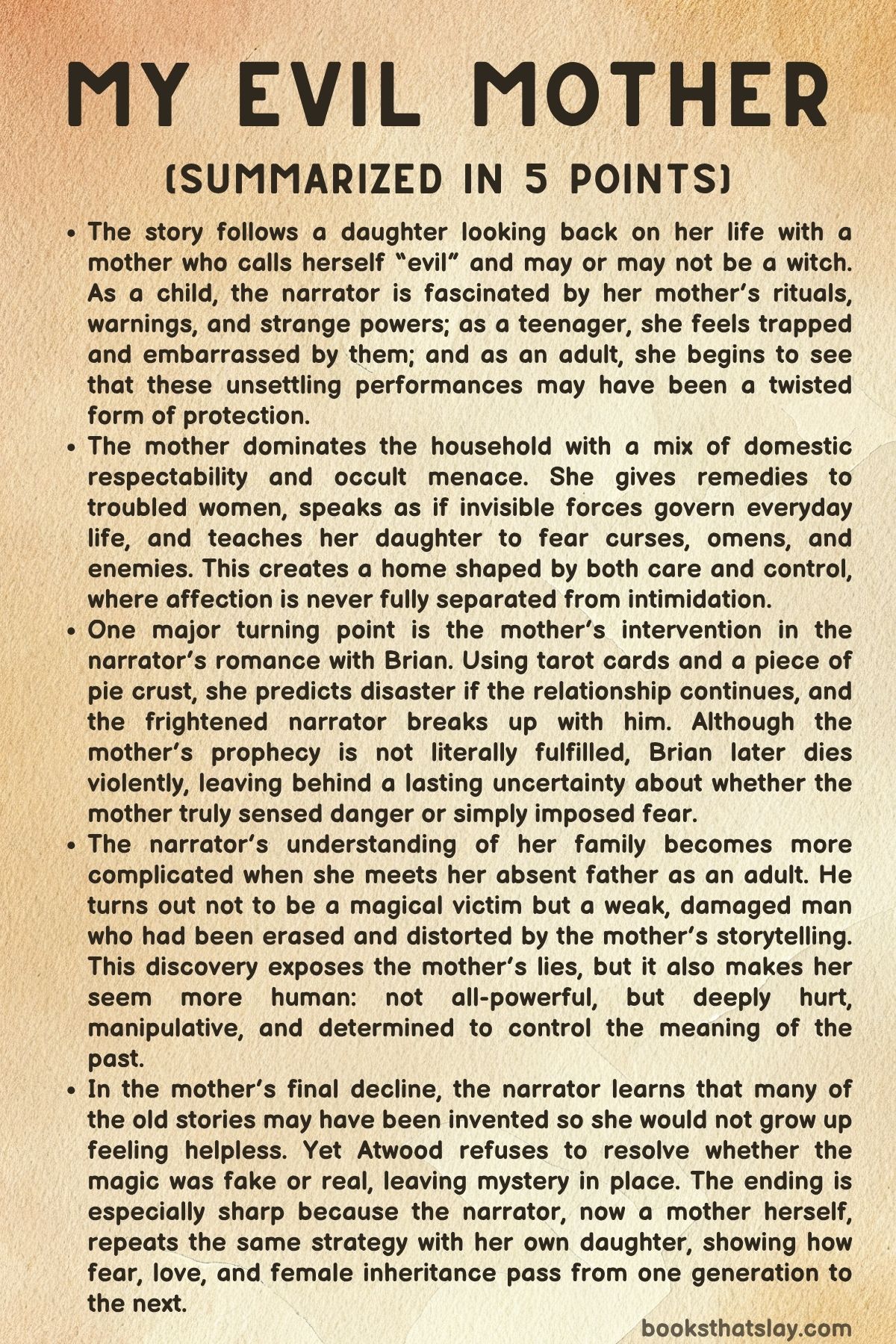
Characters
The Narrator
The narrator is the emotional center of the story because everything is filtered through her changing understanding of her mother, her childhood, and herself. As a girl, she is caught between belief and skepticism.
She is embarrassed by her mother’s strange claims, by the rumors at school, and by the social isolation that comes from living in a house that does not match the standards of suburban respectability. At the same time, she cannot fully reject what she has been taught, because her mother’s force of personality has shaped her sense of what is possible.
This conflict gives the narrator her distinctive voice: observant, witty, doubtful, defensive, and often more vulnerable than she wants to admit.
As a teenager, she wants ordinary things with almost desperate intensity. She wants to be liked, to be admired, to have a boyfriend, to fit into the world of other girls.
Her mother sees this longing as weakness, but the narrator experiences it as a normal hunger for affection and belonging. That makes her relationship with Brian especially important.
Her grief after breaking up with him is not only about first love. It is also about losing the chance to act like an ordinary girl with an ordinary future.
Her mother’s warnings turn romance into fear, and desire into danger. This leaves the narrator feeling both protected and controlled.
As an adult, she becomes more perceptive about the limits of both her parents. She sees her father’s weakness and absence more clearly, but she also sees the complexity of her mother’s power.
Her mother may have lied, manipulated, and frightened her, yet she also created a system of meaning that made the world feel less random. By the end, the narrator does not reach a clean conclusion about what was true and what was invented.
That uncertainty matters. It shows that she has inherited not only stories from her mother, but also her methods.
In the final scene, she repeats her mother’s tactic with her own daughter, using myth and menace to protect her. This does not mean she becomes identical to her mother, but it does mean she has absorbed the lesson that fear can sometimes function as care.
Her character arc rests on that uneasy realization.
The Mother
The mother dominates the story through language, performance, and sheer conviction. She is presented as witty, theatrical, authoritarian, and uncannily self-possessed.
She calls herself evil, but she does so in a playful and strategic way, as if she enjoys unsettling the categories by which ordinary people judge behavior. She lives inside a system of belief where the Universe has opinions, tarot cards reveal danger, pointing can direct a curse, and kitchen work can overlap with magic.
Whether these powers are real is never completely settled, but what is certain is that she uses them to govern the atmosphere around her. She creates a world in which she is both protector and threat.
Her character is built on contradiction. Outwardly she dresses like a respectable suburban homemaker, with aprons, pearls, and neat dresses.
Inwardly she rejects the assumptions of that world. She has no visible husband, no conventional employment, and no interest in pleasing other people.
She helps women in distress, tends her house, cooks, listens, and dispenses advice, yet she also carries an aura of danger. This combination allows her to move through her neighborhood as both familiar and unsettling.
She is not an outsider in the obvious sense; she is more destabilizing than that, because she appears to fit while quietly refusing to submit.
As a mother, she is loving in ways that are difficult to separate from control. She bakes cookies, gives practical advice, uses pet names, and appears deeply invested in her daughter’s safety.
Yet this care is inseparable from surveillance, manipulation, and domination. She decides what is good, what is dangerous, and what must be sacrificed.
Her protection often comes at the cost of the daughter’s freedom. The story therefore refuses to treat her either as a comic eccentric or as a simple tyrant.
She is both frightening and devoted.
Her decline in old age deepens her character rather than reducing her. Once so carefully composed, she becomes disordered, physically frail, and lost inside her increasingly elaborate beliefs about Miss Scace and battles across centuries.
Yet even in decline, her mind remains forceful. Her final explanation to her daughter suggests that she may have invented her magical system to give a sensitive child a sense of protection in a harsh world.
That confession is moving because it reveals a deeply intentional maternal logic. But even then she refuses full surrender to ordinary reality.
Her final sideways response to the word “invent” preserves the possibility that she still believes every bit of it. In My Evil Mother, she remains irreducible: manipulative, funny, proud, strange, and fiercely committed to shaping the lives of those she loves.
Brian
Brian occupies a relatively small amount of space in the story, yet his importance is much larger than his page time suggests. He represents adolescent desire, social legitimacy, and the daughter’s attempt to step into a life independent of maternal influence.
He is described through the sensory intensity of first love: his smell, his physical presence, his kisses, his coolness. For the narrator, he is not just a boy but a doorway into normal teenage experience.
Being with him means participating in a world of dating, movies, attraction, and popularity that her mother’s strange household makes difficult to access.
At the same time, Brian is not idealized in a full or mature way. He is surly, masculine in a limited teenage sense, and dismissive of things he considers too intellectual or soft.
That matters because it places him within a familiar social pattern. He is not a great love or a spiritual equal.
He is an ordinary boy made enormous by the intensity of youth. This makes the mother’s cosmic objections to him feel both absurd and devastating.
The daughter cannot defend him with deep knowledge of his character, only with feeling.
Brian’s later fate also changes his function in the story. He is eventually murdered as a drug dealer, which retroactively disturbs the narrator’s certainty that her mother was merely irrational.
The mother’s prophecy was wrong in its details, but perhaps not in its broader instinct that catastrophe surrounded him. Brian therefore becomes one of the story’s central ambiguities.
He is evidence both against and for the mother’s authority. Through him, the narrative shows how memory revises itself.
A teenage romance that once seemed unfairly ruined later becomes part of a larger question about danger, fate, and maternal intuition.
The Father
The father enters the story first as absence and fantasy. In childhood, the narrator is told that he has been turned into a garden gnome, and she accepts this with the flexible seriousness of a young child.
The image is comic, but it also reveals how the mother controls narrative. She does not merely explain his disappearance; she transforms it into a story that keeps him within the daughter’s emotional reach while stripping him of adult agency.
The father as gnome is harmless, static, and available for comfort. He belongs to the child without threatening the mother’s authority.
When he reappears in adult life, he is less magical and more disappointing, though not without dignity. He confesses to alcoholism, prison, failure, and the difficulty of rebuilding his life.
He is not a heroic figure returning to reclaim his place. Instead, he is a damaged man who has survived his weakness and learned to speak about it plainly.
This makes him more human than mythical. His honesty during the lunch scene gives him moral weight, especially in contrast to the mother’s habit of controlling every narrative around her.
His role in the story is not to replace the mother’s dominance but to illuminate it. Through him, the narrator learns that some of her past was shaped by concealment.
He had sent gifts; the mother withheld their origin. He had his own version of the marriage; it was one of being overpowered by someone who was always right.
Yet he is not simply a victim. He abandoned his child, built another family, and never fully made room for her in his public life.
That limitation prevents the narrator from turning him into a comforting opposite of the mother. He represents tenderness mixed with weakness, sincerity mixed with failure.
His presence helps the narrator see that reality is more ordinary and more painful than the fairy tale versions she was given.
Miss Scace
Miss Scace is one of the story’s most revealing figures because she exists somewhere between actual person and invented enemy. On the realistic level, she is the narrator’s gym teacher, a stern, unpleasant woman whom the daughter finds easy to dislike.
On the mother’s level, she is far more than that: an occult adversary, mushroom poacher, airborne enemy, shapeshifter, false nurse, and ancient rival from previous incarnations. The exaggeration is comic, but it also performs an important psychological function.
Miss Scace gives the mother’s worldview a villain.
As a symbolic figure, Miss Scace embodies everything hostile, punitive, and invasive that the mother believes threatens her family. She turns ordinary female authority into persecuting force.
This matters because the mother imagines herself as a protector operating outside official systems, whereas Miss Scace becomes linked with discipline, spying, resentment, and punishment. Their supposed conflict across centuries turns a school authority figure into the face of recurring female hostility.
Through this absurd feud, the story explores how rivalry among women can be mythologized into something monstrous.
For the narrator, Miss Scace is also a test of belief. She is one of the points at which her mother’s claims begin to feel impossible even to a child who has been raised to accept them.
Yet the mother’s certainty keeps the image alive. By the time the mother is old and frail, Miss Scace has become the central organizing force in her fantasy life, which suggests that she is also a projection of fear, aging, grievance, and unfinished struggle.
Miss Scace is therefore less a fully separate character than a dark mirror produced by the mother’s imagination and need for opposition.
The Narrator’s Daughter
The eldest daughter appears mainly in the final section, but her role is crucial because she completes the generational pattern. At fifteen, she is in open rebellion, sharp-tongued, physically confident, and entirely modern in a way that highlights the narrator’s growing identification with her own mother.
She speaks with aggression and freedom, uses language that shocks her mother, and assumes mobility and self-determination as rights. Her desire to go running at night with a boy becomes the new version of the old conflict over Brian.
What makes her important is not simply that she is a teenager, but that she reveals how inheritance works. The narrator, who once resisted stories of magic and danger, now reaches for them herself as tools of authority.
The daughter’s reaction is telling: she is skeptical, but also fascinated. The mention of witches, inherited talent, and hidden powers immediately captures her imagination.
This suggests that adolescence remains vulnerable to myth even in a more secular and modern world. The daughter is not a repetition of the narrator, but she stands in the same structural position, poised between disbelief and thrill.
She also shows that the grandmother’s legacy is not just superstition but dramatic intelligence. The story ends at the moment when the narrator realizes that narrative can still shape behavior more effectively than plain prohibition.
The daughter’s presence makes the ending both comic and unsettling, because it shows how easily love can borrow the language of fear when trying to protect the young.
Themes
Maternal Love as Control
Care in My Evil Mother rarely appears in a simple or gentle form. The mother protects her daughter through warnings, commands, rituals, and invented systems of danger.
She does not reassure by reducing fear; she reassures by making fear manageable. If there are curses, hostile forces, bad omens, and malicious people, then there are also defenses, countermeasures, and someone powerful standing guard.
This transforms motherhood into a kind of rule over the invisible. The daughter is protected, but she is also contained.
Her choices, especially around love and independence, are narrowed by the mother’s certainty that she alone understands what is safe.
This dynamic continues into the final generation. When the narrator faces her own daughter’s recklessness, she falls back on the same strategy.
Instead of offering only rational argument, she creates mystery and threat. The story suggests that parents often use narratives, warnings, and emotional pressure to do what direct control cannot accomplish.
Love is not presented as pure kindness. It can be possessive, theatrical, and manipulative.
Yet the story does not dismiss it for that reason. It asks whether some forms of control come from genuine terror at the thought of harm.
The answer remains uncomfortable because the mother’s methods are damaging, but they also arise from real devotion.
Belief, Performance, and the Power of Story
One of the most striking ideas in the story is that belief does not have to be verifiable in order to shape reality. The mother’s claims about witchcraft, curses, tarot cards, enemies, and cosmic intention may or may not be true in any literal sense, but they organize the emotional world of the household.
Her daughter behaves differently because of them. She breaks up with Brian because of them.
She burns hair because of them. She grows up with a particular sense of danger, destiny, and female inheritance because of them.
In this way, the mother’s stories function as social and psychological facts whether or not they are supernatural facts.
The story also shows how performance strengthens belief. The mother does not speak tentatively.
She dresses the part, uses ritual objects, gives commands, and speaks in finished sentences that admit no doubt. Her certainty is itself a kind of force.
Even when the narrator resists, she cannot fully dismiss what she has heard all her life. The final irony is that the narrator herself learns this lesson.
She discovers that a story, delivered with conviction, can still hold a teenager’s attention better than logic can. The narrative therefore treats storytelling as power: a way of organizing fear, identity, memory, and behavior.
Female Power Outside Respectability
The mother lives in a social world that expects women to be agreeable, domestic, and transparent. She performs some parts of that role very well.
She cooks, dresses neatly, helps neighbors, and appears respectable. But beneath this she cultivates a form of female power that does not depend on approval.
She openly rejects the desire to be liked and teaches her daughter that likability can become a trap. Her authority comes from knowledge, confidence, secrecy, and refusal.
This makes her threatening to the social order around her, even when she appears to fit inside it.
The story keeps returning to women who are judged, watched, or spoken about: distressed women visiting for help, schoolgirls gossiping, neighborhood mothers hesitating, Miss Scace as enemy, the narrator as daughter, and later the narrator’s own daughter. Female power circulates through all these relationships, but it rarely looks noble or clean.
It can be protective, jealous, punitive, competitive, and strategic. The witch figure becomes important not because the story asks readers to believe in literal witchcraft, but because witchcraft names a mode of female agency that exists outside accepted institutions.
It is feared because it is not easily supervised. The mother’s strange glamour comes partly from this refusal to submit to ordinary social judgment.
Inheritance Across Generations
What passes from mother to daughter in the story is larger than personality or family habit. The inheritance includes methods of interpretation, emotional reflexes, fears, and ways of dealing with danger.
The narrator grows up resisting her mother’s worldview, yet she never fully escapes it. Even after adulthood, marriage, and children, she continues to measure events partly against what her mother might have seen in them.
The question of what was true remains alive because inheritance works through repetition as much as through memory.
This theme becomes most visible at the end, when the narrator uses her mother’s language to manage her own daughter. The scene is comic, but it also marks a serious shift.
She has become the bearer of a tradition she once found oppressive. That does not mean she now believes everything literally.
It means she has learned that symbolic language, inherited myth, and a sense of hidden danger can become tools of parenting. The story therefore presents inheritance as selective and unstable.
Children do not simply copy parents, but neither do they leave them behind. They absorb gestures, tones, fears, and tactics that reappear later under pressure.
The result is not a neat cycle, but a chain of continuities shaped by love, resistance, and need.