My Favorite Fake Romance Summary, Characters and Themes
My Favorite Fake Romance by Elizabeth O’Roark is a contemporary romance that starts with a breakup and turns into a chaotic, sun-soaked road trip full of old history and new choices. Easton is a polished Boston academic who thinks an engagement will finally prove she’s escaped the mess of her childhood.
Then her boyfriend walks away, chasing a flashy “wellness” dream instead. Back home for her best friend’s wedding, Easton runs into Elijah Cabot—the boy who once wrecked her. When a family trip forces them into close quarters, Easton decides to use Elijah as the perfect “accidental” rebound… until pretending stops feeling like pretending. It’s the 3rd book in The Favorites series.
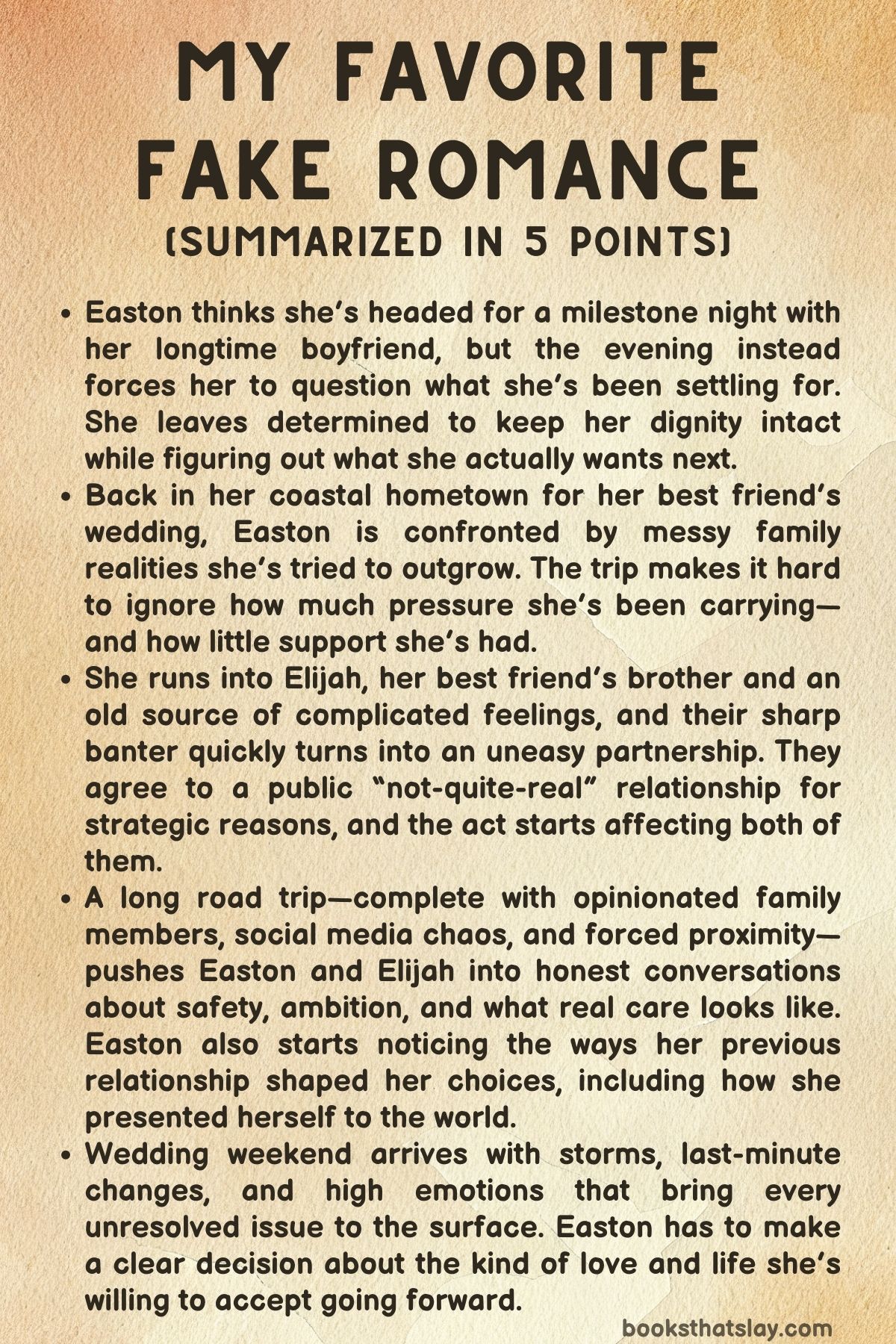
Summary
Easton goes to a Boston steakhouse convinced her boyfriend, Thomas Prescott, is about to propose on their two-year anniversary. He’s late, distracted, and strangely energized by a new obsession: Devon Hunt, a famous podcaster whose lifestyle preaching has gotten under Thomas’s skin.
Easton has never thought of their relationship as warm or dreamy, but she’s been counting on an engagement as confirmation that she has built a stable, impressive life far from where she grew up.
Thomas doesn’t propose. Instead, he announces he wants to break up so he can enjoy a few “selfish years” of travel and luxury experiences—ideas he repeats like he’s reading from Devon’s script.
He’s also skipping the upcoming wedding of Easton’s best friend, Kelsey, and canceling their planned trip. Easton refuses to give him the reaction he might use to justify himself.
She leaves with her head high, deciding that the smartest move is to make him regret his choice and come crawling back.
Kelsey calls right away, expecting engagement news. Easton admits the breakup, but insists it’s temporary and Thomas will change his mind.
Kelsey offers help and gently warns her that Elijah—Kelsey’s brother and Easton’s first major heartbreak—will be at the wedding and is currently single. Easton brushes it off, but the name lands like a bruise.
Easton flies to coastal Georgia and returns to the barrier island where she grew up. The home she shares with her father is worse than she remembered: dirty, moldy, piled with trash, and heavy with the feeling that nothing stays safe for long.
Her father is drunk early in the day and treats her like a nuisance. Easton cleans anyway, because cleaning is something she can control.
She notices a new roof and worries it means someone in her family did something dangerous to pay for it.
In town, Easton runs into Elijah outside the grocery store. He’s older, broader, still sharp around the edges, and still capable of making her feel thirteen emotions at once.
Their conversation is half sparring, half familiarity. Easton tries to present a version of herself that looks successful, untouchable, and well past him.
Elijah doesn’t apologize or fall apart the way she once fantasized he would. He just looks at her like he’s seeing too much.
Elijah quickly learns from Kelsey that Thomas dumped Easton, and he’s furious on her behalf. Easton, meanwhile, goes to Kelsey’s family home to help with wedding prep.
Kelsey’s mother, Judy, is warm and excited, and the contrast with Easton’s own house is painful. During the visit, Judy mentions a logistical problem: Elijah needs to drive to New Orleans for the wedding, detouring to Key West to pick up their elderly grandmother.
Judy wants someone with medical knowledge in the car in case things go sideways. The obvious choice is Easton, who has medical training, but both she and Elijah instantly predict disaster.
The next morning, Easton tries to reclaim an old comfort by swimming, only to stop herself because it would ruin an expensive hair treatment—one more way her life has been shaped by Thomas’s world and the scrutiny that comes with it. Elijah finds her on the beach, notices a bruise, and pushes her to explain.
Easton dodges the question. Elijah admits he wants her on the drive for his grandmother’s health, and Easton sees opportunity in the request: if she’s photographed on a trip with Elijah, it might reach Thomas and trigger jealousy.
She agrees, but only if Elijah plays along in pictures and they stop in West Palm Beach where Thomas’s social circle might see them.
That night, life at her father’s house turns ugly. Easton’s brother Kevin appears with unsettling energy, and her father, drunk and volatile, throws a remote that hits Easton in the face.
She covers the bruise with makeup and leaves the next day, but the message is clear: her “home” has never been a refuge. Elijah picks her up in a rental SUV, and they start the drive in their usual rhythm of insults, jokes, and friction.
Easton needles him about still living with his mother; he needles her about looking like someone else designed her. Underneath the banter is a shared memory of something that happened years ago—one night that Easton carried like a secret injury.
They stop in West Palm Beach for wedding events and a dinner with Melissa, a friend from Thomas’s world. Easton tries to make her “new guy” story seem casual, but she learns something worse than gossip: Thomas’s influence is so strong that even people who like her don’t want to be seen choosing her side.
Easton spirals, realizing the breakup could affect her lab, her funding, and her future. The plan to make Thomas jealous suddenly feels less like a game and more like survival.
They continue to Key West, where Elijah’s grandmother, Mrs. Cabot, is openly hostile to Easton, judging her background and assuming she’s after status and money. Mrs. Cabot’s friend Betty is the opposite—cheerfully invested in Easton’s revenge plan and eager to stir online chatter.
When Elijah sees Easton’s bruise again, she finally tells him the truth about her father. Elijah admits he confronted her father and made a threat to keep Easton safe.
Easton is furious at the interference and, in the same breath, admits that what Elijah did to her years ago hurt worse than a thrown remote.
Betty takes the jealousy campaign into her own hands, posting and commenting in ways designed to reach Thomas. It works: Thomas texts Easton, suddenly attentive and territorial.
Meanwhile, Elijah keeps noticing things Thomas never did—what Easton actually likes, what calms her, what makes her feel like herself. Elijah surprises her with a seaplane trip to Dry Tortugas, where Easton finally strips away the careful image she’s been maintaining.
She swims, snorkels, laughs, and feels light for the first time in ages. When the exhaustion returns, it’s clear how much strain she’s been carrying, and how much she’s been forcing herself into shapes that don’t fit.
The road trip continues with delays, side quests, and more staged “couple” moments orchestrated by Betty and Mrs. Cabot. Easton and Elijah end up separated from the older women for a night in a clean, modern townhome near white sand and a rare coastal dune lake.
Easton is thrilled by the landscape and drags Elijah outside, talking fast, alive in a way she hasn’t been around Thomas. When Elijah gets hurt unloading gear, Easton treats the wound, and the physical closeness sparks something neither of them can pretend is only for photos.
That night they talk more honestly: Easton admits how sterile her relationship with Thomas became, and Elijah hints that his past rejection of her wasn’t because he didn’t want her.
Then the tension snaps. After dancing and drinking at a crowded event, jealousy flares—especially when Easton mentions Kelsey once tried to set her up with someone else.
Elijah kisses Easton, and they end up together in a way that feels both inevitable and terrifying. Afterward, Easton panics, convinced she has reopened an old wound that never really closed.
She turns bitter and defensive, insisting it meant nothing, then breaks down alone.
They reach New Orleans for Kelsey’s wedding weekend just as a hurricane threatens plans, flights, and the outdoor setup. Kelsey stays focused on marrying Hawk, while everyone else rearranges schedules and panics.
Easton is stuck between Thomas—who now wants to “fix” things and even offers a rushed proposal—and Elijah, who shows care in quiet, specific ways, like leaving her a dress she once admired. At the bachelor/bachelorette crossover night, Elijah gets openly possessive when another man flirts with Easton, then apologizes for it later, revealing how much he’s already in this.
The storm shifts, and the wedding goes forward. Easton gives her maid of honor speech and tries to keep her head clear—until Thomas shows up at the reception in a tux, cornering her with pressure and jealousy.
Easton realizes the dynamic she accepted with him: control disguised as concern, judgment disguised as “standards,” and a version of love that requires her to keep shrinking. She refuses to leave with Thomas.
Later, Elijah pulls her aside, anger and desire tangled, and their private moment ends with Easton finally saying she loves him and begging him to choose her. Elijah refuses, claiming it can’t be more.
Easton walks away wrecked and decides she’s done chasing anyone’s approval.
Elijah almost immediately regrets it. His grandmother confronts him about treating Easton like a child and making choices for her.
Easton, meanwhile, realizes Thomas is about to propose and stops him before he can. She ends the relationship for good, admitting they never had what she sees in Kelsey and Hawk.
Alone and hurt, she injures her foot, and the collapse she’s been holding back finally arrives.
Elijah finds her and tells the truth about the past: years ago, he kept distance because Easton’s brothers pulled her into serious crimes and used leverage to control her, and he believed pushing her away was the only way to keep her from being dragged back home. Easton admits she changed her entire career path to escape that control.
Elijah finally recognizes that “protecting” her by deciding for her was still taking her choices away. This time, he asks instead of assuming.
Back at the mansion, they reunite openly. Kelsey reveals she’s pregnant, and major family plans shift: Hawk is relocating to New Orleans, and Judy intends to move too, meaning Elijah is no longer tied to the life he’s been stuck in.
Easton calls her father and draws a line about returning, and for the first time the future feels like something she can build on her terms. Elijah commits to being with her, even as Easton faces backlash in her academic world after the breakup.
Months later, during Mardi Gras season in New Orleans, Kelsey goes into labor mid-parade and has a baby girl. Elijah had planned a big proposal, but the timing falls apart.
Easton refuses to treat love like a performance with perfect lighting. When Elijah tells her he wants a life with her, she says yes immediately—choosing something real over something polished, and choosing each other over the story they’re “supposed” to have.
Characters
Easton
Easton is driven by a fierce need to prove she has escaped the gravity of her upbringing, and her relationship with Thomas becomes less about affection than about validation—an engagement as evidence that she has “made it” beyond a messy, precarious childhood. What makes her compelling is the way she performs control even when she’s unraveling: she choreographs calmness in the breakup, weaponizes composure to deny Thomas the satisfaction of seeing her hurt, and turns her pain into strategy by engineering a “fake romance” with Elijah.
Under that strategy, though, she is a person whose body keeps the score—exhaustion, stress, and shame flare up whenever she tries to outthink her feelings. Her arc is fundamentally about reclaiming desire and self-definition: she has spent years sanding herself down to fit a public-facing partner’s world, and the trip forces her to notice how much of her life has been optimized for other people’s approval.
By the end, her growth is not that she chooses a different man, but that she stops negotiating her worth through anyone’s gaze—Thomas’s audience, her hometown’s judgment, or even Elijah’s complicated protectiveness—and insists on a life where she can be fully seen without being managed.
Elijah Cabot
Elijah is built from contradictions that make him both infuriating and magnetic: he is protective to the point of control, emotionally perceptive yet prone to shutting doors at the exact moment vulnerability is required, and outwardly confident while carrying a private ledger of guilt and loss. His charisma shows up in the banter and bravado, but his true intimacy is quieter—he notices what Easton actually likes, remembers the shape of her joy, and pushes back against the version of herself she created to survive Thomas’s world.
The central tension in Elijah is that he equates love with shielding, and shielding with decision-making; his “I’m keeping you safe” instinct becomes a way to justify withholding honesty, commitment, and choice. His grief history adds weight to that tendency, because fear of catastrophe makes him cling to control as if it can prevent pain.
The story ultimately makes him earn his romance by evolving from protector to partner: he has to admit that care without consent is still a form of power, and that the only love Easton can live with is one that offers openness, accountability, and a shared future rather than a guarded perimeter.
Thomas Prescott
Thomas functions as a mirror for the kind of life Easton thought she wanted, and as an indictment of what happens when relationships become brand management. He isn’t a moustache-twirling villain so much as a man easily seduced by status, novelty, and external narratives about what a “best life” looks like, which makes him particularly dangerous to someone like Easton who already fears slipping back into her past.
His breakup speech is revealing because it reframes selfishness as self-actualization, borrowing wellness language to sanitize abandonment and to make Easton’s needs sound like limitations. Even when he returns, his gestures feel transactional—grand promises, sudden proposals, pressure to talk on his terms—suggesting he wants the comfort and optics of Easton more than the reality of her.
He represents a controlling dynamic disguised as stability: he sets the tempo, defines what is “reasonable,” and treats Easton’s identity as something to curate for public consumption. Easton’s final rejection of him is therefore a rejection of the entire structure he stands for: safety purchased with self-erasure.
Kelsey Cabot
Kelsey is the emotional anchor of the story and the character most at peace with choosing what she wants, even when circumstances are chaotic. Her wedding becomes more than a setting; it’s a pressure chamber that forces everyone else’s unresolved issues to the surface, and Kelsey’s steadiness highlights how restless and conditional the other relationships are.
She loves Easton with a practical, protective loyalty—offering help, creating a soft place to land, and also poking at hard truths (like warning her about Elijah’s presence) without shaming her. Kelsey’s energy can look like “party girl,” but underneath is clarity: she knows the difference between spectacle and substance, and she refuses to let storms, social expectations, or family theatrics distract her from the commitment she values.
Her pregnancy adds a second layer to her role as catalyst, because it quietly reshapes the Cabot family’s future and removes the geographic and emotional anchors that have kept Elijah stuck. In many ways, Kelsey is the story’s proof that a chosen life is possible—and that love can be both joyful and adult without becoming performative.
Hawk
Hawk is the stabilizing counterpart to the story’s more volatile romantic tension, and he serves as a benchmark for what partnership looks like when it is rooted in mutual respect rather than ego. He is not defined by dramatic speeches or grand maneuvers; his importance comes from consistency, from the way he and Kelsey prioritize one another even amid wedding chaos and an approaching hurricane.
Hawk’s gratitude toward Easton underscores that he sees people clearly and values sincerity, which contrasts with Thomas’s more utilitarian approach to relationships. He also helps broaden the meaning of “home” in the story: his relocation and willingness to build a life in New Orleans becomes one of the practical shifts that frees Elijah from old obligations.
Hawk is less a plot driver than a moral reference point, showing that real devotion can be calm, collaborative, and unglamorous in the best way.
Devon Hunt
Devon is less a fully embodied character and more an influence machine—an avatar of modern “wellness” culture and aspirational living that can sound enlightened while enabling avoidance. Through Devon’s orbit, Thomas discovers a vocabulary that reframes impulsive desire as personal growth and frames commitment as premature limitation.
Devon’s yacht trip and lifestyle fantasies don’t just tempt Thomas; they give him a story where he is the hero for leaving, rather than the person causing harm. Devon’s role also exposes a subtle theme: how easily personal relationships become collateral damage when people chase curated freedom.
In that sense, Devon is a catalyst for the breakup and a symbol of the world Easton tried to enter—a world where optics and access can matter more than integrity.
Judy Cabot
Judy offers warmth with an edge of realism, functioning as a bridge between Easton’s present self and the past she’s been trying to outrun. She welcomes Easton in a way that contrasts sharply with Easton’s own home environment, and that contrast highlights how profoundly nurture, money, and stability shape what people believe they deserve.
Judy’s “problem solving” instinct—organizing logistics, recruiting Easton for the road trip—can feel like gentle manipulation, but it comes from a place of protective pragmatism rather than control for its own sake. She represents the version of family power that can be benevolent: using resources to help, to host, to keep people safe.
At the same time, Judy’s choices demonstrate how the Cabots manage discomfort by managing situations, a trait Elijah inherits and must unlearn in his romantic life.
Mrs. Cabot
Elijah’s grandmother is openly antagonistic, and her bluntness acts like a stress test for Easton’s self-concept. She wields class judgment as a weapon—mocking Easton’s appearance, implying greed, and dragging her family history into public conversation—because control, for her, comes from gatekeeping who is “acceptable.” Yet she’s not merely cruel; she’s also perceptive, and her observations about Elijah’s feelings land because she understands him in a way that bypasses his defenses.
The grandmother embodies an older social order where status is moralized, and her hostility forces Elijah to choose: remain compliant to family hierarchy, or defend the person he cares about. When he pushes back, it marks an important shift—proof that his loyalty is moving from inherited obligation toward earned partnership.
Betty
Betty brings comedic momentum, but she also functions as a surprising agent of change because she externalizes what Easton is trying to do internally: she turns jealousy into theater, romance into a campaign, and social media into a tool. Her enthusiasm makes the fake relationship visible enough to work, but it also exposes how ridiculous the performance can be, which helps Easton start questioning why she needs it at all.
Betty’s friendliness contrasts with the grandmother’s contempt, creating a small but meaningful point: “older women” aren’t a monolith, and warmth can come from unexpected places. Beneath the humor, Betty’s presence keeps forcing public moments that Easton can’t fully control, nudging her toward the story’s larger theme that real love is not something you can stage-manage into existence.
Kevin
Kevin appears as a shadowy extension of Easton’s past—ominous, suggestive of the criminal entanglements that have shaped her life and choices. His presence is a reminder that Easton’s history isn’t just “poor and messy” but actively dangerous, with real consequences that have followed her into adulthood.
Kevin’s dynamic with Easton helps explain her reflex to minimize and hide, because exposure in her family system is not merely embarrassing; it can be weaponized. Even without constant page time, Kevin’s implied leverage and threat deepen the stakes behind Easton’s ambition and her terror of losing control of her trajectory.
Melissa
Melissa represents Easton’s professional-social ecosystem in Boston—the world where reputation, alliances, and access quietly dictate career outcomes. Her excitement about seeing Easton with Elijah shows how easily relationships become social currency, but her hesitation about openly “choosing sides” reveals the cold logic of academic power structures.
Melissa is not malicious; she’s cautious, and that caution is the point. She makes Easton confront the fact that Thomas isn’t just an ex-boyfriend, he’s a gatekeeper in her environment, and losing him could mean losing opportunities.
Through Melissa, the book illustrates how status pressure doesn’t only live on yachts and red carpets; it infiltrates labs, funding, and friendships, shaping what people feel safe enough to say out loud.
James
James functions as a quiet indicator of how far Thomas’s influence reaches. His absence—motivated by fear of appearing disloyal to Thomas—shows a social world where relationships are political and where distancing oneself from conflict is treated as self-preservation.
He adds realism to Easton’s anxiety: it’s not paranoia if people are actually calculating proximity to power. James isn’t deeply characterized, but his decision speaks volumes about the environment Easton is navigating and why she initially believes she must “win” the breakup rather than simply leave it.
Francesca
Francesca embodies the exhausting, performative side of wedding culture and the way group dynamics can center drama over care. Her determination to hook up with Elijah is less about Elijah as a person and more about conquest, attention, and the social game.
She also inadvertently disrupts a key moment between Easton and Elijah, which underscores how Easton’s emotional life keeps getting interrupted by other people’s messes—mirroring how, historically, Easton’s needs have been crowded out by chaos. Francesca’s role is therefore both comedic and thematic: she’s part of the noise Easton must learn to tune out if she wants to hear herself clearly.
Aiden
Aiden serves as a socially acceptable alternative and a lever for jealousy, but he’s also a brief glimpse of what dating could look like without all the history and volatility. His flirtation is straightforward, low-stakes, and public, which makes Elijah’s reaction more revealing than Aiden’s own behavior.
Aiden highlights Elijah’s possessiveness and forces the question of whether Elijah’s feelings are real enough to demand change, not just impulse. Even as a secondary figure, he’s useful because he exposes the difference between being wanted and being chosen with intention.
Bridget
Bridget, Hawk’s mother, represents the anxiety of control when control is impossible: she panics at the hurricane’s disruptions because the wedding’s logistics symbolize order, status, and success. Her stress contrasts with Kelsey’s calm focus on the marriage itself, illustrating the difference between valuing the event and valuing the commitment.
Bridget’s function is to amplify the story’s theme that spectacle is fragile, while love—when it’s real—can adapt. She is an example of how wealth does not eliminate fear; it simply changes what fear attaches to.
Sofia Leigh
Sofia Leigh appears as a symbol of Thomas’s glamorous, image-driven world and the kind of woman Easton suspects she can be replaced by in a heartbeat. The point is not Sofia as an individual but what her proximity triggers in Easton: insecurity, anger, and the realization that Thomas’s version of “freedom” often looks like chasing shinier reflections.
Sofia’s presence sharpens Easton’s disgust at being treated as interchangeable and accelerates Easton’s movement away from seeking validation through proximity to fame.
Paul
Paul functions as a humorous detour and a contrast point for desire across generations, but he also provides a setting where Easton’s joy becomes visible again—white sand, the coastal landscape, the thrill of discovery. The stop at Paul’s highlights how much Easton comes alive when her environment invites curiosity rather than performance.
Paul’s flirtatious ease with Betty and the grandmother underscores that attention can be playful rather than transactional, which quietly reinforces Easton’s growing belief that love and attraction don’t have to feel like negotiation. In plot terms he’s a side character; in emotional terms he helps create the conditions where Easton and Elijah’s tension finally breaks into honesty.
Themes
Identity, Image, and the Pressure to Perform
Easton’s choices are shaped by the constant demand to look like she “belongs” in a world that once felt out of reach. In My Favorite Fake Romance, her relationship with Thomas isn’t simply a private partnership; it becomes a public-facing credential, a way to prove she has escaped the limits of her upbringing and earned a place among people with influence.
That pressure shows up in small, telling decisions: she alters her appearance to suit the standards around Thomas, worries about how online strangers talk about her, and measures safety in terms of reputation as much as emotion. When Thomas ends the relationship, the loss isn’t only romantic.
It threatens the identity she has been building—disciplined, polished, academically “acceptable”—and exposes how dependent her sense of stability has become on someone else’s approval. Even her plan to stage a new relationship is driven by the need to control the narrative: she wants Thomas to doubt himself, but she also wants the wider social circle to see her as desired and secure.
The fake romance strategy is effective because it mirrors what she has already been doing—performing a role to remain protected.
Elijah functions as a sharp contrast because he remembers versions of her that existed before the performance became survival. Around him, Easton is repeatedly forced to confront what has been edited out of her life: the love of the ocean, the relief of movement, the comfort of being unobserved.
Moments like choosing not to swim because of hair treatments are not superficial; they show how far she has bent her body and habits to fit expectations. When she finally jumps into the water at Dry Tortugas, the release is physical and emotional at the same time—less about rebellion and more about recovering ownership of herself.
The theme becomes clearest as Easton starts to recognize that the version of her that “wins” in Thomas’s world is not the version that feels most alive. The conflict is not between two men as much as between two identities: one built for admiration and safety, and one built for honest desire, rest, and self-respect.
Power, Control, and the Quiet Bargains Inside Relationships
The story repeatedly shows how control can hide behind politeness, success, and even “self-improvement.” Thomas presents his breakup as a reasonable life choice, borrowing language from Devon’s lifestyle philosophy to make it sound mature rather than selfish. That framing matters because it pressures Easton to react “correctly.” She understands that visible emotion will be used against her, so she performs calmness to keep dignity and maintain leverage.
This sets the tone for how power operates in her life: not always through shouting, but through who gets to set the terms and who is forced to adapt. Thomas controls the direction of the relationship with last-minute decisions—skipping a wedding, canceling shared travel, choosing a yacht trip—while Easton is expected to accept it without disrupting the image of a functional couple.
Even when he comes back with apologies and an offer to propose, the gesture is less about repair and more about regaining ownership of the storyline. He tries to move Easton into private conversations, push her to leave events early, and reset the relationship on his timeline.
The proposal becomes another attempt to decide what she should want.
Control is also present in Easton’s family, but in a more obvious, brutal form. Her father’s violence and her brothers’ history of coercion show a home environment where autonomy is repeatedly taken from her.
The bruise from the thrown remote is not an isolated incident; it signals how quickly her body can become collateral when someone else is angry. That parallel is important: Thomas’s control is socially acceptable, while her family’s control is openly threatening, yet both teach Easton to manage men’s moods for safety.
The result is that she becomes skilled at minimizing her needs, anticipating consequences, and staying composed even when she is hurt.
Elijah complicates this theme because he is both protective and possessive. His anger toward Easton’s father and his jealousy around other men can look like care, but it can also resemble the same pattern of deciding what is best for her.
The story does not treat protection as automatically romantic; it asks whether protection respects the person’s agency. Elijah’s admission that he stayed away to keep her safe reveals the danger of love expressed through control.
He believed he was shielding her, but he also removed her ability to choose, repeating the very dynamic she has spent her life resisting. The turning point arrives when Easton refuses to be managed by anyone—Thomas, her family, or even Elijah.
Real intimacy becomes possible only when control is replaced by consent, honesty, and the willingness to let her make her own decisions, even if those decisions involve risk.
Class, Belonging, and the Fear of Sliding Backward
Easton carries a deep fear that her life is temporary, that one mistake could send her back into instability. That fear is tied to class as much as emotion.
Returning to a filthy, deteriorating house and a father who is drunk and hostile reminds her that “home” is not comforting; it is a place where she had to become tough, useful, and quiet to survive. The new roof triggers suspicion instead of relief because money in her world often comes with danger.
This is a sharp depiction of how poverty and crime distort basic signs of security. Something that should mean shelter becomes a warning signal.
Easton’s success in Boston is not portrayed as a clean escape; it is a fragile distance maintained through constant effort and strategic choices.
In Thomas’s circle, belonging is conditional. Easton’s anxiety at the rehearsal dinner—worrying that Thomas’s influence could affect her reputation, resources, and career—shows how professional environments can operate like social kingdoms.
Access is not just about talent; it is about being protected by the right people. Even friends hesitate to appear as if they have chosen a side, which reveals how power concentrates around status.
Easton has worked hard to gain credibility, but she also knows credibility can be taken away through whispers, social media narratives, and politics. That insecurity explains why the breakup feels like more than heartbreak.
It feels like a threat to her future.
The road trip settings constantly highlight class differences as a kind of background noise that Easton can’t stop hearing. She comments on lavish rentals and expensive choices not because she is greedy, but because wealth still feels unreal and suspicious to her.
She scans for the cost of everything because, in her upbringing, cost determined whether something was possible or dangerous. The Cabots’ renovated home, the wedding’s scale, and the casual travel plans of privileged people underline the gap between Easton’s internal life and the environment she now occupies.
Even when she is included, she worries she is being tolerated rather than truly accepted.
By the end, the theme shifts from “escaping” to “choosing.” Easton does not simply trade one class position for another; she redefines what stability means. She stops treating a proposal or an elite relationship as proof of worth and instead chooses a life where she is not constantly auditioning.
The move toward a shared future with Elijah also matters structurally: changes in family plans free him from being anchored to the island, which removes the old assumption that Easton must always be the one to leave and adapt. The story suggests that belonging should not require self-erasure.
It should feel like safety without humiliation, connection without calculation, and a future that isn’t held hostage by other people’s status.
Trauma, Survival Habits, and the Body Keeping Score
Easton’s reactions often make more sense when viewed as survival habits rather than personality quirks. She does not cry in the steakhouse because she has trained herself to stay composed when she is threatened.
She cleans her father’s house despite his cruelty because cleaning is a way to impose order where there is none, and because being useful has likely been her safest role in that household. Her exhaustion, the sudden need to sleep, and the way stress shows up physically suggest a nervous system that has been running on control for too long.
The narrative treats her body as honest even when she tries to be strategic. The more she pretends she is fine, the more her body signals that she is not.
The story also shows how trauma can distort desire and shame. Easton’s private sexual fantasy and immediate self-disgust are not framed as moral failure; they show how difficult it is for her to want something without fearing consequences.
Wanting Elijah is tied to old hurt—being rejected years ago after she thought she was loved—and that wound remains active. When they finally have a sexual encounter, she experiences pleasure followed by panic, anger, and grief.
Her harsh words afterward are a defense mechanism: if she labels it meaningless first, she protects herself from being abandoned again. This pattern is common for people who have learned that attachment can be dangerous.
Intimacy creates vulnerability, and vulnerability has historically cost her.
Elijah’s family history adds another layer. His grief over the plane crash and the guilt he carries show how trauma produces responsibility fantasies—believing you should have prevented the unpreventable.
His tendency to “handle” problems, including threatening Easton’s father, fits a person who has lived with loss and wants control to prevent it from happening again. When Easton learns why Elijah kept her at a distance, the theme becomes brutally clear: her past was not only emotionally painful, it was actively dangerous.
Blackmail, forced medical treatment of injuries, and fear of being trapped by her brothers explain why she redirected her career and why she has been cautious about love. Her ambition is not just aspiration; it is escape planning.
Healing in My Favorite Fake Romance is shown as messy and uneven. Easton does not become fearless overnight.
She still tries to use jealousy as a shield, still bargains with appearances, still doubts her own needs. But she begins to name what happened to her and refuse to carry it alone.
The shift happens when truths are spoken plainly, without excuses or image management. Her decision to cut ties with the idea of returning home, her willingness to reject Thomas even when he offers the status symbol she once craved, and her choice to accept love without demanding a perfect story all show trauma losing its power to dictate her future.
The theme lands on a hard-earned idea: survival skills are useful, but they are not the same as living, and real recovery starts when she no longer has to negotiate for basic safety in the places she calls home.
Love as Choice, Not Proof
Romance in this story is closely tied to the need for proof—proof of worth, proof of success, proof that pain in the past has been overcome. Easton initially treats engagement as evidence that her life is better than where she came from.
That makes Thomas’s breakup feel like humiliation, because it threatens the narrative she has been building. The jealousy plan continues that same logic.
If Thomas wants her back, then she is validated. If she can appear desirable to others, then she can’t be dismissed.
Love becomes a scoreboard, and Easton is trying to win.
What gradually changes is her understanding of what love should do to a person. With Thomas, affection arrives in controlled forms: gifts that feel burdensome, sex that is scheduled, a relationship shaped by public attention and career calculations.
It is not that Thomas never cares; it is that his care does not make Easton feel known. He is drawn to trends and “optimizing” life, but he does not organize his choices around who Easton is.
When he offers to propose after returning, the offer feels transactional, as if commitment is a tool to erase conflict. Easton’s resistance grows because she recognizes that being chosen by Thomas still requires her to shrink.
His version of love demands compliance and gratitude.
Elijah’s love is imperfect and sometimes harmful, but it is rooted in recognition. He knows what makes Easton feel like herself—movement, water, outdoor freedom—and he names it without being prompted.
He notices bruises, exhaustion, tension, and not just the polished image she presents. Even the “fake romance” becomes a mirror: the performance starts as strategy, but it accidentally exposes what real partnership could look like—shared jokes, care in small moments, physical comfort that isn’t staged for anyone else.
When Elijah refuses her after the wedding encounter, it devastates her because it repeats an old wound, yet it also becomes the moment she stops begging for love as proof. She decides she is done chasing approval, which is the most important emotional boundary she draws.
By the end, love becomes a decision made in honesty rather than a prize that confirms status. Easton rejects a proposal that once would have thrilled her because she recognizes it would lock her into a life where her needs are secondary.
She accepts Elijah not because the story is flawless, but because both of them finally stop pretending they can protect each other through distance, control, or performance. The closing choice—accepting commitment without waiting for the perfect public moment—reinforces the theme: what matters is not how the romance appears to others, but whether it allows both people to be fully themselves.