My First Mistake Summary, Characters and Themes
My First Mistake by Sadie Kincaid is a contemporary romance set between a small-town life and a high-powered career, built around a second-chance connection that never fully ended. Addison “Addie” Kinsella is practical, stubborn, and tired of settling for less, even when it feels safer.
Chase Hunter is successful, guarded, and carrying the weight of an old choice that damaged the one relationship he couldn’t replace. When a family wedding forces them into close quarters, old anger resurfaces, attraction returns, and both of them have to decide whether the past will keep defining them—or whether they’re finally ready to choose each other openly.
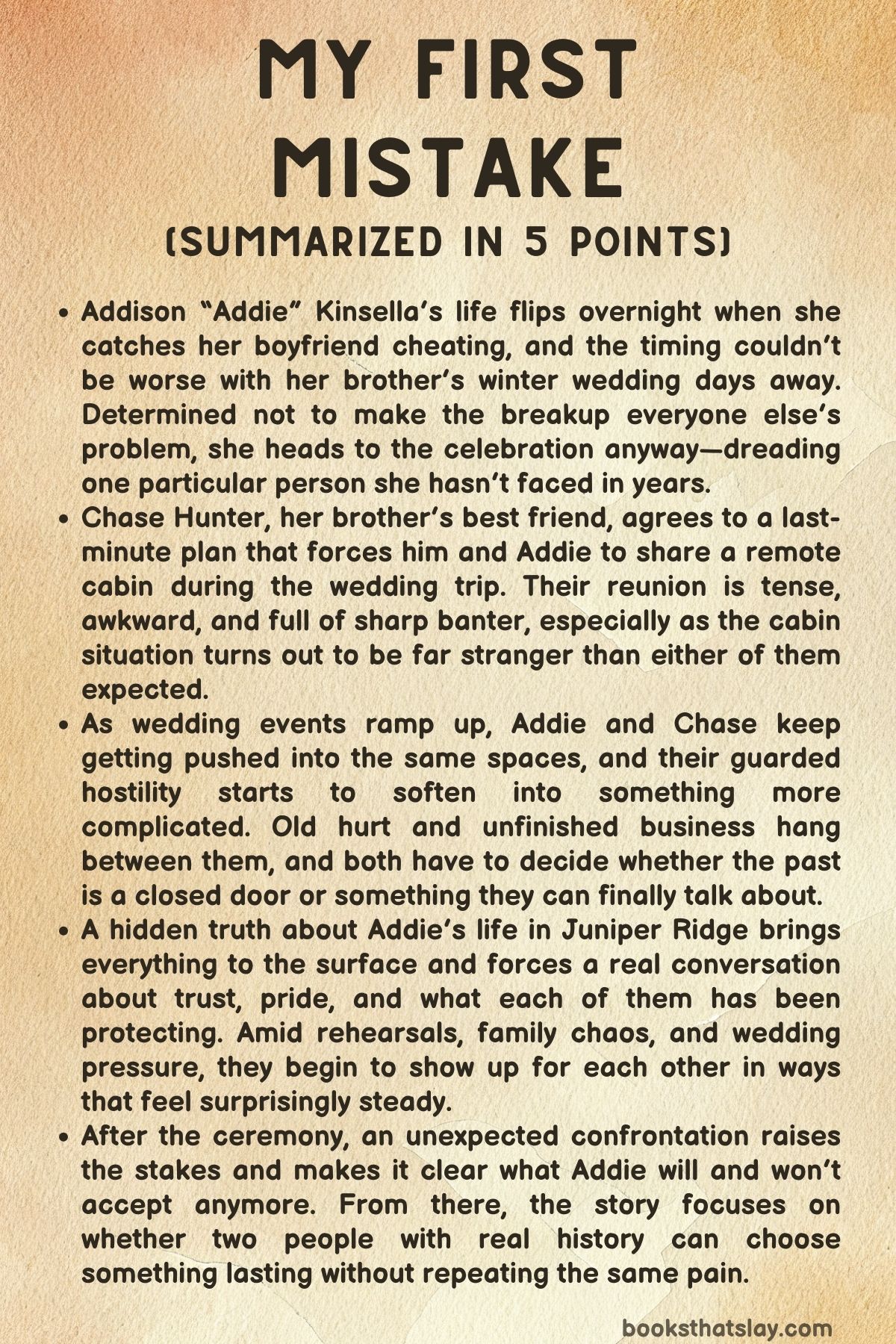
Summary
Addison “Addie” Kinsella’s week falls apart in a single moment: she comes home and finds her boyfriend, Jasper, cheating on her with a woman named Lacey—on Addie’s own couch. Jasper tries to soften it with patronizing pet names and excuses, acting like Addie should accept being replaced because the other woman “gets” him.
Addie is disgusted and furious, but her panic is just as sharp: her brother Braxton’s winter wedding is days away, and she’d kept her relationship going mainly so she wouldn’t have to attend alone. She throws Jasper and Lacey out, then discovers the humiliating final detail—Lacey has clogged the toilet by flushing a condom.
Shaken and angry, Addie immediately thinks of calling her best friend, Emma, because the wedding isn’t just a social event. It will also put her near Chase Hunter, Brax’s best friend and best man, the man Addie hasn’t spoken to in eight years.
Chase Hunter, now a successful architect and business owner, is preparing to travel to Vermont for the wedding when Brax calls him with a request that catches him completely off guard: Chase needs to share a cabin with Addie during the wedding trip. Brax is worried about his newly single sister being alone in a remote cabin with bad cell service, and there are no other places available because the wedding group has already paired off.
Chase tries to argue, but Brax insists it’s settled. Chase agrees, even though he knows Addie still blames him for something in their past, and he’s certain sharing a space will be volatile.
Back home in Juniper Ridge, Addie keeps herself busy at her flower shop, building arrangements and pretending she’s fine. Eva, Brax’s fiancée, watches her carefully—Eva recently found Addie in a bar crying into rosé, and she’s not fooled by Addie’s forced smiles.
Addie refuses to travel to Vermont with Brax and Eva and insists she’ll drive alone with the wedding flowers. Emma corners her afterward and names the real issue: Addie’s history with Chase.
Addie refuses to explain it to Eva because she doesn’t want to damage Brax’s friendship with Chase or cast a shadow over the wedding. Instead, she focuses on avoidance, choosing the cabin farthest from the lodge so she can keep distance.
In Vermont, Chase arrives and meets Brax’s family, then joins Brax and Eva at the lodge. When Chase asks if Addie knows about the cabin plan, Brax realizes he forgot to tell her, and the poor reception makes the attempt to warn her useless.
Chase considers backing out, but there’s nowhere else to stay, and the thought of Addie isolated in the woods sits badly with him.
Addie reaches the remote cabin late at night, lights already on, the air scented with cologne. She walks in and realizes someone is there.
Chase steps out wearing only a towel, and Addie erupts, demanding to know why he’s in her cabin. Chase explains Brax asked him to stay.
Addie storms through the cabin to prove her point—and discovers the second bedroom is not a normal room at all, but a full BDSM-themed setup with red walls, equipment, and a ceiling swing. Chase is visibly horrified.
Addie, despite being angry, can’t help enjoying how uncomfortable he looks. Chase refuses to sleep in that room and chooses the couch.
They head to the lodge bar together, arguing along the way. Chase criticizes Addie’s expensive stilettos as a terrible choice for a wooded path; Addie insists she can handle them.
At the bar, Brax apologizes for the surprise arrangement, and the family teases them, especially after news spreads that Chase was seen “half naked” at the cabin. Addie drinks bourbon to take the edge off the night.
On the walk back, she insists she’s fine, then trips and twists her ankle. Chase picks her up and carries her back, and for a moment the closeness feels dangerously familiar, until Addie pulls back and reminds herself why she’s angry.
The next morning is awkward and domestic in the worst way: Addie is aware Chase is just outside her room, and she tries not to make noise in a cabin with thin walls. She makes tea; Chase searches for coffee and finds none.
Their bickering shifts into reluctant laughter when Addie mentions a bizarre college story involving ginger tea and a BDSM punishment, leaving Chase stunned and then amused. They agree they need a supply run.
In Addie’s bright yellow car—named Angelina—they drive to a nearby superstore. Their teasing turns more playful, especially when Addie insists everyone should name their car, and she assigns a name to Chase’s Bentley just to annoy him.
At the store, Chase fills the cart with real food and supplies, while Addie grabs her version of “essentials,” including bourbon. At checkout, Chase tries to pay to contribute since Addie booked the cabin, but Addie refuses, framing him as an uninvited guest who doesn’t get to buy his way into comfort.
On the drive back, she blasts Christmas music, and the songs trigger memories neither of them can ignore.
Addie remembers the night eight years earlier when she and Chase first crossed a line. After a Christmas party, Chase’s friend Freddie had been drunk and obnoxious, and Addie left with Chase.
In a park, they talked about his grief for his mother, and Addie comforted him. He kissed her, and they ended up in her bedroom.
Addie admitted she was a virgin. Chase slowed down, careful and attentive, and made sure she wanted every step.
The next morning, he promised they would talk later and said he would see her that night. Addie believed him.
She felt chosen. Then he didn’t come back in the way she expected, and the silence and what followed turned that night into a wound.
Back in the present, the wedding events force them into the same orbit. During introductions, Addie’s father lets something slip about Chase making an “investment” in Addie’s flower shop.
When Addie pushes for details, the truth comes out: Chase owns her shop and several properties in town. He bought them to keep a corporate superstore from taking over, and the “landlord” Addie has dealt with for years is actually Chase’s project manager using another name.
Addie feels betrayed—not only by Chase, but by her parents for hiding it. She storms off, and Chase pulls her aside to explain.
Their argument shifts when Addie demands to know what he meant about ruining their friendship and anything else they could have been. The tension spikes into almost-kissing territory, until Addie’s mother interrupts and orders them to keep it together for the wedding.
That night, back at the cabin, the conversation turns raw. Addie presses Chase about what information he got through the landlord arrangement.
Chase needles her about Jasper and calls him insulting names, which makes Addie laugh despite herself. Then the mood turns serious.
Addie admits she wants marriage, children, and a stable life in Juniper Ridge, and she’s terrified she won’t find someone who wants the same. The next day, rehearsal events include a choreographed dance practice led by an intense instructor, and Chase’s flirting becomes physical and open.
Addie is furious, embarrassed, and unable to deny she likes the attention.
Finally, Addie demands the real reason he hurt her eight years ago. Chase admits he was grieving, drinking too much, and scared by how strongly he felt.
Addie reveals the moment that sealed her hatred: after she nearly forgave him when she saw him with his ex, she later overheard him talking to Freddie. She heard Chase say Addie meant nothing and that she was desperate, that he only did it out of pity.
Chase is shaken because he realizes she heard the worst lie he ever told—words he said to protect himself in front of his friend, not because they were true.
As the wedding approaches, Addie throws herself into decorating, determined to keep the focus on Brax and Eva. Chase supports her quietly: he arranges food deliveries, retrieves her dress, her heels, and her makeup so she can be ready, and watches her transform the hall into something magical.
Then he tells her plainly that what he said to Freddie was a lie, that their night together mattered, and that he’s sorry without trying to pressure her into forgiving him.
After the rehearsal dinner, the tension between them breaks into a kiss, but Addie panics about timing and old patterns. She insists Chase shouldn’t sleep on the couch anymore, and they agree to share the bed with boundaries.
In the dark, they talk honestly: Chase asks if she regrets him being her first. Addie admits she doesn’t regret the closeness, but she regrets how his actions afterward made her feel disposable.
She tells him she forgives him, and Chase is relieved and afraid at the same time, because forgiveness can sound like goodbye.
The wedding day is full of rituals—brunch, photos, vows, speeches. Chase gives a warm best-man speech that makes the room love him even more.
Addie is supposed to speak next and nearly falls apart from anxiety. Chase finds her, talks her through breathing, reminds her she’s loved, and steadies her until she can face the crowd.
During the wedding dance, Chase asks for one more song, choosing music tied to their past, and Addie admits she thought about him back then, too. The moment is private and intense, and it changes the way she looks at what happened between them.
Outside afterward, Jasper appears unexpectedly, dressed up and claiming he wants her back. Addie refuses, reminding him he cheated.
Jasper escalates, grabbing her wrist and insulting her when she won’t comply. Chase returns, punches Jasper, and warns him to apologize and stay away.
Jasper leaves humiliated. Addie is shaken and chooses to leave the party.
She and Chase return to the cabin together, and the fear, anger, and desire finally collide into a night where they stop pretending they don’t want each other.
In the morning, Addie tries to leave early, determined to treat it as closure. A heavy snowfall blocks the door, trapping them inside for days.
Addie and Chase argue, old hurt flashing back, but Chase refuses to let her pretend their feelings are nothing. Over the snowed-in days, they settle into closeness: interrupted work calls, teasing, meals, and repeated choices to be together.
When Brax and Eva finally arrive after the roads clear, they joke about what the couple has been doing and make sure Addie is safe. Brax warns Chase directly that he’ll destroy him if he ever cheats or breaks Addie’s heart.
Brax also reveals an old pact: years earlier, he made Chase promise he wouldn’t make a move on Addie unless he wanted something real. Once Brax and Eva leave, Addie confronts Chase, and Chase admits he never saw her as casual.
He wants a real relationship, not a repeat of the past. Addie agrees to one more night, and that night Chase tells her he loves her and that he has for a long time.
Addie admits she loves him too, but reality hits: Chase lives in Los Angeles, and Addie’s life is rooted in Juniper Ridge. Chase promises he’ll find a way.
They separate with plans for long-distance, but work swallows Chase as soon as he returns to LA. A major project and a building-code dispute consume him, and the daily calls he promised begin to slip.
Addie tries to be understanding, but after nearly two weeks, she’s left with shorter conversations, missed calls, and one lonely text saying he loves her. On Christmas Eve, she is trying to hold herself together when the door opens and Chase is there.
He tells her he didn’t come for a quick visit—he’s moving back to Juniper Ridge for good. He has reorganized his company so he can step back from constant crisis management, travel only when necessary, and build a real life with her.
Chase reveals more: he bought the house Addie always dreamed of, the old Cooper place, and he wants it to be theirs. He proposes a practical plan for work—using space above Addie’s shop as an office—while making his real request clear: he wants Addie to live with him and build a future together.
Addie is overwhelmed and stunned, especially when she realizes her family knew and kept watch over her while Chase was gone. The next day, Chase walks her through the house and speaks openly about marriage and children.
Addie feels her fear loosen, replaced by something steadier: trust.
Time jumps forward: Addie and Chase marry and travel together, openly happy and playful. Later, Addie is pregnant, and Chase surprises her with a return trip to the Vermont cabin.
There, she discovers he bought it and renovated it as a Christmas gift, including upgrades to the infamous second room that first shocked them. Chase reassures her that he doesn’t need anything else—because she is his wife, his home, and the life he chose when he finally stopped running.
Characters
Addison “Addie” Kinsella
Addie is the emotional center of My First Mistake. and the story’s most consistent tension: she wants stability and a “forever” kind of love, yet she’s spent years protecting herself from the very person who once made her feel most seen.
Her breakup with Jasper looks like a sharp inciting incident, but it mostly exposes what she has already been carrying—fear of being alone, dread of facing old wounds at her brother’s wedding, and a habit of holding things together “just long enough” so life doesn’t fall apart at an inconvenient time. Addie’s humor is not just charm; it’s armor.
She deflects with sarcasm, bourbon, and provocation (especially when she realizes she can make Chase flustered), but underneath that is a romantic who never stopped wanting the kind of love that chooses her publicly and consistently. Her independence is real—she runs a flower shop, drives herself, insists on paying her way—but it’s also complicated by the revelation that she’s been unknowingly sheltered by the people who love her, which forces her to confront how much control she truly has had over her own life.
The sex-dungeon cabin element also reveals an important trait: Addie is curious, mischievous, and more open-minded than her “small-town stability” dreams might suggest; she isn’t afraid of intensity, she’s afraid of emotional abandonment. Her arc is less about becoming “braver” and more about allowing herself to trust evidence over old echoes—learning to believe the man in front of her rather than the boy who once disappeared and the cruel sentence she overheard.
Chase Hunter
Chase is written as the classic controlled, high-achieving figure whose biggest flaw is not a lack of feeling but an inability to metabolize it in real time. His success as an architect and business owner contrasts with his earlier emotional immaturity: when he was younger, grief and fear made him run, and he chose distance and denial over vulnerability.
The story repeatedly shows that Chase experiences love as something weighty and frightening—something that can rearrange his life—so his instinct is to manage it like a project, buying properties to protect Juniper Ridge, quietly safeguarding Addie’s shop, arranging logistics, fixing problems behind the scenes. That caretaking is sincere, but it also becomes a form of control, which is why the “landlord” deception lands as a moral and emotional breach; he is helping her, yet also watching her life from a hidden position.
Chase’s growth is not simply apologizing; it is learning to be present through discomfort: staying in the cabin even when it’s awkward, facing the truth of what he said to Freddie, taking responsibility without demanding forgiveness, and later confronting the realities of long-distance rather than letting work swallow the relationship by default. His romance is intensified by protectiveness—his response to Jasper turning physical, his constant “are you okay” vigilance—but the more meaningful shift is that he eventually stops proving love through secret scaffolding and starts proving it through open commitment: returning, reorganizing his career, and choosing a life that includes Addie as a daily priority rather than a cherished exception.
Braxton “Brax” Kinsella
Brax functions as both catalyst and conscience. On the surface he’s the affectionate brother orchestrating wedding logistics, but his deeper role is that he refuses to let the two people he loves most keep hiding from each other.
His decision to put Chase and Addie in the same cabin isn’t simply meddling for comedy; it’s protective and strategic, rooted in his belief that isolation plus heartbreak is dangerous for Addie and that Chase has unfinished business with her that he will never resolve from a safe distance. Brax’s loyalty is fierce and evenly split: he wants to keep Addie safe and Chase honest, which is why the old pact matters—Brax quietly drew a line years ago that forced Chase to treat Addie as a real possibility or not at all.
He also embodies “small-town family accountability,” the idea that love doesn’t happen in a vacuum; if you hurt someone, the community remembers. Even his joking threat to bury Chase if he breaks Addie’s heart is a serious statement of values: commitment is not just emotional, it’s ethical.
Eva
Eva is more than the bride-to-be; she is a social stabilizer. She watches Addie closely with the calm attentiveness of someone who already considers her family, and her repeated check-ins reveal both emotional intelligence and quiet authority.
Eva’s role is important because she doesn’t treat Addie’s pain as gossip or inconvenience; she treats it as real, even when Addie tries to minimize it. She also acts as a subtle romantic mirror—she openly admits she always pictured Addie and Chase together, which nudges the story from private tension into acknowledged possibility.
Unlike characters who force confession, Eva creates space where truth can exist without punishment, and her delight later on reads less like nosiness and more like relief that the people she cares about are finally choosing happiness.
Emma
Emma is Addie’s truth-teller and pressure valve. She plays the vital friend role of saying what Addie won’t: that the real reason the wedding feels threatening is not the breakup, it’s Chase.
Emma’s value in the narrative is that she respects Addie’s agency while challenging her avoidance; she doesn’t expose Addie’s history to Eva or Brax, but she also doesn’t let Addie pretend the past isn’t shaping her present. Emma’s presence highlights an important aspect of Addie’s character: Addie can be honest, but she chooses secrecy when honesty might cause conflict for other people, even at her own expense.
Emma essentially stands for “your feelings are allowed to matter,” and she keeps Addie from turning self-protection into self-erasure.
Jasper
Jasper is the story’s clearest example of performative affection and entitlement. His cheating is not treated as a momentary lapse; it’s framed through how he behaves afterward—using pet names, fake sympathy, and the insistence that another woman “gets” him, as if Addie’s role was to validate him rather than be loved properly.
Later, his reappearance at the wedding underscores a pattern: he expects access to Addie even after betrayal, and when charm fails, he escalates into control, grabbing her wrist and insulting her. Jasper exists partly to make Chase’s protective instincts visible, but more importantly he clarifies Addie’s growth: she no longer negotiates her worth with someone determined to diminish it.
He is less a rival and more a contrast that defines what Addie will not accept anymore.
Lacey
Lacey is a brief but purposeful figure. She is not developed as a full antagonist so much as a symbol of the disrespect Addie has tolerated for too long.
The detail of her clogging the toilet by flushing a condom is crude on purpose; it externalizes the mess Jasper brought into Addie’s home and life, and it turns betrayal into something physically invasive and humiliating. Lacey’s narrative function is to sever the last thread of Addie’s “limping along” relationship and force Addie into the emotional arena she’s been postponing—facing the wedding, facing Chase, and facing what she actually wants.
Keeley
Keeley, Chase’s assistant, exists to reveal the “professional Chase”. Her banter and logistics-handling show that Chase is competent, respected, and busy, which becomes crucial later when his work threatens the relationship.
Keeley also serves as an early signal that Chase’s life is structured and high-demand, making his eventual choice to reorganize his company feel like a meaningful sacrifice rather than a convenient plot move. She helps frame the central conflict not as a lack of love, but as a battle over priorities and presence.
Freddie
Freddie is a small-role character with outsized impact. He functions as the accidental weapon in the story’s core wound: the cruel remark Addie overhears, the one that crystallizes her heartbreak into lasting anger.
Freddie also represents the social environment that pressures young men into posturing, especially when they are frightened by real intimacy. Importantly, Freddie isn’t portrayed as the primary villain; he’s the context in which Chase made his worst choice—turning tenderness into a joke to protect himself.
Freddie’s presence makes the hurt believable because it shows how one moment of cowardice, spoken aloud, can rewrite someone else’s entire memory of love.
Maggie Kinsella
Maggie represents familial perception and emotional continuity. She interrupts Addie and Chase when their conflict risks spilling into wedding chaos, which shows her priorities—protect the couple getting married, protect family harmony—but she also understands more than she says.
Later, her gentle conversation with Addie about Christmas reveals that she notices long emotional arcs, not just immediate crises; she clocked when Addie stopped enjoying things and she names it softly, without accusation. Maggie also becomes part of the “protective secrecy” around Chase’s plans, which complicates her: she loves Addie enough to support a grand romantic gesture, but she also participates in withholding information, contributing to the theme that even loving protection can cross into undermining autonomy.
Jack Kinsella
Jack is positioned as a well-meaning but impulsive catalyst. His accidental mention that Chase made an “investment” in Addie’s shop cracks open the hidden truth, forcing confrontation that otherwise might have stayed buried longer.
Jack’s quick retreat after blurting it out suggests he is uncomfortable with conflict and possibly aware he shouldn’t have been part of keeping that secret. Like Maggie, Jack embodies the complicated ethics of family involvement: he wants the best for his daughter, but his choices show how parents can blur lines when they believe they’re protecting their child’s future.
Samuel Brown
Samuel Brown, the dance instructor, provides comedic friction and a controlled setting where Addie and Chase’s chemistry becomes visible to everyone, including themselves. His intensity and scolding act like a spotlight—forcing them to perform coordination, touch, and trust while trying to pretend they are unaffected.
In a story full of private conversations and closed-door intimacy, Samuel creates a public arena where attraction can’t be hidden behind sarcasm or silence, and his presence turns their tension into something kinetic and undeniable.
Themes
Betrayal as a Catalyst for Self-Respect and Change
Addison’s relationship with Jasper ends in the most humiliating way possible, but the story doesn’t treat that betrayal as only a dramatic opening—it treats it as the moment Addison finally stops negotiating her own worth. What makes the cheating scene hit harder is how Jasper tries to wrap cruelty in fake tenderness, using childish nicknames and pretending he’s “softening” the blow, as if Addison should be grateful he’s even explaining himself.
That detail matters because it shows how betrayal isn’t always loud and violent; sometimes it arrives wearing a smile and a tone that assumes the victim will accept disrespect as normal. Addison’s immediate disgust is real, but her panic about the wedding reveals something even more important: she had been staying in a dead relationship partly out of fear of being alone, and partly out of wanting to avoid judgment.
The betrayal forces her to face the truth she was avoiding—she had already been living alone emotionally, she just hadn’t admitted it.
As the story moves forward, Jasper becomes more than “the ex.” He represents the kind of relationship Addison is no longer willing to tolerate: shallow charm, entitlement, and a belief that women exist as emotional support systems. His later reappearance at the wedding reinforces this theme in a sharper way.
He doesn’t show up because he loves her; he shows up because he’s losing control of the situation. His attempt to reclaim Addison isn’t romantic—it’s possessive.
When he grabs her wrist and insults her, it exposes what was always underneath his “nice guy” performance.
Addison’s refusal to take him back is not framed as a grand speech but as a clear boundary. That’s what makes it powerful.
She doesn’t need to prove she’s strong; she simply acts like her feelings matter. In My First Mistake, betrayal becomes the pressure that breaks the old version of Addison—someone who stayed quiet to keep things easy—and creates someone who chooses herself even when it’s uncomfortable, messy, or lonely.
Unresolved Pain and the Long Shadow of Miscommunication
The tension between Addison and Chase isn’t based on a small misunderstanding—it’s based on a wound that never got closure. The story shows how a single night can become emotionally life-defining when it happens at the wrong time in someone’s life, especially when it involves first experiences, vulnerability, and hope.
Addison’s memory of her first time with Chase is written with emotional clarity: she felt safe, chosen, and deeply connected. The tragedy is that she didn’t just lose Chase afterward—she lost the meaning of that night.
When he left the next morning with vague promises and then disappeared, the abandonment rewrote her understanding of herself. It wasn’t simply heartbreak; it became humiliation.
The theme deepens when Addison reveals what she overheard: Chase telling Freddie she meant nothing and that he “threw her a bone.” That line is brutal not only because it’s cruel, but because it turns intimacy into charity. It suggests she was desperate, and he was generous enough to tolerate her.
That kind of insult doesn’t fade with time; it settles into a person’s identity. Addison carries it for eight years, and it shapes how she interprets everything—Chase’s motives, his kindness, even his presence in her life.
Chase’s side of the theme is equally important. He didn’t just hurt Addison because he was careless; he hurt her because he was emotionally afraid.
He was grieving, drinking, and overwhelmed by how strongly he felt. The story refuses to excuse him, but it does explain him.
And that’s key: the damage wasn’t caused by a lack of emotion, but by an inability to handle emotion responsibly.
When the truth finally comes out—that Chase lied to Freddie because he was trying to look unaffected—it reveals the ugliest part of male pride: the need to appear unbothered even if it destroys someone else. My First Mistake treats miscommunication not as a cute romance trope but as something that can shape years of loneliness.
It shows how silence becomes its own kind of betrayal, and how healing requires more than attraction—it requires naming the wound directly, without trying to make it smaller.
Love Versus Ambition and the Cost of a Life Built Around Work
Chase is not portrayed as a villain when he returns to Los Angeles and gets consumed by work. That’s what makes this theme feel real.
His workload, the legal dispute, the constant meetings, and the pressure of running a firm aren’t presented as excuses—they’re presented as the reality of the life he built. And that life has consequences.
Chase genuinely loves Addison, but love doesn’t automatically create time, attention, or emotional availability.
The long-distance stretch is painful because it’s not fueled by cruelty. It’s fueled by neglect.
The calls become shorter, then delayed, then missed. Addison isn’t dramatic about it; she quietly watches the pattern form.
That quietness is the heartbreak. She wants to believe him, and she does believe he loves her, but she also begins to accept that love can still fail if it’s not supported by behavior.
This is one of the most emotionally grounded parts of the story. Addison’s fear isn’t that Chase is cheating.
Her fear is that she’s once again going to be left behind while Chase moves forward with his life.
Chase’s internal conflict shows the other side: he realizes he cannot even protect the one daily promise he made to her. The theme here isn’t “work is bad.” It’s that ambition becomes destructive when it replaces human connection.
Chase built his identity around being needed, fixing problems, being the guy who handles everything. That identity looks impressive from the outside, but it leaves no room for intimacy.
What makes his final choice meaningful is that he doesn’t just visit Addison. He restructures his life.
He promotes managers, steps back from constant crisis mode, and chooses a version of success that allows him to actually live. This is not a small romantic gesture.
It’s a fundamental shift in values. He chooses design, community, and partnership over nonstop control.
In My First Mistake, love is not presented as something that magically fits into a busy life. The story argues that if someone truly wants love, they have to build a life that has space for it.
Chase doesn’t win Addison by saying “I love you.” He wins her by making decisions that prove love is not an accessory to his career—it’s the center of his future.
Desire, Sexual Confidence, and Reclaiming Pleasure Without Shame
Sexuality in My First Mistake isn’t treated as a side detail or a quick source of spice. It’s tied directly to Addison’s identity, confidence, and emotional healing.
Addison’s first sexual experience with Chase is tender, careful, and deeply meaningful to her, which is why the aftermath damages her so badly. When a person’s first intimacy is emotionally safe and then later emotionally invalidated, it can create a long-lasting conflict: desire becomes connected to shame.
The story shows Addison reclaiming that space over time. Her humor about the cabin’s dungeon, her bold comments, and her teasing language aren’t just comedy—they are signals of ownership.
She is no longer the nervous girl hoping to be wanted. She is a woman who knows what she likes, knows how to speak about it, and refuses to be embarrassed.
That confidence becomes a form of emotional power, especially because Chase is both fascinated and thrown off by it.
Chase’s sexual dynamic with Addison is also connected to respect. He teases her, flirts aggressively, and clearly desires her, but he repeatedly checks in emotionally.
Even when things become intense, the story keeps returning to the idea that Addison must feel safe. That is important because her history with him is not just romantic—it’s traumatic in its own way.
The story makes it clear that passion without emotional security would repeat the original harm.
The “snowed in” section turns intimacy into something domestic as well as physical. It’s not only about sex; it’s about choosing each other in the morning, choosing each other after work calls, choosing each other when the outside world returns.
This builds a theme where pleasure is not separate from love. It becomes part of how they communicate, how they heal, and how they rebuild trust.
Even the final cabin renovation and the gift of the upgraded space carries symbolic weight. It’s not just an erotic surprise.
It’s Chase telling Addison, without embarrassment, that her desires matter, that her pleasure is worth investing in, and that the parts of her she once might have hidden are now celebrated in their marriage. The theme is ultimately about freedom: freedom to want, freedom to enjoy, and freedom to be fully loved without being reduced to “too much.”
Home, Belonging, and Choosing a Shared Future
A major emotional backbone of the story is Addison’s attachment to Juniper Ridge. Her life isn’t glamorous, but it’s hers: the flower shop, the familiar routines, her parents, her brother, and the small-town stability she craves.
Addison’s dream isn’t just romance—it’s a life that feels secure. She wants marriage, kids, and roots.
This desire is not portrayed as boring or small. It’s portrayed as brave, especially in a world where people often dismiss that kind of dream as naive.
Chase, on the other hand, has built a life that looks successful from the outside: Los Angeles, wealth, a thriving firm, high-status projects. But the story gradually reveals that his life is emotionally empty without Addison.
His wealth is not framed as the solution; it’s framed as a tool he used to cope with loneliness. He buys properties, builds businesses, solves problems, and keeps moving.
The more he achieves, the more obvious it becomes that none of it replaces connection.
The theme of home becomes powerful when Chase returns on Christmas Eve. He doesn’t arrive with excuses.
He arrives with a decision. He is not asking Addison to fit into his life.
He is fitting into hers. That reversal is the heart of the theme.
Addison doesn’t have to abandon her dream for his. He chooses to build his future where she already belongs.
The purchase of the Cooper place is especially symbolic. It’s not just a romantic house.
It represents the childhood dream Addison carried, the version of life she quietly hoped for, and the belief that she might never actually get it. Chase buying it is not only about money—it’s about him saying, “I see your dream, and I want it too.”
By the epilogue, marriage, pregnancy, and returning to the cabin complete the theme: home is not a town, a building, or a career. Home is the place where a person is chosen consistently.
In My First Mistake, belonging is created not by grand romance alone, but by daily commitment, shared values, and the decision to stop running from the life that actually matters.