My Roommate From Hell Summary, Characters and Themes
My Roommate From Hell by Cale Dietrich is a sharp, funny, and imaginative story that mixes the chaos of college life with the supernatural. It follows Owen Greene, a first-year student at Point University, who expects a typical freshman experience—until he learns his roommate is Zarmenus Bloodletter, the demon prince of Hell.
What begins as an uneasy coexistence soon turns into a surprising bond built on trust, attraction, and shared growth. Dietrich blends humor, romance, and social commentary into a tale about identity, acceptance, and the courage to bridge worlds—both literal and emotional.
Summary
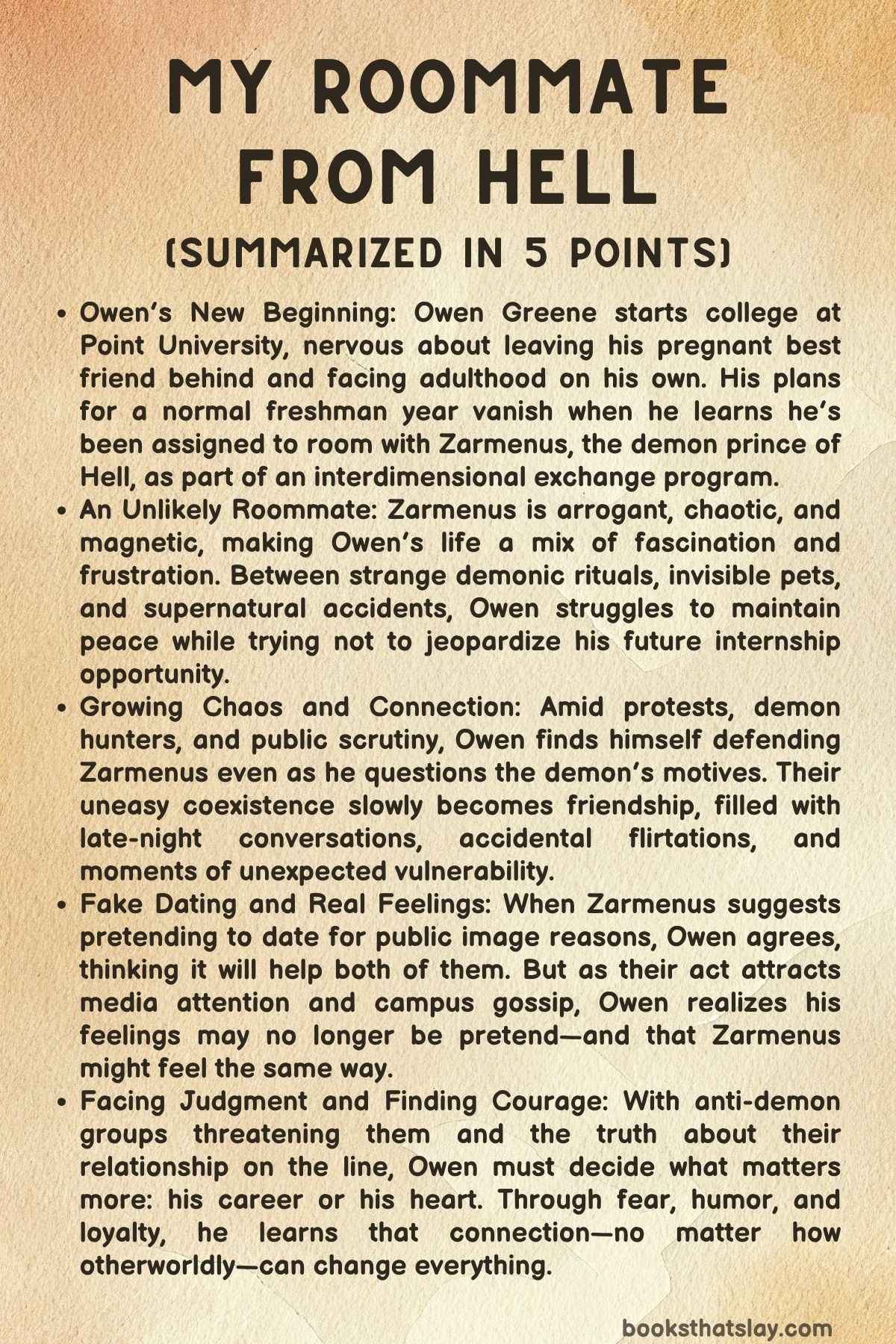
Owen Greene arrives at Point University ready for a fresh start but nervous about leaving behind his best friend, Ashley, who stayed home after an unexpected pregnancy. His anxiety only deepens when he discovers protesters outside his dorm holding signs that read “NO SATAN IN SCHOOLS.” The uproar is over a groundbreaking exchange program between Earth and Hell.
While a human student studies in Hell, a demon—specifically the demon prince, Zarmenus Bloodletter—will attend Point. Owen thinks this has nothing to do with him until he opens his dorm room door and finds Zarmenus himself sitting inside.
Zarmenus’s parents, the flamboyant king and queen of Hell, appear briefly through a fiery portal to drop off their son and insult Owen’s mother before vanishing. The awkwardness leaves Owen stunned but fascinated.
Despite his mother’s suggestion to switch dorms, he decides to stay. He senses that Zarmenus, arrogant though he may be, isn’t actually dangerous.
His curiosity wins out.
Over the following days, Owen adjusts to campus life while trying to ignore the supernatural weirdness around his new roommate. Zarmenus listens to loud music, leaves messes everywhere, and performs bizarre rituals involving candles and Ouija boards.
When Owen experiences strange allergic reactions and haunting visions, he realizes living with a demon comes with real risks. Still, he’s drawn to Zarmenus’s charm, wit, and confidence.
A turning point comes when they face anti-demon protesters together. When someone throws an egg at Owen, Zarmenus’s protective instincts trigger a terrifying but controlled display of his powers—his shadow expands into monstrous wings and horns, scattering the crowd.
For the first time, Owen sees beyond the prince’s arrogance and glimpses a deeper complexity.
Later, Dean Leeke calls them in for a meeting, emphasizing that the success of this exchange depends on their cooperation. She privately tells Owen that if he helps maintain peace and keeps Zarmenus out of trouble, she’ll recommend him for a prestigious internship at Google.
The offer motivates Owen to endure Zarmenus’s chaos and try to make things work.
Living together remains a challenge. Zarmenus is loud, messy, and unapologetically flirtatious, often bringing hookups back to their shared room.
Owen, shy and reserved, feels embarrassed but reluctant to complain. He tries to make friends and finds comfort in the “Gaymers” club, where he meets Tyrell, a friendly student journalist who seems genuinely interested in him.
But when Tyrell reveals he runs a viral TikTok account about campus life, Owen begins to question his motives.
Meanwhile, Zarmenus’s supernatural presence attracts unwanted attention—paparazzi, curious students, and even a demon hunter who attacks him during a campus fair. Zarmenus deflects the assault effortlessly, but Owen starts to grasp how dangerous the divide between humans and demons truly is.
Still, he and Zarmenus slowly grow closer, their conversations deepening beyond surface-level banter.
Their relationship takes an unexpected turn when Zarmenus proposes faking a romantic relationship to improve his public image and ease tensions between realms. Reluctantly, Owen agrees.
Their staged relationship soon captures campus attention, making them minor celebrities. But pretending to be boyfriends begins to blur the line between performance and reality.
Owen enjoys Zarmenus’s attention more than he should, while Zarmenus’s teasing turns into genuine affection.
Their “relationship” becomes the talk of Point University. They attend public dates—like bowling, where Owen defends Zarmenus from a hateful heckler—and share staged selfies online.
Behind the act, they start trusting each other deeply. Zarmenus admits that his destiny as the prophesied unifier of demons and humans weighs heavily on him, while Owen confides about his family’s failed coffee shop and the pressure he feels to succeed.
Their connection grows quietly sincere, even if neither dares to name it love.
Dean Leeke, seeing the PR success of their partnership, pushes Owen harder to maintain appearances. She arranges a meeting with a Google representative, reminding him that his opportunity depends on keeping up the relationship’s illusion.
The pressure strains his conscience, especially as his feelings for Zarmenus become real. At the same time, Tyrell publishes glowing pieces about Zarmenus’s “humanitarian” acts, secretly encouraged by Leeke.
Owen begins to feel used by everyone around him.
The tension culminates at a lavish mansion party hosted by a wealthy student, Adam. There, Owen faces rumors about Zarmenus’s many past flings and doubts the authenticity of what they share.
A private conversation between them ends in vulnerability: Zarmenus helps Owen dry his soaked shirt using gentle flame magic, and the unspoken intimacy between them becomes undeniable. Still, both hide behind the façade of their arrangement.
As the semester nears its end, their fake relationship is supposed to conclude publicly at the Heaven and Hell dance. Owen rehearses their breakup with Zarmenus, pretending to end things amicably for “distance reasons.” But the act feels too real, and the emotions they’ve suppressed bubble to the surface.
The night before the dance, at a Gaymers party, a drunken Zarmenus confesses he truly likes Owen. Unsure if he means it, Owen admits he feels the same, only to realize Tyrell overheard.
Tyrell, surprisingly, doesn’t expose them. Instead, he writes a compassionate article about friendship and honesty, keeping their secret intact.
Encouraged by both Tyrell and Ashley, Owen resolves to confess his feelings for real. But when he tries to meet Zarmenus before the dance, he finds him outside a veterinary clinic—his pet familiar, Bell, is gravely ill.
Owen stays by his side until Bell recovers, realizing her illness reflected Zarmenus’s inner turmoil. There, under dim streetlights, Owen finally admits he loves him.
Zarmenus confesses he’s felt the same all along, and they kiss—no longer pretending.
In the epilogue, their relationship continues openly. Zarmenus has negotiated with his parents to remain on Earth as Hell’s ambassador, while Owen secures the internship he once only dreamed of.
Ashley and her boyfriend welcome their baby, and Owen and Zarmenus visit as proud friends. Later, they prepare to visit Hell together through a research facility’s portal, Owen’s hand clasped firmly in Zarmenus’s as they step into the fiery unknown.
What began as a chaotic dorm assignment ends as a love story that bridges two worlds—one human, one infernal—and proves that connection can exist even between heaven and hell.
Characters
Owen Greene
Owen is the story’s emotional anchor: a cautious, conscientious freshman who arrives at Point University already carrying guilt about leaving home and fear about what distance will do to his closest friendship with Ashley. He begins the semester as someone who tries to manage uncertainty by clinging to familiar routines—checking his phone, rehearsing what might go wrong, and seeking “safe” choices—yet he’s immediately forced into the least safe situation imaginable: rooming with the demon prince.
What makes Owen compelling is that his bravery is never loud; it’s incremental and often reluctant. He stays in the dorm partly out of curiosity and partly because Dean Leeke turns him into a public symbol of coexistence, but the longer he lives with Zarmenus, the more his choices become genuinely values-driven rather than reward-driven.
Owen’s arc is about learning to advocate for himself (setting boundaries, confronting problems, admitting what he wants) and also about learning that goodness is not the same as passivity. By the end, he’s still recognizably himself—tender, anxious, thoughtful—but he’s also bolder, more honest, and willing to risk embarrassment, backlash, and uncertainty for a relationship and a future he actively chooses.
Zarmenus Bloodletter
Zarmenus is introduced as arrogance in human form—bored, effortlessly powerful, and used to being treated as an exceptional creature whose inconveniences are someone else’s problem. His early behavior reads like a perfect storm of privilege and alien norms: loud gaming, constant mess, casual hookups, and an almost playful disregard for human discomfort.
But the more time passes, the clearer it becomes that his arrogance is partly armor. He is under pressure from his parents, his public image, and a prophecy tied to his birth under a red moon, and he arrives on Earth already trained to perform “acceptable” demonhood while privately resisting being reduced to a political symbol.
Zarmenus’s power—shadow manipulation, flame control, possession, and the protective utility of his ruby pendant—works as spectacle, but it also mirrors his inner world: volatile, heavily contained, and always one bad day away from drawing attention he doesn’t want. His relationship with Owen reshapes him from someone who treats people as temporary entertainment into someone who wants to be chosen sincerely.
He learns empathy not through moral lectures but through the shock of being defended, disliked, feared, and still loved. By the epilogue, his growth culminates in his most human act: he stands up to his parents, not by destroying anyone, but by insisting he deserves agency and real connection.
Maleilius
Maleilius, the king of Hell, functions as both political force and theatrical parent: charming in a predatory, showman way, delighted by discomfort, and constantly testing social boundaries. His entrance into Owen’s dorm move-in is a deliberate display of dominance—he treats the exchange program like a stage, the human world like a novelty, and Owen like a prop he can push around while smiling.
Yet his behavior also reveals the logic of power he represents: reputation management, optics, and control over Zarmenus’s narrative. Maleilius’s involvement hints that the exchange is not simply academic—it’s diplomatic, strategic, and branded—and his ability to portal in and out reinforces that the demons operate with resources and confidence humans can’t match.
Even when he appears briefly, he casts a long shadow: he’s the reason paparazzi hover, the reason Zarmenus feels managed, and the kind of parent Zarmenus must eventually oppose to choose a life that’s actually his.
Lysteria
Lysteria, the queen of Hell, is sharp-tongued, amused by human outrage, and casually cruel in a way that reads less like villainy and more like cultural superiority. She treats the protesters as background noise and jokes about curses with the ease of someone who has never faced real consequences for intimidation.
What’s notable about Lysteria is that she embodies a different flavor of power than Maleilius: less performative seduction, more disdainful humor and effortless menace. Her presence helps establish that Owen is not just dealing with one extraordinary roommate—he’s been placed adjacent to an entire ruling family with values, instincts, and amusements that clash with human norms.
Even off-page, she represents the family pressure Zarmenus carries and the world Owen will eventually have to face directly when he steps through the portal to meet Zarmenus’s parents.
Ashley
Ashley is Owen’s emotional tether to home and the clearest example of love that doesn’t rely on proximity. Pregnant and staying behind in Bakersfield, she could have been written as a “left behind” figure, but instead she becomes Owen’s most consistent truth-teller.
She laughs at the absurdity of Owen’s demon roommate while also taking threats seriously, and her protective instinct shows up as blunt advice rather than panic. Ashley’s strength is in her clarity: she sees Owen’s feelings before he fully admits them, pushes him to stop hiding behind plans and scripts, and reminds him that choosing something scary is sometimes the only way to live honestly.
Her pregnancy adds thematic weight to the story’s transitions—she and Owen are both crossing thresholds into new identities—and her friendship with Owen demonstrates that intimacy can survive change when both people refuse to treat change as abandonment.
Jackson
Jackson plays a quieter role, but he’s important as a stabilizing presence during Ashley’s visit and as part of the “home life” Owen fears losing. He represents a supportive, grounded partnership—someone who shows up, accompanies Ashley, and helps make their visit feel like a bridge rather than a break.
In a story full of spectacle and public attention, Jackson’s relative normalcy matters: he’s a reminder that Owen’s world includes steady, everyday love, not only dramatic, headline-worthy romance. His presence also helps underline that Owen’s choices are not happening in a vacuum; there are people who care about him outside the Point University chaos, and that support system makes his risk-taking feel less like recklessness and more like growth.
Dean Leeke
Dean Leeke is the architect of the exchange program’s human-side optics, and she embodies institutional power disguised as encouragement. She speaks in the language of opportunity, safety, and leadership, but her offer to Owen—support Zarmenus publicly, keep the peace, and receive a life-changing internship recommendation—turns Owen into a controlled variable in a highly visible experiment.
Leeke is not a cartoon villain; she’s something more realistic and arguably more unsettling: a professional who believes the “greater good” justifies personal pressure. She praises Owen, elevates him, and then makes it clear that his future is conditional on performance and perception.
Her warmth later in the semester reads as strategic as much as sincere, especially when she warns that rumors of a fake relationship must be crushed. Through Leeke, the story explores how institutions convert messy human feelings into narratives and how easily mentorship can blur into manipulation when the mentor holds the keys to someone’s future.
Tyrell Finch
Tyrell begins as Owen’s first real college connection—fun, confident, and welcoming—but the reveal that he runs a viral TikTok documenting life with “the prince of Hell” complicates that warmth with questions of consent and exploitation. Tyrell represents the modern tension between friendship and content: he can genuinely like Owen and still benefit from his proximity to spectacle.
What makes Tyrell ultimately sympathetic is that he chooses restraint when it matters most. After overhearing a vulnerable confession, he doesn’t weaponize it for clicks; instead, he writes something reflective and keeps Owen’s secret.
That decision reframes him as a character who understands temptation because he lives inside it, and who tries, imperfectly, to be ethical anyway. Tyrell’s advice to Owen—about confronting Zarmenus, about regret, about choosing honesty—lands because Tyrell is also negotiating his own line between ambition and decency.
Madison
Madison is a social catalyst: she’s the person who provides Owen an entry point into community through Gaymers, and she helps shift the story away from isolation and into belonging. Her competence and confidence come through in how she hosts, how she manages the room’s reaction to Zarmenus, and even how she plays the board game with ruthless effectiveness.
Madison’s presence reinforces that Owen’s life at Point doesn’t have to revolve entirely around demon drama; he can have friendships, hobbies, and spaces where he’s not just “the roommate.” At the same time, her comfort with chaos—welcoming the prince of Hell into a casual game night—suggests she’s adaptable and socially skilled, someone who can treat extraordinary circumstances as just another variable to manage.
Evie
Evie, Madison’s girlfriend, functions as part of the story’s supportive queer environment rather than as a driver of plot. Her importance is in what she normalizes: a campus life where queer relationships are visible, introduced casually, and treated as ordinary.
That normalcy matters because it contrasts with the external hatred and sensationalism directed at Zarmenus and, later, at Owen. In a narrative about being watched and judged, Evie represents a pocket of uncomplicated acceptance, reinforcing that the problem isn’t queerness—it’s the world’s hunger to turn difference into threat.
Avery
Avery is the flirtatious wildcard who responds to Zarmenus with boldness instead of fear. He helps establish the social dynamics around Zarmenus: admiration, curiosity, and the assumption that Zarmenus is a “player.” Avery’s immediate flirtation also puts pressure on Owen, forcing him to confront jealousy, attraction, and insecurity sooner than he might otherwise.
As a character, Avery is less about depth and more about function—he’s a mirror that reflects how easily Zarmenus can charm a room and how Owen’s feelings become harder to deny when someone else openly claims space in Zarmenus’s attention.
Adam Prampin
Adam is the most pointed representation of privileged cynicism and social manipulation. He hosts wealthy parties, name-drops his father, and treats people like pieces in a game of status.
Adam’s suspicion about Owen and Zarmenus is not motivated by concern; it’s motivated by the thrill of exposing a lie and the power that comes from making someone confess. He needles Owen in private, frames Zarmenus as incapable of commitment, and tries to destabilize Owen’s confidence in what’s happening between them.
Adam matters because he’s the kind of antagonist who doesn’t need a crossbow—his weapon is social pressure, insinuation, and the implication that everyone is performing. By forcing Owen to defend the relationship (even when it started as fake), Adam unintentionally helps make the relationship real in the only way that counts: Owen chooses it publicly even when it costs him comfort.
Bell
Bell is more than a creepy familiar; she’s an externalized emotional barometer and a reminder that Hell isn’t just a place—it bleeds into the mundane. Her design (black, winged, scorpion-tailed, often invisible) turns Owen’s room into a space where reality is never fully stable, and her presence explains practical problems like Owen’s “allergies” while escalating the horror-comedy tone with things like molten lava vomit.
The most meaningful aspect of Bell is how her health reflects Zarmenus’s emotional state, turning her into a living indicator of his internal turmoil. When she falls ill near the end, it signals that Zarmenus’s feelings and fear have reached a breaking point, and her recovery coincides with honesty and connection—suggesting that, for all the demonic spectacle, love and emotional truth have measurable consequences in this world.
Janet Lewin
Janet Lewin is the person who turns Dean Leeke’s promise into a concrete reality, embodying the professional future Owen is chasing. Even with limited on-page presence, she carries symbolic weight: she represents legitimacy, gatekeeping, and the seductive idea that one “good semester” can unlock an entirely different life trajectory.
Her meeting with Owen raises the stakes because it shifts the internship from hypothetical leverage to an imminent opportunity, intensifying the pressure to maintain appearances and suppress inconvenient truths. In a story about authenticity versus performance, Janet’s role underscores how external incentives can complicate sincere emotion without fully negating it.
Ellie Smith
Ellie is a conceptual counterpart to Zarmenus: the human student studying in Hell as part of the exchange. Even if she remains mostly off-stage in the summary, her existence is crucial because it prevents the exchange from being framed as only a demon entering human space.
Ellie’s role implies that humans also become “the other” somewhere else, and it adds ethical symmetry to the program. She functions like a silent argument against simple demonophobia: if a human can be sent to Hell in the name of learning and diplomacy, then demon presence on Earth can’t be dismissed as inherently unacceptable without exposing hypocrisy.
Rohit Bahtia
Rohit is significant precisely because he disappears from Owen’s life before it begins. His sudden reassignment and “change of heart” are a narrative clue that forces are operating behind the scenes to place Owen with Zarmenus intentionally.
Even without further characterization, Rohit represents the ordinary college experience Owen expected—an experience that is removed from him without consent. That absence becomes part of the story’s tension: Owen’s life is being shaped by institutional decisions and demonic politics, and Rohit’s displacement hints at the quiet collateral damage created by headline-making experiments.
Oliver
Ashley and Jackson’s baby Oliver’s presence in the epilogue works like a thematic bookend: he represents beginnings, stakes, and the way life keeps moving whether people feel ready or not. For Owen, meeting Oliver reinforces how much has changed since move-in day—Ashley’s world has transformed, and so has his.
Oliver also softens the ending by grounding the supernatural romance in something deeply human: friends showing up for each other through major life events, building a wider definition of family that includes demons, internships, portals, and newborns in the same emotional universe.
Themes
Identity and Self-Acceptance
In My Roommate From Hell, the struggle for identity forms the foundation of both Owen’s and Zarmenus’s journeys. Owen arrives at Point University uncertain about who he is without his childhood friend Ashley, burdened by guilt for leaving her behind and by his own cautious temperament.
College becomes the space where he begins to understand not just what he wants to achieve but who he wants to be. His early attempts to please others—his mother, Dean Leeke, and even Zarmenus—stem from a deep-seated desire for validation.
Through his interactions with Zarmenus, however, Owen begins to recognize that authenticity cannot be built on fear or compromise. The fake relationship that begins as a publicity stunt gradually becomes the crucible through which both characters uncover their truest selves.
For Zarmenus, identity is even more complicated. As the heir to Hell’s throne, his existence has been defined by prophecy and expectation.
His arrival on Earth exposes him to a world where he can, for once, make choices independent of royal duty. Yet he also faces prejudice and hostility from humans who see him as a symbol of evil rather than an individual.
The tension between who he is expected to be—the unifier of realms—and who he actually wants to be—a young man seeking belonging and affection—echoes Owen’s internal conflict. Their relationship allows both to drop the masks they’ve worn: Owen sheds his timid conformity, while Zarmenus finds humanity within himself.
By the end, identity is no longer a fixed construct but something evolving—an equilibrium of vulnerability, courage, and truth.
Prejudice and Coexistence
The book situates its supernatural premise within a framework that mirrors real-world social tensions. The arrival of a demon student from Tartarus-β provokes protests, hatred, and fear, exposing the fragility of human tolerance.
Through the Order of the Golden Sun and the vitriol of campus extremists, My Roommate From Hell paints a picture of how prejudice operates under the guise of righteousness and tradition. The hatred directed at Zarmenus is rooted not in experience but in ignorance—people reacting to centuries-old myths rather than reality.
Owen’s initial fear of his demonic roommate mirrors this collective anxiety; his evolution from apprehension to acceptance reflects a personal version of the world’s larger struggle.
The novel also challenges the binary concept of good and evil. Demons are not portrayed as pure embodiments of darkness but as complex beings capable of humor, affection, and compassion.
Conversely, humans, who claim moral superiority, often display cruelty and intolerance. Through the friendship—and later romance—between Owen and Zarmenus, the book demonstrates that coexistence demands empathy more than ideology.
The quiet heroism lies in small acts: Owen standing up to a protester, Zarmenus choosing restraint during attacks, or both defending each other publicly despite social backlash. Their story argues that coexistence is not achieved through policies or portals but through personal courage to see the “other” as human.
Love and Emotional Growth
At its core, My Roommate From Hell is a love story that traces emotional growth through the lens of vulnerability. The relationship between Owen and Zarmenus begins as an uneasy partnership, then transforms into friendship, and finally into something deeply intimate.
Their dynamic captures the gradual erosion of fear and the building of trust. For Owen, love becomes the catalyst that pushes him out of his comfort zone, forcing him to confront not only his attraction to Zarmenus but also his own self-worth.
His affection is born not from fascination with the supernatural but from understanding Zarmenus’s loneliness and pressure.
Zarmenus’s journey through love is one of humility. Used to power and attention, he learns that affection cannot be commanded—it must be earned.
His teasing and arrogance mask a desire to be genuinely seen beyond his title. When Owen defends him publicly or comforts him in moments of doubt, Zarmenus experiences connection stripped of royal obligation.
Their fake relationship, intended as a political maneuver, ironically gives them the safety to express genuine emotion. By the end, their love signifies more than romance—it represents mutual recognition.
Each becomes a mirror through which the other learns compassion, forgiveness, and courage to choose emotional honesty over performance.
Ambition and Moral Compromise
Owen’s ambition drives much of the story’s early conflict. The promise of a Google internship from Dean Leeke entangles his ethics with his survival instincts.
His decision to stay with Zarmenus, despite discomfort, is initially motivated by career gain rather than empathy. This moral compromise forces him into a double life—publicly upholding an image of unity while privately struggling with guilt.
The fake relationship further amplifies this tension, as Owen grapples with the line between ambition and integrity. His eventual decision to prioritize truth over self-interest represents his emotional maturation and moral awakening.
Zarmenus also experiences the pull of ambition, though in a different form. As Hell’s heir, his life has been scripted by prophecy and expectation.
His cooperation with human authorities is partially strategic—a means to secure legitimacy for his realm. However, his growing affection for Owen disrupts this calculated detachment, leading him to reject his parents’ control.
The theme reveals that ambition, when unchecked, can isolate, but when guided by empathy, it can build bridges between worlds. By the conclusion, both characters redefine success—not as institutional approval but as the ability to act in alignment with conscience and love.
Friendship, Loyalty, and Human Connection
Amid supernatural elements, My Roommate From Hell remains grounded in the simplicity of human bonds. Owen’s enduring friendship with Ashley serves as the emotional anchor of his life.
Despite physical distance and life changes, their bond exemplifies unconditional support. Ashley’s blunt honesty and encouragement balance Owen’s hesitancy, guiding him toward emotional authenticity.
Her subplot—pregnancy, responsibility, and growth—mirrors Owen’s own journey toward maturity, illustrating that loyalty does not fade with circumstance.
Similarly, Owen’s friendship with Tyrell explores betrayal, forgiveness, and understanding. Tyrell’s decision not to expose Owen and Zarmenus despite having the power to do so reinforces the value of empathy in friendship.
Each connection in the novel—be it platonic, romantic, or reluctant—reveals that relationships are the antidote to isolation. Even Zarmenus’s familiar, Bell, symbolizes companionship and emotional tethering in a world that often feels alien.
Through these intertwined relationships, the book asserts that connection is both a human need and a moral compass, reminding readers that love and friendship are not weaknesses but acts of resistance in a divided world.