Nash Falls Summary, Characters and Themes
Nash Falls by David Baldacci is a high-stakes thriller about a polished finance executive whose carefully managed life collapses in a matter of days. Walter Nash is successful, wealthy, and emotionally guarded, but his estranged father’s funeral forces him to confront a past he never resolved.
Almost immediately, an FBI approach, unsettling deaths tied to his firm, and poisonous secrets inside his own home push Walter into a fight he never chose. As institutions fail him and enemies rewrite his story, he has to decide what kind of man he will become to protect the people he loves.
Summary
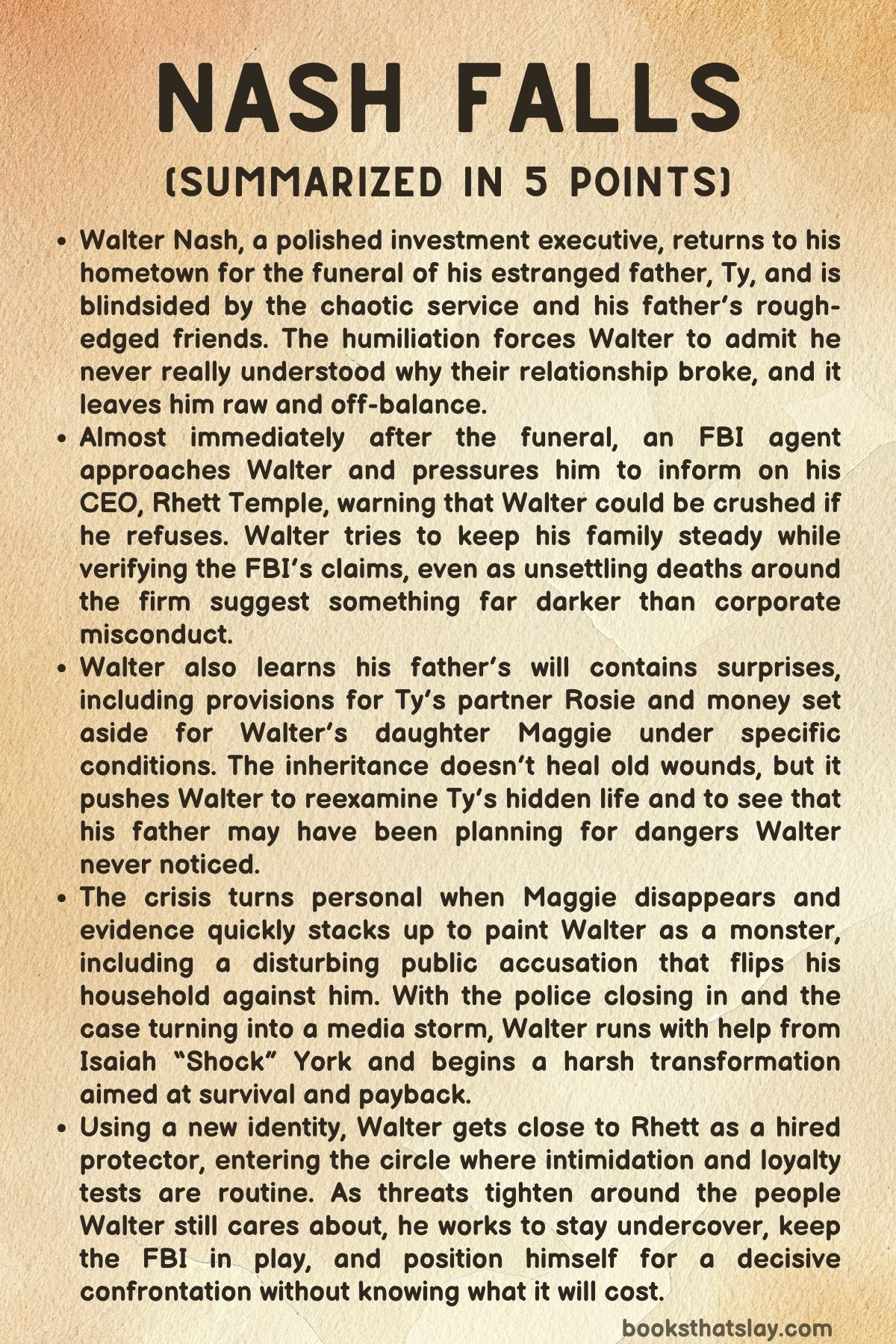
Walter Nash, a forty-year-old senior executive at Sybaritic Investments, attends the funeral of his estranged father, Tiberius “Ty” Nash, expecting a small, quiet service and little else. Instead, he walks into a crowded church filled with veterans and bikers who treat Ty like a legend.
Walter is rattled to learn Ty had been living with a woman named Rosie Parker. The ceremony becomes openly hostile when Isaiah “Shock” York, Ty’s massive Vietnam friend, takes over the room, praises Ty as a brother, and humiliates Walter as unworthy.
The crowd follows Shock’s rough ritual at the casket, and Walter leaves feeling exposed, furious, and ashamed.
At the cemetery, Ty’s attorney, Mort Dickey, approaches Walter and tells him to call about the will. That night, still shaken, Walter is confronted in his home by a man flashing an FBI badge: Special Agent Reed Morris.
Morris questions him about Sybaritic, Walter’s role in acquisitions, and CEO Everett “Rhett” Temple. Then he delivers the real message: the FBI believes Rhett is tied to serious criminal activity, and they want Walter to feed them information from inside the company.
Morris warns that refusing could leave Walter unprotected if the investigation blows back on him. He also orders secrecy, even from Walter’s wife, Judith.
Rhett Temple’s private life is as reckless as his public image is smooth. He uses drugs, lives in luxury, and answers to his billionaire father, Barton Temple, who treats him as a disappointment and credits Walter as the firm’s real engine.
Rhett also moves through a darker world. In one moment he is tender with his developmentally disabled half-sister Angie; in another, he is around security operations that feel like cages, and he relies on escorts to fill the voids in his life.
The next day, Walter tries to act normal. He hides the FBI approach, comforts Judith, and dodges his nineteen-year-old daughter Maggie’s ambitious request for a huge investment in a “lifestyle influencer” plan.
At work, Rhett appears unusually friendly and apologizes for missing Ty’s funeral. Walter doesn’t trust the sudden warmth and suspects Rhett is trying to measure what Walter knows.
Over lunch, Walter receives a secret note under his bill ordering him to meet nearby. Expecting the FBI, he instead finds Rosie Parker.
She is anxious, nearly powerless, and terrified she will be thrown out of Ty’s house. Walter promises to learn the truth through the will and honor Ty’s wishes if Ty intended to protect her.
Walter’s personal stress escalates at home. He rejects Maggie’s expensive plan as unrealistic, sparking a major fight with both Maggie and Judith, who thinks he was cruel.
Seeking clarity about Morris, Walter consults his neighbor Hal Rankin, a former FBI agent, and learns how to verify whether an agent is real and how the Bureau pressures insiders into cooperation.
Meanwhile, Rhett is shown meeting violent associates and watching a man killed without hesitation. He is also summoned by Victoria Steers, a ruthless crime boss who treats him as a tool, not a partner.
When she suspects a leak, she punishes him physically and orders him to identify who might turn informant next.
Walter meets Mort Dickey and learns his father’s will is nothing like he expected. Ty names Walter executor, leaves Rosie money and a right to live in the house for life, and directs the home’s eventual proceeds to charity in Walter’s mother’s name.
Ty also leaves substantial gifts to Shock and other members of his circle, and sets up a sizable trust for Maggie with structured payouts, giving Walter discretion as trustee. Dickey reveals Ty’s Agent Orange settlement and how Ty invested it into a larger estate, using some to fix up the house.
Walter leaves the meeting overwhelmed, realizing his father cared in ways Walter never understood.
Walter verifies that Reed Morris exists and demands more transparency. In Washington, D.C., Morris and another agent bring Walter before high-level Justice Department leadership, including Bernard Duvall.
They explain that Victoria Steers runs a sprawling criminal network through legitimate-looking businesses. The government believes she has aligned her operation with Chinese interests and is working toward major strategic harm against the United States.
Walter’s fear turns concrete when Rhett later mentions that another Sybaritic-connected person has “died,” joining two earlier deaths tied to acquisitions work. Walter begins to believe informants are being identified and eliminated.
Then the crisis becomes personal. Maggie disappears.
Detectives John Ramos and Carroll Summers question Walter and Judith, noting odd details: a forced back door but no alarm, missing electronics left behind, and inconsistent answers from Judith. Walter, who has been traveling, returns to find the house violated and his daughter gone.
He contacts Morris in secret, convinced his cooperation has put a target on his family.
Walter soon discovers Judith has been hiding an affair with Rhett. The betrayal explodes during the investigation, but the larger danger is outside their marriage.
Walter questions the neighborhood security guard, Billy Adams, and learns of a suspicious late-night “police” visit that never happened. Walter believes impostors used the false call to gain access.
Before Billy can report it, Billy dies in a staged crash. Walter tells Shock, who immediately believes Billy was silenced.
Evidence quickly turns against Walter. Police find paint transfer implicating his vehicle, and investigators treat him like the simplest suspect.
Then a video appears online showing Maggie accusing Walter of sexually abusing her and staging the disappearance. Judith, shocked and raw, believes it and calls the police.
Walter runs before he can be arrested, knowing the system is now chasing him rather than whoever took Maggie.
Rhett plays the concerned friend to Judith while privately dealing with his own family crisis. After a fight with Barton, Rhett and Barton’s wife Mindy stage Barton’s death to look like suicide, using an escort to bolster an alibi.
Rhett also maneuvers detectives toward Walter, suggesting motives and connections that deepen the frame.
Shock hides Walter at a fortified training compound and begins turning him into someone capable of surviving what’s coming. Morris later tells Walter the Maggie video appears to be AI-generated using captured data to ruin him, but the Bureau can’t publicly clear him without collapsing the operation.
Walter accepts that his old life is gone. He takes a new identity, “Dillon Hope,” and after months of hard training, he goes hunting for the people who destroyed his family.
Under cover, Walter tracks Rhett, saves him from a violent ambush, and earns a job as Rhett’s bodyguard. Living inside Rhett’s penthouse and estate, Walter watches Rhett lie to police, abuse power at work, and answer to Victoria Steers through her representative, Lynn Ryder.
Walter quietly gathers leverage while steering suspicion away from himself and Shock. When Ryder orders Judith’s elimination, Walter races to her house and kills the attackers, saving her life while keeping his true identity hidden.
He convinces Morris to put Judith into protection and fake her death for safety. As Rhett is summoned to Hong Kong for a reckoning with Steers, Walter goes with him, determined to bring down the people who framed him and to reclaim whatever justice is still possible.
Characters
Walter Nash
Walter Nash, the central figure in Nash Falls, is a man burdened by contradictions. Outwardly, he embodies success — a senior executive vice president at Sybaritic Investments, living a life of privilege with his wife Judith and daughter Maggie.
Yet internally, he is emotionally barren, estranged from his late father, Tiberius “Ty” Nash, and plagued by guilt, loneliness, and moral fatigue. Walter’s character arc transforms him from a polished corporate professional into a hunted fugitive and finally into a hardened avenger.
His evolution mirrors a descent and rebirth — the collapse of a controlled identity and the emergence of a primal, justice-driven self. Beneath his initial passivity lies a repressed yearning for connection and truth, awakened only after his world collapses.
His interactions with the FBI, the loss of Maggie, and his subsequent transformation into “Dillon Hope” reveal a man forced to shed every layer of civility to reclaim integrity and vengeance.
Judith Nash
Judith is a complex figure caught between affection, guilt, and survival. As Walter’s wife, she represents the emotional vacuum of their marriage — loving yet distant, loyal yet fallible.
Her affair with Rhett Temple exposes her vulnerability and need for validation in the face of Walter’s coldness. Yet her arc takes her from being complicit in emotional betrayal to becoming a tragic victim of manipulation and violence.
Judith’s confrontation with the false accusations against Walter and her near-death experience force her to confront her own blindness. Her inability to recognize Walter when he saves her underscores the irreversible transformation he has undergone, while her lingering intuition that “Dillon Hope” is her husband adds a note of tragic recognition to her role.
Maggie Nash
Maggie, the nineteen-year-old daughter of Walter and Judith, symbolizes both innocence and the future destroyed by corruption. Initially, she appears as a typical privileged youth with entrepreneurial ambitions, but her dreams of becoming a global influencer highlight generational conflict and moral dissonance within her family.
Her apparent “confession” video — later revealed as an AI fabrication — becomes a central tool in dismantling Walter’s life. Maggie’s disappearance and supposed death mark the loss of everything Walter valued, pushing him into his crusade for truth.
She functions both as a character and as a symbol — the representation of innocence devoured by systemic evil and deception.
Tiberius “Ty” Nash
Ty Nash, Walter’s estranged father, looms over the story as both ghost and moral compass. A Vietnam veteran and member of the rough “Fuck Off” biker club, Ty embodies raw masculinity, trauma, and stoic honor.
His relationship with Walter is defined by miscommunication and pride — a father unable to forgive what he perceives as weakness and a son yearning for approval. Yet in death, Ty indirectly redeems himself: through his will, his moral codes, and the values that ultimately guide Walter’s survival.
His relationships with Rosie Parker and Isaiah “Shock” York reveal a man who found surrogate family in loyalty and grit rather than blood.
Isaiah “Shock” York
Shock is Ty Nash’s old comrade and the most powerful moral anchor in Walter’s descent into chaos. Massive, intimidating, and foul-mouthed, he initially appears as a brute but later becomes the story’s unlikely guardian angel.
His bond with Ty extends to Walter, whom he trains, hides, and transforms into a survivor. Shock’s role bridges the worlds of war, loyalty, and redemption.
Beneath his violent exterior lies deep empathy and wisdom. Through Shock, Walter learns to merge intellect with instinct, and morality with action — the synthesis his father had once tried to teach him.
Rhett Temple
Rhett Temple, Walter’s colleague and antagonist, personifies corruption beneath charm. Handsome, wealthy, and reckless, Rhett is both victim and enabler of a vast criminal network.
His drug use, sexual exploitation, and betrayal reveal a man hollowed out by greed and parental pressure. His rivalry with Walter begins as professional jealousy and escalates into lethal manipulation, framed murders, and moral collapse.
His eventual downfall is intertwined with Walter’s rebirth, presenting a dark mirror image — both men are shaped by power and inheritance, but where Walter seeks redemption, Rhett sinks into depravity.
Barton Temple
Barton Temple, Rhett’s father, is a figure of corporate tyranny and patriarchal control. Cold, domineering, and obsessed with legacy, Barton embodies the decayed moral core of the financial empire that traps Walter and Rhett alike.
His murder — disguised as suicide — signifies the end of the old order and the beginning of chaos. Barton’s manipulation of his children mirrors Ty Nash’s failures as a father, but without the redeeming presence of loyalty or love.
Rosie Parker
Rosie Parker, Ty Nash’s partner in his final years, represents compassion amid brutality. A working-class caregiver at the VA, Rosie embodies empathy, endurance, and sincerity.
Her relationship with Ty humanizes him, revealing his capacity for tenderness despite his roughness. Her interactions with Walter are marked by tension that gradually transforms into mutual respect.
Through her, Walter confronts the truth about his father’s later life — not as a bitter recluse but as a man who rediscovered dignity.
Victoria Steers
Victoria Steers is the unseen hand manipulating the novel’s chaos. A powerful, enigmatic crime boss with global ties, she blends intellect with cruelty, symbolizing the convergence of capitalism, espionage, and psychopathy.
Her control over Rhett Temple and her orchestration of murders, AI propaganda, and financial crimes make her the embodiment of systemic evil. Victoria’s cold rationality contrasts sharply with Walter’s emotional awakening, setting up the moral dichotomy of the novel — dehumanization versus rediscovery of conscience.
Reed Morris
FBI Agent Reed Morris acts as the initial catalyst of Walter’s transformation. Calm, secretive, and morally ambiguous, he introduces Walter to the dangerous intersection between legality and corruption.
Though ostensibly an ally, Morris manipulates Walter as a tool, forcing him to choose between complicity and exposure. His complex relationship with Walter oscillates between mentorship and exploitation, reflecting the blurred line between justice and manipulation in the world of Nash Falls.
Lynn Ryder
Lynn Ryder serves as Victoria Steers’s ruthless lieutenant — efficient, brutal, and devoid of empathy. She functions as the enforcer of Steers’s empire, orchestrating assassinations and coercions with precision.
Her interactions with Rhett Temple expose his cowardice and dependence, while her confrontation with Walter (as Dillon Hope) reveals her as a formidable adversary. Ryder represents the mechanization of evil — loyalty stripped of humanity, power executed through obedience.
Themes
Family Estrangement and Emotional Disconnection
The emotional distance between Walter Nash and his father, Tiberius “Ty” Nash, defines much of the emotional terrain in Nash Falls. Their fractured bond originates from a seemingly small disagreement—Walter’s choice of tennis over football—but grows into a chasm that consumes decades of their lives.
The lack of reconciliation before Ty’s death haunts Walter, who struggles to reconcile his conflicting emotions of grief, resentment, and guilt. The novel examines how pride, silence, and unspoken expectations corrode familial ties, especially between fathers and sons.
Ty’s withdrawal from Walter after that fateful teenage decision becomes emblematic of a deeper generational failure to communicate vulnerability. Even as Walter achieves material success, he remains emotionally hollow, trapped in patterns of detachment that mirror his father’s stoic neglect.
The moment Walter realizes he mourned his dog more than his father crystallizes his emotional disconnection—not only from his family but from himself. This estrangement extends to his wife Judith and daughter Maggie, as Walter’s inability to express affection or empathy contributes to a cycle of emotional distance.
The novel shows how unresolved family wounds can echo through generations, shaping identity and moral choices. By the time Walter begins confronting the truth about his father’s life and death, it becomes clear that the real inheritance Ty left him is not financial but emotional—a legacy of isolation that Walter must either perpetuate or transcend.
Corruption and Moral Compromise
The world of Nash Falls exposes the rot beneath corporate luxury, revealing how power and greed intertwine with moral decay. Walter’s position at Sybaritic Investments situates him within a culture of ambition built on unethical practices.
His boss, Rhett Temple, epitomizes the moral corrosion of wealth: manipulative, indulgent, and entangled in criminal enterprises. The FBI’s recruitment of Walter as an informant forces him to confront not only external corruption but also his own complicity in maintaining silence.
The novel explores how privilege often shields wrongdoing while punishing those who act with conscience. Every layer of Sybaritic’s operation reflects the ease with which money erases accountability—murders disguised as suicides, fraudulent deals masked as legitimate acquisitions, and human lives treated as expendable assets.
Walter’s moral journey becomes a test of courage against this pervasive corruption. As he becomes more entangled with federal agents and criminal networks, he learns that survival in such a world demands compromise, and that complicity can come not from active wrongdoing but from inaction.
The story critiques the moral blindness bred by success and the illusion of security it provides. In Walter’s transformation from complacent executive to fugitive avenger, the novel examines how integrity, once surrendered, can only be reclaimed through sacrifice and suffering.
Identity, Transformation, and Redemption
Walter Nash’s transformation from a polished executive into a hardened survivor forms the psychological spine of Nash Falls. Stripped of reputation, wealth, and family, he is forced to reconstruct his identity under the alias “Dillon Hope.” This metamorphosis is both external and internal—a shedding of privilege, guilt, and emotional numbness.
The novel presents identity as a fragile construct shaped by circumstance, showing how crisis reveals the true self buried beneath social masks. Walter’s transformation is not glorified; it is painful, violent, and morally ambiguous.
His training with Shock, his father’s old friend, marks a symbolic rebirth, aligning him more with his father’s rugged world than his former corporate one. Yet redemption in the novel is not found through vengeance alone.
It arises from Walter’s gradual reclamation of purpose—the need to protect, to uncover truth, and to act with courage even in the face of despair. By the end, he has become both more and less human: more conscious of justice, yet hardened by trauma.
His evolution questions whether redemption is truly attainable after one has been complicit in moral blindness. Through Walter, Baldacci examines the price of reinvention and the paradox that to reclaim one’s humanity, one may first have to lose it.
Power, Control, and Manipulation
Throughout Nash Falls, power operates as an invisible but omnipresent force shaping every relationship and decision. In both corporate and criminal spheres, control is exercised through coercion, deception, and psychological dominance.
Rhett Temple’s manipulations—of Walter, Judith, and even his father Barton—illustrate how power corrodes empathy and turns human connection into exploitation. Victoria Steers, the shadowy crime boss, represents the pinnacle of this manipulation: an architect of fear who controls through information, intimidation, and global influence.
The novel draws unsettling parallels between boardroom politics and organized crime, suggesting that both operate on similar principles of hierarchy and control. Even within Walter’s family, power dynamics dictate behavior—Ty’s dominance over his son, Judith’s emotional infidelity as rebellion, and Maggie’s attempts to assert independence through social media entrepreneurship.
The result is a world where every bond becomes a negotiation of control, and autonomy is an illusion. Walter’s journey from subordinate to self-determining avenger mirrors his struggle to reclaim agency in a system designed to strip it away.
Power in Nash Falls is not just institutional but psychological, shaping how characters perceive themselves and each other. Ultimately, Baldacci uses this theme to question whether true autonomy can exist in a world governed by manipulation and deceit.
Truth, Perception, and Reality
The manipulation of truth is central to the chaos that consumes Walter Nash’s life. Lies—both personal and institutional—define the world of Nash Falls, where perception often carries more weight than reality.
The false video of Maggie’s accusations, crafted through artificial intelligence, becomes the ultimate symbol of a post-truth world where evidence can be fabricated and innocence destroyed. The ease with which society believes the digital lie reflects modern anxieties about the collapse of trust in truth itself.
Walter’s downfall begins not when he commits wrongdoing, but when perception turns against him. This theme expands beyond technology into personal relationships: Judith’s affair, Ty’s misjudgment of his son, and the FBI’s manipulation of Walter’s fears all blur the line between truth and deception.
The novel portrays truth as a fragile construct constantly contested by competing narratives. In his search for Maggie and his quest to expose Steers’s network, Walter learns that truth is no longer an absolute—it must be fought for, protected, and, at times, redefined.
The novel’s conclusion, with Walter assuming a false identity to pursue justice, encapsulates this paradox: sometimes lies become the only means to serve the truth. Through this theme, Baldacci captures the uncertainty of a world where appearance overrides authenticity and where justice depends on who controls the narrative.