Next Time Will Be Our Turn Summary, Characters and Themes
Next Time Will Be Our Turn by Jesse Q. Sutanto is a family saga that begins with a public scandal at a Jakarta Chinese New Year banquet and opens into a long, intimate story about inheritance—of power, expectation, shame, and love. When Izzy watches her formidable grandmother, Nainai, openly kiss a woman in front of their status-obsessed relatives, she fears something is wrong.
Instead, Nainai offers Izzy a startling gift: the truth about her own youth as Magnolia, a quiet Chinese-Indonesian girl who once tried to live exactly as she was told—until the costs became impossible to ignore.
Summary
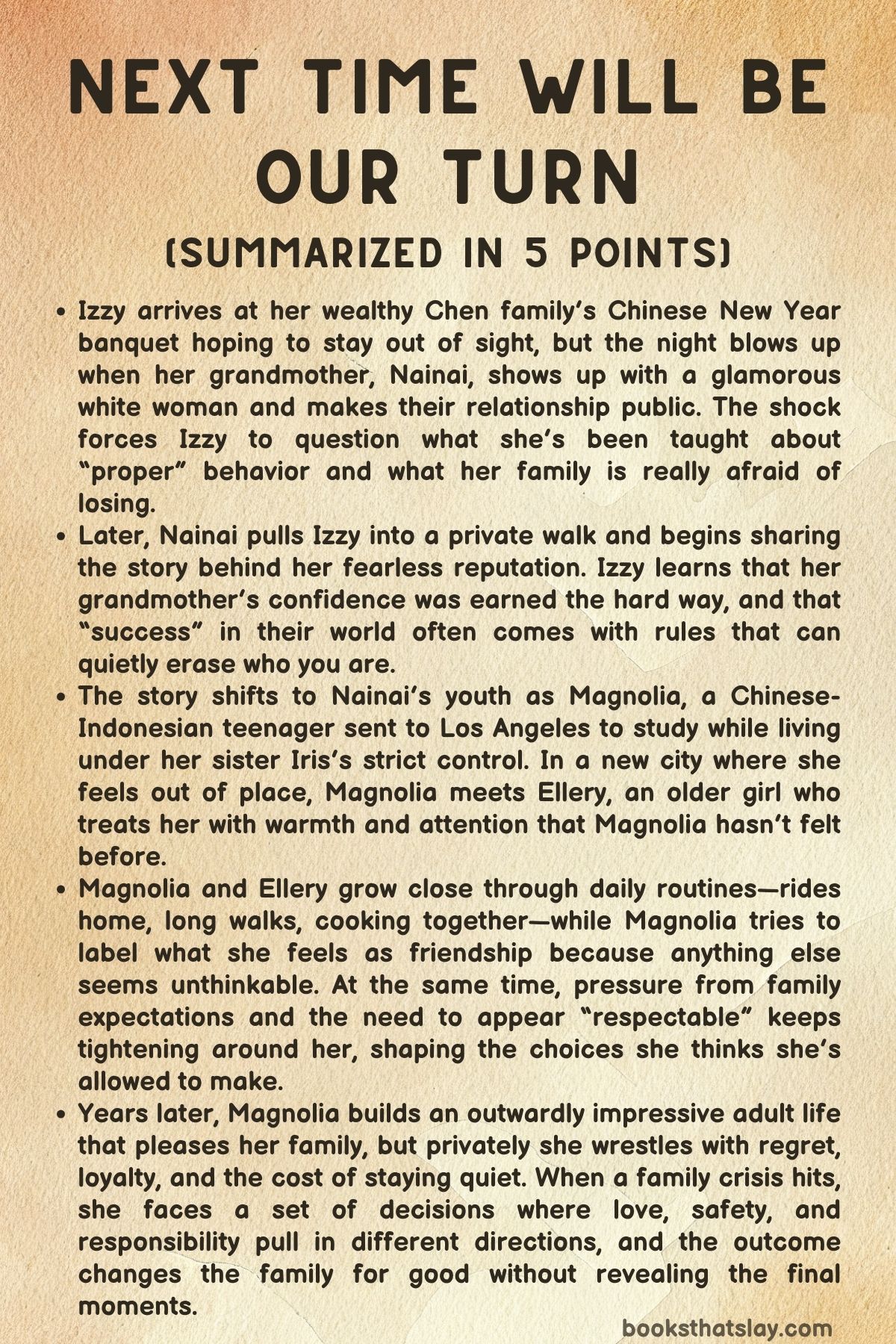
Izzy arrives late to her extended Chen family’s Chinese New Year celebration at a high-end restaurant in Jakarta and tries to disappear into a corner with a book. Her mother scolds her for being antisocial and compares her to Izzy’s older brother, Troy, who charms relatives and family associates with ease.
The event is less a holiday gathering than a performance of wealth and connection, with every auntie, uncle, and guest dressed to impress and watching one another closely.
Everything shifts when Izzy’s grandmother, Nainai, enters. As the family matriarch and the face of their influential mental-health company, she normally controls a room without trying.
Tonight, she arrives in a bold red qipao and, to everyone’s horror, escorts a tall white woman with silver hair. The restaurant falls into stunned silence.
Whispers spread immediately: investors are present, business partners are watching, the family name is at stake. Nainai meets Izzy’s eyes, winks, and then kisses the woman on the mouth in front of everyone.
Izzy’s relatives look sick with outrage; some look frightened, as if the ground rules of their world have suddenly stopped applying.
On the drive home, Izzy’s mother fumes about embarrassment and timing, while Izzy’s father grows quiet and calculating. He suggests that Nainai’s “erratic” behavior may require a board discussion about leadership and succession.
Izzy scrolls through family messages full of condemnation, yet her reaction isn’t satisfaction. She feels dread.
If Nainai is acting out of character, could something be wrong with her mind?
Unable to sleep, Izzy sneaks out through her window and climbs down a drainpipe for a late-night walk. In the shadows, Nainai is waiting as if she expected Izzy all along.
She calls Izzy “mensheng,” meaning protégé, and invites her to walk. Izzy protests that she’s not the obvious heir; another relative, Laura, seems far more prepared.
Nainai says she isn’t talking only about the company. She asks Izzy what she thought of her girlfriend.
Izzy blurts out that Nainai “can’t” have a girlfriend—because of her age, her role, her grandchildren—then hears how absurd it sounds. Nainai pushes back: why should a woman in her seventies be barred from love?
Why should anyone live only to make other people comfortable?
As they walk, Nainai reveals she wasn’t always this fearless. To explain, she begins telling Izzy about her past—back when she was Magnolia.
In the mid-1990s, thirteen-year-old Magnolia grows up in Indonesia in the shadow of her older sister, Iris, who is confident, beautiful, and treated as the family’s pride. Their parents are both doctors running a clinic, exhausted by work and anxious about reputation.
Their mother’s advice to Magnolia is practical and harsh: education matters, but mainly as a way to secure the right husband. When Iris is caught in a compromising situation with a boyfriend, their parents respond by sending her to California to protect the family name.
Iris leaves with a warning to Magnolia to toughen up, making Magnolia feel abandoned and smaller than ever.
A few years later, Magnolia graduates unusually young and is sent to Los Angeles to attend community college, moving into an apartment with Iris in San Gabriel. Iris has reshaped herself into someone determined to fit America’s idea of cool: she insists on English names, American slang, and strict rules about how Magnolia should behave.
Magnolia is instructed not to reveal she is sixteen and not to acknowledge Iris on campus. The apartment is quiet and staged, and Magnolia feels like a guest in her own life.
On her first day at school, Magnolia meets Ellery O’Shea, a friendly bookstore worker with an easy confidence. Ellery helps her get her books, steers her away from overpriced textbooks, and takes her to eat tacos from a truck—Magnolia’s first time trying Mexican food.
Ellery’s warmth and attention make Magnolia feel noticed in a way she isn’t used to. Ellery asks for her number, and Magnolia floats home on the sudden belief that maybe America can hold something for her besides loneliness.
That hope cracks the next morning when Magnolia sees Ellery kiss another girl. Magnolia feels embarrassed by her own excitement and tries to label what she felt as ordinary friendship.
She throws herself into campus life instead, joining the badminton club and meeting Winnie, who becomes a steady friend. She also meets James, a charming older boy Winnie warns her about.
Ellery reappears when Magnolia realizes they live in the same apartment complex. They start taking long walks together, trading jokes and nicknames.
Ellery calls Magnolia “Tulip,” teaches her to drive in the parking lot, and invites her into her tiny studio filled with plants. They cook simple meals together, watch television, and sometimes fall asleep side by side.
Ellery still has a girlfriend, Trish, and Magnolia tells herself that means there is nothing to want—but she aches whenever Ellery’s attention shifts away. Over time, Ellery becomes Magnolia’s safest place in a city that often feels like a test she wasn’t trained to pass.
Back home, Iris continues to belittle Magnolia, though she occasionally shows flashes of sisterly care that confuse Magnolia more than cruelty does. When their mother visits from Indonesia, she criticizes their home and presses them about men and marriage.
Magnolia, trying to avoid suspicion, mentions Ellery as a harmless friend. Her mother insists on meeting her.
At dinner, Ellery wins their mother over with politeness and charm, nearly revealing her sexuality before Magnolia interrupts in panic, terrified of what the truth would trigger.
Years pass. Magnolia returns to Indonesia and slips into a life that looks correct from the outside and empty on the inside.
She works at a clinic, attends social events, and endures matchmaking dinners. Her letters to Ellery become a private habit—part memory, part confession—until even that starts to feel like a loop she can’t escape.
Then Magnolia meets Parker, a polished Chinese-Indonesian man with ties to Los Angeles. He is attentive, organized, and instantly approved by both families.
Parker plans outings and surprises; Magnolia interprets his certainty as safety. When he proposes, the public moment is perfect, yet Magnolia feels hollow afterward, crying alone and writing Ellery a desperate message she never sends.
Still, she pushes forward into marriage, telling herself that stability is the reward for obedience.
Married life tightens around her. Parker controls decisions and expectations, and Magnolia feels herself shrinking again.
Iris returns to Indonesia with big plans and draws their parents’ disapproval, but she moves quickly—business, marriage, pregnancy—until her life collapses. When Iris shows up bruised and desperate, Magnolia takes her in and finally confronts her parents’ obsession with reputation.
Iris has been abused by her husband, Erik, and their parents blame Iris. Magnolia refuses to accept that, and in doing so discovers a voice she didn’t know she still had.
Iris gives birth to Hazel, and Magnolia becomes Hazel’s anchor. Caring for her niece gives Magnolia purpose, even as Parker grows impatient with how much of Magnolia’s attention goes to Iris and the baby.
Magnolia begins to understand that the life she built is not truly hers.
Eventually, Magnolia reconnects with Ellery in Los Angeles, and years of misunderstanding collapse in a single fierce conversation. Ellery admits she loved Magnolia and ended her relationship because of it; Magnolia admits her own feelings and her uncertainty about how to name herself, only that Ellery has always been the person she wanted most.
They choose each other at last—briefly. That same night, Iris is in a catastrophic car accident.
She dies after making Magnolia promise to protect Hazel and keep her away from Erik.
Hazel’s custody becomes a legal battle. Magnolia learns that to keep Hazel, she must appear stable in Indonesia—with a spouse, a home, and financial standing.
The simplest path is to remain married to Parker and return to Jakarta. Magnolia breaks with Ellery in a way designed to make Ellery leave, sacrificing her chance at a life with her in order to protect Hazel’s future.
Back in Indonesia, Magnolia and Parker win guardianship, using evidence of Erik’s abuse. Magnolia pours her grief and rage into building something that helps others: a counseling services division at the clinic aimed at women and new mothers, which grows into a larger mental-health mission that brings her public recognition.
Over time, she raises Hazel and later has more children, shaping a life that is functional and meaningful even if it carries an old, private wound.
Years later, Nainai—Magnolia—finishes her story for Izzy. Izzy realizes the kiss that shocked the family wasn’t a breakdown; it was a decision to stop living by their rules.
Magnolia’s life shows Izzy the cost of silence, the weight of family power, and the possibility of choosing truth anyway. After Magnolia’s death, Izzy carries her ashes to California, holding onto the idea that some loves, even if interrupted, remain real—and that the next chance to choose freely might belong to Izzy.
Characters
Izzy (Isabelle “Izzy” Chen)
Izzy begins Next Time Will Be Our Turn as the quiet outlier inside a loud, status-conscious clan: she hides in a dark corner with a book at a lavish family event, not because she is fragile, but because she is exhausted by the Chen family’s performance of perfection. Her inner life is sharply observant and emotionally reactive—she notices every glance, every whispered judgment, and she absorbs shame that she can’t fully name yet.
Izzy’s conflict isn’t only with relatives who prefer charisma; it’s with the inherited rulebook that says she must want the same things they want. Her relationship with her mother and the constant comparison to Troy shapes a self-image that is wary and defensive, but her late-night decision to climb out the window shows something else underneath: she has courage, agency, and the beginnings of rebellion.
What makes Izzy compelling is that she doesn’t romanticize rebellion; she fears it. She worries Nainai’s public scandal might signal decline, which reveals Izzy’s capacity for care and nuance even when the rest of the family sees only reputation management.
By becoming the listener to Nainai’s life, Izzy turns into a bridge between generations—someone who inherits not just wealth and expectations but also the buried truths that can finally loosen their grip on her.
Nainai (Magnolia Chen, in old age)
Nainai enters Next Time Will Be Our Turn like a thunderclap: iconic clothing, immaculate control, and then the deliberate act of breaking the room’s social contract by arriving with her girlfriend and kissing her in public. She is not merely “bold”; she is strategically unafraid, choosing visibility as a weapon against a lifetime of being managed by others.
Yet the power she wields in the present is haunted by how little power she had as a girl and young woman. The story reframes her “erratic” behavior as the opposite of instability: it is a late-life clarity that refuses to bargain with respectability politics anymore.
Her choice to recruit Izzy as “mensheng” is not only about corporate succession; it is mentorship in emotional survival—teaching Izzy that identity cannot be postponed indefinitely without cost. Nainai’s most defining trait is her complexity: she is simultaneously the matriarch who helped build a family empire and the woman who spent decades swallowing herself to keep that empire acceptable.
Her late authenticity, therefore, is not a whim; it is the culmination of grief, love, sacrifice, and a stubborn belief that desire still matters even at seventy.
Magnolia (Nainai as a teenager and adult; also “Tulip”)
Magnolia’s arc is the emotional spine of Next Time Will Be Our Turn, moving from invisibility to voice, from compliance to self-authorship. As a thirteen-year-old, she lives in the shadow of Iris and under parents who treat a daughter’s future as an arrangement to be negotiated, not a person to be understood.
Magnolia internalizes the logic of substitution: if she can’t be the admired sister, she will be the obedient one, the safe one, the “good” one. When she arrives in Los Angeles at sixteen, the freedom is initially superficial—new clothes, new accent rules, new lies—but the deeper freedom comes through relationship: Ellery sees her without requiring her to perform.
Magnolia’s love, however, is shaped by repression; she doesn’t have language for wanting a woman, so she calls the ache friendship and forces herself to misread what is obvious. This pattern repeats when she later marries Parker: she chooses stability as a way to silence longing, and she mistakes being directed for being protected.
Magnolia’s most transformative moments are tied to caretaking, but not in a sentimental way. Caring for Hazel gives her real purpose, and fighting for custody forces her to become publicly brave in a way she never had to be for herself alone.
Her later professional reinvention—building counseling services and becoming a mental-health advocate—feels like sublimation at first, but it becomes genuine identity: she turns her private suffering into public infrastructure for other women. Even when she returns to a “functional” marriage, Magnolia is no longer the girl who disappears; she is a person making hard choices inside harsh constraints.
By the end, her life becomes a testimony that authenticity can be delayed, distorted, and punished, yet still survive—and that love can change the shape of a life even when it cannot stay inside it.
Iris
Iris is both mirror and wound for Magnolia in Next Time Will Be Our Turn—the sister who embodies everything Magnolia is told to admire, and the sister who teaches her, sometimes cruelly, how to endure. As a teenager, Iris is the “successful” daughter until she becomes the family’s emergency: when she is caught with her boyfriend, she is exiled to protect reputation, and that banishment hardens her into someone who treats vulnerability like a liability.
In Los Angeles, Iris tries to re-engineer both herself and Magnolia into an Americanized version that will pass inspection, policing language, age, and even public association at school. Her harshness can read like malice, but it is also survival strategy learned from a family that punishes women for being seen.
Iris’s later life reveals how much she has been carrying: she returns to Indonesia determined to build a business and live on her terms, only to be met with patriarchal suspicion and familial condemnation. Her abusive marriage exposes the brutal underside of “respectability,” and her parents’ reaction—blaming her to protect the family image—makes Iris the clearest evidence of what that system costs women.
The tragedy of Iris is not that she is flawed; it is that her bravery is constantly met with punishment. Yet she also becomes a catalyst: her battered arrival forces Magnolia into her first true defiance, and her death becomes the event that reorders Magnolia’s priorities forever.
Iris’s final demand—protect Hazel from Erik—turns her into a moral north star, and even after she’s gone, she continues shaping Magnolia’s life through grief, responsibility, and the fierce love that sisters often express through conflict more than softness.
Troy Chen
Troy functions in Next Time Will Be Our Turn as the family-approved version of success—outgoing, socially fluent, and effortlessly able to perform belonging. He is not portrayed as a villain so much as a contrast: his ease highlights Izzy’s discomfort and intensifies her sense of being “wrong.” Troy’s presence shows how families can turn personality into hierarchy, rewarding charisma as if it were virtue.
Even without him doing anything overtly cruel, he becomes an instrument through which Izzy is disciplined—proof that the system works for some and therefore must be right. The narrative implication is that Troy is shaped by the same pressures as Izzy, but he has been trained to enjoy them, or at least to benefit from them, which makes him a subtle symbol of how compliance can look like confidence when it is socially rewarded.
Laura
Laura appears as the “obvious successor” in Next Time Will Be Our Turn, and that label matters more than the limited page time she receives. She represents the safe continuity plan: the relative who fits the expected mold, who can inherit without embarrassing anyone.
In the story’s emotional logic, Laura is what the family defaults to when it wants certainty—proof that the system can proceed without disruption. Her presence also pressures Izzy internally: if Laura is already chosen, then Izzy’s value seems conditional, secondary, and therefore negotiable.
Even without a deep on-page portrait, Laura’s function is psychologically sharp because she symbolizes how families pre-select who is allowed to matter.
Ellery O’Shea
Ellery is the first person who makes Magnolia feel real in Next Time Will Be Our Turn, and that is her deepest power. She is confident without cruelty, playful without manipulation, and she offers Magnolia a version of adulthood that isn’t anchored in family approval.
Ellery’s warmth—nicknames, shared food, long walks, easy laughter—creates a sanctuary where Magnolia can experience intimacy without immediately paying for it. Yet Ellery is not a fantasy figure; she has limitations that become painful.
She has a girlfriend, she assumes Magnolia is straight, and she lets years pass inside misunderstanding, which shows how even genuine love can be passive in the face of fear and uncertainty. When Ellery finally confesses she loved Magnolia all along, it lands as both romantic and devastating because it confirms that their tragedy was not lack of feeling, but lack of permission—socially, culturally, and personally.
Ellery also carries a quiet role as witness: she preserves Magnolia through letters, through memory, through the poem she leaves behind, turning love into an artifact that survives separation. Her death later in the story deepens her symbolism: she becomes the life Magnolia might have lived, not as a moral lesson but as a permanent ache that makes Magnolia’s later choices heavier and more meaningful.
Trish
Trish’s presence in Next Time Will Be Our Turn is less about her as an individual and more about what she represents for Magnolia and Ellery: legitimacy, existing commitment, and the reality that love does not appear in a vacuum. For Magnolia, Trish is the painful proof that desire can be real and still unavailable, and she is the trigger that forces Magnolia to confront what she has never been taught to name.
For Ellery, being with Trish also becomes a measure of how hard it is to disrupt a life that is already organized, even when the heart is elsewhere. Trish is important because she prevents the story from treating Magnolia and Ellery’s bond as destiny without consequence; she makes clear that other people exist inside the collateral of silence and delay.
Winnie
Winnie offers Magnolia a healthier model of female friendship in Next Time Will Be Our Turn, one that is direct, protective, and socially fluent without being performative. She welcomes Magnolia through badminton, gives practical warnings about James, and provides companionship that doesn’t demand Magnolia reshape herself into a different person.
Winnie functions as a stabilizing counterweight to Iris’s contempt and Magnolia’s loneliness; she is the kind of friend who helps you interpret the world when you are new to it. Her role is also quietly political: she shows Magnolia that community can exist outside family control, that belonging can be chosen rather than assigned.
James
James is the early example of conventional romance pressure in Next Time Will Be Our Turn—handsome, older, and framed as a flirt who could easily become a “solution” to Magnolia’s confusion. His presence tests Magnolia’s ability to distinguish genuine desire from the comfort of social acceptability.
The warnings about him being a predator are significant because they echo the vulnerability Magnolia carries as a young immigrant girl trying to learn the rules quickly, and they underline how easily a “normal” heterosexual path can be dangerous when pursued for safety rather than love. James matters because he represents the road Magnolia is expected to take, and the risk that comes with taking it blindly.
Dahlia
Dahlia, the bookstore connection, is a small character in Next Time Will Be Our Turn, but she helps define Ellery’s social ease. The fact that Ellery knows her and can cut through a line with charm shows Magnolia what confidence looks like in America and why it feels so intoxicating.
Dahlia’s brief presence reinforces the theme of access—who belongs, who is connected, who can move through systems smoothly—contrasting with Magnolia’s fear of being exposed as young, foreign, and unsure.
Anabelle
Anabelle serves as a hinge point in Magnolia’s later life in Next Time Will Be Our Turn by engineering the dinner that introduces Parker. In a narrative filled with family-arranged expectations, Anabelle’s matchmaking feels friendlier and more modern, which makes Magnolia’s openness to Parker feel like choice rather than coercion.
That distinction is important because it explains why Magnolia convinces herself she is finally moving forward: the setup arrives in the language of friendship and possibility, not tradition and duty.
Parker
Parker is Magnolia’s most complicated antagonist in Next Time Will Be Our Turn because he is not introduced as cruel; he is introduced as relief. He offers shared memories of Los Angeles, charm, organization, and a relationship that looks like peace after years of longing and stagnation.
The danger is that his stability is also control: he plans everything, decides everything, and rarely asks what Magnolia wants, creating a marriage where her selfhood slowly dissolves while the surface appears perfect. Parker embodies a socially rewarded form of domination—polite, competent, “good on paper”—which makes Magnolia’s emptiness harder to explain and therefore easier for her to ignore.
Yet Parker is not one-dimensional, because he also helps in crisis logistics after Iris’s death and becomes part of the legal strategy that keeps Hazel safe. That duality is the point: Parker can be both useful and suffocating, both partner and warden, illustrating how patriarchy often arrives dressed as care.
Magnolia’s tragedy is not that she chose a monster; it’s that she chose a life where her preferences became optional, and she mistook the disappearance of conflict for the presence of freedom.
Erik
Erik represents overt violence in Next Time Will Be Our Turn, the brutal endpoint of a culture that polices women’s behavior while excusing men’s harm. His abuse of Iris is not only personal cruelty; it is also the event that exposes the family’s moral rot—especially when Iris is blamed for provoking him.
After Iris’s death, Erik becomes a legal threat rather than a domestic one, using marriage and custody law as weapons to regain power over Hazel. His failure to appear in court, contrasted with the evidence of abuse, reinforces his character as someone who seeks control without responsibility.
Erik’s narrative purpose is stark: he is what happens when reputation is valued above safety, and he is the reason Magnolia’s love story cannot exist in a protected bubble—because the world’s systems can still reach into private lives and punish women for trying to choose differently.
Andika
Andika, the lawyer, functions as the voice of structural reality in Next Time Will Be Our Turn. He doesn’t speak in terms of feelings; he speaks in terms of what courts reward and what they punish.
By telling Magnolia that she must present as a stable married woman with income and housing to win custody, he reveals the institutional bias that forces Magnolia back into a marriage she no longer wants. Andika is not framed as villainous; he is pragmatic, and that pragmatism is terrifying because it shows that oppression doesn’t always need cruelty—sometimes it only needs paperwork and precedent.
His presence underscores one of the book’s sharpest themes: individual authenticity can be crushed not just by family judgment, but by legal structures that define legitimacy in narrow, patriarchal terms.
Hazel
Hazel is the emotional center of Magnolia’s adult choices in Next Time Will Be Our Turn—a child whose existence turns love into responsibility and transforms grief into mission. She is born from Iris’s suffering and becomes Magnolia’s clearest source of purpose, giving her a role that feels meaningful in a life otherwise shaped by compromise.
Hazel also symbolizes inheritance in a deeper way than wealth: she inherits trauma, family conflict, and the consequences of adults’ decisions, which makes Magnolia’s promise to protect her feel like both devotion and burden. As Hazel grows, she becomes part of Magnolia’s public-facing identity as well—proof that Magnolia’s life is full and socially legible even when her private longing remains unresolved.
In the framing with Izzy, Hazel’s motherhood connects the generations: Hazel is the reason Izzy exists, and therefore Hazel is also the living thread tying Iris’s rebellion, Magnolia’s sacrifice, and Izzy’s awakening together.
Sawyer
Sawyer appears late in Next Time Will Be Our Turn, but she carries enormous thematic weight because she proves Nainai’s central thesis: authenticity can arrive late and still be real. Sawyer is not portrayed as a replacement for Ellery; she is evidence that Magnolia’s capacity for love survived decades of suppression and grief.
By finding love again after Parker’s death, Magnolia turns from a woman who once believed she had only one acceptable life path into someone who claims desire as a right, not a youthful mistake. Sawyer’s role is to make the ending not only tragic-romantic but also affirming: love does not have to be limited to a single lost chance, and a woman’s life does not end when society thinks it should.
Lily, Chase, and Thomas
Magnolia’s later children—Lily, Chase, and Thomas—function in Next Time Will Be Our Turn as part of the “successful” life Magnolia builds after returning to Indonesia: a visible, socially approved family that helps her secure Hazel’s future and maintain stability. Their presence reinforces the theme that a life can be full and still contain absence; Magnolia’s motherhood becomes both genuine love and a narrative armor against scrutiny.
They also deepen the cost of Magnolia’s choices, because once she has multiple children, leaving or reshaping her life becomes even more complicated—not only emotionally, but practically and socially.
Themes
Reputation, Social Permission, and the Cost of “Face”
A lavish family gathering becomes a public courtroom the moment Magnolia—known to Izzy as Nainai—arrives with a woman partner and refuses to soften what it means. The shock in the room is not only about romance; it is about who is allowed to be visible, and when.
The relatives’ whispers and the parents’ panic reveal a social economy where approval functions like currency, traded for access, business trust, and family standing. In that kind of system, private life is never fully private.
A kiss can be treated like a hostile business decision because reputation is considered communal property, something elders are expected to protect and younger members are expected to inherit intact. The backlash also exposes how quickly concern becomes a convenient disguise for control.
When Magnolia’s father suggests a board meeting and frames her behavior as “erratic,” the family translates nonconformity into pathology so they can regain authority without admitting what they are truly afraid of: embarrassment and lost influence.
The theme gains weight because Magnolia understands this machine from the inside. Her earlier years show how “face” is maintained through policing daughters: Iris is sent away to preserve respectability, Magnolia is coached to treat education as a marriage asset, and everyone learns that the safest version of womanhood is the one that draws the least attention.
Even later, when Magnolia builds a public career and becomes a respected figure, the requirement to appear acceptable never fully disappears; it simply changes costume. The custody fight makes the logic brutally explicit: the law and social expectations align to reward the image of stability, and the “correct” marital status becomes a strategic weapon.
Next Time Will Be Our Turn presents reputation not as a minor pressure but as a force that shapes the available choices, rewarding obedience and punishing honesty, often while claiming to act in the name of family wellbeing.
Family Hierarchy, Inheritance, and Power as a Form of Love
The Chen family’s structure runs on deference, titles, and unspoken rules about who speaks, who decides, and who gets to be complicated. Izzy arrives already trained to evaluate herself through comparison—especially against Troy—and to anticipate correction before it comes.
That is how hierarchy reproduces itself: not only through direct control, but through children learning to monitor their own tone, posture, and ambitions. Magnolia’s entrance as matriarch shows another dimension of the same hierarchy.
Her authority is so absolute that she can turn a room silent, yet it is also fragile because it relies on collective agreement to treat her as respectable. When she disrupts expectations, the family attempts to depose her using corporate language, as if the boardroom can cleanly separate “business risk” from “a woman claiming her life.”
What makes the theme compelling is that power in this family is not purely cruel; it can also be a distorted version of care. Magnolia’s designation of Izzy as “mensheng” signals a kind of mentorship that bypasses the usual prim-and-correct path, offering Izzy a rarer gift: being chosen for who she is rather than who she performs.
At the same time, the older generation’s version of love often arrives as pressure. Magnolia’s mother believes she is preparing her daughters for survival when she reduces college to husband-hunting, and the parents believe they are preserving the family when they blame Iris for being abused.
In each case, authority claims to be protection, but it demands silence and sacrifice as proof of gratitude.
Inheritance here is not only about a company. It is about passing down narratives: which desires are “acceptable,” which conflicts are to be hidden, and which women are praised for being easy to manage.
Magnolia eventually interrupts this cycle by choosing a successor relationship with Izzy that is personal, not just corporate. That move reframes inheritance as something that can heal rather than shrink a person.
Next Time Will Be Our Turn treats family power as intimate and complicated, capable of generosity, capable of harm, and always shaping what each member believes they are allowed to want.
Identity, Assimilation, and the Violence of Reinvention
Magnolia’s arrival in Los Angeles carries the quiet terror of being new, young, and watched—by classmates, by her sister, by the invisible standards she cannot fully name. Iris becomes the clearest symbol of assimilation as command: change your accent, change how you address your parents, erase your age, erase the parts of you that might invite scrutiny.
Reinvention is presented as survival strategy, but it is also a kind of violence, because it teaches Magnolia that her original self is a liability. Even the apartment—silent, perfumed, carefully staged—feels like a museum of the identity Iris is trying to display.
Magnolia learns quickly that belonging is conditional, and the condition is performance.
Yet assimilation is not portrayed as simple betrayal of culture. It is tangled with fear and ambition.
Iris’s harshness can be read as a response to what happened when she was punished for sexuality and reputation back home; she knows how quickly a girl’s body becomes evidence used against her. Magnolia, meanwhile, is caught between the longing to be seen and the instinct to disappear.
Her panic when asked where she is from, the impulsive lies, and the shame that follows show identity as something she thinks must be defended rather than expressed. The friendships she forms become small experiments in freedom.
Eating tacos for the first time, learning to drive, walking for hours with Ellery—these moments are not trivial. They are glimpses of a self that could exist without constant translation.
The theme also extends beyond national identity into sexual identity. Magnolia’s confusion when she sees two women kiss is not simply ignorance; it is evidence of what her world had kept unnameable.
She does not have language for her feelings, so she misfiles them as friendship, admiration, or temporary fascination. That mislabeling costs her years.
Later, Izzy experiences a different but related pressure: she has language, yet she still fears the social consequences of truth. By placing these generations beside each other, Next Time Will Be Our Turn shows how assimilation can happen inside any culture: the demand to become a version of yourself that causes less trouble, even if it hollows you out.
Love, Miscommunication, and the Tragedy of Timing
The relationship between Magnolia and Ellery is defined as much by what they do not say as by what they feel. Their closeness grows through ordinary rituals—walking, cooking, napping side by side—until intimacy becomes a daily climate.
Yet the relationship remains suspended in ambiguity because each assumes the other’s limits. Ellery believes Magnolia is straight; Magnolia believes Ellery has chosen her girlfriend and will never choose her.
The result is a long emotional stalemate where affection is real but unclaimed, and longing becomes a private burden each carries alone. The miscommunication is not framed as a cute misunderstanding.
It is a structural problem created by fear, norms, and the absence of safe conversation about desire.
When the truth finally breaks open—Ellery confessing love, Magnolia admitting she has always loved her—the joy is immediate, but it arrives with grief attached. They mourn wasted time because they can suddenly see how much of their suffering came from guesswork and self-protection.
The letters intensify the theme: writing becomes a place where Magnolia can be honest without consequence, yet the very privacy of the letters keeps her from changing her life. When Iris sends copies to Ellery, it is both a gift and an exposure, proving that love sometimes needs intervention to become real.
For a brief window, timing finally aligns: Magnolia chooses Ellery, imagines staying, imagines a future that is hers.
Then loss interrupts. Iris’s death collapses the possibility of a life built purely on personal desire, because Magnolia is pulled into responsibility that is both moral and legal.
The tragedy is not only the accident; it is the way love becomes something Magnolia must abandon to protect Hazel. Her breakup with Ellery is a sacrifice performed with cruelty on purpose, because gentleness would invite Ellery to stay and risk everything.
The poem about reuniting later reads like a relic of that timing—love that was right, but not allowed to be lived continuously. Next Time Will Be Our Turn treats timing as a moral pressure: people can do the brave thing and still lose, not because they lacked feeling, but because life demanded competing loyalties.
Gender, Control, and the Everyday Mechanics of Patriarchy
Control in the story rarely arrives through overt declarations; it arrives through routines, expectations, and the smooth confidence of people who believe they are entitled to decide. Magnolia’s mother describes higher education as a marketplace for husbands and teaches her daughters that their value rises or falls based on male potential.
Iris is punished for sexual behavior, and the punishment is exile disguised as protection. These early lessons train Magnolia to accept a world where men are the default future and women are the managers of consequences.
Even in the United States, where Magnolia experiences new freedoms, patriarchal pressure reappears through different channels—age vulnerability, predatory possibilities, and the constant evaluation of female respectability.
Parker embodies a modern, polished form of dominance. He is attentive, organized, and outwardly ideal, which makes his control difficult to name at first.
He plans everything, chooses the experiences, and sets the tone so effectively that Magnolia mistakes surrender for peace. His proposal is public and cinematic, and that public setting matters: it turns her acceptance into a performance she cannot easily refuse without humiliation.
Their wedding negotiations show how “saving face” can become an excuse for male authority, framed as tradition while functioning as ownership. After marriage, the erosion of Magnolia’s identity is gradual, the way controlling relationships often work: fewer choices asked, more decisions assumed, until her life feels like a schedule she is following rather than a life she is building.
The theme sharpens when Iris is abused and the family blames her. That response exposes the cruelty at the heart of patriarchal logic: a woman’s suffering is treated as evidence of her failure.
Magnolia’s rebellion in that moment is not only sisterly love; it is a breaking point where she refuses the rule that women must swallow harm quietly to keep the family looking clean. Later, the custody battle makes patriarchy bureaucratic: Magnolia’s ability to protect Hazel depends on appearing as the “right” kind of woman, attached to a husband, backed by money, and legible to conservative institutions.
Even her professional success is shaped by this context; she builds counseling services for women because she has lived what it costs when no one protects them. Next Time Will Be Our Turn shows patriarchy not as a single villain but as a system that rewards control, excuses violence, and turns women into the caretakers of everyone else’s comfort.
Grief, Duty, and the Ethics of Choosing Someone Else
Iris’s death transforms Magnolia’s life into a set of moral obligations that cannot be postponed. Hazel is not an abstract promise; she is a frightened child with needs that do not pause for adult heartbreak.
The story treats grief as physical and destabilizing—panic attacks, collapse, numb routines—but it also shows grief becoming a source of clarity. Magnolia cannot unsee what happened to Iris, and she cannot pretend that conventional family narratives deserve loyalty when they would have left Iris in danger.
Duty, in this sense, becomes an ethical decision rather than a cultural reflex. Magnolia chooses Hazel not because it is expected, but because it is right.
This theme becomes particularly painful because duty competes directly with love. Magnolia’s life with Ellery is not casual; it is the first time she feels fully met.
Yet Hazel’s custody depends on the kind of stability the legal system recognizes, and Magnolia recognizes that her personal happiness is not the priority if Hazel’s safety is at stake. The cold ending with Ellery is an act of protection that also destroys something precious.
The story refuses to romanticize the sacrifice; it shows the ugliness required to make it stick. Magnolia’s later life—raising Hazel, building a family, expanding mental health work—can be read as both a continuation and a coping strategy.
She creates meaning where she can, turning personal loss into social contribution.
Grief also travels across generations. Izzy inherits not only the family empire but the emotional aftermath of what Magnolia endured.
When Izzy watches her grandmother’s public kiss, she feels shame and anger she cannot immediately explain because she has absorbed the family’s fear of scandal. Hearing the full story later reorders that emotional inheritance, turning confusion into understanding.
The ending, with ashes scattered in California and the imagination of reunion, does not erase duty’s cost, but it offers a form of peace: a belief that love and loss can coexist without either being denied. Next Time Will Be Our Turn suggests that duty can be a form of love, but it insists on telling the truth about what duty demands and what it takes away.