Nightmare Obscura Summary and Analysis
Nightmare Obscura by Michelle Carr is a compelling exploration of the science behind dreams and nightmares. Written by a dream scientist, the book delves into the physiological and psychological mechanisms of sleep and the powerful role dreams play in mental health.
Through research and personal insights, the author investigates why nightmares occur, how they impact our well-being, and the potential ways in which we can take control of our dreams. The work emphasizes not only the therapeutic benefits of understanding dreams but also the science behind lucid dreaming and other techniques to overcome distressing nightmares, offering readers valuable tools for emotional healing and improved sleep.
Summary
Nightmare Obscura begins with the premise that nightmares are not just fleeting illusions but real and often debilitating experiences that can affect both mental and physical health. The author, a dream scientist, explains how chronic nightmares, which occur frequently, can disrupt sleep patterns and intensify stress.
These persistent bad dreams are especially harmful for individuals who have experienced trauma, increasing their risk for conditions such as anxiety and depression. By describing how the body physically reacts during a nightmare—with increased heart rate, erratic breathing, and heightened brain activity—the author demonstrates that nightmares are more than just mental disturbances; they can have tangible, long-lasting effects on the emotional and physical well-being of individuals.
The narrative further explores how dreams, in general, function as a means of emotional processing and memory consolidation. Dreams help the mind to rehearse challenges, consolidate emotional experiences, and process stress.
They are connected to our waking lives in ways we may not fully understand, often reflecting the concerns and unresolved emotions we experience during the day. The quality of our sleep—specifically, the nature of our dreams—greatly impacts our mood and emotional regulation upon waking.
Poor sleep caused by nightmares creates a vicious cycle, perpetuating negative emotions, anxiety, and low mood that can last throughout the day.
The book also highlights the difference between typical dreams and nightmares. While most dreams serve as a safe environment to process fears or rehearse difficult situations, nightmares represent a failure in this process.
The author suggests that people who experience frequent nightmares often struggle to regulate their emotions, and these disrupted dreams reflect that struggle. This inability to manage emotions in dreams bleeds into waking life, making it more difficult to deal with real-world challenges.
As the text progresses, the author explains how dreams can be shaped or altered to improve emotional health. Modern research has revealed that dreams are more malleable than previously thought.
Techniques such as visualization, lucid dreaming, and imagery rehearsal can be used to reduce the frequency of nightmares and, in some cases, replace them with more pleasant dreams. Lucid dreaming, in particular, allows the dreamer to realize they are dreaming and gain some control over the dream’s events, transforming a terrifying nightmare into a more manageable experience.
The author’s journey into dream science began with a personal experience in college, where they had a vivid lucid dream. This curiosity about the mind’s ability to create such realistic alternate realities fueled their academic pursuit of understanding the neuroscience of dreams.
Their research led them to create a laboratory dedicated to studying dreams and their psychological effects, where they use advanced technology to monitor sleep patterns and brain activity in real-time. The book details experiments conducted in sleep labs around the world, demonstrating that the content of dreams often mirrors the social interactions, concerns, and experiences from the dreamer’s waking life.
This suggests that one of the evolutionary purposes of dreaming may be to rehearse social interactions and emotional responses.
In addition to these individual and personal themes, the author explores common dream motifs that appear universally across cultures, such as falling, being chased, or flying. These recurring themes suggest that dreams, particularly nightmares, serve a function in helping us manage real-life challenges.
For example, recurring dreams can be indicative of unresolved emotional tension or stress that needs to be addressed. Over time, these recurring dreams may transform into chronic nightmares if the emotional issue remains unprocessed.
The author also explains how dreams are not purely psychological; they arise from a complex interaction between the brain and the body. Physical sensations experienced during sleep, such as muscle tension or heart rate changes, often shape the content of dreams.
For instance, the sensation of pressure on the body may manifest as a dream about being trapped. Similarly, external stimuli like sounds or light can become integrated into dream content, often taking on symbolic or surreal forms.
The narrative then transitions to the concept of lucid dreaming as a therapeutic tool for treating nightmares. Lucid dreaming allows individuals to become aware of their dream state and, in some cases, alter the dream’s course.
This ability to change the narrative within a nightmare is highly therapeutic, as it restores a sense of agency and control. The text emphasizes that even partial lucidity—where a dreamer recognizes oddities within their dream but does not fully control it—can reduce the emotional intensity of nightmares.
The book describes how lucid dreaming therapy has been used to treat patients suffering from chronic nightmares. By practicing techniques such as reality testing (e.g., checking if one is dreaming during the day) and keeping a dream journal, individuals can increase their chances of becoming lucid in their dreams.
Once lucid, individuals can use techniques like visualization or even speech to change the outcome of the nightmare, such as transforming a threatening figure into a benign one. Over time, frequent lucid dreamers report feeling more in control of their waking life as well, suggesting a deeper connection between our sleep states and our ability to regulate emotions in real life.
Additionally, the book touches on other sleep-related disorders such as sleepwalking, sleep terrors, and insomnia. While these conditions were once thought to be separate from dreams, the author explains how they are now understood to involve dream experiences in many cases.
Sleepwalking, for example, often occurs during non-REM sleep and can be triggered by vivid or fragmented dream content. The author also explains how insomnia can lead to more frequent nightmares, creating a feedback loop of poor sleep and emotional distress.
As the narrative progresses, the author discusses how dreams and nightmares can be reflective of broader psychological conditions, such as PTSD, depression, and anxiety disorders. Nightmares are often a symptom of these conditions, and their presence can signal worsening emotional states.
The author suggests that treating nightmares through imagery rescripting and lucid dreaming techniques can significantly improve the emotional well-being of individuals with these conditions, offering a form of emotional regulation and healing.
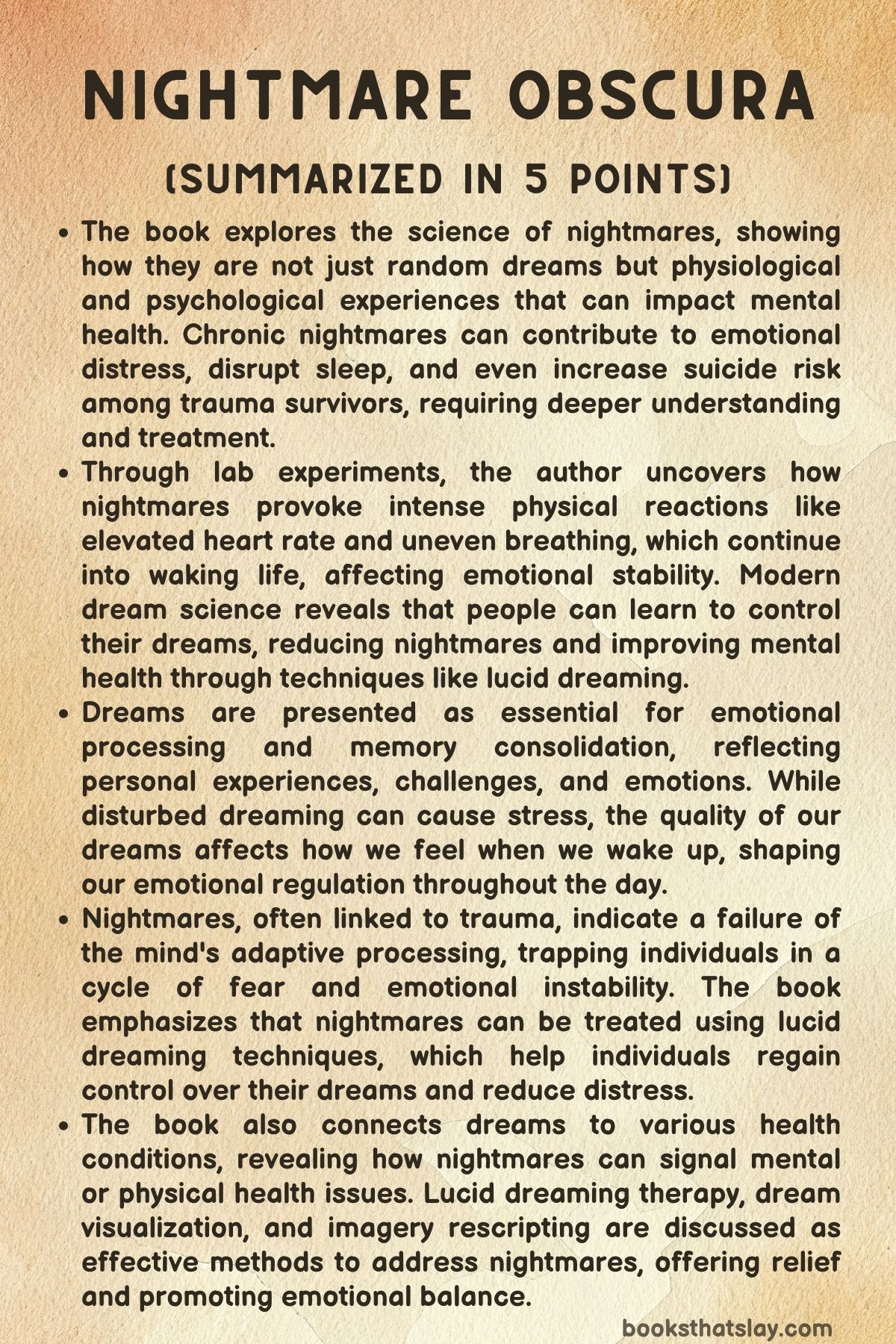
Ultimately, Nightmare Obscura provides a comprehensive look at the science of dreams and nightmares. It outlines how our dreams are not just random occurrences but deeply tied to our psychological and physiological states.
By understanding how dreams work and learning to control them, we can improve our mental health, emotional stability, and overall well-being. The book emphasizes that nightmares, though often distressing, are treatable, and with the right tools, individuals can regain control over their sleeping minds, leading to a more peaceful and restorative sleep experience.
Analysis of the Key People
The Narrator (The Dream Scientist)
The narrator, who is also the central figure in Nightmare Obscura, serves as both the guide and the researcher in exploring the complexities of dreams, particularly nightmares. A dream scientist by profession, the narrator takes on the role of both a passionate investigator and a reflective individual, offering a unique blend of scientific curiosity and personal experience.
This character is not only deeply interested in the mechanics of dreaming but also in the psychological and emotional impact that dreams, especially nightmares, can have on individuals. With an analytical mind and a background in neuroscience, the narrator explains the physiological responses during nightmares and the broader implications on mental health.
Their research into lucid dreaming and its therapeutic applications highlights their proactive approach to solving the complex issues surrounding sleep disorders. Beyond the scientific perspective, the narrator’s personal experiences with lucid dreaming and their growing curiosity about the connection between dreams and mental well-being make them a relatable character.
Their insights reveal the emotional depth and complexity of the human experience with sleep, balancing both professional knowledge and personal reflection in understanding nightmares.
The Lucid Dreamers
Lucid dreamers are portrayed as individuals who have achieved varying degrees of control over their dreams, a skill that becomes a key part of the therapeutic strategies for resolving nightmares. These characters are depicted as both students and practitioners of lucid dreaming, learning techniques to become aware within their dreams and reshape them to alleviate distress.
Their role in Nightmare Obscura is significant, as they represent the potential for overcoming the negative effects of nightmares through conscious engagement. Lucid dreamers are often shown as motivated individuals seeking a way to break free from the cycle of fear and helplessness that nightmares create.
The characterization of these dreamers is both empowering and transformative, illustrating how conscious manipulation of dreams can restore a sense of control and emotional regulation. In the context of therapy, they become active participants in their healing process, using techniques like reality testing and journaling to bring awareness into their sleep cycles.
The lucid dreamers’ ability to reshape their dream environments and manage the emotional intensity within their nightmares highlights their growing mastery over their inner worlds, transforming the very nature of their subconscious experiences.
Patients with Nightmare Disorder
Patients suffering from nightmare disorder represent another key group in Nightmare Obscura, showing the devastating effects of chronic nightmares. These individuals experience frequent, distressing nightmares that interfere with their emotional stability and overall quality of life.
Their nightmares often stem from unresolved trauma, emotional distress, or psychological vulnerability, making them prone to a vicious cycle of poor sleep and heightened anxiety. The patients are depicted as individuals struggling with their inner demons, often caught in an ongoing battle between their conscious and subconscious selves.
Their portrayal highlights the psychological toll that recurring nightmares can take, with the emotional and physical responses to these dreams often spilling over into their waking life. Despite their suffering, these characters are not without hope, as the book presents lucid dreaming and other therapeutic techniques as potential pathways for healing.
The narrative emphasizes that through the right guidance and practice, these individuals can reclaim control over their sleep, thereby improving their mental health and emotional well-being. The depiction of these characters underscores the power of sleep science and therapeutic interventions in transforming their dream experiences and overall outlook on life.
The Researchers and Sleep Lab Staff
The researchers and staff working in the sleep laboratories, including the dream scientist’s colleagues, form an important background cast in Nightmare Obscura, contributing to the scientific exploration of dreams. These characters are skilled professionals engaged in the rigorous study of sleep and dreaming, operating high-tech equipment to monitor brain activity, muscle tension, and emotional responses during sleep.
They assist in the data collection and analysis that underpins the narrative’s exploration of nightmares and lucid dreaming. Though not as prominently featured as the narrator or the lucid dreamers, the researchers play a crucial supporting role in advancing the understanding of sleep disorders.
Their contributions illustrate the collaborative nature of scientific inquiry and the diverse expertise required to explore the intricate connections between brain function, emotional regulation, and the dreaming mind. These characters embody the forward-thinking approach to dream science, with their work helping to establish the foundation for treatments like lucid dreaming therapy and other interventions aimed at improving mental health through sleep.
The Patients of Lucid Dreaming Therapy
The patients undergoing lucid dreaming therapy are significant as they represent individuals actively seeking treatment for their nightmares and emotional distress. These characters are often portrayed as facing the challenges of confronting their fears within the dream world, working with the dream scientist or therapists to learn techniques that enable them to take control of their nightmares.
Their stories are deeply emotional, as they navigate through intense fear and helplessness, only to gradually regain a sense of agency in their dreams. As these patients work through their fears, they begin to use lucid dreaming as a tool to rewrite their nightmares and restore peace to their minds.
These characters symbolize hope and resilience, showcasing the transformative power of lucid dreaming as a form of therapy. Their journeys reflect the potential for healing and personal growth, demonstrating how therapeutic interventions can guide individuals through profound emotional and psychological challenges.
The Subjects of Sleep Lab Experiments
The subjects of the sleep lab experiments, while not always individual characters, serve an important role in Nightmare Obscura as representations of the broader human experience of sleep and dreaming. These individuals participate in studies designed to reveal the mechanisms behind dreams and nightmares, often contributing valuable data that helps the researchers understand the links between brain activity, emotional regulation, and sleep disorders.
While their experiences are generally used to advance scientific knowledge, these subjects indirectly highlight the diversity of sleep experiences across different people, emphasizing that nightmares and dream experiences are not one-size-fits-all but rather shaped by personal histories, psychological states, and emotional challenges.
Through their participation, these subjects reveal the ways in which everyday experiences, emotional stress, and external stimuli influence the content and nature of dreams, providing valuable insight into the complex relationship between sleep and mental health.
Analysis of Themes
The Psychological and Physiological Impact of Nightmares
Nightmares are more than just disturbing experiences; they have a deep psychological and physiological impact that can shape an individual’s emotional and physical well-being. In Nightmare Obscura, the author explores how nightmares, especially chronic ones, can lead to a persistent state of emotional distress and undermine overall mental health.
The physical effects of nightmares are profound, as the body responds to the threat within the dream in much the same way it would in real life—heart rate increases, breathing becomes irregular, and the brain becomes highly active. This physiological response can linger even after waking, leading to heightened anxiety, disrupted sleep, and emotional instability.
For individuals who suffer from trauma or emotional distress, these nightmares can become a source of constant psychological strain, creating a vicious cycle where the nightmares themselves worsen emotional regulation. Over time, the lack of restful sleep and the continual replaying of traumatic or distressing events during sleep can severely hinder a person’s ability to cope with stressors in their waking life.
The book underscores the importance of recognizing these reactions as real physiological responses, showing that the consequences of nightmares extend far beyond the dream itself, affecting an individual’s ability to function and maintain emotional stability.
The Role of Dreams in Emotional Processing and Memory Consolidation
Dreams, as Nightmare Obscura presents, play a crucial role in emotional processing and memory consolidation. The text explains how dreams are not just random mental activity during sleep, but rather a way for the brain to process and make sense of the emotions, memories, and experiences accumulated throughout the day.
The author suggests that dreams help consolidate memories by reactivating recent events and integrating them into broader cognitive networks. This process is vital for emotional regulation, as it allows the brain to sort through memories and emotional experiences, giving them context and meaning.
Dreams provide a platform for the brain to rehearse social interactions, problem-solving strategies, and even emotional responses, creating a simulated environment for dealing with real-life challenges. In particular, dreams are said to help manage emotional distress by allowing the sleeper to reprocess difficult emotions in a safe space.
When this process is disrupted, however, the emotional benefits of dreaming are lost, leading to feelings of unresolved distress. This is particularly evident in chronic nightmares, where the emotional processing intended to soothe and resolve difficult feelings instead perpetuates negative emotional states.
The book emphasizes how disturbances in the dream process can significantly affect one’s ability to regulate emotions and deal with stress in waking life, highlighting the intricate link between mental health and the quality of our dreams.
The Evolutionary Purpose of Dreams
The idea that dreams serve an evolutionary purpose is a significant theme in Nightmare Obscura. The text suggests that, on a biological level, dreams have developed to serve adaptive functions that prepare individuals for real-world challenges.
The recurring dream motifs of being chased, falling, or flying are seen as built-in psychological responses to potential threats, helping to rehearse our responses to danger or emotional adversity in a safe environment. Through dreams, the brain is able to simulate various stressors and social interactions, providing an opportunity to practice emotional and problem-solving skills.
Nightmares, on the other hand, are seen as failures in this adaptive process. When the brain becomes overwhelmed with stress or unresolved emotions, these dreams can shift from adaptive rehearsals to harmful simulations of fear, anxiety, and helplessness.
Such disruptions reflect an imbalance in the brain’s ability to process and cope with negative emotions. The book highlights that while dreams are rooted in personal experience, they also reflect universal themes shared across cultures, suggesting a deep evolutionary connection to human survival.
The notion that dreams help train the mind for adversity and social interactions reveals an important insight into the role of dreams in human development and emotional resilience.
The Therapeutic Potential of Dream Modification
One of the key takeaways from Nightmare Obscura is the potential for therapeutic intervention in the form of dream modification. The text introduces several techniques, such as visualization and lucid dreaming, which empower individuals to take control of their dreams and reduce the negative impact of nightmares.
The author explores how lucid dreaming—where the dreamer becomes aware that they are dreaming and can exert some control over the dream environment—can be a powerful tool for overcoming the distress caused by nightmares. This technique allows individuals to alter the course of frightening dreams, confront fears, and even reshape the dream’s narrative into something more peaceful.
Through these interventions, dreamers can break the cycle of fear and distress, ultimately gaining greater emotional control both in their sleep and waking life. The book suggests that lucid dreaming is not only a form of treatment for nightmares but also a potential avenue for personal growth and emotional healing.
By teaching individuals to recognize the nature of their dreams and intervene consciously, dream modification techniques can restore a sense of agency and reduce the overwhelming power of fear in the dream world. The author’s advocacy for these therapeutic techniques underscores the importance of rethinking the traditional view of dreams as passive experiences, instead viewing them as active, co-creative states that can be harnessed for psychological healing.
The Complex Relationship Between Dreams and Physical Health
The connection between dreams and physical health is another important theme explored in Nightmare Obscura. The text reveals how dreams are not isolated from the body’s physical states; rather, they are intricately linked to the physiological condition of the sleeper.
Dreams often reflect the physical sensations and bodily states experienced during sleep. For example, a person may dream of being immobilized or flying as a result of the physical sensation of muscle paralysis or pressure during REM sleep.
In some cases, dreams can even signal potential health issues before they are physically noticeable, such as in the case of autoimmune diseases or chronic pain, where nightmares may precede flare-ups. The text also describes how sleep disorders, such as sleep apnea, can be linked to disturbed dream patterns.
When physical conditions such as airway obstruction disrupt breathing during sleep, nightmares may be triggered, and treating the underlying health problem can help alleviate these distressing dreams. This highlights how dream content can serve as an indicator of the body’s overall health, providing valuable insights into the internal state of the individual.
Nightmare Obscura suggests that by addressing the physical causes of disturbed sleep, such as through the use of CPAP machines for sleep apnea, it is possible to alleviate both the sleep disorder and its associated nightmares, leading to improved physical and emotional health. This connection underscores the importance of considering both the mind and body in understanding the full scope of dream experiences and their impact on well-being.