No Friend to This House Summary, Characters and Themes
No Friend to This House by Natalie Haynes retells the myth of Jason, Medea, and the Golden Fleece with sharp attention to the women often pushed to the edges of the old heroic stories. Rather than presenting Jason’s voyage as a simple tale of glory, the book shows the cost of ambition, divine interference, betrayal, exile, and survival.
It follows Medea from Colchis to Greece, but also gives space to figures such as Hypsipyle, Helle, Theophane, and Eriopis. No Friend to This House is a mythic story about power, abandonment, and the terrible choices forced upon women by men and gods.
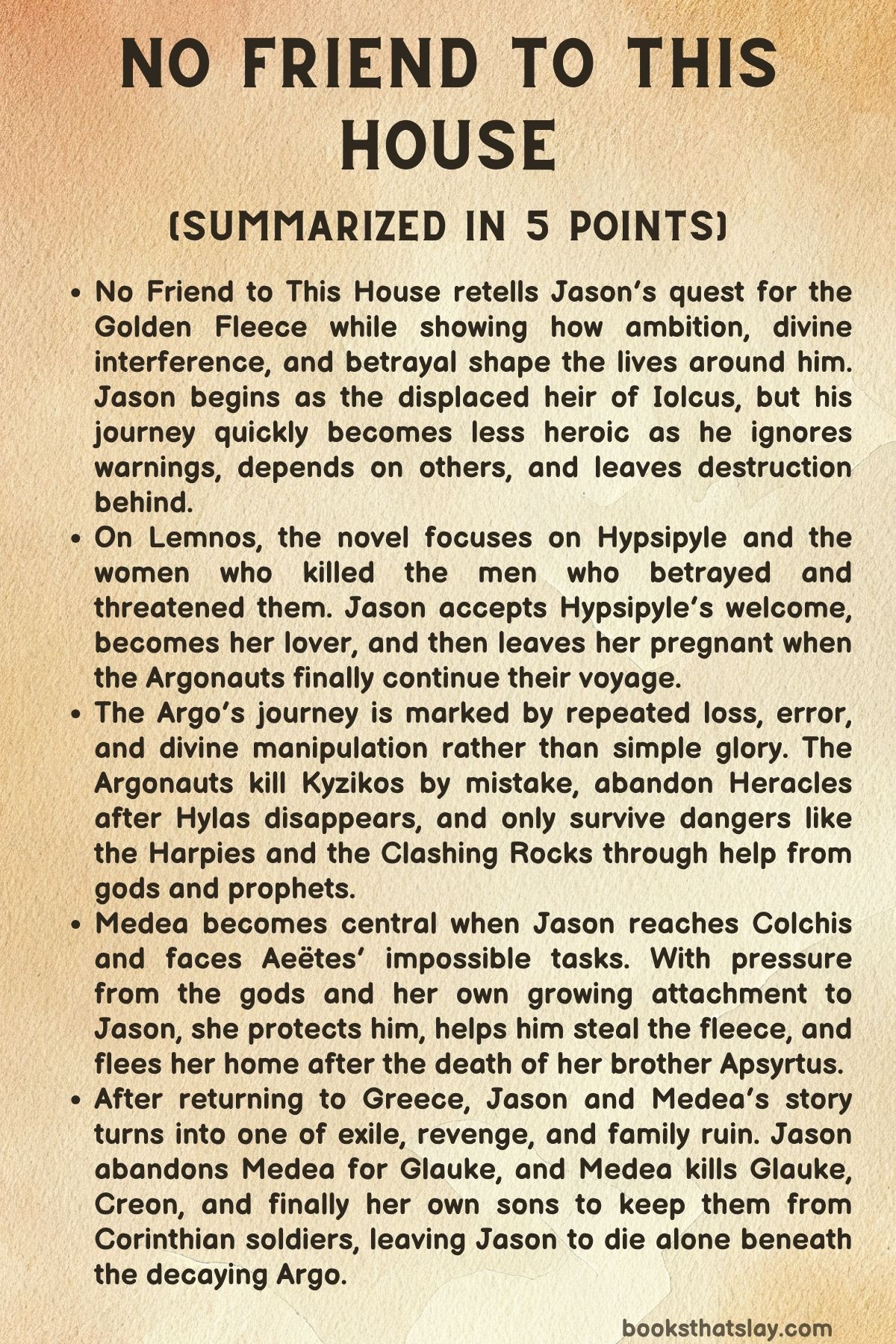
Summary
Jason, the son of Aeson and Alcimede, grows up in Iolcus under the shadow of a stolen kingdom. His uncle Pelias has taken the throne from Aeson and knows that Jason’s existence threatens his rule.
Rather than killing him openly, Pelias finds a more useful way to remove him. He encourages Jason to undertake a perilous mission to Colchis and bring back the Golden Fleece, an object tied to divine marvel, royal power, and death.
Jason accepts the challenge and gathers a band of heroes known as the Argonauts. Together they sail on the Argo, a ship that will become almost as famous as the men aboard it.
Before the voyage begins, Jason receives a warning through Iphias, a priestess of Artemis. He fails to listen.
His carelessness has consequences, because Artemis withdraws her protection from the quest. From the beginning, then, the expedition is not simply dangerous because of seas, monsters, or foreign kings.
It is also marked by divine anger and Jason’s own failure to understand the forces around him.
The Argo first reaches Lemnos, an island ruled by women after an act of collective violence. The men of Lemnos had been cursed by Aphrodite to hate their wives.
They abandoned them for enslaved Thracian women, then killed two Lemnian women and threatened the rest with expulsion. In response, Hypsipyle, Iphinoë, Polyxo, and the other women planned the deaths of nearly all the men on the island, with help from the captive Thracians.
Hypsipyle, however, cannot kill her aged father Thoas. She secretly saves him by sending him away in a boat.
When Jason and his men arrive, Hypsipyle conceals the truth. She welcomes Jason and becomes his lover.
The Argonauts remain on Lemnos far longer than their mission allows, enjoying the women’s hospitality and forgetting the urgency of the quest. Heracles finally shames them into leaving.
Jason departs while Hypsipyle is pregnant, asking that any son born to them be sent to his parents in Iolcus. His request reveals much about him: he leaves responsibility behind but still expects the future to arrange itself around his wishes.
The voyage continues with death and confusion. The Argonauts visit the land of the Doliones, where they are received as guests.
Later, returning there by accident at night, they mistake their former hosts for enemies. In the darkness, they kill King Kyzikos.
His wife Kleite, overcome by grief, dies by suicide. The tragedy shows the repeated pattern of Jason’s journey: the men seek honor, but their movement through the world leaves mourning behind them.
Another loss follows when Heracles breaks his oar and goes ashore at Kios to find a replacement. His beloved companion Hylas goes to fetch water and is taken by a water nymph, an act connected to Aphrodite’s revenge.
Heracles searches desperately for him, but the Argo sails away without both of them. The greatest hero among the Argonauts is left behind, and the voyage continues without the man whose strength had steadied the crew.
The Argonauts next encounter Phineus, a blind prophet tormented by Harpies who steal and foul his food. The winged sons of Boreas drive the Harpies away, but Iris intervenes to prevent them from killing her sisters.
In return for the Argonauts’ help, Phineus tells them how to pass the Symplegades, the Clashing Rocks that crush ships trying to pass between them. The crew sends a dove ahead.
It barely survives. The Argo follows, and though the danger seems certain to destroy them, Athene secretly saves the ship by holding the rocks apart.
The story then looks back to the origin of the Golden Fleece itself. Theophane, abducted by Poseidon and transformed into a ewe, gives birth to Chrysomallos, the Golden Ram.
That ram later rescues Phrixus and Helle, children of Athamas, from being sacrificed after their father is manipulated into turning against them. During the escape, Helle falls into the sea and dies, while Phrixus reaches Colchis.
There he sacrifices the ram and gives its fleece to King Aeëtes. The object Jason seeks is therefore already marked by abduction, transformation, rescue, sacrifice, and the death of a child.
In Colchis, Jason meets Medea, daughter of Aeëtes and priestess of Hecate. Medea’s power is real, but so is the pressure placed upon her.
Hera, Athene, and Aphrodite arrange events so that she will desire Jason and help him. Her feelings are not purely her own; the gods use her as a tool in Jason’s success.
Aeëtes does not intend to hand over the fleece easily. He sets Jason impossible tasks: he must yoke fire-breathing bulls, sow dragon’s teeth, and defeat the armed warriors who rise from the earth.
Jason survives only because Medea gives him magical protection and clear instructions. She tells him how to face the bulls, how to sow the teeth, and how to turn the earth-born warriors against one another.
Jason is praised as the hero, but his triumph depends on Medea’s knowledge, courage, and betrayal of her own family. When Aeëtes still refuses to surrender the fleece, Medea helps Jason steal it and flees Colchis with him.
Their escape comes at a terrible cost. Medea’s brother Apsyrtus is killed, and she carries the guilt of his death for the rest of her life.
The flight from Colchis is not a romantic rescue but a rupture that cuts Medea away from home, family, and innocence. She leaves as Jason’s savior, but also as a woman who has lost almost everything.
Jason and Medea’s journey back is shaped by pollution, fear, and political necessity. They are purified by Circe after the killing of Apsyrtus.
Later, on Phaeacia, Medea is forced into marriage with Jason to prevent her being returned to Colchis. What might be described in heroic legend as a union of lovers is shown here as a legal and social trap.
Medea’s safety depends on her attachment to Jason, even though that attachment has already cost her dearly.
When they reach Iolcus, Medea turns her intelligence against Pelias, the man who sent Jason on the quest. She tricks Pelias’ daughters into killing their father by pretending that she can restore his youth.
This act removes Jason’s enemy but brings no lasting peace. Jason and Medea are exiled.
Eventually they settle in Corinth and have children together.
For a time, their life appears stable, but Jason again chooses ambition over loyalty. He abandons Medea in order to marry Glauke, the daughter of King Creon.
For Jason, this marriage offers status and security. For Medea, it is a public rejection after everything she has sacrificed for him.
Creon banishes her, fearing what she might do, but Medea secures refuge with Aegeus in Athens before carrying out her revenge.
She sends poisoned gifts to Glauke through her sons. The gifts kill Glauke horribly, and Creon dies as well when he tries to save his daughter.
Medea’s revenge destroys Jason’s new marriage and the royal house that welcomed him. Yet the cost does not end there.
Corinthian soldiers pursue Medea’s children, and Helios sends a chariot for Medea’s escape. But he refuses to take her polluted sons.
Faced with the certainty that the soldiers will kill them, Medea kills the boys herself.
Medea escapes with her baby daughter, Eriopis. Years later, Eriopis recounts Jason’s end.
The hero of the Argo dies alone beneath the decaying remains of his famous ship. His pursuit of glory has led not to lasting honor but to abandonment, ruin, and memory shaped by the people he failed.
No Friend to This House ends by turning the heroic legend inside out, showing that the old story of Jason’s success is also the story of Medea’s losses, the deaths of children, and the wreckage left behind by men who call themselves heroes.
Characters
In No Friend to This House, Natalie Haynes presents the myth of Jason and Medea through a wide network of characters whose choices are shaped by ambition, fear, divine interference, family loyalty, betrayal, and survival. The characters are not simply heroic or villainous; they are shown as figures caught inside systems of power, prophecy, revenge, and consequence.
Even minor characters matter because their suffering, silence, or brief intervention helps reveal the larger cruelty of the world in which Jason and Medea live.
Jason
Jason is one of the central figures in the book, but he is not presented as a simple heroic adventurer. He begins as the dispossessed son of Aeson and Alcimede, a young man whose rightful place has been stolen by Pelias, and this gives his journey an appearance of justice and destiny.
However, his character is also marked by weakness, vanity, and a repeated dependence on others. He gathers the Argonauts and sails in search of the Golden Fleece, yet many of his successes come not from his own courage or intelligence but from the help of gods, companions, and especially Medea.
His decision to ignore Iphias’ warning shows an early flaw in him: he is willing to dismiss sacred guidance when it does not suit his confidence or ambition. This failure costs him Artemis’ support and suggests that Jason’s journey is morally unstable from the beginning.
Jason’s relationships reveal even more about his character. With Hypsipyle, he accepts hospitality, intimacy, and loyalty, but leaves her behind pregnant, treating her more as part of his voyage than as someone to whom he owes lasting responsibility.
With Medea, his dependence becomes even clearer. She saves him from Aeëtes’ impossible tasks, helps him obtain the fleece, flees her homeland for him, and carries the burden of terrible crimes committed during their escape.
Yet once Jason has gained from her devotion, he abandons her for Glauke because the marriage offers political security in Corinth. This betrayal exposes his ambition as selfish rather than noble.
By the end of the story, Jason becomes a figure of collapse: once associated with glory, kingship, and heroic adventure, he ends in loneliness beneath the decaying Argo. His death reflects the emptiness of a life built on using others and mistaking achievement for honor.
Medea
Medea is the most tragic and morally complex character in the book. She begins as the daughter of Aeëtes and a priestess of Hecate, connected to power, magic, ritual, and divine knowledge.
When she first sees Jason, her choices are shaped by forces larger than herself, since Hera, Athene, and Aphrodite manipulate events so that she will help him. This makes Medea both responsible and victimized: she acts decisively, but her desire and loyalty are stirred by divine interference.
Her magic allows Jason to survive the fire-breathing bulls, the dragon’s teeth, and the warriors who rise from the earth. Without her, his quest would almost certainly fail.
Yet her help costs her everything: her home, her family, her innocence, and eventually her children.
Medea’s tragedy deepens because her intelligence and power do not protect her from emotional devastation. She carries lifelong guilt for Apsyrtus’ death, and this guilt shadows her even after she becomes Jason’s wife.
In Iolcus, she uses deception against Pelias’ daughters, showing that she is capable of terrifying calculation. Still, her violence often grows from situations in which she has been cornered, betrayed, or threatened.
In Corinth, Jason’s abandonment and Creon’s banishment leave her politically and emotionally isolated. Her revenge against Glauke and Creon is brutal, but it emerges from a world that has repeatedly used and discarded her.
The killing of her sons is the darkest act associated with her, yet the story frames it as an unbearable decision made when Corinthian soldiers are coming for them and Helios refuses to carry polluted boys away. Medea is therefore not merely a villain; she is a woman transformed by betrayal, exile, divine manipulation, and grief into someone who commits unforgivable acts while still remaining deeply human.
Eriopis
Eriopis, Medea’s baby daughter, has a quiet but important role because she survives when so much of Medea’s family line is destroyed. Her survival separates her from her brothers, whose pollution prevents Helios from rescuing them, and it makes her a living reminder of Medea’s final escape from Corinth.
Since she later recounts Jason’s lonely death beneath the decaying Argo, Eriopis also becomes a witness to the ruin left behind by the heroic age. Her perspective matters because she inherits the consequences of Jason and Medea’s choices without having caused them.
She represents continuity after catastrophe, but not comfort. Through her, the story suggests that memory itself can be a burden, especially for those born from violence, betrayal, and exile.
Pelias
Pelias is the character whose ambition sets much of the story in motion. By stealing the throne from Aeson, he creates the injustice that shapes Jason’s early life.
His desire to remove Jason from Iolcus leads him to encourage the dangerous voyage to Colchis, using the quest for the Golden Fleece as a way to send Jason toward probable death. Pelias is therefore not only a political usurper but also a manipulator who hides murder behind heroic language.
He understands the symbolic power of quests and glory, but he uses them cynically to protect his stolen authority.
His eventual death through Medea’s deception is a fitting reversal of his own methods. Just as he manipulates Jason into danger, Medea manipulates his daughters into killing him by pretending she can restore his youth.
Pelias’ end reveals the fragility of power gained through treachery. He tries to control succession, family, and kingship, but he is finally destroyed inside his own household by the trust of his daughters.
His character shows how political violence spreads outward, corrupting not only rulers but also families and future generations.
Aeson
Aeson is important as Jason’s displaced father and as the symbol of the rightful kingship stolen by Pelias. Although he is not as active as Jason or Medea, his position gives Jason’s quest its original moral justification.
Aeson represents a past order that has been broken by betrayal. His loss of power creates the wound that Jason is expected to repair, but Jason’s later behavior complicates the idea that restoring his line would truly restore justice.
Aeson’s significance lies in what has been taken from him and in the way his dispossession shapes Jason’s identity. He is less a driver of action than a reminder that the story begins with a family wrong that expands into a much larger chain of suffering.
Alcimede
Alcimede, Jason’s mother, stands in the background of his heroic identity, but her role is emotionally significant. She belongs to the family from which Jason is separated by Pelias’ usurpation, and she represents the domestic cost of political ambition.
Jason’s request that Hypsipyle send any son to his parents shows that Alcimede remains part of the family structure he imagines continuing through heirs. However, this also reveals Jason’s tendency to think of children and women in terms of lineage and usefulness.
Alcimede’s character helps show the quieter side of the story’s violence: mothers and families are left to absorb the consequences of men’s quests, dynastic struggles, and abandoned promises.
Iphias
Iphias, the priestess of Artemis, plays a brief but meaningful role because her warning marks a point at which Jason could have acted with humility. As a priestess, she represents sacred knowledge and divine caution.
Jason’s decision to ignore her is not just a personal mistake; it is an act of disrespect toward the goddess she serves. Through Iphias, the story shows that warnings are often present before disaster, but pride prevents characters from hearing them.
Her importance lies in the fact that she identifies danger before the voyage begins. Jason’s refusal to listen helps establish the pattern of his character: he moves forward with confidence, but that confidence is often empty and costly.
Artemis
Artemis appears as a divine force whose help Jason loses after he ignores Iphias’ warning. Her withdrawal matters because it suggests that divine support is conditional and that disrespect has consequences.
Artemis is not shown as a goddess who needs to act constantly in order to shape events; her absence itself becomes powerful. By removing her protection, she leaves Jason’s quest more exposed to danger, chaos, and suffering.
Her role also contrasts with the later interventions of other gods, who manipulate events for their own purposes. Artemis’ silence after being ignored feels like judgment, and it reinforces the idea that Jason’s voyage begins under a shadow of spiritual failure.
Hypsipyle
Hypsipyle is one of the most compelling figures connected to Lemnos. She is a queen caught between public survival and private loyalty.
After the Lemnian women plan the massacre of the men who despised, abandoned, and threatened them, Hypsipyle participates in the political lie that protects the women’s new order. Yet she secretly saves her father Thoas, sending him away in a boat rather than allowing him to be killed.
This act reveals her inner conflict: she understands the rage and desperation of the Lemnian women, but she cannot fully surrender her personal love for her father. Her character is therefore shaped by divided loyalties.
Her relationship with Jason adds another layer to her tragedy. She welcomes him, hides the truth about Lemnos, becomes his lover, and is left pregnant when he sails away.
Jason’s abandonment of Hypsipyle foreshadows his later abandonment of Medea. Hypsipyle is not powerless, but she is vulnerable to the way heroic men pass through women’s lives, accepting their help and affection before continuing toward glory.
She represents a form of female leadership born from trauma, but also the pain of being turned into an episode in someone else’s adventure.
Iphinoë
Iphinoë is part of the Lemnian women’s collective resistance. Her importance comes from her participation in the planning of the massacre, which is not presented as a simple act of irrational violence but as a response to betrayal, humiliation, enslavement, murder, and the threat of expulsion.
Iphinoë helps show that the women of Lemnos act as a political community rather than as isolated victims. Through her, the story explores how oppression can turn into organized revenge.
She also helps widen the focus beyond Hypsipyle, making it clear that Lemnos is not only one queen’s secret but a shared female uprising.
Polyxo
Polyxo is another significant Lemnian woman whose role emphasizes the collective nature of the island’s revolt. She belongs to the group that decides survival requires violent action.
Her presence helps show the moral difficulty of the Lemnian episode: the women’s actions are horrifying, but they arise from a situation in which the men have already broken the bonds of marriage, loyalty, and community. Polyxo represents the voice of women who have reached the end of endurance.
Through her, the story examines how fear and rage can become political decision-making when legal or familial protection has disappeared.
Thoas
Thoas, Hypsipyle’s aged father, is important because he is the exception to the Lemnian massacre. His rescue by Hypsipyle shows that love can survive even in the middle of collective vengeance.
He represents the old male order of Lemnos, but he is not treated in the same way as the other men because Hypsipyle cannot erase the bond between father and daughter. His survival also creates danger for Hypsipyle, since saving him means she has betrayed the complete secrecy of the women’s act.
Thoas’ character therefore reveals the tension between justice, revenge, and personal attachment. He is less active than symbolic, but his presence complicates any simple reading of the Lemnian women as either monsters or liberators.
The Lemnian Women
The Lemnian women function almost as a collective character. Their massacre of the men is extreme, but the story gives it a context of abandonment, abuse, and threat.
Aphrodite’s curse causes the men to despise their wives and replace them with enslaved Thracian women, and after two women are murdered and the rest are threatened with exile, the Lemnian women choose violence as their means of survival. Their actions reveal how a society collapses when men treat women as disposable and when marriage becomes a structure of cruelty rather than protection.
At the same time, the massacre leaves the island morally stained. The Lemnian women are victims who become perpetrators, and that transformation is one of the story’s most unsettling explorations of revenge.
The Captive Thracian Women
The captive Thracian women occupy a painful position because they are enslaved and used by the Lemnian men, yet they become involved in the violence that overturns the male order on the island. Their presence reveals that the suffering on Lemnos is not limited to wives.
They are also victims of male desire, conquest, and possession. By helping the Lemnian women, they participate in a temporary alliance between women who might otherwise have been placed in opposition to each other.
Their role exposes the cruelty of a system in which men create rivalry among women while remaining the true source of exploitation.
Heracles
Heracles appears as a figure of strength, directness, and heroic authority. When the Argonauts linger too long on Lemnos, he shames them into continuing the quest, reminding them that their purpose has been weakened by comfort and desire.
His presence contrasts with Jason’s less stable heroism. Heracles seems more forceful and self-contained, but his own story is also marked by loss when Hylas is taken by a water nymph.
His grief over Hylas causes him to be left behind by the Argo, showing that even the strongest hero can be undone by attachment. Heracles’ character reveals that heroic strength does not prevent vulnerability.
His departure from the expedition also weakens the Argonauts and marks the voyage as increasingly fractured.
Hylas
Hylas is Heracles’ beloved companion, and his disappearance is one of the voyage’s most sorrowful episodes. Taken by a water nymph through Aphrodite’s revenge, he becomes a victim of divine interference and supernatural desire.
Hylas does not shape events through power or decision; instead, his importance lies in the grief his loss creates. Through him, the story shows how young and beautiful figures are often consumed by forces beyond their control.
His disappearance also humanizes Heracles, revealing the emotional dependence beneath the hero’s strength. Hylas represents innocence caught inside the dangerous world of gods, heroes, and desire.
Kyzikos
Kyzikos, king of the Doliones, is a tragic figure because he dies through misunderstanding rather than true enmity. He initially receives the Argonauts as guests, but when they accidentally return at night and mistake the Doliones for enemies, he is killed by the very men he had hosted.
His death reveals the chaos of the voyage and the fragility of guest-friendship in a world ruled by confusion and violence. Kyzikos is not destroyed because he is wicked or hostile; he is destroyed because heroic movement itself brings danger.
His fate shows that the Argonauts leave damage even in places where they are welcomed.
Kleite
Kleite, the wife of Kyzikos, embodies the intimate grief caused by heroic violence. Her suicide after her husband’s death shows how one mistaken battle can destroy not only a king but also a marriage and a household.
Kleite’s role is brief but emotionally powerful because she forces the reader to see the consequences of violence beyond the battlefield. She is not simply an extension of Kyzikos; she is the person through whom the full sorrow of his death becomes visible.
Her character deepens the tragedy of the Doliones episode by showing that accidental killing is still devastating, even when it is not motivated by hatred.
Phineus
Phineus is a blind prophet tormented by Harpies, and his suffering gives him a role as both victim and guide. His blindness connects him to prophetic knowledge, suggesting that physical sight and deeper understanding do not always belong together.
The Harpies’ torment has reduced him to misery, but once the Argonauts help him, he gives them crucial advice about passing the Symplegades. Phineus is important because he shows that knowledge often comes from suffering.
He cannot join the heroic action directly, but his insight allows the voyage to continue. His character also reflects a recurring pattern in the story: the Argonauts survive not by Jason’s greatness alone, but through the aid of wounded, marginal, or divinely connected figures.
The Harpies
The Harpies are terrifying figures of punishment and torment. They persecute Phineus by preventing him from eating in peace, turning basic survival into repeated suffering.
Yet the intervention of Iris, who stops the Boreads from harming them, complicates their role. They are not merely monsters to be destroyed; they are also sisters of a goddess and part of a divine order.
Their character function is to show how divine punishment can look monstrous from a human point of view while still being protected by divine relationships. The Harpies bring fear and disgust, but the story does not allow them to be treated as simple creatures outside the moral structure of the gods.
The Boreads
The Boreads are winged sons of the north wind, and their pursuit of the Harpies demonstrates speed, power, and heroic usefulness. They act where ordinary men cannot, chasing the tormentors of Phineus into the sky.
Their role shows how the Argonauts’ success depends on the special abilities of different companions rather than on Jason alone. However, their pursuit is also limited by Iris, who prevents them from killing the Harpies.
This restraint shows that even heroic strength must stop when divine authority intervenes. The Boreads represent action and rescue, but their episode also reveals the boundaries placed on mortal and semi-divine violence.
Iris
Iris appears as a divine mediator who protects the Harpies from destruction. Her role is brief but significant because she interrupts the heroic impulse to solve suffering through annihilation.
As the sister of the Harpies, she brings family loyalty into the divine sphere, reminding the reader that even terrifying beings may belong to relationships that demand respect. Iris’ intervention also shows that the gods do not always side with human relief or heroic justice.
She allows Phineus’ torment to end, but she prevents complete vengeance. Her character represents divine boundary-setting, where mercy, kinship, and authority complicate the heroes’ desire for a clean victory.
Athene
Athene is one of the divine forces shaping the quest. She helps manipulate events so Medea will aid Jason, and she secretly saves the Argo by holding the Symplegades apart.
Her involvement is intelligent, strategic, and decisive. Athene’s aid makes the heroic voyage possible, but it also raises questions about agency.
Jason and the Argonauts appear to achieve great things, yet Athene’s hidden support is essential to their survival. She represents divine intelligence working behind mortal action.
Her character also contributes to the story’s larger pattern of gods using human beings to fulfill designs that may not consider the emotional cost to those involved.
Hera
Hera is another goddess whose influence pushes Medea toward helping Jason. Her role is especially important because she supports the quest not through open battle but through manipulation of desire and circumstance.
Hera’s involvement shows that divine favor can be dangerous even when it appears helpful. She wants Jason to succeed, but the method of that success requires Medea to betray her family, abandon her homeland, and enter a future of exile and grief.
Hera’s character reflects the coldness of divine strategy. She may assist the hero, but she does so by redirecting a young woman’s life toward catastrophe.
Aphrodite
Aphrodite is one of the most destructive divine presences in the story. Her curse on Lemnos causes the men to despise their wives, beginning the chain of abandonment, enslavement, murder, and massacre.
Later, her revenge contributes to Hylas being taken by a water nymph. She also participates in the divine manipulation that makes Medea desire Jason.
Aphrodite’s power is therefore not gentle romance but dangerous compulsion. Love, desire, and attraction become forces that destabilize communities and destroy lives.
Her character reveals how erotic power in myth can be as violent as war. Under her influence, people do not simply choose love; they are driven into obsession, rejection, betrayal, and ruin.
Theophane
Theophane is a victim of Poseidon’s desire, abducted and transformed into a ewe. Her story is important because it lies behind the birth of Chrysomallos, the Golden Ram, and therefore behind the Golden Fleece itself.
Theophane’s transformation shows how women’s bodies are repeatedly changed, moved, and used by gods. Her suffering becomes part of a heroic object’s origin, reminding the reader that famous treasures often conceal stories of violation.
She is not central in terms of action, but she is central to the moral background of the fleece. Through Theophane, the story connects Jason’s quest to a deeper history of divine possession and female erasure.
Poseidon
Poseidon appears through his abduction of Theophane and his role in the birth of Chrysomallos. His character reflects the forceful appetite of the gods, especially their tendency to take what they desire and transform the world around that desire.
Poseidon’s actions are not presented as romantic; they are acts of power. By changing Theophane into a ewe and fathering the Golden Ram, he creates consequences that later shape mortal history.
His role shows how divine acts can become mythic foundations while still being morally troubling. Poseidon is therefore part of the story’s larger criticism of divine power, where gods create wonders through violence and then leave mortals to live with the results.
Chrysomallos
Chrysomallos, the Golden Ram, is both a miraculous rescuer and the source of the fleece that drives Jason’s quest. Born from Theophane and Poseidon, he carries within him a history of divine transformation and violation.
His rescue of Phrixus and Helle gives him a noble role, since he saves children from sacrifice. Yet his later death and the taking of his fleece turn him into an object of political and heroic desire.
Chrysomallos is important because he connects compassion, sacrifice, and exploitation. He saves a life, but his own body becomes the prize that sends Jason and Medea toward disaster.
Phrixus
Phrixus is a child marked for sacrifice by his father Athamas, and his rescue by Chrysomallos gives the Golden Fleece its sacred and tragic background. His survival depends on miraculous intervention, which makes him a figure of innocence saved from family violence.
When he reaches Colchis, he sacrifices the ram and gives its fleece to Aeëtes, transforming a rescue into a relic of power. Phrixus’ character matters because he shows that the fleece is not merely treasure; it is bound to fear, escape, gratitude, and death.
His story also parallels the later suffering of children in the book, especially Medea’s sons, who are caught in the violence of adults and rulers.
Helle
Helle is one of the book’s most poignant figures because she is rescued only to be lost. While Chrysomallos carries her and Phrixus away from sacrifice, she falls into the sea and dies.
Her fate shows the incompleteness of rescue in this world. Divine or magical intervention may save one child while failing another.
Helle’s death gives the story of the Golden Ram a permanent sorrow, reminding the reader that mythic journeys often preserve the names of the lost through tragedy. She represents the vulnerability of children in a world where adult fear, manipulation, and divine forces place them in danger.
Athamas
Athamas is the father manipulated into sacrificing Phrixus and Helle, and his role reveals the horror of parental authority corrupted by fear and deception. As a father, he should protect his children, but he becomes the person from whom they must be rescued.
His character is important because he anticipates later patterns in the story, where children are repeatedly endangered by the decisions of adults. Athamas’ willingness to sacrifice his children shows how religious or political pressure can deform natural bonds.
He is not simply a private failure; he represents a wider world in which rulers and parents can justify cruelty when they believe necessity demands it.
Aeëtes
Aeëtes, king of Colchis and father of Medea, is a powerful and suspicious ruler. When Jason arrives seeking the Golden Fleece, Aeëtes sets impossible tasks involving fire-breathing bulls, dragon’s teeth, and earthborn warriors.
These trials reveal his unwillingness to surrender power and his readiness to destroy strangers through impossible demands. As a father, he is also significant because Medea’s betrayal of him marks one of the deepest ruptures in her life.
He represents the authority of homeland, family, and kingship, all of which Medea must abandon for Jason.
Aeëtes’ refusal to surrender the fleece even after Jason completes the trials shows that he does not respect fairness when power is at stake. Like Pelias, he uses challenge and promise as tools of control.
His character helps create the conditions under which Medea turns against her own family. He is not the only cause of her betrayal, since the gods manipulate her emotions, but his harshness and dishonesty make reconciliation impossible.
Aeëtes stands as a figure of patriarchal power: commanding, possessive, and ultimately unable to prevent the loss of both the fleece and his daughter.
Hecate
Hecate is important through Medea’s identity as her priestess. She represents magic, night, ritual, and dangerous knowledge.
Medea’s connection to Hecate gives her power that ordinary mortals do not possess, but it also separates her from conventional domestic roles. Through Hecate, Medea becomes associated with forces that are both protective and frightening.
The goddess’ presence behind Medea’s magic deepens the sense that Medea’s choices are spiritual as well as emotional. Hecate’s influence helps make Medea formidable, but it also marks her as someone others may fear, misunderstand, or exile.
Apsyrtus
Apsyrtus, Medea’s brother, is one of the central wounds in Medea’s life. His death during the escape from Colchis becomes a source of lifelong guilt for her.
He represents the family bond Medea destroys when she chooses Jason and flight over loyalty to her father’s house. Whether seen as a victim of Medea’s desperation, Jason’s quest, or divine manipulation, Apsyrtus is crucial because his death proves that Medea’s departure from Colchis is not a romantic escape but a bloodstained rupture.
His character haunts the rest of her story. Medea may gain a husband and a future, but she loses her brother, and that loss follows her into every later act of violence.
Circe
Circe appears as the figure who purifies Jason and Medea after the killing of Apsyrtus. Her role is significant because purification acknowledges that a grave pollution has occurred.
She does not erase guilt, but she performs the ritual action needed for the journey to continue. Circe’s presence connects Medea to a wider world of powerful women associated with magic, knowledge, and exile.
Her character functions as a boundary figure: she stands between crime and continuation, between bloodshed and the next stage of life. Through Circe, the story shows that ritual can cleanse pollution in one sense, but it cannot remove memory or emotional consequence.
Glauke
Glauke, daughter of Creon, becomes Jason’s intended new bride in Corinth. She is important not because she drives the betrayal, but because she becomes the symbol of Jason’s attempt to replace Medea with a more politically useful marriage.
Glauke represents status, legitimacy, and safety within Corinthian society. For Jason, she offers advancement and security.
For Medea, she represents erasure: the younger bride who will take her place after all she has sacrificed. Glauke’s death by Medea’s poisoned gifts is horrifying because she is caught inside a conflict created largely by Jason’s ambition and Creon’s power.
She benefits from Medea’s displacement, but she is also a victim of a marriage arrangement designed by others.
Creon
Creon, king of Corinth and father of Glauke, represents civic authority and patriarchal control. When Jason chooses to marry Glauke, Creon protects his daughter and kingdom by banishing Medea.
His fear of Medea is not irrational, because she is powerful and dangerous, but his response also shows how easily a foreign woman can be expelled once she becomes inconvenient. Creon’s authority turns Medea’s private betrayal into public exile.
By forcing her out, he helps push her toward revenge. His death while trying to save Glauke adds tragic force to his character.
He is both a ruler protecting his household and a man destroyed by the consequences of underestimating Medea’s rage.
Aegeus
Aegeus, king of Athens, plays a crucial role because he offers Medea the possibility of refuge. His promise gives her an escape route before she carries out her revenge in Corinth.
Aegeus represents the political importance of sanctuary in a world where exile can mean death. His role also reveals Medea’s intelligence: even in grief and fury, she secures protection before acting.
Aegeus is not central emotionally, but he is structurally important because he makes Medea’s survival possible after Corinth. Through him, the story shows that power often depends on having somewhere to go and someone willing to receive you.
Helios
Helios, Medea’s divine ancestor, intervenes at the end by sending a chariot for her escape. His help confirms Medea’s connection to divine power and prevents her from being destroyed by Corinthian revenge.
However, his refusal to take her polluted sons is devastating. Helios offers rescue, but not complete rescue.
His chariot saves Medea and Eriopis, while forcing Medea into the terrible decision concerning her boys. Helios’ character embodies the cold limits of divine assistance.
The gods may provide miraculous escape, but they do not necessarily heal, forgive, or protect everyone equally.
Themes
Power, Ambition, and Moral Collapse
Power in No Friend to This House is shown as something that rarely remains clean once people begin to protect it. Pelias steals a throne and then sends Jason on a deadly mission, not because the Golden Fleece matters to him, but because Jason’s existence threatens his rule.
His ambition creates the chain of suffering that follows. Jason also becomes shaped by ambition, though his version is less openly cruel at first.
He wants fame, kingship, and heroic status, but he repeatedly accepts help without fully accepting responsibility for what that help costs. Medea’s intelligence and power are used first to protect Jason, then to punish betrayal, showing how political ambition can poison private lives.
The pursuit of status turns family members into obstacles, lovers into tools, and children into victims of adult choices. The story suggests that the hunger for power does not only destroy enemies; it slowly damages the moral judgement of everyone who enters its reach.
Women’s Anger and Survival
Female anger is presented not as sudden madness but as a response to injury, abandonment, and social powerlessness. The women of Lemnos act after betrayal, humiliation, and violence have made ordinary justice impossible for them.
Their actions are terrible, but the story gives context to their rage, showing how ignored suffering can become collective revenge. Medea’s anger follows a similar pattern.
She sacrifices her home, family, safety, and reputation for Jason, only to be discarded when he finds a more useful marriage. Her revenge is horrifying, yet it grows from a world in which women are exchanged, exiled, silenced, or blamed while men protect their public honour.
Hypsipyle, Medea, Kleite, and other women are not treated as simple victims. They think, plan, conceal, resist, and survive in different ways.
The theme exposes how women’s anger becomes frightening to society mainly after society has refused to listen to their pain.
Betrayal and Broken Trust
Trust is repeatedly offered and repeatedly damaged. Jason is trusted by women who risk far more than he does, yet he leaves Hypsipyle behind and later abandons Medea after building his success on her loyalty.
Medea’s betrayal of her father and homeland also shows how love can pull a person into choices that cannot be undone. Hypsipyle betrays her people’s secret by saving her father, but that act also reveals love and mercy inside a violent situation.
The Argonauts accidentally kill those who had welcomed them, turning hospitality into bloodshed through confusion and fear. These betrayals are not all the same, but together they create a world where bonds between family, lovers, hosts, and guests cannot be trusted to hold.
The story treats betrayal as more than a single act of disloyalty. It becomes a force that reshapes identity, leaving characters trapped between what they once promised and what they have done to survive.
Guilt, Responsibility, and the Cost of Survival
Survival in the story often comes with a burden that cannot be escaped. Medea survives Colchis, exile, Corinth, and pursuit, but each survival requires another moral wound.
The death of Apsyrtus remains with her because escape does not erase responsibility. Jason survives many dangers with the help of gods, women, and companions, yet he rarely faces the full cost of his choices until it is too late.
Even heroic success is stained by deaths, abandoned people, and ruined homes. The Argonauts win passage through danger, but their journey leaves grief behind them, from Kyzikos and Kleite to Hylas and the families damaged by Jason’s quest.
The ending reinforces this theme through Jason’s lonely death beneath the decaying Argo. The ship that once represented adventure and glory becomes a reminder of unpaid debts.
Survival, the story suggests, is not the same as victory when it depends on sacrifice that the survivor refuses to honour.