No One Aboard Summary, Characters and Themes
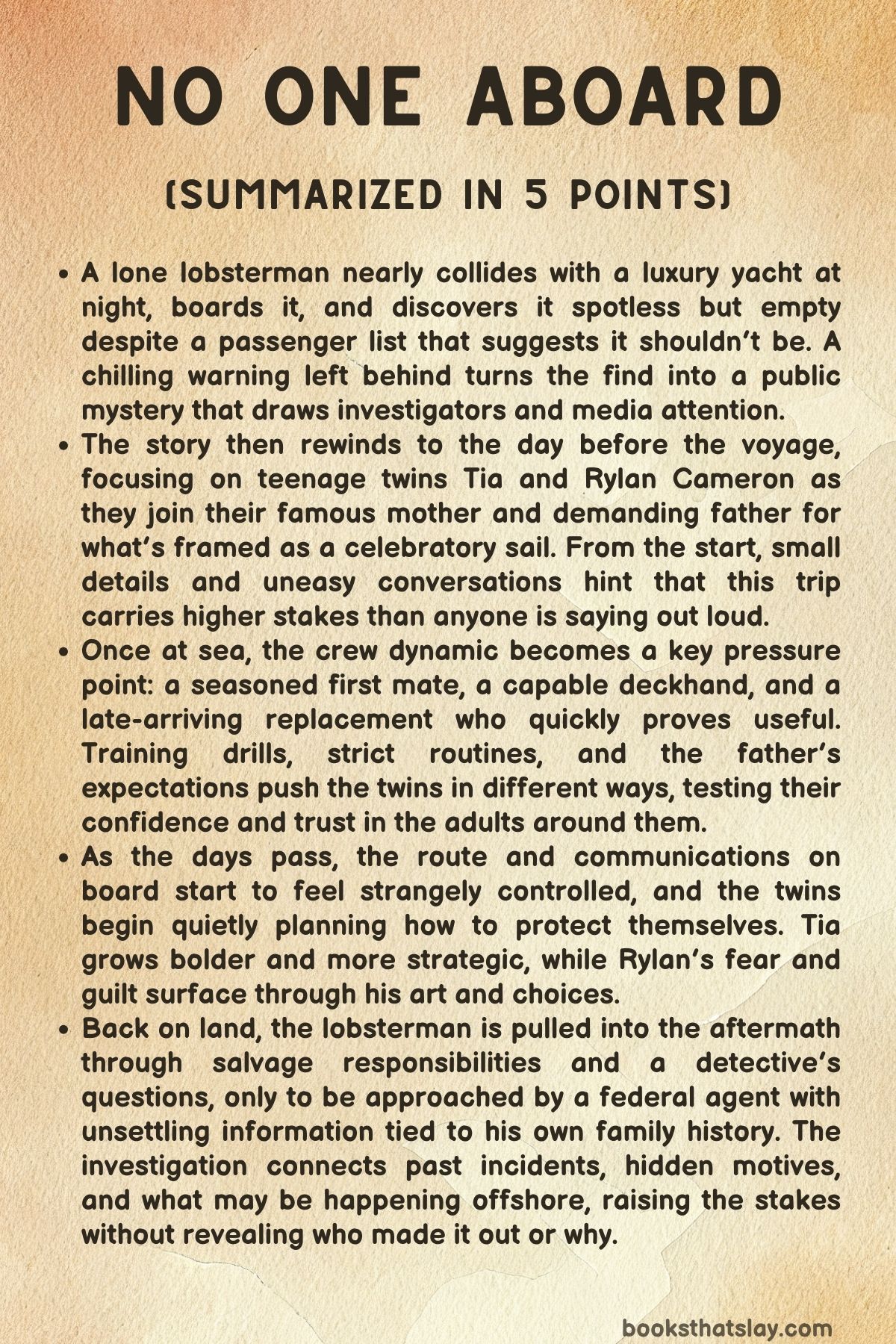
No One Aboard by Emy McGuire is a suspense-driven mystery told through two timelines: the day a luxury yacht is found drifting empty, and the days leading up to the disappearance. When lobster fisherman Jerry Baugh boards the unmanned yacht The Old Eileen, he expects theft or mechanical failure.
Instead, he finds spotless rooms, a cut radio cord, a missing life raft, and a message smeared on a mirror: “SAVE YOUR SELF.” As authorities circle and the media feasts, the story rewinds to the Camerons’ “graduation trip,” where family pressure, secret plans, and a death at sea turn a vacation into something much darker.
Summary
Jerry Baugh is guiding his small lobster boat back toward Hallandale Marina after midnight when his radar shows a large sailboat dead ahead. The vessel is a sleek, high-end yacht named The Old Eileen, and it isn’t responding to radio calls or horn blasts.
Jerry considers moving on—then thinks of his brother Steve, who drowned years earlier while nobody stopped to help. He decides he won’t repeat that kind of indifference.
Jerry climbs aboard with a harpoon gun for protection. The deck is empty.
Inside, everything looks orderly and expensive: clean salon, neat chart house, carefully maintained cabins. A manifest lists seven people aboard: Captain Francis Ryan Cameron; mate MJ Tuckett; crew Alejandro Matamoros and Nicolás “Nico” de la Vega; and passengers Lila Logan Cameron and her teenage twins, Rylan and Taliea “Tia.” Jerry searches every room and finds no one.
In a bathroom, he discovers a warning written on the mirror in red: “SAVE YOUR SELF.” The yacht appears intact, as if the people vanished without a struggle.
News coverage turns the abandoned yacht into a spectacle. Commentators compare it to other sea mysteries and demand answers about why a wealthy family’s boat was found empty about eighty miles offshore.
The case becomes public entertainment, but for Jerry, it feels personal—another unanswered ocean story connected to loss.
The narrative shifts back to the day before the yacht departs from New Haven. Tia arrives from boarding school for a weeklong sail that is meant to celebrate the twins’ graduation.
She senses from the start that this trip is not a normal vacation. Her mother, Lila Logan Cameron—an actress whose fame is fading—greets her with high energy and carefully staged warmth.
Tia notices that Rylan’s belongings are already unpacked with precision in their shared cabin. When Rylan finally appears, Tia sees changes in him: he’s older in a way that isn’t just physical.
He hugs her tightly, but his fear shows through.
Tia tells Rylan she plans to leave their parents after the trip and wants him to come with her. She has thought it through, at least in spirit: she wants freedom and a life not shaped by their father’s control.
Rylan reacts with panic. He says he can’t.
He asks for time to talk later, and his refusal lands like betrayal.
That evening, the family stages a celebration dinner on deck. Alejandro, a longtime crew member, prepares lobster bisque and champagne.
Rylan gives Tia a thoughtful drawing as a gift. Alejandro unveils an extravagant cake, and what starts as celebration turns into chaos when a cake fight breaks out.
For a moment the twins laugh and run like kids again, but the lightness doesn’t last. Under the surface, every exchange carries pressure: who is favored, who is watched, who is expected to perform.
Lila gives the twins luxury gifts, reinforcing the family’s wealth as a substitute for emotional safety. Francis gives Rylan a deep-sea fishing kit and then gives Tia a pearl necklace that unsettles Lila, partly because it matches something she bought and partly because it suggests Francis is tracking details that shouldn’t matter.
Lila receives a call from a sailing friend, Ernie Carmichael, who abruptly backs out of the trip without explanation. Francis insists they will sail anyway and announces a replacement deckhand—someone Alejandro knows only vaguely.
Later that night, the yacht’s mate MJ Tuckett arrives early, bringing a one-eyed Maine coon cat. The cat quickly becomes a strange comfort on board, especially to the twins.
Tia overhears her parents discussing the replacement crewman’s delayed arrival, and the tension spikes. When Tia goes out on deck alone, a figure boards in the dark, startling her.
It’s Nico de la Vega, carrying a guitar case and introducing himself as the last-minute hire.
Day 1 at sea begins in rougher conditions than expected. Francis runs the boat with crisp authority, treating even small mistakes like moral failures.
He orders Rylan to act as lookout with a radio. When the yacht drifts toward a nearby vessel, Rylan freezes, overwhelmed.
Nico steps in calmly, handles the radio, and helps avert a collision. Lila struggles with nausea and the sight of land disappearing, but she steadies herself using the discipline of performance.
While trying to regain a sense of control, she forms a private decision: she needs to do something that makes the world pay attention to her again.
After Jerry reports his discovery, he becomes a target for reporters. He keeps his phone ringer off until a message directs him back to the yacht.
Detective Brenna Madden meets him at the dock. Jerry recognizes her from years ago, before her life took a darker turn.
Brenna explains that authorities searched the yacht, removed personal items as evidence, and now—under salvage rules—Jerry is responsible for the vessel while the investigation continues.
Brenna shares what they found: little evidence of violence, no obvious struggle, and food on board that suggests the trip wasn’t planned as a long disappearance. One of the life rafts is missing, and marks indicate it was likely launched.
Brenna frames this as a reason for hope: the passengers may have left the yacht alive. Jerry argues it makes no sense to abandon a seaworthy boat in open water, especially without distress calls.
Then Brenna reveals one more complication: a cat was found in a cage onboard, still alive. With no family immediately claiming it, Brenna asks Jerry to keep it alive until the case moves forward.
Jerry resists but agrees. Brenna notes a timeline detail that changes everything: Jerry found the yacht just after midnight on June 9, and the last recorded boat check was more than ninety-six hours earlier.
That means at least one person was alive on board around June 5—close to the twins’ birthday.
Back on the voyage, Francis assigns watch rotations and presents Nico as new crew. MJ takes charge of teaching Tia and Rylan basic sailing work, including knots and sail handling.
When MJ grips their shoulders during instruction, it triggers an uneasy memory in the twins—something older and not fully spoken. MJ also warns that Francis’s whistling is bad luck, hinting at superstition mixed with experience.
On Day 2, Francis forces a CPR drill with a mannequin. Rylan panics under pressure and performs poorly.
Francis declares the mannequin dead, using the exercise as humiliation rather than teaching. MJ confronts Francis about both his approach to Rylan and questions about the planned route.
After Francis leaves, MJ corners Rylan and pushes him to say what’s happening at home. Rylan’s fear of his father is not new, and MJ’s insistence makes it clear she sees more than the family wants to admit.
Nico bonds with Rylan at the helm, sharing his own story of dropping out of school and taking work at sea. He also tells a story Alejandro shared: years earlier, a storm-chasing expedition ended with a friend swept overboard and killed.
Two people survived—Alejandro and Francis. The story casts a long shadow, linking Francis’s current authority to a past that may involve more than bad luck.
On Day 3, the yacht approaches Icara Key for a dive. Tia wakes from a nightmare and notices the passageway is wet, as if the boat itself is sweating.
She finds confidence steering at night under Nico’s quiet guidance, using stars to hold course. Before the dive, Rylan tells Lila he no longer feels safe in the water, and the family’s tension snaps into view.
Francis forces Rylan to apologize after he speaks too sharply, treating fear as disrespect. Francis also frames the dive as a stage for “rescue skills,” turning safety into another test.
During preparations, Tia notices maps and a log with coordinates circled—details that don’t match the “weeklong sail to Florida” story. Underwater, Tia dives with Francis while MJ partners with Rylan.
Rylan drifts toward a rocky cave while distracted by the impulse to draw what he sees. A current traps him and pulls him deeper.
MJ reaches him and forces him out of danger, pushing him toward safety. Rylan escapes, but MJ is caught.
In the last moments he sees her reaching for him, struggling, and then slipping away.
When they surface, alarms and frantic movement take over. Alejandro and Nico dive in and return towing MJ’s body.
She is unresponsive and dead. The shock breaks Rylan; he collapses and vomits.
Francis calls it an accident and frames Rylan’s actions as the right choice, but Tia cannot accept the explanation. Lila reveals she found MJ’s heart medication—verapamil—stored in the crew area and had pocketed it.
Alejandro reasons MJ likely suffered a heart attack under stress and depth pressure, panicked, and did not make it back.
Nico argues they must sail to the nearest port and report what happened. Francis refuses.
He insists they will continue and deliver MJ’s body to her family in Florida. The decision locks everyone into Francis’s control.
Alejandro begins reorganizing the freezer, implying a grim practical step: MJ’s body will be stored there.
As the days pass, unease hardens into dread. Pirate, MJ’s cat, behaves as if it senses danger in the boat itself—pacing, fixating on the freezer, acting like something is wrong behind closed doors.
Before dawn on a later day, Tia wakes Rylan and tells him she and Nico found their real destination in the ship’s log. It is not Florida.
It is a tiny, unlabeled island far south, closer to the Bahamas than anywhere safe. Tia wants to radio for help and get off the yacht before they reach it.
She hides the coordinates in Rylan’s raincoat pocket so he is forced into the plan.
Nico puts Tia at the wheel while he takes Rylan below to the chart house. Alejandro is asleep near the log.
Nico shows Rylan the plotted route and the island target. Rylan tries to use the radio.
Nothing works. The reason is immediate and terrifying: the radio cord has been cut cleanly.
The yacht has been isolated since the start.
Tia reacts with fury and desperation. While stuck at the helm, she yanks the wheel hard to starboard, trying to force the yacht toward land.
The sudden move causes a dangerous crash jibe; the boom swings and sails snap, nearly injuring them. Alejandro storms up, takes control, and restores course.
He scolds Tia and strikes Nico for letting her take the helm. When confronted about the cut cord, Alejandro admits it was cut from the beginning “to protect someone”—“ourselves”—and refuses to say more.
Rylan, barely sleeping, fills pages with dark drawings and images of sea monsters, as if he’s trying to trap fear on paper. One night he finds Francis on watch and hears a confession wrapped in wonder.
Francis speaks about his own harsh teenage sailing experience and shows Rylan the glow of bioluminescent water. Then Francis makes the truth plain: this is not a vacation.
He is running away. He talks about changing their lives, about protecting what he built, and about doing extraordinary things so the family will not “fall.” Rylan hears it as a threat dressed up as destiny.
Tia takes Rylan’s news and names it for what it is: they are being taken. She proposes stealing the yacht with Nico’s help.
As a backup, she and Rylan agree on a distress plan: if either signals SOS, they will inflate the life raft and abandon ship together.
Rylan carries another secret that explains his terror. In the past, Francis offered him a bargain: pass nine “tests” at school, and Tia could come home.
Rylan agreed, kept the deal hidden, and failed every test. Tia never knew her return was made conditional on her brother’s performance.
The shame binds him to Francis even as it destroys him.
Meanwhile, Jerry’s part of the story shifts again when FBI Special Agent Koshida approaches him after a hurricane. Koshida says Steve Baugh’s death has been reopened as homicide.
Steve had worked with Francis Cameron and Alejandro Matamoros. What was called an accident is now suspected murder tied to profit, fraud, and sabotage that helped build Francis’s business empire.
A tipster connected to this case was reportedly on the yacht and is now missing. Koshida believes the Camerons are fleeing to a private island outside U.S. waters, and the empty yacht may be the aftermath of that escape plan going wrong—or being interrupted.
On another day at sea, Francis hooks a massive sailfish. He orders Rylan to kill it with a mallet as a test of strength and loyalty.
Rylan freezes, horrified. Nico offers to do it, but Francis refuses.
When Francis walks away and leaves the fish suffering, Tia takes the mallet and kills it herself with three hard blows. She confronts Francis directly, telling him he is what is wrong with all of them.
Soon after, Tia and Nico, charged with adrenaline and fear, hook up in a bathroom. Their connection is messy and urgent, part desire and part escape.
Nico calls Rylan weak, and Tia doesn’t argue. She gives Nico a call sign—Siren—turning their plan into something like a mission, because treating it like a game is easier than admitting how trapped they feel.
By the time the yacht is later found empty, the pieces form a chilling outline: a family under a controlling patriarch, a dead mate stored away, a radio disabled from the start, a course aimed at an unmarked island, and two teens trying to get free with the help of a new crewman they don’t fully know. The missing life raft suggests someone made a last attempt to leave the yacht alive.
The message on the mirror—“SAVE YOUR SELF”—reads like a final warning from someone who understood too late that rescue was not coming from inside the boat.
Characters
Jerry Baugh
Jerry is introduced as an exhausted working mariner whose instincts are shaped as much by routine as by grief. His first reaction to the looming yacht is irritation—until the memory of his brother Steve’s drowning reframes the moment into a moral test he refuses to fail again.
That mix of pragmatism and conscience defines him: he arms himself with a harpoon gun not because he wants violence, but because he understands how quickly the sea turns uncertainty into danger. Once he boards The Old Eileen and finds it eerily preserved, Jerry becomes the story’s grounded witness—someone without wealth or performance to hide behind, trying to make sense of a mystery that keeps expanding.
His role deepens when the law effectively places the yacht in his care; the salvage arrangement dangles a future reward that Jerry doesn’t quite trust himself to want, because it turns catastrophe into opportunity. The cat’s custody pushes him further into reluctant responsibility, forcing him to care for a living remnant of people who may already be dead, and that emotional burden keeps pulling him back toward the truth even when he wants to step away.
Francis Ryan Cameron
Francis is the gravitational force aboard the yacht—charismatic enough to command, rigid enough to suffocate. He operates through “tests,” demonstrations, and controlled crises, turning fatherhood into a proving ground where love is conditional and fear becomes a tool.
His obsession with competence isn’t really about safety; it’s about obedience and the preservation of his self-made mythology, the idea that the family must be “extraordinary” and that ordinary rules do not apply. At sea, he behaves like someone staging a narrative: the route, the “surprise destination,” the insistence on not stopping after MJ’s death, even the sailfish incident—all read as deliberate calibrations of dominance meant to force everyone else to accept his version of reality.
What makes Francis especially dangerous is that he can be tender at the exact moment it will bind someone tighter—his late-night talk with Rylan, the awe of bioluminescence, the hug and “my boy” language—affection delivered like a leash. Beneath the polished captain persona, the later revelations about Steve Baugh and long-running fraud suggest a man who treats people as assets and obstacles, and who flees not out of panic but out of strategic self-preservation.
Lila Logan Cameron
Lila is both performer and survivor, someone who has lived by being watched and fears what it means to fade from view. Her nausea at sea and her use of acting techniques to steady herself show how deeply performance has fused with coping; she doesn’t just play roles, she uses them as scaffolding to stay upright.
Yet her most revealing moments are private: the quiet calculation that she must do something memorable, the discomfort when Francis’s gift to Tia mirrors her own, and the slow emergence of a separate plan “in motion through Alejandro.” Lila’s parenting is complicated and troubling—she favors Rylan’s gentleness, she supported sending Tia away, and she seems willing to trade one child’s freedom for the stability of her marriage and image. Still, she isn’t merely a hostage to Francis; she understands leverage, optics, and timing, which makes her morally slippery rather than simply victimized.
Her decision to pocket MJ’s verapamil is especially telling: it can be read as panic, guilt, control, or self-protection, but in every reading it shows Lila’s instinct to manage the story around crisis, even when the cost is clarity and trust.
Taliea Indigo “Tia” Cameron
Tia is the narrative’s engine of defiance—direct, volatile, and fiercely future-oriented. From the start she experiences The Old Eileen as a force with a pull, but she refuses to interpret that pull as destiny; she wants it to be a turning point she authors, not one imposed on her.
Her plan to leave the family, her blunt confrontation with Rylan in the water, and her readiness to act—steering at night by stars, pushing for radio contact, attempting to force land with a hard starboard turn—paint her as someone who will choose risk over captivity. That boldness, however, is also fueled by desperation and hurt: Tia’s certainty often comes from refusing to sit with helplessness, so she converts fear into motion.
Her relationship with Nico intensifies this pattern, becoming a channel for adrenaline, rebellion, and intimacy that feels like proof she still controls her body and choices. Tia’s most defining moment is the sailfish scene: she does what Rylan cannot, ends the animal’s suffering cleanly, and then names Francis as the source of the family’s damage—an act of moral clarity mixed with rage that also shows how she is becoming the protector her household never provided.
Francis Rylan “Rylan” Cameron
Rylan is shaped by fear that has been trained into him, not chosen, and his gentleness reads less like softness than like a survival strategy in a home where emotional wrong moves are punished. His art is his language—sketches, monsters, morbid images—serving as both refuge and confession, and it’s significant that the story repeatedly frames him drawing when he is most trapped.
The “nine tests” bargain with Francis reveals the core of Rylan’s inner collapse: he accepts a cruel premise (earn your sister back), keeps it secret, fails, and carries the shame as proof he is inherently inadequate. That guilt makes him pliable to Francis’s control and also makes him deeply dependent on Tia’s approval, so he is constantly torn between the two gravitational centers of his life.
Rylan’s involvement in MJ’s death becomes an emotional wound that Francis can manipulate—casting it as accident, responsibility, and a lesson—while Rylan spirals into self-blame. His arc is not just about fear; it’s about the slow, painful formation of consent to resist, seen in the creation of the shared SOS plan and in the moment he finally understands the trip as flight and kidnapping rather than vacation.
MJ Tuckett
MJ arrives as competence with a sharp edge—someone who belongs on a boat in a way that the wealthy passengers do not. Her professionalism is paired with a blunt moral spine: she challenges Francis’s decisions, notices panic as a learning barrier, and refuses to let cruelty masquerade as “training.” The one-eyed cat and her “water bug” encouragement toward Tia make her feel like a stabilizing presence, a person who can turn the ocean from a stage for fear into a place of skill and belonging.
MJ’s confrontation with Rylan—shaking him until he speaks—lands as harsh care, the kind that emerges when someone recognizes danger and refuses polite distance. Her death is pivotal because it removes the only adult on board who openly checked Francis’s authority, and it leaves behind ambiguity that poisons everyone: whether it was accident, medical crisis, preventable risk, or something darker, the aftermath becomes a power vacuum Francis fills instantly.
The detail of her verapamil matters not just medically, but symbolically: her vulnerability was real, and in a world of control and image, her mortality becomes one more thing others handle, hide, or weaponize.
Alejandro Matamoros
Alejandro is the trip’s enforcer in plain sight—competent, physical, and positioned as “crew,” yet clearly embedded in Francis’s deeper agenda. He cooks elaborate food, organizes, handles emergencies, and speaks with the authority of someone who expects to be obeyed, which makes his role feel larger than job description.
The backstory tied to storm chasing and the earlier fatal incident that left Francis and Alejandro as survivors suggests a shared history forged by risk and secrecy, the kind that becomes loyalty or mutually assured destruction. His reaction after MJ’s death—moving her body to the freezer, insisting on procedures, then aligning with Francis’s decision not to stop—shows how he can rationalize the unthinkable through logistics.
The cut radio cord is the clearest expression of his function: isolation as control, communication as threat, escape as something to be prevented “to protect someone,” which reads like the rhetoric of abusers who rename domination as safety. Later, the FBI framing of long-term fraud and Steve Baugh’s death pushes Alejandro from “intimidating crewman” into accomplice with decades of practice at making accidents convenient.
Nicolás “Nico” de la Vega
Nico enters as charm wrapped in mystery: a replacement crewman arriving in darkness with a guitar case, immediately carrying the aura of someone who can improvise identities. On board, he becomes the twins’ bridge to competence and possibility—calm during the near-collision, patient at the helm, willing to show the charts, willing to attempt radio contact—yet he is also morally unreadable in ways that matter.
His intimacy with Tia feels genuine in its heat and urgency, but it also functions as alliance-building, and his comment that Rylan is “weak” reveals a value system that could slide easily into Francis’s worldview of strength tests and contempt for fear. Nico’s call sign “Siren” captures his dual nature: an escape song and a danger song at once, attraction that might save or wreck.
His most important trait is adaptability—he can be soothing, daring, complicit, or resistant depending on who holds power in the moment—which makes him either the most plausible lifeline on the yacht or the most plausible betrayer.
Pirate
Pirate, the one-eyed Maine coon cat, operates as more than a pet; he is the story’s living barometer of dread. His presence ties directly to MJ, so after her death he becomes a moving reminder that someone was lost and that the yacht is carrying grief in a cage.
The recurring suggestion that Pirate “knows more than everyone thinks”—his strange behavior near the freezer, his insistence, his timing when waking Rylan—casts him as an uncanny witness, a creature responding to subtle cues humans miss or refuse to face. Pirate also forces caretaking in characters who would rather not feel: Jerry’s reluctant custody, Rylan’s comfort-seeking, the boat’s eerie emptiness contrasted against one small life that continues.
In a story obsessed with control, Pirate represents the uncontrollable—instinct, hunger, attachment, and the stubborn fact of a body that needs care even when the humans are disappearing.
Brenna Madden
Brenna is a pragmatic investigator with personal history that makes her interactions with Jerry emotionally charged even when she tries to keep them procedural. Her professionalism shows in what she emphasizes: evidence collection, the missing life raft, the painter line, the timeline of the last check, the urgency of hurricane season—she thinks in logistics because logistics are what rescue depends on.
Yet her brief mention that Ida is dead, and the awkwardness that follows, suggests she carries private loss that mirrors Jerry’s, which may be why she is both firm and oddly humane when she asks him to keep the cat alive. Brenna’s biggest function is to keep hope technically plausible—people could be alive because the raft is missing—while also grounding the mystery in rules and consequences, like salvage ownership and evidence removal.
She embodies the tension between compassion and bureaucracy: the desire to find survivors constrained by process, jurisdiction, and time.
Special Agent Koshida
Koshida arrives like a door being kicked open in the larger narrative, shifting the mystery from eerie disappearance to targeted flight. His focus on Steve Baugh reframes Jerry’s past grief as part of a long pattern rather than a random tragedy, and by linking Francis and Alejandro to profit, fraud, and sabotage, he turns the yacht into a moving crime scene with history.
Koshida’s approach is controlled and strategic—he withholds, reveals, and directs attention toward the “tipster” who is now missing, implying there were forces on The Old Eileen beyond family drama and accidental death. He also acts as the story’s moral counterweight to the Camerons’ self-mythology: where Francis calls his actions protection, Koshida names them homicide and exploitation.
Even without extensive page time, his presence expands the stakes from personal escape to criminal reckoning.
Steve Baugh
Steve is physically absent but narratively central: the wound that shapes Jerry’s ethics and the anchor that ties the present-day mystery to a buried past. The fact that no one stopped to help him when he drowned becomes Jerry’s defining regret, the reason he boards The Old Eileen when it would be easier not to.
When Koshida reopens Steve’s death as homicide, Steve becomes more than tragedy—he becomes evidence of a pattern in which Francis and Alejandro turn danger into profit and write off bodies as “accidents.” Steve’s role is thus twofold: he motivates Jerry’s compassion, and he exposes the Camerons’ darkness as something longstanding rather than newly emerged at sea.
Ernie Carmichael
Ernie functions as an early warning signal—an offstage voice whose sudden withdrawal implies that something about the trip is wrong before the characters fully understand it. His abrupt cancellation and hang-up feel less like inconvenience and more like fear or knowledge he cannot safely share.
Even with limited presence, he helps establish that the voyage is not simply a family holiday; it is already orbiting secrecy, last-minute changes, and an agenda that makes seasoned sailing friends back away.
Lainey
Lainey is a small but important human tether for Jerry, representing ordinary companionship and the possibility of life continuing outside the yacht’s shadow. Her presence after Hurricane Ida places Jerry in a world of cleanup and routine, emphasizing how the mystery intrudes on working-class reality rather than staying confined to wealthy scandal.
When Jerry impulsively invites her fishing, it reads like a grasp for normalcy—an attempt to reclaim a simple version of the sea that isn’t filled with disappearance, evidence, and FBI agents.
Ida
Ida appears only through absence, but the blunt fact of her death adds quiet weight to Brenna and to the story’s overall atmosphere of loss. She also subtly mirrors the broader theme that people vanish from lives in ways that feel abrupt and unresolved, whether by ocean, accident, illness, or violence.
Ida’s mention deepens the emotional texture of Brenna’s scenes, showing that the investigation is carried out by people who are not untouched by grief.
Themes
Isolation as Control
On The Old Eileen, isolation isn’t just a setting; it becomes a method. Once the yacht leaves the coastline behind, the family’s options narrow in ways that feel physical and emotional at the same time.
The open ocean removes ordinary escape routes—no neighbors, no teachers, no friends, no police station down the road. That emptiness gives Francis Cameron room to shape reality for everyone on board.
He dictates schedules, watch rotations, drills, and even what information is allowed to circulate. The cut radio cord turns that control into something literal: communication isn’t merely difficult, it is made impossible.
When Tia and Rylan discover the severed line, they don’t just realize a device is broken; they realize someone anticipated their need for outside help and chose to block it. The ocean then stops being freedom and starts feeling like confinement.
This theme gains strength because the isolation also affects perception. After MJ’s death, the normal structures that could challenge Francis’s decisions aren’t available.
Nico’s suggestion to report at a port is shut down, and the group is forced to accept a plan that benefits Francis’s timeline rather than anyone else’s safety. The body being kept onboard compounds the sense of being trapped with consequences that can’t be processed in a healthy way.
Even Jerry Baugh’s discovery of the empty vessel reflects isolation differently: a ship that should be full of life feels staged, silent, and unreachable, as if the ocean has swallowed context along with people. The story keeps returning to how distance from society can be used to rewrite what is “reasonable,” turning extreme choices into the only choices.
Power, Fear, and Family Hierarchy
The Cameron family runs on a hierarchy that looks polished from the outside but operates through fear underneath. Francis holds authority not simply because he is the father and captain, but because he ties love, approval, and belonging to obedience.
His “tests” for Rylan are a concentrated example of this: instead of offering care when the family is fractured, he sets conditions for connection and makes Rylan responsible for earning Tia’s presence in the household. Rylan’s secret failure becomes a private shame that Francis’s system produces on purpose—because shame is useful.
A child who believes he has failed morally is easier to steer, easier to silence, and less likely to trust his own instincts.
Fear shows up in the smallest interactions. Rylan freezing during the near-collision, panicking during CPR practice, and struggling underwater isn’t just personal anxiety; it’s the consequence of being trained to associate mistakes with punishment and humiliation.
Even when Francis appears gentle—hugging Rylan at night, calling him “my boy,” speaking about wonder in the glowing sea—there is always an edge of possession. The affection arrives paired with a message: your life is tied to my plan.
Tia’s response to this system is different. She resists more openly, challenges Francis, and acts when others hesitate, but her boldness is also shaped by the same environment.
She has learned that waiting for permission never works. The family hierarchy therefore damages both twins in opposite ways: it trains Rylan toward compliance and Tia toward confrontation, and the gap between them becomes another tool Francis can exploit.
Identity Under Performance Pressure
Several characters are forced to perform versions of themselves, and the cost of that performance keeps rising. Lila Logan Cameron lives with the public memory of her celebrity, and the story shows her responding to the ocean’s blank horizon with a craving to be remembered.
That need for recognition isn’t framed as shallow; it is presented as something that affects her choices as a mother and as a partner. When her fame feels like it is fading, she begins to treat significance like a problem that needs solving.
Her acting techniques help her steady herself physically, but the same mindset also encourages her to treat life as something that can be staged, managed, and directed. Even moments that should be intimate—gift-giving, family dinners—carry a layer of display.
The luxury items, the pearls, the elaborate cake: they function like props that reinforce who the Camerons are supposed to be.
Rylan experiences performance pressure in a more painful way because his identity is constantly measured. The “tests,” the demand to kill the sailfish, the insistence that he prove himself under his father’s gaze—these are attempts to force him into a version of masculinity and toughness that doesn’t fit him.
His art becomes both refuge and evidence: his drawings show what he can’t safely say, and they also mark him as “soft” in the eyes of people who equate sensitivity with weakness. Tia’s identity struggle runs on a parallel track.
She believes she knows who she is—someone who will leave, someone who will fight—but she still has to ask herself whether her independence is real if she can’t bring her brother with her. Even her relationship with Nico carries this tension.
The attraction is genuine, but it also becomes a space where she tries on a sharper, more decisive version of herself, one that can survive the situation. Across the book, identity isn’t treated as a stable trait; it’s treated as something shaped by who is watching, who is judging, and who holds the power to reward or punish.
Trauma, Guilt, and the Search for a Story That Makes Sense
After MJ dies, the characters don’t only deal with loss; they deal with the mind’s demand to explain loss. Rylan’s guilt forms instantly because he was closest to the moment and because he already carries a lifelong habit of blaming himself.
His panic underwater becomes more than fear of drowning—it becomes fear of being responsible for another death. That guilt then spreads into behavior: sleeplessness, compulsive drawing of disturbing images, and a sense that he is becoming the kind of person his father says he is.
The tragedy also becomes a pressure point between family members. Tia immediately senses that the official explanation doesn’t satisfy the emotional reality of what happened, while Francis insists on a narrative that keeps the trip moving and keeps his authority intact.
The book also shows how trauma interacts with secrecy. Lila finding and pocketing MJ’s heart medication is especially charged because it suggests she is trying to understand the death while also controlling the information around it.
Whether that act comes from suspicion, fear, or calculation, it reinforces how grief is never allowed to be simple on this ship. Every detail is evaluated for what it could mean, who it could blame, and how it could threaten the family’s image or plans.
Rylan and Tia’s distress signal—SOS—becomes a coping mechanism as much as a strategy. It gives them a shared story they can hold onto: if things become unbearable, they have a rule, a plan, and a promise to act “together.” That promise is important because trauma tends to isolate people inside their own minds.
Their pact pushes back against that isolation, even as the circumstances keep forcing them into fear and suspicion.
Loyalty, Betrayal, and Moral Compromise
The central relationships keep testing what loyalty actually means when safety is at stake. Tia’s loyalty to Rylan is the anchor of her choices: she wants freedom, but she wants it with him, and the possibility of leaving alone feels like its own kind of betrayal.
Rylan’s loyalty is more conflicted because he has been trained to equate loyalty with obedience, especially toward Francis. He can recognize that something is wrong and still feel drawn to his father’s approval.
That split creates moral paralysis. When Francis orders him to kill the sailfish, Rylan’s refusal isn’t just squeamishness; it is a refusal to participate in a ritual designed to harden him and bind him tighter to Francis’s value system.
Tia stepping in to kill the fish is morally complicated too. She ends the animal’s suffering, but she also accepts the role of the one who can do what others can’t, which feeds a new kind of self-image—more capable, more ruthless, less afraid of blood.
The moment is victory and damage at the same time.
Betrayal operates on multiple levels. The severed radio cord implies premeditation by someone onboard, and that shifts everyone’s understanding of their situation.
If help was blocked from the beginning, then the trip wasn’t merely risky—it was designed to reduce outside interference. Alejandro’s claim that the cord was cut “to protect someone” introduces a justification that sounds like care but functions like a threat: the crew and captain have decided what safety means, and it does not include the twins’ right to call for rescue.
Nico complicates the theme further. He helps Tia and Rylan uncover the destination and tries to support their attempt to reach out, yet he also judges Rylan as “weak” and uses the family’s crisis as a space to bond with Tia through intensity.
Loyalty in the story is therefore rarely pure. It keeps getting tangled with desire, fear, ambition, and survival, forcing characters to choose between protecting someone and becoming someone they don’t fully recognize.
The Ocean as Judgment, Not Romance
The sea in No One Aboard is not treated as a dreamy escape; it acts like a harsh measure of what people are made of. It exposes skill gaps quickly—steering, watch duty, diving safety—and it punishes mistakes without caring about intention.
The near-collision on the first day shows how quickly panic can become danger. MJ’s death underscores that the ocean doesn’t need villains to be lethal; pressure, currents, and stress can end a life even when no one wants it to happen.
But the book also shows how people use the ocean to justify decisions. Francis leans on the authority of the environment to support his authority as captain: the idea that the sea demands discipline, toughness, and obedience becomes his argument for controlling others.
At the same time, the ocean strips away social masks. Away from land, the family’s wealth can’t buy normal protection, and fame can’t summon help.
Lila’s realization about her fading celebrity hits harder because the horizon offers no audience. The ocean becomes a place where the usual currencies—money, reputation, charisma—don’t guarantee outcomes.
Even the bioluminescent water, which briefly calms Rylan, carries a double meaning. Wonder exists, but it doesn’t cancel danger; it sits beside it.
That balance reinforces the book’s tone: beauty can appear in the same frame as fear, and the presence of wonder can be used to distract from the fact that someone is being controlled. By the time the yacht is found empty, the ocean’s role as judgment becomes final: it has erased the people’s whereabouts while leaving behind an immaculate stage, daring everyone to decide what story explains the absence.