No One Can Know Summary, Characters and Themes
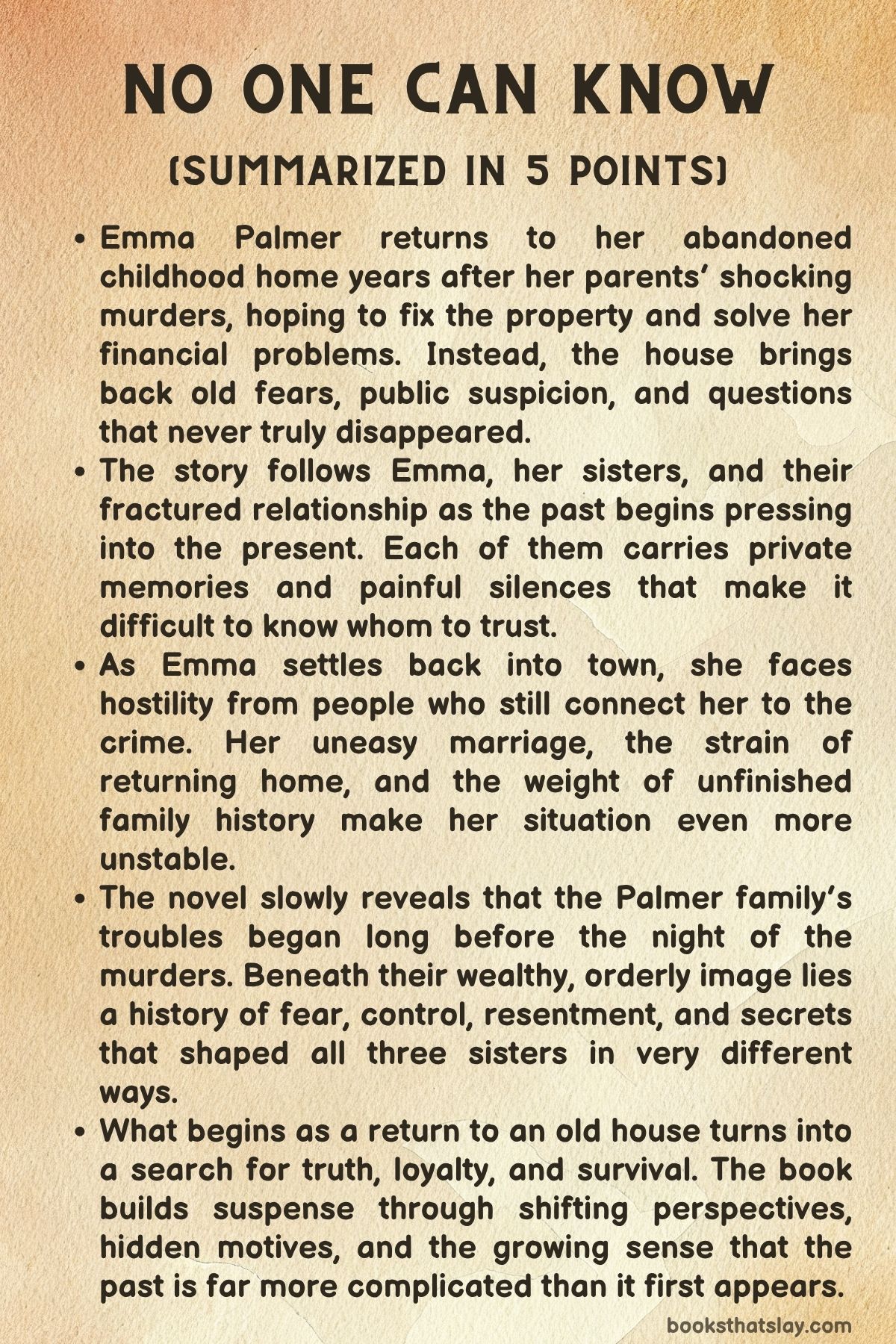
No One Can Know by Kate Alice Marshall is a psychological suspense novel about three sisters bound by trauma, secrecy, and a crime that never truly stayed in the past. Fifteen years after their parents were found shot dead in the family home, Emma Palmer returns to the place she has spent years avoiding.
What follows is not just a murder mystery, but a story about abuse, memory, fear, and the ways families can both protect and damage one another. The novel builds its tension through shifting perspectives and buried truths, showing how survival can leave people carrying versions of the same night that do not fully match.
Summary
Fifteen years after her parents were murdered, Emma Palmer returns to her childhood home in Arden Hills, Colorado. She does not come back out of nostalgia or choice.
She is pregnant, her husband Nathan has lost his job, and the two of them are deep in debt. Nathan persuades her that moving into the long-empty Palmer estate is the only practical option.
His plan is simple on the surface: fix the property, get Emma’s estranged sisters to agree to a sale, and use the money to start over. For Emma, though, the house is the site of the worst night of her life.
When she was sixteen, she came home in the early hours of the morning and found her parents dead from gunshot wounds. She called the police, but the missing weapon and her own lies about that night made her the main suspect.
Emma has carried that burden ever since. She never told the full truth because she believed one or both of her sisters, Juliette and Daphne, were involved.
That belief shaped the rest of her life. The sisters were separated after the murders, and whatever remained of their bond was slowly worn down by distance, silence, and fear.
Returning to the house forces Emma to face both the town’s suspicion and the memories she tried to bury.
The hostility begins almost at once. People in town still remember the Palmer murders, and Emma feels their judgment in small encounters.
Inside the house, she and Nathan find graffiti accusing her of being a killer. The damage is ugly, but what unsettles Emma more is how quickly the past starts to feel present again.
She remembers how she cleaned up parts of the scene before calling the police, told her sisters to change their clothes, and gave investigators a false story about all three of them sleeping in the treehouse. She did all of it to protect them.
As Emma settles uneasily into the house, the novel reveals the family’s history through alternating past and present perspectives. The Palmer household was ruled by control, cruelty, and emotional violence.
Their mother Irene was manipulative and punishing. Their father Randolph was physically abusive and obsessed with authority.
Juliette, the eldest, learned to survive by appearing perfect and obedient. Emma pushed back, wanting a different future through art and independence.
Daphne, the youngest, was observant, intense, and often underestimated. She loved her sisters deeply, noticed everything, and quietly absorbed the family’s ugliest truths.
Emma’s teenage life had included a close connection with Gabriel Mahoney, the grandson of her art teacher Lorelei. The police treated Gabriel as a likely accomplice, partly because Emma lied about being with him on the night of the murders.
That lie left him without an alibi and turned him into another target of suspicion. In the present, his reappearance unsettles Nathan and stirs old feelings in Emma, but Gabriel also becomes one of the few people willing to help her uncover what really happened.
Nathan, meanwhile, becomes more troubling the longer Emma stays in the house. At first he seems practical, if insensitive, but his need for control grows harder to ignore.
He monitors Emma’s movements, questions her interactions, and treats her history like an inconvenience that reflects badly on him. Emma begins to recognize familiar patterns in him, ones she had spent years teaching herself to excuse.
The marriage she believed was stable begins to look far more fragile.
Juliette, now known as JJ, has built a new life for herself with her girlfriend Vic. She is wary of Emma’s return because she fears the past will destroy the stability she fought to create.
Daphne, now working in end-of-life care, lives nearby and has secretly kept watch over both of her sisters for years. She is still protective, still vigilant, and still willing to cross boundaries if she thinks it will keep Emma safe.
Each sister has spent years holding pieces of the truth, and none of them fully trusts the others.
As Emma starts asking questions, she learns more about her parents than she ever knew as a teenager. Randolph may have been involved in organized cargo theft.
Irene was hiding secrets of her own, including drug use and fear that her husband’s crimes were closing in on the family. Emma remembers a flash drive connected to the night of the murders, something she took from a lockbox while preparing to run away from home.
She dropped it without realizing it, and Daphne found it. That drive becomes central to both the old murders and a new one.
The past sharpens through revelations about what happened on the night Randolph and Irene died. Juliette had snuck out to meet Logan Ellis, the police chief’s son, and spent time at the abandoned Saracen House.
She was intoxicated, emotionally shaken, and trying to understand her attraction to girls in a home where such feelings would have been met with hatred. She returned home hours later to chaos and blood, but for years even she could not fully trust her memory.
Daphne, on the other hand, remembered more than anyone realized. She had found evidence on the flash drive linking Randolph to serious crimes and had overheard him planning to “take care of” the problem after the drive was discovered.
Before Emma can get to the full truth, violence erupts again. One night Nathan is found shot dead in the carriage house.
Emma discovers his body and immediately becomes the obvious suspect in the eyes of local police. The same old assumptions return, now strengthened by her history.
But state investigators become involved, and Emma, helped by Gabriel and her lawyer Chris, begins digging deeper. Security footage shows that JJ visited the house shortly before Nathan died, and Nathan himself appears to recover the missing flash drive from the carriage house.
Emma learns he had been in contact with the police chief and had likely planned to use the house sale, his affair, and her reputation to strip her of everything, including her child.
At the same time, the old case begins to crack open. The flash drive contains evidence that Randolph was involved in a criminal operation and links him to the death of Kenneth Mahoney, Gabriel’s father, who had discovered irregularities in Randolph’s trucking business.
Officer Hadley, once Randolph’s friend and one of the original investigators, is tied to that criminal circle as well. Emma realizes that Hadley has spent years trying to control the story around her family.
He also sent anonymous letters that helped keep the sisters apart.
When Emma finally gathers JJ and Daphne together, long-hidden truths come out. JJ admits that her memory suggests she may have killed their parents, or at least held the gun that night.
She remembers blood, yellow wallpaper, and the white-handled gun, but not enough to be certain. Daphne then reveals what she saw: Irene had already been shot and was suffering; Randolph was dead in his study; JJ was holding the gun in shock.
For years, Daphne protected both sisters by hiding evidence and staying silent.
The crisis comes when Hadley intercepts Emma and JJ, demanding the flash drive at gunpoint. Logan has just confessed that Hadley once took possession of his gun, connecting him to the weapon used in both the old murders and Nathan’s death.
JJ tries to save Emma by driving at Hadley, but she loses control on the bridge and sends the car into the river. The sisters escape, only to face Hadley again on the bank.
Daphne, who has been tracking Emma’s phone, arrives in time. In the struggle, Hadley is overpowered and left gravely injured.
Police later find the gun and flash drive in Hadley’s possession, making him the prime suspect in the murders of Randolph, Irene, Nathan, and Kenneth. Officially, the case appears solved.
But the truth is more complicated than the authorities realize.
Daphne finally confesses that she killed Nathan. She found him in the carriage house with the gun and flash drive, heard enough to know he intended to destroy Emma and take her child, and shot him in the struggle.
She then planted the evidence to frame Hadley. Later, in the final revelation, it becomes clear that Daphne also killed Randolph years earlier.
As a child, she believed he was about to murder the family to protect his secrets. She used the gun Hadley had given Irene for protection and shot Randolph in the head.
Irene then took the gun, sent Daphne away, and soon afterward killed herself. JJ came downstairs in time to see only the aftermath and carried that confusion for years.
In the end, Emma chooses not to expose Daphne. The sisters, damaged but reunited, remain together.
Emma gives birth to a daughter, Wren, and begins building a quieter life at the old house. She also opens herself to a future with Gabriel.
The central mystery is solved only in part by the official story, but for Emma the deeper answer lies elsewhere: the danger was never the outside world alone. It began inside the home, where fear ruled everything, and where survival turned three sisters into keepers of truths they could barely bear.
Characters
Emma Palmer
Emma stands at the center of the novel as the sister who has spent the longest time living under suspicion, blame, and self-erasure. As a teenager, she is the child who resists the family’s rigid control most openly.
She wants art school, independence, and a life beyond the narrow future chosen for her by her parents. That refusal makes her the obvious scapegoat long before the murders happen.
Her anger is visible, her unhappiness cannot be hidden, and her desire to leave home gives others an easy story to tell about her. Yet the deeper truth of her character is not recklessness but endurance.
She takes on the role of protector in the immediate aftermath of the killings, cleaning the scene, directing her sisters, and crafting a false story that places suspicion on herself rather than on them. That decision shapes the rest of her life.
Emma grows into adulthood carrying guilt, fear, and an identity formed by survival rather than freedom.
In the present timeline, Emma’s character is defined by the cost of that long survival. She has learned to make herself smaller in relationships, especially in her marriage to Nathan.
She avoids conflict, buries her instincts, and accepts controlling behavior because peace feels safer than confrontation. This is one of the most important aspects of her characterization: she has not escaped her childhood patterns as fully as she thinks.
Her marriage repeats the logic of her upbringing in subtler ways, with her needs pushed aside and her perceptions doubted. Returning to the family home forces Emma to confront not only the mystery of her parents’ deaths but also the damaged version of herself she has been living with for years.
What makes Emma compelling is that she gradually begins reclaiming the self that was buried. The pregnancy raises the stakes of every choice she makes, because she can no longer think only about her own pain.
She wants a different future for her child, and that desire pushes her toward truth even when truth threatens to destroy what remains of her life. Her investigation is therefore emotional as much as criminal.
She is trying to solve a murder, but she is also trying to understand the system of fear that shaped her and her sisters. By the end, Emma becomes stronger not because she gains perfect knowledge, but because she stops surrendering her judgment to others.
She accepts that love does not require self-betrayal, that family loyalty can be complicated, and that some truths remain partial. Her ending is not built on innocence in a simple legal sense, but on a hard-won ability to live without allowing the past to define every part of her identity.
Daphne Palmer
Daphne is one of the most unsettling and fascinating characters because she combines fragility, intelligence, watchfulness, and moral ambiguity in a way that resists easy judgment. As a child, she is seen by others as odd, quiet, and overly interested in strange things such as poisons, animals, and patterns that most people miss.
Adults underestimate her because she does not demand attention in obvious ways. In reality, she is the sister who sees the most and understands danger earliest.
Her silence is not emptiness but observation. She recognizes the emotional weather of the house, senses threats before the others fully name them, and understands that adults lie, manipulate, and conceal their motives.
That awareness gives her a unique role in the story. She is both witness and actor, the keeper of information that no one else fully possesses.
Daphne’s childhood is shaped by profound vulnerability. Her asthma, panic attacks, and sensitivity become tools through which her mother exerts control, creating a terrifying environment in which Daphne is taught to doubt even her own physical reality.
This is crucial to understanding her later character. She grows up in a setting where care and cruelty are tangled together, and where she learns that survival may require actions other people would call extreme.
Her devotion to her sisters becomes the most stable principle in her life. She loves them in a practical, vigilant way rather than through open emotional expression.
Even as an adult, she watches them from afar, monitors their lives, and crosses ethical boundaries because she believes protection matters more than permission.
As an adult, Daphne works in end-of-life care, which is a fitting extension of her character. She is someone who thinks in terms of suffering, mercy, and difficult thresholds.
Her profession suggests calm objectivity, but beneath it is the same child who once confronted pain too early and too often. She is capable of tenderness, but her tenderness is inseparable from control.
She decides what must be done and then does it, whether others understand or not. That makes her both admirable and frightening.
Her confession near the end confirms what the novel has been suggesting all along: Daphne does not divide the world into clean moral categories. She acts according to what she believes will keep her sisters safe, even when those actions involve violence, deception, and framing another person.
Daphne’s final position in the story is especially complex because she is neither exposed nor entirely known. Emma realizes she will never fully understand her youngest sister, and that recognition carries a strange kind of peace.
Daphne remains a character whose love is real, but whose methods are shaped by trauma so severe that protection and destruction can exist side by side in her mind. She embodies the novel’s darkest idea about family: sometimes the person who saves you is also the person carrying the heaviest, most dangerous secret.
Juliette Palmer / JJ
Juliette, later known as JJ, is the sister whose life reveals the cost of perfection. In childhood, she is the obedient daughter, the polished one, the girl who practices the piano, follows rules, and seems most capable of succeeding within the family’s expectations.
But this outward composure is not a sign of ease. It is a role she has taken on to manage chaos.
Because Emma rebels, Juliette feels pressured to absorb the opposite function in the household: she must be the compliant child who keeps the peace. That pressure leaves her deeply split.
On the surface, she performs control and refinement; underneath, she is frightened, resentful, lonely, and increasingly unable to contain the parts of herself that do not fit the world her parents demand.
Her hidden life becomes central to her character. She is drawn toward risk, secrecy, and forbidden desire, especially in her encounters outside the house.
Her attraction to girls carries enormous emotional force because it exists in direct conflict with her father’s violence and the family’s strict, punishing worldview. Juliette’s terror is not abstract.
She has every reason to believe that being known fully could lead to rejection, humiliation, or worse. This fear helps explain her fragmented memory of the night of the murders.
The intoxication matters, but so does the fact that she is already living in a state of emotional fracture. By the time catastrophe strikes, she is a young woman already struggling to hold herself together.
As JJ in adulthood, she has remade herself with visible effort. Her name, style, relationship, and professional life all signal distance from the girl she once was.
Yet reinvention has not erased the past. She is guarded, defensive, and deeply anxious about reopening old wounds because she knows how unstable memory can be.
One of the strongest elements in her characterization is that she carries both gratitude and shame toward Emma. She knows Emma protected her, but she also knows that protection came at an enormous cost.
Her avoidance of her sisters is not simple selfishness. It reflects trauma, fear, and the fragile structure of the life she has built.
JJ is also important because she represents uncertainty. For much of the book, she appears as a possible killer, a damaged witness, and a sister who may know more than she is willing to say.
That uncertainty is not just a plot device; it reflects how trauma distorts self-knowledge. JJ cannot initially distinguish what she remembers, what she fears, and what she has perhaps unconsciously rewritten in order to survive.
By the end, she emerges as someone more honest with herself, but not fully healed. Her strength lies in her willingness to return, to speak, and to stand beside her sisters even when certainty is impossible.
She is not the perfect child anymore, and that is part of her liberation.
Nathan
Nathan is one of the novel’s most revealing characters because he first appears ordinary enough to pass as a stabilizing partner. He offers practical solutions, talks about finances, and positions himself as the adult willing to handle a difficult situation.
That surface normality matters because it mirrors how controlling people often present themselves. He is not introduced as openly monstrous, which allows the story to show how domination can enter a relationship through small permissions, subtle pressure, and emotional framing rather than overt threat alone.
Emma initially experiences him as the safe opposite of her chaotic past. Over time, however, it becomes clear that he benefits from her old conditioning.
He is comfortable when she yields, doubts herself, and prioritizes his comfort over her instincts.
Nathan’s character is built around selfishness disguised as concern. He frames his surveillance, questioning, and decision-making as practical or protective, but these actions consistently narrow Emma’s freedom.
He wants information, access, and leverage. His interest in the house is not merely financial necessity; it becomes part of a larger pattern in which Emma’s inheritance, reputation, and vulnerability can all be turned to his advantage.
His affair reveals the emotional emptiness beneath his marriage, but the greater betrayal lies in his plan to use Emma’s past against her. He is willing to exploit the town’s suspicion and even the possibility of her losing custody, which shows that his ambition has displaced any genuine loyalty.
Nathan is especially effective as a character because he is not written as a dramatic villain from the start. He is the kind of person whose moral emptiness becomes visible only under pressure.
This makes him thematically important. He shows how someone with no history of severe visible violence can still recreate a familiar structure of coercion for a survivor of abuse.
Emma’s awakening to his nature is one of the novel’s emotional turning points because it proves that she has begun to trust her own judgment again. Even after his death, Nathan remains significant, since the truth about him changes how Emma understands her marriage, her compromises, and the false life she had been preserving.
Gabriel Mahoney
Gabriel functions as both a connection to Emma’s past and a contrast to the damaging men who have shaped much of her life. When Emma was a teenager, Gabriel represented art, freedom, and a world outside the Palmer house.
He treated her with seriousness and kindness at a time when her own parents denied her interior life. The rumor that he was her boyfriend became part of the story used against her, but the truth is more restrained and more meaningful.
He cared for her, protected her as best he could, and refused to exploit her vulnerability. That distinction becomes very important in the present, because Gabriel is one of the few people tied to Emma’s youth who can be reexamined and found fundamentally decent.
As an adult, Gabriel carries scars of his own. Emma’s lie left him exposed to police suspicion for years, and he has every reason to resent how the past damaged his life.
His first response to her return reflects that pain. Yet he does not remain fixed in bitterness.
Once he understands the seriousness of what Emma is facing, he helps her investigate, shares family history, and becomes a steady source of emotional support. This does not make him a simplistic rescuer.
He has boundaries, frustration, and his own losses, especially concerning his father. But he is written as someone capable of care without domination, which sets him apart sharply from both Randolph and Nathan.
Gabriel’s role also extends into the mystery itself through his family history. His father Kenneth’s disappearance is tied to Randolph’s criminal world, meaning Gabriel is not just a romantic possibility but part of the larger web of buried violence.
This gives his character narrative weight beyond emotional support. By the end, Gabriel represents the possibility of a healthier future for Emma, but not because he magically solves her life.
Rather, he is meaningful because with him she does not have to distort herself into someone else’s expectations. Their connection suggests that trust after trauma is possible, though only after painful clarity.
Irene Palmer
Irene is one of the most difficult characters to judge because she is both perpetrator and victim. For much of the novel, she appears through the daughters’ memories as a cruel, controlling mother who humiliates, manipulates, and harms her children.
She enforces obedience, destroys Emma’s artistic ambitions, mocks Daphne’s suffering, and contributes to the atmosphere of terror that governs the house. She is not a passive participant in Randolph’s abuse but an active source of psychological damage in her own right.
Her parenting is built on domination rather than care, and the girls grow up learning that their mother’s approval is unstable, conditional, and often impossible to earn.
At the same time, later revelations complicate her position. Irene is also trapped inside a marriage shaped by fear, secrecy, and criminal corruption.
She is having an affair with Hadley, using drugs, and apparently gathering evidence against Randolph. These details do not erase her cruelty, but they do show that she is living under serious pressure and threat.
She knows more about Randolph’s crimes than her daughters do, and she appears increasingly desperate as the danger closes in. This makes her a morally tangled character rather than a flat villain.
She can terrorize her children and still be frightened herself. She can inflict harm and still try, in a final and catastrophic way, to interrupt greater violence.
Her final act is one of the novel’s most haunting ambiguities until the end clarifies it. The official story formed by police is cleaner than the emotional truth.
Irene did not simply die as an innocent casualty. She became part of the last desperate chain of events that ended the family as it had existed.
What remains most powerful about her character is not redemption but contradiction. She is someone whose choices damaged her daughters profoundly, yet whose last actions may also have been shaped by a terrible effort to contain danger.
The daughters inherit both her violence and her fear, which is why her presence continues to shape the story long after her death.
Randolph Palmer
Randolph is the clearest embodiment of patriarchal violence and private corruption. He rules the household through fear, physical abuse, humiliation, and rigid control over every possible future his daughters might imagine.
He is the force against which each sister defines herself differently: Emma through resistance, Juliette through compliance, and Daphne through silent observation. His authority is not merely domestic.
He expects ownership over his family’s bodies, thoughts, and choices. His brutality is often immediate and physical, but it is also ideological.
He believes his daughters exist within a narrow structure of obedience, and any movement outside that structure feels to him like betrayal.
What makes Randolph especially chilling is the gradual revelation that his violence extends beyond the home. He is not just an abusive father but a man implicated in serious criminal activity.
His trucking business appears connected to organized cargo theft, and Kenneth Mahoney’s disappearance points to murder beyond the household walls. This expansion matters because it shows continuity between public respectability and private cruelty.
Randolph’s social standing protects him, allowing the town to see him as successful and authoritative while his family experiences him as dangerous. The split between appearance and reality is one of the novel’s central moral patterns, and Randolph embodies it completely.
Even after his death, Randolph’s influence remains active. His daughters still make decisions in relation to the fear he created.
His expectations remain lodged inside them, shaping how they love, hide, and judge themselves. He is important not because he is psychologically subtle, but because he establishes the environment that makes every later secret possible.
He is the origin point of the house’s terror, the man whose authority poisoned the family long before the murders occurred.
Officer Rick Hadley
Hadley is one of the novel’s most sinister figures because he combines intimacy, institutional power, and criminal opportunism. He begins as a familiar adult in the sisters’ lives, close to Randolph and present in the original investigation.
That position gives him enormous influence over how events are interpreted. He is able to question vulnerable children, steer suspicion, and disguise coercion as official procedure.
His connection to the family is not external. He belongs to the same social world, knows the household’s dynamics, and uses that knowledge to manipulate rather than protect.
As the story develops, Hadley emerges as a figure who has benefited from nearly every structure that failed the Palmer sisters. He is tied to Irene through an affair, tied to Randolph through criminal partnership, and tied to the murder investigations through policing.
This overlap makes him emblematic of corruption in its most personal form. He is not a distant conspirator but a man whose power comes from being embedded in the town’s systems of trust.
He helps shape the narrative that Emma is dangerous, sends letters that keep the sisters apart, and remains close enough to events to suppress, distort, or redirect suspicion whenever necessary.
Hadley is also carefully written to preserve uncertainty for much of the novel. He is clearly threatening, but the full extent of his guilt remains unstable until late in the story.
This uncertainty matters because it shows how difficult it is to separate legal blame from actual truth in a world where power distorts evidence. By the time he is exposed, he has become the convenient answer to several crimes.
Yet even then, the sisters know the official story is not complete. Hadley’s final significance lies in this tension.
He is absolutely guilty of major wrongdoing, but he also becomes a vessel into which a town can pour a simpler story than the real one. That makes him both villain and cover.
Chris Best
Chris serves as one of the few steady figures in Emma’s life, but his importance goes beyond simple loyalty. As the family lawyer, he occupies a position near the center of the Palmer family’s public respectability while never fully belonging to its moral corruption.
Years earlier, he helped shield Emma when the evidence against her remained insufficient, and in the present he again becomes one of the rare adults who treats her as someone worth protecting rather than managing. His belief in her innocence has emotional value because it exists in contrast to the town’s suspicion and Nathan’s weakening faith in her.
Chris is not portrayed as all-knowing or heroic in a dramatic sense. He does not possess the full truth and cannot prevent every danger.
What he offers instead is something structurally important: a measure of lawful support in a story crowded with broken institutions. He respects process more than the local police do, advises caution, and helps create the small space in which Emma can defend herself.
His character also helps reveal the extent of corruption around the case, especially once connections emerge between Randolph’s crimes, Hadley’s role, and Chief Ellis’s failures.
What makes Chris valuable as a character is his restraint. He does not dominate the story, but his presence helps anchor Emma when everything else becomes unstable.
In a novel filled with adults who failed the sisters, Chris stands out precisely because he does not demand that Emma surrender her judgment in exchange for help.
Logan Ellis
Logan is a morally compromised but revealing figure whose presence ties together adolescence, memory, policing, and guilt. In the past, he is part of Juliette’s secret life, offering excitement, drugs, and escape.
He is also careless and self-serving, the kind of person who can exploit someone’s vulnerability while still convincing himself that he cares. His relationship with Juliette is shaped by unequal emotional footing.
She is frightened and confused; he is more worldly, more casual, and more comfortable moving through danger. He gives her access to a hidden life, but not safety.
In the present, Logan becomes important because he carries pieces of the truth that were never properly confronted. He reveals information about Irene’s drug use, his own past dealings, and what he did after finding Juliette in shock the night of the murders.
One of his most consequential admissions is that he helped direct suspicion toward Emma to shield Juliette. That choice captures his character well.
He is capable of loyalty, but his loyalty is compromised, partial, and often damaging to someone else. He solves immediate problems by creating larger moral ones.
Logan’s role is not to become redeemed but to expose how many people around the sisters made choices based on convenience, fear, and self-protection. He is neither mastermind nor innocent bystander.
He belongs to the story’s broad field of compromised men who contribute to harm without necessarily understanding the full scale of what they are doing.
Chief Craig Ellis
Chief Ellis represents institutional weakness shading into corruption. Compared with Hadley, he may initially seem less openly menacing, but his role is still deeply important.
He downplays threats, treats serious incidents casually, and participates in the local environment that has long treated Emma as an easy suspect. As more information surfaces, Ellis appears connected to mismanagement and possibly to the wider criminal network that surrounded Randolph’s operations.
Even where he is not the principal architect of violence, he is part of the machinery that allows violence to stay hidden.
His relationship to Nathan becomes particularly revealing. Nathan contacts him after discovering evidence, which suggests Ellis is still positioned as someone through whom dangerous information passes.
Whether out of greed, fear, or habit, he does not function as a trustworthy guardian of justice. Instead, he reinforces the novel’s larger point that official titles do not guarantee moral authority.
Ellis matters less as an individual psychology than as a sign of how institutions fail when they become entangled with local power and old loyalties.
Lorelei Mahoney
Lorelei brings warmth, memory, and continuity into a story otherwise dominated by intimidation and secrecy. As Gabriel’s grandmother and Emma’s former art teacher, she symbolizes one of the few nurturing influences in Emma’s adolescence.
She recognized Emma’s talent and offered her a space where creativity could exist without punishment. That role makes her deeply important, even though she is not at the center of the mystery.
In practical terms, she helped Emma imagine another self beyond the identity imposed by her parents.
Lorelei also carries grief connected to Kenneth’s disappearance and Gabriel’s difficult upbringing. Through her, the story gains a perspective shaped by endurance without cruelty.
She has suffered, but she has not turned that suffering into domination. Her recollections help complicate the assumptions around Kenneth and expose Randolph’s lies.
She therefore contributes both emotional softness and narrative correction. In a novel where homes are often dangerous, Lorelei’s presence suggests what adult care might have looked like if Emma had grown up under different conditions.
Kenneth Mahoney
Kenneth is largely an absent figure, but his absence is active and consequential. His disappearance links the family’s private tragedy to broader criminal violence in the town.
Through scraps of evidence and the memories of others, he emerges as a flawed man with a temper and struggles of his own, yet not the monster some have assumed. He discovered irregularities in Randolph’s business and likely paid for that knowledge with his life.
Because he cannot speak for himself, Kenneth becomes a contested memory, shaped by rumor, class prejudice, and convenience.
His importance lies in how his fate expands the meaning of the murders. The danger surrounding the Palmer house was never only domestic.
Kenneth’s death shows that Randolph’s world extended into organized criminal activity and that the same secrecy threatening his daughters had already destroyed another family. Kenneth’s story also deepens Gabriel’s role, giving emotional and investigative stakes to his involvement with Emma in the present.
Vic
Vic has less page time than the central sisters, but she plays an important stabilizing role in JJ’s adult life. She represents the future JJ has built away from the house, one based on openness, partnership, and chosen family.
Vic’s caution about Emma and the past is understandable because she can see how dangerous that history remains for JJ’s emotional stability. She is not cold or obstructive for the sake of plot; she is someone trying to protect the person she loves from a force that once nearly destroyed her.
Vic matters because she highlights the difference between old and new forms of intimacy. With Vic, JJ has a relationship not structured by performance for parental approval or by panic over forbidden desire.
Even though Vic stays somewhat at the margins, her presence confirms that JJ’s life is not defined only by trauma. There is a real world waiting for her outside inherited fear.
Addison
Addison is not deeply developed on the page, but she plays an important functional role in exposing Nathan’s real motives. Through the affair, the reader sees that Nathan’s emotional betrayal is tied to financial calculation.
His relationship with her is not merely a private failure of fidelity; it is part of a scheme involving Emma’s inheritance, the sale of the house, and future custody of the child. Addison therefore helps reveal the extent to which Nathan viewed Emma as a route to gain rather than a partner.
Even in limited appearances, Addison’s significance lies in what she uncovers about male opportunism. She is one of the means through which Emma finally understands that her marriage was sustained by illusion.
That recognition becomes necessary for Emma’s eventual freedom.
Themes
Family as the First Site of Danger
The house at the center of No One Can Know is not frightening because outsiders invade it. It is frightening because the threat has long been inside it, built into ordinary routines, parental authority, and the logic of family loyalty.
The novel keeps returning to the idea that danger often arrives in intimate forms first. Emma, Juliette, and Daphne are not shaped by one terrible night alone.
They are shaped by years of fear, punishment, and control that teach them how to read footsteps, moods, tones of voice, and sudden shifts in power. The murders matter, but they become legible only when placed against this earlier domestic terror.
This theme gives the novel much of its emotional force because it refuses the comforting distinction between home as shelter and the outside world as threat. The Palmer house is spacious, wealthy, and socially respectable, yet it is the least safe place in the sisters’ lives.
Randolph and Irene govern the family through humiliation, coercion, physical violence, and emotional manipulation. Even the daughters’ identities are formed through adaptations to danger.
Emma becomes defiant, Juliette becomes polished and compliant, and Daphne becomes quiet and hyperaware. None of these responses are personality traits in a simple sense; they are survival methods learned inside a hostile environment.
The novel also shows how this damage continues long after the original source is gone. Emma’s marriage to Nathan repeats elements of control she had once accepted as normal.
Juliette’s adulthood is shaped by secrecy and by the need to perform stability. Daphne continues to love through surveillance and intervention because she learned early that waiting passively can be fatal.
In this way, family is not only the setting of trauma but the structure through which later relationships are understood. The book’s final insight is especially sharp: locking gates and fearing public suspicion never addressed the core problem.
The sisters were taught to fear the outside, but the true danger was always inside the home. That reversal is what makes the ending resonate.
Survival does not come from escaping a single event. It comes from finally naming the house itself as the original source of fear.
Secrecy, Protection, and the Moral Cost of Love
Secrets in this novel are not decorative devices meant only to create suspense. They are part of the emotional architecture of survival.
Each sister hides something, but the reasons differ, and that difference matters. Emma lies to protect her sisters and ends up sacrificing her own future.
Juliette hides because memory, shame, and fear make honesty feel impossible. Daphne hides because she believes knowledge is safest in her own hands, especially when adults and institutions have already failed them.
The result is a world in which concealment is both an act of love and a source of further damage.
What makes this theme so powerful is that the novel does not sort secrets neatly into good and bad categories. A secret can preserve someone for years and still injure them deeply.
Emma’s original lie keeps suspicion away from her sisters, but it also traps her inside public blame and private isolation. Daphne’s silence protects the family from legal ruin and from the total collapse of the sisters’ bond, yet it also means Emma spends years without the truth that might have changed how she understood her own life.
Even the letters that keep the sisters apart operate in this field of secrecy and protection, because their estrangement is sustained by the belief that distance may be the only way to keep one another safe.
Love itself becomes morally unstable under these conditions. The novel asks what counts as care when ordinary methods of protection have failed.
Daphne’s choices are rooted in devotion, but they cross lines that cannot be easily excused. Emma’s loyalty is admirable, but it is also tragic because it requires self-destruction.
Juliette’s silence looks like abandonment from one angle and from another like the broken response of someone who barely survived. The book does not celebrate secrecy, but it understands why traumatized people rely on it.
That understanding prevents the story from becoming a simple lesson about honesty. Truth matters here, but truth arrives late, unevenly, and at great cost.
By the end, the sisters remain bound not by complete openness but by a more difficult form of recognition. They accept that love in their family has often taken distorted forms.
Protection has come mixed with fear, silence, and violence. The novel’s achievement lies in showing that the moral cost of love is sometimes impossible to separate from the conditions under which that love was forced to operate.
Trauma, Memory, and the Instability of Truth
Memory in the novel is not a neutral record of facts waiting to be retrieved. It is damaged territory.
Characters remember in flashes, substitutions, bodily reactions, and partial scenes that only later begin to align. This treatment of memory is central to the way the mystery works, but it is also central to the emotional realism of the story.
The sisters do not simply choose not to tell the truth. In several cases, they do not fully possess it in a coherent form.
Trauma has broken experience into fragments, and those fragments return unpredictably.
Juliette’s recollections are the clearest example of this. For years she associates the night of the murders with disconnected images and sensations rather than a stable narrative.
Her intoxication contributes to that confusion, but the deeper cause is psychic shock. She cannot trust herself because what she remembers is incomplete and terrifying.
Emma, too, lives with a selective understanding of the past. She knows certain physical facts, but she has built emotional explanations around them that turn out to be wrong or only partly right.
Daphne perhaps remembers most clearly, but even her relation to memory is shaped by the habit of withholding and by the certainty that some truths are safer when hidden.
The theme becomes even more significant because official truth proves unstable as well. Police theories, town gossip, and legal suspicion all create narratives that are easier to manage than the actual complexity of events.
Emma becomes the obvious suspect not because the evidence is complete, but because her known anger fits a story people are ready to believe. Later, Hadley becomes the convenient answer to multiple crimes, and while he is deeply guilty, even that solution does not contain the whole truth.
The book repeatedly shows that public narratives tend to simplify trauma into something legible, even when that simplification distorts reality.
This matters because the novel is not interested in mystery as a mere puzzle. It is interested in what happens when human beings must build lives around facts they cannot yet organize.
The final revelations do not create perfect clarity. Instead, they reveal that truth may exist in layers: legal truth, emotional truth, remembered truth, and buried truth.
The sisters are not healed because every detail is resolved. They are changed because they are finally able to live with a version of the past that is fuller, more honest, and less dominated by the false stories imposed on them by others.
Women’s Lives Under Control and the Fight to Reclaim Selfhood
Control operates at every level of the novel, from overt physical violence to subtler forms of emotional management, and its effects are felt most sharply in the lives of the women and girls at the story’s center. Emma, Juliette, Daphne, and even Irene are all shaped by systems that attempt to define what they may want, know, say, and become.
Randolph’s rule over the household is the clearest expression of this force. He regulates ambition, sexuality, obedience, and fear.
But the novel is careful to show that control does not end with him. It reappears in Nathan’s surveillance and manipulation, in the town’s suspicion of Emma, in the police effort to direct the story of the murders, and in the social expectations that reward female silence and punish female complexity.
Emma’s arc gives this theme particular depth. As a teenager, she is punished for wanting art, distance, and choice.
As an adult, she believes she has escaped, yet her marriage reveals how deeply she has internalized the idea that keeping peace matters more than honoring her own perception. Nathan’s behavior works because Emma has been trained to distrust herself and accommodate male discomfort.
Her growth therefore involves more than solving crimes. It involves recovering the right to interpret events on her own terms.
The same is true, differently, for Juliette, whose sexuality had to remain hidden in a violent household, and for Daphne, whose physical suffering was dismissed until she learned to rely on herself above all others.
Even Irene fits this theme in a twisted and unsettling way. She has some power in the household and uses it cruelly, yet she is also constrained by Randolph’s violence and by the criminal world around him.
The novel does not redeem her, but it does suggest that domination produces distorted forms of agency in which harm can flow downward as easily as it flows from above. This is part of what makes the novel’s treatment of gender so effective.
It does not divide women into pure victims and men into simple aggressors. Instead, it shows how structures of control shape everyone differently while still falling hardest on those with the least power.
The ending matters because reclaiming selfhood does not look grand or public. It looks like Emma refusing false versions of love, choosing what to protect, and recognizing that home can be rebuilt only when fear is no longer mistaken for care.
The sisters do not achieve purity or perfect openness. What they gain is narrower but more believable: the right to exist beyond the identities forced on them by fathers, husbands, police, and rumor.