Nobody’s Quest Summary, Characters and Themes
Nobody’s Quest (The Nobody Chronicles #1) by Alyssa Day is a fantasy adventure about an abused servant who has spent most of her life believing that she is insignificant.
Soli Graymind is unexpectedly chosen to carry a divine amulet and undertake a dangerous mission to free the imprisoned goddess Artemisen. Her journey takes her beyond the library that once confined her and places her among warriors, sorcerers, criminals, princes, and ancient beings. Alongside its magical conflict, the book examines freedom, mental illness, personal choice, coercion, friendship, and the difficult process of rebuilding an identity after years of cruelty.
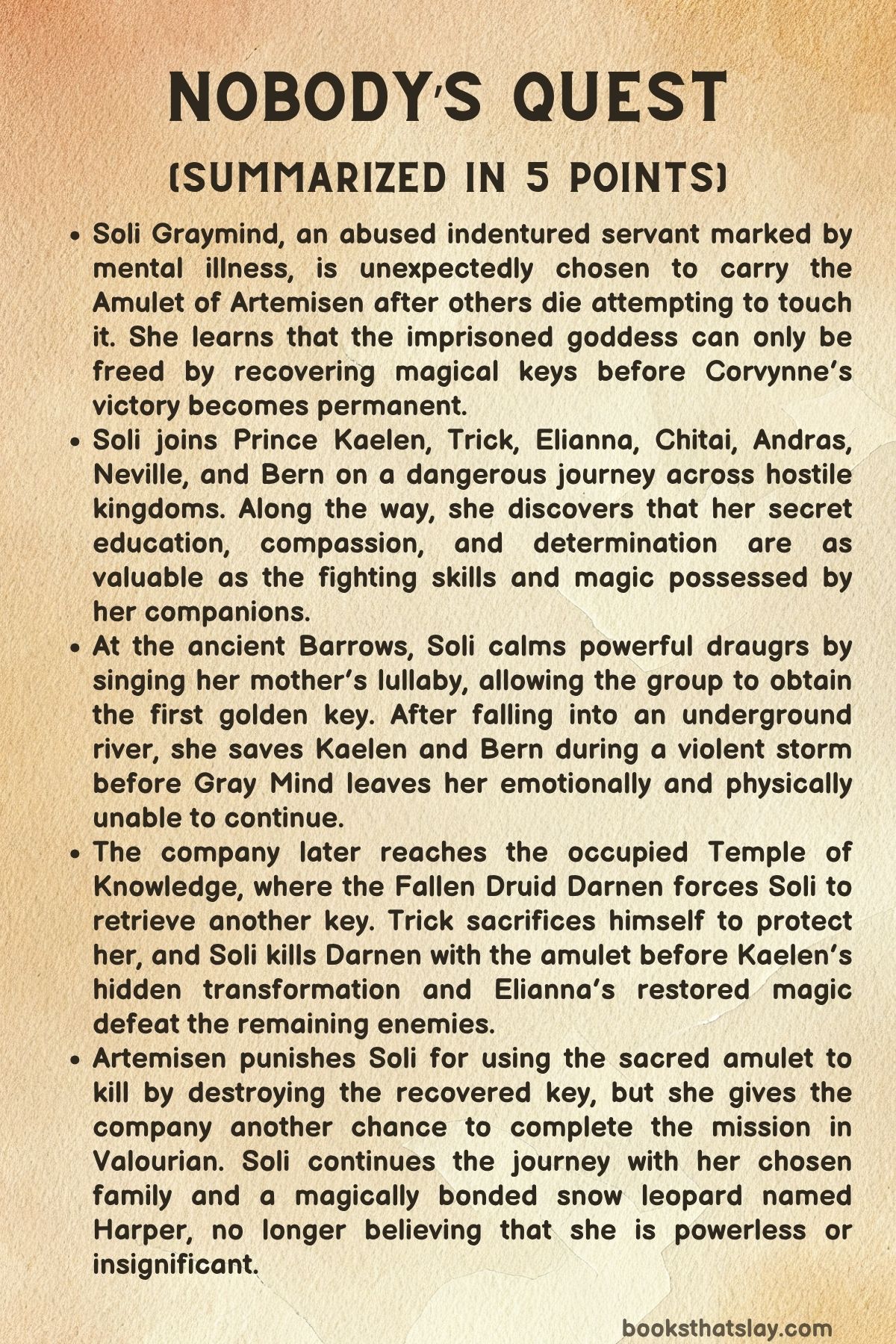
Summary
Soli Graymind has spent seventeen years as an indentured servant in the Royal Library of Pyrrh, where she cleans neglected shelves and secretly reads books that servants are forbidden to possess. Marked by the Inquisitors because she has Gray Mind, a condition that causes periods of crushing despair and emotional numbness, she is treated as defective and disposable.
Her life changes when six royal guards arrive to take her to King Pallan. Soli assumes she is being arrested or executed, especially after the brutal guard Flack cuts her neck, but Sergeant Garth Neville shows her unexpected kindness during the journey.
At the palace, Soli is brought before Pallan, the Air Touched sorcerer Elianna, and Prince Kaelen of Valourian. Kaelen initially dismisses Soli as weak, filthy, and unsuitable for whatever purpose Pallan has in mind, but he violently defends her when Flack tries to humiliate her.
Soli soon learns that Elianna has been searching for people considered socially insignificant. Prophecies concerning the imprisoned goddess Artemisen repeatedly state that “nobody” can touch the goddess’s amulet and that “nobody” can defeat Corvynne, Artemisen’s sister and the goddess of war and death.
Elianna has interpreted the prophecy literally. She believes the only possible heroes are people regarded as nobodies by kings, institutions, and society.
Several such people have been gathered to test the Amulet of Artemisen. A young pig keeper named Lil is forced to touch it and initially appears unharmed, but she soon burns to death.
When Soli’s only friend, Trick Jovann, is selected next, Soli objects and volunteers in his place. Refusing to remain powerless, she declares that she will become the architect of her own destiny and grasps the amulet.
Instead of burning, Soli becomes surrounded by brilliant light. Artemisen speaks through her, explaining that Corvynne imprisoned her almost a century earlier and that the prison will become permanent at the approaching summer solstice.
The amulet is only the final key to the prison. Two additional golden keys must be recovered, one from the ancient Barrows and another from the Scholars’ Temple, with each key restoring part of Artemisen’s strength and helping her repair the natural world.
King Pallan forms a company around Soli. Prince Kaelen will lead it, accompanied by Trick, Elianna, Neville, the young guard Bern, the immortal Sylvan lord Andras, and the desert warrior Chitai.
Soli is freed from her indenture and trained to pose as an expert poisoner. Although she dreams of escaping and building an ordinary life, an attack by Zhagarn soldiers and Corvynne’s monstrous Fell forces the company to leave Pallanhold immediately.
During the escape, Soli kills a Fell creature in self-defense. Kaelen reveals extraordinary speed and strength in battle, while Elianna uses powerful magic that leaves her strangely exhausted.
Soli’s terror of horses nearly prevents her from leaving, but Kaelen places her on his stallion and promises that he will not allow her to fall. As the city disappears behind them, Soli recognizes that she has finally escaped the library, although her freedom has immediately been tied to a dangerous divine mission.
Life on the road exposes Soli to landscapes, animals, sunlight, and choices she has never experienced. Chitai pledges her protection and declares Soli part of her tribe, while Neville and the others begin teaching her survival skills.
Tension grows when Elianna magically binds Trick to the company, preventing him from fleeing or revealing information that might damage the quest. Soli condemns the spell as another form of imprisonment and argues that their mission cannot claim moral superiority if it relies on coercion.
The company encounters mercenaries, forcing Kaelen to present Soli as both his poisoner and his lover. Their staged kiss becomes genuinely passionate, revealing an attraction that neither can easily dismiss.
Soli’s knowledge, acquired through years of forbidden reading, allows her to answer an experienced poisoner’s questions. For the first time, she sees that the education she gained in secret could provide independence and employment rather than merely helping her survive confinement.
Around the campfire, Soli explains Gray Mind to her companions. She describes it as a vicious inner voice combined with a fog that can remove motivation, emotion, and hope, making clear that it is an illness rather than weakness or moral failure.
Chitai explains that her people recognize the condition and treat it with compassion. Kaelen and Andras show Soli their scars as evidence of survival, but Soli reminds them that her most dangerous wounds cannot be seen.
At the Brazen River, the travelers discover a ferryman named Reland Wyle who has been tortured by Zhagarn soldiers. Elianna heals him with a mixture of magic and prepared medicine, but the effort leaves her dangerously weak.
Wyle reports that the soldiers repeatedly mentioned the Bane, an old name for Artemisen’s amulet. Andras then reveals that he personally carried the amulet away from the goddess’s prison almost one hundred years earlier.
Andras explains that touching it set him on fire, although Sylvan healing and the healers of the Dawn saved him. He also reveals that official histories removed his role and changed the truth, teaching Soli that written records may be shaped by political interests, incomplete knowledge, and the decisions of powerful rulers.
Chitai admits that she belongs to the supposedly destroyed warriors of the Dawn. Her people remain hidden, but Corvynne’s spreading Degradation threatens their water, medicine, land, and survival.
As they approach the Barrows, Soli’s relationship with Kaelen grows more intense. He confesses that he would kill or die for her, but he repeatedly withdraws because he believes his political obligations, his captive sister Karrina, and his uncertain future prevent him from offering Soli a lasting commitment.
When Soli encounters a pack of wolves, the amulet glows and the animals respond peacefully to her. She keeps her promise to provide them with meat, and the wolves bow before departing, suggesting that her connection to Artemisen is expanding.
The company reaches the Barrows while being pursued by Zhagarn and Fell. The Fell refuse to enter the ancient burial grounds, but the travelers are forced into an underground cavern filled with gemstones.
Trick ignores Soli’s warning and takes a ruby, awakening four enormous draugrs. Andras attempts to calm the spirits with a song, but one of them attacks him.
Soli then sings the only lullaby she remembers from her mother. Although people have mocked her voice throughout her life, the love and sincerity behind the song calm the draugrs and put them to sleep.
The first golden key hangs above them. Chitai retrieves it through an acrobatic leap, but removing it causes the cavern’s gemstones to fall, awakening the spirits again.
During the resulting attack, Soli, Kaelen, and Bern fall through a concealed pit into an underground river. All three are injured, cold, and trapped, with Bern unconscious and neither he nor Soli able to swim.
Kaelen pulls them through the water and reaches the outside river, but his wounds cause him to collapse. Soli is left responsible for keeping both men alive.
Using the skills Neville taught her, she makes bandages, drags the men away from the water, gathers wood, and builds a fire. A violent storm destroys her work, yet she shields Kaelen and Bern with her body for hours while fighting cold, hunger, fear, and the approaching Gray Mind.
After the storm, Soli attaches the first key to the amulet and summons Artemisen. The goddess heals their physical injuries, but the exhaustion inside Soli remains.
Once Kaelen and Bern are safe, Soli falls completely into Gray Mind. She can hear them calling to her but cannot move, speak, or care enough to respond.
For two days and nights, Kaelen and Bern remain beside her. They finally reach her by reminding her of the friends who may still need her and repeating her familiar promise that storms pass, pain ends, and they will never quit.
Soli slowly returns and begins listing what she has accomplished. She kept two men alive, survived the river and storm, made fire, treated wounds, and refused to surrender, proving that she is not nothing.
The three reach the village of Merrion and reunite with the rest of the company. Soli then forces Elianna to admit that she lost most of her magic after attempting the dangerous final Pillar of Magic without supervision.
The first key allows Artemisen to channel power through Soli and restore fields destroyed by the Fell. Wheat and flowers grow at impossible speed, demonstrating that freeing Artemisen is already helping repair the damaged world.
Soli and Kaelen finally accept their desire for each other and become lovers. Their intimacy allows Soli to exercise control over her body after years of servitude, while Kaelen reveals the guilt and anger he carries over fleeing Valourian and failing to liberate his homeland.
Their progress is interrupted by Khyrran bounty hunters who intend to enslave Soli because of her Gray Mind mark and sell Chitai. Soli leaves her hiding place during the battle and kills an attacker who is about to murder Andras.
Feeling that her brand has endangered everyone, Soli considers removing her arm. Instead, Andras transforms the mark into sacred body art showing a crescent moon above the Panterran Mountains.
The new design changes the meaning of the mark from shame and ownership to courage, travel, hope, and freedom. Soli declares that Gray Mind is something she has, not everything she is.
At the Temple of Knowledge, warrior scholars initially resist the company’s entry. Once inside, Soli discovers that the temple has been conquered by Darnen the Exiled, a Fallen Druid who serves Corvynne.
Darnen has spent decades forcing scholars and prisoners to attempt to retrieve the second key from a magical sphere. Thousands have died, but he continues to describe himself as devoted rather than cruel.
Darnen captures Soli, Trick, and Elianna and orders Soli to obtain the key. Trick attempts to protect her by distracting the druid, but Darnen drives a spear of magical light through his body.
Trick dies in Soli’s arms after giving his life to protect her. Overcome with grief but determined to prevent more deaths, Soli removes the amulet from its protective locket and presses it against Darnen’s neck.
The amulet burns Darnen and the surrounding Zhagarn while leaving Soli unharmed. Kaelen arrives and kills the wounded druid, but more soldiers attack before Soli can reach the key.
Seeing Soli wounded awakens Kaelen’s ancient Valourian magic, transforming him into a giant snow leopard. Elianna’s full power also returns, allowing her to master the Last Kiss of Breath and remove the air from the remaining enemies.
Soli retrieves the second key, but Elianna cannot restore Trick to life. The company carries his body outside and builds a funeral pyre because Soli knows that her friend feared being trapped in dark, enclosed places.
She sings her mother’s lullaby and burns the surviving pages of her beloved Captain Wynona Wavedancer book, which she and Trick once shared. She keeps the wooden snow leopard he carved and the document proving her freedom.
When Soli attaches the second key to the amulet, Artemisen appears. The goddess acknowledges Trick’s sacrifice but condemns Soli for using the amulet to kill, an action that disturbed the balance the quest was meant to restore.
Artemisen uses the key’s power to return winter snow across Altarra and then dissolves it. Soli is given one final opportunity because a replacement key exists inside Valourian Keep.
As the company rides toward Valourian, a living snow leopard named Harper appears and forms a magical bond with Soli. The emptiness in his soul has recognized the silence created by her Gray Mind, connecting them as mutual protectors.
Soli ends this stage of the journey surrounded by people who have become family, carrying grief but no longer believing herself powerless. She accepts that she has friends, knowledge, freedom, magical allies, and claws of her own, and she vows never to call herself nobody again.
Characters
Soli Graymind
Soli Graymind is the central character of Nobody’s Quest, beginning as an impoverished indentured servant who has learned to make herself small in order to survive. Years of humiliation, physical violence, forced labor, and institutional prejudice have convinced her that she has no social value, yet her secret education reveals a determined and intellectually gifted person beneath that imposed identity.
Her knowledge is not decorative. Information gathered from forbidden books repeatedly saves the company, allowing her to identify poisons, understand cultural customs, interpret legends, calm draugrs, treat injuries, and question official accounts of history.
Soli’s struggle with Gray Mind gives her development psychological depth. Her illness does not disappear when she becomes a chosen amulet bearer, and courage does not protect her from periods of numbness, hopelessness, panic, or total incapacity.
Her progress comes from recognizing that an episode does not erase everything she has already accomplished. By surviving the river, caring for Kaelen and Bern, resisting the storm, challenging Elianna’s coercion, and standing against Darnen, she gradually creates an identity based on her choices rather than the judgments of kings, Inquisitors, or servants.
Soli remains morally complicated because she kills Darnen with a sacred object designed to restore balance. She does not celebrate the act, but she also refuses to pretend that leaving him alive would have protected her friends, showing that her growing confidence includes accepting responsibility for difficult decisions.
Prince Kaelen of Valourian
Kaelen is an exiled prince whose beauty, confidence, and combat ability initially make him appear untouchable. Beneath that commanding exterior, however, he is shaped by grief, political captivity, anger, guilt, and the belief that he failed his kingdom by surviving.
His parents were murdered when Corvynne’s forces conquered Valourian, and he escaped only because they ordered him to protect Karrina. King Pallan’s continued control over his sister has kept Kaelen obedient for ten years, turning his royal status into another form of imprisonment.
Kaelen’s relationship with Soli exposes both his tenderness and his emotional instability. He respects her intelligence, protects her without treating her as entirely helpless, and repeatedly asks for consent, but he also displays jealousy, possessiveness, and violent instincts that become more pronounced as his dormant magic awakens.
His transformation into a snow leopard connects his identity to Valourian history and suggests that the parts of himself he considers monstrous may also be sources of protection. Within Nobody’s Quest, Kaelen is not simply a romantic hero but a displaced leader who must decide whether vengeance, duty, love, or responsibility will define his return home.
Trick Jovann
Trick is Soli’s oldest friend and the person who preserved part of her humanity during her years in the library. His jokes, carved snow leopard, shared stories, and companionship gave her small moments of comfort when she had almost nothing of her own.
He presents himself as an important member of the Thieves’ Guild, although Elianna claims that he was expelled for incompetence. His exaggerations reveal embarrassment and insecurity rather than a lack of loyalty, since his rank matters far less than his desire to appear worthy in Soli’s eyes.
Trick’s resistance to the quest is closely connected to childhood trauma. Elianna’s binding spell recalls the terror of being locked in a closet by his abusive father, making his repeated plans to escape understandable rather than merely selfish.
His final actions prove that his devotion to Soli is genuine. He tries to retrieve the key in her place, distracts Darnen, and knowingly places himself between the druid and his friend, transforming a character often treated as unreliable into one of the story’s clearest examples of courage and sacrifice.
Elianna
Elianna is an Air Touched sorcerer whose intelligence, ambition, and political influence make the quest possible. She interprets the prophecy literally, locates Soli, studies the amulet, organizes the company, and accepts enormous personal risk to free Artemisen.
Her dedication is weakened by her willingness to control others. Binding Trick without consent, withholding her loss of power, and requesting the amulet for her own restoration show how easily she places the mission above individual freedom.
Elianna’s magical failure also reveals pride and fear beneath her authority. She secretly attempted the Last Kiss of Breath without the required masters because she wanted to prove herself, and the resulting loss of power threatened both her identity and her position within the Sorcerers’ Guild.
Her eventual restoration does not erase her mistakes, but it allows her to confront the technique that destroyed her abilities. Her relationship with Chitai further humanizes her, giving her a space where desire, humor, vulnerability, and uncertainty exist outside her role as strategist.
Chitai
Chitai is a warrior of the Dawn’s Eagle Clan, a people believed to have been destroyed by Corvynne’s forces. She joins the quest because the Degradation threatens her homeland, healing plants, water supply, and the survival of her hidden people.
Her understanding of honor differs sharply from the hierarchical values found in Pyrrh. Chitai believes that cooking, hunting, protection, cleaning, healing, and every other task that sustains a group deserve equal respect.
This philosophy changes Soli’s understanding of usefulness. Instead of measuring herself against trained warriors, Soli learns that contribution depends on willingness, effort, and shared responsibility.
Chitai is physically formidable, emotionally direct, and openly attracted to Elianna. Her pledge of water, blades, and life to Soli establishes one of the story’s strongest chosen-family bonds, while her willingness to call Soli part of her tribe gives the former servant a sense of belonging she has never possessed.
Andras
Andras is an immortal Sylvan lord whose formal behavior and rigid code of honor initially create distance between him and the others. His presence connects the current quest to Artemisen’s defeat nearly one hundred years earlier.
He was the first person ordered to remove the amulet from the goddess’s prison, and touching it nearly killed him. His survival, imprisonment by King Prasan, and disappearance from official records demonstrate how personal sacrifice can be erased when history becomes politically inconvenient.
Andras respects knowledge and responds positively when Soli understands Sylvan customs. His willingness to transform her Gray Mind brand into sacred art is especially significant because he does not merely conceal the mark; he helps her reclaim control over its meaning.
Although reserved, Andras repeatedly risks himself for the company. His growing affection for Soli, Bern, and the others shows that his formal distance does not reflect indifference but a deeply controlled emotional nature.
Sergeant Garth Neville
Neville is introduced as one of the guards ordered to collect Soli, but he immediately distinguishes himself from Flack through small acts of kindness. He cannot openly challenge every cruelty within Pallan’s system, yet he consistently treats Soli as a human being rather than an object.
His most important contribution is practical education. By teaching Soli to light fires, manage camp duties, and prepare for separation from the group, he gives her the skills that later allow her to save Kaelen and Bern.
Neville represents dependable service without blind obedience. He follows orders and understands military discipline, but his loyalty gradually shifts from Pallan’s authority to the people traveling beside him.
His acceptance of Soli’s Gray Mind episode is also meaningful. Instead of accusing her of weakness, he compares her collapse to the reactions of soldiers after terrible battles, helping place her condition within a recognizable human response to pressure and trauma.
Bern
Bern begins as a young palace guard whose strongest emotional connection is his love for Lil. Her death during the amulet test leaves him grieving, but he continues with the company despite the pain and danger.
His youth and relative inexperience make him less imposing than Neville, Kaelen, Andras, or Chitai. Nevertheless, he repeatedly demonstrates courage, including his survival in the Barrows and his efforts to help Soli return from Gray Mind.
Bern’s shared repetition of Soli’s mantra changes the meaning of her private survival strategy. By saying that “we” will never quit, he helps transform an individual burden into a collective promise.
His presence also prevents the company from becoming a collection of nearly invincible heroes. Bern is vulnerable, frightened, injured, and grieving, yet he remains useful because courage in the story depends on continuing despite fear rather than feeling no fear.
King Pallan
King Pallan is a calculating ruler who understands the threat posed by Corvynne but treats individuals as resources. He frees Soli from indenture and authorizes the quest, yet his actions are driven less by compassion than by political necessity.
His willingness to test the amulet on powerless people exposes the cruelty beneath his strategy. Lil’s death is acceptable to him because he views servants, criminals, and social outcasts as expendable instruments.
Pallan also controls Kaelen through Karrina, proving that royal hospitality can operate as imprisonment. His behavior raises an important question about whether a ruler opposing a terrible enemy is automatically just.
Although Pallan supports Artemisen’s return, he repeatedly uses the same methods of fear, leverage, and disposability associated with oppressive regimes. He therefore represents the danger of treating a noble objective as permission to violate individual lives.
Karrina
Karrina is Kaelen’s younger sister and the person whose safety has kept him under Pallan’s control. She has spent much of her life as a political hostage, even when her captivity is disguised by royal comfort and courtly treatment.
Her uncontrolled magical potential makes her valuable to Pallan, the Sorcerers’ Guild, and anyone seeking influence over Valourian. She is therefore surrounded by people who see her future abilities before they see her personal wishes.
Karrina’s situation reflects Soli’s in a different social form. Soli is controlled because society calls her worthless, while Karrina is controlled because powerful people consider her extraordinarily valuable.
Although she does not travel with the company, her presence shapes Kaelen’s decisions throughout the story. His refusal to act freely, his fear of emotional commitment, and his delayed return to Valourian all originate in his determination to keep her alive.
Artemisen
Artemisen is the imprisoned goddess of nature whose defeat has caused the stars to vanish and the natural world to deteriorate. Her connection with Soli gives the former servant purpose, power, and access to a conflict far larger than her personal suffering.
The goddess is neither completely gentle nor easily understood. She heals Soli and her companions, restores crops and winter snow, and expresses faith in her chosen bearer, but she also withholds information and warns Soli to trust no one.
Artemisen’s commitment to balance governs her judgment. She recognizes that Darnen was dangerous but still condemns Soli for using the amulet to murder, because accepting necessary violence without consequence would weaken the principles she represents.
Her decision to dissolve the second key is both punishment and correction. Yet by providing another chance, she acknowledges that moral failure does not have to end a person’s purpose, especially when that person accepts responsibility rather than hiding behind excuses.
Corvynne
Corvynne is the goddess of war and death who defeated and imprisoned her sister. Although she rarely appears directly, her influence shapes every political, environmental, and personal conflict in the story.
Her armies have conquered kingdoms, destroyed communities, burned harvests, and created the Fell. The continuing Degradation shows that her victory damages more than human society, disrupting the natural balance of the entire world.
Corvynne also rules through systems of fear and conversion. The Zhagarn, Fallen Druids, hidden sorcerers, and occupied institutions demonstrate that her power depends on both military force and the corruption of existing structures.
Her absence gives her a mythic quality, but it also emphasizes the reach of institutional evil. Soli does not need to stand before Corvynne to feel the consequences of her rule, because those consequences already exist in laws, wars, hunger, prejudice, ruined land, and frightened communities.
Darnen the Exiled
Darnen is a Fallen Druid whose fanaticism makes him one of the clearest human representatives of Corvynne’s rule. He has occupied the Temple of Knowledge for decades and sacrificed thousands of lives while attempting to retrieve the golden key.
He describes himself as devoted and places responsibility for the deaths on Artemisen. This refusal to recognize his own agency allows him to preserve an image of righteousness while committing systematic murder.
Darnen’s treatment of Trick and the scholars reveals that he values people only according to their usefulness. He does not negotiate in good faith because loyalty to his mission has destroyed his capacity to respect any life outside it.
His death places Soli in a moral crisis. Killing him saves others but violates the sacred purpose of the amulet, proving that defeating a cruel person does not automatically make every method morally acceptable.
Harper
Harper is an enormous snow leopard who forms an ancient magical bond with Soli near the end of the story. His arrival suggests that the world contains older forms of magic that neither the Sorcerers’ Guild nor the royal courts fully understand.
The connection forms because the emptiness within Harper recognizes the silence created by Soli’s Gray Mind. Their bond transforms something associated with isolation into a point of contact, protection, and mutual understanding.
Harper is proud, sarcastic, dangerous, and initially considers eating Kaelen. His humorous hostility adds energy after Trick’s funeral without erasing the company’s grief.
The mark placed on both Soli and Harper makes their responsibility equal. He is not merely a magical animal assigned to defend her; each must protect the other, continuing the story’s rejection of relationships built entirely on ownership or obedience.
Queen Isabella
Queen Isabella offers Soli a level of respect that contrasts with Pallan’s impatience and manipulation. Her limited appearance suggests that kindness can exist within the palace even when the larger royal system remains unjust.
She does not control the quest, and the story does not present her courtesy as enough to repair the harm caused by Pallan. Her role instead shows how individual decency and institutional power are separate matters.
Isabella’s respectful behavior matters to Soli because the young woman has rarely been treated with dignity by anyone of high status. Even so, the queen’s presence also raises questions about how much responsibility belongs to people who remain inside cruel systems without openly challenging them.
Flack
Flack embodies the everyday brutality permitted by Pyrrh’s social order. He cuts Soli’s neck, threatens her, forces her to kneel, and uses her lack of status as permission to inflict pain.
Unlike Corvynne or Darnen, Flack possesses no grand ideology. His cruelty comes from enjoying power over someone who cannot safely resist him.
Kaelen’s immediate attack on Flack establishes the prince’s hatred of bullies, but it does not erase the system that gave the guard access to Soli. Flack demonstrates how oppression survives through ordinary individuals who exploit rules, prejudice, and institutional protection.
Lil
Lil is a frightened sixteen-year-old pig keeper selected because society considers her unimportant. Her love for Bern and her fear in the palace make her clearly human before the amulet test reduces her to an experiment.
Her death exposes the moral cost of Elianna and Pallan’s interpretation of the prophecy. Even though freeing Artemisen may save the world, Lil is given no meaningful choice about risking her life.
Soli’s decision to volunteer after witnessing Lil burn represents both courage and protest. Lil’s brief presence continues to influence Bern and prevents the quest from being viewed as a clean heroic undertaking without innocent victims.
Maisie
Maisie, the palace cook, gives the starving Soli a plum turnover when others treat her with suspicion or contempt. The act is small, but its effect is powerful because Soli has experienced so little uncomplicated generosity.
Maisie demonstrates that resistance to cruelty does not always require magic or weapons. Providing food, warmth, and recognition can preserve someone’s dignity at the moment when fear has nearly overwhelmed them.
Her kindness also anticipates the chosen family Soli later finds. Before warriors and gods begin telling Soli that she matters, a cook quietly proves it through an ordinary act of care.
Reland Wyle
Reland Wyle is the ferryman found tortured after refusing or failing to cooperate with the Zhagarn. His injuries reveal the expanding reach of Corvynne’s forces beyond formal battlefields.
Saving him requires Soli’s medical knowledge and Elianna’s remaining resources. The scene allows Soli to act as a healer rather than a fighter, broadening her understanding of how she can contribute.
Wyle’s information about the Bane also forces Andras to reveal his hidden history. Although Wyle appears briefly, his rescue changes the company’s knowledge of both the enemy and the amulet.
Haven, Bean, and the Scholar Superior
Haven and Bean are warrior scholars stationed at the Temple of Knowledge. Their ability to identify members of the company suggests extensive information networks, but their guarded behavior also reflects the pressure of living under occupation.
The Scholar Superior has waited decades for the amulet bearer yet initially orders the company to leave. Her apparent rejection is later revealed to be an attempt to prevent Darnen from gaining control of Soli and the key.
Their cooperation with the trap remains morally troubling even when coercion explains it. Soli’s refusal to forgive them immediately recognizes that victimhood does not automatically remove responsibility for actions that place others in danger.
Drysk and Grigos
Drysk leads the mercenaries who encounter the company during its disguise, while Grigos serves as their poison expert. Their presence tests whether Soli can convincingly perform the identity assigned to her.
Grigos expects to expose her as an impostor, but her knowledge earns his respect and an offer of future employment. This encounter gives Soli one of her first practical visions of economic independence.
At the same time, the mercenaries show the moral danger of her new expertise. Soli understands that poison knowledge could free her from poverty, yet she does not want to build a life around helping others commit murder.
Themes
Identity, Social Worth, and Self-Definition
Soli’s society assigns human value through rank, magical ability, health, wealth, occupation, and family. As an indentured servant marked with Gray Mind, she is taught that she is defective, replaceable, and too insignificant to possess books, choices, ambitions, or bodily autonomy.
The prophecy in Nobody’s Quest turns this judgment against the powerful people who created it. The person capable of carrying the amulet is not a celebrated warrior or respected sorcerer but someone whom the existing order has dismissed as nobody.
Soli’s development does not depend on discovering that she was secretly noble or socially important. Her worth comes from qualities she possessed even in the library: curiosity, endurance, compassion, intelligence, moral judgment, and the ability to continue after despair.
The transformation of her Gray Mind brand captures this process physically. Andras does not erase the past but incorporates the letters into an image of moonlit mountains, allowing Soli to decide what the mark will represent from that point forward.
Her changing language is equally important. She moves from calling herself nobody to naming specific actions she has completed, including saving lives, making fire, singing before the draugrs, confronting Darnen, and protecting her companions.
Self-definition therefore becomes an active practice rather than a single revelation. Soli must repeatedly challenge the voices of the Inquisitors, the king, strangers, enemies, and her own illness, choosing to see herself as a full person even when fear tells her otherwise.
Freedom, Consent, and Coercive Power
Freedom appears in legal, physical, emotional, political, and magical forms. Soli receives an official document ending her indenture, but a signed proclamation cannot immediately remove the habits, fear, and self-erasure created by seventeen years of servitude.
Kaelen is a prince, yet Pallan controls him through Karrina. Trick is not imprisoned in a cell, but Elianna’s binding spell prevents him from traveling freely or revealing information, reproducing the bodily helplessness associated with his childhood abuse.
Karrina is confined because of her magical potential, while Soli was confined because society considered her defective. Their different positions reveal that oppressive systems can exploit both supposed worthlessness and supposed value.
Elianna’s decisions place the theme in morally difficult territory. She believes that freeing Artemisen may save kingdoms and restore nature, but her willingness to bind Trick raises the question of whether a just goal can be achieved through methods that deny another person’s autonomy.
Soli consistently rejects this reasoning. Her objections are not naïve resistance to responsibility; they come from direct knowledge of what happens when powerful people decide that someone else’s body, labor, or future may be used without permission.
Her relationship with Kaelen provides a contrasting model. Their physical intimacy is built around repeated consent, choice, mutual vulnerability, and Soli’s ownership of her newly freed body, showing that closeness becomes meaningful when neither person treats the other as property.
Courage, Gray Mind, and the Limits of Heroism
Courage is presented as action taken alongside fear, exhaustion, grief, or illness rather than the absence of those experiences. Soli is terrified of horses, draugrs, battle, abandonment, romantic rejection, and responsibility, yet she continues learning and participating.
Gray Mind prevents the story from offering a simple transformation from frightened servant to fearless hero. Soli’s growing confidence does not cure her condition, and surviving extraordinary dangers does not stop her from collapsing after the storm.
Her two-day withdrawal is especially important because Kaelen’s encouragement cannot instantly restore her. Soli hears his words but lacks the internal energy required to respond, demonstrating why mental illness cannot always be overcome through willpower, love, duty, or inspiring speeches.
The support of Kaelen and Bern still matters, but it works through patience and connection rather than command. By repeating that “we” will never quit, they tell Soli that survival does not have to remain a solitary responsibility.
The company’s response after her recovery further changes the meaning of heroism. Chitai and Neville compare Soli’s collapse to the reactions of warriors after extreme danger, removing the shame attached to reaching a psychological limit.
Soli becomes courageous not because she never falls into the Gray but because she continues building a life around it. She learns to accept assistance, identify what she has accomplished, prepare for future episodes, and refuse to let the condition become the sole definition of her identity.
Chosen Family, Loyalty, and Sacrifice
Soli begins the story almost entirely alone, with Trick serving as her only meaningful companion. The quest gradually gives her a community formed not through blood or social position but through shared danger, practical care, trust, disagreement, forgiveness, and mutual protection.
Chitai’s declaration that Soli belongs to her tribe gives this new family explicit language. Neville teaches her skills, Bern joins her survival mantra, Andras transforms her brand, Elianna challenges and frustrates her, Kaelen loves her, and Trick repeatedly tries to protect her from the demands of the quest.
These relationships are not idealized. Kaelen becomes jealous, Elianna violates Trick’s freedom, Trick conceals information, Soli questions the others’ decisions, and several companions carry secrets that could endanger the group.
Their bond gains strength because loyalty does not require pretending that every action is acceptable. Soli can love Elianna while condemning the binding, love Trick while questioning his lies, and love Kaelen while refusing to let his rank or fears decide the limits of their relationship.
Trick’s death gives sacrifice its most painful form. He does not die because he is the strongest or most powerful member of the company but because he chooses to stand between Soli and Darnen when he understands the likely cost.
His funeral shows how chosen family preserves identity after death. Soli honors his fear of confinement, burns the stories they shared, keeps his carved leopard, and carries forward the belief that she deserves freedom.
Harper’s arrival does not replace Trick. It expands the community around Soli while allowing grief to remain, showing that new bonds can grow without diminishing the importance of those who have been lost.