Nymph by Sofia Montrone Summary, Characters and Themes
Nymph by Sofia Montrone is a coming-of-age novel about memory, desire, family loyalty, and the painful distance between loving someone and understanding the harm they cause. Set mainly in a centuries-old Italian hotel, the story follows Leo during two decisive summers separated by eight years.
As a child, she watches her father’s charm collapse under addiction and self-destruction; as a young woman, she returns to the same place carrying grief, confusion, and unspoken desire. Through family labor, classical myths, physical transformation, and a brief romance, Sofia Montrone examines how people inherit stories and eventually learn to rewrite them.
Summary
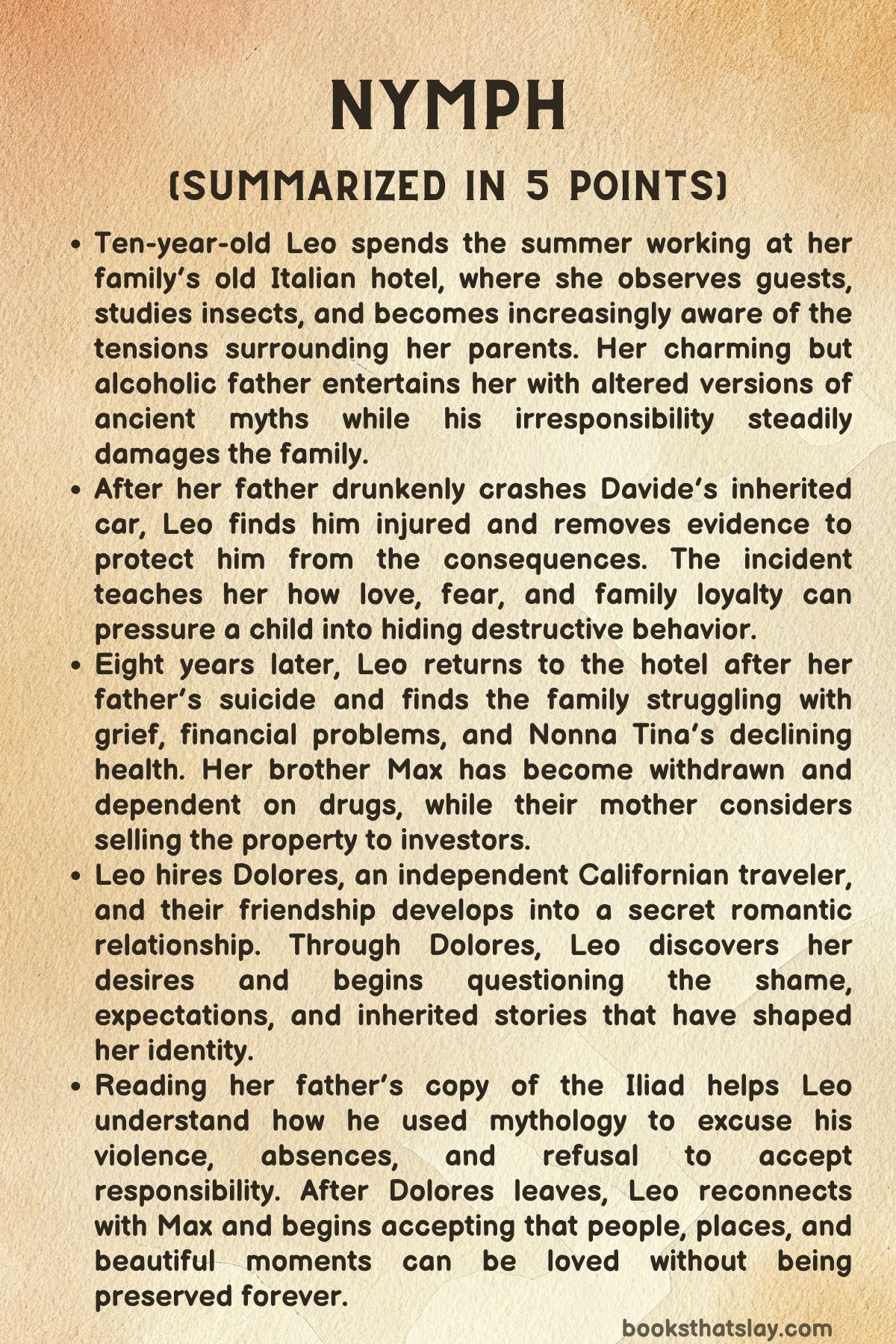
Ten-year-old Leo spends the summer at her family’s old Italian hotel, a place shaped by generations of labor, tradition, and memory. She shares the crowded household with her younger brother Max, her mother Violetta, her grandmother Nonna Tina, and her American father, whose energy can make ordinary events seem magical.
The hotel is both Leo’s home and her workplace. Under Nonna Tina’s supervision, she cleans rooms, assists with daily chores, studies the habits of guests, and collects small objects that visitors leave behind.
These abandoned possessions fascinate Leo because they seem to contain traces of lives she cannot fully know. Her interest in insects reflects the same desire to observe, classify, and preserve things before they disappear.
Leo is also becoming newly conscious of her own body. She notices physical changes, compares herself with others, and experiences the uneasy feeling that childhood is ending before she has understood what adulthood will require.
Her father plays a central role in the imaginative world of the summer. He tells Leo revised versions of the Odyssey, changing details, adding jokes, and presenting the ancient journey as though it belongs partly to him.
His stories make him appear clever, fearless, and nearly all-knowing. Leo is captivated by his ability to transform danger into entertainment and confusion into a dramatic tale with himself at the center.
Yet his charm increasingly conflicts with his behavior. He drinks heavily, sleeps through parts of the day, abandons his writing, resents the hotel’s demands, and reacts angrily when anyone questions him.
Violetta confronts him about his alcohol use, but the argument does not lead to lasting change. Leo senses that her mother is exhausted from managing his moods while also protecting the children and keeping the hotel running.
The summer nevertheless contains moments of celebration. The World Cup brings excitement, and the arrival of the glamorous Marlena adds mystery and adult sophistication to Leo’s surroundings.
Marlena’s appearance gives Leo another image of womanhood to study. Leo notices how beauty creates attention, how confidence can command a room, and how adults often conceal tension beneath polished behavior.
Nonna Tina remains the hotel’s strongest authority. She expects discipline, values practical work, and treats the building as a living inheritance that must be maintained through effort rather than sentiment.
Leo admires her grandmother’s competence, though she also feels the pressure of Nonna Tina’s standards. The older woman offers stability at a time when Leo’s parents seem unable to provide it consistently.
A fishing trip with her father becomes one of the summer’s most disturbing experiences. When they catch a fish that has been badly injured, he forces Leo to watch as he kills it rather than allowing it to suffer.
He frames the act as a lesson in responsibility, insisting that causing harm creates an obligation to finish what has been started. For Leo, however, the moment links responsibility with violence and teaches her that adults can use moral language to justify frightening actions.
Her father’s decline becomes impossible to dismiss when he takes Davide’s treasured inherited car. After drinking, he drives into the mountains to fetch a plumber and crashes on the road.
Leo finds him injured and covered in blood near the damaged vehicle. Instead of immediately seeking help, she removes broken glass and other evidence, instinctively trying to protect him from the consequences of what he has done.
Her decision reveals how deeply she has already entered the family pattern of concealment. She loves her father, fears losing him, and believes that preserving his image may be more urgent than admitting the truth.
At the hospital, the adults continue the deception. The family avoids a complete account of the accident, and Leo learns that silence can become a shared form of loyalty even when it protects destructive behavior.
The rain that closes the summer changes the atmosphere of the hotel. Her father completes his version of Odysseus’s journey with an account of slaughter, return, and forgiveness, leaving Leo with a story in which violence is followed by acceptance.
She is not yet able to reject his interpretation, but she begins to understand that forgiveness cannot undo damage. Love may survive betrayal, yet survival does not make the betrayal harmless.
Eight years later, eighteen-year-old Leo returns to the hotel before leaving for college. The building is still recognizable, but time has altered both the family and the future they once assumed was secure.
Her father has died by suicide at a treatment center. His absence shapes the household as strongly as his presence once did, leaving each family member with a different mixture of grief, anger, guilt, and unresolved attachment.
Leo still carries memories of his tenderness and imagination. She also recognizes his drinking, manipulation, recklessness, and repeated failure to accept responsibility for the pain he caused.
Nonna Tina is now physically weak. The woman who once governed the hotel through force of habit and authority can no longer perform the work that defined her position in the family.
The hotel itself requires expensive repairs. Violetta considers offers from investors, knowing that selling may be necessary even though the property represents family history, identity, and years of sacrifice.
For Leo, the possible sale feels like another death. The building contains childhood memories and provides a physical connection to people and experiences that can never return.
Max has also changed. Once Leo’s younger companion, he has become withdrawn, angry, and dependent on drugs, responding to grief through self-isolation and self-destructive behavior.
Leo wants to help him, but their relationship is burdened by years of silence. They remember their father differently, and neither initially knows how to speak honestly without threatening the other’s version of the past.
The arrival of Dolores interrupts this tense family atmosphere. A young Californian traveler, she reaches the hotel by bicycle and asks for work, carrying herself with independence and confidence.
Leo hires her and quickly becomes fascinated by her intelligence, directness, and physical ease. Dolores appears comfortable occupying space and making choices in ways Leo has never permitted herself to be.
At the same time, Leo has begun a tentative sexual relationship with Tonino. Their connection offers familiarity and an expected path, but it does not answer the desires Leo is only beginning to recognize.
Her attraction to Dolores develops through shared labor and daily companionship. They clean rooms, work in the orchards, attend local celebrations, and spend time together away from the family’s watchful presence.
Their relationship becomes sexual and emotionally intimate. Through Dolores, Leo experiences desire as something immediate and real rather than something that must be explained through inherited rules.
Yet the romance remains secret. Leo’s happiness is accompanied by shame, uncertainty, and fear of what her attraction might mean for her future or for the way others see her.
Dolores’s confidence cannot remove Leo’s conflict, but it gives her a model of freedom. She encourages Leo to notice her own wishes instead of shaping herself entirely around family expectations.
During this summer, Leo reads her father’s copy of the Iliad. The text allows her to reconsider the myths he used throughout her childhood and to compare his versions with stories that do not protect him from judgment.
She recognizes that he altered myth in ways that excused violence, disappearance, male pride, and betrayal. By controlling the story, he transformed himself from a troubled and harmful man into a tragic wanderer who deserved endless understanding.
This realization does not erase Leo’s love for him. Instead, it allows her to separate love from obedience and memory from unquestioning admiration.
She begins to see that her father’s storytelling was both a gift and a defense. He gave her imagination, humor, and language, but he also used those qualities to avoid accountability.
Meanwhile, the pressures surrounding the family continue. Nonna Tina’s decline makes the future of the hotel increasingly uncertain, while Violetta must decide whether preserving the property is worth the financial and emotional cost.
Max’s distress worsens the sense that the family cannot continue living through denial. Leo understands that saving the hotel would not automatically save the people who live within it.
Dolores has always been clear that she will leave. Her fixed departure date gives the relationship urgency, but it also prevents Leo from pretending that their happiness can remain untouched by time.
Leo wants to hold on to Dolores, just as she wants to hold on to the hotel, her grandmother’s strength, and the gentler memories of her father. Gradually, she realizes that possession is not the same as love.
An important change occurs when Leo and Max finally speak honestly about their father. Instead of defending or condemning him completely, they acknowledge that he could be tender, imaginative, selfish, unstable, and damaging at the same time.
Their conversation breaks part of the silence that has separated them. By accepting conflicting truths, they begin to create a relationship that is not governed entirely by their father’s memory.
Before leaving, Dolores pierces Leo’s ears. The act becomes a small ritual of transformation, marking Leo’s body through a choice she has made rather than through a role imposed upon her.
Dolores promises letters and calls, but both of them understand that distance may change what they have shared. Their goodbye is painful because the relationship has been real, even though it may not continue in its present form.
After Dolores departs, Leo watches the sunset with Max. The moment does not resolve the hotel’s future, cure Max’s addiction, restore Nonna Tina’s health, or answer every question about Leo’s identity.
It does, however, show Leo learning to remain present without demanding permanence. She returns to cleaning with a new understanding that beauty can be described, remembered, and loved without being owned.
Characters
The characters in Nymph are shaped by the conflict between preservation and change. Each person responds differently to family history, grief, responsibility, and the fear of losing the stories through which they understand themselves.
Leo
Leo is the central consciousness of Nymph, and her development is measured through the difference between observation and understanding. As a child, she watches insects, hotel guests, abandoned objects, and adult behavior, believing that careful attention may allow her to make sense of a world that often feels unstable.
Her instinct to collect discarded objects reflects a desire to rescue meaning from disappearance. She treats small possessions as evidence that people leave parts of themselves behind, just as the hotel stores the emotional traces of generations.
Leo’s relationship with her father defines much of her childhood. She admires his humor, intelligence, and storytelling ability, but her admiration makes it difficult for her to identify his manipulation, alcoholism, and irresponsibility.
When she removes evidence after the car crash, she acts out of love and fear rather than calculated dishonesty. The incident shows how children in unstable families may become protectors of the adults who are supposed to protect them.
Her growth as a young woman depends on recognizing that compassion does not require denial. Reading the Iliad helps her understand how her father modified heroic stories to defend himself and place his suffering above the suffering he caused.
Leo’s attraction to Dolores creates another stage of self-recognition. She begins to experience her body and desires as her own, although shame and uncertainty reveal how strongly she has learned to distrust feelings that do not fit expected roles.
By the end, Leo has not solved every problem surrounding her family or identity. Her achievement lies in accepting that people, places, and relationships may be meaningful without belonging to her forever.
Leo’s Father
Leo’s father is charming, imaginative, intelligent, and dangerously unreliable. His storytelling gives Leo a rich inner life, but it also allows him to control how she interprets his behavior.
By reshaping the Odyssey, he presents wandering, disappearance, and return as signs of heroic suffering. This interpretation protects him from ordinary moral judgment by encouraging others to see his failures as part of a larger tragedy.
His alcoholism affects every member of the family. Violetta must manage the practical consequences, Leo becomes his defender, Max inherits unresolved anger, and the household learns to hide what would expose him.
The fishing scene reveals his confused understanding of responsibility. He insists that Leo witness the fish’s death as a lesson, yet he repeatedly refuses to accept responsibility for the injuries his own decisions cause.
His reckless use of Davide’s car and the resulting crash demonstrate the real danger beneath his theatrical personality. He damages what another person values, risks his own life, and draws Leo into hiding the truth.
His suicide makes him permanently unavailable for explanation or accountability. Those left behind must decide how to remember him without either erasing his tenderness or excusing his harm.
Max
Max begins as Leo’s younger brother and fellow witness to the instability of their childhood. Because the early story remains close to Leo’s perspective, his experience is less visible, suggesting that children within the same family may endure identical events while forming very different memories.
As a young adult, Max has become angry, isolated, and dependent on drugs. His behavior reflects grief that has not found a language, as well as the damage created by years of secrecy surrounding his father.
Max’s withdrawal is not simply rebellion. He appears trapped between missing his father and resenting what his father did, while also fearing that admitting either feeling will betray the other.
His eventual conversation with Leo is therefore an important act of trust. The siblings stop competing over whose memory is correct and accept that affection and anger can exist together.
Watching the sunset with Leo suggests the beginning of renewed closeness rather than a complete recovery. Max remains vulnerable, but he is no longer entirely alone with his version of the past.
Violetta
Violetta carries the practical and emotional burden of the family. During Leo’s childhood, she manages the hotel while confronting a husband whose addiction repeatedly disrupts the household.
Her exhaustion reveals the cost of living beside someone who turns every crisis into a demand for further patience. She must protect her children, satisfy Nonna Tina’s standards, and respond to her husband without knowing whether confrontation will lead to anger, guilt, or temporary promises.
Violetta’s participation in concealing the crash shows the limits of her resistance. Although she recognizes her husband’s problem, she has also become accustomed to protecting the family’s appearance and preventing immediate consequences.
Eight years later, she faces the possible sale of the hotel. Her willingness to consider investors may appear disloyal to family tradition, but it also demonstrates realism and an understanding that inheritance can become a burden.
Violetta represents endurance without romanticizing it. She survives her husband’s death and continues working, yet survival has required compromises that affect her relationship with both children.
Nonna Tina
Nonna Tina is the guardian of the hotel and the family traditions attached to it. Her authority is grounded in work, discipline, memory, and the belief that continuity must be earned through daily effort.
For young Leo, Nonna Tina offers a form of stability absent from her parents’ marriage. She may be demanding, but her expectations are clear, and the tasks she assigns have visible purposes.
Her strength also creates pressure. By treating the hotel as an unquestionable duty, she leaves younger family members with little space to ask whether preserving it remains financially or emotionally possible.
Her physical decline during Leo’s second summer changes the family’s balance. The building’s deterioration mirrors her weakening body, making it clear that neither personal authority nor tradition can defeat time.
Nonna Tina is therefore both admirable and limiting. She embodies devotion, competence, and continuity, but her values may also encourage the family to preserve structures that no longer serve them.
Dolores
Dolores arrives from California by bicycle and immediately represents movement, independence, and self-direction. Unlike the family, whose identities are tied to one building and its history, she appears able to travel without being defined by what she leaves behind.
Her confidence attracts Leo because it makes desire seem less shameful and the body less threatening. Dolores is comfortable with physical labor, sexuality, conversation, and temporary experience.
The romance is significant because Dolores does not rescue Leo from grief. Instead, she gives Leo a relationship in which discovery is possible without requiring permanence.
Her clear departure date prevents the relationship from becoming another fantasy of possession. She cares for Leo while maintaining her own plans, demonstrating that affection does not always require sacrificing independence.
Piercing Leo’s ears becomes a symbolic act of chosen change. Dolores helps Leo mark her body through consent and trust, leaving behind a visible sign of a relationship that cannot remain unchanged.
Tonino
Tonino represents familiarity and the expected path available to Leo. Her tentative sexual relationship with him allows her to experiment with adulthood in a form that appears socially understandable.
However, the connection lacks the intensity and self-recognition she experiences with Dolores. This contrast does not necessarily make Tonino cruel or inadequate; instead, it reveals that safety and expectation cannot manufacture desire.
Tonino’s role also highlights Leo’s uncertainty. She has not yet developed the confidence to state what she wants, so she moves between a relationship that is recognizable and one that exposes parts of herself she has kept hidden.
Through him, the novel distinguishes between performing adulthood and making an authentic choice. Leo’s experience with Tonino is part of her development, but it does not define the person she must become.
Marlena
Marlena appears during Leo’s childhood as a glamorous figure who briefly changes the atmosphere of the hotel. Her appearance, confidence, and adult presence capture Leo’s attention at a time when Leo is becoming more conscious of femininity.
Because Leo observes Marlena from a child’s perspective, the woman remains partly mysterious. What matters is not only who Marlena is, but what Leo imagines adulthood, beauty, and social power might look like through her.
Marlena also belongs to the hotel’s temporary population. Like the objects guests leave behind, she becomes part of Leo’s memory without becoming a permanent member of the household.
Her presence reinforces the difference between visitors and family. Guests can enter, create excitement, and depart, while Leo remains among the people responsible for cleaning the rooms and restoring order.
Davide
Davide is most important through his connection to the inherited car that Leo’s father destroys. The vehicle carries personal and family value, making the crash more than an ordinary accident.
By taking the car while drunk, Leo’s father violates another person’s trust and damages an object linked to memory. Davide therefore becomes one of the people whose losses are overshadowed by the family’s efforts to protect the man responsible.
The concealment following the crash prevents Davide’s perspective from receiving full recognition. This reflects a larger family pattern in which attention is directed toward the troubled person rather than toward those affected by his choices.
Although Davide occupies a smaller role, he represents the wider consequences of addiction. Harm extends beyond the immediate household and reaches people whose possessions, trust, and safety are treated as secondary.
Themes
The Difference Between Love and Excusing Harm
Love repeatedly places Leo in situations where truth feels dangerous. As a child, she believes protecting her father means removing evidence, accepting his explanations, and participating in the family’s silence.
Her father encourages this confusion by presenting himself through heroic stories. If he resembles Odysseus, then absence becomes wandering, selfishness becomes destiny, and forgiveness appears to be the natural reward for returning.
The book rejects the idea that recognizing harm requires the destruction of affection. Leo can remember her father’s humor and tenderness while also acknowledging his alcoholism, manipulation, recklessness, and emotional damage.
This understanding becomes possible only when she stops demanding a single judgment. Her father was neither an innocent victim nor a figure without redeeming qualities, and accepting that contradiction gives Leo a more honest form of grief.
Her conversation with Max is especially important because the siblings no longer need to defend competing versions of him. By allowing love and anger to exist together, they begin to escape the silence he left behind.
In Nymph, emotional maturity is not shown through unconditional forgiveness. It is shown through the ability to care about someone without surrendering moral clarity or denying the injuries that care could not prevent.
Storytelling, Myth, and Self-Deception
Stories shape how Leo understands her family long before she can judge events for herself. Her father’s retellings of the Odyssey make him appear like a brilliant guide who can transform danger into adventure and failure into meaning.
His versions are entertaining, but they also serve his personal needs. By identifying with heroic men who travel, fight, disappear, and return, he creates a language that makes his own instability seem larger and more noble than it is.
Leo initially receives these myths as gifts. They strengthen her imagination and connect private family life with ancient questions about homecoming, loyalty, violence, and forgiveness.
Later, reading the Iliad allows her to notice what her father changed or ignored. She recognizes that stories can reveal truth, but they can also be arranged to protect the storyteller from responsibility.
This realization alters her relationship with language rather than destroying it. Leo does not abandon description or imagination; she learns to use them without turning other people’s pain into material for a flattering personal legend.
Her final readiness to describe beauty rather than possess it signals a new ethical approach to storytelling. Description can honor an experience while accepting its limits, whereas possession tries to control what the experience is allowed to mean.
Change, Loss, and the Failure of Preservation
The hotel appears to offer permanence because it has survived for centuries. Its rooms, orchards, routines, and inherited objects allow the family to imagine that careful labor can preserve the past indefinitely.
Leo’s childhood collecting habits arise from the same desire. She saves abandoned objects because she wants to prevent traces of other lives from vanishing, just as she later wants to preserve ideal memories of her father.
The second summer exposes the limits of this instinct. Nonna Tina’s body is failing, the building requires expensive repairs, Max is struggling, Dolores will leave, and Leo herself is preparing to move away.
Selling the hotel feels like betrayal because the property contains family history. Yet keeping it cannot restore the dead, repair relationships, or guarantee that younger generations will find meaning in the same responsibilities.
Dolores provides an alternative relationship with change. She travels, forms attachments, and departs without treating departure as proof that the attachment was false.
Leo gradually understands that preservation can become a refusal to live. By returning to work after Dolores leaves, she accepts that love may continue through memory and influence even when the person, place, or moment cannot be kept.
The Body, Desire, and Personal Freedom
Leo’s body becomes a major source of uncertainty as she moves from childhood into adulthood. At ten, physical change feels mysterious and partly threatening because she observes it without having the language to understand it.
The adults around her offer conflicting models of embodiment. Marlena represents glamour, Nonna Tina represents labor and endurance, Violetta’s body carries exhaustion, and her father’s body reflects addiction, injury, and self-destruction.
At eighteen, Leo’s relationship with Tonino allows her to test an expected form of sexuality. Her attraction to Dolores, however, reveals desires that do not fit the identity she has assumed she should perform.
Dolores’s physical confidence matters because it separates the body from shame. Through work, touch, cycling, sex, and ordinary movement, she treats physical existence as something active rather than something that must constantly be judged.
The ear piercing gives Leo a form of bodily change that she consciously chooses. Unlike the injuries, inherited expectations, and unwanted transformations surrounding her family, this mark is created through consent and trust.
Leo’s freedom does not depend on immediately selecting a permanent label or future. It begins when she accepts her desire as real and recognizes that her body can become a place of choice rather than a surface controlled by fear, family history, or social expectation.