Oath to a Withered Star Summary, Characters and Themes
Oath to a Withered Star by Joseph Young is a sweeping science-fantasy adventure set among dying worlds and divided empires. The novel follows Captain Aris Solene, once a loyal officer of the Olyssian fleet, now an outlaw leading her ship, the Zephira Dawn, across the storm-choked frontiers of space.
What begins as a scientific expedition to the mysterious planet Velmora soon turns into a fight for survival and meaning against forces both human and cosmic. Through its vivid world-building, moral complexity, and exploration of identity, the story examines how loyalty, guilt, and redemption collide under the weight of forgotten promises.
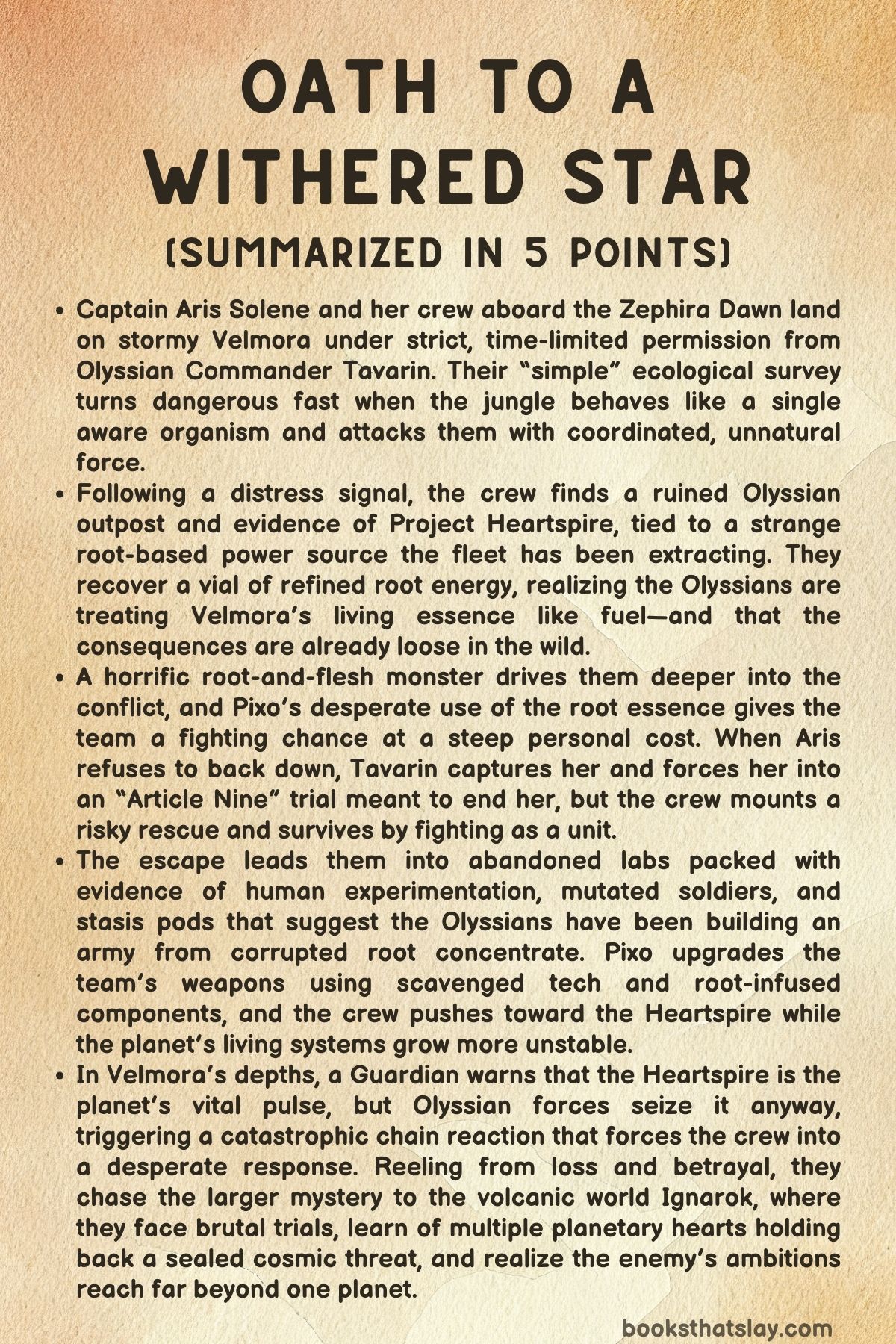
Summary
Captain Aris Solene commands the Zephira Dawn on a mission to the storm-covered world of Velmora. Once part of the Olyssian fleet, she now works independently, pursued by her former command.
Her crew—Ralik, the analytical navigator; Thorne, the hardened soldier; Fen, the disciplined marksman; and Pixo, the inventive mechanic—approaches Velmora under restricted access granted by Commander Tavarin, who warns them to stay away from Olyssian operations.
Upon landing, they find the planet’s surface pulsing with strange vitality. The forests seem to breathe, their roots shifting underfoot.
When an enormous vine-like predator attacks, the crew fights with precision and discipline to bring it down. The encounter reveals that Velmora’s ecosystem functions as a single living consciousness.
That night, as unease settles over the camp, Ralik suggests that the planet is aware of them.
Aris dreams of Samir, a fallen comrade from her Olyssian days, revealing the guilt that haunts her. In the quiet hours, Ralik finds her awake, and they share painful memories, deepening their connection.
Soon after, Ralik detects an Olyssian distress signal nearby. Despite Tavarin’s warning, Aris leads her team to investigate.
The group discovers a ravaged Olyssian outpost, its inhabitants slaughtered and the structure torn apart. Logs recovered from a damaged terminal mention “Project Heartspire,” a secret experiment involving Velmora’s root energy.
Among the ruins, they find a vial of refined energy—violet and luminous. Pixo identifies it as concentrated planetary essence, proof that the Olyssians were exploiting Velmora’s life force.
Following energy traces deeper into the jungle, they find a wounded Olyssian soldier pursued by a monstrous creature—a hybrid of root and flesh. The soldier urges Pixo to consume the vial to stop the beast.
Pixo reluctantly complies, transforming into a powerful, root-infused version of himself. The crew fights as one, finally defeating the monster.
Before dying, the soldier confesses that Project Heartspire corrupted Velmora’s essence, twisting it into the purple energy that creates abominations.
Determined to end the exploitation, Aris decides to uncover the truth behind the project despite Ralik’s warning that defiance could spark war. Their search leads them to an underground city where Olyssian laborers mine the corrupted roots.
Disguised, the crew infiltrates a miners’ tavern and learns the Heartspire lies beneath them—a source of unimaginable energy. Before they can escape, Tavarin arrests Aris under the pretext of treason, sentencing her to an “Article Nine” execution trial.
Refusing to abandon her, the crew teams up with a sympathetic miner to infiltrate the arena. Aris is forced to fight a monstrous hybrid in front of an audience, but just as defeat looms, her crew bursts in through a maintenance tunnel.
Working together with improvised tactics and relentless resolve, they kill the creature. As the silence falls, Aris looks up at her judges and declares, “They wanted a trial—we just gave them a verdict.”
The team escapes through an old shaft, descending deeper into the mining sectors. There they find laboratories filled with grotesque experiments—Olyssian soldiers mutated by root concentrate.
Mutants attack, and the crew barely survives after retreating to repair their weapons. Pixo upgrades their equipment with fragments of root energy, creating powerful enhancements.
Armed with new technology, they push forward, cutting through waves of enhanced foes until they reach the core of the facility.
At the heart of Velmora lies a vast cavern glowing with crystalline light. A Guardian—a robed being of root and energy—emerges to warn them that the Heartspire is the planet’s pulse.
Commander Tavarin arrives with Olyssian forces, claiming the Heartspire for herself. She wounds the Guardian and steals the glowing relic, triggering the planet’s collapse.
The Guardian mutates into a towering, vengeful entity as Tavarin escapes to orbit.
The Zephira Dawn’s crew fights through chaos, facing the monstrous Guardian in a desperate battle. Pixo sacrifices himself by detonating a custom explosive at its core, restoring balance to the planet but losing his life in the process.
The Guardian reappears in calm form, blessing the survivors and warning that Tavarin is headed for Ignarok—a volcanic world holding another planetary heart.
Grieving their loss, the crew mourns Pixo and shares quiet moments of memory. Aris and Thorne share a brief kiss, but Aris pulls away, reminding him that the mission must come first.
Soon after, they report to the Interstellar Alliance, only to discover that command knew about the planetary hearts all along. Aris decides not to wait for reinforcements and sets course for Ignarok.
On the volcanic world, the crew allies with locals who reveal the existence of four planetary hearts—Velmora, Ignarok, Oquelis, and Skyrend—each guarding part of a cosmic seal that contains an ancient threat named Threxion. With one heart already stolen, the balance of the galaxy hangs in danger.
The crew meets the fiery Guardian Pyronyx, who demands they prove their intent in a trial.
Each crew member faces an individual crucible shaped by their past. Ralik confronts the guilt of losing someone he loved; Thorne faces memories of imprisonment and failure; Fen relives the massacre of his home; Aris faces the vision of Samir and her fear of love.
Emerging from their trials transformed, they gain renewed strength and are blessed by Pyronyx.
Their victory is short-lived. They uncover an Olyssian fortress within Ignarok’s volcano, commanded by Tavarin.
During a tense confrontation, Tavarin reveals that she and Aris share the same father. Before reconciliation can occur, General Talos—an Olyssian warlord—arrives and kills Tavarin for showing mercy.
Aris is captured and taken aboard Talos’s dreadnought, The Graven.
Inside the oppressive vessel, the crew endures psychological torment meant to erase identity. Through coded communication and planning, they exploit the ship’s routines and escape in a bold operation involving deception and stolen disguises.
Outside, they regroup and march toward Talos’s stronghold.
In a final confrontation within the volcano’s heart, Talos seeks to merge with the second planetary Heart. The ensuing battle devastates the fortress.
The crew fights valiantly but cannot stop him from absorbing the Heart’s power. As the volcano erupts, the Guardian of Fire warns that Talos now commands two Hearts and that the stars themselves are at risk.
Barely escaping aboard the Zephira Dawn, the survivors face their losses and acknowledge their shared strength. Their pain binds them as much as their mission.
Aris, Ralik, and Thorne share an intimate night of connection, finding solace before dawn. As the sun rises, Aris promises to find the remaining Guardians and end Talos’s conquest.
The novel closes with the Zephira Dawn sailing into the void—its crew scarred, determined, and united. Their oath to a dying star becomes a promise to defend the living cosmos from the forces that seek to consume it.
Characters
Captain Aris Solene
Captain Aris Solene stands at the emotional and moral core of Oath to a Withered Star. Once a decorated Olyssian officer, she carries the dual burden of leadership and guilt.
Her journey is one of redemption and rediscovery—haunted by the loss of Samir and scarred by the corruption of the Olyssian fleet, Aris evolves from a duty-bound soldier into a self-defined protector of life. Her commanding presence is tempered by quiet introspection and deep empathy for her crew.
As she leads the Zephira Dawn through Velmora’s hostile jungles and into cosmic trials, Aris’s strength lies not in unyielding control but in her capacity to adapt and care. Her defiance against Olyssian authority in defense of living worlds reveals her as a captain driven less by allegiance and more by moral conviction.
Her moments of vulnerability—especially her dreams of Samir and conflicted affection for Thorne and Ralik—expose a human depth beneath her steel exterior. Ultimately, Aris embodies the paradox of the soldier who must destroy to protect, and the leader who must let go to truly lead.
Ralik Aeran
Ralik Aeran serves as the Zephira Dawn’s navigator and intellectual compass. His analytical mind and cautious temperament balance the impulsive and battle-hardened energy of his crewmates.
Yet beneath his calm logic lies a man haunted by personal loss—the brother he could not save and the remnants of relationships destroyed by his pursuit of perfection. His trial within the Crucible of Fire forces him to confront this flaw directly; he learns that not everything broken can—or should—be fixed.
Through this acceptance, Ralik’s character transforms from one of control to one of compassion. His technological ingenuity and emotional intelligence often hold the crew together, particularly through the Heartspire crisis and the Velmoran horrors.
By the novel’s end, his quiet resilience becomes a symbol of rationality entwined with empathy, representing humanity’s capacity to learn, adapt, and forgive.
Thorne Kaid
Thorne Kaid is the embodiment of endurance and loyalty. A veteran of Blackmarsh-7, the infamous Olyssian prison, Thorne’s hardened demeanor conceals a profound sense of guilt and moral struggle.
His history of rebellion against tyranny marks him as both a warrior and a survivor, yet his inner turmoil often manifests through stoic restraint. Thorne’s Crucible vision forces him to confront his own hypocrisy and shame, but it also frees him—allowing him to stand as a man who acknowledges his failures without being defined by them.
His evolving relationship with Aris, from soldierly respect to romantic tension, humanizes him beyond his battlefield persona. In combat, he is the crew’s shield—literally and symbolically—and his unwavering defense of others cements him as their moral backbone.
Thorne’s journey is one of reclaiming dignity, proving that redemption is not the absence of sin but the courage to live despite it.
Fen Orlan
Fen Orlan’s stoicism and discipline reflect the quiet pain of survival. A soldier shaped by the trauma of his village’s destruction, Fen initially appears as the least expressive member of the Zephira Dawn crew.
However, his Crucible vision reveals the depth of his scars: a man reliving the horror of helplessness until he chooses to face it rather than suppress it. This act of acceptance transforms him into a symbol of courage through endurance.
Fen’s tactical precision and sense of duty make him indispensable in battle, yet it is his internal calm that often steadies the group amid chaos. While less vocal than his peers, his loyalty and quiet wisdom anchor the crew, and his arc illustrates that heroism can exist not in grand gestures but in the simple persistence of hope after loss.
Pixo
Pixo, the feline-like mechanic, is both the heart and the spark of the Zephira Dawn. Mischievous, witty, and endlessly inventive, he provides levity amid despair.
Yet beneath his humor lies boundless courage and selflessness, culminating in his ultimate sacrifice to save Velmora. His transformation through Root energy marks a physical and spiritual evolution—from a tinkerer obsessed with machines to a being who understands the harmony between creation and life.
Even in death, his presence lingers, manifesting as a spectral companion and symbol of eternal curiosity. Pixo represents the essence of creative sacrifice—the idea that innovation and empathy can coexist, and that heroism may take the form of laughter as easily as battle.
Commander Tavarin
Commander Tavarin is a study in tragic duality. As Aris’s former ally and later revealed half-sister, she mirrors Aris’s struggles with loyalty and conscience.
Initially presented as a strict enforcer of Olyssian law, Tavarin’s eventual revelations expose the conflict between obedience and morality. Her attempts to balance compassion with duty make her a tragic foil to Aris—two women shaped by the same heritage but divided by ideology.
Tavarin’s death at the hands of General Talos underscores the price of empathy in an empire built on control. Her brief alliance and final apology transform her from antagonist to martyr, leaving a haunting legacy that fuels Aris’s resolve.
General Talos
General Talos embodies the ruthless ambition and philosophical corruption of Olyssian power. Cold, calculating, and obsessed with dominance over the Hearts, Talos represents the inverse of Aris’s idealism.
His fusion with the planetary Heart transforms him into a living weapon—both literally and symbolically merging man with imperial greed. Talos is less a character than a force of ideology: the will to command existence itself.
His cruelty toward Tavarin and his manipulation of power expose the hollowness of the Olyssian dream. Yet his measured intelligence and composure prevent him from being a simple villain—he is terrifying precisely because he believes his conquest is necessary order.
Keven
Keven, the aged prisoner aboard the Graven, functions as a subtle catalyst in the story’s latter half. Though his role is brief, his presence reminds the crew—and Aris in particular—that resistance is as much a matter of patience as defiance.
His insights into the ship’s routines and his quiet endurance embody the resilience of those forgotten by empire. Through him, the theme of persistence against oppressive systems gains a grounded, human dimension.
Themes
Power Taken Without Consent and the Cost of Extraction
Velmora is treated less like a world and more like a resource deposit, and the story makes that violation feel immediate and physical rather than abstract. The Olyssians don’t simply study the planet; they take from it, refine it, weaponize it, and then label the consequences as acceptable losses.
The corrupted logs about batches, dosages, emotional instability, and “acceptable failure rate” show a system that has normalized cruelty as procedure. That mindset spreads outward: once a living planet can be reduced to “root concentrate,” people can be reduced to “test subjects,” and entire mining sectors can be reduced to output and quotas.
The purple corruption becomes a visible sign of extraction done past the breaking point—energy that turns unstable because it has been forced into shapes it was never meant to hold.
This theme also matters because it explains why Velmora fights back in ways that mirror the harm done to it. The vine predator, the hybrid abominations, and the mutated soldiers are not random threats; they are consequences shaped by human greed and military impatience.
Even the Guardian’s transformation into a raging titan after the Heartspire is stolen reads like a body reacting to trauma, not an evil entity choosing violence. The same pattern continues on Ignarok, where the local elders describe hearts not as trophies but as seals that keep something far worse contained.
Every time someone tries to “own” a heart, they gamble with systems they do not control, and the price is never paid only by the thief. It is paid by ecosystems, workers forced into brutal labor, and by ordinary people who will never see the benefit of the power being taken.
In Oath to a Withered Star, extraction is not presented as an economic activity; it is presented as a moral failure with a widening blast radius.
Sentient Worlds and the Ethics of Relationship
The planets in the story are not backdrops. Velmora’s biosphere behaves like a single awareness, responding to intrusion with coordinated defense, rhythmic pulses, and adaptive threats.
That changes the ethical stakes: entering Velmora is not like hiking through wilderness; it is like walking into someone’s home while armed, afraid, and uncertain of the rules. The crew’s early realization that the planet is aware of them reshapes every later choice, because it introduces the possibility that harm is not accidental damage to scenery but harm done to a living being.
The Heartspire being described as Velmora’s pulse pushes this further. If removing it kills the planet, then theft becomes a form of murder even when done in the name of “strategy” or “progress.”
What makes this theme land is that the story contrasts two ways of relating to living power. The Olyssians approach the roots as something to dominate, tune, bypass, and extract.
Commander Tavarin arrives with tools that treat the Guardian’s protections like locks to be picked, and her method works in the short term—she gets the Heartspire—but it breaks the world in the process. Aris and her crew, even while fighting, show signs of relationship rather than ownership: they listen, they observe, they respond to warnings, and they engage with the Guardian as an entity with authority rather than as an obstacle.
The Guardian even says the heart revealed itself because they did not come seeking conquest, which suggests that intention affects access, not just skill.
The later blessing that purges corruption and replaces it with balanced green energy matters here too. It implies a kind of consent-based exchange: power given to protect, not taken to control.
Ignarok’s Guardian, Pyronyx, demands proof of intent before granting passage, reinforcing that these are not resources to be harvested but partners that judge character. In Oath to a Withered Star, the universe draws a line between possession and relationship, and that line becomes the difference between healing and catastrophe.
Trauma, Memory, and Choosing to Keep Living
The crew’s battles are brutal, but the book’s emotional engine is the way each character is forced to live with what happened before the current mission. Aris carries Samir’s death like an unresolved verdict against herself, and her dreams show that she has never truly left that moment.
The Crucible trials externalize what each person avoids: Ralik’s need to “fix” the people he loves, Thorne’s shame and anger from Blackmarsh-7, Fen’s helplessness during the massacre of his village, and Aris’s fear that love always becomes loss. These trials are not framed as motivational challenges; they feel like confrontations with inner histories that keep reasserting control.
The story suggests that survival is not only staying alive in combat—it is staying human while memory keeps trying to rewrite your identity into failure.
What changes the crew is not forgetting the past, but learning a different relationship with it. Ralik’s revelation that love is not repair but release is a shift from control to acceptance.
Thorne refusing to let guilt define him is not the same as denying wrongdoing; it’s choosing selfhood beyond a single chapter of his life. Fen’s decision to face the memory rather than fight it shows that courage can look like standing still with pain instead of charging at an enemy.
Aris admitting she still loves and can live beyond grief is the most directly tied to leadership, because her isolation is not just personal—it shapes every risk decision, every refusal to lean on others, every moment she tries to carry consequences alone.
This theme deepens after Tavarin’s death. Aris is hit with a new layer of grief: not only losing someone, but losing the possibility that an enemy could have been family, could have been redeemed, could have changed outcomes.
Talos executing Tavarin for compassion shows how trauma is also manufactured by systems: a regime that punishes empathy creates a world where people learn to suppress it. The book’s answer is not easy optimism.
It is persistence with scars, and a slow willingness to let connection exist anyway. Oath to a Withered Star treats healing as a decision made repeatedly under pressure, not a single breakthrough.
Identity Under Systems That Erase People
Olyssian power is shown not only through weapons and fleets but through processes designed to strip individuals of meaning. “Article Nine” is presented as a mock trial designed as execution, which turns justice into theater and turns the accused into a prop.
The mining city’s brutal conditions reduce workers to bodies that move ore and absorb risk. The lab logs reduce living beings to “batch seventeen” and failure rates.
On Talos’s warship, the sterile monotony is explicitly engineered to erase identity, replacing reduceable, personal selves with compliant silence. Across these settings, the same pattern repeats: when a system wants control, it begins by flattening people into categories—prisoners, subjects, miners, intruders—because categories are easier to discard.
Aris’s arc pushes against this flattening. She was once a decorated officer, a title that carried prestige, structure, and public identity.
Now she is an independent captain hunted by her former fleet, which forces her to define herself by choices rather than rank. Her refusal to walk away from Heartspire is not only moral; it is a declaration that she will not let Olyssian authority decide what kind of person she is allowed to be.
Even her decision to surrender so her crew can flee becomes an identity statement: she chooses responsibility over survival in a way the Olyssian system cannot comprehend, which is why it tries to crush her through ritual punishment.
The crew’s escape from The Graven also shows identity as an active practice. They survive by performing Olyssian roles—uniforms, keycards, checkpoints—without becoming those roles.
Their deception is not a loss of self but a strategy to protect it. Afterward, the intimate moments aboard the Zephira Dawn are not just romance; they are restoration of personhood after environments designed to make them feel like numbers.
In Oath to a Withered Star, the fight against empire is also a fight to remain a full human being when institutions profit from making humans smaller.
Loyalty, Chosen Family, and Leadership as Shared Weight
The crew functions as a unit long before anyone calls it a family, and the book earns that bond through action under stress rather than sentimental declarations. The early fight with the vine predator requires precise teamwork and shared trust, establishing that survival depends on coordination, not heroics.
Later, when Aris is taken under Article Nine, the apparently rational choice would be retreat. The crew refuses that logic and breaks into the arena to pull her out, turning loyalty into something costly and concrete.
Their combat style reinforces this theme: Ralik’s tactical calls, Fen’s covering fire, Thorne’s shielding, and Pixo’s engineering are not supporting roles around a central figure. They are interlocking forms of leadership that keep the group alive.
Aris’s leadership is tested because her instincts push her toward carrying everything alone. Her guilt about Samir and her fear of losing people again encourage distance, even when closeness would make the crew stronger.
The narrative repeatedly forces her to accept that command is not control. When Pixo proposes upgrading weapons with Root vials, it is not Aris single-handedly “saving the day”; it is trusting another person’s expertise with risks that could backfire.
When the Guardian later purges corruption and blesses the weapons, it reinforces that their strength comes from shared exchange rather than unilateral force.
Pixo’s sacrifice brings this theme to its most painful point. He chooses to detonate the explosive at point-blank range, not because he is disposable, but because he believes the team’s survival and the planet’s survival require a decision someone must make.
The aftermath aboard the ship—mourning, stories, silence—shows that chosen family includes grief as a permanent member. The crew becomes defined by who is missing as much as by who remains.
The kiss between Aris and Thorne, and later the night of vulnerability among Aris, Ralik, and Thorne, are framed less as escapism and more as a refusal to let constant danger erase tenderness. In Oath to a Withered Star, loyalty is not blind obedience; it is the decision to share weight, share fear, and still move forward together.
Fate, Cosmic Responsibility, and the Stakes of Intent
As the story expands from Velmora to Ignarok, the conflict shifts from a local atrocity to a cosmic structure held together by fragile agreements. The elders’ explanation of four planetary hearts—Pyronyx and the others—reframes the earlier theft as more than a raid.
The hearts are part of a containment design meant to keep a sealed threat, Threxion, bound. That revelation makes intent the central moral variable.
The same act—approaching a heart—can mean protection, greed, desperation, or conquest. Pyronyx demanding proof before granting passage shows that the universe does not treat all seekers equally; it judges why someone wants power, not only whether they can take it.
Talos becomes the clearest expression of power without responsibility. He executes Tavarin for compassion, which signals that his regime treats empathy as weakness and domination as virtue.
When he absorbs the Heart into himself, he crosses a line from wielding power to becoming a vessel for it, turning his body into a political weapon and a spiritual hazard at once. The Guardian’s warning that Talos now holds two hearts and that the stars are in danger raises the stakes beyond personal survival.
The crew is no longer fighting to escape a fleet or expose a project. They are fighting to keep reality’s safeguards from collapsing.
Against that scale, the crew’s choices stay grounded in intention rather than destiny. Even when Alliance Command orders them to wait for reinforcements, Aris decides they will not wait, partly because she suspects command is withholding truth.
That decision can be read as reckless, but it also fits the theme: responsibility is not always aligned with authority. The book repeatedly shows official structures failing—Olyssian command becomes predatory, Alliance command becomes evasive, trials become executions—so the moral burden shifts onto individuals and small groups who act before permission arrives.
Oath to a Withered Star frames heroism less as reminding the universe who is “chosen,” and more as refusing to outsource conscience when the cost of delay could be cosmic.