Only Way Out Summary, Characters and Themes
Only Way Out by Tod Goldberg is a crime novel about how one disastrous day can bend a whole town’s future. It starts in coastal Oregon during a brutal winter storm, where a desperate police officer and a doomed thief cross paths without ever planning to.
Fifteen years later, the fallout has turned into local legend, a tourist industry, and a weapon powerful people use to protect themselves. The story follows the people trapped inside that legend—those who stole, those who covered it up, and those still trying to learn what really happened.
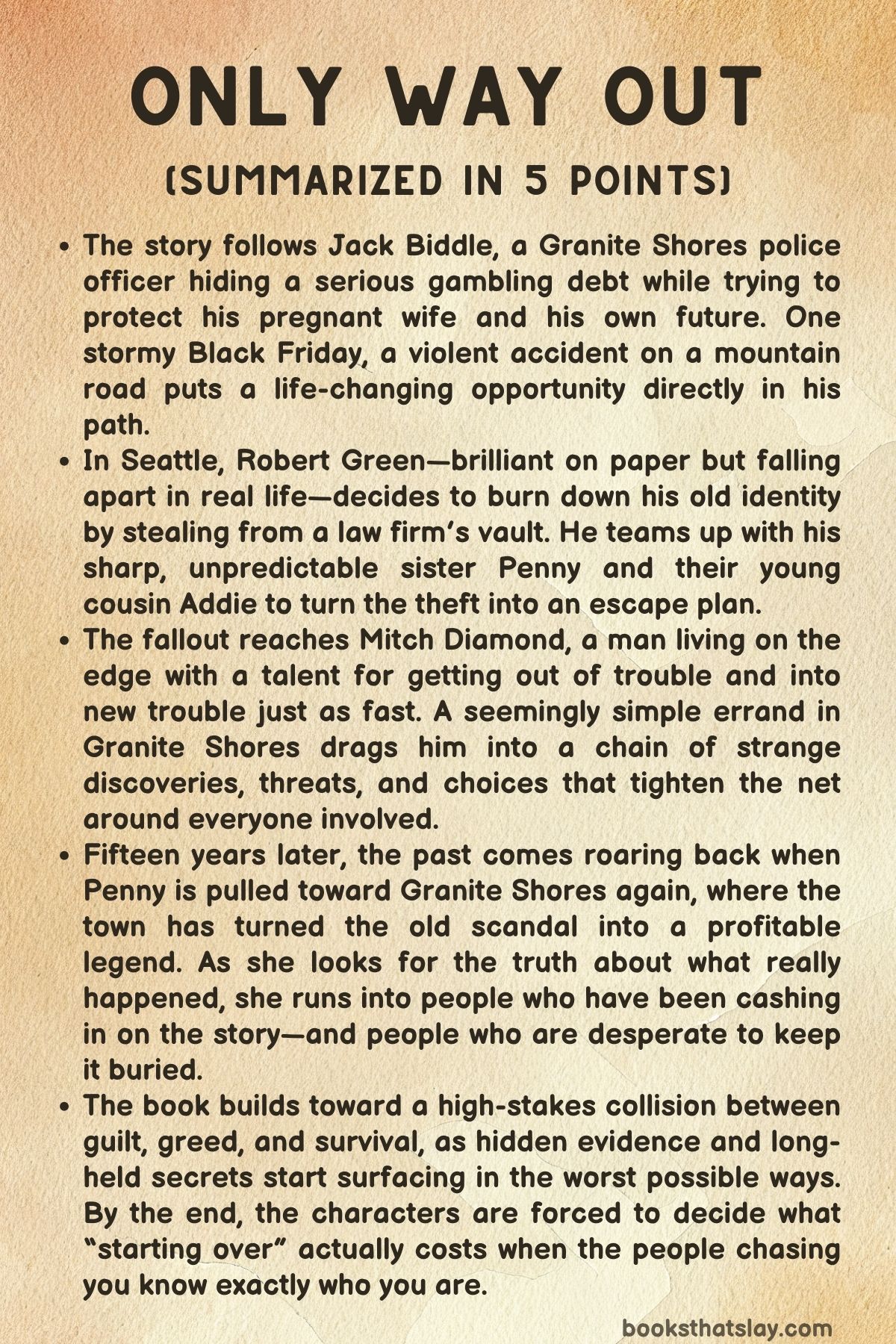
Summary
On a freezing Black Friday in Granite Shores, Oregon, Officer Jack Biddle sits alone in his unmarked police Tahoe near the top of Yeach Mountain. Jack is a decorated veteran, but he is also a corrupt cop with a gambling addiction and a history of violent enforcement work.
He has been skimming cash from the police evidence room for months, telling himself it is temporary, yet he has burned through nearly two hundred thousand dollars and now owes fifty thousand more to a local bookie, Danny Vining. Danny’s collections man, Bobby C., has been calling nonstop.
Jack refuses to answer because he knows what happens to people who cannot pay.
Jack’s panic is sharper because his wife, Caroline, has just learned she is pregnant after years of being told they could not have children. In a burst of optimism, Jack placed a huge bet—money he did not have—convinced luck had finally turned.
The bet failed, and the next morning Bobby C. came to Jack’s house, threatening him and humiliating him when Jack stayed hidden. Now Jack is on the mountain trying to decide whether to run, steal more, or do something worse.
That same day in Seattle, Robert Green—once a celebrated local prodigy from Granite Shores—makes his own break from a life he hates. Robert graduated from Harvard Law but failed the bar exam fifteen times and is crushed by enormous debt.
He admits to himself he never truly wanted to become a lawyer. Working at the law firm Barer & Harris, he has access to a private vault of safe-deposit boxes used by wealthy clients who want discretion.
Security is weak because the head of security has died at his desk and the replacement will not start for weeks. Robert chooses Black Friday because the office is officially closed, but he can still enter under the cover of his vault responsibilities.
Robert empties the boxes with precision, taking cash, jewelry, and valuables worth millions. He coordinates with his sister Penny, brilliant and unstable, who builds a spreadsheet to organize what they can use for leverage and money.
Their underage cousin Addie is enlisted to help with future mailing and messaging through a shared drafts folder in a dummy Gmail account. The plan is simple: Robert drives the loot to Granite Shores, meets Penny at the marina, and they escape on their late father’s sailboat.
Robert heads toward the coast in a battered white van as a winter storm turns the roads into ice. Penny calls to warn him that the wind and squall may delay their departure.
They agree to unload the van, sleep on the boat, and leave at first light. Robert is close to freedom, distracted for a moment by the radio, when a rear tire blows on the steep grade of Yeach Mountain.
The axle fails, the van spins, and it slams into a massive evergreen. The impact tears the vehicle open and kills Robert instantly.
From his hiding spot above the road, Jack sees the spinning headlights and the crash. Instead of calling it in, he hikes down into Patterson Gulch.
Wind scatters papers and money into the dark. Jack grabs an itemized spreadsheet that lists safe-deposit contents and follows the smell of electrical damage to the wreck.
Inside the van he finds Robert’s body and, in the back, bags and boxes stuffed with cash and high-end valuables. He recognizes Robert’s name and realizes the haul could wipe out his gambling debts and buy him security.
Jack fills his backpack with jewelry and as much cash as he can carry. He also takes Robert’s severed head in a bag, not out of mercy or duty, but to control what evidence exists.
He climbs back up the mountain richer than he has ever been, leaving the crash to become someone else’s problem.
The next day, Mitch Diamond appears far away in Klamath Falls, trying to live quietly while planning a new job in Seattle. Mitch has a criminal past he is hiding under a newer identity.
He works at the Purple Flamingo casino for a man named Dale, an ex-cousin-in-law with his own schemes. Dale pays Mitch and sends him to Granite Shores in a red Cadillac to deliver keys to an elderly woman, Dorothy Copeland, in exchange for a cashier’s check.
Mitch senses the job is dirty but takes it for quick money. The storm worsens as he drives toward Yeach Mountain, where highway patrol escorts cars in small groups across the pass.
On the mountain road, Mitch stops after something strikes the car. In the brush he finds cash scattered in the muck, plus a torn envelope marked “PERSONAL AND CONFIDENTIAL” and an old wedding photo with a boot print across them.
Before he can search further, Officer Biddle arrives. Jack questions him, casually destroys the photo and envelope, and escorts him into town.
Mitch hides the cash and keeps driving, unsettled by the officer’s calm.
Mitch reaches Dorothy Copeland’s apartment in an upscale complex. He picks the lock when he notices newspapers piling up.
Inside, the apartment is tidy but reeks. On the patio he finds Dorothy dead on a chaise lounge while a crow pecks at her face.
Mitch calls Dale, who immediately asks about the cashier’s check and orders Mitch to search for cash, a safe, or anything valuable. Mitch tries to avoid leaving evidence, but Dale pressures him, then stops answering calls.
Mitch realizes he has been set up and decides to leave.
In the parking lot, Mitch meets Addie, a goth teenager who recognizes the Cadillac and assumes Mitch is someone else. Police sirens approach.
Jack shows up again, acting strangely relaxed, almost impaired. After Jack goes inside the building, Mitch opens the trunk and finds a cooler containing a dead German shepherd and a threatening note demanding payment.
Mitch panics, locks the car, and recruits Addie to use Dorothy’s credit cards to pull cash quickly. Addie returns later with thousands of dollars and stolen goods, and Mitch flees town on a Greyhound, destroying his phone along the way and recommitting to a life built on lies and movement.
Meanwhile Penny, waiting on the sailboat Pere-a-Dice, grows desperate as Robert never arrives. She searches for him, calls in favors, and eventually borrows money from casino-connected men who attach threats to their help.
Her isolation stretches into days, then weeks, and her fear becomes certainty: something went wrong on the mountain.
Jack, now sitting on stolen wealth, understands he cannot let Penny get close to the truth. He uses surveillance and police access to track her to the marina.
He boards the Pere-a-Dice intending to arrest her and seize whatever she has, and if necessary, kill her. Penny resists, and in the struggle Jack slips and accidentally shoots himself in the thigh.
Penny could let him bleed out, but instead she makes a tourniquet and calls for help. That choice costs her everything.
The system turns on her, and she ends up spending more than thirteen years in prison, while Jack uses the aftermath to cement his position and reshape the town’s story.
Fifteen years later, Granite Shores has built an economy around the myth of Robert Green. The heist, the vanished thief, and Penny’s notoriety have been packaged into festivals, tours, and souvenirs.
Mitch, now tied to the law firm case and motivated by his own secrets, finds Penny in Wonder Valley, California, working at a desert bar. He offers her a way back into the world: come to Granite Shores, chase the truth, and collect what he hints is a fortune.
Penny agrees, not because she trusts him, but because she cannot live with the unanswered question of what happened to her brother.
Back in Oregon, Mitch also needs to erase loose ends that could expose his former identity. He tracks down Dale, who is spiraling, and finds him dead in a library.
Mitch removes the body to prevent public discovery, then stages evidence to point suspicion elsewhere. At the Purple Flamingo, a fire and a planted severed thumb pull police attention into a new, grotesque direction and raise the stakes for everyone involved.
Penny returns to Granite Shores and confronts the town’s warped celebration of her family’s ruin. Her childhood home has been turned into an attraction, her room recreated as an exhibit.
She sees how the town profits from a story that never included the real cost. She also confronts Bobby C., now older and reduced, but still connected to the same network of fear and favors.
Bobby hints that powerful people still want the Greens silenced.
Chief Jack Biddle, now a pillar of Granite Shores, meets Mitch and Penny with controlled outrage, but privately he is terrified. He watches camera feeds, manipulates narratives, and calculates who he can frame if the truth surfaces.
Penny refuses to leave without answers. Mitch warns her that dangerous men like Rodney Golubev will not settle for money—they will kill to protect themselves.
A body washes onto the shore, torn by birds and surf. It is Bobby C. Panic spreads.
Jack tries to redirect suspicion, even planting false forensic signals to implicate others. Penny and Mitch push forward, following the trail to an abandoned Sno-Cone Depot that has been fortified with cameras and steel.
Mitch forces entry, and Penny goes down into a hidden basement.
What Penny finds is not a simple stash. It is a massive freezer and storage system filled with numbered boxes matching the stolen vault inventory—keys, jewelry, cash, weapons, drugs, and blackmail material.
The evidence is clear: someone recovered Robert’s van and kept everything. Penny opens a smaller interior freezer and discovers the final horror—Robert’s preserved body, stored for years like a trophy and an insurance policy.
Mitch admits he lied about key parts of his reason for coming. His true goal was to confirm who Robert tried to shake down and how the stolen goods moved into local hands.
Penny is furious, but the truth is finally solid. Jack arrives armed, attempting to shut it down.
Mitch shoots him, restrains him, and forces a confession on camera about Robert’s death and the long cover-up. Mitch then locks Jack inside the freezer with Robert’s body, ensuring Jack faces what he did before help arrives.
A year later Penny lives under a new name in Utah, working quietly at a bar and trying to stay invisible. One night she receives a brick of cash labeled with her real name.
She understands immediately: Mitch has found her again, and the past is still close enough to touch. She leaves early, steps into the night, and sees a large Cadillac waiting—proof that escape, even after the truth, is never simple.
Characters
Officer Jack Biddle
Jack Biddle is the story’s engine of corruption in Only Way Out—a man whose public identity as a Granite Shores cop is built to conceal a private life ruled by debt, fear, and impulse. His gambling addiction isn’t portrayed as a quirky flaw; it’s a compulsion that turns every good moment into a trigger for self-destruction, including the “miracle” of Caroline’s pregnancy that he immediately converts into a catastrophic wager.
Jack’s defining trait is opportunistic violence: he can rationalize brutality as necessity, and he can rationalize theft as survival, which allows him to cross moral lines without experiencing the kind of conscience that would stop him. When Robert’s van crashes, Jack’s first instinct is not duty or shock but acquisition—he sees a dead man as a solution, and that choice becomes the sin that poisons the next fifteen years of his life.
What makes Jack especially dangerous is that he evolves from petty corruption (skimming evidence cash) into institutional control. He learns how to use the “story” of crime to shape the town itself—surveillance, property, politics, and narrative management—until he’s not just hiding wrongdoing but designing a local reality where he stays untouchable.
Jack’s panic about prison reveals a core cowardice: he isn’t a criminal who accepts consequences; he’s a man who believes consequences are for other people. That fear drives him to escalate—first to silencing Penny, later to framing others, and finally to the grotesque preservation of Robert as a literal frozen secret.
By the time the truth resurfaces, Jack is no longer merely a crooked cop—he’s a curator of evidence, a manipulator of civic myth, and a man who mistakes control for safety until it traps him.
Caroline Biddle
Caroline is often mistaken, at first glance, for the innocent spouse orbiting Jack’s chaos, but Only Way Out gives her sharper edges: she becomes a political actor who understands that truth is less powerful than the version of truth people agree to consume. Her pregnancy—and later her role as mayor—frames her as someone who turns private longing into public image.
She speaks the language of stability (family, community, adoption, “helping” their son Travis), yet she also recognizes that Granite Shores has built an economy on a legend, and legends require maintenance.
Caroline’s most revealing moments are the ones where she doesn’t recoil from Jack’s manipulation but strategizes around it. She understands reputational risk, the silence of powerful victims, and the value of controlling the narrative before the narrative controls you.
Whether she knows every detail of Jack’s crimes matters less than the role she plays: she functions as the respectable face of a corrupt structure, giving Jack cover and also pushing him toward more aggressive containment when threats arise. Caroline embodies the civic version of complicity—less about pulling the trigger, more about ensuring the trigger never gets traced back to the institution.
Robert Green
Robert is the tragedy at the center, but he’s not written as a saint; he’s written as a man trying to outsmart his own collapse. A Harvard Law graduate who fails the bar exam fifteen times, Robert becomes an emblem of gifted-person ruin—someone whose intelligence cannot compensate for emotional drift, avoidance, and denial.
His decision to rob Barer & Harris is less a mastermind flex than a desperate attempt to cut a clean exit from a life he believes has already been wasted. He doesn’t merely want money; he wants erasure—freedom from debt, identity, and expectation.
Robert’s flaw is the same as his hope: he believes a single dramatic act can reset everything. The heist is carefully planned, but it’s also built on magical thinking—if he executes the scheme, the future will obey.
His partnership with Penny and Addie shows that Robert’s desperation is contagious; he pulls family into the blast radius of his escape plan. When he dies in the crash, the physical brutality of his death matches the thematic brutality of his illusion shattering.
Yet Robert remains “alive” in the story because others weaponize his name—tourism, mythmaking, blackmail economies, and Jack’s cover-up all require Robert to be simultaneously dead and narratively useful. His ultimate fate—preserved and hidden—turns him into a symbol of the book’s bleakest idea: in a world of corruption, even a corpse can be leveraged like currency.
Penny Green
Penny is the emotional counterweight to Jack: where Jack’s instinct is to bury the truth, Penny’s instinct is to dig until her hands bleed. She is brilliant, volatile, and fiercely survival-minded—someone who can build systems (blackmail targets, logistics, coordination) yet also be undone by rage, grief, and a refusal to accept a convenient lie.
Her loyalty to Robert is complicated: she’s not blind to his failures, but she is bound to him by shared history, shared damage, and the intimate burden of growing up in a collapsing home. That bond is why she waits on the boat, why she begs Freddie for money, and why she keeps moving even when every rational signal says the situation is lethal.
Penny’s most defining moment early on is her choice to save Jack when she could let him die. That decision is both morally luminous and tragically expensive: it’s the point where her humanity becomes the tool that ruins her life, sending her to prison for over thirteen years.
Fifteen years later, she returns not as a naive accomplice but as a hardened survivor who has learned how quickly society turns trauma into entertainment. The town’s commodification of her childhood and Robert’s legend sickens her because it converts pain into souvenirs, and she refuses to let that be the final meaning of what happened.
Penny’s arc is the story’s insistence that truth has a cost—but it also has a gravity. Even when she runs at the end under a new name, she cannot fully escape the machinery around her because the world keeps trying to monetize her tragedy, and Mitch keeps trying to “find” her like an asset.
Penny becomes the book’s clearest portrait of endurance: not purity, not victory—endurance with teeth.
Addie Green
Addie begins as the underage cousin pulled into a high-risk adult scheme, and the storyline tracks how that early coercion shapes her into a person who makes a living selling stories instead of solving them. When we first meet her in the present of the older timeline, she’s opportunistic, streetwise, and emotionally insulated; she has learned that attention is currency and that tragedy can be repackaged into content.
Her condo’s deliberate recreation of Penny’s childhood aesthetics is the book’s clearest image of how Addie treats the past: not as a wound, but as a set design.
Addie is not purely villainous; she is a product of being used early and learning to use back. She shifts theories, follows psychics, builds a podcast ecosystem, and keeps Granite Shores’ mythology circulating because mythology pays better than closure.
Her moral numbness functions as a defense mechanism—if she admits what really happened, she must admit how vulnerable she was and how badly she was exploited. Penny’s confrontation exposes the ethical difference between them: Penny wants the truth even if it destroys her; Addie wants whatever version of the truth keeps her safe and solvent.
Addie represents how trauma can mutate into entrepreneurship when a community rewards spectacle more than justice.
Mitch Diamond
Mitch is the book’s most slippery figure—a professional criminal who has evolved into a professional manipulator, someone who can speak the language of evidence and procedure while still thinking like a thief. He is defined by reinvention: fake identities, careful social reading, and an instinct for leverage.
His early scenes show him as a small-time survivor taking shady errands, looting pills, and improvising exits; later, he reappears with greater resources and a more polished threat—proof that criminals don’t always “go straight,” they just get better at looking legitimate.
Mitch’s psychology is built around control and risk management. He eliminates loose ends (Dale’s DNA, the trailer fire, the staged evidence), not out of cruelty alone but out of an obsessive need to keep the past from touching the present.
At the same time, he’s capable of restraint in moments that matter—he stops himself from stealing wallets on the bus, suggesting a thin but real internal line he won’t cross when the cost-benefit shifts. His relationship with Penny is transactional at first and then morally complicated: he wants her cooperation to close his own narrative, and he uses her pain as a tool, but he also recognizes her strength and, in a warped way, respects it.
The freezer confrontation reveals Mitch’s true center: he is not chasing justice, he is chasing resolution on his terms. By forcing Jack’s confession and locking him in with Robert, Mitch delivers a punishment that is both theatrical and calculated—less about law, more about control of meaning.
Even the ending—Mitch finding Penny again via money and a Cadillac—suggests that for Mitch, people are never fully free; they are variables in a system he believes he can always locate and influence.
Danny Vining
Danny Vining is the town’s connective tissue between street crime and civic power. He starts as Jack’s lifelong link to gambling debt—an ordinary local bookie with extraordinary reach—and ends as someone whose influence is durable enough to remain relevant across decades.
Danny’s most important trait is his ability to survive by staying adjacent to violence without being the one who swings the bat. He delegates collection to Bobby C., keeps his own hands comparatively clean, and maintains relationships that make him difficult to remove without consequences.
Danny also functions as an “invisible institution,” parallel to the official institutions Caroline and Jack control. The bar ownership, the knowledge network, the ability to suggest who is a liability—these are the quiet powers Danny holds.
He’s not driven by ideology; he’s driven by continuity. If Jack represents corrupt authority, Danny represents corrupt commerce, and the two reinforce each other in a system where debt becomes a tool for governance.
Bobby C. (Bobby Calhoun Jr.)
Bobby is the physical enforcement arm of the criminal ecosystem, and Only Way Out uses him to show how intimidation becomes routine. In the past, he is a looming threat—someone Jack fears not just because of violence but because Bobby’s job is to make fear personal (showing up at homes, threatening spouses, humiliating targets).
As an adult, Bobby carries the residue of that history, and Penny’s confrontation with him highlights how predation and cruelty can persist even when time changes everyone’s body and posture.
Bobby is also a cautionary figure about “liability.” In a world where secrets are the real currency, the people who know too much are eventually disposable. His later death—violent, public, and immediately useful to Jack’s framing instincts—shows how enforcers often end up as evidence when higher-ranking operators need a scapegoat or a distraction.
Bobby’s arc is bleakly functional: he exists to threaten, and when his existence threatens the wrong person, he gets removed.
Dale
Dale is a parasite character—comic in his incompetence at times, frightening in his capacity for damage, and ultimately pathetic in his end. He’s introduced as the guy sending Mitch on errands, but his real role is as a generator of chaos and exposure: he knows too much about Mitch’s former life, and that knowledge makes him dangerous.
Dale’s behavior suggests a person who survives by drifting from scheme to scheme, leaving harm behind without processing it.
His death in the library, paired with the childlike note and the sentimental book, reframes him: Dale is not a mastermind; he’s a broken man who finally runs out of exits. For Mitch, Dale becomes a problem to be managed even in death—something that can create headlines, trigger investigations, and pull old identities into the light.
Dale’s significance is less about what he accomplishes and more about what he threatens to reveal: he is the past that won’t stay buried.
Dorothy Copeland
Dorothy is a haunting absence—present mostly through the consequences of her death and what her home contains. She represents the vulnerability of ordinary life when it becomes entangled with criminals looking for leverage.
Her apartment is orderly, quiet, and intimate, which makes the discovery of her body—decomposing on a chaise lounge with a crow pecking her face—feel like an assault on the idea that anyone gets to die privately.
Dorothy’s role also exposes Mitch’s moral temperature early on. He breaks in, rummages, steals pills, eats her food, and searches for valuables under pressure from Dale.
Dorothy is not only a victim; she is the mirror that shows how quickly the living can treat the dead as an inconvenience. Even the German shepherd in the trunk and the “Paul” confusion around her connect Dorothy to a web of coercion and threat that extends beyond her life.
She becomes one more person reduced to a plot object by people who think survival excuses everything.
Rodney Golubev
Rodney is violence with social polish—the kind of criminal who can operate openly because people fear the cost of resisting him. He embodies the predatory side of the local underworld: he doesn’t bargain the way Danny bargains; he punishes.
His reaction to being framed (finding the thumb, reading the staged message) reveals a man who understands symbolism and reputation—he knows the accusation is meant to provoke a response as much as invite police scrutiny.
Rodney’s most chilling trait is emotional detachment. When a mutilated corpse washes ashore, his unwillingness to help beyond confirmation suggests a person whose humanity has been filed down to utility.
He is a credible threat because he isn’t motivated by money alone; he’s motivated by dominance and retaliation. That makes him the kind of antagonist who escalates not because it’s rational, but because it’s identity-confirming.
Freddie Golubev
Freddie plays the role of the “reasonable” criminal—the one who speaks calmly, offers logistical solutions (a cruise, cash, plans), and frames exploitation as partnership. He is not less dangerous than Rodney; he’s simply more strategic.
Freddie understands that desperation is a resource, and Penny’s desperation becomes something he can price. His threat isn’t loud; it’s contractual.
Freddie also shows how criminal economies overlap with legitimate systems. Booking travel, arranging exits, providing envelopes of instructions—he operates like a concierge for fugitives.
That professionalism is exactly what makes him frightening: he turns life-or-death leverage into customer service.
Officer Frane
Frane is one of the few law-enforcement figures who reads like a genuine counterforce rather than an extension of corruption. Her sharpness is immediate: she sizes Mitch up, pokes at his identity, and doesn’t accept performance as truth.
Yet she’s not written as a flawless crusader; her own history—saving some cousins, losing Calvin—gives her a personal relationship with unresolved bodies and the way loss distorts time. That backstory makes her attentive to Penny’s motive: the need to confirm whether the dead belong to the people you love.
Frane’s interactions with Jack also matter because they show the internal compromises of policing. She has knowledge of Jack’s earlier activity and has “cleaned up” evidence before, which suggests she understands the department’s political reality, even if she doesn’t fully endorse it.
Frane stands at the edge of complicity and resistance, and her value in the narrative is that she sees how stories get manufactured—then tries, within constraints, to keep the truth from being completely buried.
Gabino Jones
Gabino is mostly offstage, but his absence creates the opening that makes Robert’s heist possible. As head of security whose death leaves a gap until mid-December, he represents the mundane vulnerability of systems: even “secure” structures can hinge on one staffing change, one unfilled position, one overlooked transition.
Gabino’s importance is structural—he is the missing lock on the door Robert walks through.
Travis Biddle
Travis exists largely as a pressure point—a child around whom Caroline and Jack build justifications. Caroline’s belief that adoption will “help” Travis frames him as someone with needs the parents are trying to solve, but the deeper implication is harsher: Travis is part of the image they must protect.
His presence intensifies Jack’s desperation because Jack’s crimes are no longer only about himself; they’re about defending a constructed family narrative.
Corey
Corey functions as the keeper of a small town’s rewritten memory. When Penny visits the comic shop that used to be Mel’s, Corey’s scrapbook rummaging scene highlights how the town has moved on in a way that still feeds on the past.
He isn’t portrayed as malicious; he’s simply part of the ecosystem where people’s tragedies become local lore and local commerce. Corey’s normalcy makes the exploitation feel more real.
Mel
Mel is absent in the present timeline, but his death marks the passage of time and the way communities absorb loss into routine. Mel’s disappearance from the living world parallels Robert’s: both become stories other people handle, repurpose, or move past, and the living are left to navigate institutions that keep operating after individuals vanish.
Glory
Glory is a small but telling figure because she shows how collateral damage spreads. She’s simply living alongside Dale—messy, compromised, ordinary—until Mitch uses her and then burns the trailer, turning her life into another disposable stage in his cleanup operation.
Glory’s role underlines one of the book’s recurring cruelties: the people nearest to criminals often become fuel, not partners.
Marcy
Marcy is a survivalist with situational clarity. She warns Mitch that his photo is posted and that Rodney is watching, yet she also accepts cash to help clear the building—an exchange that captures the book’s worldview where morality is often subordinate to immediate safety and money.
Marcy’s presence adds realism: she’s someone who reads threats quickly and makes the best deal available, not the best deal ethically.
Dorothy’s “Paul” Copeland
Paul is never fully centered, but he matters as a shadow identity marker around Dorothy’s death: Addie’s comment that Mitch isn’t “Paul” and the note-laced intimidation suggest Paul is part of a network of scams, threats, and coerced errands. Paul functions as a ghost-role criminals step into and out of—one more example of how identity becomes a tool rather than a self.
Calvin
Calvin appears only through Frane’s memory, but he gives emotional context to her fixation on bodies that never surface. Calvin represents unresolved loss—the kind that keeps people scanning shorelines and evidence bags with a particular dread.
His absence helps explain why Frane can empathize with Penny’s need for certainty even while remaining professionally guarded.
Themes
Corruption as a Daily Practice
Power in Only Way Out is rarely loud or ceremonial; it shows up as routine access, small permissions, and the quiet certainty that rules are for other people. Jack Biddle’s job gives him the kind of authority that doesn’t need explanation: he can stop a car, ask questions, and decide what becomes “evidence.” That everyday leverage becomes the foundation for everything that follows.
His theft from the evidence locker begins as a way to patch a hole, but the important shift is psychological: once he convinces himself it is borrowable, stashable, just sitting there anyway, the boundary between public duty and personal need stops being a boundary at all. The novel treats corruption less as a sudden fall and more as a habit that builds its own logic, where each next choice feels “necessary” because the last one was made.
What makes this theme hit hard is how many systems appear designed to absorb wrongdoing rather than prevent it. The law firm’s vault exists to protect the wealth of clients whose lives can’t withstand daylight, and the security gap created by a dead guard at his desk is not a dramatic failure so much as a reminder that institutions often run on assumption and inertia.
Jack’s later success depends on the same principle: he understands that paperwork, cameras, and official language can be tools of concealment as much as tools of truth. He can shred what Mitch finds, track Penny with city cameras, and even decide what story the town hears.
Corruption becomes self-reinforcing when it is paired with narrative control. By the time Granite Shores has a festival economy built around a crime, the community’s incentives start lining up with Jack’s secrets.
The result is a world where moral compromise is not an exception but a currency—spent in private, defended in public, and protected by the very structures meant to stop it.
Debt, Desperation, and the Mathematics of Panic
Money in Only Way Out is not simply a resource; it is a pressure that changes how characters experience time, risk, and even their own bodies. Jack’s gambling losses do not just create a shortfall—they create a countdown.
Each phone call from Danny and Bobby C. turns the future into a threat that could arrive at the front door. The novel captures how debt collapses choices: you stop weighing options and start chasing exits.
That collapse explains why Jack’s thinking becomes both practical and reckless, why a miraculous pregnancy can translate into a $50,000 bet, and why “fixing it” becomes indistinguishable from burying it.
Robert Green’s half-million-dollar educational burden creates a different form of panic: the dread of living inside a life he never wanted, trapped by credentials that don’t convert into competence. Failing the bar exam fifteen times is humiliating, but the deeper wound is identity—he has been performing a version of himself that is no longer believable.
The heist becomes a reset button disguised as a plan. Yet the book refuses the fantasy that a single score cures desperation.
The stolen millions do not grant Robert freedom; they place him on an icy mountain road where one distracted moment turns everything into wreckage.
Mitch embodies the long tail of desperation. Even years later, he remains a person built around improvisation, aliases, and quick calculations.
When he finds Dorothy dead, he does not see a tragedy first; he sees fingerprints, phone records, and a shrinking window. The choices that follow—credit card fraud through Addie, fleeing on a bus, destroying his phone—show how survival thinking becomes a permanent setting.
The theme is not that debt makes people “bad,” but that it trains them to treat every situation as an emergency. Once life is reduced to immediate problem-solving, ethics becomes a luxury item, and the characters keep spending what they don’t have.
Reinvention, Aliases, and the Fear of Being Known
Names in Only Way Out behave like clothing: useful, disposable, and sometimes dangerous. Mitch is a man who has lived by becoming someone else, not as a dramatic transformation but as a skill.
He understands how records follow people, how a single connection can collapse a new life, and how quickly attention turns into capture. His habit of lying is not just deception; it is an operating system designed to keep consequences from catching up.
When he snaps his phone and flushes it, the act is symbolic but also practical—he is trying to erase the version of himself that can be traced.
Penny’s reinvention is more painful. She does not change herself to chase profit; she does it to survive the afterlife of a public story.
Prison takes years, but notoriety takes ownership. When she returns to Granite Shores and finds her childhood home turned into an attraction, she meets a version of herself curated for strangers.
Her past has been packaged, sold, and restaged with replica bedrooms and merchandise, as if her suffering is a brand asset. In that environment, reinvention becomes both escape and protest: she wants to exist outside the story that the town is selling.
Jack’s reinvention works in the opposite direction. He does not hide from public view; he builds a respectable identity that can shield his private crimes.
Chief, property owner, decision-maker—his roles create legitimacy, and legitimacy creates disbelief. The novel suggests that the most effective disguise is status.
Addie’s podcast persona adds a modern layer: identity becomes content, a set of theories swapped in and out based on what draws attention. That casual flexibility is unsettling because it turns real events into entertainment.
Across these characters, reinvention is never purely liberating. It is tied to fear: fear of prison, fear of poverty, fear of being reduced to a headline.
The book keeps asking what it costs to be seen accurately—and whether anyone in this world can afford that cost.
Story Control, Tourism, and the Business of Legend
Granite Shores does not merely remember the robbery; it monetizes the unresolved parts of it. Only Way Out shows how a community can convert a crime into an economic engine, and how that engine reshapes morality.
The town’s “Green Days” festival and the museum-like treatment of Penny’s childhood home turn uncertainty into a product. The missing truth becomes a feature, not a flaw, because mystery sells better than closure.
The mayor’s worry that catching Robert would damage tourism makes a blunt argument: livelihoods are now tied to a narrative in which the criminal is both villain and mascot.
This theme becomes sharper when the book shows how stories are maintained. Silence from wealthy victims, even prominent ones, hints at a shared incentive to keep certain details buried.
The vault theft threatens reputations because the safe-deposit inventories are not just valuables; they are secrets. When powerful people refuse to talk, the public story fills the gap with whatever it can carry—rumors, podcasts, amateur sleuthing, and officially managed soundbites.
Addie’s approach to her podcast makes the machinery visible: she treats theories as interchangeable, because attention is the goal and truth is optional. That is not presented as a unique personal flaw; it is presented as a market response.
Jack understands this better than anyone, which is why his biggest strength is not force but framing. He can steer investigations, plant implications, and create villains who absorb suspicion.
When a town’s economy depends on a myth, law enforcement becomes vulnerable to becoming part of the marketing department—keeping the legend intact, controlling what visitors believe, and ensuring the “right” ending if an ending becomes unavoidable. The novel’s bleak insight is that once a story becomes profitable, the truth has to compete with payroll.
The result is a moral climate where public memory is curated, pain becomes scenery, and justice is treated like a risk to the brand.
Family Loyalty, Exploitation, and Inherited Damage
Blood ties in Only Way Out rarely provide safety; they provide obligations, leverage, and old wounds that never stop billing interest. The Green siblings are bound by shared history and a sense that no one else will rescue them, yet that loyalty is constantly strained by the ways they use each other.
Robert involves Penny and Addie in the aftermath of his theft, not only because he trusts them, but because he needs them. Penny becomes the strategist and caretaker—spreadsheets, blackmail targets, escape logistics—turning familial love into unpaid labor for a dangerous plan.
Addie, underage and impressionable, is pulled into a system that treats her as useful precisely because she is easier to overlook.
The book also shows how family can become a weapon in the hands of outsiders. Bobby C.’s threats toward Caroline and Jack’s fear for his wife and unborn child expose how quickly loved ones become bargaining chips.
Later, Mitch’s coercion of Addie—offering money while reminding her he knows where her grandmother lives—echoes the same logic. Family becomes a map of vulnerabilities.
Even the Biddles’ marriage carries this theme: Caroline is not simply a bystander; she participates in the town’s political calculus, defending the legend, managing perceptions, and planning adoption as part of a carefully maintained household narrative. The family unit becomes another institution protecting the version of life they want others to believe.
Returning to Penny’s childhood home and seeing it staged for tourists forces her to confront inherited damage in physical form. Her father’s illness, debts, and the bleak intimacy of that final period shaped the choices that followed, yet the town presents those rooms like props.
Addie’s adult life—decorating her condo to mimic the past and filling a podcast with whatever sells—shows another inheritance: not just trauma, but a learned sense that pain is something you can trade. Loyalty, in this novel, is never pure comfort.
It is the reason people take risks, the excuse they use to justify them, and the chain that keeps them tied to decisions made long ago.
Violence, Moral Injury, and the Normalization of Threat
Violence in Only Way Out is not limited to gunshots and corpses; it is a language characters speak to set boundaries, collect debts, and manage fear. Jack’s background—two tours in Iraq and a history of violent work—sits behind his choices like a shadow that never leaves the room.
The book does not treat his brutality as a cinematic trait; it treats it as something he knows how to use, and something he expects from the world in return. His terror of prison is not abstract—it is a calculation about what violence will find him there.
That expectation shapes every decision, including the decision to take Robert’s haul instead of reporting the crash.
The story repeatedly shows how threat becomes casual. Bobby C.’s visit to Jack’s house includes humiliation as well as intimidation, demonstrating that violence can be psychological and performative.
Dale’s orders to Mitch, the cooler with the dead dog, and Rodney’s demands all operate the same way: compliance is enforced not by argument but by fear. Even when characters are not actively hurting someone, they are planning how to avoid being hurt, and that planning becomes a way of life.
What is striking is how violence is paired with procedure. Jack in tactical gear boarding a boat, bribing a guard, and presenting an arrest as lawful action shows how harm can be delivered through official posture.
The accidental self-inflicted gunshot on the wet deck is a grim reminder that violence does not need intent to ruin lives; it needs proximity and weapons. Penny’s decision to save Jack, despite every reason not to, becomes one of the novel’s most revealing moral moments: compassion does not protect her; it condemns her to years of punishment.
By the time the freezer is revealed—Robert preserved like evidence that never got filed—the theme reaches its coldest expression: violence as preservation, as ownership, as a method of controlling the past. The novel suggests that when violence becomes normal, people stop asking whether they should do something and focus only on whether they can get away with it.
That is the true injury: not the physical damage alone, but the shrinking of moral imagination until harm feels like a standard tool.