Our Sister’s Keeper Summary, Characters and Themes
Our Sister’s Keeper by Jasmine Holmes is a historical speculative novel about a prosperous Black town built upon the concealed suffering of Black women.
Set primarily in Mississippi during the 1920s, the story follows women who possess the supernatural ability to absorb painful memories from others. Their power is presented as service, but it soon becomes a system of imprisonment, medical abuse, and social control. Through Marah, Thea, Clotilde, and the women of East Cobb, the book examines racial violence, gender expectations, motherhood, ambition, memory, anger, and collective resistance. It asks whether freedom can be genuine when it depends upon another person’s silence and destruction.
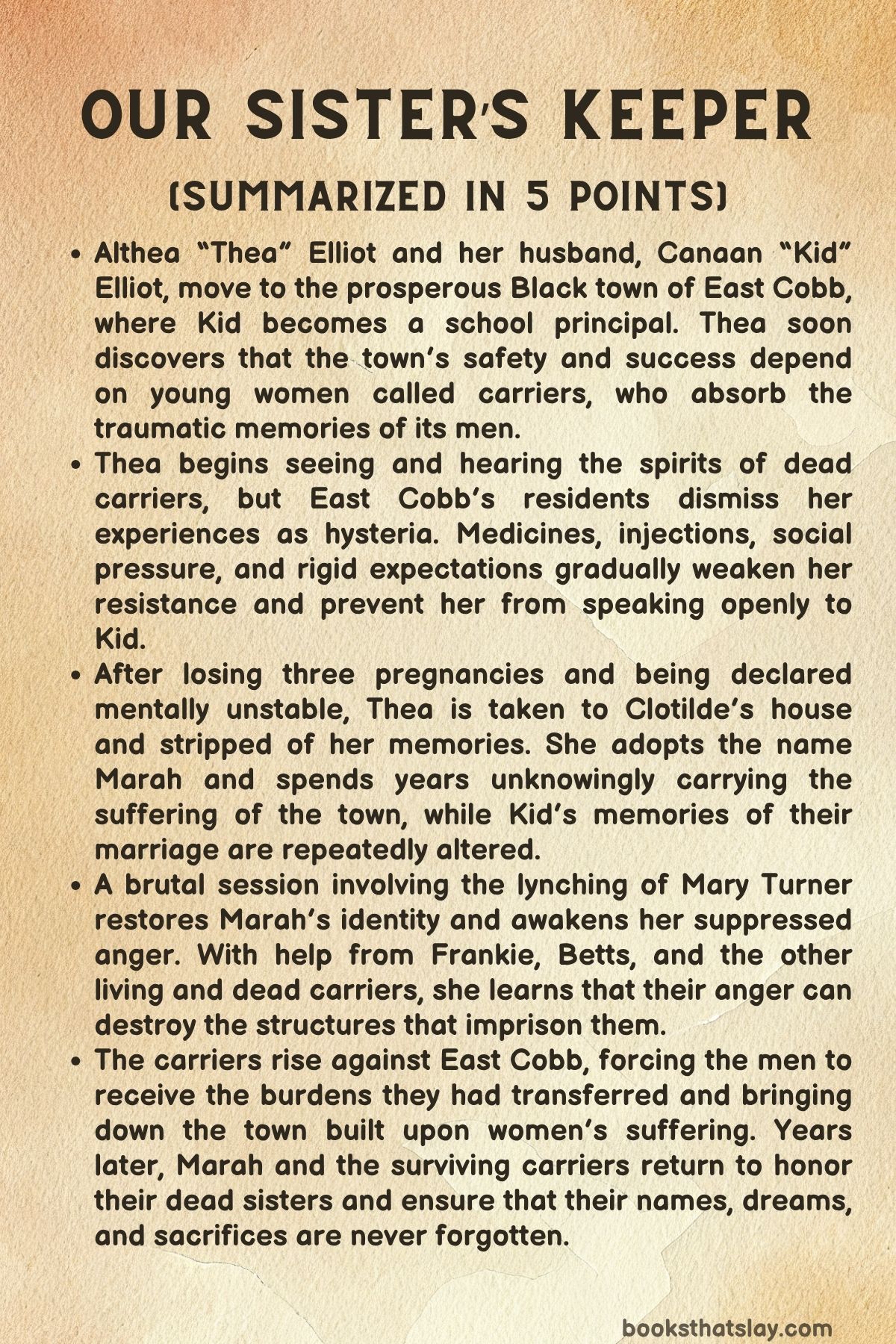
Summary
Marah lives in a secluded house near East Cobb, Mississippi, where she and several other young women work as carriers. During supervised sessions, they take traumatic memories from the town’s men, leaving the men peaceful while the carriers inherit their terror, injuries, and emotional pain.
After absorbing Lucas Fulton’s memories of the Great War, Marah experiences trench warfare, death, and physical agony. Although Lucas leaves relieved, Marah discovers that the wrist injured in his memory has become broken in her own body.
The carriers are controlled by Clotilde, an older woman with far greater powers, and Dr. Xavier Grimm, the physician who studies the transfer of memory. When Delphine dies after repeatedly bearing the childhood memories of Arthur Blake, Grimm treats her death as an unfortunate scientific outcome rather than the loss of a human life.
At the same time, newlyweds Althea “Thea” Elliot and Canaan “Kid” Elliot arrive in East Cobb. Kid has accepted a position as principal of the town’s Black high school, while Thea hopes to continue working as a journalist and teacher.
East Cobb appears to offer safety, wealth, and dignity to its Black residents. The homes are elegant, the schools are well funded, and Black professionals enjoy opportunities that would be denied to them elsewhere.
Yet Thea quickly notices that the town’s prosperity is accompanied by rigid expectations for women. Men repeatedly dismiss her journalism, while wives tell her that motherhood, domestic service, and emotional obedience should become her highest priorities.
Thea also begins hearing women screaming and seeing battered female apparitions. One appears hanging from a magnolia tree in her garden and commands her not to look away, but the body disappears before anyone else acknowledges it.
The town’s women offer Thea bergamot-scented salts, perfume, tea, tablets, and other substances whenever she becomes frightened or outspoken. These treatments leave her calmer, less certain of herself, and increasingly willing to accept opinions she had previously resisted.
Kid undergoes one of Grimm’s treatments after confessing that a white man humiliated and threatened him during the couple’s journey south. The memory remains, but the shame and fear connected to it disappear, allowing him to feel secure and confident.
Thea understands why Kid desires relief, but she becomes disturbed when she learns that another woman must now carry his suffering. She fears that removing painful emotions may also alter his personality, his capacity for empathy, and the emotional intimacy upon which their marriage depends.
At Clotilde’s house, Marah is comforted by the apparition of her dead friend Betts. Betts warns her that the sleeping medicines suppress more than nightmares because they also erase the carriers’ identities and memories of their former lives.
Frankie, Belle, Inez, Violet, and the other carriers have already begun secretly refusing the tablets. At night, they push their beds together and use their shared power to divide their pain, allowing no single woman to bear the full force of the memories alone.
They also help one another recover small pieces of their pasts. Belle remembers books and her family, Inez recalls her grandmother’s hands, Violet remembers her father, and Frankie remembers the perfume worn by her mother.
Marah assists the others but refuses to explore her own history. Whenever she tries to remember her life before becoming a carrier, she encounters darkness, terror, and unbearable grief.
Delphine’s burial deepens the women’s anger. Clotilde places her in an unmarked grave without a coffin and claims that the carriers are not prisoners because there are no locks, fences, or guards.
After Clotilde leaves, the women gather around Delphine and perform a private ritual. They call themselves their sister’s keepers, declare that they have heard their sister’s blood crying from the earth, and promise not to let her be forgotten.
Thea’s suspicions about East Cobb intensify during a welcoming party. She overhears men discussing their visits to Clotilde’s house and learns from Mildred Fulton and Vera that the carriers absorb traumatic memories from the men.
The wives argue that Black women are naturally strong enough to endure what Black men cannot. They insist that the carriers volunteer, are paid, and perform necessary work for the advancement of the race.
Thea asks where the transferred pain goes and why respectable wives do not perform the work themselves. A spectral woman then appears in the ballroom and accuses the wives of repeating the exploitation once imposed upon enslaved Black women.
When Thea demands that the others acknowledge the apparition, Mildred slaps her, Vera restrains her, and someone injects her. The town accepts the explanation that Thea is hysterical rather than confronting what she has witnessed.
The history of the carriers gradually becomes clearer. Belle was recruited after running away from poverty in pursuit of education and adventure, while Inez believed she was accepting medical work that would allow her to support her sick grandmother.
Violet was sent to East Cobb after refusing to move aside for a white woman and attracting the attention of the Ku Klux Klan. Betts accepted Clotilde’s offer because she hoped to escape a controlling aunt and become a jazz singer.
Frankie once lived openly in East Cobb and planned to marry Lem Robbins. After she told him that the wives could hear the groanings, the town declared her mentally unstable, removed her from her home, and converted her into a carrier.
Each woman entered East Cobb because she wanted something beyond the limited future offered to her. Clotilde turned their ambition, loyalty, creativity, and courage into vulnerabilities that could be used to recruit and control them.
Marah’s buried identity begins to surface when she meets Canaan. He looks at her with shock, calls her by name, and begs her to remember him, although she recognizes him only as a distressed client.
Clotilde reacts violently to their meeting and claims that Canaan has confused Marah with a dead sister. Her desperate attempt to erase the encounter convinces Marah that Canaan knows something important about her past.
Thea, meanwhile, discovers that the groanings are real and that East Cobb’s wives have trained themselves to ignore them. Mildred admits that the work kills carriers but argues that their sacrifice protects Black husbands, families, and institutions.
Thea condemns the system as another form of slavery. During a confrontation with Mildred, their anger causes objects to move without physical contact, revealing that suppressed emotion is connected to supernatural power.
Determined to escape the town’s influence, Thea persuades Kid to let her return temporarily to Washington. As soon as the train crosses East Cobb’s boundary, however, an internal force begins crushing her body.
After she is returned, Vera explains that every woman entering East Cobb receives an injection that gives her the potential to bear burdens. The medicines placed throughout the town suppress anger, memory, resistance, and open communication.
Thea also learns that she is pregnant. Vera warns that if Thea continues opposing the town, Kid may transfer the distress caused by their marriage until his emotional connection to her disappears.
Over the following years, Thea loses three pregnancies and becomes increasingly isolated. The town publicly labels her hysterical, and Kid eventually signs papers allowing Clotilde to remove her for treatment because he believes confinement may save her.
Exhausted by grief and convinced that she has failed as a wife and mother, Thea agrees to let Clotilde erase her past. When asked her name, she rejects Althea and chooses Marah, a name associated with bitterness.
The revelation confirms that Thea and Marah are the same woman. Canaan is Kid, whose memories of his wife have been repeatedly altered, while Marah has spent two years unknowingly carrying the burdens of East Cobb’s men.
Grimm then assigns Marah to a white client named Mr. Jamison. He participated in the historical lynching of Mary Turner, a pregnant Black woman murdered after she publicly condemned the killing of her husband.
Instead of entering Jamison’s perspective, Marah experiences Mary’s suffering. She feels the burning, mutilation, murder of the unborn child, and deliberate destruction of a woman punished for expressing anger against racial violence.
Grimm orders Marah to comfort Jamison. She tells him that the victim deserved what happened, allowing him to leave without remorse while she remains physically and emotionally shattered.
The session breaks through the barriers around Marah’s memories. She remembers being Thea, loving Kid, losing her children, resisting East Cobb, and surrendering her identity.
Her restored memory produces rage rather than helplessness. Frankie discovers that she can see Marah’s memories without touching her, and the dead carriers appear around them as visible forms of the anger the living women have carried.
Betts explains that their power does not require them to die or remain containers for other people’s suffering. Their anger can instead be directed outward against the structures that imprisoned them.
When Marah releases the emotion she has suppressed, her scream cracks the infirmary wall. She and Frankie realize that the carriers can use their anger to destroy Clotilde’s house, East Cobb, and the boundaries holding them captive.
Before they can act, Grimm enters Clotilde’s garden and uproots the plants she uses to store transferred burdens. He announces his plan to expand the treatment into white communities, turning the carriers into servants for white men seeking freedom from guilt.
Clotilde has sacrificed Black women in the belief that strengthening Black men will protect the race, but she refuses to accept their use for white clients. Her anger ignites the infirmary and transforms the rain into blood.
She forces every burden stored in the soil into Grimm’s body. The accumulated suffering destroys him, while Clotilde dies after emptying herself of the pain that sustained her power.
Gertie then confronts Dr. Michael Farmer, who has secretly promised to leave Vera and build a life with her. When he casually accepts Vera’s marriage proposal instead, Gertie’s rage restores the memories of her family and the racial massacre that killed her father.
She splits Michael’s house apart, killing herself, Michael, and Vera. Her final act shows that the obedience forced upon her never erased her anger; it only delayed its release.
With Clotilde dead, the men of East Cobb begin receiving every burden they transferred. Lucas relives the Great War and begs Mildred to help him, but she refuses because taking his pain might destroy her body.
The surviving carriers recover their identities and join the dead women. Blood-red rain falls as they enter East Cobb and tear down the houses, institutions, and monuments built through their suffering.
Marah finds Kid in the town square with a new pregnant wife. He finally recognizes her as both Thea and Marah and apologizes for failing to protect her, although she understands that the town manipulated them both.
Mildred arrives with a rifle and reveals that she deliberately encouraged Lucas to request Marah for repeated sessions because she had always disliked Thea. When she fires, Kid pushes Marah aside and receives the bullet.
Kid dies after apologizing to Marah and repeating the familiar gesture that once expressed their love. Overcome by grief and rage, Marah destroys Mildred’s home and kills Mildred.
The Mississippi River breaks through the levee and floods East Cobb. The waters sweep away buildings, bodies, graves, and evidence of the supernatural destruction, allowing official accounts to blame the town’s disappearance on the Great Mississippi Flood of 1927.
Ten years later, Marah, Frankie, Belle, Inez, and Violet return to the abandoned site. They have built new lives across the country but continue gathering each year to honor the women buried in the unmarked graves.
Marah brings her daughter, whom she has named Betts. She teaches the child that an unjust world may punish women for wanting more, but that fear must not prevent them from wanting, remembering, speaking, and building lives of their own.
The five survivors repeat their ritual and declare themselves their sisters’ keepers. Although only five living women speak, many additional voices seem to answer, confirming that the dead carriers remain present through memory, testimony, and collective love.
Characters
Marah / Althea “Thea” Elliot
Marah is the central character of Our Sister’s Keeper, and her divided identity represents the destructive power of forced forgetting. As Thea, she is intelligent, ambitious, outspoken, and determined to preserve both her marriage and her independent work.
Her arrival in East Cobb places those qualities under constant attack. The town uses medicine, social pressure, pregnancy, accusations of hysteria, and Kid’s emotional needs to convince her that resistance is selfish.
Thea’s decision to ignore the groanings marks an important moral failure. She recognizes that women are suffering but temporarily chooses the safety offered to respectable wives, only to become one of the women sacrificed by that same arrangement.
After her memories are removed, Marah appears obedient because she no longer knows what she has lost. Her terror of remembering reflects the depth of her grief over her marriage, her children, and her abandoned ambitions.
Her restored memory turns bitterness into purposeful anger. She does not simply seek revenge for herself; she uses her power to free the women whose names, histories, and desires East Cobb attempted to erase.
Marah’s later life shows that survival is more than escaping physical captivity. By raising her daughter to want boldly, she transforms inherited pain into instruction, remembrance, and hope.
Canaan “Kid” Elliot
Kid is Thea’s husband, childhood friend, and emotional partner before East Cobb changes their relationship. He admires her independence and intelligence, making his later participation in her confinement especially tragic.
His attraction to Grimm’s treatment grows from genuine racial trauma. After being humiliated and threatened by a white man, he longs to recover the dignity and confidence that racism has damaged.
The treatment relieves his pain but separates him from its emotional meaning. As he repeatedly transfers distress to carriers, he becomes less capable of recognizing what Thea is experiencing or understanding why she fears the town.
Kid does not knowingly set out to destroy his wife. He signs the commitment papers because the town has convinced him that Thea is ill and that removing her pain will restore her.
His failure comes from trusting a system that benefits him more than the woman he loves. He accepts peace without fully investigating who pays for it, allowing East Cobb to turn his desire for protection into complicity.
His final sacrifice confirms that his love for Thea was never entirely erased. By shielding Marah from Mildred’s bullet, he attempts to perform the protection he once promised, though the action comes too late to repair what has been lost.
Clotilde / Tilly
Clotilde is both an architect of oppression and a survivor shaped by racial violence. Born enslaved, she loses her family, endures medical experimentation, and becomes the first successful subject of the burden-transfer process.
Her strength allows her to survive experiences that kill others, but survival hardens into ideology. She comes to believe that Black women exist to absorb pain so that Black men can become powerful, stable, and socially competitive.
Clotilde’s garden reveals her complex relationship with suffering. The soil provides relief by storing what she carries, yet she eventually treats younger women like crops that may be consumed for a larger purpose.
The murder of Zion explains her obsession with creating a protected Black community. After seeing freedom destroyed by racist violence, she chooses control and sacrifice over uncertainty.
Her tragedy lies in reproducing the logic of the people who abused her. In Our Sister’s Keeper, she uses the language of duty, choice, and racial advancement to justify imprisoning women whose ambitions remind her of the freedom she lost.
Her final rebellion against Grimm does not erase her crimes, but it reveals that her loyalty was never to science or profit. She destroys him when he attempts to use the carriers for white men, proving that her moral boundaries were real but disastrously narrow.
Dr. Xavier Grimm
Dr. Xavier Grimm represents scientific authority separated from morality. He treats suffering as measurable material and regards the carriers as useful subjects rather than people with lives, families, or rights.
He claims that his research helps Black men overcome the effects of enslavement, racism, and war. However, his language repeatedly exposes his belief that Black people must be altered to compete within a racist society rather than allowed to challenge that society.
Grimm’s calm manner makes him particularly dangerous. He rarely needs visible violence because medicine, diagnosis, institutional power, and supposedly objective research allow him to control the women without admitting cruelty.
His decision to treat white clients reveals the commercial ambition beneath his stated mission. The suffering of Black women becomes a product that can absolve guilty men and preserve unequal power.
His destruction by the burdens stored in Clotilde’s garden is fitting. He dies under the accumulated weight he spent his life observing from a safe distance.
Frankie / Frances Lowery
Frankie is one of the carriers’ most compassionate and emotionally perceptive members. She comforts Marah, braids her hair, brings food, and provides the everyday care that the official medical system refuses to offer.
Before becoming a carrier, she was Frances Lowery, a joyful woman engaged to Lem Robbins. She hoped to open a hair salon and build a life based on love, creativity, and independence.
Her punishment begins when she refuses to participate in East Cobb’s culture of denial. By trusting Lem with the truth about the groanings, she threatens a system that depends upon wives remaining silent and husbands remaining unaware.
The town turns her honesty into proof of mental instability. Her transformation into a carrier demonstrates how accusations of hysteria are used to remove women whose testimony endangers powerful institutions.
Frankie’s ability to share Marah’s restored memories without touch shows the strength of their emotional connection. She helps translate personal anger into collective understanding and becomes one of the leaders of the final uprising.
Betts
Betts is Marah’s dead friend, guide, and connection to the forgotten carriers. Her appearances initially seem like hallucinations, but she gradually reveals herself as part of the collective presence created by the women’s suppressed anger.
In life, Betts dreamed of becoming a jazz singer. Clotilde recruited her by promising employment, independence, and the possibility of returning to Harlem.
Betts is the first carrier to recognize that ambition is being used as bait. The women are selected not because they are weak, but because they want education, love, creative work, family security, or personal freedom.
Her discovery that the medicines erase memory allows the carriers to preserve parts of themselves. Even after death, she continues trying to help Marah remember and understand that anger can become power.
Betts also brings humor and tenderness into a brutal environment. Her presence prevents the dead from becoming abstract symbols because she remains a friend with a distinct personality, dream, and history.
Belle
Belle grows up in severe poverty with her mother and sisters, finding freedom through books and stories. She dreams of becoming a journalist and writing about a world larger than the one-room shack surrounding her.
Her decision to run away is motivated by frustration rather than selfishness. She loves her family but fears that remaining with them will permanently close every path toward education and meaningful work.
Clotilde appeals directly to Belle’s desire to be important. By presenting carrier service as an extraordinary destiny, she turns Belle’s hunger for recognition into a means of control.
Belle’s comparison between her choice and a dangerous fairy tale shows her literary imagination. Even after her memories fade, stories remain connected to her original identity.
Her recovery involves remembering not only the books she loved but also the family she left behind. She must accept that her former life contained love and value even though poverty made it feel unbearably small.
Inez
Inez is motivated by loyalty rather than adventure. Her deepest bond is with the grandmother who raised her and taught her the art of sewing.
When her grandmother becomes ill, Inez assumes adult responsibilities and accepts work in East Cobb because she believes it will provide medical care and financial support. Her recruitment exploits her love for another woman.
Unlike Belle or Betts, Inez does not seek escape from her family. She sacrifices the life she wants because she hopes to preserve it, making her imprisonment especially cruel.
Her sewing continues to protect the carriers after her memories fade. The careful stitches inside Marah’s clothing help ground Marah during moments of extreme physical pain.
Remembering her grandmother restores the purpose that first brought Inez to East Cobb. It also reveals the full betrayal of wages never sent, promises never fulfilled, and a family connection deliberately erased.
Violet Milton
Violet is outspoken, educated, and politically aware. Her prosperous childhood does not make her passive because she recognizes that her family’s comfort exists within a society that still humiliates and exploits Black people.
Her refusal to move aside for a white woman represents her belief that dignity should not depend upon location or private wealth. The violent response shows how even minor resistance by a Black girl can be treated as a threat.
East Cobb is presented to her family as a place of protection and correction. In reality, Clotilde attempts to transform her critical intelligence into obedience.
Violet remains the carrier most willing to confront authority openly. Her anger toward Gertie, Clotilde, the wives, and the town reflects her refusal to accept explanations that disguise exploitation as service.
During the uprising, Violet is more willing than Marah to punish the residents collectively. Her position reveals the moral difficulty of distinguishing people who created the system from those who merely tolerated or benefited from it.
Gertie
Gertie initially appears weak, disloyal, and desperate for male approval. She reports Marah’s conversations with Betts and believes Michael’s promises because she wants to be chosen and protected.
Her behavior is partly shaped by the carriers’ environment. Clotilde rewards obedience, isolates the women from outside relationships, and encourages them to compete for approval.
Michael exploits Gertie by telling her that she is softer and more feminine than Vera. His attention offers an identity that seems separate from suffering, even though it is built upon manipulation.
When she hears him accept Vera’s proposal, her rage restores the history the medicines erased. She remembers her father’s death in the Elaine Massacre, her mother’s grief, and her sister Hannah.
Her final act destroys the house containing the people who used her. Although she dies, she does so after rejecting the agreeable personality that had kept her emotionally imprisoned.
Delphine
Delphine’s death initiates the carriers’ movement from fear toward resistance. She spends years repeatedly absorbing Arthur Blake’s childhood memories until the accumulated violence destroys her.
The town treats her as replaceable. Grimm describes her death as a miscalculation, while Clotilde denies her a proper burial or public recognition.
The carriers preserve her humanity through memory. They remember her singing, quilting, kindness, and desire to have children, refusing to let her become only a dead body or failed experiment.
Her blood becomes part of their language of justice. By speaking her name, the women begin rebuilding the collective history East Cobb attempted to bury.
Tabitha
Tabitha is one of the earliest carriers to discover that refusing the pills and sharing memories can protect identity. Her contribution is nearly erased because the women continue losing memories after her death.
When she crosses the boundary of Clotilde’s property, she remembers her grandmother and the daughter she was forced to surrender. Her forgotten child becomes the reason she refuses to return.
The supernatural boundary destroys her body, proving that the carriers’ lack of fences does not mean they are free. Their prison has been placed inside them.
Grimm displays Tabitha’s body as scientific evidence, while Clotilde uses it as a warning. Their treatment of her death shows how terror can be presented as education when authority controls the story.
Mildred Fulton
Mildred is one of the novel’s clearest examples of an oppressed person protecting a system that grants her privilege over others. She has experienced poverty, racism, displacement, domestic labor, and the collapse of her family’s security.
East Cobb restores the home, status, and authority she believes she deserves. Because the system benefits her husband and elevates her socially, she accepts the suffering of carriers as an acceptable cost.
Mildred understands more than she admits. She hears the groanings, knows that carriers die, and remembers the period when wives carried their husbands’ pain themselves.
Her refusal to help Lucas during his final crisis reveals the self-interest beneath her arguments about family and racial advancement. She loves him but will not risk becoming the exhausted woman she once was.
Her hostility toward Thea is also personal. She deliberately ensures that Marah repeatedly receives Lucas’s burdens, turning social disagreement into prolonged physical punishment.
Lucas Fulton
Lucas is a veteran whose war experiences and racial persecution leave him traumatized, angry, and unstable. His treatment makes him appear calm, affectionate, and successful.
His peaceful personality is therefore partly manufactured through the suffering of carriers. He benefits directly from a process that forces women to relive his memories and bear his physical injuries.
Lucas rarely questions what happens to the pain after it leaves him. His acceptance reflects the larger moral failure of East Cobb’s men, who receive emotional relief without examining its source.
When the transferred memories return, he becomes overwhelmed by the experiences he avoided. His desperate request for Mildred’s help shows that the pain was never healed; it was only displaced.
Vera
Vera is intelligent, strategic, and committed to navigating East Cobb rather than opposing it. Her memories of racial violence in Chicago make security appear more valuable than moral purity.
She views the town as an imperfect refuge. In her reasoning, Black families must sometimes accept unjust arrangements because the outside world offers violence, poverty, and humiliation.
Vera plans to preserve her nursing career through compromise. She encourages Thea to do the same, believing that intelligent women can find private freedom while publicly obeying restrictive expectations.
Her approach to love is similarly transactional. She chooses Michael because marriage to a doctor promises status and independence, while emotional distance seems safer than vulnerability.
Her final attempt to express love exposes the loneliness hidden beneath her practicality. Michael’s mockery reveals that the security she defended never produced genuine intimacy or respect.
Dr. Michael Farmer
Michael combines medical authority with emotional manipulation. He dismisses Thea’s visions as exhaustion and feminine delicacy, helping the town convert truthful testimony into a diagnosis.
His explanations appear compassionate because he speaks of protecting Black women from overwork and racial burdens. In practice, his treatment encourages dependence, silence, and obedience.
Michael also manipulates both Vera and Gertie. He accepts Vera as a socially advantageous wife while privately promising Gertie a romantic future.
His destruction inside the collapsing house reflects the instability of relationships built upon dishonesty. He believes he can control both women because he never takes either woman’s emotional life seriously.
Minerva Blake
Minerva helps reveal that East Cobb’s wives originally carried their husbands’ suffering. She once accepted Arthur’s pain because she loved him and wanted to ease the trauma of enslavement.
The work nearly destroys her, teaching her why the burden-transfer process is dangerous. Instead of rejecting it, she supports assigning the suffering to women with less status.
Her position shows how personal vulnerability can produce either solidarity or exclusion. Minerva chooses to protect herself by allowing another class of women to bear what she cannot.
Arthur Blake
Arthur is an elderly man haunted by memories of enslavement and brutal punishment. His suffering is real, severe, and deserving of compassion.
However, his repeated demand for Delphine makes him part of her destruction. His desire for a particular carrier matters more to the town than her declining health.
When Delphine dies, some of his memories return, demonstrating that the transfer never truly resolves the trauma. It only creates temporary relief by placing the pain in another body.
Mary Turner
Mary Turner is a historical figure whose murder becomes central to Marah’s awakening. After her husband is lynched, she publicly condemns the killers and threatens to seek justice.
The mob responds by murdering her and her unborn child with extraordinary violence. Her death shows how Black women could be denied the protections supposedly connected to marriage, pregnancy, and motherhood.
Mary’s importance extends beyond a single historical crime. Her anger becomes part of a collective memory connecting the carriers to generations of women punished for refusing silence.
Through Marah’s experience of her death, Mary becomes a witness whose suffering cannot be reduced to an image in Jamison’s memory. Her story demands moral recognition rather than the absolution Grimm offers her killer.
Zion
Zion is Clotilde’s husband and the symbol of the future she once believed freedom might provide. He is cautious about accepting land from Grimm but joins her in imagining a stable life together.
His murder exposes the limits of legal emancipation. White men kill him even after Tilly explains that she is Black because the violence is not based on misunderstanding alone.
Losing Zion helps transform Tilly into Clotilde. Her grief convinces her that safety for Black men must be purchased through the endurance of Black women.
Lem Robbins
Lem is Frankie’s fiancé and represents the life stolen from her. Their plans for marriage and meaningful work show that she possessed a future before East Cobb redefined her as mentally unstable.
Frankie trusts him enough to speak about the groanings. Although he initially believes her, his decision to repeat the information allows Mildred and the town to act against her.
His promise to rescue Frankie is never fulfilled. Whether he is prevented, manipulated, or persuaded to forget, his absence becomes part of the emotional abandonment she must survive.
Fiona Fulton
Fiona is Mildred and Lucas’s teenage daughter. She appears mainly within the controlled domestic environment Mildred has created.
Her presence reveals Mildred’s ability to shift instantly from aggression to maternal gentleness. Mildred hides violence from Fiona, preserving the image of a stable household while the family’s security rests upon hidden abuse.
Fiona also represents the next generation of East Cobb women. Without the carriers’ rebellion, she might have inherited her mother’s lessons about silence, privilege, and the acceptable sacrifice of other women.
Frank and Hilde Benson
Frank Benson openly mocks Thea’s career and argues that educated Black women should devote themselves to domestic life. His behavior reveals how racial advancement can be used to justify renewed restrictions upon women.
Hilde initially participates in the wives’ denial of the groanings. Her eventual admission that men cannot hear them exposes the gendered nature of East Cobb’s supernatural knowledge.
Together, the Bensons show how public prosperity depends upon private agreement. Frank speaks the ideology confidently, while Hilde helps preserve the silence that protects it.
Mr. Jamison
Mr. Jamison is a white man seeking freedom from guilt after participating in Mary Turner’s lynching. He asks whether he is a monster, but his willingness to transfer the memory shows that he wants relief more than accountability.
Grimm’s treatment allows him to leave comforted without confession, punishment, or moral change. His session proves that the technology can protect perpetrators from the emotional consequences that might otherwise lead to remorse.
Jamison represents the final corruption of Grimm’s stated mission. Black women’s bodies become instruments for preserving white innocence.
Themes
The Transfer of Suffering
In Our Sister’s Keeper, pain is treated as though it can be separated from history, responsibility, and moral consequence. The men of East Cobb remember what happened to them, but once the emotional force is removed, the memories no longer demand healing, accountability, or change.
The process does not eliminate suffering because every burden remains alive inside another woman. Trauma becomes invisible to the person who benefits from forgetting while growing more destructive inside the carrier forced to contain it.
This arrangement reflects a broader pattern in which comfort is created by moving hardship onto people with less power. East Cobb’s wealth, peaceful homes, stable marriages, and successful institutions all depend upon women whose deaths remain unmarked and unexplained.
Jamison’s treatment reveals the darkest form of this transfer. A perpetrator can escape guilt by forcing a Black woman to experience the violence he committed, allowing him to retain social innocence while she bears both the victim’s pain and his responsibility.
The collapse of the system begins when the burdens return to those who surrendered them. The final destruction insists that suffering cannot be permanently removed from its causes, because concealed pain remains active in bodies, land, memory, and community.
Memory, Identity, and Historical Witness
Memory is the foundation of personal identity and collective resistance. The carriers remain controllable because the medicines erase their families, ambitions, relationships, and reasons for entering East Cobb.
Without those memories, they cannot fully understand what was stolen from them. They may feel fear, grief, or anger, but the absence of context makes those emotions appear irrational and easier for authority to dismiss.
The women resist by remembering in fragments. A grandmother’s hands, a father’s name, a familiar perfume, a song, a book, or a careful stitch becomes evidence that each carrier existed before the town defined her as a container.
Remembering the dead is equally important. Delphine and Tabitha are first reduced to bodies, warnings, or failed experiments, but the carriers restore their humanity by speaking their names and recalling their dreams.
Mary Turner’s story expands this process beyond East Cobb. Her murder joins personal memory with historical witness, showing that present oppression cannot be understood without recognizing the violence carried across generations.
The annual ritual at the graves confirms that memory is not passive remembrance. It is an ethical duty that prevents institutions from controlling the meaning of the past.
Anger as Knowledge and Power
East Cobb treats women’s anger as illness because anger exposes injustice. The medicines, social expectations, diagnoses, and accusations of hysteria are designed to disconnect women from the emotion that tells them something is wrong.
Thea’s uncertainty grows whenever she accepts the town’s calming substances. Once she recognizes how the treatments affect her, anger restores clarity and allows her to identify patterns of manipulation.
The carriers initially direct their anger inward. They experience shame, fear, confusion, and physical suffering because they have been trained to surrender themselves rather than question those who use them.
Betts teaches them that anger does not have to remain a burden. When acknowledged collectively, it becomes communication, memory, physical force, and a means of breaking the walls that contain them.
The novel does not present anger as harmless. Gertie’s rage kills her alongside Vera and Michael, while Marah’s fury destroys Mildred in front of her children.
These consequences preserve the moral complexity of resistance. Anger can liberate, but when injustice has been allowed to accumulate for generations, its release may be violent, uncontrolled, and costly.
Sisterhood, Ambition, and Collective Survival
The carriers survive because they reject the idea that strength means suffering alone. By sharing nightmares, memories, food, touch, songs, and grief, they create a form of care that directly opposes East Cobb’s system.
The town repeatedly praises Black women’s strength, but its definition of strength requires endless sacrifice without complaint. Sisterhood replaces that destructive expectation with mutual responsibility.
Each carrier was recruited through a personal desire. Belle wanted education, Betts wanted music, Inez wanted to protect her grandmother, Violet wanted dignity, Frankie wanted honesty, and Thea wanted meaningful work alongside marriage.
Their ambitions are not presented as flaws. The tragedy comes from a society that leaves ambitious Black women vulnerable to anyone offering an escape from poverty, racial violence, domestic restriction, or social invisibility.
The phrase declaring each woman her sister’s keeper transforms individual survival into collective obligation. No woman can be fully free while another woman’s suffering remains hidden beneath her security.
The survivors’ return to the graves shows that liberation continues after escape. Their careers, families, and partnerships matter, but so does the responsibility to remember those who did not survive and to teach future daughters that wanting more remains necessary despite the dangers.