Out Law by Jim Butcher Summary, Characters and Themes
Out Law by Jim Butcher is an urban fantasy novella that follows wizard Harry Dresden as he is forced to help a criminal attempt an unlikely moral transformation. The book is set after the events of Twelve Months and is a part of the Dresden files (#18.75 to be specific).
What begins as repayment of a debt to Chicago crime lord John Marcone soon expands into a dangerous conflict involving illegal gambling, corrupt financial dealings, supernatural parasites, and rival criminal organizations. The story combines magical action with questions about responsibility, forgiveness, and whether a person can become better after years of selfish choices. Harry must protect an unpleasant man, guide his apprentice, confront the consequences of past victories, and decide how much responsibility one person can reasonably carry.
Summary
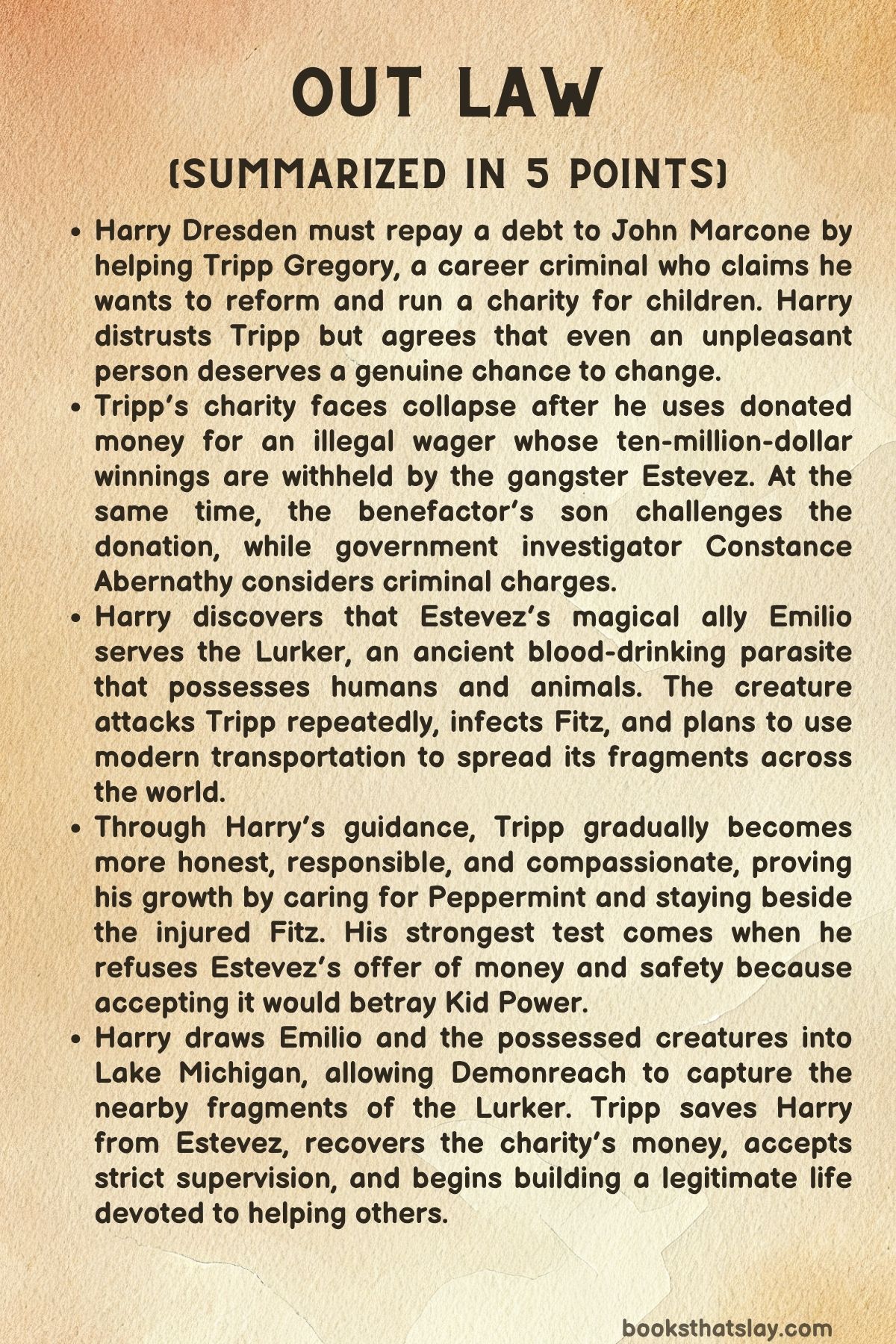
Harry Dresden awakens before dawn when the magical warning flames inside his Chicago castle signal the arrival of a powerful visitor. Because his daughter Maggie is sleeping inside, Harry prepares for the worst by putting on his spell-armored coat and taking his staff and blasting rod.
Bear, the enormous Valkyrie serving as Harry’s bodyguard, follows him with a heavy rifle. Harry also orders his young apprentice Fitz to hide behind a magical veil because he does not want the White Council to learn about the talented young wizard before Fitz is properly trained.
The visitor is Gentleman John Marcone, Chicago’s criminal ruler and the supernatural Baron of the city. Harry refuses to invite him across the castle’s threshold and instead meets him outside, where Marcone reminds him of two serious obligations.
During the Battle of Chicago, Marcone protected civilians at Harry’s request. He later helped save Harry’s life after the defeat and binding of the Titan Ethniu, giving him a legitimate claim on Harry’s assistance.
Marcone offers Harry a direct way to repay the debt. One of his employees wants to leave organized crime and become an honest citizen, but several problems are preventing him from doing so.
The man is Tripp Gregory, a manipulative criminal whom Harry already dislikes because of the trouble he once caused for a tutoring organization. Marcone challenges Harry to prove that his belief in redemption applies even to someone he personally finds offensive.
Harry reluctantly agrees to hear Tripp’s story. Tripp explains that criminals from St. Louis once abducted him over unpaid debts and prepared to execute him beside a river.
While facing death, Tripp recognized that his selfish life had brought him neither happiness nor respect. He remembered his religious mother, prayed for survival, and promised God that he would change if he escaped.
The gun placed against his head misfired, and Tripp survived by jumping into the river. He now believes that breaking his promise will eventually lead him back to another gun and another river.
Tripp created a charity called Kid Power to help Chicago children whose education had been disrupted by the city’s recent catastrophe. Marcone introduced him to useful contacts, while an elderly woman named Adeline Hathaway donated approximately two million dollars.
Tripp claims the charity is genuine, but legal and financial problems now threaten its survival. Harry takes him to Maximillian Valerious, an experienced attorney whom he trusts, and Max’s wife Heloise, a retired forensic accountant, examines the organization’s finances.
Max warns Harry that many criminals seek respectability only after their former lives become too dangerous. He questions whether Tripp truly understands that other people have needs, fears, and rights independent of his own desires.
Harry admits that Tripp remains selfish and unpleasant. However, he argues that imperfect motives may still provide the beginning of genuine reform if Tripp repeatedly chooses better actions.
Before the legal discussion can continue, Peppermint, Max and Heloise’s basset hound, senses danger. A diseased mountain lion enhanced by dark magic attacks Tripp, forcing Harry to stop it with a kinetic blast.
Peppermint courageously intervenes and is badly injured. When the animal attacker dies, a mass of living black tissue escapes from its body and disappears into a storm drain, proving that someone has sent a supernatural assassin after Tripp.
Tripp volunteers to pay Peppermint’s veterinary expenses and shows sincere concern for the dog. Harry sees this reaction as the first convincing sign that Tripp may be developing empathy rather than merely performing goodness for personal advantage.
Heloise’s examination reveals that Tripp’s situation is far worse than he admitted. Adeline Hathaway’s son Norman is challenging the donation, claiming that Tripp manipulated a sick and mentally diminished woman.
Norman seeks to freeze the charity’s assets and recover the money. Several hospice nurses are willing to testify that Adeline remained mentally competent, but Norman has political connections and appears determined to destroy Tripp.
The financial records expose an additional disaster. Tripp awarded most of the donation to himself as an executive bonus and used the money to place an illegal bet on an underdog fighter.
The bet unexpectedly won and should have produced ten million dollars. However, the bookmakers have refused to pay, leaving Tripp looking like a criminal who stole and lost charitable funds.
The wager was placed with Estevez, a Las Vegas gangster connected to a cartel-backed organization expanding into Chicago. Harry now has only a week to recover the winnings, protect Tripp from assassination, and prevent the legal case from destroying Kid Power.
Harry hides Tripp inside the castle, where the ancient defenses should keep supernatural attackers away. Tripp dislikes being confined but accepts that he cannot repair the charity if he is killed.
Bear investigates Estevez through Sigrun Gard, Marcone’s Valkyrie associate. Meanwhile, Harry and Fitz prepare concealment potions using holy water and silver while researching the black parasite that controlled the mountain lion.
Fitz questions whether Tripp deserves so much effort. Harry reminds him that Fitz once survived through theft, suspicion, and desperation before Harry and Mortimer Lindquist gave him an opportunity to choose another life.
Harry eventually identifies the creature as an ancient blood-consuming demon sometimes called the Lurker in the Shadows. It divides itself into pieces, enters animals or humans, and gradually takes control of their bodies.
The parasite increases a host’s speed, strength, aggression, and magical ability. It often appears during periods of war, political instability, suffering, and social collapse, but it is vulnerable to fire, sunlight, blessed water, and similar forces.
Harry arranges a daylight meeting with Estevez in Columbus Park. Estevez positions himself across running water, demonstrating that he understands enough about magic to weaken Harry’s abilities during the negotiation.
Estevez does not deny that Tripp won the wager. He claims that gathering ten million dollars requires time and insists that he did not order the attempts on Tripp’s life.
His bodyguard Emilio radiates the same supernatural evil Harry sensed inside the mountain lion. Harry recognizes that Emilio is infected by the Lurker and warns Estevez that refusing to pay will destroy his organization’s reputation among gamblers.
Harry gives Estevez three days to produce the money. Although Emilio appears eager to fight, Estevez accepts the deadline and allows Harry to leave.
The legal conflict becomes more hostile when Norman confronts Max and accuses Tripp of exploiting his dying mother. Max points out that Norman never visited Adeline in hospice and has no firsthand knowledge of her mental condition.
Norman threatens to use prosecutors, the Internal Revenue Service, and political pressure against everyone supporting Tripp. His arrogance strengthens Max’s determination, although the attorney admits that their chances of stopping the asset freeze remain uncertain.
Max believes their best hope is Constance Abernathy, a strict government investigator known for pursuing people who abuse charitable organizations. Harry must move Tripp from the castle and bring him to her office without allowing the Lurker to find him.
Fitz disguises himself as Tripp and wears the criminal’s bloodstained suit while Bear drives him away as a decoy. The real Tripp drinks a concealment potion and leaves through the rear entrance with Harry.
At Abernathy’s office, the investigator summarizes the case in the harshest possible terms. A convicted criminal accepted two million dollars from an elderly woman, paid most of it to himself, and then gambled the money illegally.
Max argues that imprisoning Tripp would cost the government money while destroying a charity capable of helping thousands of children. Heloise supports this argument with financial projections showing the potential long-term value of Kid Power.
Abernathy demands proof that Tripp’s intentions are sincere. Following Harry’s advice, Tripp abandons his practiced salesmanship and honestly describes the execution attempt, his prayer, and his promise to change.
Abernathy offers conditional cooperation if Harry recovers the winnings. Taxes must be paid, the remaining money must go to Kid Power, Max and Heloise must supervise the charity without compensation, and Tripp must obey every legal requirement.
As Harry and Tripp enter a dark parking garage, Emilio attacks with possessed cats and crows. Speaking through Emilio, the Lurker reveals that it intends to use modern transportation to spread its fragments throughout the world.
The demon also recognizes Harry as the wizard who destroyed the Red Court. That victory unintentionally freed the Lurker from the supernatural masters who had controlled and limited it.
Harry uses fire against the advancing creatures, but Emilio destroys his magical shield with corrosive energy. Tripp supports the injured wizard, fights through the possessed animals, and drives the Blue Beetle toward direct sunlight.
A tendril of the Lurker enters the vehicle through the ventilation system and attempts to force itself into Harry’s mouth. Tripp crashes through a garage barrier into a sunlit intersection, where the parasite catches fire and dies.
Captain John Stallings of Chicago’s Special Investigations division arrives after the incident. He understands that supernatural forces were involved but warns Harry that the police can no longer protect him from official consequences as freely as they once did.
Bear and Fitz return from their decoy mission after being attacked by possessed crows. Fitz appears exhausted but initially seems unharmed, while Tripp voluntarily admits that he kicked several possessed cats during the escape.
Harry explains that defending another person from demon-controlled predators was morally justified. More importantly, Tripp’s willingness to admit the act without being forced demonstrates growing honesty.
Bob, the spirit of intellect who lives in a skull, explains that the Lurker is related to the supernatural force behind the Red Court. Once swallowed, it settles in a victim’s stomach, creates an intense thirst for blood, and spreads through the nervous system.
Because the Lurker has a distributed consciousness, destroying one fragment will not kill the others. Harry realizes that defeating it completely would require gathering the scattered pieces into one place.
The Brotherhood of St. Giles provides information about Estevez and Emilio. Estevez was once infected by the Red Court and later cured when Harry destroyed it, giving him extensive knowledge of supernatural creatures.
Emilio is an old cult leader and near-wizard who has survived for generations because the Lurker extended his life. His magical experience and willingness to use blood-fueled power make him exceptionally dangerous.
Before Harry can finalize his plan, he discovers that Fitz has become infected. The young wizard is found drinking blood from packages of raw meat and claiming that the parasite has given him wonderful magical strength.
Rather than attack him, Harry forces Fitz to examine his own behavior and recognize the source of his new desires. Fitz realizes that a possessed crow infected him during the decoy mission.
Harry keeps him focused with questions about magic, mathematics, and logic. He teaches Fitz that will is the ability to choose despite fear, pain, temptation, or outside control.
Bear gives Fitz holy water, but Harry insists that the young wizard must decide for himself to drink it. Fitz accepts the pain, consumes the water, and violently expels the living parasite from his body.
The experience leaves Fitz seriously ill. Tripp stays beside him, brings coffee to the exhausted caretakers, and accepts that his earlier decisions helped create the circumstances in which the apprentice was harmed.
Harry distinguishes responsibility from direct guilt. Tripp did not infect Fitz, but he can still acknowledge his connection to the situation and choose actions that repair some of the damage.
Harry arranges a final meeting with Estevez and Emilio at Montrose Point beside Lake Michigan. Tripp must act as bait because the enemy will not appear without proof that he is present.
During the meeting, Estevez produces suitcases of cash but offers Tripp another option. Tripp can take one suitcase, receive false documents, disappear overseas, and avoid the criminals in St. Louis who still want him dead.
The offer gives Tripp a safe path back to selfishness. He refuses it and demands the full winnings for Kid Power, proving that his reform is no longer based only on fear of punishment.
Emilio surrounds Harry, Bear, and Tripp with baboons controlled by the Lurker. Harry releases magically stored sunlight, while Bear blocks hostile spells and battles the enhanced animals.
Estevez shoots Tripp in the back when he tries to help Bear. Harry, believing Tripp may be dead, fights Estevez while Emilio breaks through his magical defenses.
Harry retreats toward Lake Michigan and draws Emilio, the possessed animals, the demon’s tendrils, and Bear into the freezing water. The apparent retreat is actually the central part of his plan.
Lake Michigan connects the battlefield to Demonreach, the supernatural prison controlled by Harry. Alfred, the spirit of the island, answers his summons and sends glowing roots of magical force through the water.
The roots seize every nearby piece of the Lurker, remove it from the possessed animals, and tear it out of Emilio. The captured fragments are carried to Demonreach for imprisonment.
Emilio becomes fully mortal and begins aging rapidly. As Harry reaches the surface, Estevez appears above him with a gun and prepares to kill him.
Tripp survived because Fitz’s enchanted clothing stopped the bullet. Despite his injuries, he strikes Estevez with a baseball bat and saves Harry’s life.
Harry avoids killing Estevez because doing so could provoke retaliation from the larger criminal organization. Instead, he demands the money, Tripp’s safety, and Estevez’s permanent withdrawal from Chicago.
He claims that imprisoning part of the Lurker gives him the ability to locate or destroy every remaining fragment. Although this is partly a bluff, Estevez believes the threat and accepts the agreement.
Tripp briefly considers taking the money and disappearing but rejects the temptation. He chooses to work with Max and Heloise, pay the taxes, protect Kid Power, and use the remaining funds for children and possibly animals.
Abernathy discourages criminal prosecution, while Norman withdraws his legal challenge after Max threatens an ethics investigation. Kid Power survives with stricter supervision and a genuine chance to improve children’s lives.
Marcone returns to the castle and declares Harry’s debt settled. Harry accuses him of arranging the assignment so that a dangerous wizard would remove a supernatural criminal rival from Chicago.
Marcone does not deny the manipulation. He argues that he also gave a troubled man access to the person most capable of helping him change.
Harry refuses Marcone’s suggestion that they cooperate against the remaining fragments of the Lurker. Helping a criminal abandon his old life is different from assisting a powerful man who continues to choose crime.
Bear questions Harry’s decision not to pursue every remaining fragment and criminal connected to Estevez. Harry accepts that no individual can fight every evil in the world without eventually destroying himself.
He considers Tripp’s reform a meaningful victory because one former enemy may now become an ally. By saving Kid Power, Harry may also help create a future generation capable of confronting problems he will never personally reach.
With Fitz recovering, Tripp alive, and the immediate danger contained, Harry finally allows himself to rest. He plans an evening of beer and steak sandwiches with his companions, satisfied that the battle directly in front of him has been won.
Characters
Harry Dresden
Harry Dresden is the moral and emotional center of Out Law, functioning as a protector, teacher, investigator, and reluctant guide to a man he strongly dislikes. His decision to help Tripp begins as repayment of a debt, but it gradually becomes a personal commitment to the belief that people should not be permanently defined by their worst choices.
Harry’s greatest strength is his willingness to act according to his principles even when doing so is inconvenient. It would be easy for him to abandon Tripp, dismiss him as an irredeemable criminal, or allow Marcone’s rivals to remove the problem, yet Harry understands that moral convictions have little value when they are applied only to sympathetic people.
His relationship with Fitz shows his developing maturity as a mentor. Instead of merely giving orders, Harry teaches the young wizard how to reason through fear, temptation, and supernatural influence.
When Fitz becomes infected, Harry refuses to treat him as an enemy. He helps the apprentice recover control of his own mind, making personal choice the foundation of the cure.
Harry also confronts the unintended consequences of destroying the Red Court. He does not regret saving his daughter, but he accepts that a justified action can still produce new dangers and responsibilities.
His decision not to pursue every remaining fragment of the Lurker demonstrates an important limit in his heroic identity. Harry recognizes that accepting responsibility for everything would leave him unable to protect anyone effectively.
Tripp Gregory
Tripp Gregory undergoes the clearest transformation in Out Law, moving from selfish criminal calculation toward responsibility, courage, and concern for others. At the beginning, even his attempt at reform is driven by fear that God will punish him if he breaks the promise made during his near-execution.
His creation of Kid Power contains both genuine and corrupt elements. He wants to help children, but he also pays himself an enormous bonus and gambles charitable funds, showing that he initially expects a good goal to excuse dishonest methods.
Tripp’s development occurs through small choices rather than an immediate moral conversion. His concern for Peppermint, his honesty with Abernathy, and his voluntary confession about fighting the possessed animals show that he is slowly learning to view other lives as valuable.
His greatest test comes when Estevez offers him money, safety, false documents, and escape from his enemies. Earlier in his life, Tripp would almost certainly have accepted, but he instead demands the full winnings for Kid Power.
His courage during the supernatural attacks is especially significant because he possesses no great magical power. He saves Harry in the parking garage, remains with the injured Fitz, confronts Estevez despite his terror, and finally strikes the gangster before Harry can be executed.
Tripp does not become entirely virtuous by the end. He remains tempted by money and personal survival, but he has learned that becoming better requires repeated action, accountability, and the acceptance of difficult consequences.
Gentleman John Marcone
John Marcone is controlled, strategic, and morally unsettling because he can produce beneficial outcomes without becoming a good man. He uses Harry’s debt to eliminate a rival supernatural operation, protect his criminal territory, and strengthen his influence over Chicago.
At the same time, Marcone recognizes that Tripp may genuinely want to reform. Sending him to Harry is manipulative, but it is also an accurate judgment that Harry will take the possibility of redemption seriously.
Marcone’s intelligence lies in arranging circumstances where every outcome serves him. If Harry succeeds, Marcone’s rival is weakened and his debt is collected; if Tripp reforms, Marcone can claim that he helped an employee leave crime rather than punishing him for disloyalty.
His presence also establishes a contrast between someone attempting to abandon criminal life and someone who deliberately continues choosing power. Harry can support Tripp because Tripp is moving away from wrongdoing, while cooperation with Marcone would help strengthen a criminal empire.
Marcone’s polite behavior never removes the threat beneath his words. His formal courtesy represents discipline and control rather than kindness, making him an adversary who can cooperate with Harry without ever becoming trustworthy.
Bear
Bear is Harry’s Valkyrie bodyguard, tactical partner, and steady source of practical judgment. Her physical size, heavy weapons, combat experience, and supernatural resilience make her essential whenever Harry faces dangers that cannot be solved through magic alone.
She protects Harry without becoming passive or obedient. Bear questions his decisions, points out weaknesses in his plans, and warns him when an enemy may be more dangerous than he realizes.
Her partnership with Fitz during the decoy mission shows both courage and responsibility. When Fitz later becomes infected, Bear blames herself for failing to detect the danger, revealing that her confidence does not prevent her from feeling guilt.
Harry’s response reminds her that surviving a mistake and learning from it are more useful than endless self-punishment. Bear’s willingness to continue fighting after acknowledging failure makes her a dependable companion rather than an invulnerable warrior.
During the final confrontation, Bear protects Tripp, battles possessed baboons, and follows Harry into Lake Michigan without knowing every detail of his strategy. Her trust is based on experience, but it is supported by her own ability to adapt under pressure.
Fitz
Fitz is a talented young wizard whose difficult past makes him an important parallel to Tripp. Because Fitz once survived through theft, secrecy, and distrust, his existence provides evidence that people with damaged lives can change when someone offers them guidance.
His early judgment of Tripp is understandable but incomplete. Fitz sees only a lifelong criminal and initially fails to recognize that others might once have viewed him with the same suspicion.
The decoy mission tests his courage before he is fully prepared. Although frightened, he creates the illusion, wears Tripp’s bloodstained clothing, and enters danger under Bear’s protection.
His infection by the Lurker exposes the vulnerability that accompanies magical talent. The parasite offers him effortless strength, encouraging him to believe that power without discipline is a gift rather than a form of enslavement.
Fitz’s recovery depends on his ability to think and choose. Harry guides him, but Fitz must personally drink the holy water and accept the pain required to remove the demon.
His protective enchantments later save Tripp from Estevez’s bullet. Even while absent from the final battlefield, Fitz’s skill and earlier work contribute directly to the victory.
Maximillian Valerious
Maximillian Valerious represents law used as a tool for protection rather than punishment alone. His legal experience allows him to understand the weaknesses in Tripp’s position without becoming either naïve or needlessly condemning.
Max immediately recognizes that many criminals claim to reform only when their former lifestyle becomes personally dangerous. He therefore questions Tripp’s sincerity and warns Harry that respectable appearances do not automatically demonstrate moral change.
Despite his caution, Max believes that people deserve a fair opportunity to defend themselves. Once Norman insults him, threatens his household, and attempts to misuse political influence, Max becomes personally committed to the case.
His argument before Abernathy is practical rather than sentimental. Instead of pretending that Tripp’s conduct was acceptable, he demonstrates that preserving Kid Power may benefit society more than destroying it through prosecution.
Max’s character shows that mercy and accountability can operate together. He is willing to save Tripp from legal ruin, but only if the money is recovered, the charity is supervised, and future misconduct is prevented.
Heloise Valerious
Heloise provides the financial expertise needed to separate Tripp’s intentions from the actual consequences of his conduct. Her forensic accounting reveals the executive bonus, illegal wager, missing funds, and dangerous weaknesses within Kid Power.
She does not allow emotional arguments to replace evidence. By examining records and preparing projections, she gives Max the factual foundation required to negotiate with Abernathy and defend the charity.
Heloise’s role becomes particularly important because good intentions cannot repair poor financial controls. Her involvement ensures that Kid Power will not depend entirely on Tripp’s judgment after the crisis ends.
She also shares the personal cost of the conflict when Peppermint is injured during the supernatural attack. Her willingness to continue helping Tripp after her household is endangered shows considerable discipline and generosity.
Estevez
Estevez is a disciplined criminal leader who understands both organized crime and the supernatural world. His former connection to the Red Court gave him knowledge that ordinary gangsters lack, allowing him to use monsters and magical practitioners as strategic assets.
Unlike Emilio, Estevez does not seek violence for its own sake. He values reputation, profit, territory, and organizational survival, which makes him more predictable but no less dangerous.
His refusal to pay Tripp threatens the unwritten trust supporting illegal gambling. Harry correctly understands that publicizing the unpaid wager could damage Estevez more effectively than a simple magical attack.
Estevez’s offer to Tripp is designed to expose the man’s remaining selfishness. By presenting money, protection, and escape, he expects Tripp to abandon Kid Power and prove that his reform is fraudulent.
His defeat occurs because he misjudges both Tripp and Harry. He assumes everyone is motivated by the same self-interest that governs his own decisions, leaving him vulnerable to loyalty, sacrifice, and moral commitment.
Emilio
Emilio is a powerful practitioner who has surrendered his humanity in exchange for strength and extended life. His relationship with the Lurker gives him magical abilities capable of breaking Harry’s defenses and controlling possessed animals with terrifying efficiency.
His age and experience make him more dangerous than a simple infected servant. Emilio understands magical combat, uses blood-fueled power, and knows how to attack without respecting the limits that restrain Harry.
However, his apparent strength depends on submission. The Lurker sustains his life, enhances his abilities, and turns his body into an instrument of its larger purpose.
Once Alfred removes the parasite, Emilio rapidly ages and loses the supernatural power that supported him. His condition reveals that the immortality he pursued was never truly his own.
Emilio serves as a warning about accepting power that destroys personal independence. Unlike Fitz, who rejects the parasite despite the pain of doing so, Emilio has built his identity around the benefits of possession.
The Lurker
The Lurker is both a physical monster and a force that magnifies existing human weakness. It enters through the mouth, settles in the body, creates a thirst for blood, and gradually turns its hosts into extensions of a distributed consciousness.
Its ability to divide itself makes ordinary victory nearly impossible. Destroying one possessed creature does not defeat the larger organism, while every infected animal or human becomes another weapon and another place of concealment.
The creature thrives during social collapse because fear, violence, and instability create ideal conditions for expansion. Its plan to exploit modern transportation shows that ancient evil can adapt quickly to contemporary systems.
The Lurker also offers power before taking freedom. Fitz experiences increased magical strength, Emilio gains extended life, and possessed animals receive unnatural speed and aggression.
Its deepest threat is therefore not only physical infection but the temptation to accept domination in exchange for ability. Harry defeats it by gathering its fragments and placing them inside a prison designed to contain beings that cannot safely be destroyed.
Constance Abernathy
Constance Abernathy is strict, intelligent, and resistant to emotional manipulation. She sees the facts of Tripp’s conduct clearly and refuses to minimize the seriousness of using charitable funds for an illegal wager.
Her skepticism protects the public from people who use nonprofit organizations as personal financial tools. Tripp’s history and actions give her every reason to suspect that Kid Power is simply another criminal scheme.
However, Abernathy is not interested in punishment for its own sake. She listens to Max’s practical argument and considers whether preserving the charity could provide greater public value than imprisoning Tripp.
Her conditions combine mercy with control. She requires taxes, independent supervision, legal compliance, and the return of the winnings to the charity.
Abernathy also challenges Harry by mentioning his unusual finances and connection to Marcone. She makes it clear that helping Tripp will not excuse Harry from scrutiny if he benefits personally from the recovered money.
Norman Hathaway
Norman Hathaway represents entitlement disguised as moral outrage. He claims to be protecting his mother’s estate, but his absence during her final illness suggests that his primary concern is recovering money he believes should have become his inheritance.
His accusation against Tripp is not entirely baseless because Tripp did behave irresponsibly. However, Norman weakens his position by threatening witnesses, insulting Max, and attempting to use political influence as a weapon.
Norman’s treatment of his mother contrasts sharply with his determination to control her money after her death. The hospice nurses’ willingness to defend her mental competence suggests that she made a deliberate choice he simply refuses to respect.
His withdrawal after Max threatens an ethics investigation reveals the weakness beneath his aggression. Norman is willing to pressure others only while he believes his status protects him from consequences.
Bob
Bob is a spirit of intellect whose extensive supernatural knowledge gives Harry the information needed to understand the Lurker. He explains its biology, its relationship to the Red Court, its method of infection, and the near impossibility of destroying a distributed consciousness.
His explanation forces Harry to confront an uncomfortable consequence of his earlier victory. By eliminating the Red Court, Harry also removed the power that had controlled and restrained the Lurker.
Bob’s value lies in turning scattered observations into a usable theory. Once Harry understands how the parasite feeds, spreads, and survives, he can design a strategy based on containment rather than simple destruction.
Bob also serves as the connection between Harry and Demonreach. By warning Alfred that a new prisoner may be arriving, he helps prepare the supernatural prison for the final operation.
Captain John Stallings
Captain John Stallings represents the changing relationship between Harry and Chicago’s authorities. He understands enough about the supernatural world to recognize that the parking garage incident cannot be explained through ordinary criminal behavior.
Unlike Karrin Murphy, however, Stallings is unwilling to risk his career and family by repeatedly shielding Harry. Increased funding and official attention after the Battle of Chicago have made quiet cooperation more dangerous.
His decision to let Harry leave while issuing traffic citations is a limited form of assistance. Stallings helps where he can, but he establishes boundaries that Harry must respect.
The character shows that institutional allies cannot always act according to personal loyalty. Even sympathetic officers must consider regulations, scrutiny, and the consequences their decisions may bring to others.
Peppermint
Peppermint is a small but morally important presence. The basset hound senses the supernatural attacker before the humans fully understand the danger and courageously intervenes despite having no magical protection.
The dog’s injury provides one of the first genuine tests of Tripp’s developing empathy. His immediate concern, willingness to pay the veterinary expenses, and later questions about Peppermint’s recovery reveal an emotional response that offers him no obvious financial advantage.
Peppermint therefore becomes evidence that Tripp is capable of caring about another living being. The animal’s bravery also anticipates the larger acts of courage later performed by characters who choose to protect others despite fear.
Alfred and Demonreach
Alfred is the spirit of Demonreach, the supernatural prison under Harry’s authority. His power is ancient, territorial, and designed for the containment of beings too dangerous to remain free.
Harry’s connection with Alfred gives him an advantage that Emilio and the Lurker fail to anticipate. By drawing the enemy into Lake Michigan, Harry extends the confrontation into an area connected to Demonreach’s influence.
Alfred does not defeat the enemy through ordinary combat. He identifies the scattered fragments, removes them from their hosts, and carries them into confinement.
His role reinforces Harry’s growth as a strategist. Instead of attempting to overpower every enemy personally, Harry uses location, preparation, relationships, and specialized resources to achieve what direct force cannot.
Themes
Redemption as Repeated Choice
Redemption in Out Law is presented as a difficult process built from repeated decisions rather than a single declaration of regret. Tripp’s promise to change begins during a moment of terror, making it uncertain whether he truly understands morality or merely fears punishment.
His early conduct shows how little he has changed. He creates a charity but pays himself an enormous bonus, gambles the money, and expects a successful result to justify dishonest behavior.
Progress becomes visible through smaller actions that offer no immediate reward. Tripp cares about Peppermint, tells Abernathy the truth, admits what he did during the attack, stays beside Fitz, and accepts that his decisions helped place others in danger.
The offer from Estevez becomes the clearest measurement of his growth. Tripp can choose money, safety, and disappearance, yet he refuses because doing so would betray the children his charity is supposed to serve.
The story does not suggest that one courageous act erases his criminal past. Tripp must still accept supervision, pay taxes, follow legal requirements, and rebuild trust over time.
Redemption therefore requires more than feeling guilty or announcing good intentions. It demands honesty, responsibility, sacrifice, and continued effort when returning to selfish behavior would be easier.
Responsibility Without Self-Destruction
Harry repeatedly confronts the difference between accepting responsibility and attempting to control every problem. He acknowledges that destroying the Red Court unintentionally freed the Lurker, even though his original action was necessary to save his daughter.
This recognition does not require him to condemn himself for making the earlier choice. Instead, he takes responsibility for confronting the immediate danger created by the creature’s new freedom.
The same distinction appears in Harry’s conversation with Tripp after Fitz becomes infected. Tripp did not order the attack, but his criminal conduct created the conflict that placed the apprentice in danger.
Accepting responsibility gives Tripp a reason to help repair the damage. It does not mean that he must claim direct guilt for the deliberate actions of Estevez, Emilio, or the parasite.
Harry eventually applies the same principle to himself. Although fragments of the Lurker remain outside Chicago, he refuses to pursue every host and every criminal organization connected to them.
Trying to fight all evil personally would destroy his health, relationships, and ability to protect the people directly under his care. The novel argues that responsible action includes recognizing limits, choosing the battle immediately present, and trusting that other people can confront dangers beyond one individual’s reach.
Power, Temptation, and the Loss of Freedom
The Lurker offers its hosts power while quietly taking control of their bodies and minds. Fitz receives effortless magical strength, Emilio gains an extended lifespan, and possessed animals become faster, stronger, and more aggressive.
These benefits create the illusion that surrender is a form of advancement. Fitz initially feels powerful and liberated, even though his new hunger and behavior show that his choices are already being replaced by the parasite’s desires.
Emilio represents the final stage of this bargain. He has survived for generations and developed dangerous magical abilities, but his life depends entirely on the creature living inside him.
When Alfred removes the parasite, Emilio’s borrowed youth disappears immediately. The power he treated as personal achievement is revealed as a temporary reward for obedience.
Marcone and Estevez present less literal versions of the same temptation. Both gain influence through systems of violence and control, but their authority requires them to treat people as tools, investments, or threats.
Harry’s strength operates differently because it depends on discipline, restraint, and relationships. He wins not by accepting unlimited power but by refusing black magic, trusting his companions, and using Demonreach’s authority for containment rather than personal domination.
Honesty, Trust, and Human Cooperation
Tripp initially views honesty as useful only when it produces an immediate advantage. His criminal experience has taught him that deception, pressure, and manipulation are normal tools for dealing with other people.
Harry explains that legitimate life requires a different foundation. Families, friendships, charities, workplaces, and legal systems cannot function when every person assumes that everyone else is constantly lying.
The meeting with Abernathy demonstrates this principle. Tripp’s polished explanations fail because she has heard countless excuses from people trying to avoid responsibility.
His irrational but truthful account of the failed execution succeeds because it reveals something genuine. Abernathy may not share his religious interpretation, but she recognizes that he has stopped performing and started admitting the truth.
Trust is not restored immediately after this confession. Max and Heloise must supervise Kid Power, Abernathy imposes conditions, and Tripp must demonstrate reliability over time.
Harry’s alliances operate through the same process. Bear, Fitz, Max, Heloise, Bob, Alfred, and Stallings help him because earlier actions have created varying degrees of trust.
The story presents honesty as more than personal virtue. It is the structure that allows independent people to cooperate, share risk, correct mistakes, and build something lasting together.