Outlier by Susie Tate Summary, Characters and Themes
Outlier by Susie Tate is a contemporary romance that explores love, trauma, and neurodivergence through the lens of an unconventional heroine. Vicky, a brilliant but socially anxious woman with autism, lives in a world that constantly misunderstands her.
When she crosses paths with Mike Mayweather, a rugged furniture maker harboring misconceptions about her, both are forced to confront their prejudices and vulnerabilities. The story unfolds as a slow-burning exploration of acceptance, communication, and healing—showing that love can thrive even between two people who see and experience the world very differently. It’s the 3rd book in the Daydreamer series by the author.
Summary
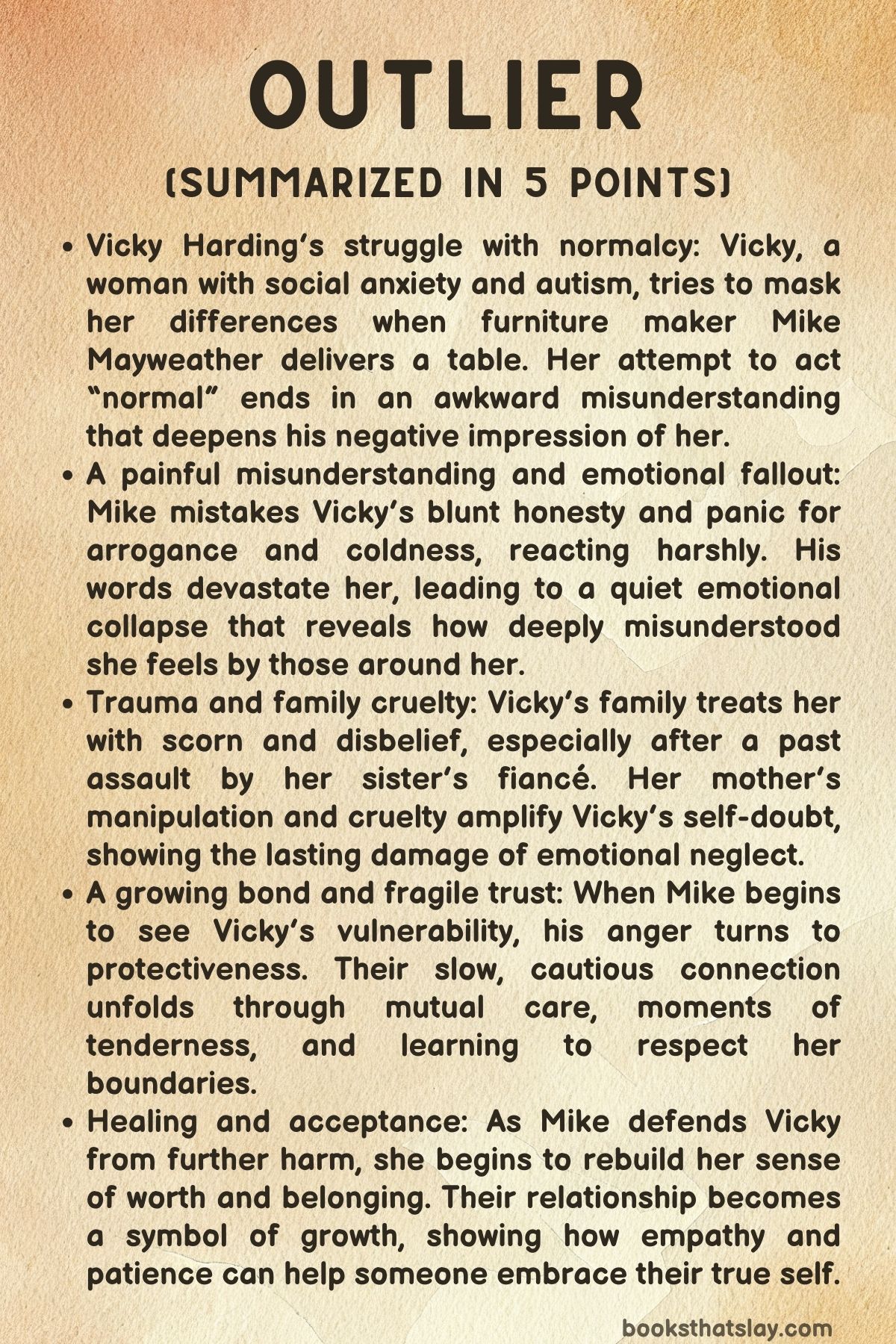
Vicky Harding’s world is built on routines, precision, and an overwhelming need to appear “normal” in a society that constantly judges her for being different. Her life takes an unexpected turn when she orders a custom coffee table from Mike Mayweather, a craftsman she secretly admires but who harbors resentment toward her because of an incident involving his sister, Lucy.
When Mike arrives late with the table, Vicky’s attempt to start a normal conversation fails—her blunt honesty about his tardiness and discomfort with physical contact reinforce his view of her as cold and odd. Her analytical confession that she finds him attractive only worsens things, leading him to assume she’s seeking a meaningless fling.
He lashes out, accusing her of being shallow and emotionless. Vicky, humiliated, retreats into herself, collapsing emotionally in the solitude of her home.
Her half-brother Ollie and his partner Lottie comfort her, reminding her of the small joys she finds in her hedgehog rescue work. Meanwhile, Mike’s guilt grows after hearing about her fragile state.
Ollie’s defense of Vicky forces him to question his assumptions. The next time Mike sees her, he begins to notice the signs of her anxiety and trauma—details that contradict his earlier beliefs.
During a gathering, he apologizes, surprised by her gentle, self-blaming response. Vicky’s quiet acceptance of cruelty and her clear discomfort around people reveal the depth of her isolation.
As he speaks kindly to her for the first time, a fragile connection forms.
When Mike later kisses her impulsively, Vicky reacts with panic and sensory overload. Instead of withdrawing, Mike learns how to help her calm down—through stillness, gentleness, and asking permission before touch.
She explains her need for warning and pressure, and he begins to grasp how different her world feels. This moment of care becomes the foundation of a new kind of intimacy built on trust and consent.
Despite her insecurities, Vicky starts to see that Mike doesn’t view her as broken.
As their relationship grows, the story reveals the layers of pain shaping Vicky’s life. Her mother and half-sister, Rebecca, are manipulative and cruel, emotionally abusing her and exploiting her wealth.
Rebecca’s fiancé, Darrell, had previously assaulted her, an event dismissed by her family. When she faces them again, the encounter reawakens her trauma.
Her stepfather, Gareth, is the only one who shows compassion. In contrast, Mike’s world is straightforward and filled with warmth—his family and friends may tease, but they care deeply.
This difference magnifies how toxic Vicky’s upbringing has been.
Margot, Vicky’s stepmother, manipulates circumstances to push Mike toward her, even using financial leverage. Despite being offended, Mike’s attraction and concern override his anger.
During a gala, when Vicky is harassed by an investor and later triggered by fireworks, Mike’s instinctive protection of her exposes his growing affection. It’s then revealed that Vicky is autistic—a truth that explains her social struggles and sensory distress.
Mike is furious no one told him, but his care only intensifies. When Vicky asks to stay with him, he brings her to his secluded cabin, where she feels safe for the first time.
In the calm of his home, they begin to understand each other. Mike’s patience allows Vicky to open up, and his respect for her boundaries turns their interactions into moments of discovery rather than fear.
He learns about her food sensitivities, routines, and literal way of speaking. When she awkwardly suggests sex as a logical step, he resists, choosing to build emotional closeness first.
Their shared meals, laughter, and quiet honesty transform both of them—Vicky begins to see that love doesn’t require pretending to be someone else.
Mike’s care becomes even more crucial when Vicky’s mother guilts her into attending Rebecca’s wedding. Determined to protect her, he accompanies her.
The event turns disastrous as her family mocks and belittles her. When Darrell assaults her again, Vicky fights back, recalling Mike’s encouragement and self-defense advice.
Mike arrives in time to stop the attack and confronts her family. Gareth finally believes her and defends her, but the others still accuse her of lying.
Mike takes her to the police and then to his mother’s home, where she receives genuine kindness and safety.
The aftermath brings long-awaited accountability. Vicky’s family begins to realize the damage they caused, and some seek forgiveness.
Mike’s anger softens when he sees Vicky’s grace in facing them. Together, they build a new life defined by mutual understanding.
In his cabin, they find peace and joy in small routines—simple food, quiet mornings, and shared work. Vicky’s confidence grows, and she slowly accepts that she deserves love.
However, their happiness is tested when gossip spreads that Mike is merely her “carer. ” Shaken by the cruelty of others and her lingering self-doubt, Vicky breaks things off, convinced she’s a burden.
Mike refuses to give up, patiently waiting until she’s ready. During Lucy’s wedding preparations, Vicky’s loyalty and courage shine through when she defends Mike publicly from a flirtatious woman.
This moment becomes a turning point—Mike declares his love openly, affirming that she is not broken but extraordinary. Vicky reciprocates, admitting she has loved him since they were young.
Their reunion is followed by a symbolic gesture: Mike sells his beloved cabin to repay Margot, proving his love isn’t tied to money. Vicky surprises him by secretly buying it back, declaring it their shared home.
They marry, plan for children, and continue building a quiet, content life surrounded by the people who finally appreciate Vicky for who she truly is.
In the epilogue, years later, Vicky and Mike’s home is filled with warmth, laughter, and family. Their daughter Harriet toddles around, their relatives visit, and even the once-divided families have blended into a caring whole.
Vicky, once burdened by loneliness and misunderstanding, now lives freely, her differences accepted and cherished. The novel closes with a sense of hope—showing that understanding, respect, and patience can turn even the most wounded souls into a family bound by love.
Characters
Vicky Harding
Vicky Harding, the protagonist of Outlier, is a deeply complex and sensitively drawn woman whose life is shaped by her struggles with autism, social anxiety, and past trauma. From the outset, her meticulous counting of time and discomfort with unpredictability expose her hyperawareness of detail and her constant self-monitoring to appear “normal.” Beneath this surface lies a woman of intense emotion and vulnerability, perpetually misunderstood by those around her. Her fixation on Mike Mayweather isn’t superficial infatuation but rather an attempt to find connection and understanding in a world that constantly alienates her.
Vicky’s journey throughout the novel traces her evolution from self-protective isolation to emotional openness, learning that she deserves love without having to mask her true self. Her interactions are often literal and awkward, but they reveal a raw honesty rarely found in others.
Her sensory sensitivities, her need for structure, and her trauma responses—especially following her assault—portray the intersection between neurodivergence and trauma with remarkable realism. By the end, Vicky emerges not as a figure to be pitied but as one of resilience and quiet strength, capable of reclaiming her identity, setting boundaries, and creating a life built on mutual respect and safety.
Mike Mayweather
Mike Mayweather begins as a brusque, rough-edged craftsman whose initial view of Vicky is filtered through ignorance and class prejudice. He mistakes her social differences for arrogance or emotional coldness, branding her an “ice princess.” Yet, as the narrative unfolds, Mike’s character undergoes one of the most significant transformations in Outlier. Beneath his gruff exterior lies a man of deep empathy and protective instinct, who must learn to see beyond his biases.
His growing affection for Vicky teaches him patience, gentleness, and the humility to admit when he’s wrong. Mike’s journey mirrors Vicky’s in a way—while she learns to trust, he learns to understand.
His steady presence becomes a grounding force in Vicky’s chaotic world, and his willingness to learn about her boundaries and sensory needs marks a mature, emotionally intelligent masculinity. Despite his roughness, Mike becomes the safe space Vicky never had, someone who loves her not despite her differences but because of them.
His evolution from judgment to genuine understanding elevates the novel’s central theme: that love rooted in empathy can heal even the deepest wounds.
Ollie Harding
Ollie, Vicky’s half-brother, stands out as one of her few consistent allies. His role in Outlier is that of the protective sibling who bridges Vicky’s isolated world with the warmth of human connection.
Though sometimes exasperated by her quirks, his affection is unwavering. He understands her unspoken cues and provides both emotional and physical safety, as seen when he comforts her after meltdowns or shields her from their family’s cruelty.
Ollie’s relationship with Vicky underscores the idea that understanding doesn’t require perfection but patience. His partnership with Lottie also expands his characterization, showing him as nurturing and supportive in his own right.
His anger toward Mike early in the novel for misunderstanding Vicky highlights his role as her moral defender and emotional anchor. Through Ollie, readers glimpse the unconditional love that becomes Vicky’s foundation for healing.
Lottie
Lottie, Ollie’s partner and Vicky’s assistant, represents compassion wrapped in practicality. Her character blends humor, warmth, and quiet competence.
Lottie understands Vicky’s rhythms intuitively, guiding her through social situations with grace—whether at business meetings or overwhelming public events. Unlike others who treat Vicky as fragile or strange, Lottie treats her with normalcy and respect, ensuring her needs are met without condescension.
She also functions as a bridge between Vicky’s inner world and the neurotypical environment she must navigate daily. Lottie’s unwavering support and subtle advocacy highlight the importance of allyship, portraying how simple understanding can make profound differences in a neurodivergent person’s life.
Her decision to pursue child psychology later in the book reflects her empathy and desire to continue helping others like Vicky find acceptance.
Janet Harding
Janet, Vicky’s mother, embodies emotional neglect and cruelty, serving as one of the novel’s primary antagonistic forces. Her relentless criticism and gaslighting of Vicky lay the foundation for much of her daughter’s trauma and low self-esteem.
Janet’s obsession with appearances, social status, and control make her incapable of empathy. She blames Vicky for her own suffering, minimizes her assault, and manipulates her into financial dependence.
Through Janet, Outlier explores the long-term psychological scars left by parental abuse—how cruelty from a caregiver can distort self-worth and identity. Janet’s behavior is not just villainous; it’s tragically familiar, representing how society often punishes difference, especially in women who don’t conform to expected emotional norms.
Rebecca Harding
Rebecca, Vicky’s half-sister, mirrors their mother’s cruelty with added malice. Her jealousy and disdain for Vicky’s differences stem from insecurity and learned behavior.
Throughout the story, Rebecca mocks Vicky’s mannerisms, invalidates her trauma, and enables Darrell’s abuse, embodying the toxic sibling dynamic often bred in dysfunctional families. Her willingness to exploit Vicky financially, all while belittling her, highlights the parasitic relationships that thrive in the absence of empathy.
Rebecca’s role reinforces the central motif of Outlier—that cruelty often masquerades as normality within families, and escaping it requires immense strength.
Darrell
Darrell represents predation and the embodiment of Vicky’s deepest trauma. His assaults are portrayed with chilling realism and sensitivity, emphasizing the devastating impact of sexual violence—especially when the victim is dismissed and disbelieved.
Darrell’s manipulation and entitlement expose the darker undercurrents of misogyny and privilege, making him a stark contrast to Mike’s evolving gentleness. His presence in the narrative functions not merely as a source of conflict but as a catalyst for Vicky’s eventual empowerment.
Her ability to fight back and report him marks a turning point in her journey from victimhood to agency.
Margot Harding
Margot, Vicky’s stepmother, is a multifaceted character who transitions from cold indifference to maternal protectiveness. Initially complicit in the emotional neglect Vicky endures, she later acknowledges her failures and seeks redemption.
Her confession to Mike about her past cruelty and her later orchestration to reunite him with Vicky reflect her complexity—part manipulative, part well-intentioned. Margot’s evolution is essential in Outlier, as it showcases that remorse and growth are possible even for those who once caused harm.
By the end, her acceptance of Vicky as a daughter, not an obligation, helps heal old wounds and fosters the found-family dynamic that defines the novel’s resolution.
Hetty Mayweather
Hetty, Mike’s mother, provides the maternal warmth and acceptance Vicky has been denied all her life. She embodies kindness without pity, treating Vicky as capable and worthy.
Her gentle gestures—making food, offering comfort, and welcoming Vicky into her family—symbolize unconditional love. Hetty’s presence reinforces one of the novel’s most poignant ideas: that family is defined by love and understanding, not blood.
Through Hetty, Vicky finally experiences the tenderness and belonging that allow her to believe she is deserving of happiness.
Abdul
Abdul, Vicky’s therapist, serves as her voice of reason and moral compass. His grounded empathy and professionalism contrast sharply with the chaos of Vicky’s family life.
He encourages her to confront her trauma and recognize her worth. Abdul’s calm, consistent presence helps Vicky articulate her feelings and begin to understand her boundaries, functioning as a stabilizing force throughout her emotional journey.
His character demonstrates the importance of compassionate therapy and its role in recovery for those grappling with both neurodivergence and trauma.
Gareth
Gareth, Vicky’s stepfather, is one of the few members of her extended family who shows decency. Though initially passive, his later confrontation with Darrell reveals genuine moral courage.
His realization of the family’s mistreatment of Vicky and his attempt to make amends add a layer of humanity to an otherwise cruel household. Gareth’s arc underscores that silence in the face of cruelty is complicity, and redemption requires action.
Claire Harding
Claire, another of Vicky’s half-sisters, occupies a middle ground between cruelty and remorse. Initially distant and complicit, she later shows guilt and attempts to reconcile.
Her daughters’ affection for Vicky acts as a generational bridge toward healing, suggesting that compassion can break cycles of cruelty. Through Claire, Outlier subtly explores the idea that empathy can be learned and that recognition of past wrongs is the first step toward change.
Themes
Neurodiversity and Acceptance
In Outlier, Susie Tate crafts a deeply human exploration of neurodiversity through Vicky Harding’s experience of living with autism, anxiety, and sensory sensitivities. Rather than reducing her to a set of symptoms, the narrative illuminates her as a complete person—brilliant, loving, and painfully self-aware.
The story dismantles stereotypes about autism, showing that her “odd” behaviors are not flaws but expressions of how she processes the world. Her precision with time, need for order, and sensitivity to sound or touch are survival mechanisms in an environment that rarely accommodates difference.
What becomes clear is not that Vicky struggles to connect, but that the world fails to meet her halfway. Her difficulty in reading social cues or masking discomfort is constantly misinterpreted as coldness or arrogance, leading to cycles of misunderstanding and alienation.
Yet Tate also highlights the quiet strength in Vicky’s existence—her persistence in volunteering at “Hogwatch,” her capacity for empathy toward animals, and her courage in confronting trauma. The novel invites the reader to see neurodiversity not as a limitation but as a variant form of beauty and intelligence.
When Mike begins to recognize Vicky’s differences as part of her essence rather than obstacles to love, the story shifts from alienation to acceptance. His journey toward understanding her needs—asking permission before touch, learning her triggers, and valuing her directness—serves as a model of compassionate adaptation.
The message becomes clear: true acceptance doesn’t mean changing someone to fit social norms but creating space where their way of being can exist without apology.
Trauma and Healing
The novel traces the profound effects of trauma—emotional, sexual, and psychological—and its slow, painful healing. Vicky’s past is littered with violations: her mother’s verbal cruelty, Darrell’s assaults, and years of being gaslit into silence.
Her trauma manifests not through grand gestures but in moments of withdrawal, shutdowns, and hypervigilance. Tate portrays these experiences with honesty, refusing to sensationalize them.
The lingering aftershocks—the panic at unexpected touch, the freezing in moments of confrontation—become a language through which the reader understands the depth of her wounds. Healing, in contrast, is depicted not as a singular triumph but as a gradual reclamation of safety.
Mike’s presence does not “fix” her; instead, he learns to build an environment where she can breathe freely. His willingness to hold her during meltdowns or to respect her autonomy becomes part of her recovery.
The therapy sessions with Abdul reinforce that healing is self-driven, not granted by others. When Vicky finally reports her assault, the act signifies not just justice but ownership of her narrative.
Even more powerful is her evolution from silence to self-defense—fighting back against Darrell at the wedding marks a reclamation of agency. Tate suggests that trauma recovery is cyclical, marked by regressions and breakthroughs, yet anchored by small acts of trust.
The book’s portrayal of healing resists romantic clichés; it’s messy, uncomfortable, and real. Ultimately, Vicky’s journey from victimhood to empowerment underlines the theme that survival is not just endurance—it is the conscious decision to live authentically after being broken.
Love and Miscommunication
At the core of Outlier lies the fragile, often painful evolution of love between two people who perceive the world through vastly different lenses. The early interactions between Vicky and Mike are marred by misinterpretation—her factual honesty mistaken for coldness, his bluntness for cruelty.
The narrative demonstrates how love can falter not from lack of feeling but from the inability to translate emotion into the same social language. Tate uses their contrasting communication styles to show that emotional intelligence is not universal but contextual.
For Vicky, expressing attraction means stating facts; for Mike, affection is physical and spontaneous. Their connection begins to flourish only when each learns the other’s rhythm.
The tenderness that grows between them—Mike’s gentle patience and Vicky’s hesitant vulnerability—illustrates how understanding can bridge seemingly insurmountable divides. Yet Tate resists idealizing their love.
Misunderstandings continue, underscoring that relationships involving neurodiverse individuals require ongoing empathy, not momentary insight. The novel also questions societal definitions of “normal” romance, portraying intimacy as a process of unlearning assumptions.
Vicky’s candid approach to sexuality and emotion challenges Mike’s—and the reader’s—expectations, forcing a reconsideration of what sincerity in love looks like. By the end, their partnership stands as an argument for radical honesty and accommodation: love not as the erasure of difference but as a commitment to navigate it together.
Through them, Tate proposes that miscommunication can either destroy or deepen intimacy, depending on one’s willingness to listen beyond words.
Family and Emotional Neglect
The book offers a striking study of familial cruelty and the enduring damage of emotional neglect. Vicky’s family embodies a form of domestic toxicity that masquerades as respectability.
Her mother’s manipulation, her sister’s mockery, and her stepfather’s passivity form a collective pattern of abuse disguised as concern. They exploit Vicky’s wealth and compliance while undermining her self-worth, teaching her to equate love with pain and obedience.
Tate’s portrayal of this dynamic is harrowing precisely because it reflects the subtle, everyday violence of emotional neglect. The constant invalidation of Vicky’s feelings and differences shapes her belief that she must perform normalcy to earn affection.
This makes her initial self-perception—seeing herself as a burden—heartbreakingly believable. The turning point arrives when Mike and his family model genuine care, contrasting the performative love of her biological family.
Hetty’s maternal kindness, Margot’s remorse, and Ollie’s growing protectiveness form a surrogate family grounded in acceptance rather than control. Through these relationships, Tate explores how chosen family can become the antidote to inherited pain.
The final scenes, where Vicky is surrounded by warmth, laughter, and authenticity, signify a radical redefinition of family: not those bound by blood, but by mutual respect and emotional safety. The novel thus exposes the lasting wounds of neglect while offering the possibility of rewriting one’s understanding of home and belonging.
Identity and Self-Acceptance
A central thread running through Outlier is Vicky’s journey toward accepting herself as she is—autistic, sensitive, intelligent, and whole. For most of the novel, she measures her worth through others’ perceptions, internalizing labels of “strange” and “defective.
” The pressure to appear normal becomes a form of self-erasure, one that leaves her exhausted and disconnected from her own emotions. Tate’s narrative gradually dismantles this conditioning, leading Vicky to recognize that her differences are not deficits but integral to her identity.
Her eventual realization that she does not need to mask her behaviors or apologize for her needs marks her liberation from the gaze of others. Mike’s unconditional acceptance reinforces this transformation, but it is Vicky’s own acknowledgment of her worth that solidifies it.
When she begins to set boundaries, assert preferences, and express affection in her own way, she moves from survival to self-ownership. The closing chapters—showing her professional competence, emotional growth, and domestic happiness—signal that she no longer defines herself by contrast to others.
Tate’s portrayal of identity is not about overcoming autism but embracing authenticity. In this sense, the title Outlier gains profound significance: it represents not an outsider status to be remedied, but a unique position from which to view and enrich the world.
Through Vicky’s self-acceptance, the novel champions the idea that embracing one’s truth, however unconventional, is the ultimate act of freedom.