Palaver by Bryan Washington Summary, Characters and Themes
Palaver by Bryan Washington is a novel that examines the complexities of family, identity, and belonging, set against the backdrop of Tokyo, Japan. The story revolves around a mother who visits her estranged son, a man who has lived in Japan for over a decade.
The novel explores their difficult reunion, filled with emotional distance, misunderstandings, and cultural differences. Through their strained interactions, the book delves into themes of family, the search for home, and the process of reconciling with the past. It is a story about personal growth, missed connections, and the quiet, tender moments that can bridge even the deepest gaps.
Summary
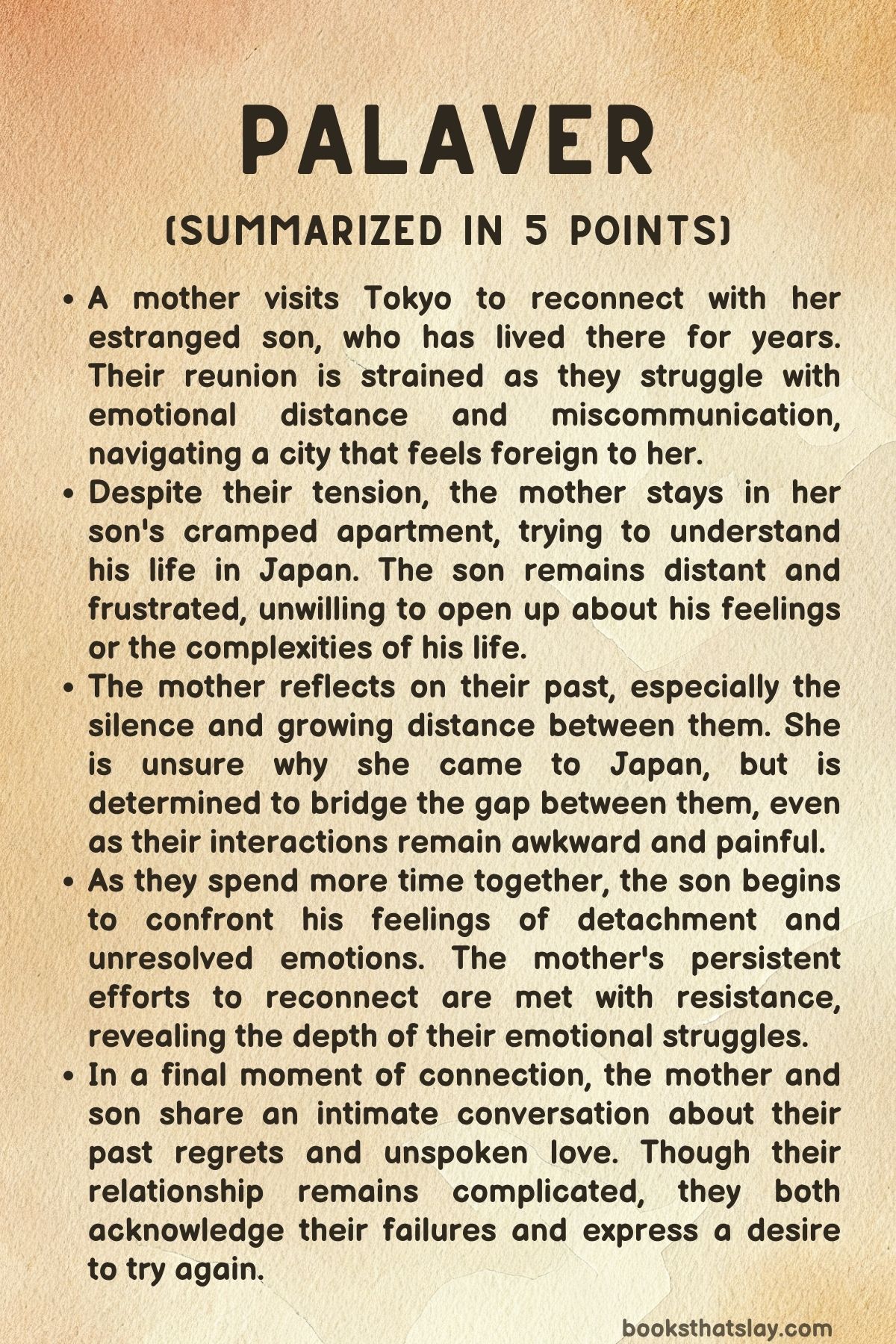
The novel Palaver follows the journey of a mother who travels from Houston to Tokyo to reconnect with her son, who has been living in Japan for over twelve years. Their relationship has been marked by years of emotional distance, and the mother’s visit is an attempt to bridge this gap.
She struggles to navigate the unfamiliar streets of Tokyo, feeling lost and out of place, both in the city and in her son’s life. Despite the strain between them, she stays in his cramped apartment, trying to understand his world, which feels foreign and isolating to her.
The son is irritable and distant, clearly frustrated by his mother’s presence. He is a tutor in Tokyo, grappling with the challenges of his life in a foreign city.
His interactions with his mother are filled with awkwardness and passive-aggressive remarks, highlighting the emotional disconnect between them. The mother tries to reconnect, but her efforts are met with resistance.
Over time, their strained relationship reveals the depth of their miscommunication, with the son struggling to express his feelings and the mother desperately seeking some form of connection.
Throughout her stay, the mother reflects on the past, particularly the years when her son stopped answering her calls. She recalls the moment when she heard his voice on the phone again after years of silence, which led her to make the decision to visit him in Japan.
However, she is unsure why she made the journey or what she hopes to achieve. The son, on the other hand, seems overwhelmed by her visit and the unresolved emotional distance between them.
One day, the son and mother visit a small izakaya, where their conversation grows increasingly tense. The son admits that he doesn’t know why she came to Japan, revealing the deep emotional divide between them.
This moment forces both the mother and the son to confront their relationship’s reality: the son doesn’t feel the same familial duty that the mother does. The mother tries to make sense of her son’s actions, wondering if his detachment is a way of coping with the challenges of being far from home.
The narrative also delves into the son’s personal life in Tokyo, including his relationships with others. He forms a connection with Taku, a man with whom he has a casual sexual relationship.
However, the son’s emotional void remains unfilled, and he struggles with the loneliness that comes with living in a foreign city. The son is unsure if Tokyo will ever truly feel like home, even as he contemplates the possibility of permanence in the city.
His relationships with friends like Danny, Han, and Taku highlight the fleeting nature of connections in Tokyo, as people come and go, and the city’s transient nature reflects his own uncertainty about his future.
The mother, meanwhile, attempts to navigate Tokyo on her own, taking long walks around the city and trying to familiarize herself with her surroundings. She becomes increasingly frustrated with her son’s reluctance to communicate openly and the emotional distance that remains between them.
Despite this, she continues to care for him, even if she cannot understand his life or the choices he has made. As the mother spends more time in Tokyo, she begins to realize how little she knows about her son’s life.
Her attempts to connect with him reveal the deep gaps in their relationship, but she also sees glimpses of the person he has become.
During a trip to Nara, the mother and son continue to struggle with their relationship. The son dismisses his mother’s suggestion that he come home, asserting that Tokyo is now his home.
This statement marks a turning point in their relationship, as it reveals the finality of the son’s emotional detachment. The mother, on the other hand, is left to reflect on her place in his life and whether there is any hope for their relationship to heal.
The narrative shifts between the perspectives of the mother and the son, capturing their emotional journeys as they navigate their complicated bond. The son’s struggle to reconcile his past and his future in Tokyo becomes more apparent as he contemplates his relationships with his friends, his mother, and his former partner Chris.
He begins to reflect on what it means to truly belong, both in Tokyo and in his own life. The novel highlights the themes of identity and belonging, as the son grapples with the pull of his past and the uncertain future that lies ahead.
In the final chapters, the son and mother share a quiet moment together, acknowledging their failures to truly care for one another but also expressing a desire to try. The mother leaves Tokyo, and the son continues to navigate his life in the city.
The novel ends with the son reflecting on the time he spent with his mother and the complicated emotions that remain between them. Despite the unresolved tension, there is a sense of hope that the son will continue to grow and find a sense of belonging, whether in Tokyo or elsewhere.
Palaver is a powerful exploration of family dynamics, the complexities of identity, and the challenges of reconciling with the past. Through the lens of the mother and son’s relationship, the novel examines the emotional distance that can grow between people, even those who are supposed to be closest.
The story captures the universal struggle to understand oneself, find home, and navigate the tangled web of human connections. In the end, the characters are left to ponder the uncertain path ahead, but with the understanding that life, like relationships, is a continuous journey marked by both loss and hope.
Characters
The Mother
The mother in Palaver is a woman who is deeply rooted in her role as a caregiver, though her relationship with her son is fraught with emotional distance and a sense of abandonment. She arrives in Tokyo, attempting to reconnect with her estranged son, only to find herself navigating both the unfamiliarity of the city and the strained dynamics with him.
She is portrayed as a woman who cares deeply, yet struggles with her son’s reluctance to engage with her. Despite the awkwardness between them, she remains determined to rebuild some semblance of connection.
Her background, including her previous life in Toronto with her late brother Stefan and the dissolution of her relationship with Cheryl and Earl, speaks to her resilience and past emotional wounds. The mother’s character arc is defined by her attempt to understand her son’s life in Tokyo, but she also comes to terms with the limitations of her relationship with him.
Her journey reflects a search for meaning in her interactions with her son and in the memories of her past, as she begins to question the emotional distance that has defined her life. Her emotional vulnerability and the quiet moments of self-reflection—such as her acknowledgment of past regrets—are juxtaposed with her efforts to support her son, even as he resists her.
The mother’s character is one of quiet determination and an underlying hope that, despite their fractured relationship, she can find some form of reconciliation with her son.
The Son
The son is a complex character caught between his life in Tokyo and his emotional ties to his past, especially to his mother. Having lived in Tokyo for several years, he has adjusted to life in a foreign city, forming friendships with people like Danny, Han, and Taku.
However, his connection to Tokyo is uncertain, and he frequently contemplates whether the city can truly be his home. His relationship with his mother is one of emotional distance and resentment, rooted in years of miscommunication and lack of closeness.
When she arrives in Tokyo, he maintains strict boundaries, unwilling to engage with her past or present life. His relationship with Taku is equally complex, evolving slowly as the son grapples with his feelings and the implications of a long-term commitment.
The son’s emotional turmoil is evident in his strained connections with those around him, as well as his internal struggles over his sense of belonging. Despite his reluctance to return to the United States, he is deeply impacted by memories of his former partner, Chris, who continues to linger in his thoughts.
The son is at a crossroads, uncertain about his future in Tokyo and torn between the pull of his past and the possibility of forging a new life in the city. His character development throughout the story reflects his journey of self-discovery, as he comes to terms with his past relationships and the emotional void he feels, all while trying to understand what it means to call a place home.
Ben
Ben serves as a supporting character who plays a pivotal role in the mother’s emotional journey in Palaver. He is a compassionate figure, one who seems to understand the mother’s sense of displacement and emotional turmoil.
Ben is a friend to the mother, and their interactions evolve from casual encounters to a deeper emotional connection. He has his own complex relationship with his estranged son, Jun, and his experiences of grief and loss shape his empathetic nature.
In his conversations with the mother, Ben offers insights into the nature of familial relationships, suggesting that parents are meant to be a “landing space” for their children. Ben’s presence in the narrative serves as a mirror to the mother’s own experiences, as both characters reflect on their estranged relationships with their children.
His relationship with his son, Jun, whom he has lost touch with, parallels the mother’s estrangement from her son, further deepening the emotional resonance of the story. Ben’s role in the narrative is also significant in providing a sense of comfort to the mother, especially as she navigates her complicated feelings about her son.
Their conversations, often intimate and revealing, help the mother gain clarity about her own life and the decisions she has made. Ben is both a confidant and a source of solace, providing a quiet but essential presence in the mother’s journey of self-discovery.
Taku
Taku is a significant character in the son’s life in Tokyo. Their relationship evolves slowly, marked by an emotional detachment that mirrors much of the son’s own struggles with intimacy and connection.
Taku offers the son a chance for a deeper emotional bond, yet the son remains hesitant to fully engage, uncertain about his feelings and his place in Tokyo. Taku’s role in the story is to challenge the son’s perceptions of love and connection, forcing him to confront his own emotional barriers.
While their relationship is never fully defined, it serves as a counterpoint to the son’s interactions with his mother and highlights the son’s internal conflicts. The relationship with Taku also acts as a metaphor for the son’s search for belonging and stability in a city that, despite offering him some comfort, still feels alien to him.
Taku is a symbol of the possibility of emotional intimacy, yet the son’s reluctance to open up to him underscores his deep-seated fear of vulnerability and commitment. Taku’s quiet presence in the son’s life provides a contrast to the more tumultuous relationship between the son and his mother, emphasizing the son’s struggle to find balance in his personal connections.
Alan
Alan is a friend of the son, a figure who represents the stability and support the son lacks in other parts of his life. As a fellow member of Tokyo’s queer community, Alan offers the son a sense of belonging, especially in the safe space of his bar.
Alan’s role in the son’s life is one of mentorship and emotional support. He sees the son as a surrogate family member, offering guidance and encouragement when the son struggles with emotional issues.
Alan’s vulnerability is also evident, as he openly shares his own fears and challenges, such as his upcoming top surgery. Despite the emotional distance the son feels toward his biological family, Alan embodies a form of familial connection and acceptance that the son is gradually learning to embrace.
Alan’s presence is crucial in the son’s process of emotional growth, serving as both a friend and a grounding figure amidst the complexities of his relationships.
Iseul
Iseul is another important figure in the son’s social circle, adding another layer to his exploration of identity and belonging. Iseul’s own painful history, marked by his experiences in Seoul and his struggles with being HIV-positive, provides a window into the challenges faced by marginalized individuals.
His story offers the son a sense of camaraderie, as they bond over shared feelings of loneliness and isolation in Tokyo. Iseul’s relationship with the son is one of quiet understanding, as they both navigate their own personal histories while trying to forge meaningful connections in a foreign city.
Iseul’s friendship with the son helps him realize the importance of community and the comfort of having people who understand his struggles. His character serves as a reminder to the son of the importance of embracing relationships, even in the face of past trauma.
Themes
Emotional Distance and Estrangement
The theme of emotional distance and estrangement runs deeply throughout the story, centering on the strained relationship between the mother and her son. At the heart of this tension is the unresolved emotional gap that has developed over years of silence and miscommunication.
Despite the mother’s attempts to reconnect, her son is distant and reluctant to engage in meaningful conversation. This emotional detachment is not merely the result of physical distance between them but also the result of years of emotional neglect, where the son has shut off from his mother and avoided addressing their complex past.
Their relationship is marked by frustration and passive-aggressive exchanges, where each struggles to communicate their needs and feelings. The mother longs for closeness and understanding, yet she constantly finds herself unable to breach the emotional wall her son has erected.
This emotional chasm is not only seen in their interactions but also in the son’s resistance to returning home, even after years of estrangement. The son’s reluctance to engage, despite his deep-seated feelings, highlights the difficulty in bridging emotional gaps once they have widened over time.
The emotional distance between them is further accentuated by their divergent lives — the mother is from a completely different culture and environment, while her son has lived in Japan for over a decade, forging a life that feels foreign and disconnected to her.
Identity and Belonging
Throughout the book, there is a consistent exploration of identity and belonging, particularly through the son’s struggle to find his place in Tokyo. As an outsider in a foreign country, he experiences a sense of both connection and alienation.
He has been in Tokyo long enough to become a part of the city’s rhythm, yet he remains unsure whether he can truly call it home. The concept of home becomes elusive as the son navigates the complexities of his existence in a foreign land, trying to reconcile his past with his present.
This internal conflict is mirrored by his relationships with others, including his complicated feelings toward his mother and his emotional entanglements with people like Taku. The theme of identity is further explored as the son’s interactions with his friends and his romantic partners raise questions about who he is, where he belongs, and how his past influences his present.
The son’s struggle to define home underscores the broader question of what makes a place or a relationship truly meaningful. Ultimately, the story portrays the search for belonging as a complex and ongoing process, one that is never fully resolved but always evolving.
The notion of identity is fluid, influenced by the environments, relationships, and personal histories that shape the characters’ lives.
Family Dynamics and Communication
Family dynamics and communication—or the lack thereof—are central to the story’s exploration of relationships. The mother’s visit to Tokyo is not just about reconnecting with her son but also about navigating the complexities of family bonds that have been stretched thin over time.
The strained communication between the mother and son reflects broader issues of miscommunication and emotional disconnect within families. The mother tries to understand her son’s life, but her efforts are met with resistance, leading to moments of frustration and heartache.
Despite these challenges, there are glimpses of hope and tenderness, such as when the son acknowledges his past distance and expresses regret. These small moments of vulnerability reveal the possibility of healing, even though it is unclear whether a full reconciliation will ever occur.
The story shows how family bonds can be both a source of comfort and conflict. It also highlights the difficulty of navigating these relationships when communication is broken, and the emotional needs of both parties are left unaddressed.
The mother’s journey to Tokyo represents her attempt to bridge the gap, but it becomes clear that true communication requires both parties to be open and willing to confront their past and present emotions. The theme of family dynamics explores the inherent messiness of relationships, where love and care exist alongside misunderstandings and unmet needs.
Change and Impermanence
The theme of change and impermanence is woven throughout the story, reflected in the evolving nature of the characters’ lives and relationships. The son’s experience in Tokyo underscores the transient nature of his existence, from his fleeting connections with people like Danny and Han to the changing nature of the places he frequents.
The closure of the club where the son and his friends gathered symbolizes the impermanence of the spaces and communities that once felt familiar. The fleeting nature of friendships and the constant change in the environment serve as a reminder that nothing remains the same forever.
This theme is also explored through the mother’s journey in Tokyo, as she reflects on her past, her relationships, and the passage of time. She contemplates how her life has changed since leaving Toronto and how her relationship with her son has shifted over the years.
In both cases, the characters are confronted with the inevitability of change, which is both a source of loss and a catalyst for growth. The impermanence of relationships and places forces the characters to confront their emotional needs and the reality that life, no matter how familiar, is constantly in flux.
The story suggests that while change can be unsettling, it is also an essential part of life, forcing individuals to adapt, grow, and find meaning in the moments they have.
Grief and Loss
Grief and loss are recurring themes throughout the book, particularly in the context of the mother’s experiences. The mother’s grief over her son’s emotional distance is compounded by the loss of her brother, Stefan, who died of AIDS.
This loss shapes her perspective on relationships and emotional connections, influencing her desire to reconnect with her son. The son, too, grapples with loss, not only through his estranged relationship with his mother but also through his memories of Chris, a past lover.
The emotional weight of these losses lingers in their interactions, coloring their efforts to bridge the gap between them. The theme of grief is also explored through the son’s relationships with others, particularly his connection with Taku.
As the son struggles with his own emotional void, he finds solace in the relationships he forms, even though these connections are complicated by the unresolved grief from his past. Grief, in this context, is not just about the loss of people but also about the loss of connections and the emotional fulfillment that comes from meaningful relationships.
The story portrays grief as a multifaceted experience that influences how the characters engage with each other and with the world around them. It is a force that shapes their identities, their actions, and their capacity for connection, pushing them to confront both the past and the future.