People We Meet on Vacation Summary, Characters and Themes
People We Meet on Vacation is a contemporary romance about friendship, timing, emotional safety, and the fear of wanting the one person who knows you best. The book follows Poppy, a restless travel writer who has achieved the life she once dreamed of, yet feels strangely empty, and Alex, her quiet, careful best friend from college.
For years, their annual summer trips have been the center of their bond, until one unresolved moment breaks their closeness. The story moves between past vacations and a present-day attempt to repair what they lost, asking whether love can survive fear, distance, and the pressure of real life.
Summary
Poppy is a successful travel writer living in New York, working for the luxury travel magazine Rest + Relaxation. On paper, she has everything she once wanted: a stylish apartment, a dream job, professional respect, and a life full of beautiful destinations.
Yet she feels disconnected from the work that once thrilled her. During a meeting, she cannot produce the kind of inspired travel ideas her boss expects.
Later, while talking with her best friend Rachel, Poppy admits that she is unhappy even though she has achieved her goals. Rachel asks her to think about the last time she felt truly alive, and Poppy immediately thinks of Alex Nilsen, her former best friend, and the summer trips they used to take together.
Poppy and Alex have barely spoken for two years. Their silence began after a trip to Croatia, though the full reason remains painful and unclear to Poppy.
Still, she cannot stop thinking about him. She looks through old travel posts and sees how much her writing changed after he disappeared from her life.
After much hesitation, she texts him. Their exchange is awkward at first, but their old humor soon returns.
They joke, tease, and fall into familiar patterns, but Poppy also learns that important things happened in Alex’s life while they were apart, including the death of his cat and his grandmother. The realization hurts because it proves how much of each other’s lives they have missed.
Their history began years earlier at college orientation, where they seemed like total opposites. Poppy was bold, colorful, talkative, and eager to reinvent herself, while Alex was quiet, cautious, and more comfortable with books than parties.
Their only obvious connection was that they were both from the Linfield area in Ohio. At first, neither expected the other to matter.
That changed when they carpooled home after freshman year. The drive began badly, with uncomfortable silences and clashing habits, but slowly turned into a long, strange, funny conversation.
By the end, they were singing together and discovering that their differences made them oddly comfortable around each other.
From there, Poppy and Alex became close. They texted, talked, explored Chicago, and eventually began taking summer trips.
Their first major vacation together was to Vancouver Island, where Poppy’s love of adventure met Alex’s steadier nature. She pushed them toward spontaneity; he kept them grounded.
Their trips became a yearly ritual and the emotional center of their friendship. Each summer showed a different stage of their lives.
They traveled to places like Nashville, Northern California, New Orleans, Vail, Sanibel Island, and later Europe. Along the way, they dated other people, changed jobs, faced family pressures, and tried to keep their friendship safely defined, even as attraction and love kept rising beneath the surface.
In the present, Poppy decides that the only way to regain her happiness is to reconnect with Alex. When she learns he will be in Palm Springs for his brother David’s wedding, she suggests they take another trip together, the way they used to: cheap, chaotic, and improvised.
She does not tell Alex the full truth that her magazine is not funding it. She wants the trip to feel like the old days, hoping that if she can recreate their former rhythm, they can repair what broke between them.
At first, Palm Springs seems like a disaster. Their rental car is old and unreliable, their Airbnb is under construction, the air-conditioning barely works, the pool is crowded or unusable, and the heat is brutal.
The cramped space makes their physical awareness of each other harder to ignore. Alex injures his back, and Poppy cares for him with practical tenderness, buying medicine, food, ice, and heat pads.
These ordinary acts of care reveal how deep their bond still is. Even after two years of distance, she knows how to help him, and he still reads her moods with painful accuracy.
As they spend time together, the old jokes return, but so do the wounds. Poppy learns more about what she missed during their silence, and Alex admits he was unsure whether she wanted to hear from him.
They try to pretend they are just rebuilding a friendship, but their conversations keep turning personal. While helping Alex improve his dating profile, Poppy is forced to confront how attractive, sincere, and lovable she finds him.
Alex, in turn, makes it clear that he sees her as someone he would choose. Their attraction is no longer something they can easily dismiss.
Past trips show that this tension has existed for years. In Nashville, Poppy first felt a strong urge to kiss him.
In Northern California, Alex told her he loved her when she feared no one outside her family ever would. In New Orleans, his writing made her feel deeply understood.
In Vail, after she injured her ankle, he carried her down a mountain with such care that she again recognized how safe he felt. In Sanibel Island, Poppy finally admitted to herself that she was in love with him, though she quickly tried to deny it.
Their relationships with other people never fully remove the problem. Poppy dates men like Julian, Guillermo, and Trey, while Alex repeatedly returns to Sarah, a woman who seems to fit the stable life he thinks he should want.
Yet Alex and Poppy continue to occupy the most important emotional space in each other’s lives. In Tuscany, while traveling with Trey and Sarah, Poppy has a pregnancy scare, and Alex is the one who finds her, comforts her, and promises she will not be alone.
The moment makes it clear that their bond is unfair to their partners because neither of them can truly put anyone else first.
The real break happens in Croatia. By then, both Poppy and Alex are single, but fear and bad timing still stand between them.
After a night of drinking, Alex comes to Poppy’s room and they kiss. When the moment grows more serious, Alex stops because they are drunk and he does not want their first real step into romance to happen carelessly.
Poppy misunderstands him. Feeling rejected and embarrassed, she insists the kiss meant nothing.
Alex is hurt, and neither of them explains the truth. Their texts become distant, then rare, and their friendship falls apart.
In Palm Springs, the truth finally pushes through. After one more failed day and a fight about Poppy’s attempt to recreate the past, Alex tells her they cannot simply go back.
The argument forces them to admit that the old version of their friendship is gone. In the heat and rain, anger turns into honesty, and they kiss.
This time, they do not pretend it means nothing. They admit their love, become physically intimate, and begin to understand that the line they feared crossing has already been crossed emotionally for years.
Still, love does not solve everything at once. Poppy learns that Alex nearly proposed to Sarah but ended the relationship because his choices were still shaped by his feelings for Poppy.
Alex explains that Sarah left partly because of his attachment to Poppy, and that the Tuscany pregnancy scare led him to make life choices Sarah had not agreed to. Poppy realizes how much pain their uncertainty has caused.
They also face the practical problem that Alex values home, family, and stability, while Poppy has used travel as an escape from old wounds.
After David’s wedding, Poppy confesses that the magazine did not pay for the trip. Alex feels hurt because it confirms his fear that Poppy has treated him as part of a break from real life rather than someone she can build a life with.
He tells her he loves her, but that love has never been the whole problem. They part again, not because their feelings are uncertain, but because they both need to face what they are afraid of.
Poppy begins therapy, leaves behind the version of success that no longer makes her happy, and reconsiders her feelings about Linfield. An apology from an old bully helps her understand that the shame she attached to her hometown has shaped her restlessness.
She returns to Ohio and finds Alex. In front of others, she tells him the truth: she loves him and is willing to risk being hurt.
Alex is afraid they do not make sense, but he follows her outside and admits that he has started therapy too. He understands that he is afraid of happiness because happiness can be lost.
Together, they accept that love is frightening, but worth choosing.
Months later, Alex has moved to New York, and he and Poppy are building an everyday life together. Their relationship is no longer confined to vacations, dramatic reunions, or idealized escapes.
It includes chores, work, small irritations, shared routines, and ordinary joy. Poppy begins writing again in a way that feels true to her.
She realizes that happiness is not found only in distant places. With Alex, ordinary life itself can feel like coming home.
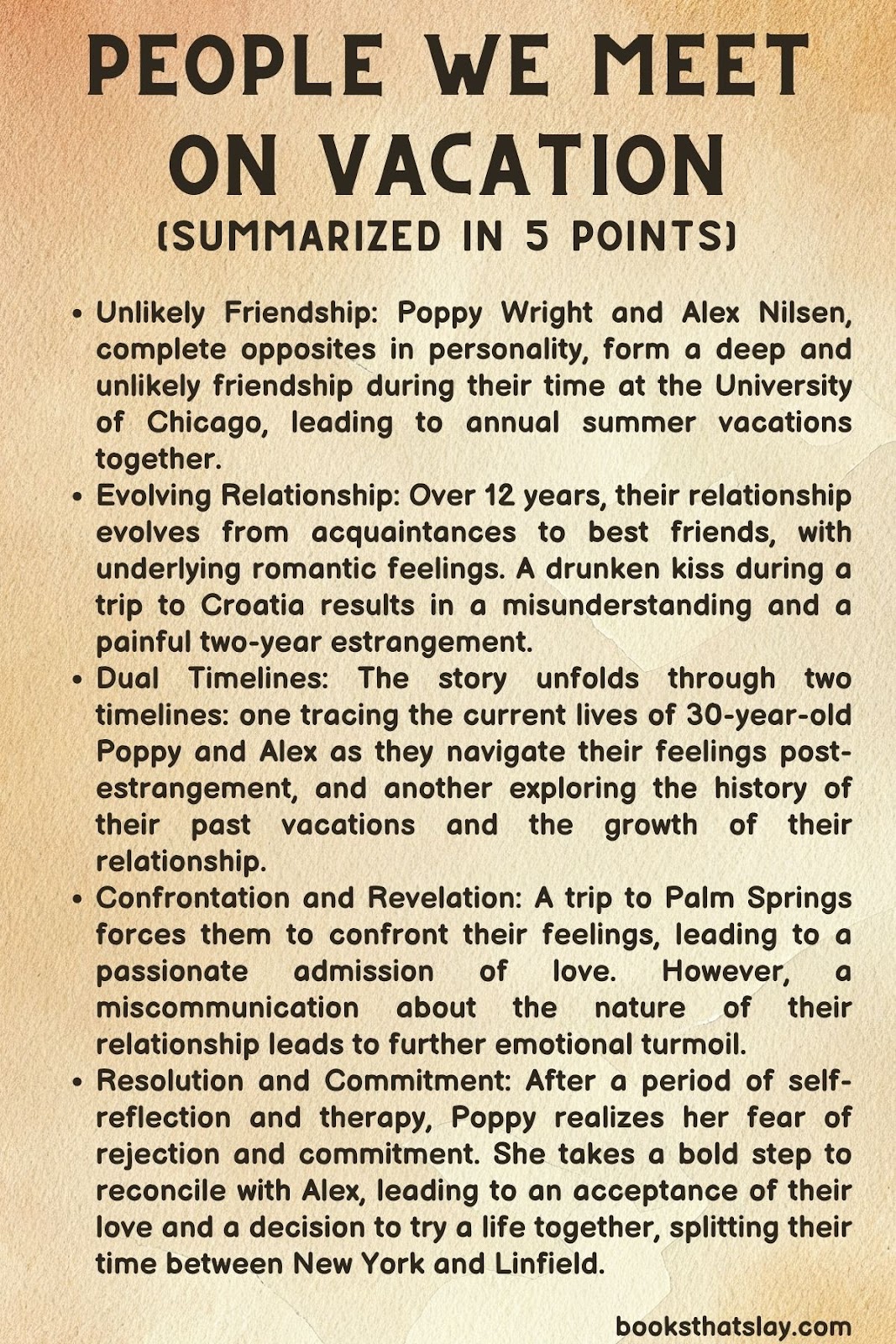
Chapter-By-Chapter Summary
Prologue
Five summers before the main timeline, Poppy and Alex are on a rainy trip to Sanibel Island. Poppy reflects on how vacation lets people become freer versions of themselves, then finds Alex reading at a dingy local bar called BAR.
Pretending to be a flirtatious stranger, she tries to help him “practice” dating after his breakup with Sarah, but their banter quickly exposes how deeply they know each other. Alex, serious and repressed on the surface, reveals the private silliness Poppy loves.
After the bar, they run through the rain to their rental car, and Alex suggests taking a picture together. The selfie is terrible, but Poppy insists they keep it because it captures the trip as it truly was.
They agree that next year they should go somewhere cold and dry, and the chapter quietly establishes their intimacy, love, and tension.
Chapter 1
In the present summer, Poppy works at Rest + Relaxation, a high-end travel magazine, but she has lost her excitement for travel. During a pitch meeting, she cannot offer her usually inspired ideas, and her formidable boss, Swapna, expects more from her.
Later, Poppy meets her best friend Rachel, a fashion influencer, for wine. Poppy admits that although she has achieved her dream job, apartment, and lifestyle, she is not happy.
Rachel suggests that Poppy may have lost her sense of purpose after reaching her goals and advises her to “retrace her steps” to find the last time she was truly happy. Poppy immediately knows the answer: two years ago, in Croatia, with Alex Nilsen.
The problem is that she and Alex have barely spoken since then.
Chapter 2
Poppy cannot stop thinking about Alex and their old summer trips. Back at her minimalist New York apartment, she scrolls through her old travel blog and realizes that after the Croatia trip, her writing and joy both faded.
She debates texting Alex, trying several messages before accidentally sending only “Hey.” To her shock, he replies. Their conversation begins awkwardly but soon revives their old rhythm: jokes about stolen sandwiches, his Sad Puppy Face, and his cat Flannery O’Connor.
Then Poppy learns that Flannery has died, and the fact that Alex never told her hurts deeply. Their conversation cools, ending with a polite goodnight.
The chapter shows that their bond still exists, but so does the pain of the two years they lost.
Chapter 3
Twelve summers earlier, Poppy first meets Alex during orientation at the University of Chicago. She notices him standing alone in khakis and a university T-shirt, looking nothing like the artistic, exciting people she imagined meeting at college.
She jokes with him, but he responds awkwardly, and they quickly seem mismatched. She is loud, colorful, restless, and eager for parties; he is quiet, cautious, serious, and interested in the library.
Their only real point of connection is that they are both from the Linfield area of Ohio: Poppy from East Linfield, Alex from West Linfield. Even this feels more like coincidence than destiny.
They trade basic facts about their families and studies, but neither feels a spark of friendship. When they part, both assume they will never speak again.
Chapter 4
Back in the present, Rachel presses Poppy to identify what makes her happy, and Poppy admits it is Alex, or more specifically their summer trips together. Rachel encourages her to contact him, but Poppy insists he probably does not want to reconnect.
Then Alex unexpectedly texts her a photo of her embarrassing senior picture, proving he has been thinking about her too. Their banter resumes with surprising ease, and Poppy feels a rush of the old closeness.
She suggests that the next time she is home they should get drinks, and Alex gives a noncommittal but not negative response. Emboldened, Poppy finally asks whether he is free before school starts because she is thinking of taking a trip.
The chapter ends with her sending the message that could reopen their friendship.
Chapter 5
Eleven summers earlier, Poppy and Alex reconnect when they carpool home from college at the end of freshman year. The drive begins painfully awkwardly: Alex dislikes noise in traffic, Poppy cannot stand silence, and they seem incompatible.
Gradually, though, they start teasing each other about music, Christmas songs, saxophones, khakis, running, and the strange things they love or hate. Poppy tells him about her family’s odd movie game, and Alex reveals his own highly specific dislikes.
The more they talk, the more Poppy realizes that beneath his reserved exterior is someone funny, strange, and unexpectedly delightful. By the end of the drive, they are singing dramatically together and making tentative plans for karaoke and shopping.
When Poppy asks whether he loves or hates travel, Alex says he thinks he would love it. So does she.
Chapter 6
In the present, Poppy pitches Palm Springs to Swapna because Alex will already be there for his brother David’s wedding. Swapna likes the idea briefly but rejects it as unsuitable for the magazine’s summer brand and instead decides to send Poppy to Santorini.
Poppy realizes that she does not want Santorini, or even the glamorous career opportunity; she wants Alex and a chance to fix their broken friendship. She tells Swapna she needs real vacation time instead of an assignment.
Then Poppy texts Alex suggesting they do the trip “like they used to”: cheap, improvised, and without the polished luxury of R+R. When Alex asks whether the magazine is okay with that, Poppy avoids the full truth, saying everything is set. The chapter sets up her deception: she is funding the trip herself but lets Alex think work is covering it.
Chapter 7
Poppy lands in Los Angeles, flooded with texts from Rachel, Garrett, her mother, David, and Alex. She reflects on David’s upcoming wedding to Tham and on the Nilsen family, especially Alex’s father and brothers.
She also remembers how Alex once met her chaotic, cluttered, loving family, and how he never judged them even though their house and energy were exactly the kind of overwhelming environment that made him uncomfortable. At the airport, Poppy is anxious about seeing Alex after two years without real contact.
When he appears, however, he hugs her naturally, and the old familiarity returns immediately. His smell, his height, his careful gentleness, and his quiet smile all feel unchanged.
Poppy cannot say aloud how much she has missed him, but Alex reads her anyway and says it is good to see her too.
Chapter 8
Ten summers earlier, Poppy and Alex take their first official summer trip to Vancouver Island. Their friendship has grown through texts, calls, shared classes, and city wanderings, and they save money from campus jobs to afford a cheap red-eye flight.
During the flight, Poppy learns that Alex has never flown before and is terrified—not of flying, he insists, but of dying. When turbulence hits, he accidentally elbows her, then panics.
Poppy takes his hand and promises she will tell him when it is time to panic. Their hand-holding creates a small but noticeable “what if” feeling, though Poppy dismisses it as minor and impossible because they are incompatible and too important as friends.
The chapter captures the innocence and excitement of their early travel partnership, when Poppy believes nothing can truly go wrong.
Chapter 9
In the present, Poppy and Alex leave the airport and retrieve a cheap, questionable car Poppy found through a travel group. They pretend to be honeymooners during the ride, slipping easily into one of their old games, and then discover their rented Ford Aspire is rusty, smelly, and barely functional.
On the drive toward Palm Springs, they joke about the car’s many failures, and Poppy reflects on how Alex makes her feel safe and known, unlike the bullied girl she was in Linfield. Their Airbnb, however, is a disaster: the exterior is under construction, plastic sheeting blocks the balcony, the pool is crowded, and the air-conditioning barely works.
Worse, the studio layout makes changing awkward. The chapter mixes comedy with tension, showing that the trip is already going wrong but also bringing their physical awareness back to the surface.
Chapter 10
Ten summers earlier, Alex and Poppy explore Victoria and Vancouver Island on their first trip. Exhausted and giddy, they wander through shops, restaurants, and galleries, joking about whether odd objects “speak” to them.
They pick up a rental car, visit misty forests and hot springs, and encounter Buck, a laid-back water taxi driver who invites them to crash at his communal house. Poppy is thrilled by the spontaneous adventure, while Alex goes along for her sake.
At the party, Poppy makes out with Buck but declines to sleep with him, and Buck politely redirects her to a tent. She finds Alex already asleep there, and they laugh together about the absurdity of the night.
The chapter reinforces their perfect travel chemistry: Poppy chases adventure, Alex steadies her, and both become more themselves together.
Chapter 11
In the present, Poppy and Alex spend time at the crowded Desert Rose pool, where the heat and their renewed attraction make everything feel charged. Poppy notices Alex’s body and worries about her own changing appearance, but Alex tells her she looks better now than when they were younger.
Their banter remains familiar, but the closeness is newly difficult because of what happened in Croatia. Back in the Airbnb, the air-conditioning has gotten worse, and Poppy calls the host, Nikolai, whose advice is useless and condescending.
They discover a bizarre, futuristic “spaceship bathroom,” and the absurdity breaks some of the sexual tension. The chapter turns the terrible apartment into a comic pressure cooker: heat, discomfort, and forced proximity push Poppy and Alex closer while they try to pretend everything is normal.
Chapter 12
Nine summers earlier, Poppy and Alex cannot afford a major trip because Alex is helping pay his brother Bryce’s tuition, so they choose Nashville as the “Paris of America.” Before leaving, Poppy’s mother awkwardly gives her condoms, assuming Alex and Poppy might be sexually involved. Poppy insists they are not, but the conversation underscores how hard it is for others to understand their friendship.
Poppy is also hiding from her parents that she plans to drop out of college and pursue travel blogging instead. In Nashville, she wants to help overworked Alex loosen up.
They talk about sex, Sarah, and Poppy’s inexperience, and their teasing becomes physically intimate in a way that startles her. When Alex leans over her with his Sad Puppy Face, Poppy feels, for the first time, a sudden desire to kiss him—and buries it.
Chapter 13
In the present, Alex and Poppy go to Casa de Sam, a Mexican restaurant whose air-conditioning is the best part of the evening. Their conversation turns serious when Poppy learns that Alex bought his late grandmother Betty’s house and that Betty died during the two years they were estranged.
Combined with Flannery O’Connor’s death, this makes Poppy feel the cost of their silence. Alex admits he was not sure she wanted to hear from him, and Poppy tells him she did.
The moment opens old wounds but is interrupted before they can say everything. Poppy also lies that R+R will reimburse the trip, deepening her deception.
Back at the sweltering apartment, they try to sleep separately, but Alex takes the uncomfortable chair bed so Poppy can have the real bed. Their playful struggle over it becomes intensely charged, though Poppy pulls away.
Chapter 14
Poppy wakes before dawn to find Alex in severe pain from a back spasm. He had tried to get up for his usual morning run from the low chair bed, triggering an injury that has been happening for about a year—another fact Poppy missed during their estrangement.
Alex immediately apologizes for “messing up” the trip, showing how deeply he fears being a burden. Poppy refuses to let him blame himself and insists on helping.
She gets his muscle relaxants, water, and pillows, then learns he needs ice and heat. Remembering how much he hates being cared for, she still goes to a pharmacy for supplies.
The chapter is tender because Poppy’s care for Alex is practical, intimate, and instinctive. It also reveals how much of each other’s daily lives they have lost.
Chapter 15
Eight summers earlier, Poppy and Alex travel to Northern California after Alex graduates and prepares to begin his MFA. Poppy is dating Julian, a reckless artist, but Alex dislikes him and says Julian does not understand how lucky he is to have her.
In wine country, Poppy and Alex pretend to be newlyweds, sometimes earning discounts and free tastings. The act blurs emotional boundaries, especially when Poppy drunkenly cries that only her parents will ever love her and Alex says he loves her and will “die alone” with her if necessary.
They visit the Blue Heron Inn and San Francisco, enjoying bookstores, vintage shops, wine, and inside jokes. By the end, Poppy realizes she may want to break up with Julian, but after drunkenly asking Alex not to leave her bed, she decides to wait so Alex will not think the breakup is about him.
Chapter 16
Back in Palm Springs, Poppy returns from the pharmacy with heat pads, ice packs, medicine, and food for Alex. She cares for him through his back spasm, and the forced quiet gives them a chance to be emotionally close.
The broken air-conditioning improves slightly, and they celebrate tiny victories, joking that the theme of the trip is “taking what we can get.” As they watch TV and eat sandwiches, Poppy starts teasing Alex about his Tinder profile. He reluctantly lets her inspect it, and she criticizes his overly formal bio and terrible group photo.
The joking grows flirtatious when they discuss whether women would swipe right on him—and whether he would swipe right on her. Alex says he would, and the charged silence afterward makes clear how much their feelings are shifting out of friendship.
Chapter 17
Seven summers earlier, Poppy and Alex travel to New Orleans. They explore the French Quarter, drink themed cocktails, sing karaoke in character, and fully indulge in the city’s strange, humid, chaotic energy.
Poppy is dating Guillermo, a chef, and Alex has recently reconnected with Sarah. Poppy encourages him to pursue Sarah, believing this will help resolve the small “what if” tension between them.
Yet the chapter shows how uniquely Alex and Poppy fit: they invent characters, dance in the street, and understand each other’s oddities. At the end of the trip, Alex lets Poppy read one of his short stories, about a boy with wings who is happier once people stop expecting him to fly.
Poppy cries because the story makes her feel profoundly understood, as if Alex’s mind has reached inside her loneliness.
Chapter 18
In the present, Poppy continues helping Alex fix his Tinder profile while he is stuck recovering from his back spasm. She mocks the length of his bio and the uselessness of his group photo, then rewrites his profile to highlight his sincerity, stability, humor, and hatred of saxophones.
The exercise becomes revealing: Alex does not seem to understand how attractive he is, and Poppy becomes irritated by his self-doubt. When he suggests she would not swipe right on him, she insists she would.
He challenges her by asking to see her own profile, then studies it seriously. When he says, “I would,” the moment lands with startling intimacy.
Neither of them acts on the tension, partly because Alex is injured, but the chapter makes clear that their attraction is no longer safely theoretical.
Chapter 19
Six summers earlier, Poppy is recovering from her breakup with Guillermo and struggling financially when a Vail resort offers her a free stay through her growing blog. Meanwhile, Alex is dating Sarah, and the boundaries of his friendship with Poppy have become more complicated.
Sarah is uneasy about Alex traveling with Poppy, and Alex tells Poppy they may need to pause summer trips someday. Poppy fears he might choose Sarah over their friendship, and the possibility devastates her.
When the Vail opportunity arrives, she contacts Alex, and he calls early the next morning. The chapter largely builds the emotional stakes before the Colorado trip: Poppy is newly single, Alex is committed elsewhere, and both are trying to preserve a friendship that no longer fits neatly beside romance, loyalty, and adult life.
Chapter 20
In the present, Poppy wakes beside Alex after the Tinder-profile night, their bodies tangled on the bed despite their intention to keep distance. She extracts herself before he wakes, worried that he will regret the intimacy.
Determined to make the day successful, she plans activities around Palm Springs, but things go badly. They visit the zoo, where the heat wears Alex down, and they miss the giraffe feeding Poppy hoped would be a fun surprise.
Still recovering from his back spasm, Alex tries to keep up, while Poppy privately sees every mishap as evidence that she is failing to restore their friendship. Nikolai finally messages about the broken apartment situation, offering faint hope.
The chapter captures Poppy’s anxious need to make the trip “work” while Alex simply tries to be present with her.
Chapter 21
Six summers earlier, Alex and Poppy go to Vail after Sarah agrees to the trip. At first, things feel normal again, with the “what if” tension reduced.
They bike, hike, ride gondolas, and enjoy the mountain setting. On a rafting trip, they meet Lita, who turns out to know Buck from their Vancouver Island adventure, creating one of the book’s “small world” travel moments.
Lita’s reflections on connection make Poppy think about the strange intimacy created by travel and coincidence. Later, Poppy injures her ankle badly while hiking, and Alex insists on carrying her down the mountain.
The moment is both funny and deeply romantic: he jokes about not being treated like a racehorse, but his steadiness and care overwhelm Poppy. She recognizes again that Alex feels almost impossibly good and safe to her.
Chapter 22
In the present, Poppy and Alex visit the Cabazon Dinosaurs, a roadside attraction she has chosen partly to fill the day and partly to recreate the spontaneity of their older trips. They joke about the dinosaurs and the strange creationist museum, but Poppy senses Alex is tired and not especially delighted.
She then drives them around Palm Springs to look at midcentury architecture, assuming Alex will love it because he liked New Orleans architecture, but he admits he does not care about strangers’ mansions in the same way. The day keeps unraveling.
Their car gets a flat tire, they are stuck in the heat, and they ride back with a driver whose car smells overwhelmingly sweet. Exhausted and defeated, they decide they will still get into the pool that night, even if they have to climb the fence.
Chapter 23
Five summers earlier, on the last night of the Sanibel Island trip, Poppy lies awake replaying the week. This chapter revisits the prologue from a more vulnerable emotional angle.
She remembers the rain, the bars, the Twilight Zone marathon, Alex talking about his breakup with Sarah, and the ridiculous moment at BAR when she pretended to be a stranger flirting with him. She then focuses on the terrible selfie they took in the rental car and Alex’s suggestion that next year they go somewhere cold.
In that quiet, ordinary moment, Poppy realizes she is in love with Alex. She immediately tries to dismiss the thought as dangerous and possibly untrue, but the feeling leaves a mark.
This chapter is pivotal because it identifies when Poppy’s love first becomes conscious, even if she refuses to hold on to it.
Chapter 24
In the present, Poppy and Alex discover that the pool at their Airbnb is empty, not just closed. They run into the honeymoon couple from their airport ride, who still believe Alex and Poppy are newlyweds.
The encounter is funny but also humiliating because the trip Poppy planned is collapsing. Back in the overheated apartment, Poppy resists Alex’s suggestion that they move to a hotel because she wants to keep the trip cheap and “like it used to be.” Alex finally snaps, telling her they cannot go back and that she must stop forcing their friendship to be what it was.
The fight breaks something open. In the rain-soaked, plastic-wrapped balcony, anger turns into honesty, then physical closeness.
The chapter ends on the edge of a kiss, with Poppy realizing that what is happening feels both impossible and inevitable.
Chapter 25
Four summers earlier, Poppy is newly employed at Rest + Relaxation and plans a dream work-funded trip for herself and Alex: Sweden and Norway, including the Icehotel. She wants to surprise him with the kind of luxury they could never previously afford.
Before leaving, however, she gets seriously ill, and Swapna tells her to rest while sending a photographer, Trey, in her place. Poppy becomes feverish, lonely, and unable to care for herself in her New York apartment.
Alex abandons the trip and comes to her, caring for her through what turns out to be pneumonia. Their intimacy deepens as he bathes her, changes her bedding, feeds her, and tells her about his mother.
The closeness becomes physically charged, but Poppy concludes they want different lives and must preserve the friendship by repressing the “what if.”
Chapter 26
The present-day balcony moment finally becomes physical. In the rain and heat, Poppy and Alex kiss, at first cautiously and then with years of longing behind it.
Their desire is urgent but emotionally saturated: this is not a casual hookup but the release of everything they have denied. Poppy experiences the moment as the culmination of years of friendship, love, restraint, and fear.
They say “I love you,” and the words carry both romantic and familiar meaning because they have said versions of them before, but never like this. The chapter is important because it crosses the line they have spent the entire friendship protecting.
Poppy knows they have triggered consequences they cannot yet understand, but in the moment she can only feel the “crush of love” between them.
Chapter 27
After their night together on the balcony, Poppy and Alex lie in the rain-soaked aftermath, stunned and tender. They joke, confirm that the experience was meaningful for both of them, and consider doing it again, but reality begins to intrude.
They are still at the disastrous Airbnb, the apartment is still unbearable, and nothing about their future has been decided. Their conversation remains playful, including memories and jokes about past trips, but the emotional stakes have changed.
They are no longer pretending not to want each other. Still, Poppy is cautious: she does not want to repeat the mistake of Croatia or ruin the friendship.
The chapter ends with a practical decision to find a hotel, marking a shift away from clinging to the failed “old-school” trip and toward accepting what the present has become.
Chapter 28
Poppy and Alex check into the colorful, cheap Larrea Palm Springs Hotel, which feels like salvation mostly because it is cold. Both are wet, exhausted, and emotionally overwhelmed.
The practical question of showering and sleeping becomes loaded because they have just crossed a major line. Poppy is determined not to assume anything or pressure Alex into defining what happened.
She worries that last time, in Croatia, intimacy led to silence and loss, and she refuses to let that happen again. Alex falls asleep before they have a major conversation, and Poppy debates whether to share his bed.
Ultimately, she covers him with the comforter and gets into the other bed. The chapter is quiet but tense: Poppy loves him, wants closeness, and is terrified that expectation will destroy the fragile repair they have made.
Chapter 29
Three summers earlier, Poppy and Alex take a couples’ trip to Tuscany with their partners, Trey and Sarah. At first, Poppy believes this will finally make everything simple: she loves Trey, Alex is back with Sarah, and everyone can become friends.
The villa is beautiful, and the group relaxes into wine, games, conversation, and shared meals. But emotional complications surface.
Sarah and Trey notice pieces of the Poppy-Alex bond, and Poppy feels defensive when Sarah mocks things she loves. Then Poppy has a pregnancy scare and panics before dawn.
Alex finds her with the tests and promises she will not be alone, whatever happens. The tests are negative, but the moment exposes how much they rely on each other beyond normal friendship.
Poppy realizes their bond is unfair to their partners and resolves to stop getting in Alex’s way, even as she continues loving him.
Chapter 30
After the balcony night, Poppy wakes in the hotel and worries when Alex has gone running, leaving only a short note. He returns with coffee, a cinnamon roll, and the repaired car, and they spend the day lounging by the pool.
Their awkwardness dissolves when they admit they do not regret what happened. They become physically intimate again before David’s bachelor party, and this time the mood is joyful rather than panicked.
At the party, Poppy meets David and sees the world Alex’s family inhabits, including Tham’s glamorous L.A. circle. Holding Alex’s hand in public feels surreal and wonderful.
Then David tells Poppy that Alex once had a ring and planned to propose to Sarah. This revelation devastates her because it suggests Alex’s love for her may have cost him the stable life he wanted.
Chapter 31
Back at the hotel, Poppy confronts Alex about Sarah and the engagement ring. Alex finally tells the truth: Sarah ended things because of his attachment to Poppy, and the Tuscany pregnancy scare affected him so deeply that he got a vasectomy without consulting Sarah.
When he later saw a ring and thought of proposing, he realized his choices were still centered on Poppy, not Sarah, and he ended the relationship. Alex admits he has loved Poppy for years and has been terrified of how much.
Poppy tells him she loves him the same way and that he is not responsible for making her happy. They reconcile tenderly and go to the rehearsal dinner together.
There, Poppy sees Alex’s complicated relationship with his father and encourages Ed Nilsen to be present for David, prompting Alex to consider therapy.
Chapter 32
At the rehearsal dinner, Poppy sees Alex with his nieces and nephews, playful and open in a way that confirms how deeply family matters to him. Tham’s sister gives a moving toast about gaining David as family, and then Alex’s father gives an awkward but heartfelt speech accepting and honoring David and Tham.
The wedding itself is beautiful, joyful, and full of dancing, food, music, and love. For Poppy, the night is magical, but it is haunted by the knowledge that vacations end.
The next morning, she and Alex rush to the airport, where she confesses that R+R did not pay for the trip. Alex feels deceived and hurt, especially when Poppy describes him as part of a “break” from her real life.
He says he loves her, but that love has never been the problem; he cannot be her escape.
Chapter 33
Two summers earlier, Poppy and Alex take the Croatia trip that broke their friendship. They are accompanied by Bernard, an older R+R photographer whose constant presence prevents them from having the private conversation they both need.
Poppy has broken up with Trey, and Alex has broken up with Sarah, so the usual barriers seem gone—except for timing, fear, and Bernard. On the last night, after getting drunk, Alex comes to Poppy’s room.
They finally kiss passionately, but when things escalate, Alex stops, saying they are drunk and should not continue. Poppy feels rejected and embarrassed, so she insists it does not mean anything and frames it as two friends kissing once.
Alex looks hurt, but they never repair the misunderstanding. After returning home, their texts become sparse and awkward until the friendship effectively disappears.
Chapter 34
After Palm Springs, Poppy rethinks the Croatia kiss and realizes she misunderstood Alex. He had not rejected her because he felt nothing; he stopped because he cared too much and feared the kiss meant less to her.
She also begins to question why her dream job no longer makes her happy. Swapna notices her funk and kindly encourages her to take her own needs seriously.
Poppy starts therapy and slowly builds a fuller life in New York. A chance encounter with Jason Stanley, an old school bully and first crush, shakes her view of Linfield.
Jason apologizes, and Poppy realizes she has treated Linfield as a symbol of failure and rejection, when the real wound has been inside her. By the end, she tells Rachel she plans to leave her job because she finally understands part of her unhappiness.
Chapter 35
Poppy flies home to Ohio, supported by Rachel and welcomed by her loving parents. She realizes that Linfield is not simply the place that trapped or humiliated her; it is also home, family, and part of who she is.
After spending time with her parents, she goes looking for Alex. She first tries the school, despite her painful memories, because she wants him to know she would go anywhere for him.
She eventually finds him at Birdies with other teachers, including Delallo. In front of everyone, Poppy tells Alex the truth: she loves him, would risk anything for him, and does not regret saying so.
Alex is shaken but afraid. He says they do not make sense and that he cannot watch them fall apart again.
Poppy leaves heartbroken but proud that she finally told the whole truth.
Chapter 36
Poppy breaks down in the parking lot after leaving Alex, but he follows her. He tells her he has started therapy too, and that his therapist thinks he is afraid to be happy.
Alex admits he would be happy with Poppy, but he is terrified of what comes after: losing her, disappointing her, being abandoned, or reliving the devastation he felt after his mother died. Poppy does not deny that love is frightening.
Instead, she reminds him that he has already survived loss and continued loving the people in his life. They acknowledge that being in love with each other is terrifying, but they choose it anyway.
Alex calls Poppy his home, and they kiss. The chapter resolves the central conflict by showing that love cannot eliminate fear, but it can become worth facing.
Epilogue
Months later, Alex has moved to New York, and he and Poppy are building a shared everyday life. They take a deliberately touristy New York bus tour, wearing matching outfits and visiting iconic sites, turning Poppy’s own city into a vacation.
Their life together is not constant glamour: it includes work, chores, subway annoyances, sleep habits, and ordinary routines. But Poppy realizes that ordinary life with Alex feels like the kind of vacation she never has to leave.
She is writing again, now in a way that feels more personal and true, and Alex is present in her daily life rather than confined to summer trips. The epilogue closes the book’s emotional arc: the “people we meet on vacation” matter, but the ones who stay and become home matter most.
Poppy is finally happy down to the bones.
Characters
Poppy
Poppy is the emotional center of the book, and her journey is built around the gap between the life she thought would save her and the life that actually makes her whole. In People We Meet on Vacation, she begins as someone who seems successful from the outside: she has escaped Linfield, built a career in travel writing, and gained access to places and experiences she once could only dream about.
Yet her unhappiness shows that achievement alone has not healed her. Poppy uses travel as freedom, reinvention, and protection.
It allows her to step outside the version of herself who was bullied, underestimated, and made to feel strange. Her bright clothes, humor, restlessness, and appetite for adventure are genuine parts of her, but they also hide deep insecurity.
She fears being trapped, ordinary, unwanted, or seen too clearly. Her relationship with Alex challenges all of this because he sees her without requiring her to perform.
He loves her loudness, her jokes, her messiness, and her hunger for life, but he also sees the loneliness beneath it. Poppy’s growth comes from realizing that constant motion cannot replace emotional honesty.
She must stop treating happiness as something located somewhere else and learn to build it in daily life. Her choice to go home, face Linfield, enter therapy, and tell Alex the truth marks her movement from escape toward courage.
Alex Nilsen
Alex is quiet, careful, emotionally guarded, and deeply loyal, but beneath his reserved surface is a man with humor, tenderness, fear, and intense feeling. In People We Meet on Vacation, he serves as both Poppy’s opposite and her safest person.
He prefers routine, books, family, and stability, while she seeks novelty and movement. Yet his steadiness is not dullness; it is a response to loss and responsibility.
Alex has spent much of his life trying not to want too much, because wanting creates the possibility of pain. The death of his mother leaves him with a fear of abandonment and a belief that happiness can be dangerous because it can disappear.
This explains why he often chooses restraint, even when his love for Poppy is obvious. He cares for people through action rather than display: carrying Poppy when she is hurt, coming to New York when she is sick, making sacrifices for his brothers, and taking the uncomfortable bed without complaint.
His flaw is that he hides behind practicality and self-denial. He convinces himself that choosing the safe life is the responsible thing, even when it means hurting himself and others.
His arc is about admitting that fear has shaped his choices for too long. By choosing therapy, honesty, and a future with Poppy, Alex does not become fearless; he becomes willing to live with fear rather than be ruled by it.
Rachel
Rachel is Poppy’s best friend in New York and one of the few people who can speak to her with directness and affection. She is fashionable, confident, and socially sharp, but her importance in the story is not limited to comic support or lifestyle contrast.
Rachel sees that Poppy’s unhappiness is not a passing mood. She recognizes that Poppy has reached her goals and still feels empty, which means the problem lies deeper than career disappointment.
Her advice to retrace the steps of happiness pushes Poppy toward the truth she has been avoiding: Alex is central to her sense of joy. In People We Meet on Vacation, Rachel also represents chosen family in Poppy’s adult life.
She supports Poppy without letting her hide behind vague explanations. While Rachel does not share Poppy’s history with Alex, she understands emotional avoidance when she sees it.
Her presence shows that Poppy is not alone in New York, even before she and Alex reconcile. Rachel gives Poppy a mirror that is loving but not indulgent, encouraging her to identify what she wants rather than keep performing success.
Swapna
Swapna is Poppy’s boss at Rest + Relaxation, and she represents the glamorous professional world Poppy once believed would complete her. She is demanding, polished, and intimidating, but she is not simply an obstacle.
Swapna expects excellence from Poppy because she knows what Poppy is capable of. Her disappointment during the pitch meeting signals that Poppy’s creative spark has faded.
Through Swapna, the book shows how a dream job can become complicated once the dream has been achieved. Poppy once wanted the luxury, access, and recognition that come with magazine work, but the job also distances her from the raw, personal joy that first made her love travel writing.
Swapna’s later kindness matters because she does not punish Poppy for being lost. Instead, she encourages her to take her own needs seriously.
This makes Swapna a more rounded figure: she is ambitious and exacting, but she also understands burnout and emotional truth. Her role helps Poppy see that leaving a dream behind is not failure if the dream no longer fits.
Sarah
Sarah is Alex’s on-and-off partner and one of the clearest examples of how Poppy and Alex’s unresolved bond affects other people. She is not presented as a villain.
Her discomfort with Alex and Poppy’s friendship is understandable because their intimacy often exceeds the boundaries of ordinary friendship. Sarah wants a committed, stable life with Alex, and in many ways she seems aligned with the future Alex thinks he should choose.
Yet she senses that part of him remains emotionally tied to Poppy. Her unease reveals a hard truth: even when Poppy and Alex are not physically involved, they are often emotionally unavailable to their partners.
Sarah’s relationship with Alex collapses not because she is inadequate, but because Alex is unable to build a fully honest future with her while loving someone else. Her presence adds moral weight to the romance.
The book does not treat love as harmless simply because it is sincere; it shows that avoidance can wound innocent people.
Trey
Trey is Poppy’s boyfriend during an important period of her life, and he represents a version of romance that appears exciting, adult, and compatible with her new professional world. As a photographer connected to travel and creative work, he seems to fit the life Poppy is building.
Yet his relationship with Poppy also exposes what she lacks when she is not with Alex. Trey can share experiences with her, but he does not understand her in the same instinctive way.
During the Tuscany trip, his presence highlights the emotional imbalance between the official couples and the deeper, less acknowledged bond between Poppy and Alex. Trey is not merely a failed boyfriend; he is part of Poppy’s attempt to make a reasonable adult life outside the emotional risk of loving Alex.
Through him, the story shows that compatibility on paper cannot replace the feeling of being fully known. His role also makes Poppy confront the unfairness of using other relationships to avoid the truth.
David
David, Alex’s brother, plays an important role in revealing Alex’s family life and the emotional context that shaped him. His wedding brings Poppy and Alex to Palm Springs, but he is more than a plot device.
David’s relationship with Tham shows a form of love that is public, chosen, celebrated, and supported by community, even when family acceptance has been complicated. Through David, Poppy sees Alex as part of a larger family system, not just as her private travel companion.
David also gives Poppy important information about Alex’s past with Sarah, including the engagement ring, which forces a painful but necessary conversation between Poppy and Alex. His wedding acts as a contrast to Poppy and Alex’s uncertainty.
While they are still struggling to define what they are, David and Tham are openly committing to a shared life. That contrast pushes the main relationship toward honesty.
Tham
Tham is David’s partner and later husband, and his presence helps create one of the book’s clearest images of love as belonging. Though he is not as central as Poppy or Alex, he matters because his wedding to David becomes a setting where family, acceptance, and commitment are brought into focus.
Tham’s world in Los Angeles feels glamorous and socially confident, which makes Poppy more aware of the different spaces Alex moves through. His family’s acceptance of David, especially through the wedding speeches, creates an emotional environment that affects Alex.
Tham’s role also helps show that love is not just private feeling; it asks to be recognized, supported, and lived in public. His relationship with David gives Poppy and Alex a living example of partnership as an everyday choice, not only a powerful emotion.
Ed Nilsen
Ed Nilsen, Alex’s father, is tied to Alex’s deepest fears and emotional habits. His relationship with Alex is strained, shaped by grief, silence, and the family’s history after Alex’s mother died.
Ed’s emotional distance helps explain why Alex learned to suppress his needs and take responsibility for others. Alex’s caution, guilt, and fear of becoming a burden are not random traits; they come from a life in which love and loss became closely linked.
At the rehearsal dinner, Poppy’s interaction with Ed encourages him to be more present for David, and his speech becomes awkward but meaningful. This moment does not erase the past, but it suggests that change is possible even in families where communication has long been difficult.
Ed’s character matters because he helps reveal why Alex fears happiness and why therapy becomes necessary for him.
Betty
Betty, Alex’s grandmother, is important even though much of her role is felt through memory and absence. Her house becomes a symbol of Alex’s connection to home, family, and continuity.
When Poppy learns that Betty died during the years she and Alex were estranged, the loss hits hard because it represents more than one missed event. It proves that their silence cost them access to the real texture of each other’s lives.
Betty’s house also reflects Alex’s desire for rootedness. While Poppy often dreams of elsewhere, Alex is drawn to places that hold memory and obligation.
Through Betty, the book shows how family history shapes ideas of home. Her absence becomes one of the reminders that lost time cannot be recovered, which makes Poppy and Alex’s later honesty more urgent.
Poppy’s Parents
Poppy’s parents are loving, strange, warm, and slightly embarrassing in the way close families often are. Their home is cluttered and chaotic, but it is also full of affection and acceptance.
They help explain both Poppy’s confidence and her insecurity. She comes from a family that loves her deeply, yet she still carries the pain of being mocked and rejected by others in Linfield.
Her parents’ odd habits and openness shaped her imagination, humor, and comfort with weirdness. Alex’s acceptance of them matters because he does not judge the environment that Poppy sometimes sees through the eyes of her old shame.
When Poppy returns home near the end of the book, her parents’ welcome helps her reinterpret Linfield. It is not only the place where she was hurt; it is also the place where she was loved.
Their role is essential to her healing because they remind her that home can contain pain and comfort at the same time.
Nikolai
Nikolai, the Airbnb host in Palm Springs, functions as a comic source of frustration, but his role also supports the emotional pressure of the present-day trip. His useless responses to the broken air-conditioning and terrible apartment conditions make the setting more uncomfortable, forcing Poppy and Alex into close quarters.
The bad rental becomes a test of Poppy’s fantasy that they can simply recreate their old cheap trips and regain their old selves. Nikolai’s incompetence adds humor, but it also helps strip away illusion.
The worse the apartment becomes, the harder it is for Poppy to pretend that nostalgia can fix everything. His role is small, but the situation he creates becomes one of the conditions that pushes Poppy and Alex toward confrontation.
Jason Stanley
Jason Stanley is connected to Poppy’s painful memories of Linfield. As an old bully and former crush, he represents the humiliation and rejection she has spent years trying to outrun.
When Poppy encounters him again and receives an apology, the moment forces her to revise the story she has told herself about her past. Jason’s apology does not undo the hurt, but it helps Poppy see that she has allowed old wounds to define an entire place and part of her identity.
He becomes a catalyst for her emotional reorientation. Through him, Poppy begins to understand that leaving Linfield did not fully free her because she carried its shame with her.
His brief role helps prepare her to return home not as the girl who was rejected, but as an adult who can face her past without being controlled by it.
Bernard
Bernard is the photographer who accompanies Poppy and Alex on the Croatia trip, and his presence is important because it blocks the privacy they need at a decisive moment. He is not emotionally central, but he affects the timing of the story.
By constantly being around them, he delays the conversation Poppy and Alex should have had before alcohol, fear, and misunderstanding take over. His role highlights how fragile timing can be in relationships.
Sometimes the difference between honesty and silence is not only courage, but circumstance. Bernard’s presence contributes to the conditions that make the Croatia kiss go wrong, and that failed moment shapes the next two years of Poppy and Alex’s lives.
Buck
Buck appears during Poppy and Alex’s early Vancouver Island trip and represents the kind of spontaneous travel encounter Poppy loves. He is relaxed, open, and connected to a freer way of moving through the world.
Poppy’s brief attraction to him reflects her appetite for adventure and novelty, but the real significance of the episode lies in how it brings her back to Alex. After the party, she ends up laughing with Alex in a tent, and the absurdity of the night becomes part of their shared private history.
Buck helps show the difference between passing attraction and lasting emotional safety. He belongs to the world of vacation chance, while Alex becomes the person who makes even the strangest moments feel like home.
Lita
Lita appears during the Vail trip and adds to the book’s interest in travel, coincidence, and unexpected connection. Her link to Buck creates one of those strange small-world moments that Poppy finds meaningful.
Lita’s reflections encourage Poppy to think about how people enter one another’s lives briefly yet leave a mark. Her presence also comes during a trip where Poppy is emotionally vulnerable and Alex is trying to maintain boundaries because of Sarah.
Lita’s role is minor, but she supports one of the story’s central ideas: travel creates temporary communities, strange overlaps, and moments of recognition. At the same time, her briefness contrasts with Alex’s permanence in Poppy’s life.
Themes
Love as Friendship, Risk, and Choice
Love in People We Meet on Vacation grows from years of jokes, shared discomfort, bad trips, private language, and quiet acts of care. Poppy and Alex do not fall for an idealized version of each other; they fall through knowing too much.
They have seen each other afraid, sick, awkward, jealous, selfish, generous, and lonely. That history makes their love powerful, but it also makes it frightening.
If they risk romance and fail, they do not simply lose a partner; they lose the person who has been their safest witness. This is why both of them hide behind timing, other relationships, and the label of friendship for so long.
The book treats love not as a single confession but as a series of choices. Alex chooses to come when Poppy is sick.
Poppy chooses to care for him when he is injured. They both eventually choose honesty over self-protection.
Their romance becomes convincing because it is built on ordinary loyalty before desire is openly admitted. The risk is real, but so is the reward: a love that does not erase fear, but gives them someone with whom to face it.
Travel, Escape, and the Meaning of Home
Travel begins as Poppy’s way of becoming freer. Away from Linfield, she can be brighter, louder, stranger, and less burdened by the girl she once was.
Her trips with Alex give her joy because they allow her to step outside routine and enter a world shaped by discovery, humor, and shared improvisation. Yet the book gradually questions whether movement alone can heal old pain.
Poppy’s career gives her luxury travel and professional success, but it does not restore her happiness. The more polished her travel life becomes, the farther she gets from the emotional honesty that made her early trips meaningful.
Alex complicates her idea of escape because he is both her favorite travel partner and the person most associated with home, routine, and stability. By the end, Poppy learns that home is not the opposite of freedom.
It can be the place where she is known without performance. The final New York scenes matter because they turn ordinary life into its own kind of adventure.
The destination is no longer the source of happiness; the relationship, the honesty, and the shared daily life are.
Fear, Vulnerability, and Emotional Avoidance
Both Poppy and Alex are shaped by fear, though they express it differently. Poppy runs from shame, boredom, rejection, and the possibility of being trapped.
Alex retreats from desire, uncertainty, and the possibility of loss. Their emotional avoidance creates much of the book’s conflict.
They are honest in jokes but evasive when truth becomes dangerous. They can share beds, trips, family stories, and private rituals, yet still deny the meaning of what they are to each other.
The Croatia misunderstanding is the clearest example of this pattern: Alex stops because he cares, Poppy pretends it meant nothing because she feels rejected, and both protect themselves so thoroughly that they lose each other. The book presents vulnerability as uncomfortable rather than romanticized.
Telling the truth does not instantly fix everything. It leads to hurt, confrontation, and the need for therapy.
Still, avoidance proves more damaging than honesty. Poppy and Alex begin to heal only when they admit not just that they love each other, but that they are scared.
Their courage lies in speaking from that fear instead of hiding behind it.
Success, Identity, and Redefining Happiness
Poppy’s professional life raises a sharp question: what happens when a person gets exactly what they wanted and still feels unhappy? Her job at Rest + Relaxation once represented escape, validation, and proof that she had outgrown the smallness of Linfield.
She wanted a life filled with movement, beauty, and stories worth telling. But success becomes hollow when it no longer connects to her real self.
Her inability to pitch fresh ideas is not just career fatigue; it is a sign that she has lost contact with the emotional source of her writing. The book does not condemn ambition, but it does challenge the belief that achievement can repair old wounds.
Poppy has to separate what she truly wants from what her younger self imagined would make her untouchable. Therapy, her return to Ohio, and her decision to leave her job all show a more mature understanding of happiness.
She stops measuring her life by how far she has traveled from her past. Instead, she begins to build an identity that can include ambition, love, family, memory, and ordinary contentment without treating any one of them as a complete cure.