Phantasma by Kaylie Smith Summary, Characters and Themes
Phantasma by Kaylie Smith is a dark fantasy romance set in a supernatural New Orleans where necromancy, devils, ghosts, and curses exist beside ordinary city life. The story follows Ophelia Grimm, a young necromancer who inherits her family’s magic after her mother’s sudden death.
When her sister disappears into Phantasma, a deadly devil-run competition housed inside a haunted manor, Ophelia enters to bring her back. Inside, she faces brutal trials, family secrets, and a dangerous attraction to the mysterious Blackwell. The novel blends horror, paranormal lore, romance, and high-stakes survival while asking what love, legacy, and freedom are really worth.
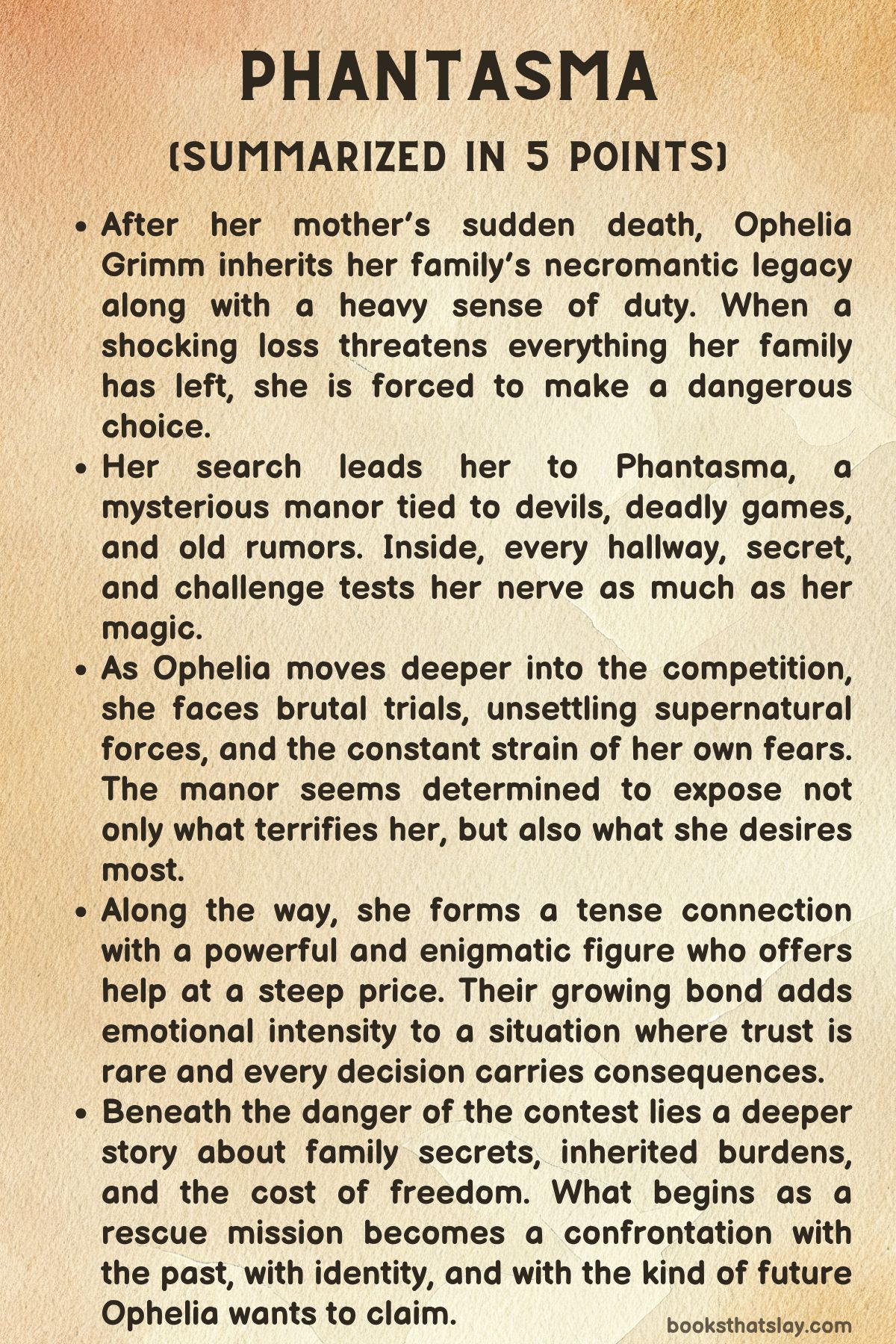
Summary
After her mother Tessie dies unexpectedly, Ophelia Grimm performs a painful necromantic rite to inherit the Grimm family magic. The ritual changes her, marking her with Grimm Blue eyes and opening her sight to ghosts.
Ophelia has spent her life under the weight of her family’s reputation and under the constant torment of the Shadow Voice, an intrusive presence in her mind that threatens disaster unless she obeys it. Her younger sister, Genevieve, has always seemed freer, lighter, and less burdened by the Grimm legacy, which creates a tension between them even in grief.
The sisters soon discover that Tessie left behind crushing debts, and Grimm Manor will be taken from them in thirty days. Ophelia is horrified, not only because the manor is their home, but because it represents generations of Grimm history.
Genevieve, by contrast, sees the possible loss of the house as a chance to start over. Their argument leaves both wounded.
Soon after, Genevieve vanishes, leaving a note that says she has gone to solve their financial disaster. When Ophelia searches her room, she finds clippings and notes about Phantasma, a deadly contest run by devils, and realizes Genevieve has entered it.
Ophelia goes to Phantasma to bring her sister back. At the gate, she must pay an entry price by surrendering her greatest fear.
Once inside the manor, she finds a strange, beautiful, dangerous place filled with contestants, apparitions, and supernatural rules. She quickly learns the competition is structured around the Nine Circles of Hell and that survival depends on wit, nerve, and an ability to bargain.
In her room, a hidden passage and a ghostly cat lead her toward secrets buried inside the manor. There she meets a mysterious man named Blackwell, a powerful being with white hair, green eyes, and missing memories.
He seems drawn to her immediately, and he suggests he has been waiting for her.
Ophelia refuses his first offer of a blood bargain, but she soon understands how brutal the contest truly is. The early trials test the contestants through fear, isolation, desire, greed, and violence.
In one challenge, she crosses a maze while losing her senses and escapes a Hellhound. In another, illusions and lust are used to confuse contestants and lead them into deadly choices.
During these trials, Ophelia proves resourceful and brave, but she also learns she has unusual abilities even beyond necromancy. When threatened, parts of her body can turn incorporeal, allowing attacks to pass through her.
Blackwell recognizes that she is not ordinary and continues pressing her to accept his help.
Eventually, Ophelia agrees to a blood bargain with him. He promises to appear when she calls, help her survive danger, and guide her through parts of the manor he can access.
In return, she must help him find the heart and key that bind him to Phantasma, or he will take a decade of her life. Their pact helps him heal her and deepens their connection.
As they search secret rooms and corridors between the official trials, Ophelia learns that Blackwell is trapped in the manor and that many contestants before her made deals with him but failed to free him.
Their partnership gradually becomes intimate. Blackwell trains her to use her powers and urges her to trust him.
He also sees the darkness she wrestles with inside her own mind, especially the Shadow Voice, and does not treat her like something broken. That acceptance matters to Ophelia more than she wants to admit.
At the same time, the competition keeps growing bloodier. Contestants die in traps, turn on one another, or fall apart under the psychological strain.
Cade, one of the cruelest competitors, becomes obsessed with targeting Ophelia, suspecting she is not fully human. Luci, another contestant, becomes one of Ophelia’s few allies, but Phantasma punishes emotional attachment, and affection itself becomes dangerous.
As Ophelia and Blackwell grow closer, she also uncovers threads connecting her family to the manor. She finds the names Gabriel White and Tessie Grimm in old contestant records.
Blackwell finally reveals that Gabriel, Ophelia’s father, was once one of his bargainers. Ophelia’s parents met in Phantasma years earlier and fell in love there.
That love brought a curse. Gabriel became unnaturally obsessed with Tessie, while Tessie grew emotionally distant.
Eventually she fled, tried to protect her daughters, and never fully told them the truth. Genevieve had discovered part of this history before entering the competition, which explains why she came looking for answers as well as a solution to the family’s debts.
Ophelia also learns that she and Genevieve are both Specters in addition to being part of a necromancer bloodline, though Genevieve has long known and secretly mastered her own abilities. This revelation hurts Ophelia, who feels once again that she carried the heavier burden while Genevieve lived with more freedom.
Still, when the sisters finally reunite inside the manor, they reconcile and begin working together. Genevieve explains that Tessie’s debt came from trying to buy another house as an escape route in case Gabriel returned.
Their mother’s secrecy, once seen as cruelty, begins to look more like fear.
The later rounds force Ophelia into harsher moral choices. She sees contestants exposed, crushed, manipulated, and cursed.
She watches Luci suffer because of forbidden love. She faces trials based on lies, selfishness, and violence.
When she is forced into a direct fight with Cade, the contest turns personal and savage. He tears away her protective locket, nearly stopping her heart, but she gets it back and kills him with her magic.
That act has a terrible cost. By taking his life directly, she seems to unleash the Shadow Voice into physical form, only to discover later that the manor used her deepest fear against her and pushed her into violently injuring herself.
Blackwell rescues her and heals her, proving again that she is not as alone as the voice insists.
Meanwhile, other devils, especially Sinclair, try to tempt and manipulate her. He offers pleasure, fantasy, and alternate bargains, often trying to turn her against Blackwell.
Through these encounters Ophelia realizes that desire alone is not love, and that what she feels for Blackwell is deeper, more frightening, and more real. Yet the history of her parents warns her that love formed inside Phantasma may be cursed.
This makes both of them hesitate even after admitting their feelings.
As the competition narrows, Genevieve eventually forfeits, leaving Ophelia to continue. In one of the final tests, Ophelia is confronted with two versions of Genevieve and told that choosing wrong will kill her sister outside the manor.
By thinking through the trick rather than surrendering to panic, Ophelia realizes neither one is real and passes the test. She reaches the threshold of the final confrontation ready to demand the reward that could save her home and free Blackwell.
Instead, she learns the truth. Blackwell is not merely a trapped phantom.
He is Salemaestrus Erasmus Blackwell, the Prince of Devils. Centuries earlier, he loved a mortal woman named Angel.
His father, the King of Devils, tortured Angel, ripped out her heart, trapped her soul in a locket, and bound Salemaestrus to Phantasma for five hundred years. The locket was given to the Grimm line to protect and carry that soul until it was reborn.
Ophelia is that reborn soul. This is why Blackwell was drawn to her, why she could summon hidden doors, and why the locket is vital.
Ophelia also learns that she arrived at the final chamber too early, before the contest formally ended, so she cannot claim the Devil’s Grant. Still, she understands what Blackwell has needed all along: the heart is her willing love, and the key is the locket.
She tells him she loves him and removes the locket, restoring his full power and breaking his tether to Phantasma. The act nearly kills her because of the curse tied to the locket and her own heart.
Blackwell saves her by giving her a functioning heart, but he cannot fully break the curse without another bargain. He offers her a choice: become his tether and live as long as he does, even if she does not stay at his side.
After Phantasma collapses, Ophelia returns home transformed. The Shadow Voice has lost much of its hold over her.
She decides to build her own legacy rather than simply inherit one, turning Grimm Manor into a refuge for supernatural beings who might otherwise make desperate deals. Blackwell uses his restored power to save the manor and solve the sisters’ financial problems.
By the end, Ophelia has not only survived Phantasma but stepped beyond fear, secrecy, and inherited pain to choose her own future, with Blackwell waiting for her at Grimm Manor.
Characters
Ophelia Grimm
Ophelia Grimm is the emotional and moral center of Phantasma. She begins the story as a young woman shaped by grief, duty, fear, and isolation.
After her mother’s death, she does not get the luxury of mourning in peace because she must immediately step into the role of heir to the Grimm necromancy line. That inheritance is not only magical but psychological.
She carries the pressure of family legacy, the expectation of perfection, and the burden of being the responsible sister. Her inner life is marked by the Shadow Voice, which constantly torments her with threats, compulsions, and violent suggestions.
This makes her one of the most internally conflicted figures in the novel, because much of her struggle comes not from external monsters alone but from the fear of what may be living inside her own mind.
One of the strongest aspects of Ophelia’s characterization is the contrast between how fragile she feels and how capable she actually is. She often sees herself as someone on the edge of losing control, yet again and again she proves resilient, intelligent, and brave.
Inside Phantasma, she adapts quickly to danger, reads patterns, survives lethal trials, and continues moving even when terrified. Her fear never disappears, but it does not stop her from acting.
That makes her courage convincing, because it is never the absence of fear; it is action taken despite fear. She also has an instinct to protect others, which remains intact even in a place designed to strip people down to selfish survival.
She helps fellow contestants, worries constantly about Genevieve, and resists the violence that Phantasma tries to normalize.
Her relationship with power is also important. Ophelia inherits necromancy, develops ghost-sight, and later discovers that she possesses Specter abilities as well.
Yet her growth is not presented as effortless empowerment. Her powers often emerge through stress, danger, or pain, which mirrors how unstable and difficult her emotional life is.
Even her body reflects her divided identity, since she can become incorporeal when threatened, as though she exists between worlds. That liminal quality defines her throughout the story.
She stands between life and death, duty and desire, inheritance and self-invention, terror and longing. The novel uses her magical development to mirror her psychological development.
Ophelia’s emotional arc is just as significant as her survival arc. At first, she is deeply guarded.
She believes she must carry everything alone, and she is suspicious of comfort, pleasure, and help. Her bond with Blackwell slowly changes that.
He sees the darkest parts of her without reducing her to them, and that matters because Ophelia has spent much of her life fearing she is too damaged, too strange, or too dangerous to be wanted fully. Her movement toward intimacy is therefore not only romantic but existential.
To be loved by someone who knows her fear, her compulsions, and her family history is to imagine a life beyond mere endurance. By the end, she does not simply survive the manor; she chooses her own legacy.
That choice marks the deepest shift in her character. She stops living only as the daughter of Tessie Grimm and becomes a woman willing to define what her life, her magic, and her future will mean.
Blackwell / Salemaestrus Erasmus Blackwell
Blackwell is introduced as mystery, temptation, and danger, but his character gains depth because he gradually becomes more than a seductive supernatural figure. At first he appears to be a trapped Phantom with fractured memories, hidden motives, and an unsettling familiarity with the manor’s secrets.
He is clever, watchful, and emotionally guarded, which allows him to occupy the role of both helper and possible threat. His bargain with Ophelia places him in a morally ambiguous position from the start.
He offers protection, healing, and knowledge, but always at a cost. That keeps him from feeling simple or purely romantic.
He is a character shaped by captivity, powerlessness, and long habit. He has survived in Phantasma by becoming strategic, emotionally controlled, and selectively honest.
What makes him compelling is the gap between what he seems to be and what he truly is. On the surface, he often acts like a dangerous, teasing, almost theatrical figure who understands desire and uses it skillfully.
Underneath that is someone worn down by centuries of confinement and repeated disappointment. The revelation that previous contestants made bargains with him and failed to free him adds sadness and hardness to his personality.
Hope has become dangerous for him. When Ophelia arrives, his attraction to her is immediate, but he does not fully understand why, which creates an emotional tension in his behavior.
He is drawn toward her tenderness and strength even as he tries to remain practical about what he needs from her.
His relationship with Ophelia reveals the most human parts of him. He trains her, protects her, notices her tells, helps her through panic, and offers her forms of care that are unexpectedly gentle.
He is not merely possessive or lust-driven, though he is intensely sensual. He pays attention.
He sees the Shadow Voice not as a reason to fear or diminish her but as part of her suffering that deserves patience. This gives his character a tenderness that offsets his more dangerous qualities.
He also becomes emotionally vulnerable in stages. His jealousy, protectiveness, and frustration are not just signs of attraction but evidence that he is losing the distance that once kept him safe.
The later revelation that he is Salemaestrus, the Prince of Devils, recontextualizes his entire role. Suddenly his beauty, power, and aura of command make fuller sense, but so does his tragedy.
He is not just trapped in a haunted competition; he is living inside a punishment created by his father after loving a mortal woman. His romance with Ophelia thus carries the weight of repetition, memory, and rebirth.
He becomes a character defined by both immense supernatural power and profound emotional helplessness. For centuries he could not free himself because the key required willing love, something that cannot be forced, bargained into existence, or stolen.
That is a strong irony for a devil prince. In the end, his character is shaped by the fact that for all his strength, his freedom depends on trust and reciprocal feeling.
That dependence makes him more than a fantasy figure. It makes him tragic, yearning, and deeply tied to the story’s larger idea that love can be both curse and release.
Genevieve Grimm
Genevieve initially seems like Ophelia’s opposite: more social, lighter in spirit, less tied to the heavy rituals and expectations of the Grimm legacy. Because the story begins through Ophelia’s perspective, Genevieve is first filtered through an older sister’s frustration and protectiveness.
She appears impulsive, less serious, and perhaps less aware of consequences. However, as the narrative progresses, Genevieve becomes one of the clearest examples of how incomplete first impressions can be.
Beneath her easier manner is a character with agency, secrecy, and her own private courage.
Her choice to enter Phantasma is central to understanding her. It would be easy to interpret the decision as reckless, but it comes from a mix of love, curiosity, and hidden knowledge.
She is not wandering blindly into danger. She has been investigating the family’s past, tracking clues about Gabriel, Tessie, and the manor, and trying to solve problems that Ophelia does not yet fully understand.
That makes her less childish than Ophelia assumes. Genevieve’s secrecy is not proof of selfishness but of a life lived partly in self-protection.
She hid parts of herself because she feared being controlled the way Ophelia had been controlled. That detail gives her emotional complexity and prevents the sisters’ conflict from becoming too simple.
The revelation that Genevieve is also a Specter is one of the most important turns in her characterization. It shows that she is not merely the unburdened younger sister living freely while Ophelia suffers.
She had her own knowledge, her own fear, and her own method of surviving within the Grimm household. Her control over her powers and her choice not to reveal them reflect both independence and guilt.
She does not want to deepen Ophelia’s pain by flaunting what seems easier for her, but her silence also contributes to the emotional distance between them. That tension feels believable.
She loves Ophelia, but she has also withheld truth from her.
Genevieve’s role in the story is not only to motivate Ophelia but to complicate her understanding of family. Through Genevieve, the novel shows that sisters can love each other deeply while still misunderstanding each other for years.
Once they reunite, Genevieve becomes a source of clarity and hope. She explains the truth behind Tessie’s debts, the family’s danger, and her own choices.
Their reconciliation matters because it allows Ophelia to move from possessive protection toward genuine partnership. Genevieve may not dominate the page in the same way Ophelia and Blackwell do, but she is essential to the story’s emotional structure.
She represents the life Ophelia could never quite reach, and then finally reconnects with.
Tessie Grimm
Tessie Grimm shapes the novel long after her death. She begins as a corpse, a loss, and a legacy, but she quickly becomes a much more complicated presence.
In life, she was a powerful necromancer, a guardian of family tradition, and a mother who raised her daughters under strict rules. Ophelia remembers her as demanding, knowledgeable, and often emotionally distant.
Much of Ophelia’s anxiety and sense of responsibility can be traced back to Tessie’s expectations. At first, Tessie seems like a stern matriarch whose obsession with legacy burdened her eldest daughter unfairly.
As the story reveals more of her past, Tessie becomes both more sympathetic and more morally ambiguous. Her secrets were not harmless omissions; they shaped the lives of both daughters.
She never told Ophelia the full truth about Phantasma, Gabriel, the family curse, or the reasons behind her decisions. She controlled information in the name of protection, but that protection came at a price.
It left Ophelia unprepared in some ways and emotionally wounded in others. Tessie’s silence reflects a pattern common to many parents in gothic fantasy: she withholds truth because she believes knowledge itself is dangerous, but secrecy creates the very confusion and pain she wants to avoid.
Yet Tessie is not reduced to a cold or cruel figure. The more the story uncovers, the more clear it becomes that she lived in fear of repeating or reviving an old catastrophe.
Gabriel’s obsession, the curse born from love in Phantasma, and the threat hanging over her daughters all forced her into survival mode. Her debt, which initially looks irresponsible, turns out to be linked to an attempt to secure an escape route for herself and her children.
That detail changes the moral shape of her choices. She was not simply preserving family pride; she was preparing for disaster.
Her later appearance as a spirit allows the novel to soften and deepen her role. In that encounter, Tessie apologizes for the weight she placed on Ophelia and urges her daughter to make her own legacy.
This moment is important because it reframes Tessie not as a final authority but as a flawed mother who recognizes too late how fear shaped her parenting. She remains a force of warning, especially in telling Ophelia to stay away from Blackwell, but she also finally offers release.
Her character functions as both inheritance and caution. She is the embodiment of what happens when love becomes entangled with secrecy, fear, and control.
Cade
Cade serves as one of the clearest human antagonists in the manor. Unlike the devils, whose danger is supernatural and often elegant, Cade represents cruelty in a more immediate and familiar form.
From early on, he is antagonistic, suspicious, and aggressive, especially toward Ophelia. He quickly identifies her as different and decides difference must mean guilt.
His hostility grows into obsession, and he becomes a constant threat during the trials. In a setting full of monsters, Cade stands out because he chooses brutality again and again without needing supernatural coercion.
His character reflects the uglier instincts that Phantasma rewards or exposes: selfishness, paranoia, misogyny, and opportunism. He believes survival belongs to those willing to crush weaker people and justify it afterward.
He wakes the Hellhound, attacks Ophelia, hoards gold in the Greed challenge, and repeatedly endangers others. Even when he may have a painful past, the story does not let that past erase his behavior.
The revelation involving his sister’s husband adds context but not redemption. He remains someone who directs pain outward and becomes more dangerous when threatened.
Cade is also important because he triggers key developments in Ophelia’s arc. Her incorporeal ability emerges when he attacks her.
His violence pushes her toward sharper self-knowledge. Most importantly, killing him marks a turning point in her psychological and moral journey.
He is not just an obstacle but the person through whom the story asks what happens when a heroine finally crosses a line she has resisted for so long. His death unleashes terror within her not because he did not deserve to be stopped, but because the act confirms how fragile her control feels.
In that sense, Cade functions as both antagonist and catalyst.
Luci
Luci provides one of the few pockets of warmth and companionship inside the competition. From the beginning, she seems friendlier and more approachable than most contestants, and that quality remains significant in a setting designed to isolate people.
She offers Ophelia a social connection that is not rooted in desire, manipulation, or family obligation. Because of that, Luci helps reveal the softer side of Ophelia’s personality.
Around her, Ophelia can be skeptical, but she can also be protective and sincere.
Luci’s storyline also shows one of the novel’s key themes: love inside the manor is dangerous. Her growing attachment to Leon becomes a warning sign long before its consequences are fully visible.
She is not portrayed as foolish for feeling deeply. Rather, her emotional openness makes her vulnerable in a system built to punish attachment.
The revelation that she is also a paranormal being adds another layer to her character and shows that, like many others in the story, she carries hidden dimensions beneath her outward role.
What makes Luci memorable is the sadness of her arc. She becomes one of the clearest examples of the manor’s cruelty because her suffering is not caused by ambition or malice but by hope and feeling.
Her experience foreshadows what may await Ophelia and Blackwell if they do not find another path. Luci therefore matters beyond her page time.
She gives emotional weight to the curse and makes the stakes of forbidden love feel immediate rather than abstract.
Leon
Leon is a more restrained character, but he plays an important role in exposing the emotional costs of survival. He becomes tied to Luci through mutual attraction, yet when the truth of their connection is tested, he is unable or unwilling to meet the depth of what she feels.
That makes him less villainous than disappointing. He reflects the kind of person who may care for someone, enjoy closeness, and even act as though a bond matters, but stop short when commitment has consequences.
His importance lies in contrast. Through him, the story shows the difference between desire, affection, and love that can withstand risk.
Luci’s suffering grows sharper because Leon cannot or will not stand with her fully. His eventual devastation suggests he is not heartless, but he is not brave enough emotionally.
In a novel filled with large supernatural forces, that small-scale emotional failure still matters. It helps define the danger around Ophelia and Blackwell by showing what happens when a connection remains partial.
Sinclair
Sinclair is one of the most intriguing devils because he does not function only as a tempter in a generic sense. He is theatrical, sensual, manipulative, and consistently interested in Ophelia, but beneath that surface there is a figure shaped by his own history of confinement and compromise.
He enjoys provocation and uses fantasy, flirtation, and jealousy as weapons. He understands emotional vulnerability and knows how to exploit it.
Whenever Ophelia is off-balance, hurt, or uncertain, Sinclair appears ready to offer an alternate path.
What makes him effective is that he is not purely lying when he speaks. He often mixes truth with temptation.
He reveals important information, warns Ophelia in his own way, and hints at larger structures of power within the manor. This makes him more dangerous, because he cannot be dismissed as a simple deceiver.
He wants something from Ophelia, but he is also responding to his own position within the political and emotional world of the devils. His past involvement in helping Salemaestrus hide a lover suggests that he, too, is marked by old loyalties and punishments.
Sinclair also serves as a foil to Blackwell. Where Blackwell’s desire is increasingly bound to care, Sinclair’s desire remains performative and destabilizing.
He offers pleasure without grounding, fantasy without trust, and intimacy without emotional safety. Ophelia’s interactions with him help clarify her own heart.
When she turns to him in hurt and confusion, she feels the absence of what she shares with Blackwell. That contrast gives Sinclair an important place in the romantic and thematic structure of the novel.
Jasper
Jasper often appears as a sharp-tongued, mocking devil who enjoys provoking both Ophelia and Blackwell. He can seem like comic relief in a dark setting because of his intrusive timing and irreverent remarks, but reducing him to that would miss his function.
Jasper acts as a reminder that the devils are always watching, always amused, and always involved in games larger than the contestants understand. He enjoys exposing tension, especially romantic tension, and he treats emotional seriousness with casual irreverence.
At the same time, Jasper is useful as an information-bearing figure. He reveals pieces of the past, comments on patterns in Blackwell’s behavior, and helps move hidden truths toward the surface.
His personality suggests the strange social world of the devils, where cruelty, gossip, desire, and power mix freely. He is not presented as deeply sympathetic, but he is more than decorative.
He contributes to the atmosphere of instability and reminds the reader that even moments of tenderness are taking place under supernatural scrutiny.
Salemaestrus’s Father, the King of Devils
The King of Devils appears late, but his presence defines much of the story’s history. He is the architect of the central punishment that shapes Blackwell’s existence and, indirectly, Ophelia’s life.
His cruelty is absolute, intimate, and political. He does not merely kill Angel; he stages suffering as punishment and uses knowledge of Blackwell’s true name to dominate him completely.
This makes him a figure of tyrannical control, someone who turns love itself into a vulnerability that can be weaponized.
He matters because he embodies the most authoritarian version of power in the book. If Blackwell represents desire mixed with care and risk, the King represents power stripped of tenderness, interested only in possession, obedience, and punishment.
His decision to trap Angel’s soul in the locket and manipulate its rebirth across generations extends his violence beyond a single act into a system. He creates the conditions for inherited suffering.
Even with limited page time, he casts a long shadow over the entire narrative.
Gabriel White
Gabriel is important less as a fully present character and more as a haunting legacy. He was one of Blackwell’s earlier bargainers, a Specter, and the man who loved Tessie in Phantasma.
His story acts as a dark precursor to Ophelia’s. Through him, the novel shows what can happen when love in the manor becomes cursed rather than liberating.
Gabriel’s obsession with Tessie after the competition is especially important, because it turns romance into fixation and transforms what might once have been sincere feeling into something frightening and destructive.
This history gives Gabriel a tragic and unsettling role. He is both victim and threat.
He was caught in the same system of bargains, curses, and manipulation that now surrounds Ophelia, but the effect of that system on him was deeply damaging. Tessie’s need to flee from him and erase him from their lives shows how badly things went wrong.
Gabriel’s second journey into Phantasma to recover his family suggests longing and desperation, but it also confirms how impossible it was for him to let go. His story exists as warning, inheritance, and painful mirror.
Charlotte
Charlotte is one of the quieter surviving contestants, but she serves an important structural role in the later stages of the competition. She is not as vividly individualized as Ophelia, Luci, or Cade, yet her continued presence adds pressure because she represents the narrowing field and the reality that survival is partly arbitrary.
Her uncertainty during the Deceit level, especially around her own identity as a possible twin, contributes to the atmosphere of instability that defines the later trials. She is someone whose life can turn on uncertainty she herself cannot resolve.
In the later game dynamics, Charlotte also helps underline the loneliness of the endgame. By the time only a few contestants remain, every surviving person feels more exposed.
Charlotte’s presence reminds the reader that not everyone in the manor is driven by flamboyant cruelty or deep romance. Some are simply trying to endure.
That makes the competition feel broader and more human.
Angel
Angel appears only in the backstory, yet she is foundational to the emotional design of the novel. She is the mortal woman Salemaestrus loved before Ophelia, the one whose death and trapped soul set the entire long tragedy in motion.
As a character, Angel is less defined through personal speech or action than through the force of what was done to her and what she meant to Salemaestrus. She represents innocence subjected to extreme cruelty, but she also symbolizes enduring love that survives beyond death, punishment, and rebirth.
Her most important function is in the way the story links her to Ophelia. Ophelia is not simply repeating Angel’s role; she is both continuation and new possibility.
That distinction matters. Angel’s fate is one of helpless suffering under tyranny, while Ophelia’s story becomes one of choice, resistance, and transformation.
Even so, Angel remains the emotional origin point for Blackwell’s centuries of grief. Without her, his longing, his captivity, and his desperate hope for release would not have the same depth.
Raeya
Raeya has a smaller but useful role as a devil connected to Blackwell’s romantic past. She introduces tension not because she dominates the plot but because her existence reminds Ophelia that Blackwell has a life, history, and body of experience beyond what Ophelia knows.
In romantic fantasy, this kind of character often exists merely to provoke jealousy, but Raeya also helps reinforce the larger supernatural social world. She belongs to the manor’s hierarchy and carries herself with ease in a space where mortals are constantly destabilized.
Her interactions with Ophelia sharpen the heroine’s insecurity and force more honest confrontations between Ophelia and Blackwell. Through Raeya, the story makes clear that jealousy is not only about possession; it is about fear of not being singular or enough.
That emotional pressure contributes to Ophelia’s growth by forcing her to confront what Blackwell means to her.
Zel, Drima, Devon, Phoebe, and the Other Devils
The devils who oversee different levels may not each receive extended personal arcs, but together they create the ruling atmosphere of the manor. They are not interchangeable monsters.
Each presents a different tone of authority, amusement, and menace, and each frames a challenge in language that sounds ceremonial, playful, and cruel all at once. Their function is to make the trials feel designed rather than random.
They are hosts, judges, and manipulators presiding over a system that treats human desperation as entertainment and contract.
As a collective, they also broaden the cosmology of the novel. They show that hellish power is not singular but social, layered, and political.
Some devils are mocking, some seductive, some almost bureaucratic, but all of them help maintain a world where bargains shape destiny. Their presence keeps the story from narrowing too much around only one supernatural relationship.
They remind the reader that Blackwell is unusual among them, not because he is harmless, but because his emotional depth sets him apart from a culture built on transaction and spectacle.
The Shadow Voice
Although not human in a conventional sense, the Shadow Voice is one of the most important presences in the novel and deserves to be read as a character-like force. It operates as tormentor, accuser, manipulator, and embodiment of Ophelia’s deepest fears.
Its power lies in repetition, threat, and intimate knowledge of Ophelia’s vulnerabilities. It is the voice that tells her disaster is always one failed ritual away, that she is dangerous, and that she must remain trapped in cycles of fear and compulsion.
Because it speaks from within, it is harder for her to resist than any visible monster.
What makes the Shadow Voice so effective in the story is its ambiguity. It feels both psychological and supernatural, both symptom and haunting.
The manor later weaponizes Ophelia’s fear of it, which shows that whether it is “real” in a literal sense matters less than the damage it can do. The Shadow Voice represents the story’s most intimate horror: the fear that the worst danger comes from oneself.
Ophelia’s growth is measured partly by the fact that, in the end, its taunts no longer control her in the same way. She does not erase it entirely, but she changes her relationship to it, and that shift is one of the novel’s clearest signs of healing.
Grimm Manor / Phantasma as a Living Presence
The manor itself functions almost like a character because it has intention, memory, appetite, and mood. It changes spaces, creates haunts, withholds truth, and responds to the fears and desires of the people inside it.
Contestants do not merely move through it; they are studied, shaped, and tested by it. Secret passages, shifting rooms, hidden gates, and tailored nightmares give it a will of its own.
It behaves less like architecture and more like a living instrument of punishment and revelation.
Its role is central because it externalizes everything the story cares about most: inheritance, captivity, temptation, and performance. The manor is a stage, prison, maze, and judge.
It is where love becomes dangerous, where identity is exposed, and where buried family history returns in monstrous form. Reading it as a character helps make sense of why the atmosphere feels so personal.
The place does not simply contain the plot. It acts on the people within it.
Themes
Inheritance, Legacy, and the Burden of the Past
Inheritance in Phantasma is not limited to property, family reputation, or magical skill. It arrives as grief, debt, fear, secrecy, and emotional damage passed from one generation to the next.
Ophelia does not simply lose her mother and step into a role; she is pushed into a structure that was already waiting to define her. The Grimm legacy gives her necromantic power and status, but it also traps her inside expectations that were built long before she was born.
She has been raised to believe that being the eldest daughter means carrying the family line correctly, preserving the manor, and absorbing the full pressure of responsibility. This makes legacy feel less like honor and more like confinement.
Her sense of self is shaped by duties she did not choose, which is why her struggle throughout the novel is not only about survival but about separating who she truly is from what her bloodline demands of her.
The novel strengthens this theme by showing that the past does not stay buried, even in a world where death itself can be spoken to. Tessie’s hidden history, Gabriel’s obsession, the curse tied to love, and the strange significance of the locket all show how unfinished choices continue working through later generations.
Ophelia and Genevieve are living inside consequences created by their parents, and those parents were themselves caught inside forces older than them. That gives the story a strong sense that inheritance can be both visible and invisible.
It can live in a family home threatened by foreclosure, in magical rituals handed down through blood, and in emotional patterns that children receive before they have language for them. Tessie thought she was protecting her daughters by withholding the truth, but secrecy becomes its own inheritance, shaping the sisters’ confusion, distance, and pain.
What makes this theme especially effective is that the story does not stop at exposing inherited burdens; it asks whether legacy can be remade. Ophelia begins in fear of failing the Grimm name, but by the end she starts imagining legacy as something she can shape rather than simply receive.
That shift matters because it changes inheritance from a sentence into a choice. Grimm Manor no longer has to stand only for pressure, tradition, and hidden suffering.
It can become a refuge built according to Ophelia’s values instead of her mother’s fears. The novel therefore presents legacy as unstable rather than fixed.
Family history matters deeply, but it does not have to dictate the future without resistance. That idea gives emotional force to the ending, because Ophelia’s growth is measured not by rejecting her family outright, but by deciding which parts of the inheritance she will carry forward and which parts she will refuse.
Love as Risk, Power, and Possible Ruin
Love in this novel is never presented as simple comfort. It appears as longing, temptation, recognition, memory, and danger all at once.
The story repeatedly asks whether love saves people or destroys them, and it refuses easy answers. Ophelia and Blackwell’s bond develops in a setting where emotional attachment is actively dangerous, which means that every moment of tenderness carries a shadow of threat.
Their connection grows through trust, care, rescue, desire, and confession, but all of it takes place under the knowledge that love inside Phantasma has already led to catastrophe before. That history matters.
The romance is not framed as a break from the novel’s darkness; it is part of the darkness, because it raises the stakes of every decision and makes vulnerability unavoidable.
The story also contrasts different kinds of attachment. Gabriel’s cursed fixation on Tessie shows love turned into obsession, something invasive and corrosive rather than mutual.
Luci’s feelings for Leon reveal how painful it is when emotional devotion is not matched with equal courage. Sinclair offers pleasure and fantasy, but without trust or grounding.
Against these examples, Ophelia and Blackwell’s relationship is tested not only by attraction but by whether they can remain honest and willing in the face of fear. This is important because the novel separates desire from love without pretending the two are unrelated.
Physical intimacy between them matters, but it matters most when it reflects a growing emotional recognition. Blackwell sees Ophelia’s panic, shame, and inner torment.
Ophelia sees his loneliness, fractured hope, and buried grief. Their love becomes meaningful because it is connected to knowledge, not only appetite.
At the same time, the novel never lets love become purely idealized. It is shown as destabilizing, irrational, and frightening because it makes each person newly vulnerable to loss.
Blackwell, who has survived through distance and strategy, becomes exposed through hope. Ophelia, who has lived through control and fear, becomes exposed through trust.
Their feelings are powerful precisely because they threaten the defenses that once kept them alive. The final revelation, that Blackwell’s freedom depends not on force or cunning but on Ophelia’s willing love, gives the theme a larger significance.
Love becomes a source of release that cannot be manufactured through manipulation. Yet even this release comes at a cost.
The act of loving is tied to curse, sacrifice, and bodily risk. The novel therefore treats love as something transformative but not safe.
It can liberate, but only by demanding honesty, surrender, and pain. That gives the romance much of its intensity and keeps it closely connected to the story’s central emotional questions.
Fear, Control, and the Struggle for Inner Stability
Fear operates in the novel as both atmosphere and private torment. The haunted manor, the deadly trials, the devils, and the shifting rules all create an external environment of danger, but the most persistent fear comes from Ophelia’s own mind.
The Shadow Voice makes this theme especially powerful because it turns fear into something intimate, repetitive, and humiliating. Ophelia is not merely afraid of monsters or death.
She is afraid of losing control, of harming others, of failing the people she loves, and of becoming the kind of person the voice insists she is. That gives the story a psychological intensity that extends beyond gothic spectacle.
Fear is not just what surrounds her; it is what speaks to her from within and tries to define her.
Control becomes the natural counterpart to this fear. Ophelia relies on rituals, repetition, rules, and restraint because they give her some sense of order against inner chaos.
The recurring pattern of tapping, knocking, or performing actions in threes is not incidental. It shows how strongly she clings to structure when the world feels unstable.
Yet the novel is careful in how it handles this need for control. It does not mock it, and it does not magically cure it.
Instead, it shows both the comfort and the limits of control. Ophelia’s rituals can steady her, but they cannot prevent grief, stop the competition, or erase the voice.
In many of the trials, survival depends on adapting to uncertainty rather than mastering it. She has to keep moving without guarantees, which is especially difficult for someone whose mind is always demanding certainty.
The manor itself intensifies this theme by weaponizing fear. It stages illusions, manipulates perception, and pushes contestants toward breakdown.
In Ophelia’s case, it uses her deepest internal terror against her, creating the horrifying experience of self-directed violence. That moment is crucial because it reveals the full cruelty of the world she is trapped in.
The greatest danger is not always physical death but the collapse of trust in one’s own mind and body. This is why Blackwell’s role matters so much here.
He does not remove fear from Ophelia’s life, but he helps interrupt her isolation within it. He tells her that she can call for help when the voice grows too loud, and that idea becomes emotionally important because it directly challenges fear’s favorite lie: that she is alone and must contain everything by herself.
By the end, the story offers not the disappearance of fear but a changed relationship to it. The Shadow Voice still exists, but it no longer governs Ophelia with the same force.
That is a meaningful distinction. Stability is not presented as purity, total calm, or perfect mastery over the self.
It is shown as the ability to continue living without surrendering full authority to fear. The theme becomes especially strong here because the novel understands that inner peace is rarely absolute.
What matters is whether fear remains the organizing principle of a life. Ophelia’s development suggests that healing begins when fear stops being the only voice that matters.
Choice, Bargain, and the Cost of Survival
The world of the novel is built on bargains, and that makes choice one of its deepest concerns. Almost every major turning point involves an offer, a condition, or a cost.
Entry into the manor requires surrendering fear. Advancement through the trials demands sacrifice, calculation, or risk.
Deals with devils promise power, escape, healing, or pleasure, but always require something in return. This structure gives the novel a strong moral texture because survival is never free.
Characters are constantly deciding what they are willing to trade away, and those decisions reveal who they are more clearly than any speech could. The question is not simply whether someone can endure danger, but what they will become while enduring it.
Ophelia’s arc is shaped by the tension between desperation and principle. She enters the competition to save Genevieve and protect Grimm Manor, but once inside, she repeatedly refuses easy surrender to the logic of pure self-interest.
She makes a bargain with Blackwell, yet even then she tries to set moral terms, insisting she will not kill another contestant if she can avoid it. That insistence matters because it shows her refusal to let survival erase her ethics completely.
The novel places this against a broader environment where many others accept that brutality is simply practical. Cade, in particular, embodies the idea that survival belongs to those willing to discard conscience first.
By contrast, Ophelia’s choices suggest that what one preserves inwardly matters as much as whether one physically survives.
The theme becomes richer because bargains in the novel are not always framed as evil in a simple way. Some are exploitative, some seductive, some necessary, and some intimate.
A bargain can be coercive, but it can also become a form of trust. Blackwell’s bond with Ophelia begins as a contract and gradually deepens into emotional commitment, which complicates the meaning of exchange.
The novel repeatedly asks whether there can be any such thing as a fair bargain when power is uneven or desire is involved. This is especially important in a story where devils rule by transaction.
Their world assumes everything has a price. What resists that logic is willing love, freely offered rather than extracted.
That idea culminates in the final revelation that Blackwell cannot truly be freed through manipulation, force, or technical victory alone.
Survival, then, is not only physical continuation. It is tied to what remains of a person after every deal, compromise, and test.
Ophelia survives because she learns when to refuse, when to accept help, and when to choose from conviction rather than panic. The novel suggests that cost cannot be avoided; every path asks for something.
What matters is whether the choice is made consciously, and whether the person making it still recognizes herself afterward. That gives the bargain motif unusual emotional weight.
It is not just a supernatural device. It is the story’s way of examining agency under pressure, and of asking how much of the self can be traded away before survival stops meaning anything at all.