Phobia by Keri Lake Summary, Characters and Themes
Phobia (Nocticadia #1.5) by Keri Lake is a dark and intense psychological thriller that explores the complex layers of trauma, obsession, and manipulation. It is set after the events of Nocticadia.
The story follows Bee, a young woman who is haunted by a traumatic past, including memories of her mother’s attempt to drown her. As she navigates life in a school designed to help students like her, Bee’s trauma resurfaces, manifesting through vivid hallucinations. The novella combines elements of horror, mystery, and twisted psychological dynamics as Bee is drawn into a dangerous web of fear, attraction, and danger, where her emotional journey is as dark as the forces stalking her.
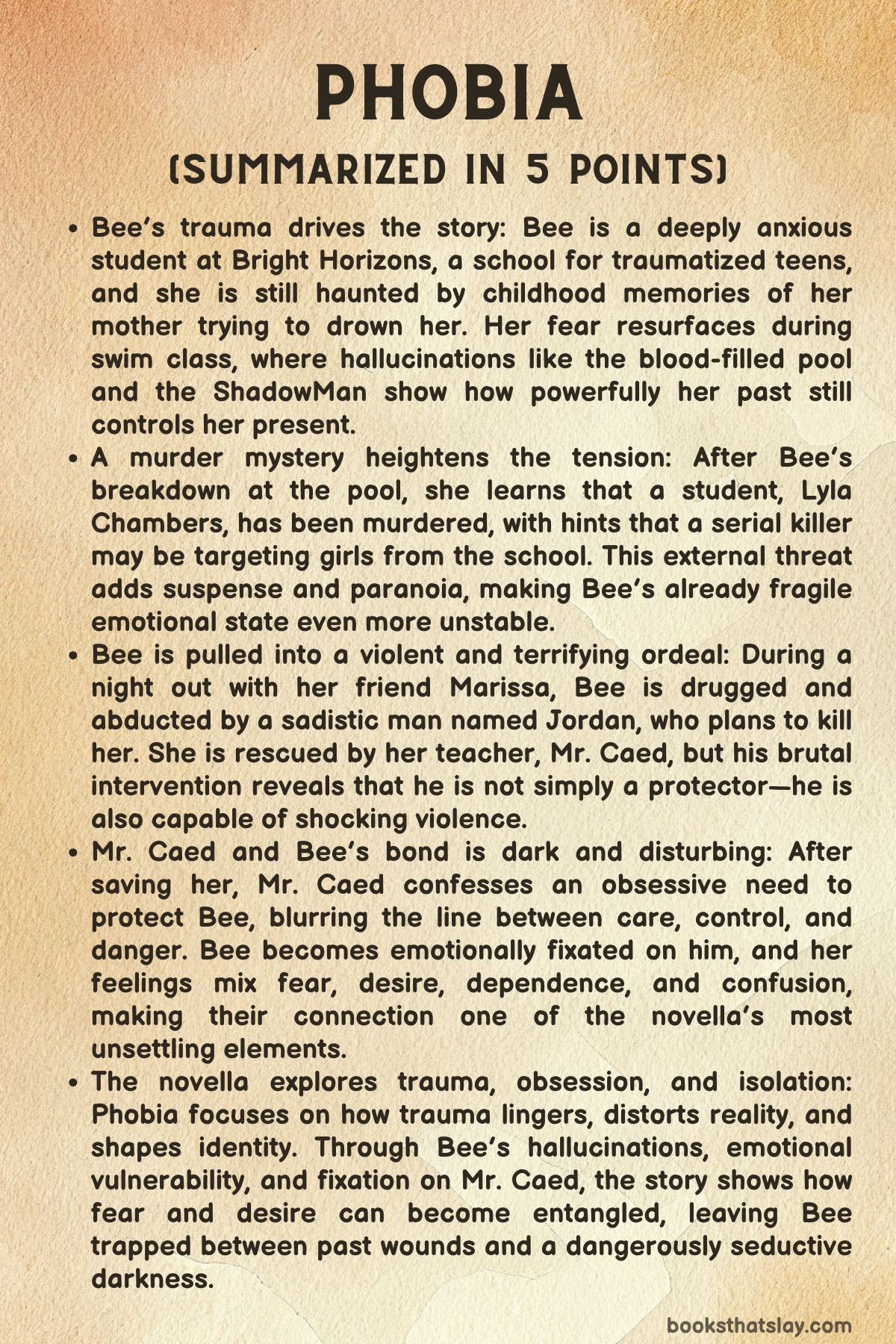
Summary
Bee, a troubled and anxious young woman, finds herself standing on the edge of an indoor pool, dreading her swim class at Bright Horizons, a school meant to help students deal with trauma. Her instructor, Ms. Balleo, is distant and unsympathetic to Bee’s past.
As she watches the water ripple, Bee is overwhelmed by memories of her mother, who tried to drown her when she was a child. These memories blur into a terrifying hallucination where the pool turns to blood, and a dark figure known as ShadowMan emerges from the depths, gripping her wrist.
In a panic, Bee manages to escape, injuring her arm in the process.
After the incident, Bee visits the school nurse, Nurse Darla, who is concerned about the injury. While at the nurse’s office, Bee overhears the mention of a police presence at the school, investigating a recent murder.
Her classmate, Eunice, informs her that a student named Lyla Chambers has been found dead under circumstances eerily similar to a previous murder. Eunice hints that a serial killer may be targeting girls at Bright Horizons, which only adds to Bee’s unease.
However, her attention is drawn away from this chilling news when she spots her English teacher, Mr. Caed, nearby. There is something unsettling about his presence that causes Bee to feel uneasy.
When Bee’s friend Marissa visits for the weekend, Bee’s anxiety is compounded by tension at home, particularly regarding her father’s new child. Despite her inner turmoil, Bee agrees to join Marissa for a night out, where they use a fake ID to get into a bar.
The night takes a dark turn when Bee spots a man at the bar who matches the description of the killer in the news. As the night progresses, things spiral out of control.
Bee soon realizes she has been drugged and taken to a remote, abandoned basement by a man named Jordan. He is the same man she had seen at the bar earlier.
Jordan reveals his sadistic nature, taunting her and making it clear he plans to kill her.
Just as the situation becomes even more terrifying, Mr. Caed appears, intervening with brutal force. His demeanor is cold and calculating as he kills Jordan in a shocking and violent confrontation.
Afterward, he reveals his dark side, confessing his deep obsession with protecting Bee at any cost. In a moment that blends fear with an unexpected intimacy, Mr. Caed and Bee share a complicated and tense connection.
Mr. Caed’s true identity as both a protector and a killer is revealed, leaving Bee in a state of confusion and fear.
The next day, Bee struggles with the aftermath of the violent events. Her mind is clouded with the trauma she has endured, and she finds herself obsessively drawing Mr. Caed.
She becomes increasingly aware of how her emotions are being manipulated, as her feelings for him blur the lines between fear, desire, and dependence. Despite her internal turmoil, Bee prepares to visit her sister, Lilia, in Dracadia, hoping for a brief escape from the chaos in her life.
Yet, even as she attempts to distance herself, Bee can’t shake the feeling that Mr. Caed is watching her, his presence lingering in her thoughts.
Bee’s art teacher notices her dark fixation and suggests she exhibit her work in a gallery, but Bee’s unease only grows as she feels an unsettling presence around her. Her obsession with Mr. Caed continues to deepen, even as she tries to move on from the horrors of the past.
The novella’s closing scenes depict Bee caught between her past trauma and the overwhelming pull of her attraction to Mr. Caed, who remains a constant, shadowy figure in her life. She adds the word “PHILIA” to a sketch of him, symbolizing the twisted connection that binds them together.
This unsettling final note leaves readers with a sense of lingering dread, as Bee’s emotional turmoil continues to control her fate.
Characters
Bee
Bee is the protagonist of Phobia and is at the heart of the story’s emotional and psychological turmoil. A deeply traumatized young woman, Bee is haunted by memories of her mother’s attempt to drown her, which shapes much of her interactions and behavior.
Her anxiety is palpable, especially during moments like the dreaded swim class at Bright Horizons, where she is placed under the care of Ms. Balleo, a teacher who dismisses Bee’s emotional and psychological needs. The pool, which symbolizes both a place of healing and terror, becomes a recurring nightmare where her trauma is physically manifested through the appearance of the ShadowMan.
Her emotional journey is marked by a series of conflicting emotions, from fear to attraction, particularly toward Mr. Caed, a teacher who shifts from a figure of authority to one with a disturbing dark side. Bee is a character caught between the forces of fear and desire, trying to make sense of her past while grappling with the present’s disturbing realities.
Despite the chaotic events around her, Bee’s inner conflict is most evident in her artwork, which becomes a medium through which she processes her complex emotions, including her fixation on Mr. Caed. Her struggle is not just against the external threats she faces but also against her internal, unresolved trauma.
Mr. Caed
Mr. Caed initially appears to be a standard English teacher at Bright Horizons, but as the story unfolds, his true, darker nature is revealed. He is more than just a protector for Bee; he is a deeply troubled man with a sinister past, driven by an obsessive desire to protect her at any cost.
When Bee is drugged and abducted by Jordan, Mr. Caed emerges as her savior, revealing his brutal side as he kills the sadistic man. This moment marks a pivotal shift in his character, as it becomes clear that he is not just a teacher but also a killer with a hidden agenda.
His dark past and his deep connection with Bee blur the lines between safety and danger, creating a relationship that is both protective and possessive. Mr. Caed’s obsession with Bee goes beyond mere guardianship, delving into a more unsettling territory where his desire to protect her becomes intertwined with his need to control and dominate.
The intimacy shared between them is laced with an eerie tension, and it is in these moments that his duality as a protector and killer becomes most evident. Mr. Caed is a complex character, one who hides his true self behind the facade of a teacher but reveals his darker instincts when necessary.
His relationship with Bee is toxic yet magnetic, leaving her both terrified and fascinated by him.
Marissa
Marissa plays a crucial role as Bee’s friend, offering both support and a sense of normalcy in her life. While Bee is dealing with the weight of her past and the unfolding danger around her, Marissa serves as a contrast, urging Bee to let loose and enjoy life, even if it means using a fake ID to get into a bar.
She encourages Bee to engage in reckless behavior, which pushes Bee into a situation that spirals into danger. Marissa’s role is that of a friend who, despite her good intentions, leads Bee down a path that ultimately contributes to her traumatic experience with the man who resembles the killer.
Marissa’s presence is a reminder of the external world that exists outside of Bee’s trauma, yet her inability to fully understand Bee’s inner turmoil limits her effectiveness as a source of support. Marissa’s character serves as a catalyst for some of the story’s darker moments, though she is not a malevolent force.
Rather, she represents the contrast between normal teenage experiences and the intense emotional and psychological challenges Bee faces.
Eunice
Eunice is a minor but significant character who introduces Bee to the unsettling news about Lyla Chambers’ murder. Her conversation with Bee reveals the existence of a serial killer targeting girls from Bright Horizons, and though her role is small, Eunice helps set the tone for the chilling atmosphere of the story.
Eunice’s revelation about the murder and the killer serves as a key moment of tension, marking the beginning of a larger mystery that Bee will have to confront. She serves as an informative figure, alerting Bee to the danger around her, but does not have a strong presence beyond this.
Eunice’s role is to heighten the feeling of danger and contribute to the sense of paranoia that permeates the narrative.
Nurse Darla
Nurse Darla’s brief yet notable appearance highlights the indifference and detachment that Bee experiences from authority figures, like Ms. Balleo. Although Nurse Darla expresses concern over Bee’s injuries, her role remains passive, reflecting the lack of genuine support that Bee finds from the adults around her.
While Nurse Darla is more sympathetic than other figures, her limited involvement underscores the isolation Bee feels in her struggle to confront her trauma. The nurse serves as a subtle reminder of Bee’s disconnection from the world around her, as those who are supposed to offer comfort or protection fail to meet her emotional needs.
ShadowMan
The ShadowMan is not a physical character in the traditional sense but rather a manifestation of Bee’s trauma. He represents the deep-rooted fear and emotional scars from her past, particularly the terrifying memory of her mother’s attempted drowning.
As a psychological figure, the ShadowMan embodies the overwhelming sense of dread that Bee cannot escape. His appearances, especially in the water, are a haunting reminder of the violence she endured.
The ShadowMan is a personification of the psychological horror that dominates Bee’s life, continuously stalking her and embodying the constant tension between fear and memory. His presence serves as a constant threat to Bee’s emotional stability, and his role is integral to understanding Bee’s psychological state as she attempts to navigate both her past and the present dangers she faces.
Themes
Trauma and its Long-lasting Effects
In Phobia, trauma is not a fleeting moment but a lingering, omnipresent force that affects every aspect of Bee’s life. The narrative doesn’t just present trauma as something that happened in the past; it reveals how trauma manifests in present-day reality, influencing decisions, behaviors, and perceptions.
For Bee, trauma isn’t just something confined to memories; it’s something that shapes how she interacts with the world, from the way she views people to her physical responses, like the anxiety she experiences during the swim class. Her mother’s attempted drowning of her is not merely an event she can recount—it’s something that actively haunts her, even distorting her sense of safety in the present.
The transformation of the pool into blood, the haunting appearance of ShadowMan, and the involuntary physical reactions she experiences all illustrate the overwhelming nature of trauma. Despite being in an environment that is meant to help students like Bee overcome their pasts, the indifference of Ms. Balleo and the school’s inability to understand her unique struggles only serve to compound her feelings of isolation.
Trauma, in Bee’s life, is not a single experience—it is an ongoing battle that affects everything from her perception of others, like her teacher Mr. Caed, to her own sense of self-worth and agency. Her frequent drawings, especially the ones that start to focus on Mr. Caed, reflect the ongoing processing of her trauma.
This continuous processing leads to her confusing her feelings of fear and desire, blurring lines between the need for protection and the emotional scars left by past pain. Trauma, therefore, doesn’t just reside in the past; it shapes the future in ways that are complex, often difficult to understand, and impossible to fully escape from.
The Search for Identity and Control
Bee’s journey throughout the story reflects a deep struggle for self-definition, something that becomes particularly complicated in the face of overwhelming trauma and the sinister forces surrounding her. At school, Bee’s sense of self is constantly undermined, both by the traumatic memories of her past and by the circumstances that unfold around her.
The strictness of her swim teacher, Ms. Balleo, serves as a metaphor for how society often fails to understand or accommodate the complexities of trauma. As Bee experiences various events, from her troubling night at the bar with Marissa to the terrifying encounter with Jordan, it becomes clear that Bee is searching for control over her life—control that seems continually out of reach.
Even in moments when she does assert herself, like when she manages to escape the pool, her body betrays her through injury, making her feel as though she is always one step behind her own desires. The moment she is abducted and taken to the basement, where Jordan reveals his sadistic nature, marks a pivotal point in this struggle for control.
Yet, in the most unexpected twist, Mr. Caed, someone Bee once considered a teacher and mentor, emerges as a protector. This shift in power dynamics, however, leaves Bee in an even more complicated emotional space, as her desire for safety becomes entangled with the realization that she is under the protection of someone who embodies both violence and care.
Bee’s fixation on Mr. Caed reflects her internal conflict—her need for control and safety juxtaposed against the reality of being emotionally and physically drawn to a figure who represents both protection and danger.
Fear and Desire
One of the most complex and unsettling themes in Phobia is the intertwining of fear and desire, particularly through Bee’s evolving relationship with Mr. Caed. Throughout the story, Bee struggles to differentiate between these two intense emotions, especially when they come from the same source.
Mr. Caed, initially a figure of authority in Bee’s life, is revealed to be much more than a mere teacher. His intervention in saving Bee from Jordan’s sadistic clutches is both an act of protection and violence, and it leaves Bee emotionally confused.
She is simultaneously grateful and terrified of him, as she becomes aware of the depths of his dark past. The way Bee expresses her feelings through her artwork further illustrates this internal conflict.
Her drawings, particularly those that fixate on Mr. Caed, reflect an obsession that blurs the lines between admiration and fear. As Bee navigates her trauma, she also grapples with her feelings for Mr. Caed, which are now inseparable from her experiences of survival and danger.
This complex relationship highlights how, in the aftermath of trauma, fear and desire can become intertwined in ways that are both liberating and suffocating. The desire for protection, rooted in vulnerability, can sometimes create emotional attachments to those who embody both the capacity for care and harm.
Bee’s inability to separate the two, as she continues to be haunted by her thoughts of Mr. Caed, underscores the deep psychological impact of her trauma. Ultimately, this theme questions the nature of safety and whether it can ever truly exist when emotional vulnerability is so intricately tied to fear.
Isolation and Alienation
From the beginning of the story, Bee is depicted as someone who is isolated both physically and emotionally. This sense of alienation is heightened by the trauma she carries and the school environment that is meant to offer support but instead seems to exacerbate her feelings of being misunderstood.
The strict and unempathetic attitude of Ms. Balleo reflects the larger societal tendency to dismiss or overlook the needs of those suffering from trauma. Bee is placed in a position where she is forced to confront her fears, but without the proper understanding or support, her emotional wounds remain raw and open.
The revelation of the murder at her school further compounds this sense of alienation, as it creates a chilling atmosphere of danger and suspicion, particularly when Eunice hints at a serial killer targeting girls from the school. The presence of this external threat only magnifies Bee’s internal sense of isolation, as she feels increasingly disconnected from the people around her.
Even when Bee seeks solace with her friend Marissa, her family issues, such as the arrival of her father’s new child, alienate her further. The wild night out that Marissa persuades Bee to join turns into another moment of danger and alienation when Bee realizes that she is once again powerless, drugged, and at the mercy of a stranger.
Her sense of alienation is compounded by the fact that even when someone tries to save her, like Mr. Caed, the complex nature of their relationship forces Bee to confront a new form of isolation—one where the person who saves her is also someone she cannot fully trust or understand. The final moments of the book, with Bee grappling with her feelings of obsession and trauma, leave her in a state of emotional isolation, trapped between her past experiences and her present reality, unable to escape the haunting presence of her own emotions.