Play Nice Summary, Characters and Themes
Play Nice by Rachel Harrison is a supernatural horror novel that examines family trauma, unreliable memories, and the dangerous attraction of things that promise attention while causing harm.
The story follows Clio Barnes, a fashionable New Yorker who inherits a house associated with her mother’s disturbing claims of demonic activity. Determined to renovate the property and establish her independence, Clio begins investigating the childhood experiences her family has spent years trying to forget. As unsettling incidents multiply, she discovers that the truth about her mother, her sisters, and the house is considerably more complicated than she imagined. The novel combines psychological suspense, dark humor, and supernatural horror to explore the consequences of confronting a painful past.
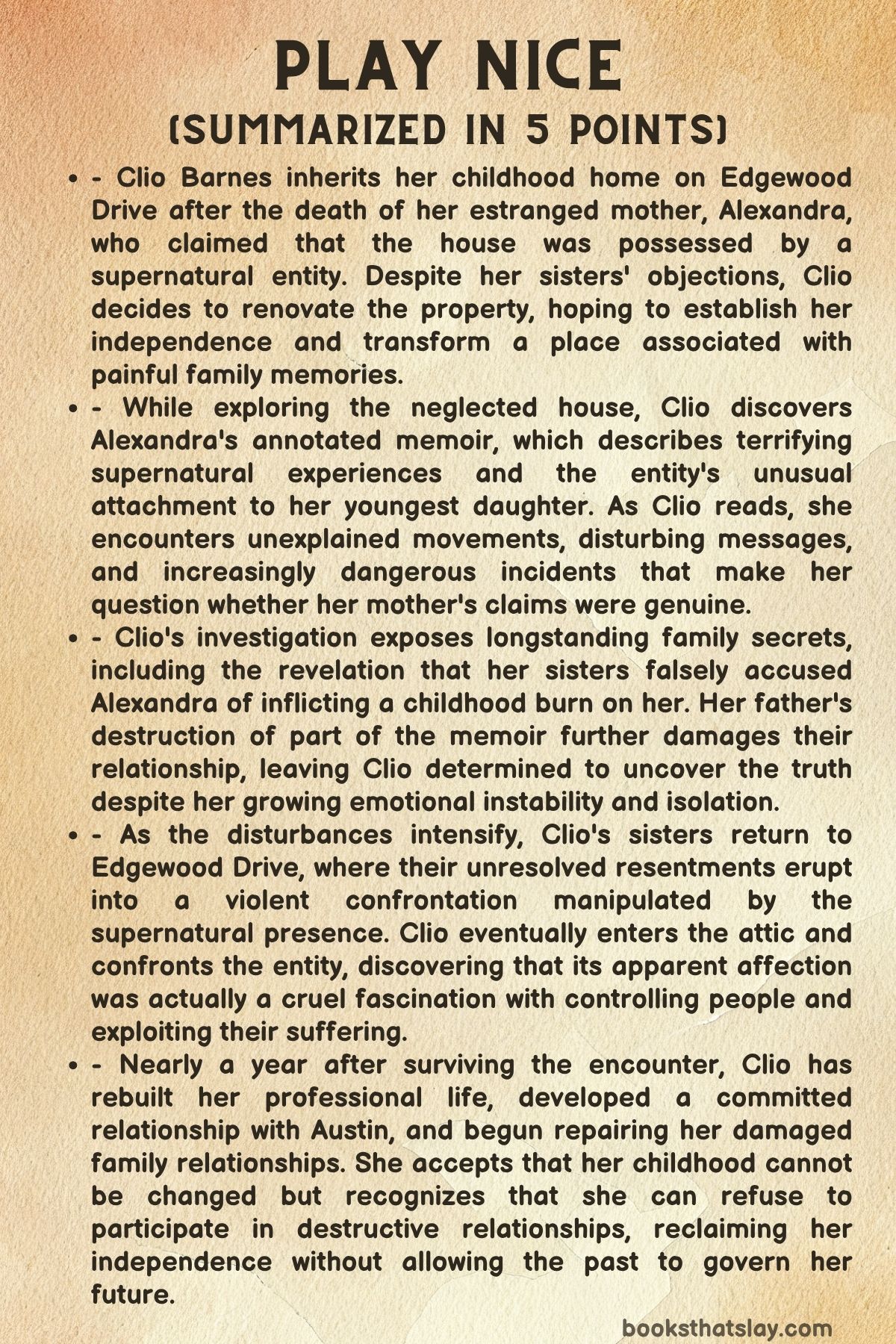
Summary
Clio Louise Barnes is attending a glamorous party in New York City when she discovers that her estranged mother, Alexandra, has died of a heart attack. The news reaches her through repeated calls from her sisters, Leda and Daphne, who expect her to be devastated.
Instead, Clio responds with her characteristic emotional detachment. She has spent most of her life separated from Alexandra, whose alleged experiences with a supernatural presence destroyed their family.
Clio travels to New Jersey to join her sisters at their father James’s house. Their reunion exposes the different ways the three women have dealt with their childhood.
Leda is controlling and intensely protective, while Daphne prefers avoiding painful subjects. Clio relies on humor, appearances, and emotional distance to avoid confronting uncomfortable feelings.
Their conversations return repeatedly to Alexandra, whom the family remembers as an unstable mother obsessed with the belief that their former home was possessed.
When Clio announces that she intends to attend Alexandra’s funeral, her sisters object. They believe that reconnecting with their mother’s associates will expose her to people who encouraged Alexandra’s destructive beliefs.
Clio refuses to change her mind.
Accompanied by Leda’s husband, Tommy, she attends the funeral at an unusual Victorian house in Connecticut. The gathering introduces her to Alexandra’s friends from the world of paranormal investigation, including Mariella and Roy.
Her aunt Helen offers a different perspective on Alexandra’s life. Rather than portraying her sister exclusively as an abusive mother, Helen describes a complicated woman whose suffering continued long after she lost her children.
During their conversation, Clio unexpectedly breaks down. Her grief reveals that the absence of a conventional relationship with Alexandra has not eliminated her attachment to her mother.
Helen also reveals that Alexandra never sold the house on Edgewood Drive.
The property has remained in her possession throughout the years of estrangement. Clio immediately recognizes an opportunity to renovate it, document the transformation online, and potentially increase its resale value.
Her sisters are horrified by the proposal.
For them, the house represents childhood terror and family destruction. For Clio, renovating it offers a chance to reclaim something from the past while demonstrating that she can manage an important undertaking without constant supervision.
Despite their objections, she proceeds.
Her first visit reveals a neglected property that appears almost unchanged since childhood. Familiar rooms awaken fragmented memories, while the deteriorating interiors provide numerous opportunities for improvement.
Inside her former bedroom, Clio discovers a damaged copy of Alexandra’s memoir, Demon of Edgewood Drive: The True Story of a Suburban Haunting.
The book contains handwritten annotations and a personal inscription addressed to Clio. Its message suggests that Alexandra wanted her youngest daughter to understand what happened inside the house.
Clio has never read the memoir because James made his daughters promise to avoid it.
She finally breaks that promise.
Alexandra’s account describes a divorced mother struggling to establish a new life with her three daughters. What begins as a difficult domestic situation gradually becomes a record of inexplicable noises, moving objects, disturbing encounters, and the apparent attachment of an unseen presence to young Clio.
The memoir claims that Clio communicated with an invisible companion who wanted to be her friend.
Adult Clio remembers certain childhood details but cannot recall the supernatural incidents surrounding them. She suspects that Alexandra exaggerated events, particularly because the memoir presents their family history in ways that contradict her memories.
Nevertheless, the house begins producing disturbances that resemble those described in the book.
Clio experiences sudden coldness, unexplained movements, and the sensation of being watched. Her sleeping position changes mysteriously, and she occasionally awakens somewhere other than where she fell asleep.
She initially attributes these incidents to alcohol, exhaustion, and the building’s deteriorating condition.
Meanwhile, her renovation introduces her to Austin, a former neighborhood acquaintance whose nephew, Baker, injures himself while attempting to investigate the supposedly abandoned property.
Austin is charming, humorous, and comfortable with Clio’s outspoken personality. Their attraction quickly develops into a physical relationship.
Unlike Clio’s previous romantic encounters, however, their connection gradually acquires emotional significance.
Austin also introduces her to his mother, Dawn, who remembers Alexandra with sympathy. Dawn’s recollections complicate the family narrative by suggesting that Alexandra was a troubled woman whose circumstances were more difficult than her daughters understood.
As Clio continues reading, the memoir describes Alexandra’s attempts to obtain religious assistance.
Priests visit the property, and disturbing incidents apparently intensify. Alexandra becomes convinced that the presence is deliberately frightening her and manipulating her behavior.
She also describes painful injuries, increasing dependence on alcohol, and the fear that the entity wants her to harm herself.
Clio recognizes evidence of genuine cruelty in her mother’s parenting, including memories of Alexandra striking Daphne. Yet she begins questioning whether Alexandra’s destructive behavior can be understood without considering the terror she experienced.
The distinction becomes increasingly important when Clio discovers unexplained writing in her sketchpad.
A message appears beneath one of her drawings, apparently responding to her expressed desire to be left alone.
The incident suggests that an intelligent presence is communicating with her.
Clio becomes frightened but also fascinated.
Her determination to understand the house begins interfering with her personal relationships and professional responsibilities. She increasingly resents her family’s attempts to discourage the renovation, interpreting their concern as another effort to control her.
The tension reaches a breaking point during a Memorial Day gathering at James’s house.
Clio discovers that her father secretly removed the missing portion of Alexandra’s annotated memoir from Edgewood Drive.
She confronts him, demanding to know why he concealed material that might explain their childhood. Their argument expands into accusations concerning his marriage, his relationship with Amy, and the possibility that he deliberately distorted Alexandra’s reputation.
James insists that his actions were intended to protect his daughters.
Clio rejects his explanation, arguing that protection does not justify withholding the truth.
In response, James throws the missing pages into a firepit.
Their destruction devastates Clio. She believes that her father has deliberately eliminated her opportunity to understand Alexandra’s experiences.
Her relationship with Leda also deteriorates when her eldest sister condemns her for reading the forbidden memoir.
Clio withdraws further from her family.
Even her familiar New York lifestyle begins losing its appeal. Her social behavior becomes increasingly erratic, and a fire in her apartment building leaves her temporarily displaced.
Although the fire has an ordinary explanation, it reinforces her growing sense that nowhere feels secure.
Returning to Edgewood Drive, Clio encounters worsening conditions. Food spoils, mold spreads, and the house appears increasingly hostile.
The memoir introduces paranormal investigators who exploited Alexandra’s desperation. Their involvement suggests that some people were more interested in spectacular supernatural experiences than in helping a frightened mother.
Clio becomes especially disturbed by accounts suggesting that the entity considered her its favorite.
The possibility appeals to something she recognizes in herself: the desire to be noticed and regarded as special.
Meanwhile, Helen reveals an extraordinary detail concerning Clio’s childhood burn scar.
Clio has always believed that Alexandra deliberately inflicted the eye-shaped injury on her arm. Helen explains that Alexandra did not know how the injury occurred.
Instead, Leda and Daphne accused their mother after telling James that they witnessed the incident.
Clio confronts her sisters.
They admit that their accusation was false. Frightened by life inside the house, they believed that blaming Alexandra would help them escape and secure their father’s protection.
Clio is devastated by the revelation.
She realizes that one of the most damaging beliefs about her mother originated in a deliberate lie. Her sisters insist that they were frightened children attempting to survive, but Clio cannot immediately accept their justification.
Feeling betrayed, she returns to Edgewood Drive.
Her behavior becomes increasingly dangerous.
She drinks heavily, attempts to communicate with the entity, and places paper throughout the house to encourage written responses.
Instead of obtaining the controlled interaction she wants, she experiences frightening disturbances and unexplained activity on her social media accounts.
Her public image deteriorates as disturbing material appears online.
James eventually collects her and brings her home.
While staying with him, Clio discovers that he has been researching psychiatric emergencies, delusions, and involuntary hospitalization. She fears that he intends to force her into treatment.
Her alarm increases when a new burn develops on her arm, resembling the childhood scar.
Clio contacts Roy, Alexandra’s longtime partner and a demonologist involved in the original investigation.
Roy confirms that the supernatural presence was real, although he admits that parts of Alexandra’s memoir were altered for commercial reasons.
He also acknowledges that the entity demonstrated an unusual attachment to Clio.
However, Clio recognizes that Roy’s fascination with the supernatural may have encouraged him to exploit Alexandra’s suffering.
Despite her distrust, she arranges to meet him at the house.
Her family meanwhile organizes a therapy session.
The therapist, Maya, challenges the family’s established assumptions, particularly Leda’s belief that the older sisters’ experiences automatically outweigh Clio’s.
She explains that children raised in the same household can experience their circumstances very differently.
The session exposes longstanding grievances without resolving them.
Clio subsequently returns to Edgewood Drive, where Roy has mysteriously disappeared.
As she searches for him, her phone begins livestreaming her increasingly disturbing behavior.
Leda and Daphne arrive after seeing the broadcast.
Their attempts to intervene rapidly deteriorate into accusations and physical violence. Clio recognizes that the entity is encouraging their hostility and enjoying the spectacle.
During the confrontation, Clio is accidentally struck and loses consciousness.
When she recovers, further revelations emerge.
Daphne discovers that Leda secretly read Alexandra’s memoir years earlier, despite insisting that her sisters should never open it.
Leda defends her deception as an attempt to protect the family.
The sisters exchange cruel accusations concerning their childhood, relationships, and emotional weaknesses.
Leda eventually reveals that she once envied the attention the supernatural presence gave Clio.
She also explains that she learned to resist it by refusing to acknowledge its existence.
When Leda becomes trapped in a bedroom, the sisters discover Roy near the attic access.
They attempt to rescue him, but Clio realizes that the hidden attic contains the source of the disturbances.
She enters alone.
Inside, Clio finally encounters the entity.
Its existence confirms the central truth of Alexandra’s memoir, although not every detail of her account was accurate.
The encounter also forces Clio to confront the nature of the creature’s attachment to her.
Its behavior resembles some of her own worst tendencies: craving attention, enjoying control, and treating others’ emotional reactions as entertainment.
However, Clio finally recognizes that its interest was never love.
The entity regarded the Barnes family’s suffering as a source of amusement.
Its attention made Clio feel special while exposing her to profound danger.
When it attacks, she struggles to escape.
She eventually survives and reunites with her sisters outside as emergency responders arrive.
The confrontation changes her understanding of the house and her family. Alexandra was not simply inventing the supernatural threat, but the reality of the entity does not erase the harm she caused her daughters.
Nearly a year later, Clio has rebuilt much of her professional life.
With Hannah’s assistance, she has secured a creative director position with a luxury fashion brand.
Her relationship with Austin has become stable, and her family continues attempting to repair its damaged bonds.
Clio and James have exchanged apologies, although their relationship can no longer return to its former simplicity.
The experience has also altered Clio’s understanding of herself.
She accepts that she cannot erase her childhood or obtain perfectly satisfying explanations for everything that happened.
Most importantly, she recognizes that attention is not necessarily affection and that refusing to participate in destructive relationships can be an act of independence.
The house remains part of her history, but she no longer allows its demands to determine the direction of her life.
Characters
Clio Louise Barnes
Clio Louise Barnes is the protagonist of Play Nice, a fashionable New Yorker whose apparent self-confidence conceals a complicated relationship with vulnerability, affection, and childhood trauma. Her sharp humor and carefully maintained public image initially make her appear indifferent to almost everything.
Her response to Alexandra’s death establishes this emotional distance. Rather than expressing conventional grief, she concentrates on social appearances and practical arrangements, suggesting that emotional avoidance has become an important means of protecting herself.
Clio’s decision to renovate Edgewood Drive reveals both ambition and insecurity. She wants to demonstrate her independence, but her determination is also motivated by resentment toward relatives who continue treating her as incapable of making responsible decisions.
Her fascination with the property gradually exposes a deeper psychological need. Discovering that the supernatural presence once considered her special awakens her desire for attention, even when that attention becomes frightening.
Clio’s relationship with Alexandra is especially complicated. She begins with a largely inherited understanding of her mother as abusive and unstable, but reading the memoir introduces a more difficult picture of a woman who experienced genuine terror while also harming her children.
The discovery that her sisters falsely accused Alexandra of burning her fundamentally destabilizes Clio’s identity. She realizes that an important part of her personal history was constructed around a deception.
Her relationship with Austin provides a contrasting experience of attachment. He offers affection without attempting to manipulate her, but accepting his emotional sincerity requires Clio to abandon some of her habitual defenses.
The climactic encounter with the entity becomes a confrontation with qualities she recognizes in herself. Its craving for attention and enjoyment of emotional manipulation force her to reconsider how she treats other people.
By the conclusion, Clio has not become an entirely different person. She remains ambitious, outspoken, and conscious of appearances, but she has developed a stronger understanding of boundaries, emotional responsibility, and the difference between genuine affection and destructive fascination.
Alexandra Barnes
Alexandra is the absent but central maternal figure whose death initiates the events of Play Nice. Her influence continues shaping her daughters long after their separation, making her one of the novel’s most consequential characters.
Initially, Alexandra exists primarily through other people’s recollections. James presents her as unstable, Leda remembers her as dangerous, and Daphne associates her with fear and emotional neglect.
Her memoir introduces an alternative perspective. It portrays a divorced mother attempting to establish a secure home while confronting disturbing experiences that progressively undermine her confidence and stability.
Alexandra’s account complicates her characterization without completely absolving her. Her drinking, anger, and harmful treatment of her daughters remain significant aspects of her parenting.
However, the eventual confirmation of the supernatural presence demonstrates that her central fear was not simply imaginary.
Her attempts to secure help also reveal her vulnerability to exploitation. Paranormal investigators and other interested parties become involved in her suffering, sometimes prioritizing their fascination with the phenomenon over the family’s safety.
Alexandra’s decision to retain the house after losing custody suggests an attachment that may combine obsession, unfinished business, and a desire to preserve evidence of her experiences.
Her relationship with Clio is particularly significant because the youngest daughter retains comparatively few memories of their time together. The annotated memoir becomes Alexandra’s final attempt to communicate her perspective.
Alexandra ultimately represents the difficulty of evaluating someone whose life contains both genuine suffering and harmful behavior. The book refuses to make her either an innocent victim or a purely destructive parent.
Leda Barnes
Leda is the eldest Barnes sister and the family’s most determined guardian of established boundaries. Her disciplined personality and commanding manner reflect a lifelong attempt to impose order on experiences that once seemed uncontrollable.
In Play Nice, her insistence that Clio abandon the renovation initially appears motivated entirely by concern. However, the story gradually reveals that Leda’s protectiveness is inseparable from her need to control how the family remembers its past.
Her childhood responsibilities shaped her understanding of motherhood and sisterhood. As the eldest, she believes that she witnessed the worst of Alexandra’s behavior and therefore possesses greater authority concerning what happened.
This belief becomes problematic when she dismisses her sisters’ different experiences.
Leda’s involvement in the false accusation concerning Clio’s burn scar exposes the moral complexity of her protective instincts. She participated in a lie because she believed escaping the house was necessary, yet she allowed that deception to determine Clio’s understanding of Alexandra for years.
Her secret decision to read the forbidden memoir reveals another contradiction. She demands obedience from her sisters while exempting herself from the rules she considers essential to their safety.
Leda also admits feeling jealous of the entity’s attention toward Clio. This confession exposes the insecurity beneath her authoritative exterior and demonstrates how the supernatural presence exploited ordinary sibling emotions.
Her eventual confrontation with the entity forces her to acknowledge that controlling everyone around her cannot eliminate danger.
Leda remains a protective sister, but her development suggests that genuine care requires recognizing other people’s independence rather than demanding unquestioning compliance.
Daphne Barnes
Daphne is the middle Barnes sister, characterized by her comparatively relaxed manner, avoidance of confrontation, and desire to preserve family harmony. Her successful career as a chef also distinguishes her from Leda’s rigid relationship with food and Clio’s fashion-oriented lifestyle.
Daphne initially appears to occupy a mediating position between her sisters. She shares Leda’s fear of Edgewood Drive but generally expresses her objections with less aggression.
Her reluctance to discuss Alexandra reflects unresolved trauma rather than indifference. Even the prospect of returning to the house produces considerable emotional discomfort.
Daphne’s admission that she helped falsely accuse Alexandra reveals that her apparently accommodating personality conceals significant guilt.
Unlike Leda, she appears less committed to defending every aspect of the family’s established account, but she has nevertheless maintained the deception for years.
Her behavior demonstrates how silence can preserve harm even when it originates in fear rather than deliberate cruelty.
During the final confrontation, Daphne’s willingness to examine the memoir signals a change in her relationship with the past. She becomes increasingly prepared to question assumptions she previously accepted.
Her conflict with Leda also exposes the resentment created by years of unequal authority within their family.
Daphne’s character illustrates the difficulty of maintaining peace when doing so requires suppressing painful truths. Her eventual participation in confronting the entity suggests a movement toward greater honesty and independence.
James Barnes
James is the father of the three sisters and a central influence on their interpretation of childhood. His role in Play Nice becomes increasingly ambiguous as Clio investigates the circumstances surrounding her parents’ separation.
He initially appears affectionate, dependable, and generous. He collects Clio when she asks, assists with the renovation, and offers financial support when her apartment becomes temporarily uninhabitable.
These actions establish that his love for his daughters is genuine.
However, James also demonstrates a strong need to control information and decisions. His insistence that the sisters never read Alexandra’s memoir deprived them of an opportunity to encounter their mother’s perspective.
His destruction of the missing pages becomes the clearest expression of this controlling tendency.
James justifies his actions as protection, but Clio increasingly recognizes that withholding information has prevented her from understanding her own history.
His research into psychiatric emergencies further complicates his characterization. He may sincerely fear for Clio’s safety, yet his willingness to consider intervention also reinforces her anxiety about losing personal autonomy.
James’s relationship with Amy raises additional questions about how he has presented his marriage to Alexandra.
The novel does not require every suspicion about his past to be resolved for his actions to matter. His determination to preserve a particular family narrative has already produced consequences.
His eventual reconciliation with Clio therefore cannot depend on returning to unquestioned paternal authority. Their relationship must accommodate her right to form independent judgments.
Austin
Austin is Clio’s romantic partner and an important source of emotional stability throughout the novel. His approachable personality, humor, and familiarity with her childhood neighborhood distinguish him from the glamorous social environment she usually inhabits.
He first enters the story when his nephew Baker injures himself while attempting to investigate Edgewood Drive.
The encounter establishes Austin as someone who can respond to Clio’s sarcasm without becoming intimidated or defensive.
His relationship with his mother, Dawn, reveals another aspect of his personality. Living with her while she experiences multiple sclerosis demonstrates a willingness to accept practical responsibilities for someone he loves.
This contrasts with Clio’s initial preference for relationships that require little emotional commitment.
Their physical attraction develops quickly, but Austin gradually becomes more significant because he offers Clio companionship without demanding that she perform a particular version of herself.
He is not completely immune to the tensions surrounding the house. Clio’s increasing secrecy and emotional withdrawal create genuine difficulties between them.
Nevertheless, his concern generally arises from affection rather than a desire to dominate her.
His willingness to acknowledge that the house always disturbed him becomes especially meaningful after the supernatural confrontation.
Austin represents the possibility of a relationship founded on mutual care, emotional honesty, and ordinary companionship rather than manipulation or constant excitement.
Helen
Helen is Alexandra’s sister and an important connection to the maternal side of Clio’s family. Her presence challenges the assumption that James and his daughters possess the only legitimate interpretation of Alexandra’s life.
At the funeral, Helen recognizes Clio’s resemblance to her mother and responds with warmth.
Their private conversation allows Clio to express grief she has previously suppressed.
Helen’s perspective is sympathetic toward Alexandra without being entirely uncritical. She understands that her sister’s behavior caused suffering, but she also remembers circumstances that the Barnes family has minimized or excluded.
Her revelation that Alexandra retained ownership of Edgewood Drive initiates Clio’s investigation.
Later, Helen provides the crucial information that Alexandra did not know how Clio received her childhood burn. This disclosure exposes the deception maintained by Leda and Daphne.
Helen also questions Clio’s determination to remain involved with the house, recognizing that pursuing the past can become destructive.
Her character demonstrates the value of alternative perspectives while acknowledging that complete certainty may remain impossible.
Roy
Roy is Alexandra’s longtime partner and a demonologist whose fascination with Edgewood Drive gives him considerable knowledge about the family’s supernatural experiences.
He initially appears to offer a sympathetic alternative to James. He loved Alexandra, participated in her investigations, and confirms that her central claims were not entirely fabricated.
However, his involvement carries serious ethical complications.
Roy admits that the memoir contained alterations designed to attract commercial interest. This revelation undermines the reliability of a text that Clio has increasingly treated as a source of truth.
His professional interest in the entity also raises questions about his priorities.
Although he cared for Alexandra, he appears to have regarded access to the supernatural presence as an extraordinary opportunity.
Clio recognizes that his curiosity may have encouraged him to remain involved in circumstances that endangered her mother and the children.
His disappearance inside the house demonstrates that expertise and fascination do not guarantee control over supernatural danger.
Roy represents the temptation to prioritize discovery over responsibility, especially when other people’s suffering provides access to something unusual.
Amy
Amy is James’s second wife and the Barnes sisters’ stepmother. Her earlier role as their dance teacher gives her a connection to the family that predates her marriage to James.
She generally presents herself as welcoming and supportive.
Clio associates James and Amy’s home with safety, suggesting that Amy contributed to a comparatively stable environment after the sisters left Edgewood Drive.
However, Clio’s investigation raises questions about the beginning of Amy’s relationship with James.
Amy’s discomfort when Clio asks whether their romance began before the divorce introduces uncertainty into the family’s established history.
Although the novel does not conclusively establish every detail of their early relationship, Amy’s reactions demonstrate that the past contains subjects the adults would prefer to avoid.
Her character illustrates how a seemingly secure family structure can depend partly on selective recollection and unspoken agreements.
Tommy
Tommy is Leda’s husband and a comparatively steady presence within the Barnes family.
His willingness to accompany Clio to Alexandra’s funeral establishes him as someone prepared to support her even when her decisions create disagreement.
Unlike Leda, Tommy does not immediately attempt to dictate Clio’s response to her mother’s death.
He encourages her to recognize her grief and acknowledges that emotional detachment does not necessarily mean an absence of feeling.
His relaxed participation in the funeral’s unusual activities also introduces humor into an otherwise uncomfortable experience.
However, his support is not unconditional compliance. When Clio is distressed, he refuses to leave her alone at Edgewood Drive because he fears for her safety.
Tommy demonstrates a form of practical care that balances affection with reasonable concern.
Dawn
Dawn is Austin’s mother and a former neighborhood acquaintance of the Barnes family.
Her recollections of Alexandra provide Clio with an important perspective outside the immediate family.
Rather than reducing Alexandra to her reputation, Dawn remembers a woman struggling with divorce, isolation, and the loss of her daughters.
Her sympathy does not establish that Alexandra was blameless, but it encourages Clio to reconsider the certainty of her inherited judgments.
Dawn’s relationship with Austin also demonstrates the importance of sustained care. His assistance with her multiple sclerosis reveals a household organized around mutual affection and responsibility.
Through Dawn, Clio encounters a model of family attachment that differs from the secrecy and control characterizing her own childhood.
Mariella
Mariella is an eccentric member of Alexandra’s paranormal circle who participates in the investigations surrounding Edgewood Drive.
Her dramatic appearance and enthusiastic embrace of Clio initially make her seem like an unusual but welcoming figure.
However, her involvement in Alexandra’s attempts to confront the entity raises questions about the effectiveness of supernatural expertise.
The investigators’ confidence does not prevent events from becoming increasingly dangerous.
Mariella represents a community willing to acknowledge experiences that conventional authorities dismiss, but the novel also exposes the risks of treating frightening circumstances as opportunities for extraordinary encounters.
Her character contributes to the uncertainty surrounding the distinction between sincere belief, genuine assistance, and sensationalism.
Hannah
Hannah is one of Clio’s friends and a practical counterbalance to the supernatural interpretations surrounding Edgewood Drive.
When Clio describes the house’s disturbances, Hannah suggests ordinary explanations, including possible carbon monoxide exposure.
Her skepticism is not necessarily dismissive. Instead, it reflects a concern for explanations that can be examined and tested.
Hannah also provides emotional support when Clio’s behavior and circumstances deteriorate.
Her most significant contribution becomes apparent after the supernatural confrontation, when she helps connect Clio with a luxury fashion brand.
This opportunity allows Clio to rebuild her professional identity.
Hannah demonstrates that friendship can involve both questioning someone’s interpretation of events and remaining supportive during difficult circumstances.
Veronica
Veronica is another member of Clio’s New York social circle.
Unlike Hannah, she is readily receptive to the possibility that Edgewood Drive is haunted.
Her response illustrates how Clio’s experiences can become fascinating stories for people who do not have to live with their consequences.
Veronica also helps establish the social environment Clio inhabits before her investigation.
Within that world, personal experiences can easily become entertainment, conversation, or material for public attention.
Her willingness to entertain supernatural explanations contrasts with the family’s insistence that the disturbances cannot be real.
Maya
Maya is the family therapist who facilitates the Barnes family’s attempt to address its escalating conflicts.
Her importance comes from her refusal to accept the family’s established hierarchy of suffering.
When Leda insists that the older sisters experienced the worst of Alexandra’s behavior, Maya explains that siblings can experience the same household in fundamentally different ways.
This observation challenges the assumption that one person’s memories automatically invalidate another’s.
Maya also creates an environment in which the sisters can acknowledge experiences they have previously avoided.
The session does not immediately reconcile the family, but it exposes the limits of their familiar patterns of accusation and defensiveness.
Her character represents the possibility of understanding family trauma through conversation rather than control.
Baker
Baker is Austin’s teenage nephew, whose attempt to enter Edgewood Drive creates Clio’s first encounter with Austin.
His curiosity about the supposedly abandoned house reflects its reputation within the neighborhood.
Although his role is relatively brief, his accident introduces a moment of ordinary vulnerability into Clio’s supernatural investigation.
The incident also establishes Austin’s willingness to assume responsibility for his nephew.
Baker’s experience demonstrates how the property’s frightening reputation continues attracting attention long after the Barnes family left.
Jackson
Jackson is Austin’s older brother and a former neighborhood acquaintance connected to Alexandra’s early experiences at Edgewood Drive.
His assistance when Alexandra moved into the property gives him a place within the house’s history.
Clio recognizes his name from the memoir, making him another potential connection between her mother’s written account and independently remembered events.
Although Jackson remains a secondary figure, his presence reinforces the idea that Alexandra’s experiences occurred within a wider community rather than in complete isolation.
Kiera
Kiera is a figure within Clio’s New York social environment whose interaction with her reveals the deterioration of Clio’s emotional control.
Clio behaves badly toward Kiera while attempting to resume her familiar social routine.
The encounter demonstrates that Clio’s distress is no longer confined to Edgewood Drive or her immediate family.
Her resentment begins affecting people who have little connection to the events that caused it.
Kiera’s role therefore helps expose the widening consequences of Clio’s refusal to acknowledge her emotional difficulties.
Father John
Father John is one of the religious figures Alexandra approaches in her attempts to understand and remove the presence.
His visit demonstrates that Alexandra initially sought assistance through established religious channels rather than relying exclusively on paranormal enthusiasts.
The encounter ends badly, leaving Alexandra frightened and physically injured.
His involvement helps establish the extent of her desperation and the limitations of the assistance available to her.
Father Bernard
Father Bernard becomes involved after Alexandra’s initial attempts to obtain religious help prove unsuccessful.
He takes her concerns seriously enough to investigate the property and consider the possibility that the family faces genuine danger.
His involvement provides a contrast to people who simply dismiss Alexandra’s experiences.
However, his inability to resolve the disturbances also demonstrates that recognizing a threat does not necessarily provide the means to eliminate it.
Jed
Jed is a participant in the attempted exorcism described in Alexandra’s memoir.
His involvement becomes memorable when he suffers a disturbing injury associated with his headphones and bleeding ears.
The incident suggests that the entity can inflict physical harm on people attempting to confront it.
Jed’s experience also illustrates the danger of entering the house with confidence that exceeds one’s understanding of the threat.
Because the account comes through Alexandra’s partly embellished memoir, the precise circumstances remain less certain than the broader reality of the entity.
Daisy
Daisy appears among the family members attending Clio’s professional celebration near the conclusion.
Her presence contributes to the picture of a family attempting to maintain ordinary relationships after extraordinary suffering.
Although she receives little independent development in the supplied account, her inclusion reinforces the significance of the broader family network in Clio’s recovery.
The Supernatural Entity
The supernatural entity is the principal antagonist of Play Nice, an intelligent presence whose attachment to Edgewood Drive and the Barnes family drives the novel’s central conflict.
Its most disturbing quality is not simply its capacity to produce frightening phenomena. It demonstrates an understanding of human vulnerability and appears to enjoy manipulating emotional reactions.
The entity focuses particularly on Clio, presenting its attention as a form of special recognition.
This apparent favoritism creates jealousy among the sisters and encourages Clio’s fascination.
Its behavior also exploits Alexandra’s fear and desperation. By making her appear unstable to others, it contributes to the circumstances that destroy her relationship with her daughters.
The creature’s power appears connected to attention and engagement.
Leda discovers that refusing to acknowledge it offers some protection, while Clio’s attempts to communicate provide additional opportunities for manipulation.
Its resemblance to aspects of Clio’s personality gives the supernatural conflict psychological significance.
Both demonstrate a desire for attention and an interest in controlling other people’s reactions, although the entity expresses these tendencies through deliberate cruelty.
The final confrontation reveals the essential difference between genuine attachment and possessive fascination.
The entity’s interest in Clio has never required it to care about her well-being.
Its role extends beyond that of a conventional supernatural monster. It embodies a destructive relationship in which attention becomes a means of domination and suffering becomes entertainment.
Themes
Family Trauma and the Unreliability of Memory
The Barnes sisters grow up sharing a household but emerge with sharply different understandings of their childhood. Their conflicting memories demonstrate that family history is rarely experienced or preserved uniformly.
In Play Nice, Clio’s limited recollections make her especially dependent on the explanations supplied by her father and older sisters. Because she was young when the family separated, she accepts their account of Alexandra without possessing enough independent memories to challenge it.
The discovery that Leda and Daphne falsely accused Alexandra of burning Clio exposes the vulnerability of this inherited understanding.
A single deception becomes part of the family’s accepted history, influencing Clio’s relationship with her mother long after the original events.
The memoir introduces another problem: Alexandra’s account contains genuine experiences alongside alterations designed to produce a more compelling narrative.
Consequently, neither the family’s oral history nor the written record provides an entirely dependable account of the past.
The supernatural entity further complicates memory by appearing to preserve or manipulate experiences that Clio cannot consciously recall.
These uncertainties do not suggest that childhood suffering is imaginary. Rather, they establish that genuine trauma can coexist with incomplete recollection, mistaken interpretation, and deliberate concealment.
Leda’s insistence that her suffering outweighs her sisters’ experiences also reveals how families can turn trauma into a contest for authority.
Maya challenges this assumption by explaining that siblings may experience the same circumstances differently.
The novel ultimately suggests that understanding family trauma requires acknowledging these differences without allowing one person’s perspective to erase another’s.
Clio’s development depends on learning to evaluate competing accounts while accepting that some details may remain unresolved.
Motherhood, Blame, and Moral Complexity
Alexandra’s experience raises difficult questions about the expectations placed on mothers and the ways society interprets maternal failure.
After her divorce, Alexandra attempts to establish a new household while managing financial difficulties, emotional isolation, and increasingly frightening supernatural experiences.
Her deteriorating circumstances contribute to behavior that harms her daughters.
However, the story distinguishes between understanding the conditions surrounding harmful behavior and excusing the behavior itself.
Alexandra’s alcoholism, anger, and cruelty remain significant even after the supernatural presence is confirmed to be real.
At the same time, the revelation that she was genuinely terrorized challenges the assumption that her supernatural claims were simply attempts to avoid responsibility.
Her attempts to obtain religious and paranormal assistance demonstrate that she recognized a problem and sought solutions, even when those efforts proved ineffective.
The exploitation she experiences also exposes how vulnerable people can become dependent on supposed experts who prioritize their own interests.
James’s role complicates the moral landscape further.
Although he offers his daughters stability, his determination to control their understanding of Alexandra prevents them from forming independent judgments.
His destruction of the memoir’s missing pages symbolizes the power one parent can exercise over the reputation of another.
Clio’s investigation eventually requires her to reject the simplified opposition between a good father and a bad mother.
Neither parent can be understood adequately through a single defining quality.
The novel presents motherhood as a relationship shaped by love, obligation, personal limitations, and circumstances that may exceed an individual’s ability to manage them.
Recognizing Alexandra’s suffering does not erase her daughters’ injuries, just as acknowledging those injuries does not require dismissing everything Alexandra experienced.
This distinction allows the story to examine responsibility without reducing its characters to absolute innocence or guilt.
Attention, Validation, and Destructive Relationships
Clio’s desire to be noticed influences nearly every aspect of her life, from her professional identity to her romantic relationships and fascination with the supernatural.
Her work in fashion and social media depends partly on attracting attention. She understands how to construct an appealing public image and how to control the impression she makes on others.
This ability provides professional opportunities but also encourages her to treat personal relationships as performances.
The supernatural entity exploits this tendency by presenting its attention as evidence that Clio is special.
During childhood, its apparent preference distinguishes her from her sisters, creating jealousy and curiosity.
As an adult, Clio initially interprets the possibility of renewed contact as an extraordinary opportunity.
She wants to understand the entity, communicate with it, and perhaps demonstrate that she can manage a force that overwhelmed her mother.
However, the entity does not seek mutual understanding.
It uses attention to establish control, encouraging Clio to invest increasing amounts of time and emotional energy in interactions that leave her frightened and isolated.
The resulting pattern resembles destructive human relationships in which affection, recognition, or intimacy becomes conditional on continued participation.
Clio’s relationship with Austin provides an important contrast.
He offers companionship and affection without requiring her to surrender her independence or perform for his approval.
Nevertheless, accepting this ordinary form of care initially makes Clio uncomfortable because it requires emotional openness rather than strategic control.
Her professional life also illustrates the instability of public validation.
When disturbing material appears on her social media accounts, the audience that once supported her carefully maintained image becomes a source of humiliation.
By the conclusion, Clio recognizes that being observed is not equivalent to being valued.
Her decision to stop participating in the entity’s games demonstrates a new understanding of emotional autonomy.
The novel suggests that genuine relationships provide room for personal agency, while destructive relationships turn another person’s attention into a form of possession.
Control, Independence, and the Power of Refusal
Clio’s determination to renovate Edgewood Drive begins as an attempt to establish control over her life.
In Play Nice, she repeatedly encounters relatives who regard her as irresponsible or incapable of understanding the family’s traumatic history. Taking responsibility for the property offers an opportunity to challenge that perception.
Her proposed renovation also has symbolic significance.
By replacing damaged interiors with attractive new designs, Clio hopes to transform a place associated with childhood helplessness into evidence of adult achievement.
However, her desire for independence gradually becomes difficult to distinguish from obsession.
She refuses assistance, dismisses warnings, and repeatedly returns to the property even when doing so threatens her safety and relationships.
The entity exploits this determination.
Every attempt to confront or command it becomes another opportunity for the creature to demonstrate that Clio cannot control its behavior.
Her family responds by attempting to impose control of its own.
James conceals information, destroys the memoir’s missing pages, and considers psychiatric intervention. Leda demands obedience to rules she has secretly violated herself.
These responses are partly motivated by genuine concern, but they also deny Clio the opportunity to form independent conclusions.
The novel therefore presents control as a problem that extends beyond the supernatural threat.
Alexandra attempted to manage the entity through religious and paranormal interventions. James tried to manage family suffering through secrecy, while Leda attempted to maintain safety through rigid rules.
Clio initially repeats this pattern by believing that sufficient determination will allow her to master the house.
Her eventual transformation comes from recognizing that autonomy does not require controlling every circumstance.
Sometimes independence involves deciding that a particular relationship, argument, or encounter no longer deserves participation.
Leda’s childhood discovery that refusing to acknowledge the entity could weaken its influence anticipates this realization.
Clio’s final refusal to engage with the creature represents a rejection of the belief that every challenge must be confronted on its own terms.
The ending consequently redefines strength as the capacity to establish boundaries, accept uncertainty, and direct attention toward relationships and ambitions that support a meaningful life.