Please Don’t Lie Summary, Characters and Themes
Please Don’t Lie by Christina Baker Kline is a psychological suspense novel about a woman trying to rebuild her life after devastating loss, only to discover that the sanctuary she hoped for may hide more danger than the past she escaped. The story follows Hayley, a young woman seeking recovery and privacy after tragedy and public scrutiny uproot her world.
When she marries Brandon and moves with him to an isolated home in the Adirondacks, she hopes for quiet and renewal. Instead, she enters a landscape filled with secrets, shifting loyalties, and threats she never sees coming until they are right at her door.
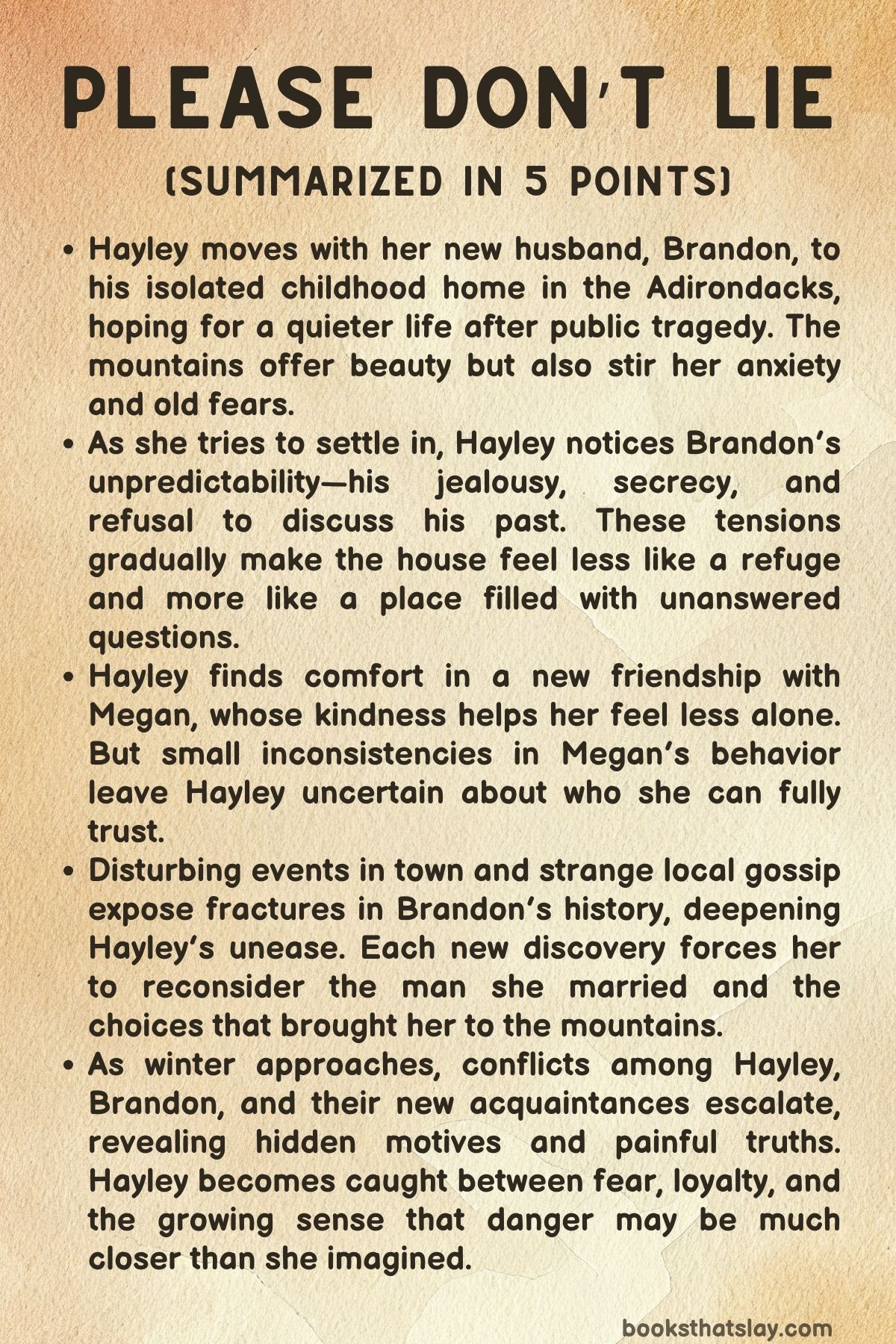
Summary
Hayley’s story begins at its most desperate moment: injured, terrified, and running through a blizzard while someone she trusted chases her. She finds refuge in the property’s old smokehouse and braces herself against the door, knowing he will find her.
From there, the narrative shifts back two months to reveal how she reached this point.
Hayley and her new husband, Brandon, are driving toward his inherited childhood home deep in the Adirondacks. She has left behind the bustle of New York City in the hope that isolation will finally bring peace after unimaginable trauma.
A fire in Florida took her parents’ lives, and months later her sister Jenna overdosed, unable to cope with the grief. Their story became the subject of a sensational true-crime podcast, thrusting Hayley into a wave of unwanted attention.
When someone sold photos of her private wedding to a tabloid, she fled the city altogether.
Brandon’s father’s house is striking and remote. Hayley admires the renovations and tries to absorb the beauty around her, but unease occasionally breaks through.
Brandon once planned to sell the property due to painful memories, but an emotional moment there convinced him to restore it instead. His spontaneous mountaintop proposal made Hayley believe this place could become a new beginning.
Yet as she explores the grounds, she senses both serenity and threat in the surrounding forest.
Her first night is marked by restlessness. The wilderness sounds unfamiliar, the moonlight unsettling, and her trauma brings phantom smells of smoke.
She rereads old news clippings about Jenna and the fire, remembering how public opinion twisted their story and how Brandon entered her life as a source of comfort when she had none.
When Hayley and Brandon drive into the nearby town of Crystal River, she instantly feels like an outsider. A run-in with Pellet, who remembers Brandon from childhood, reveals his old nickname, “the Coyote Kid,” for how he howled in the woods.
An older woman named Cheryl makes sharp comments about Brandon’s parents, clearly hinting at unresolved local history. Brandon abruptly shuts down the conversation, agitated.
At the hardware store, Brandon browses weapons while Hayley meets Megan, a cheerful wellness writer who becomes her first potential friend in the area. Brandon reacts coldly when he sees them talking, but Megan later texts Hayley, opening the door to a new connection.
Hayley clings to that hope despite Brandon’s moodiness and refusal to discuss his past.
Sleepless again, Hayley sorts through childhood belongings and the box of Jenna’s items. Inside are Polaroids from Jenna’s last months, including one torn photo where Jenna stands beside her ex-fiancé Sean.
He is wearing a distinctive black-and-gold ring once owned by Hayley’s father. Disturbed, Hayley confronts Brandon with her grief, but he dismisses her pain and throws the photo away.
She retrieves it later and hides it.
Suspicion rises when she sees repeated missed calls from a Florida number on Brandon’s phone. He claims it is Olivia Blackwood, the podcaster who exploited her tragedy.
His evasiveness leaves her unsure of what to believe.
Hayley’s friendship with Megan grows when they go on a hike together. Megan is knowledgeable, relaxed in the wilderness, and nonjudgmental.
Hayley lies about her past, trying to avoid the weight of her actual story. A human howl echoes through the woods—Brandon’s old habit—embarrassing her.
Still, she finds comfort in Megan’s company, especially as Brandon becomes more unpredictable.
Cheryl pays an unexpected visit to the house and drops hints about Brandon’s history, the property’s renovations, and a long-ago incident involving her husband. Brandon reacts with hostility, and he and Hayley argue again.
Hayley increasingly turns to Megan for emotional support, drifting further away from her husband.
A brief period of calm arrives when Brandon apologizes and forms a friendly rapport with Tyler, Megan’s boyfriend. While the men work around the property, Hayley and Megan spend more time together.
But tension returns when Hayley wakes to find a mutilated coyote placed deliberately in their yard. Brandon brushes it off, but she cannot shake the dread.
Emily, Hayley’s friend from New York, arrives for a visit. Cheryl confronts them at the farmers’ market with more cryptic comments about the past.
Emily later discovers a police report suggesting that Brandon, as a teenager, crashed his car while drunk, resulting in Cheryl’s husband’s death. Hayley is crushed by the revelation.
Brandon admits part of the truth but avoids deeper explanation.
Things worsen when Hayley, Megan, Brandon, and Tyler share dinner and end up drinking and taking shrooms. A game of Truth or Dare escalates when Tyler kisses Hayley at Megan’s urging.
Brandon storms off, and the night spirals. Hayley later discovers Megan’s laptop open to a drafted exposé about her.
Megan confesses she originally sought Hayley out for a story but insists her feelings became genuine. She warns Hayley to look closely at Brandon’s motives.
The story races toward its violent turning point as Hayley uncovers Emily’s phone hidden in Brandon’s nightstand and realizes something is terribly wrong. A confrontation explodes when Brandon attacks Megan, throwing her down the staircase.
Believing Megan dead, Hayley flees into the blizzard, Brandon chasing her with a knife. She hides in the smokehouse, but he breaks in.
At the final moment, an arrow strikes him from behind. Tyler stands in the doorway, holding the crossbow.
Safe for the moment, Hayley lets Tyler help her back to the cottage. But when she puts on his jacket and finds the black-and-gold ring, she realizes Tyler may actually be Sean, Jenna’s ex-fiancé.
What follows is a chilling revelation: Sean admits to killing Emily and Cheryl and reveals he manipulated both Brandon and Megan to get close to Hayley. He also blackmailed Brandon by threatening to expose Brandon’s role as Jenna’s drug source and his cooperation with the true-crime podcast.
Sean plans to escape and leave Hayley dead. She manages to throw scalding tea in his face just as Megan, alive but injured, bursts through the door.
Together, they subdue Sean, binding him until help can arrive.
Two years later, Hayley has reclaimed her life. Sean has been convicted, and Hayley has become a bestselling author and advocate.
She and Megan, now genuine friends, support each other as they continue forward, determined never to let their lives be defined by the people who tried to break them.
Characters
Hayley
Hayley is the emotional core of Please Dont Lie, a woman shaped by profound trauma, loss, and relentless public scrutiny. Her parents’ tragic death and her sister Jenna’s downward spiral leave her carrying an enormous burden of guilt, which makes her extraordinarily vulnerable when she meets Brandon.
She begins the story yearning for a fresh start, seeking safety in marriage and the quiet of the Adirondacks, but her inner world is a landscape of grief, fear of abandonment, and a desperate desire to be understood. Hayley’s anxiety, insomnia, and constant hypervigilance are not signs of weakness but manifestations of unprocessed trauma and repeated betrayals by both the people she loved and the public who consumed her family tragedy.
Over time, she transforms from a woman who clings to others for stability into someone who confronts danger head-on. Her evolution is marked by growing self-awareness, courage, and an eventual refusal to let others define or exploit her story.
By the end, Hayley’s resilience becomes not a reactive survival mechanism but a deliberate reclamation of power and identity.
Brandon
Brandon is a complex blend of charm, fragility, secrecy, and long-buried guilt. To Hayley, he initially appears as a safe harbor—gentle, attentive, and understanding in a way she desperately needs.
Beneath that exterior, however, lies a man haunted by a violent, negligent adolescence and a lifetime of concealed shame. His traumatic past, including his role in Rick Snyder’s death and his involvement in Jenna’s access to fentanyl, shapes him into someone who is emotionally volatile and increasingly controlling.
The weight of generational dysfunction, his complicated relationship to his childhood home, and his fear of exposure lead him toward possessiveness, paranoia, and self-destructive behavior. Although he is not the story’s ultimate villain, Brandon is dangerous in ways he cannot fully admit.
His inability to face truth makes him susceptible to manipulation and traps him in cycles of deceit. Brandon’s downfall represents what happens when trauma festers instead of heals, and when guilt curdles into denial rather than responsibility.
Megan
Megan begins as an enigmatic presence—warm, spiritual, welcoming, and seemingly guided by kindness and curiosity. Yet her character is built on layers of contradiction: she is both compassionate and opportunistic, grounded yet adrift, sincere yet deceptive.
Her initial motive for befriending Hayley—to craft a sensitive exposé—reveals a troubling willingness to blur personal and professional boundaries. However, as she becomes more deeply entangled in Hayley’s life, Megan experiences genuine connection and remorse.
Her internal struggle highlights themes of integrity, intention, and the ethics of storytelling. When she recognizes the harm she has caused, she actively works to step away, eventually returning in the blizzard not for a story but to warn and help Hayley.
By the end, Megan’s journey mirrors Hayley’s: both women learn to confront their mistakes, reclaim agency, and transform pain into advocacy. Megan becomes not just a friend but a partner in truth-telling, someone who chooses responsibility over exploitation.
Tyler / Sean
Sean, operating under the alias Tyler, is the story’s chilling antagonist—calm, calculating, and capable of weaponizing charm with surgical precision. His dual identity embodies deception at its most intimate level.
Sean’s presence in Hayley’s life is not accidental but meticulously engineered, built on years of bitterness, criminal behavior, and a twisted sense of entitlement. His connection to Jenna’s overdose and the fire that killed Hayley’s parents reveals a man who thrives on chaos and exploitation, using vulnerability as an entry point for manipulation.
What makes Sean particularly terrifying is his emotional detachment; even his confessions are delivered with eerie calmness, expressing no remorse for the deaths he causes, including Emily’s and Cheryl’s. His long-term infiltration of Hayley’s world—through Megan, through Brandon, through fabricated charm—exposes how predatory individuals exploit trauma and trust.
Sean serves as the dark mirror of the true-crime genre the book critiques: he creates stories, orchestrates narratives, and moves people like pieces in a game. His defeat at the hands of Hayley and Megan symbolizes the reclaiming of narrative from those who distort it.
Emily
Emily represents the rational, grounding voice in Hayley’s life—a friend who sees warning signs long before Hayley does. Her blend of independence, sharp intuition, and emotional loyalty highlights what healthy connection looks like, especially in contrast to Hayley’s increasingly fraught relationships in the mountains.
Emily challenges Hayley to reflect on Brandon’s secrecy and encourages her to reclaim her autonomy. Her tragic death at Sean’s hands transforms her from a supportive friend into a catalyst for Hayley’s awakening and later advocacy.
Emily’s bond with Hayley, especially their late-night conversation about Jenna, reveals her deep empathy and her willingness to hold Hayley’s pain without exploiting it. Ultimately, Emily stands as a symbol of the life Hayley could have had—one rooted in honest friendship—and her loss amplifies the urgency of Hayley’s ultimate fight for survival and justice.
Jenna
Though Jenna never appears directly in the present timeline, her presence permeates every emotional beat of Please Dont Lie. She embodies both the fragile aftermath of trauma and the brutal impact of substance abuse, media exploitation, and unresolved grief.
For Hayley, Jenna is a source of love, guilt, and regret—someone she longs to save but could not protect from the emotional collapse that followed their parents’ deaths. The true-crime sensationalism around Jenna’s overdose dehumanizes her, reducing her to a public spectacle rather than a sister who suffered.
The revelation that Brandon was her dealer and Sean her manipulative fiancé deepens the tragedy, reframing Jenna not as a cautionary tale but as a victim of predatory men and societal judgment. Jenna’s memory becomes the driving force behind Hayley’s transformation; honoring Jenna’s life becomes synonymous with reclaiming her own.
Cheryl Snyder
Cheryl is a haunted, sharp-edged figure whose bitterness masks decades of grief and unanswered questions. Her confrontational nature is rooted in the loss of her husband Rick, whose death was tied to Brandon’s recklessness.
Cheryl’s clipped comments, her discomfort around Brandon, and her cryptic warnings reveal her as a woman who has lived with the burden of an unresolved injustice. Despite her abrasive exterior, she carries genuine concern—particularly for Hayley, whom she senses is walking into danger.
Tragically, her suspicions and her inclination to speak out make her a target for Sean, who eliminates her before she can expose the truth. Cheryl’s death underscores the novel’s themes of silenced voices and buried histories, and it contributes to the unraveling of the lies surrounding the house and Brandon’s past.
Rick Snyder
Rick, though present only through recollections and revelations, exerts a significant influence on the narrative. His death marks the beginning of the long chain of secrets, cover-ups, and moral decay that shape both Brandon and the larger community.
Rick’s fatal attempt to rescue Brandon from the crashed car transforms him into a tragic symbol of parental sacrifice and the consequences of teenage recklessness. The silence surrounding his death—maintained by adults desperate to protect Brandon—creates a moral fault line that never heals.
Rick’s story becomes a cautionary tale about the harm caused when truth is hidden rather than confronted.
Olivia Blackwood
Olivia Blackwood represents the exploitative side of true-crime media, a voice that thrives on sensationalism, speculation, and the commodification of tragedy. Her podcast turns Jenna’s death and Hayley’s grief into entertainment, stripping them of nuance and humanity.
Olivia functions as an external antagonist whose presence hovers over Hayley’s life even before Sean’s violence emerges. Her later decision to publish Sean’s prison “tell-all” further underscores her lack of ethical boundaries.
Yet Olivia also serves an important thematic function: she embodies the danger of narratives controlled by outsiders rather than by the people who lived them, making Hayley’s eventual authorship all the more powerful.
Themes
Trauma and the Struggle for Psychological Safety
Hayley’s life in Please Don’t Lie is defined by a constant search for safety—emotional, physical, and psychological—after an unrelenting series of traumatic events. Her parents’ deaths, Jenna’s overdose, the public dismantling of her family by a sensationalist podcast, and the social media spectacle that followed leave her without any stable ground to stand on.
When she moves to the Adirondacks, she hopes distance will quiet her memories, yet isolation becomes a magnifying glass. The forest seems watchful, noises feel threatening, and even the scent of smoke resurrects her deepest fears.
Trauma here is not a single event; it is a persistent state that rewires how she perceives the world. She reacts to shadows, to silence, to the idea of being observed, not because she is fragile but because unresolved grief keeps old wounds alive.
Every relationship she forms—including her marriage—is filtered through the lens of someone who has been chronically overwhelmed and betrayed. Her longing for peace stands in contrast to her body’s instinctive vigilance.
Even acts of kindness, such as Megan’s friendliness, are tinged with suspicion once her past experiences surface. Brandon’s volatility intensifies her instability, as his mood swings mimic the unpredictable dangers she has known before.
The smokehouse scene at the start and end of the novel encapsulates this theme: threat becomes literal, survival becomes immediate, and her trauma-driven instincts guide her actions. By the end, her transformation is not about forgetting the past but about reclaiming control over narratives that once imprisoned her.
Trauma, once an invisible cage, becomes the foundation for a new resilience that allows her to redefine safety on her own terms.
Betrayal, Manipulation, and the Fragility of Trust
Trust in the novel repeatedly proves to be both essential and perilous. Hayley clings to Brandon because he arrives during a moment when she is desperately lonely, grieving, and stripped of confidence.
His early tenderness fills a void, yet beneath the surface there are warning signs—his secrecy, his jealousy, his refusal to discuss his past. As Hayley tries to build a marriage on hope, she ignores the gut feelings that later become impossible to dismiss.
Megan’s arrival brings another test of trust. Her warmth offers relief from loneliness, and yet the eventual revelation that she sought out Hayley intentionally to write about her fractures the fragile connection they were forming.
The most profound betrayal comes from Sean, who enters her life behind masks—Tyler, friend, helper—only to be revealed as someone who has stalked her grief for years and orchestrated chaos around her. Betrayal in the story is not simply personal deception; it is weaponized trust.
The people who harm Hayley most are those who insert themselves into her vulnerability and reshape her reality for their own agendas. This dynamic highlights how manipulation feeds on emotional need: Hayley wants connection, wants understanding, wants stability, and each antagonist exploits these desires.
Yet the novel also suggests that trust, though dangerous, remains necessary for healing. Her eventual alliance with Megan, forged through honesty, remorse, and shared danger, proves that trust rebuilt on truth can become stronger than what was broken.
The fragility of trust is undeniable, but the story argues that its restoration is possible when motives are confronted openly and mutual accountability replaces hidden intentions.
Isolation and the Unease of Rural Escape
The Adirondacks promise quiet, beauty, and a restart, yet isolation becomes both a physical reality and an emotional pressure cooker. Hayley arrives expecting refuge from public scrutiny, only to discover that solitude amplifies everything she hoped to escape.
The rural landscape is majestic but unforgiving; sounds are unfamiliar, the darkness is overwhelming, and the remoteness makes her feel exposed rather than protected. Brandon’s childhood home carries its own atmosphere of unease, shaped by unresolved tragedies and family secrets that still inhabit the space like invisible residues.
Meanwhile, the local community seems wary, distant, or hostile, reinforcing Hayley’s sense that she does not belong. The woods become a symbolic space—beautiful from afar but unsettling up close.
They hold memories of Brandon’s past, conceal dangers she cannot identify, and intensify her fear of the unknown. Isolation also deepens her dependency on the few relationships she has, which becomes especially dangerous as Brandon grows unpredictable and Megan’s motives blur.
The more cut off she feels, the more she suppresses her instincts, convincing herself that she must adapt to the environment instead of questioning the threats around her. The revelation of Sean’s presence and Brandon’s collusion gives isolation a sinister edge: it is not just loneliness but entrapment.
The wilderness becomes the backdrop for manipulation, violence, and hidden crimes. By the end, overcoming isolation requires not a physical escape but the ability to rebuild community on her own terms—through advocacy, friendship, and storytelling—transforming the idea of solitude from something imposed on her to something she can choose or reject with agency.
Grief, Guilt, and the Shadow of Family
Family loss shapes every decision Hayley makes. The deaths of her parents and the collapse of Jenna’s life create a deep well of guilt that defines how she views herself.
She carries the belief that she failed her sister, and that belief makes her susceptible to relationships where she compensates by accepting blame or downplaying her needs. Her grief is complicated by public judgment; strangers assign motives, speculate about her wealth, and distort the narrative until Jenna becomes more myth than memory.
This external noise contaminates her natural grieving process, trapping her in a cycle of self-blame and rumination. Objects connected to Jenna—a torn Polaroid, a box of belongings, the ring—act as emotional triggers that reopen wounds but also push Hayley toward the truth about what really happened.
Meanwhile, Brandon’s own family dynamics reveal how unresolved grief can warp identity. His father’s death, covered-up accidents, and years of hidden guilt shape his instability and secrecy.
The house he inherits becomes a physical representation of unfinished mourning—renovated on the outside but rotting underneath. Grief in the novel is not a passive state; it becomes a force that binds people to dangerous choices, suppresses their instincts, or traps them in cycles of denial.
Ultimately Hayley’s healing begins when she stops trying to rewrite the past and instead confronts it head-on—acknowledging Jenna’s humanity, exposing the lies that obscured her family’s story, and carrying the truth forward with purpose. Grief evolves from something that isolates her to something that fuels her fight for justice and her commitment to telling stories with compassion.
Power, Control, and the Dynamics of Abuse
Throughout the novel, subtle shifts in power forecast the larger dangers Hayley eventually faces. Brandon’s behavior—possessiveness, mood swings, secrecy—creates a psychological imbalance long before physical violence emerges.
He uses vulnerability as leverage, urging Hayley to trust him while withholding information that affects her safety. His unpredictability keeps her off balance, drawing her deeper into dependence.
Sean represents a more calculated form of control, using charm to disarm and information to manipulate. He studies her trauma, anticipates her responses, and constructs scenarios that position him as both protector and threat.
The manipulation intensifies when he exploits Megan, pretends to be Tyler, and infiltrates Hayley’s life through layers of fabricated identity. Control in the story is not always loud; it thrives in quiet decisions—deleted messages, hidden calls, secrets about the past, and subtle emotional pressure.
These patterns mirror real-world cycles of abuse where trust becomes a weapon and affection becomes a tool for dominance. Hayley’s journey highlights how easily control can disguise itself as comfort when someone is already emotionally fragile.
Yet the climax shows a reversal of power when she stops reacting in fear and begins asserting agency, using her instincts and determination to survive. By the conclusion, power is no longer held by those who manipulated her story; she becomes the one shaping narratives, influencing public dialogue, and reclaiming the parts of her life that were once used against her.
The novel therefore frames power as something that can shift dramatically when a person recognizes manipulation for what it is and refuses to remain trapped within it.
Identity, Narrative Ownership, and the Fight to Be Seen Truthfully
A central conflict Hayley faces is the loss of control over her own story. The podcast about Jenna, the media frenzy around her family, and Megan’s initial deception all underscore how easily others lay claim to her narrative.
Public speculation turns her into a character rather than a person, stripping away nuance in favor of sensationalism. She spends much of the novel reacting to other people’s versions of her life—versions crafted for attention, profit, or manipulation.
Brandon sees her wealth as an opportunity and imagines a future built on her resources. Sean studies her grief and constructs a path that merges his obsessions with her vulnerabilities.
Even Megan, before her redemption, approaches her with an agenda shaped by journalistic ambition. Identity becomes something Hayley must protect as fiercely as her physical safety.
The torn Polaroid, online comments, and archived articles serve as reminders that misinformation can swallow truth when left unchallenged. The turning point arrives when she begins to reclaim authorship—first through private reflection, then through decisive action, and eventually through writing First Frost.
By choosing to publish her own account, she breaks the long cycle of being spoken for. The novel presents storytelling as a form of empowerment; controlling the narrative becomes an act of survival and resistance.
Instead of being defined by trauma, she reshapes her identity around resilience, purpose, and leadership. The final chapters emphasize that identity is not fixed by tragedy but rebuilt through courage, honesty, and the refusal to let others dictate the meaning of her experiences.