Portrait of a Witch Undone Summary, Characters and Themes
Portrait of a Witch Undone by K. S. Shay is a contemporary fantasy novel that combines witchcraft, supernatural mystery, family conflict, and romance.
Set against the atmospheric backdrop of Massachusetts marshlands and Boston’s Isabella Stewart Gardner Museum, the story follows Maeve Ryan, a gifted witch who fears that her extraordinary abilities are transforming her into something monstrous. When her closest friend disappears into a magical prison connected to the Gardner Museum’s stolen paintings, Maeve must confront the power she has spent years avoiding. Through its exploration of friendship, identity, inherited prejudice, and institutional secrecy, the novel questions whether dangerous magic necessarily makes its wielder dangerous.
Summary
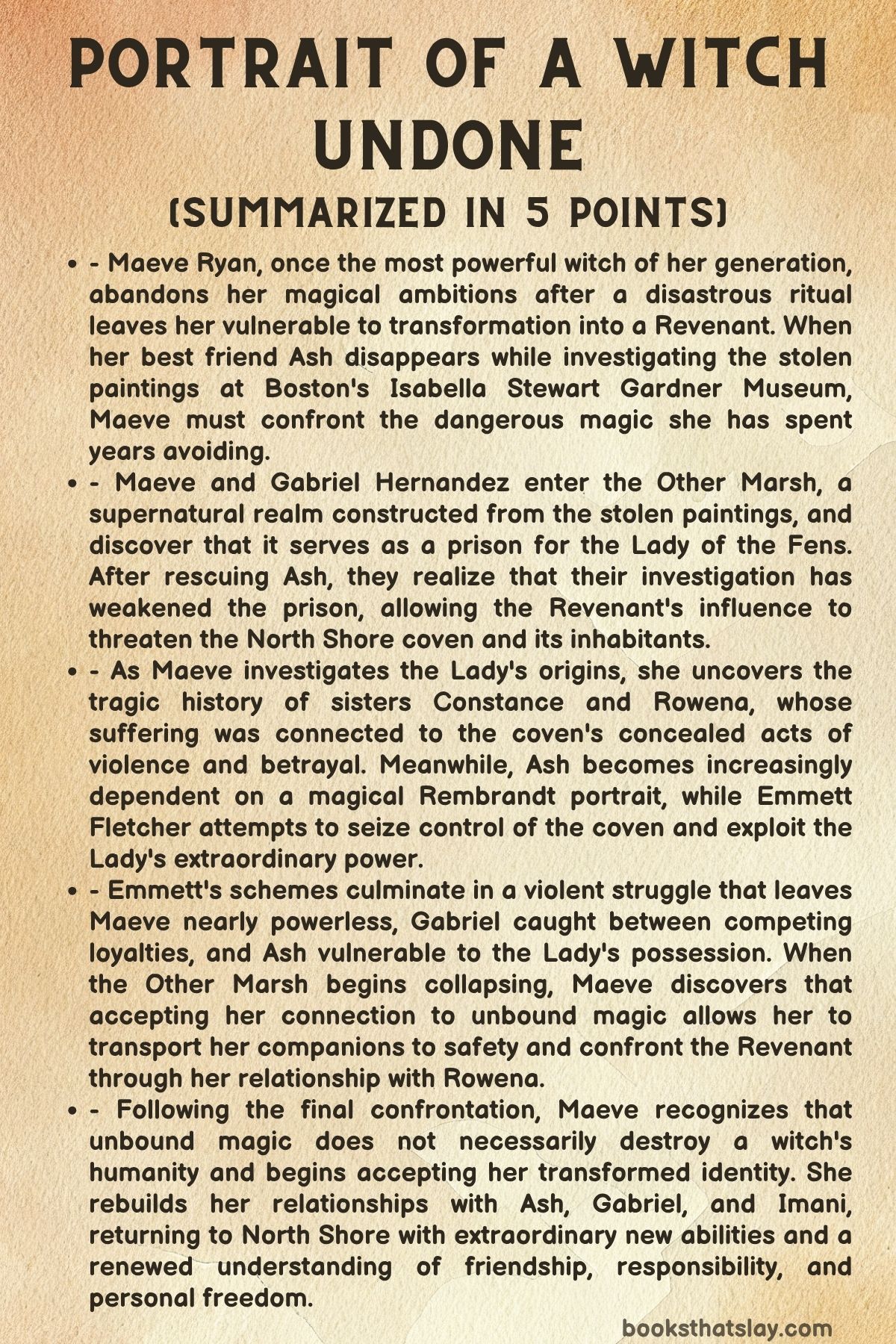
Maeve Ryan was once considered the most powerful witch of her generation and the natural successor to her grandmother, Matriarch Elizabeth, who leads the North Shore coven. However, a disastrous magical experiment has left Maeve terrified of her abilities, prompting her to abandon the coven and establish an ordinary life in Boston.
She works at a bookstore and avoids casting spells, hoping that distance from magic will protect her from the frightening transformation already taking place within her.
When Maeve returns to the Marsh House for the autumn equinox, she finds that her absence has changed the community. Her former rival, Imani Davis, has emerged as the leading candidate for matriarch, while Maeve’s mother continues criticizing her decision to abandon her magical responsibilities.
Only her best friend, Ash, welcomes her without judgment. Their reunion nevertheless carries the memory of an earlier tragedy that neither has fully overcome.
During the equinox ritual, Maeve notices a mysterious lantern attracting a young witch named Rosemary toward the marsh. She recognizes the light as belonging to the Lady of the Fens, an ancient Revenant believed to survive by consuming magic.
The encounter strengthens Maeve’s determination to remove her abilities permanently. She secretly steals the Hexionary, a forbidden spell book containing a ritual capable of stripping a witch of her power.
Her desperation originates in an accident involving Ash. A year earlier, the friends attempted to summon the Lady and obtain her legendary Favor, which supposedly grants an impossible wish.
The ritual went disastrously wrong when the Lady seized Ash. Maeve saved her by drawing upon unbound magic, but Ash suffered terrible injuries, and Maeve’s own power became unstable.
Since then, Maeve’s eyes have begun changing whenever she casts, suggesting that she is gradually becoming a Revenant herself. She believes sacrificing her magic is the only way to avoid harming another person.
Meanwhile, Ash has been investigating the mysterious disappearance of paintings from Boston’s Isabella Stewart Gardner Museum. She brings Maeve to the museum and reveals a concealed symbol on the empty frame of Rembrandt’s The Storm on the Sea of Galilee.
The symbol belongs to the Lady of the Fens. Ash believes the stolen artworks were taken not merely for their monetary value but because they could sustain an extraordinary magical construction.
Maeve refuses to investigate further, remembering the consequences of their previous encounter with the Lady. However, Ash proceeds independently and disappears through an enchanted passage connected to the paintings.
Fearing for her friend’s life, Maeve returns to the museum and encounters Gabriel Hernandez, a witch investigating the same mystery. Although Gabriel initially attempts to prevent her from entering the passage, they become reluctant allies.
Together, they enter the enchanted frame and arrive in the Other Marsh, an artificial reality containing distorted landscapes, animated paintings, and supernatural creatures.
Maeve immediately senses the presence of unbound magic, which threatens to accelerate her transformation. The Lady’s lantern repeatedly attempts to lure the intruders into dangerous water, while monstrous birds guard important locations.
As they search for Ash, Maeve and Gabriel discover that the stolen artworks serve as structural components of the Other Marsh. The Degas sketches, in particular, help maintain the magical environment.
Their investigation eventually reunites them with Ash, who reveals a disturbing truth: the Other Marsh is not the Lady’s kingdom but her prison.
Someone used the stolen Gardner paintings to imprison the Revenant, and disturbing the artwork has weakened the spell holding her captive. The three escape through an enchanted passage, but the Lady’s influence follows them into the ordinary world.
Back at North Shore, Maeve discovers that two children, Connor and Rosemary, have been attacked by supernatural forces connected to the marsh.
Matriarch Elizabeth blames Maeve and Ash for endangering the coven. Their difficulties worsen when Emmett Fletcher arrives with members of his own coven, seeking access to the paintings and the imprisoned Revenant.
Although Emmett presents himself as someone capable of helping, Maeve suspects that his interest is motivated by his desire for magical power.
Defying her grandmother’s restrictions, Maeve reunites with Ash and Gabriel. They devise a plan to repair the prison using alternative paintings associated with the Lady’s history.
Their research reveals that the Revenant’s origins are closely connected to North Shore itself. Through magical visions, Maeve discovers the history of two sisters, Constance and Rowena, whose relationship was destroyed by the coven’s decisions.
The evidence suggests that the Lady’s imprisonment followed acts of violence and betrayal concealed by generations of coven leadership.
Maeve begins questioning everything she has been taught about Revenants. She also learns that unbound magic may be a natural force rather than an inherently corrupting influence, raising the possibility that her transformation does not necessarily mean losing her humanity.
Nevertheless, she remains determined to remove her abilities, particularly after Connor dies from the injuries associated with the Lady’s attacks.
As the investigation continues, Maeve develops feelings for Gabriel. His knowledge of healing and his willingness to challenge her self-condemnation gradually make him someone she trusts.
However, Gabriel carries painful secrets concerning his former coven, the death of a witch named Lou, and a missing grimoire. Their growing affection becomes complicated by their reluctance to reveal their vulnerabilities.
Maeve’s relationship with Imani also begins changing. While investigating the coven cemetery, the former rivals discover additional evidence of the injustices surrounding Constance and Rowena.
Imani admits that she has spent years struggling to prove herself worthy of leadership, while Maeve begins recognizing the emotional cost of their competition.
Their discoveries lead the group to Star Island, where they encounter Sam, an artist connected to the original imprisonment.
Sam explains the involvement of the Order of the Feathered Skull, an organization responsible for constructing the magical prison. The group also discovers that Ms. Griswald possesses knowledge of the original conspiracy.
During this investigation, Maeve learns that Ash has secretly retained a stolen Rembrandt portrait from the Other Marsh.
The painting supplies extraordinary magical power, but every time Ash uses it, the Lady gains greater influence over her.
Ash refuses to surrender the artwork, arguing that its power is essential to saving the coven. Maeve fears that her friend is sacrificing herself in pursuit of magical significance.
Their disagreement becomes increasingly painful. Ash resents Maeve’s protective behavior, believing that her naturally gifted friend has never understood what it means to be considered magically inadequate.
When another attempt to repair the prison goes wrong, Ash draws upon the painting’s power and nearly falls under the Lady’s control.
She eventually abandons Maeve, declaring that she no longer requires her approval.
Meanwhile, Emmett challenges North Shore’s leadership through the Contest for matriarch. His intention is not simply to acquire authority but to gain control over the coven’s magical resources and exploit the imprisoned Revenant.
The Contest deteriorates into violence. Maeve is attacked, captured, and subjected to a brutal magical procedure that damages her abilities.
She also discovers that Gabriel has made a bargain with Emmett involving his missing grimoire. Believing that he has betrayed her, Maeve struggles to distinguish his genuine concern from his desperate pursuit of the book.
Her confrontation with her grandmother reveals further evidence of North Shore’s involvement in the Lady’s imprisonment.
Elizabeth admits that the coven leadership has concealed important truths, and she appears willing to allow the Lady to destroy the Fletchers if doing so will protect her own community.
Maeve rejects this willingness to sacrifice others for institutional survival.
After Gabriel enters the Other Marsh again, Maeve attempts to follow him but discovers that her familiar magic no longer responds.
For the first time, she confronts the reality of the powerlessness she once desired. Rather than feeling liberated, she experiences the loss as a separation from an essential part of herself.
An encounter with Sam changes her understanding of her condition. Sam demonstrates that bound and unbound magic need not exist in absolute opposition, suggesting that Maeve’s abilities may have transformed rather than disappeared.
Using this new understanding, Maeve returns to the Other Marsh.
There, she discovers that the magical prison is approaching collapse. Emmett continues pursuing the Lady’s power, convinced that he can control the Revenant through ordinary magical domination.
His confidence proves disastrous. The Lady turns against him, crushes his body, and consumes his magic.
As the survivors attempt to escape, Ash remains vulnerable to possession. The Lady exploits Maeve’s guilt and her fear of losing her friend, making their struggle as emotional as it is physical.
Gabriel and Maeve also confront their unresolved feelings. Despite the betrayals and misunderstandings between them, their continuing willingness to protect one another leads to a romantic reconciliation.
Their reunion occurs just as the Other Marsh begins collapsing.
With the enchanted frames becoming unusable, Maeve realizes that the remaining escape route lies within the unfamiliar power she has spent years resisting.
She perceives tiny spaces between the components of the magical construction and discovers that birds can move through these gaps.
Rather than attempting to restore her former abilities, she accepts her connection to unbound magic and uses it to transport the survivors out of the collapsing prison.
They return to the ordinary marshland, but the Lady remains free.
Maeve’s transformation has given her a new understanding of the marsh, allowing her to perceive Rowena’s lingering presence. She recognizes that Constance’s desire for revenge cannot be separated from her grief over her sister.
By freeing Rowena and confronting Constance, Maeve creates an opportunity to end the immediate threat.
The final confrontation resolves the Lady’s long imprisonment and brings the conflict surrounding the stolen paintings toward its conclusion.
In the aftermath, Maeve understands that her relationship with magic has permanently changed. She has neither returned to her former existence nor become the mindless monster she once feared.
Instead, she discovers that she can retain her identity while accepting both bound and unbound power.
Her relationships with Ash, Imani, and Gabriel also undergo significant changes. Each has confronted the consequences of personal ambition, secrecy, or fear.
Later, Maeve returns to the coven with a grackle familiar and extraordinary new abilities. She demonstrates her altered magic by retrieving the coven grimoire through the space between spaces.
A new lead concerning the missing Gardner artworks suggests that further mysteries remain.
However, Maeve no longer approaches the unknown through desperation or the need to prove herself. She accepts her connection to the marsh and recognizes that her future belongs to her, rather than to the expectations of her family or the limitations imposed by her former understanding of magic.
Characters
Maeve Ryan
Maeve Ryan is the protagonist of Portrait of a Witch Undone, and her struggle with magical identity provides the foundation for the novel’s central conflict. Once celebrated as the most gifted witch of her generation, she becomes terrified of her abilities after using unbound magic to save Ash from the Lady of the Fens.
Her transformation challenges the identity she developed during childhood, when her family and coven treated extraordinary magical strength as evidence of her destiny.
Maeve consequently attempts to construct a life in which magic no longer determines her value. Her employment at Norman’s Abnormal represents her desire for independence, while her determination to perform the forbidden stripping ritual demonstrates how completely fear has come to govern her decisions.
Her defining characteristic is her willingness to protect others, even when doing so places her in terrible danger. She enters the Other Marsh to rescue Ash, defies the matriarch to investigate the Lady, and repeatedly risks herself to prevent others from suffering.
However, this protectiveness becomes destructive when Maeve assumes responsibility for circumstances beyond her control.
She believes that Ash’s injuries, Connor’s death, and the deterioration of the Lady’s prison are ultimately her fault. This habit of self-condemnation prevents her from recognizing the responsibility of other individuals and institutions.
Her relationships expose different aspects of this struggle. Ash challenges her assumptions about magical privilege, Imani forces her to reconsider inherited competition, and Gabriel helps her understand that failure does not automatically invalidate a person’s worth.
Maeve’s most significant development occurs when she realizes that removing her abilities will not resolve the deeper conflict between her identity and her fear.
By accepting her altered connection to unbound magic, she rejects the rigid distinction between acceptable and forbidden power that has shaped her entire life.
Her eventual survival demonstrates that personal transformation does not necessarily require the destruction of one’s former identity.
At the conclusion, Maeve remains powerful, but her relationship with that power has fundamentally changed. She no longer seeks authority through the expectations of others or attempts to escape herself through magical sacrifice.
Instead, she becomes someone capable of defining her own responsibilities, accepting uncertainty, and maintaining relationships without surrendering her independence.
Ash
Ash is Maeve’s closest friend and one of the most emotionally complicated figures in Portrait of a Witch Undone. Her loyalty, intellectual curiosity, and desire for magical recognition repeatedly place her at the center of the novel’s most dangerous developments.
Although she lacks Maeve’s extraordinary natural abilities, Ash possesses considerable intelligence and an exceptional understanding of magical construction. Her investigation into the Gardner Museum theft demonstrates her capacity to identify patterns that more powerful witches have overlooked.
However, Ash’s curiosity is inseparable from a longstanding sense of inadequacy.
Growing up beside Maeve has left her feeling overshadowed, and she frequently interprets her friend’s protective behavior as evidence that Maeve considers her incapable.
This insecurity helps explain why she enters the enchanted frame alone despite the danger. She wants to accomplish something extraordinary without relying upon the friend whose magical strength has always attracted greater recognition.
Her discovery of the stolen Rembrandt portrait intensifies this conflict.
The painting offers access to abilities beyond her natural limitations, making it difficult for Ash to surrender even after discovering that the Lady can influence her through it.
Her growing dependence on the painting illustrates how the pursuit of recognition can distort otherwise admirable ambitions.
Ash genuinely wants to protect North Shore and repair the damaged prison, but her determination to prove herself gradually overrides her judgment.
Her relationship with Maeve consequently becomes strained by competing forms of fear.
Maeve fears that Ash will die if she continues using dangerous magic, while Ash fears that surrendering the painting will return her to a position of permanent inferiority.
Their conflict is especially painful because neither woman entirely understands the other’s insecurity.
Ash’s eventual resistance to the Lady demonstrates that her identity cannot be reduced to her magical ambition. Her loyalty and determination remain meaningful even when her choices have placed others in danger.
Ultimately, Ash represents the struggle to distinguish genuine personal achievement from the desperate pursuit of external validation.
Gabriel Hernandez
Gabriel Hernandez introduces an important emotional and moral counterpoint to Maeve’s understanding of magic.
Initially appearing suspicious and argumentative, he gradually emerges as a skilled witch whose apparent cynicism conceals grief, guilt, and a strong desire to recover something essential from his past.
His investigation into the stolen paintings is connected to his missing grimoire, which represents far more than a collection of magical knowledge.
The book is associated with his former life, his complicated relationship with the Fletcher Coven, and the unresolved circumstances surrounding Lou’s death.
Gabriel’s experience as a healer has taught him that magical ability cannot guarantee a successful outcome. This understanding allows him to recognize the destructive nature of Maeve’s belief that she must prevent every tragedy.
Nevertheless, Gabriel struggles to apply the same compassion to himself.
His determination to recover his grimoire repeatedly exposes him to manipulation, particularly when Emmett offers access to the object in exchange for cooperation.
His apparent betrayal of Maeve demonstrates how unresolved guilt can make even intelligent individuals vulnerable to dangerous bargains.
Yet Gabriel’s behavior cannot be understood solely through that betrayal.
His willingness to rescue Ash, protect Maeve, and return to the Other Marsh reveals that his emotional commitments remain genuine despite his mistakes.
His developing romance with Maeve is especially significant because both characters initially conceal their vulnerabilities behind defensive behavior.
Gabriel uses sarcasm and emotional withdrawal to avoid confronting his feelings, while Maeve interprets his hesitation through her own fear of being fundamentally unacceptable.
Their eventual reconciliation requires them to recognize that trust involves acknowledging imperfect decisions rather than demanding complete emotional certainty.
Gabriel’s artistic portrayal of Maeve also reveals his capacity to perceive qualities she has forgotten about herself.
Through his character, the novel examines the difficulty of recovering from failure without allowing the past to determine every future choice.
Imani Davis
Imani Davis begins as Maeve’s rival for the position of North Shore matriarch, but her character gradually reveals the pressures beneath this competition.
Unlike Maeve, whose exceptional magical abilities once made her an obvious successor, Imani has spent years attempting to establish her worth through discipline, achievement, and unwavering commitment to the coven.
Her ambition is consequently rooted in a complicated relationship with belonging.
Although her family has longstanding connections to North Shore, she has frequently experienced the feeling of being treated as an outsider.
This experience makes her especially sensitive to the differences between inherited privilege and earned recognition.
Maeve’s apparent rejection of her responsibilities initially frustrates Imani because it seems to represent a disregard for opportunities that others have struggled to obtain.
Her adherence to the matriarch’s authority also reflects her belief that institutional stability is essential to the coven’s survival.
However, Imani’s investigation alongside Maeve forces her to reconsider the reliability of that authority.
Their discovery of the suppressed history surrounding Constance and Rowena reveals that the coven’s official account has concealed serious wrongdoing.
Imani’s willingness to investigate these truths demonstrates that her loyalty is not merely obedience.
She gradually recognizes that protecting a community may require questioning its leaders rather than defending every inherited decision.
Her relationship with Maeve develops from resentment into cooperation as they discover their shared concern for North Shore.
Imani ultimately represents a model of leadership grounded in accountability, perseverance, and responsibility rather than the possession of exceptional magical strength.
Matriarch Elizabeth
Matriarch Elizabeth is Maeve’s grandmother and the leader of the North Shore coven.
Her authority shapes the community’s social structure, succession practices, and understanding of magical responsibility.
She initially appears to embody the stability that protects witches from supernatural threats. However, her decisions increasingly reveal the moral compromises underlying that stability.
Elizabeth expects Maeve to fulfill the destiny associated with her extraordinary abilities, leaving little room for her granddaughter’s fear or personal independence.
Her treatment of Maeve demonstrates how familial affection can become entangled with institutional expectations.
When the Lady’s prison begins deteriorating, Elizabeth attempts to maintain control through restrictions, secrecy, and the enforcement of coven bonds.
Her willingness to conceal the history of Constance and Rowena reveals that preserving institutional legitimacy matters deeply to her.
The most troubling aspect of her leadership emerges when she considers allowing the Revenant to destroy the Fletchers.
This calculation demonstrates her willingness to expose outsiders to danger if doing so protects North Shore.
Elizabeth is therefore not simply an authoritarian obstacle to Maeve’s independence.
She represents a system in which the responsibility to protect a community has gradually become an excuse for withholding information and tolerating injustice.
Her relationship with Maeve illustrates the difficulty of challenging inherited authority when that authority is also connected to family, affection, and personal identity.
Emmett Fletcher
Emmett Fletcher is a principal antagonist whose pursuit of magical authority threatens both North Shore and the imprisoned Lady.
He presents himself as a knowledgeable and influential witch capable of resolving the crisis surrounding the Gardner paintings.
However, his actions reveal an ambition that extends beyond repairing the damaged prison.
Emmett recognizes the extraordinary power contained within the Other Marsh and seeks to exploit it for his own purposes.
His attempt to challenge North Shore’s leadership through the Contest demonstrates his willingness to use established institutions as instruments of personal advancement.
He also understands how to manipulate individual vulnerabilities.
His arrangement with Gabriel exploits the healer’s attachment to his missing grimoire, while his treatment of Ash attempts to turn her dangerous connection to the Lady into a strategic advantage.
Emmett’s defining flaw is his conviction that supernatural power can be controlled through sufficient knowledge, preparation, and domination.
He interprets the Lady primarily as a resource rather than as an independent being with her own history and intentions.
His eventual death directly exposes the limitations of this worldview.
When the Lady turns against him and consumes his magic, the power he sought to command becomes the instrument of his destruction.
Through Emmett, the novel explores the consequences of treating magical beings, historical objects, and other people as possessions to be acquired.
Constance / The Lady of the Fens
Constance, known as the Lady of the Fens, is the central supernatural antagonist of Portrait of a Witch Undone. Her identity as a Revenant initially makes her appear to be an embodiment of forbidden magic and predatory supernatural hunger.
Her lantern, monstrous birds, and ability to manipulate the marsh create an atmosphere of persistent danger.
She threatens witches by consuming their magic and attempts to extend her influence beyond the prison constructed from the stolen Gardner paintings.
However, the gradual revelation of her history complicates this initial characterization.
Constance’s transformation is connected to the death of her sister, Rowena, and the decisions made by North Shore’s former leadership.
Her anger consequently emerges from a history of loss and betrayal rather than from an inexplicable desire for destruction.
This does not excuse the suffering she inflicts upon innocent people.
Instead, it establishes that victimhood and cruelty can coexist within the same individual.
Her manipulation of Ash demonstrates how effectively she exploits emotional vulnerability.
She recognizes Ash’s desire for power and Maeve’s terror of losing her friend, using these weaknesses to undermine their resistance.
Constance’s relationship with Rowena remains central to her identity.
Her attachment to her sister provides the emotional foundation for her rage, while the separation between them has helped sustain her destructive existence.
Her confrontation with Maeve becomes significant because Maeve recognizes similarities between Constance’s grief and her own fear of losing Ash.
The Lady ultimately represents the destructive possibilities of love when grief transforms attachment into an overwhelming desire for revenge.
Rowena
Rowena is Constance’s sister and an essential figure in the concealed history of North Shore.
Although she initially appears through visions and fragments of the past, her experiences gradually become central to understanding the Lady’s origins.
Her relationship with Constance reveals that the Revenant was once connected to an ordinary human world of affection, family, and belonging.
The violence surrounding Rowena’s death exposes the responsibility of the coven’s former leadership in creating the circumstances that eventually produced the Lady.
Rowena therefore provides an emotional counterweight to the official narrative that treats the Revenant as an isolated supernatural threat.
Her lingering presence also suggests that the consequences of historical violence cannot be contained simply by imprisoning the individual who survived it.
Maeve’s eventual recognition of Rowena’s presence changes the direction of the final confrontation.
Rather than relying exclusively on overwhelming magical strength, Maeve responds to the relationship at the center of Constance’s suffering.
Rowena’s character demonstrates how recovering a suppressed history can reveal possibilities that conventional forms of power cannot provide.
Sam
Sam is an artist connected to the original construction of the Other Marsh and the imprisonment of the Lady.
The character possesses knowledge of the Order of the Feathered Skull, the magical properties of the stolen paintings, and the historical circumstances surrounding the prison.
Sam’s importance extends beyond providing information.
The character challenges Maeve’s understanding of the relationship between bound and unbound magic.
Through Sam’s unusual magical nature, Maeve discovers that the categories established by her coven may be less absolute than she has always believed.
This revelation becomes essential after Maeve loses access to her familiar abilities.
At a moment when she believes that her magical identity has been destroyed, Sam introduces the possibility that her power has changed rather than disappeared.
Sam consequently functions as a guide toward a more flexible understanding of magic.
The character’s connection to the original imprisonment also raises questions about the responsibility of individuals who participate in institutional decisions that later produce serious harm.
Tristan
Tristan is a member of the Fletcher faction whose actions demonstrate the immediate dangers associated with Emmett’s pursuit of power.
He participates in the violence surrounding the Contest and attacks Maeve with a spell jar containing a traumatic magical memory.
His cruelty reinforces the threatening character of the Fletcher operation.
Tristan also exploits Gabriel’s attachment to his missing grimoire, recognizing that emotional vulnerability can be used as effectively as physical force.
Unlike Emmett, whose ambition is expressed through elaborate plans and political maneuvering, Tristan frequently represents the direct enforcement of those ambitions.
His behavior exposes how powerful leaders depend upon individuals willing to carry out intimidation and violence.
His confrontations with Maeve and Gabriel also demonstrate that knowledge of another person’s suffering can become a weapon when empathy is replaced by manipulation.
Maeve’s Mother
Maeve’s mother represents the influence of family expectations upon individual identity.
Her persistent criticism of Maeve’s refusal to practice magic reflects her investment in the values established by North Shore’s leadership.
She struggles to understand why someone possessing extraordinary abilities would willingly abandon them.
Her response to Maeve’s transformation consequently becomes another source of emotional isolation for her daughter.
Rather than recognizing the depth of Maeve’s fear, she frequently approaches the situation through expectations concerning duty, reputation, and magical responsibility.
Her reluctance to challenge Elizabeth further illustrates the difficulty of resisting established authority within a tightly organized family structure.
Although she is not the primary antagonist, her behavior contributes to Maeve’s belief that acceptance depends upon fulfilling a predetermined role.
Ms. Griswald
Ms. Griswald is a secondary character whose association with the Order of the Feathered Skull connects the present investigation to the original imprisonment of the Lady.
Her knowledge helps establish that the supposedly mysterious supernatural threat has a documented history involving members of the magical community.
Her guarded reactions to discussions about the Lady suggest that the older generation understands considerably more than it initially admits.
Through her association with the Order, the novel demonstrates how historical secrets can survive within ordinary relationships and institutions.
Her character also reinforces the importance of questioning accepted explanations when those explanations have been shaped by individuals with reasons to conceal the truth.
Rosemary and Connor
Rosemary and Connor are young members of North Shore whose suffering establishes the human cost of the deteriorating magical prison.
Rosemary first encounters the Lady’s lantern during the autumn equinox, when Maeve prevents her from following its dangerous attraction.
Her later attack demonstrates that the threat has extended beyond the enchanted paintings and entered the ordinary lives of the coven’s children.
Rosemary eventually awakens without her magical abilities, suggesting that survival can still involve a profound loss.
Connor’s fate is more devastating.
His death intensifies the community’s fear and gives Maeve another reason to condemn herself for the consequences of the investigation.
Neither child bears responsibility for the decisions that created the Lady’s prison or weakened its protections.
Their suffering therefore emphasizes the disproportionate consequences that the mistakes of powerful adults can impose upon vulnerable members of a community.
Lou
Lou is a deceased witch whose history remains central to Gabriel’s emotional development.
Her death has contributed to the accusations made against him by members of the Fletcher Coven.
Although she is not an active participant in the present conflict, her absence continues shaping Gabriel’s decisions.
His relationship with his former companions, his guilt, and his determination to recover his grimoire are all influenced by the unresolved events surrounding her death.
Lou’s narrative significance lies in demonstrating how a person can remain psychologically bound to an earlier tragedy.
Her history also establishes a parallel between Gabriel and Maeve, both of whom allow past failures to influence their understanding of their own worth.
Themes
Identity, Transformation, and Self-Acceptance
Maeve’s fear of becoming a Revenant establishes a conflict between personal identity and the physical changes that appear to threaten it. Having spent her childhood understanding herself through extraordinary magical talent, she discovers that the very abilities once associated with her future now seem capable of destroying it.
Her initial response is to reject magic altogether.
The forbidden stripping ritual represents her belief that identity can be preserved by removing the part of herself that has become frightening. She imagines that a powerless existence will allow her to escape the consequences of her earlier accident.
However, Portrait of a Witch Undone challenges the assumption that safety and self-acceptance require complete separation from dangerous or unfamiliar aspects of the self.
Maeve’s experiences demonstrate that suppressing her abilities does not eliminate her guilt, resolve her relationships, or provide a stable understanding of who she is.
The loss of her familiar magic further complicates this struggle.
When her abilities are damaged during the Contest, she discovers that achieving the powerlessness she once desired feels less like liberation than the loss of something essential.
Her encounter with Sam introduces a different possibility: transformation may alter the expression of identity without necessarily destroying the individual.
The distinction between bound and unbound magic subsequently becomes a metaphor for the limitations of rigid categories.
Maeve’s eventual acceptance of her changed abilities allows her to recognize that identity is not fixed by childhood expectations or past mistakes.
Her transformation also changes her relationship with responsibility.
Instead of believing that she must control every consequence of her power, she learns to make decisions while acknowledging uncertainty.
The conclusion consequently presents self-acceptance not as a return to an earlier, supposedly perfect existence but as the ability to live meaningfully with irreversible change.
Friendship, Insecurity, and the Desire for Recognition
Maeve and Ash’s relationship demonstrates how genuine affection can become strained when friendship develops within an unequal social environment.
Both women care deeply for one another, yet their understanding of the relationship is shaped by very different experiences of magical ability.
Maeve has spent her life being celebrated for her extraordinary strength, while Ash has struggled to establish herself beside someone whose natural abilities attract recognition.
Their conflict develops because neither fully appreciates the emotional consequences of the other’s position.
Maeve views her power primarily through the suffering it has caused, making her increasingly determined to protect Ash from further magical danger.
Ash, however, interprets this protectiveness through her own history of feeling inadequate.
When Maeve questions her ability to perform dangerous spells, Ash hears confirmation that her friend considers her inferior.
The stolen Rembrandt portrait intensifies the struggle by offering Ash the extraordinary power she has always wanted.
Although using the painting creates a dangerous connection to the Lady, Ash finds it difficult to surrender because it allows her to experience a form of magical significance previously denied to her.
Her dependence on the object illustrates how the desire for recognition can make external validation more important than personal safety.
Maeve’s opposing desire to abandon magic is equally revealing.
Where Ash believes that possessing more power will resolve her insecurity, Maeve believes that possessing none will resolve hers.
Both characters therefore attempt to solve emotional problems by changing their relationship with magical ability.
Their eventual confrontation demonstrates that neither approach adequately addresses the underlying need for acceptance.
Friendship requires recognizing another person’s autonomy without treating every disagreement as rejection.
Through their painful experiences, the novel examines how affection becomes healthier when individuals acknowledge their insecurities rather than allowing comparison to govern their relationships.
Institutional Power, Secrecy, and Historical Injustice
North Shore’s leadership initially appears to provide the structure necessary for protecting its members from supernatural danger.
The coven possesses established rituals, inherited knowledge, a formal succession process, and powerful magical bonds that maintain collective order.
However, these same mechanisms become instruments of control when the leadership prioritizes its authority over transparency.
Matriarch Elizabeth’s treatment of Maeve demonstrates how institutional responsibility can be interpreted as an obligation to obey rather than an opportunity to exercise independent judgment.
The concealed history of Constance and Rowena reveals a more serious consequence of this approach.
The Lady’s imprisonment was not simply an isolated act of supernatural defense.
It emerged from a history involving violence, personal betrayal, and decisions made by the coven’s own members.
By concealing these events, successive generations have preserved an incomplete understanding of the threat facing them.
The community consequently treats the Revenant as an inexplicable monster while remaining largely ignorant of the circumstances that contributed to her transformation.
This selective preservation of history allows the institution to protect its reputation without confronting its responsibility.
In Portrait of a Witch Undone, the investigation into the stolen paintings becomes inseparable from the recovery of suppressed historical knowledge.
Each discovery challenges an explanation previously accepted by the characters.
Imani’s development is particularly important because she demonstrates that loyalty to a community need not require unquestioning loyalty to its leaders.
Her willingness to investigate the past alongside Maeve suggests that institutional belonging can coexist with critical examination.
Emmett provides a contrasting illustration of power exercised without accountability.
His attempt to acquire the matriarchy demonstrates how formal structures can be exploited by individuals seeking personal advancement.
Ultimately, the novel suggests that genuine communal protection requires historical honesty, moral responsibility, and a willingness to question inherited systems.
The Nature of Power and the Limits of Control
Magic operates throughout the novel as both a practical force and an expression of the characters’ assumptions about control.
Maeve initially believes that her abilities make her dangerous because she cannot guarantee their consequences, while Ash believes that greater magical strength will allow her to overcome her perceived limitations.
Emmett approaches power through an even more possessive understanding.
He treats the Lady, the stolen paintings, and the coven’s magical resources as instruments that can be acquired and directed through sufficient preparation.
These competing attitudes reveal a shared assumption: possessing the correct amount or form of power will resolve the characters’ deepest uncertainties.
The events surrounding the Other Marsh repeatedly challenge that belief.
Maeve’s extraordinary strength cannot prevent Ash’s injuries or Connor’s death.
Ash’s access to the Rembrandt gives her abilities beyond her natural limitations but also exposes her to the Lady’s manipulation.
Emmett’s elaborate schemes end catastrophically when the Revenant refuses to submit to his authority.
Gabriel’s experiences as a healer reinforce the same principle through a different kind of suffering.
His inability to prevent every tragedy demonstrates that even knowledge and benevolent intentions cannot guarantee control over the outcome of an action.
The distinction between bound and unbound magic further complicates the characters’ understanding of power.
North Shore’s teachings present bound magic as manageable and unbound magic as inherently threatening.
Maeve’s transformation reveals that this division is insufficient to explain the nature of either force.
Her eventual ability to escape the collapsing Other Marsh emerges only when she abandons the attempt to impose her former understanding upon the unfamiliar magic surrounding her.
Rather than conquering the unbound, she learns to recognize its possibilities and work within its nature.
This development offers a different model of strength, one based on understanding, adaptability, and responsible choice.
The novel ultimately distinguishes the possession of power from the wisdom required to use it, suggesting that genuine mastery begins with recognizing the limitations of control.