Pride and Prejudice Summary and Key Themes
Pride and Prejudice by Jane Austen is a timeless romance that explores themes of love, marriage, social class, and personal growth.
Set in rural England, it centers around Elizabeth Bennet, a witty and independent young woman, and her evolving relationship with the wealthy, reserved Mr. Darcy. As the story unfolds, Elizabeth’s initial prejudice against Darcy gives way to admiration as she discovers his true character. Through their journey, the novel examines the impact of first impressions, the consequences of pride and prejudice, and the transformative power of love and understanding. This work remains one of the most beloved classics in English literature.
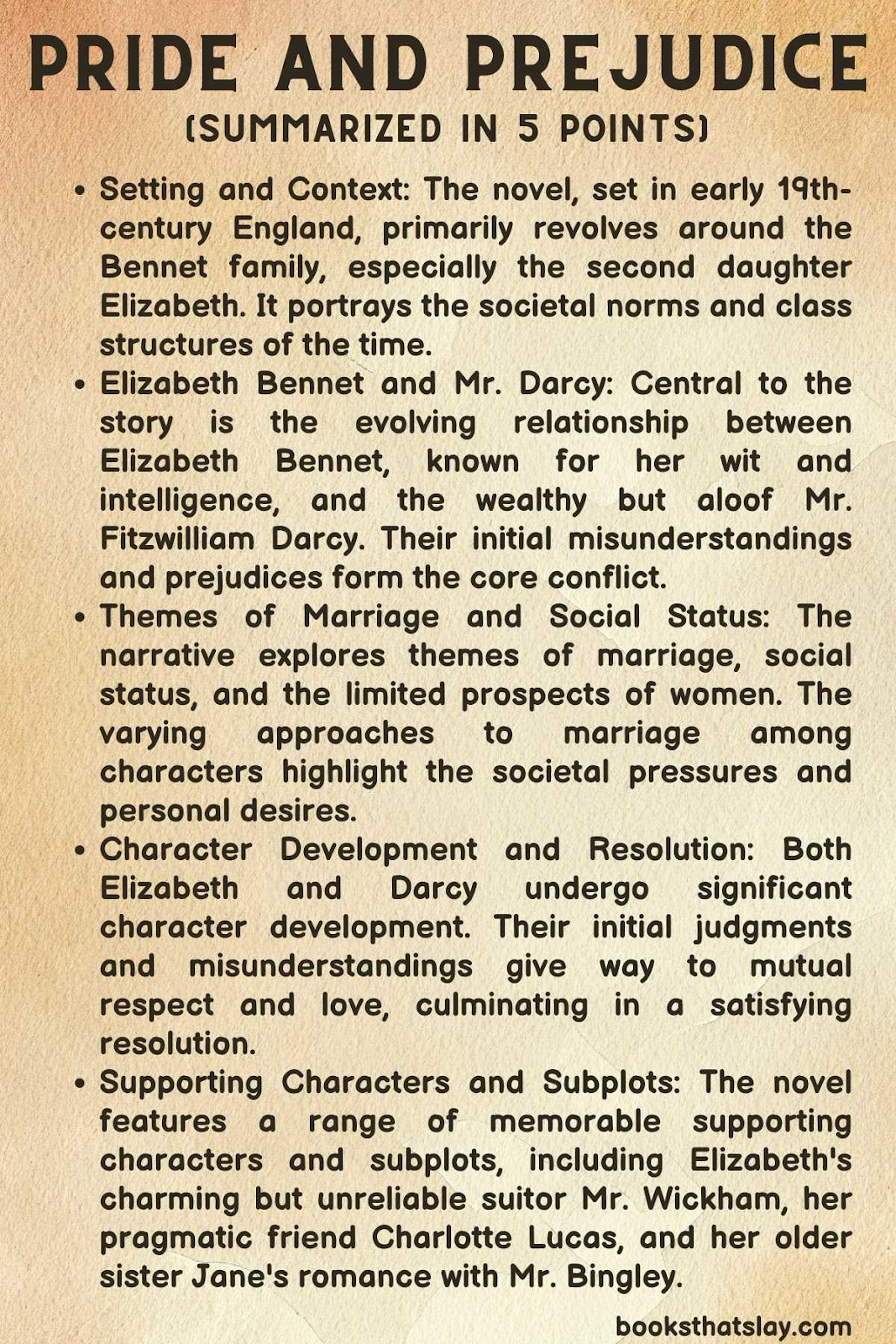
Summary
The story of Pride and Prejudice begins with the Bennet family learning about the arrival of Mr. Charles Bingley, a wealthy bachelor who has rented Netherfield Park near their home.
Mrs. Bennet is eager to marry one of her daughters to him and insists her husband, Mr. Bennet, visit him. While Mr. Bennet reluctantly agrees, he is more interested in the gossip than the prospect of a marriage match. During a ball, Mr. Bingley immediately takes a liking to Jane, the eldest Bennet daughter, though Mrs. Bennet mistakenly believes he may be drawn to Elizabeth.
At the ball, Elizabeth meets Mr. Darcy, Bingley’s wealthy and seemingly aloof friend. Darcy, despite his good looks and wealth, acts distant and dismissive, even refusing to dance with Elizabeth, calling her “tolerable, but not handsome enough to tempt me.” This comment stirs Elizabeth’s dislike for Darcy, setting the tone for their complex relationship.
Soon after, Jane falls ill during a visit to the Bingleys, and Elizabeth walks three miles to check on her, impressing Darcy with her determination. Despite the condescending behavior of Bingley’s sisters, Elizabeth begins to notice Darcy’s subtle interest in her. While Bingley shows kindness to Jane, Darcy’s growing admiration for Elizabeth complicates his feelings. Elizabeth, however, remains suspicious of Darcy’s intentions, especially as she continues to see him as prideful.
Meanwhile, Elizabeth’s younger sister, Lydia, is obsessed with the local officers, particularly Captain Carter, and her flirtations cause some concern for their parents. Lydia’s actions often leave her mother in a state of excited anticipation, but Mr. Bennet disapproves of her behavior.
As Jane’s health improves, Elizabeth and Darcy’s interactions continue to evolve. Darcy’s coldness and Elizabeth’s distrust of him persist, although his behavior seems to shift toward an interest in her. This ongoing tension between the two continues to shape their interactions, with Darcy showing subtle affection and Elizabeth increasingly aware of his regard.
While Jane’s romance with Bingley continues to develop, Mrs. Bennet remains optimistic about Jane’s future, hoping for a proposal from Bingley. However, Darcy’s feelings for Elizabeth grow, and despite his pride, he cannot help but be drawn to her wit and intelligence. As time passes, Darcy begins to see beyond Elizabeth’s lower social status and is captivated by her independence.
In the midst of this, Mr. Collins, a clergyman and cousin to the Bennets, arrives at Longbourn. He is pompous, self-important, and eager to marry one of the Bennet daughters due to the inheritance of the family estate. He initially proposes to Jane but, after being told she is likely engaged, turns his attention to Elizabeth. Elizabeth rejects his proposal, much to her mother’s displeasure.
While Elizabeth is in Meryton, she meets a charming officer named Mr. Wickham, who seems to have a history with Darcy. Wickham tells Elizabeth that Darcy wronged him by denying him a promised church living, sparking Elizabeth’s sympathy for Wickham and her disdain for Darcy. She shares this information with Jane, who, ever the optimist, remains unconvinced by Wickham’s story.
Bingley invites the Bennet family to the Netherfield ball, where Darcy and Elizabeth have another tense encounter. Darcy, acknowledging his growing feelings for Elizabeth, asks her to dance, though their interaction is marked by tension and irony. Meanwhile, Miss Bingley mocks Elizabeth, and the family dynamics at the ball lead to further embarrassment for Elizabeth, particularly when her mother makes crude comments about Jane’s impending engagement.
In a shocking turn of events, Darcy proposes to Elizabeth, but his proposal is filled with condescension. He admits he has struggled with his feelings but insists that he has overcome his objections regarding her family’s lower social standing. Elizabeth rejects him, citing his interference in Jane’s relationship with Bingley and his treatment of Mr. Wickham. Darcy is initially shocked but leaves without further comment.
The following day, Darcy sends Elizabeth a letter, explaining his actions. He reveals that he separated Bingley from Jane because he believed Jane was not genuinely in love with Bingley and that his actions were motivated by concern for his friend. He also recounts the truth about Wickham, explaining that Wickham had been deceitful and had tried to elope with Darcy’s sister, Georgiana. Elizabeth, after reading the letter, begins to reconsider her harsh judgment of Darcy and realizes that she may have been too quick to believe Wickham’s version of events.
As time passes, Elizabeth’s understanding of Darcy grows. She and her aunt and uncle visit Pemberley, Darcy’s estate, where they are greeted warmly by Darcy’s housekeeper, who speaks highly of him. Darcy, to Elizabeth’s surprise, acts with politeness and civility, and their interaction hints at a budding reconciliation. Elizabeth begins to see Darcy in a new light, and her feelings for him begin to shift.
After some time, Bingley returns to Longbourn and proposes to Jane, much to Mrs. Bennet’s delight. Meanwhile, Darcy continues to visit Elizabeth, and their relationship deepens. Lady Catherine de Bourgh, Darcy’s aunt, visits Elizabeth and attempts to pressure her into rejecting Darcy’s advances, but Elizabeth refuses to comply.
Finally, Darcy proposes to Elizabeth once more, and this time, she accepts. Their engagement is met with joy, and they share their happiness with their family. Elizabeth later reveals Darcy’s role in facilitating Lydia’s marriage to Wickham, an act that had previously been kept secret.
The couple’s relationship is solidified, and the novel ends with their marriage, symbolizing the triumph of love and understanding over pride and prejudice. The story concludes with the Bennet sisters married, with Jane and Bingley living near Darcy and Elizabeth, and Lydia and Wickham continuing their turbulent life.
Characters
Mr. Fitzwilliam Darcy
Mr. Fitzwilliam Darcy, one of the central characters in Pride and Prejudice, initially appears as a wealthy, aloof, and seemingly proud gentleman. His behavior, particularly his refusal to dance with Elizabeth Bennet at the Meryton ball, leads her to view him as arrogant and disdainful.
However, as the story progresses, Darcy’s true character is revealed. His pride stems from his high social standing, and he often shows a reserved demeanor, particularly when interacting with people of lower social rank, such as Elizabeth’s family. Despite his initial actions, Darcy’s character evolves as he falls deeply in love with Elizabeth, transcending his pride.
His acts of kindness, like helping to arrange Lydia’s marriage and guiding Bingley’s actions toward Jane, show his hidden depth and care for those he loves. Darcy’s transformation from a seemingly prideful man to one who humbles himself for Elizabeth’s love illustrates the depth of his internal growth. His willingness to change and confront his flaws is one of the novel’s most significant character developments.
Elizabeth Bennet
Elizabeth Bennet, the protagonist of Pride and Prejudice, is intelligent, witty, and known for her sharp sense of humor. Her views on marriage and society are shaped by her strong independence and her refusal to conform to traditional expectations.
At the beginning of the novel, Elizabeth is quick to judge others, particularly Mr. Darcy, based on initial impressions and hearsay. Her initial prejudice against Darcy stems from his perceived arrogance and his rejection of her at the ball. As the story unfolds, Elizabeth’s character undergoes a transformation as she confronts her own misjudgments, especially regarding Darcy and Wickham. Her keen observations and her eventual realization of her own pride allow her to grow emotionally. Elizabeth’s wit and strength of character make her one of the most enduring and beloved heroines in classic literature.
Her eventual acceptance of Darcy’s love reflects her personal growth, as she learns to see beyond superficial judgments and embraces both his faults and virtues.
Mr. Charles Bingley
Mr. Charles Bingley is introduced as a wealthy, cheerful, and affable man who rents Netherfield Park.
His amiable nature and kindness immediately attract the attention of Jane Bennet, and it is clear that he harbors deep affection for her. Although he is portrayed as a gentleman with a good heart, Bingley lacks the assertiveness and strength of character that Darcy possesses. His susceptibility to the opinions of others, particularly his sisters and Darcy, causes him to hesitate in pursuing Jane at certain points. However, Bingley is not as proud as Darcy, and his willingness to return to Jane after Darcy’s interference reveals his true feelings.
His character is defined by his gentle disposition, sensitivity, and his eventual courage to defy the influence of others for the sake of love. Bingley’s devotion to Jane and his happy marriage to her provide a contrast to the more tumultuous relationship between Darcy and Elizabeth, highlighting the novel’s theme of different forms of love and personal growth.
Jane Bennet
Jane Bennet, the eldest Bennet daughter, is the picture of beauty, grace, and kindness. Throughout Pride and Prejudice, Jane’s temperament remains steady and calm, rarely showing the same sharpness or wit as her younger sister, Elizabeth.
Her modesty and quiet nature contrast sharply with the more overt personalities of her sisters. Jane’s relationship with Mr. Bingley, while initially appearing as a perfect match, faces several obstacles, most notably the interference of Darcy and his sisters, who wrongly believe that Jane does not return Bingley’s affections. Despite these setbacks, Jane’s deep love for Bingley never wavers.
Her character is often seen as a foil to Elizabeth’s more outspoken personality, as Jane tends to avoid conflict and maintains an optimistic view of the world. Over the course of the novel, Jane learns to navigate the complexities of love and social expectations, ultimately finding happiness with Bingley.
Lydia Bennet
Lydia Bennet, the youngest of the Bennet sisters, is characterized by her flirtatiousness, immaturity, and lack of prudence.
Throughout Pride and Prejudice, Lydia is depicted as someone who is preoccupied with the superficial aspects of life, such as her attraction to soldiers and her desire to catch the eye of the local officers. She lacks the wisdom or introspection of her older sisters and often acts without regard for the consequences of her actions. Lydia’s impulsive nature leads to a scandal when she runs away with Mr. Wickham, putting the family in jeopardy.
While Lydia’s actions are reckless and selfish, they serve to highlight the contrasting nature of Elizabeth’s more thoughtful and rational approach to life. Despite her immaturity, Lydia’s eventual marriage to Wickham provides a resolution to her storyline, although her behavior remains largely unchanged, and she continues to rely on others for support.
Mr. William Collins
Mr. William Collins is the clergyman cousin of the Bennet family and the heir to the Longbourn estate.
He is a pompous, self-important man, overly concerned with social propriety and eager to please his benefactor, Lady Catherine de Bourgh. Collins is the epitome of obsequiousness, often lavishing praise on Lady Catherine and blindly following her every wish.
His proposal to Elizabeth, which she rejects, is an example of his lack of genuine understanding of love and marriage. Rather than recognizing Elizabeth’s feelings, he sees marriage as a duty and a form of obligation to secure the family estate.
His absurdity and lack of self-awareness provide much of the novel’s comedic relief. Despite his failings, Collins is not an inherently malicious character; rather, he is a victim of his own naivety and the influence of his social position.
Lady Catherine de Bourgh
Lady Catherine de Bourgh is one of the novel’s most notable antagonists. As the wealthy aunt of Mr. Darcy and the mother of Miss Anne de Bourgh, she embodies the aristocratic snobbery and condescension that are central themes of Pride and Prejudice.
Lady Catherine is proud, domineering, and believes herself to be superior to everyone around her, particularly the Bennet family. Her interference in Elizabeth and Darcy’s relationship, as well as her demand that Elizabeth promise never to accept Darcy’s proposal, underscores her belief in controlling the lives of others for her own convenience. Despite her strong will and her belief in social hierarchy, Lady Catherine is eventually shown to be more vulnerable than she lets on, particularly when she reacts to Darcy and Elizabeth’s engagement. Her character serves as a foil to Elizabeth’s independent spirit, representing the oppressive social structures that Elizabeth rejects.
Mr. George Wickham
Mr. George Wickham is a charming, handsome, and seemingly affable man who initially wins Elizabeth’s favor through his pleasant demeanor and his captivating story about his relationship with Mr. Darcy. Wickham’s narrative, in which he accuses Darcy of withholding a promised living, fuels Elizabeth’s animosity toward Darcy.
However, as the story unfolds, Wickham’s true character is revealed. He is shown to be deceitful, self-serving, and manipulative, particularly in his dealings with Lydia Bennet. His attempt to elope with Georgiana Darcy, his greed, and his disregard for the consequences of his actions reveal him to be a morally compromised individual.
Wickham’s role in the story is crucial as he serves as a catalyst for Elizabeth’s realization of Darcy’s true character and the complexities of human motives.
Themes
Social Class and Marriage
Throughout Pride and Prejudice, the social structure and the role it plays in marriage decisions is a central theme.
Marriage in this society is often seen as a social contract, and much of the book revolves around characters navigating the expectations tied to their social status. The Bennet family’s struggle to find suitable husbands for their daughters is a direct reflection of this societal pressure. Mrs. Bennet, for instance, is driven by the desire to secure her daughters’ futures, believing that a marriage to a wealthy man like Mr. Bingley would provide stability and respectability. However, this notion is complicated by the arrival of Mr. Darcy, who comes from a higher social class, and yet his initial disdain for Elizabeth is rooted in her lower status.
Darcy’s pride, fueled by his sense of superiority due to wealth and lineage, contrasts with Elizabeth’s more egalitarian views. Her initial resistance to his advances stems not only from his arrogance but also from his belief in the importance of class. It is only when Darcy begins to understand the complexities of his feelings, and Elizabeth grows more aware of her own worth, that the traditional class-based barriers to their union start to fall apart.
Their eventual marriage represents a reconciliation of social class distinctions, challenging the idea that marriage should only be between equals in wealth and status.
Personal Growth and Self-Reflection
A key element of Pride and Prejudice is the theme of personal growth, with both Elizabeth and Darcy undergoing significant changes in their attitudes and perspectives. Darcy’s journey is one of humility, as his initial pride and sense of superiority are gradually dismantled by his admiration for Elizabeth’s wit and character.
He is forced to confront the ways in which his actions, particularly his interference in Jane and Bingley’s romance, were motivated by his own prejudices and assumptions. Elizabeth, too, experiences personal growth, as her initial judgment of Darcy, based on her perception of his arrogance, is later challenged when she uncovers the truth of his actions. Her ability to reconsider her earlier conclusions and acknowledge her own biases is a testament to her character’s depth.
As the two characters grow, they learn to see beyond first impressions, ultimately leading to a more authentic connection. Their evolution reflects the idea that personal growth is essential in overcoming misunderstandings and building meaningful relationships.
Pride and Prejudice
The very title of the novel points to the dual nature of this theme, with both pride and prejudice playing significant roles in shaping the characters’ relationships. Darcy’s pride in his social status leads him to dismiss people like Elizabeth, who he initially perceives as beneath him due to her family’s lack of wealth and decorum.
On the other hand, Elizabeth’s prejudice against Darcy is born out of her initial negative impressions, particularly after his dismissive behavior toward her at the ball. The tension between these two characters stems largely from these flaws, which initially seem insurmountable. Darcy’s journey involves recognizing that his pride has caused harm, particularly to those he cares about, while Elizabeth must come to terms with her own prejudices and the ways they have clouded her judgment.
The resolution of these themes shows how pride and prejudice can distort reality, leading to misunderstandings, and how, through reflection and growth, individuals can transcend these faults to achieve a deeper understanding and acceptance of each other.
Family and Its Influence
Pride and Prejudice also examines the complex dynamics within families and the influence they have on individuals’ lives, particularly in matters of marriage. The Bennet family, with its varying levels of sophistication, represents a range of attitudes towards marriage, from the practical and social ambitions of Mrs. Bennet to the more thoughtful and reflective approaches of Mr. Bennet and Jane.
Elizabeth, however, is critical of her family’s obsession with status and wealth, and this creates tension between her and her parents, particularly when it comes to her refusal to marry Mr. Collins, who offers financial security but lacks emotional compatibility.
In contrast, Darcy’s family dynamics are largely hidden from view until later in the novel, but the contrast between his upbringing and Elizabeth’s is stark. Darcy’s relationship with his sister Georgiana reflects a different set of family expectations, driven by wealth, duty, and propriety. The contrast between Elizabeth’s relationship with her family and Darcy’s relationship with his reveals how family expectations and relationships shape one’s worldview and decisions, particularly regarding marriage.
Ultimately, Pride and Prejudice suggests that while family influence is powerful, the choices individuals make must be their own, guided by personal values rather than external pressures.
The Role of Money in Marriage
In Pride and Prejudice, the pursuit of wealth plays a crucial role in the way characters approach marriage, particularly for women.
The novel is set in a time when women’s financial security was often tied to their marriage prospects. The Bennet sisters, for example, face the real possibility of financial ruin if they do not marry well, a theme that is underscored by the entailment of the family estate to Mr. Collins.
For Mrs. Bennet, the ultimate goal is to marry off her daughters to wealthy suitors to ensure their social and financial security. However, as the story unfolds, the emphasis on wealth is critiqued, particularly through the development of Elizabeth and Darcy’s relationship. Darcy’s wealth initially serves as a point of contention between him and Elizabeth, as she refuses to marry him for his money alone.
Jane’s relationship with Bingley is also complicated by class and financial considerations, yet it is ultimately love, not money, that secures their union. The novel suggests that while money and status can influence marriage decisions, true happiness in marriage is built on mutual respect, understanding, and affection, rather than financial security alone.
The Importance of Individuality
The theme of individuality in Pride and Prejudice is seen through the contrast between characters who conform to societal expectations and those who defy them.
Elizabeth Bennet, with her strong sense of independence, challenges the conventional norms of her society. She refuses to marry for financial security or social standing, as her interactions with Mr. Collins, Mr. Darcy, and others illustrate. Her sharp wit and refusal to adhere to the role expected of women in her society are central to her character and the development of her relationship with Darcy.
In contrast, characters like Mr. Collins, Lady Catherine de Bourgh, and even Jane at times, represent conformity to societal expectations.
Mr. Collins, for example, is willing to marry for financial gain and social obligation rather than love, while Lady Catherine imposes her own views on others, insisting that Elizabeth conform to the idea of marrying Darcy because of her own status.
Pride and Prejudice suggests that true fulfillment comes from embracing one’s individuality and making choices based on personal conviction rather than external pressures, ultimately portraying the importance of autonomy and self-respect in the pursuit of love and happiness.