Progress by Samuel Miller McDonald Summary, Characters and Themes
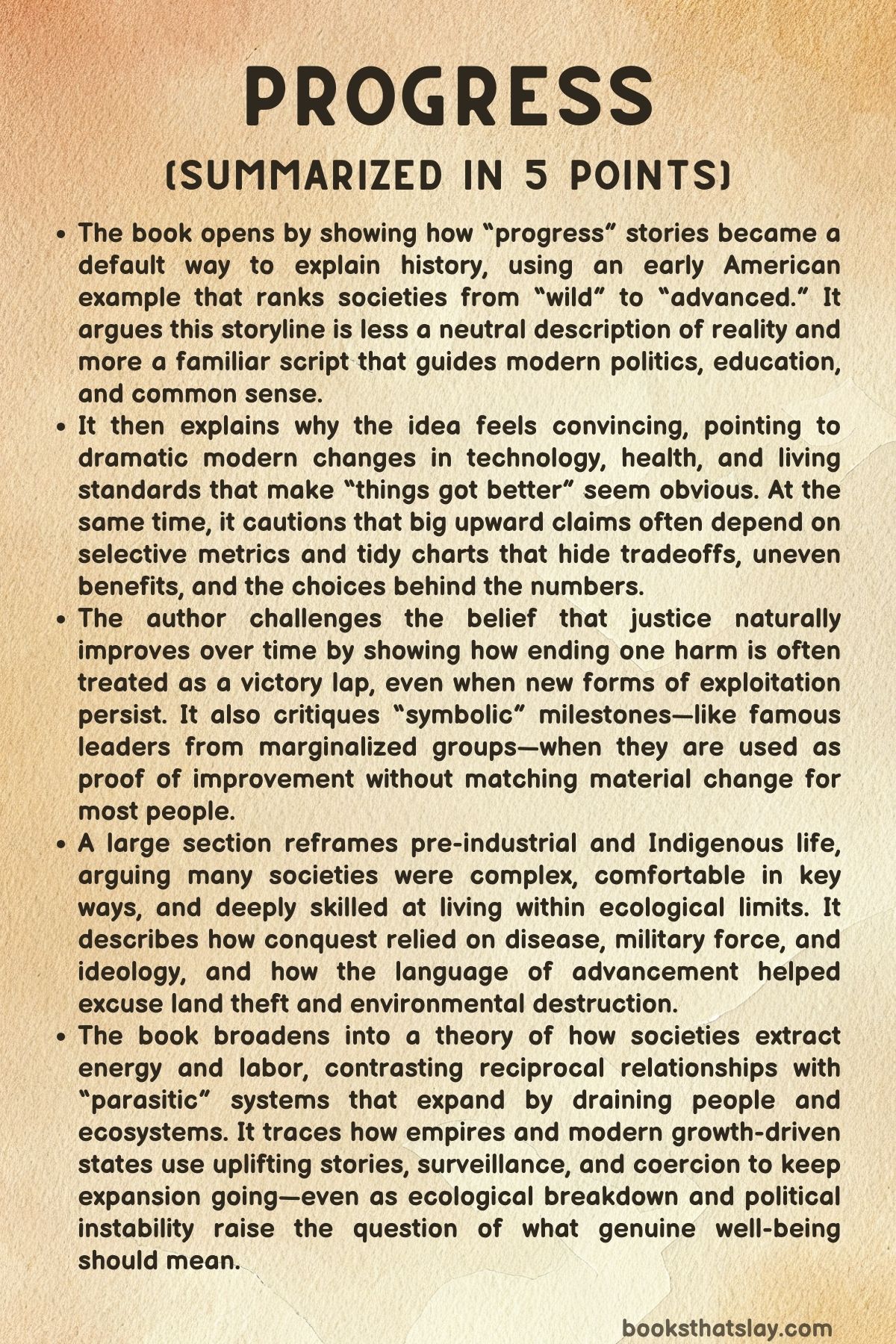
Progress: How One Idea Built Civilization and Now Threatens to Destroy It by Samuel Miller McDonald is a critical examination of one of the most powerful ideas shaping modern thought: the belief that human history naturally moves upward toward better, more advanced conditions. Rather than treating progress as a neutral or self-evident truth, the book investigates it as a cultural story with deep historical roots and real material consequences.
McDonald brings together history, ecology, political economy, and anthropology to question whether technological growth, empire, and economic expansion have truly improved life for humans and the nonhuman world. The book challenges readers to reconsider what improvement actually means, who benefits from it, and what has been lost along the way.
Summary
The book opens with an image drawn from Thomas Jefferson’s writing, in which the North American continent is imagined as a living timeline of humanity itself. Moving from west to east is presented as moving from “savagery” to refinement, from nature-bound existence to law, commerce, and technology.
This vision portrays history as a single rising path and assumes that societies naturally advance by leaving earlier ways of life behind. McDonald presents this not as an isolated opinion but as a classic example of a wider progress narrative that has shaped Western thinking for thousands of years.
He explains that progress stories follow a familiar structure. They begin with a dark or chaotic past, move through struggle and expansion, and arrive at a superior present that promises an even better future.
These stories rely on sharp divisions such as civilised versus uncivilised or developed versus backward. They often include a frontier where chosen people must expand, improve land, or spread ideas, with moral worth attached to those who advance the mission.
According to the author, this framework has influenced religion, politics, economics, and modern policy, often operating so quietly that it feels like common sense rather than ideology.
To show why belief in progress feels convincing, the book reviews dramatic twentieth-century achievements. Human flight rose from fragile early planes to space travel and interstellar probes.
Buildings grew from ancient monuments to skyscrapers hundreds of metres tall. Weapons advanced from early explosives to devices capable of unimaginable destruction.
Medical and public-health systems expanded through sanitation, antibiotics, vaccines, and imaging technologies. For many people, life expectancy increased, incomes rose, and populations grew.
This period is often described as the “Great Acceleration,” and institutions such as the United Nations continue to treat economic growth as the main driver of human improvement.
McDonald argues that these success stories are selective and shaped by ideology. He examines commonly cited statistics, especially claims about global poverty reduction, and shows how outcomes depend on definitions and thresholds that can make change look larger than it is.
Measuring poverty at extremely low income levels can create an impression of triumph while ignoring continued hardship. The author emphasizes that data never speak for themselves; what is counted, averaged, or excluded reflects political choices.
Simple graphs with upward lines can hide uneven outcomes and ongoing suffering.
Life expectancy is another example. Average figures rise mainly because fewer children die young, not because adult lives have become universally longer or better.
Elite groups in earlier societies often lived as long as many people today, while poor populations still face much shorter lives. McDonald challenges the idea that longer life is automatically better life and questions whether progress claims can be considered valid when benefits are uneven, fragile, and reversible.
The book then addresses social justice. Ending or reducing harm, such as abolishing slavery, should not be framed as proof that societies have risen from a primitive past.
Slavery still exists worldwide, and history shows that systems of domination can return after periods of reform. In the United States, the author points to mass incarceration, racial inequality in policing and sentencing, forced prison labor, and ongoing gaps in wealth and political power.
Celebrating representation, such as electing leaders from marginalized groups, is criticized when it substitutes symbolism for structural change. Examples show that leaders who appear to represent progress may still support policies that harm vulnerable populations.
McDonald weaves his personal background into the argument, describing how growing up around activism led him to question dominant historical stories. He argues that progress narratives often erase the violence and destruction that make growth possible.
Modern prosperity, he suggests, rests on fossil fuels and industrial systems that have destabilized the climate, poisoned ecosystems, and driven mass extinction. Many measures of well-being are now declining, raising the possibility that twentieth-century gains were temporary and dependent on unsustainable energy use.
The book then turns to life before modern progress stories. It challenges portrayals of Indigenous societies as simple or deprived, describing complex political systems, productive agriculture, and social structures that often offered greater autonomy and security than colonial settlements.
In eastern North America, many Indigenous communities combined farming, foraging, and trade in ways that supported large populations without exhausting ecosystems. Women played central roles in food production and governance.
Early European accounts reveal that some settlers voluntarily joined Indigenous societies and resisted returning to colonial life.
Colonization succeeded not because Europeans were more advanced, McDonald argues, but because of disease, military force, and an ideology that framed conquest as improvement. Expansion destroyed villages, crops, and forests, often through deliberate campaigns.
Land was recast as empty or wasted unless transformed for profit. These practices were justified through progress stories that later became formalized as manifest destiny.
From here, the book introduces an ecological framework. All living beings survive by capturing energy from their environment.
Some relationships are mutual or neutral, while others are harmful. Many human societies historically developed ways of living that fit within local limits, migrating or adjusting when resources were strained.
The author highlights animism as a widespread worldview that treats animals, plants, and places as sentient and deserving of respect. Such belief systems often encoded practical ecological knowledge and promoted restraint.
Modern science has increasingly confirmed the sophistication of Indigenous environmental understanding.
McDonald also challenges assumptions about nature as a place of constant misery. Research on animal behavior shows that many species experience curiosity, play, attachment, and cooperation alongside pain and fear.
Intelligence and emotional complexity are widespread in the nonhuman world. Industrial domestication, especially in factory farming, often produces far greater suffering than life in the wild.
The book then introduces the idea of abstract energy capture, the extraction of labor, time, and attention from others. While some dependence is natural, large-scale systems can become exploitative.
Societies that maintain balanced relationships with their environments often limit extreme inequality internally. In contrast, around 3000 BCE, large empires emerged that extracted resources far beyond local limits.
These systems expanded through conquest or collapsed when expansion failed.
Historical empires such as Rome illustrate this pattern. External extraction was mirrored by internal inequality, enforced through taxation, debt, slavery, and violence.
Progress narratives helped justify these arrangements by promising order, meaning, and future reward. The book traces similar themes through ancient myths and religions, showing how stories of domination over chaos, nature, and other peoples supported hierarchy and expansion.
Modern ideologies are treated as continuations of this pattern. Twentieth-century socialist states promoted growth and production stories despite immense human and ecological costs, including famine, forced collectivization, and cultural destruction of Indigenous peoples.
China under Mao followed a similar path, with catastrophic outcomes justified as necessary steps toward a better future.
After the Cold War era, neoliberalism revived growth-centered ideology under the banner of markets and freedom. Inequality rose, state surveillance expanded, and ecological damage continued.
Contemporary tech elites promote visions of space colonization and digital futures, which the author portrays as new frontiers for extraction rather than genuine solutions.
The final sections describe a world facing ecological collapse, political instability, and expanding security states. Intelligence agencies, surveillance, and repression are presented as tools used by modern empires to protect resources and suppress resistance.
Environmental activists increasingly face criminalization as conditions worsen.
The book concludes by suggesting that dominant systems of progress are unsustainable. It gestures toward alternative ways of organizing life based on reciprocity, ecological integration, and limits, drawing inspiration from long-standing human societies that lived with less inequality, lower violence, and closer alignment with the living world.
Key People
Samuel Miller McDonald
As the author and guiding voice of Progress, Samuel Miller McDonald functions as both narrator and critic of the “progress story” that modern societies often treat as common sense. He frames progress not as a neutral description of reality but as a persuasive narrative formula that simplifies history into an upward march, smoothing over violence, inequality, and ecological costs.
He also places himself within the argument: raised around activism and later turning to scholarship, he writes with the posture of someone trying to explain why certain stories feel emotionally compelling while also exposing what those stories conveniently hide. Across the summaries, his “character” is defined by a method—question the baseline assumptions, interrogate the graphs and thresholds, and keep returning to the material foundations of human life: energy, ecosystems, coercion, and the stories that make those systems feel righteous.
Thomas Jefferson
Thomas Jefferson appears as a symbolic architect of the classic Western progress narrative: a mind that maps geography onto a hierarchy of human “stages,” from “savage” to “civilised,” and treats the continent as a timeline. In the summaries, his 1824 framing is less about the accuracy of what he saw and more about how he structured it—turning complex living societies into a moral ladder that implies inevitability, superiority, and the eventual disappearance of those placed at the “lower” end.
Jefferson’s role is also revealing because his story makes colonisation feel like a natural law rather than a political project powered by violence, disease, and dispossession. He functions as the clean, confident storyteller whose clarity depends on erasing the human and ecological wreckage that enabled the so-called “advance.”
Thomas Hobbes
Thomas Hobbes is presented as an intellectual ancestor of the belief that nature is fundamentally a theatre of misery and that human improvement means escape from “wildness” into strong centralized order. In the summaries, Hobbes’s famous depiction of life in nature as short and brutal is not treated as timeless truth but as a useful argument that served particular political ends—especially the justification of state power.
His “character” therefore becomes a rhetorical lever: by painting wilderness as relentless suffering, he makes domination and control look like compassion and rationality. The text uses him to show how ideas about nature can quietly become ideas about people—who counts as “advanced,” who needs “management,” and why intervention can be framed as moral even when it is exploitative.
Malcolm X
Malcolm X enters not as a background reference but as a moral disruptor of the progress storyline, especially in the domain of social justice. Through the metaphor of a knife wound, he provides a way to see that reducing harm you imposed is not the same as creating a new, better world; it can be merely the partial withdrawal of violence.
In the summaries, his presence forces a shift from celebratory narratives (“look how far we’ve come”) to accountability narratives (“look what was done, what persists, and what is renamed”). He functions as a reminder that “progress” language can become a tool of self-congratulation that blurs ongoing exploitation and makes incomplete repair feel like moral triumph.
George Washington
George Washington is portrayed in the summaries as a figure whose revered national image clashes with the realities of expansion and conquest. He is associated with campaigns that used scorched-earth tactics—destroying villages, orchards, and food systems, and targeting civilians to break resistance—while also being tied to land ambition and speculation.
Within the text’s framework, Washington becomes an example of how “civilisation” projects are often enforced through deliberate ruin, and how the frontier is not a neutral meeting place but a battlefield structured to clear land for a new order. His role also supports the book’s larger claim that progress stories routinely omit the coercive work needed to make the “line go up.”
Charles Curtis
Charles Curtis appears as a pointed example of how representation can be weaponized as proof of “progress” even when policy outcomes harm the very communities the representative is assumed to uplift. The summaries position him as a Native American political figure whose status could be celebrated symbolically while being connected to actions or frameworks that undermined tribal governance and land security.
In the book’s logic, Curtis functions as evidence that identity in high office can be used to launder coercive agendas, making domination look inclusive. He embodies the gap between visibility and material change, and he sharpens the book’s warning against confusing narrative satisfaction with structural transformation.
Barack Obama
Barack Obama is used to examine the same representational dynamic in a modern register: the idea that electing a leader from a historically oppressed group is treated as an endpoint in itself. In the summaries, Obama’s presidency is presented as something that can be celebrated as a milestone while still being compatible with policies and systems that leave deep inequalities intact.
His role is not to be reduced to villain or hero but to expose how “proof of progress” can become a political shield—an argument used to block or delegitimize broader egalitarian demands. He becomes a character through whom the book tests a recurring claim: that the optics of progress can coexist with the machinery of extraction and control.
Margaret Thatcher
Margaret Thatcher is invoked to challenge the idea that leadership identity automatically translates into collective liberation. In the summaries, a woman leader does not guarantee improvement in women’s material conditions, and her era is connected to shifts that can deepen inequality.
Thatcher’s function is therefore diagnostic: she helps separate symbolic breakthroughs from the distribution of power and resources. She also reinforces the book’s underlying insistence that progress should be measured in lived conditions and relational realities, not in the inspirational storyline of “firsts.”
Joseph Stalin
Joseph Stalin is portrayed as a paradigmatic builder of state-directed “progress” through coercion, transforming growth statistics into moral justification. The summaries emphasize the Five-Year Plans, forced collectivization, mass displacement, and catastrophic famine, presenting them as the hidden price behind the triumphalist narrative of modernization.
Stalin’s “character” is defined by the fusion of ideology, bureaucracy, and violence: dictatorship framed as proletarian rule, dissent framed as backwardness, and suffering reframed as necessary sacrifice on the road to a promised future. He also illustrates how progress narratives can be especially potent when paired with real industrial output—numbers that appear to confirm destiny even as they are soaked in human cost.
Vladimir Lenin
Lenin appears in a more liminal role, primarily as a figure whose legacy is contested within the revolutionary storyline. The summaries present him as someone who, near the end of his life, worried about Stalin’s rise and temperament, which positions Lenin as both origin point and caution sign.
His presence underscores the text’s point that centralized state power can transform an emancipatory promise into a coercive apparatus, and that early critics—such as anarchists—warned about this trajectory. Lenin therefore becomes a hinge character: part of the mythic revolutionary lineage, yet also a reminder that the path from ideal to institution can produce outcomes that betray the original emancipatory claim.
Mao Zedong
Mao Zedong is presented as another major architect of forced “progress,” combining industrial ambition, mass mobilization, and ideological certainty. The Great Leap Forward, famine, and the cultic distribution of Quotations from Chairman Mao position him as someone who turns “progress” into a moral command—optimism as loyalty, pessimism as error.
The summaries also depict Mao’s relationship to nature as openly conquerive, with ecological interventions like the Four Pests Campaign backfiring into imbalance and worsened losses. Mao’s character, in this account, is less about personal psychology and more about a governing style: grand historical acceleration pursued through simplification, compulsion, and the belief that reality will submit to political will.
Friedrich Hayek
Friedrich Hayek appears as an intellectual organizer of neoliberal revival, patiently constructing networks designed to replace Keynesian social democracy when crisis made the public receptive. In the summaries, his “character” is defined by a particular moral priority: market freedom elevated above political freedom, and an openness to authoritarian governance if it protects market order.
He therefore illustrates a key theme of the book: ideologies can claim “freedom” while producing intensified coercion and inequality, especially when state power is redirected to defend corporate interests. Hayek functions as a strategist of narrative and institution-building—someone whose influence operates through think tanks, policy pipelines, and crisis opportunism rather than direct rule.
Elon Musk
Elon Musk is portrayed as a modern prophet of technological salvation whose “multiplanetary” promise functions like a secularized end-times narrative. In the summaries, he is linked to a billionaire-led progress story that converts space into a new frontier for extraction and self-legitimation, while depending on fragile supply chains, heavy resource use, and real environmental impacts.
His character represents the book’s critique of elite futurism: the idea that the same system producing ecological breakdown claims it can engineer an exit—often without addressing the underlying parasitic logic. Musk therefore serves as an emblem of how progress language can be both visionary and evasive, directing attention upward and outward while conditions on Earth deteriorate.
Jeff Bezos
Jeff Bezos plays a parallel role to Musk, embodying the fusion of wealth, technological ambition, and frontier mythology. The summaries frame his space projects as both faith-driven and self-serving, tied to extraction and labor structures that mirror the broader system being critiqued.
Bezos’s narrative function is to show that modern progress myths still rely on chosen leaders, spectacular technologies, and promised futures, even when the material constraints—energy, ecology, political instability—make those promises increasingly tenuous. He represents the way “progress” can become a brand, a personal destiny story, and a shield against accountability for present harms.
Karl Marx
Marx is introduced as one of the political “ghosts” haunting the modern world, shaping rhetoric and identity even when the deeper structure the author calls parasitic remains unchallenged. In the summaries, Marx functions less as a fully developed thinker and more as a symbol of unresolved conflict over labor, ownership, and historical direction.
His presence highlights the book’s claim that opposition often recycles old frameworks—sometimes sincerely, sometimes superficially—while the machinery of extraction adapts and continues. Marx’s role therefore is spectral but consequential: a name that still organizes loyalties, fears, and narratives of salvation.
John Maynard Keynes
Keynes appears as another “ghost,” representing the social democratic compromise that once shaped policy in parts of the Global North and supported a period of greater equality and middle-class expansion. In the summaries, Keynes is not framed as a radical challenger but as a lingering alternative to neoliberal primacy—an older blueprint for managing capitalism through redistribution and regulation.
His character is important because he shows how progress narratives can be attached to different economic regimes, and how the collapse of one consensus (under stagflation and oil shocks) can open the door to another that produces sharply different outcomes. Keynes stands for a fork in the story of modern governance: not an escape from the system’s core logic, but a different way it once tried to stabilize itself.
Adolf Hitler and Benito Mussolini
Hitler and Mussolini are named as political ghosts whose ideological residues persist in contemporary life, even when few openly endorse them. In the summaries, they function as reminders that modernity does not automatically generate moral improvement and that technologically advanced societies can produce extreme brutality.
Their inclusion also supports the book’s broader critique of linear optimism: if the twentieth century is held up as proof of progress, it must also be held accountable for industrialized violence and mass political terror. They operate as symbols of how quickly “civilisation” stories collapse when power is organized around domination, mythic destiny, and dehumanization.
Constantine
Constantine appears as a turning point figure in the relationship between spiritual narrative and imperial machinery. In the summaries, Christianity begins with critiques of wealth and exploitation yet becomes, under imperial adoption, a tool for unity and expansion—summarized in the logic of “one god, one empire, one emperor.” Constantine’s character illustrates a recurring pattern the book emphasizes: moral frameworks that could restrain power can be absorbed by power, repurposed, and broadcast as universal truth.
He personifies the state’s ability to convert a potentially disruptive ethic into an adhesive for hierarchy.
Augustine
Augustine is presented as a thinker who supplies Christianity with a linear historical framework and moral tools compatible with empire, including concepts that can legitimize violence as righteous necessity. In the summaries, his role is not merely theological; it is architectural, helping build a story of time that moves toward judgment and fulfillment, and a moral vocabulary that can reconcile conquest with conscience.
Augustine therefore functions as a narrative engineer—someone whose ideas make it easier for large coercive systems to depict themselves as agents of order and salvation rather than domination.
Ibn Khaldun
Ibn Khaldun appears as a complex intellectual figure who blends progressive and cyclical theories of civilization, anticipating later political and economic thought while still reflecting hierarchical assumptions of his era. In the summaries, he represents the book’s broader point that scholarship and brilliance can flourish within imperial contexts without dissolving the underlying structures of extraction and domination.
His character complicates simple moral sorting: he is neither reduced to propagandist nor idealized as pure critic. Instead, he illustrates how even sophisticated frameworks can carry the imprint of the systems that sustain intellectual production.
Gilgamesh, Enkidu, and Humbaba
These mythic figures are treated as narrative prototypes that encode and justify a civilizational worldview. In the summaries, Enkidu’s transformation from wildness into city life models the civilising storyline: the “natural” is framed as incomplete until absorbed by urban order.
Humbaba, as forest guardian, becomes an obstacle whose killing legitimizes extraction—especially the taking of cedar—so that deforestation can be narrated as heroic achievement rather than ecological violence. Gilgamesh, then, embodies the conquering hero whose glory is measured by domination of wilderness and acquisition of resources.
Their role in Progress is not to entertain but to demonstrate how ancient stories rehearsed the same moral logic that later empires and modern growth narratives continue to deploy.
Marduk and Tiamat
Marduk and Tiamat appear as mythic symbols used to frame political hierarchy as cosmic necessity. In the summaries, Marduk’s victory over Tiamat is linked to a story where order defeats chaos and sovereignty is affirmed through ritual retelling, reinforcing kingship and social stratification.
The narrative function here is to show how “progress” can be mythologized as a moral war against disorder, allowing domination to be experienced as protection and abundance. These characters illustrate how a society can naturalize hierarchy by embedding it in the structure of the universe, turning obedience into participation in cosmic rightness.
Themes
Progress as a Story That Pretends to Be a Fact
The opening move in Progress is to treat “progress” less like a neutral description of history and more like a familiar plotline that people have been trained to accept. Jefferson’s letter becomes a perfect example: geography is turned into a timeline, and human societies are arranged into a ladder where the East represents “completion” and the West represents “childhood.” The point isn’t only that this ranking is insulting or inaccurate.
The deeper point is that it feels natural to many readers because it matches a story structure that Western culture has repeated for a very long time: a dark beginning, a difficult journey, and a superior present that promises an even better future. This is why the book compares it to the predictability of genre fiction.
It has a comforting rhythm, and once people internalize it, they start using it automatically to interpret policy, economics, and morality.
What makes this narrative powerful is its simplicity. It divides the world into pairs: civilised and savage, modern and primitive, advanced and backward.
It also assigns moral worth to the direction of change. Moving toward industrial cities and centralized law becomes “good,” while living differently becomes “bad” by definition.
The story is designed so that the winners of history look like proof of history’s meaning. If one group dominates another, the domination can be reframed as destiny rather than violence.
The theme also highlights how this narrative quietly turns disagreement into heresy. If someone questions the direction of the journey, they are framed as opposing progress itself.
That rhetorical trick is extremely useful for governments, corporations, and empires because it turns resistance into irrationality. The book’s larger argument depends on this: “progress” is not just an idea people have.
It is a cultural tool that makes certain systems feel inevitable, even when those systems are destructive.
The Seduction of “Lines Going Up” and the Politics of Measurement
A major theme in Progress is that modern belief in progress often rests on charts, metrics, and statistical storytelling that appear objective while hiding value judgments. The book doesn’t argue that data is useless.
It argues that data is never innocent. Every famous progress claim depends on definitions that are chosen by someone, and those definitions can quietly reshape reality into a victory narrative.
The poverty example shows how this works: declaring that poverty fell from around 90% to 10% sounds like a moral triumph, but the triumph depends heavily on defining “extreme poverty” at $1.90 a day. If the threshold is raised to something closer to what people actually need for dignity and security, the story changes dramatically.
The “progress” wasn’t simply discovered; it was manufactured by where the line was drawn.
The life expectancy discussion extends this critique by showing how averages can create a fictional “average person.” If infant mortality drops, average life expectancy rises sharply even if adult life changes less than the headline suggests. This does not mean reducing infant mortality is unimportant.
It means that the way the improvement is framed can exaggerate the sense of a universal, permanent transformation. The book pushes a stricter standard: for something to count as progress in the grand historical sense, it should be broadly shared, represent a real break from the past, and be stable rather than reversible.
The text then shows how these conditions often fail. Class, geography, and power shape who benefits, and what seems permanent can unravel quickly.
The theme also challenges the hidden assumption that longer life automatically equals better life. A longer lifespan can coexist with loneliness, surveillance, meaningless labor, ecological collapse, and political repression.
By focusing on numbers that are easy to graph, societies avoid confronting what is harder to quantify: autonomy, safety, joy, dignity, and the right to live without being exploited. The book’s critique is not anti-science.
It is anti-propaganda. It treats the worship of upward graphs as a modern form of mythmaking, where statistics replace gods but serve the same purpose: telling people that the system is working and must not be questioned.
Colonisation, “Civilising Missions,” and the Erasure of Indigenous Prosperity
The book’s attack on progress narratives becomes most concrete when it turns to Indigenous North America. Progress argues that the standard Western image of Indigenous societies as primitive is not just a misunderstanding; it is a political necessity for colonial expansion.
If Indigenous communities are seen as thriving, skilled, and socially complex, then conquest looks like theft. But if they are framed as living in an earlier stage of human development, conquest can be reframed as a moral upgrade.
This is why Jefferson’s ladder of civilisation matters: it is not merely a personal prejudice. It is a blueprint for justification.
The text repeatedly emphasizes that many Indigenous societies were not only functional but attractive. They had political systems, agriculture, trade, and sophisticated ecological knowledge.
Women often held significant autonomy and central roles in food production and social stability. Some societies were hierarchical, others were more egalitarian, but the overall picture is one of variety and competence, not stagnation.
The book also highlights an uncomfortable fact for colonial mythology: Europeans sometimes voluntarily joined Indigenous communities and resisted being forced back. That detail is devastating to the idea that “civilisation” was obviously superior.
Disease becomes another crucial part of this theme. Colonisation did not succeed because Europeans were naturally more advanced.
It succeeded partly because epidemics shattered populations and social structures. The book stresses that colonists often celebrated these catastrophes.
That celebration exposes the moral emptiness at the heart of the civilising story. Progress narratives present expansion as uplift, but the historical record includes scorched-earth campaigns, the destruction of orchards and gardens, kidnapping, and systematic terror designed to break resistance.
The theme also connects colonisation to ecological transformation. Forests are cleared, often by burning, and land is remade into property.
This is not portrayed as “development” but as conversion: a living system is turned into a resource platform. The idea of “wasteland” is revealed as ideological language that makes it easier to destroy what is already abundant.
By reframing Indigenous lands as unused or underused, settlers can claim they are creating value rather than extracting it. In this theme, progress is shown as a mask worn by conquest, and the mask works precisely because it teaches people to confuse domination with improvement.
Ecology, Reciprocity, and the Moral Meaning of How Societies Take Energy
A core theme of Progress is that the deepest difference between societies is not their technology level but the kind of relationship they form with the living world. The book introduces ecology not as a background subject but as a framework for moral and political analysis.
It defines “concrete energy capture” as the physical taking of energy and mass from the environment—food, wood, animals, crops. That is unavoidable for any organism.
The question is not whether energy is taken, but whether it is taken in a way that destroys the system that provides it.
The book then expands the idea into “abstract energy capture,” meaning the extraction of time, labor, and attention from other humans. Children depend on caregivers, so dependence itself is natural.
But societies can institutionalize dependence into domination. When a small elite can reliably extract labor from a larger population, abstract energy capture becomes parasitic.
The theme argues that external extraction and internal extraction mirror each other. A society that treats forests, rivers, and animals as objects tends to treat workers, enslaved people, and marginalized groups as objects too.
This is where reciprocity becomes central. Many Indigenous and long-term human societies are described as building mutualistic or commensal relationships with ecosystems.
They develop rules, beliefs, and customs that restrain overuse and maintain long-term abundance. The book resists simplistic assumptions such as “agriculture automatically creates hierarchy.” Instead, it argues that social structure depends on power arrangements and ecological context, not on a single technological shift.
Animism becomes important here, not as a quaint superstition but as a sophisticated ethical technology. Treating animals, plants, and places as person-like encourages restraint, gratitude, and careful observation.
These beliefs often encode real ecological knowledge. The book suggests that modern societies dismiss animism partly because it blocks the mentality needed for industrial extraction.
If a river is treated as alive, poisoning it becomes harder to justify. If a forest is treated as a community of beings, clear-cutting it becomes morally visible.
This theme reframes “progress” itself. Instead of measuring advancement by growth, the book pushes a different question: does a society’s way of living increase the long-term capacity of life to flourish, or does it burn through the future for short-term gains?
Under that standard, many so-called advanced systems look less like progress and more like a brief, unstable surge powered by extreme extraction.
Animal Minds, Joy, and the Limits of Human-Centered Progress
One of the most striking themes in Progress is its insistence that any serious moral account of progress must include nonhuman animals. The book challenges a foundational assumption in modern ideology: that nature is mainly a theatre of suffering, and that humans become better by escaping it.
Hobbes’s “nasty, brutish, and short” becomes an intellectual ancestor of this worldview, and the book argues that it was politically useful because it made centralized authority seem like salvation. If nature is horror, then the state and industry can be framed as rescue.
Against this, the text presents a wide range of evidence that wild animals experience not only fear and pain but also play, attachment, curiosity, and pleasure. Examples from whales, orangutans, parrots, magpies, octopuses, frogs, ants, and bees are not included as trivia.
They are included to break the monopoly humans claim on complex inner life. The book’s argument is that Western culture has often refused to acknowledge animal joy because acknowledging it would make domination harder.
If animals are seen as emotionally rich beings, then converting ecosystems into industrial resource zones becomes morally uglier.
This theme also critiques the modern habit of comparing wild suffering to domesticated “safety.” The book argues that industrial livestock systems create levels of misery that are not honestly comparable to life in the wild. The point is not to romanticize wilderness.
The point is to reject the propaganda that portrays human control as inherently kinder.
Joy becomes a serious philosophical measure here. The book treats joy as more than pleasure.
It describes well-being as a kind of fit between an organism’s inner nature and its outer conditions. Fish are built to swim, birds to fly, cats to hunt.
When creatures can express their evolved capacities freely, they tend to display signs of contentment. This becomes a quiet indictment of modern human life as well.
Many people live longer, but are they living in ways that allow their minds and bodies to function as they were shaped to function? The book suggests that progress narratives often confuse comfort and consumption with genuine flourishing.
By widening the moral circle beyond humans, the theme forces a harsher evaluation of industrial society. If progress is measured only by human wealth and human lifespan, the costs to other beings disappear.
But if animal lives matter, then the modern era’s “improvements” look inseparable from mass suffering and habitat destruction. The theme therefore turns ecology into ethics and refuses to let progress remain a human-only celebration.
Empire, Myth, and Religion as Machines for Making Inequality Feel Sacred
Progress treats empire not as an accidental feature of history but as a repeating social technology. Once societies begin expanding beyond local limits, they need a justification that can unite elites and subjects under a shared mission.
The book argues that progress narratives are one of the most effective justifications ever invented because they convert exploitation into destiny. Under this logic, conquest is not theft; it is history moving forward.
The theme becomes especially powerful when the book traces a lineage from Mesopotamian myths to modern ideologies. Stories like Gilgamesh celebrate the taming of the wild and the killing of a forest guardian so that valuable timber can be taken.
That matters because it frames deforestation and domination as heroic. The Enuma Elish frames kingship as cosmic order, reinforced by public ritual and law.
The book’s argument is that these stories did not merely entertain. They trained populations to accept hierarchy as natural and good.
The theme then tracks how later religions and philosophies refined this structure. Zoroastrianism introduces an intense end-times framework where history becomes a moral battlefield that will end in purification and bliss.
That structure is politically useful because it makes suffering feel temporary and meaningful. Genesis intensifies human dominion over the earth and ties land conquest to divine mandate.
Greek and Roman thought secularize progress into stages of civilisation, turning superiority into a cultural “fact” rather than a divine decree. Christianity begins as a critique of wealth but becomes, under imperial adoption, a unifying ideology compatible with conquest, missionary expansion, and “just war.” Islam is described as unifying fragmented tribes into a powerful imperial force, producing scholarship and cultural brilliance while still relying on conquest and hierarchy.
The key theme is not that religion is uniquely harmful. The theme is that large-scale power systems repeatedly borrow the same narrative structure: a chosen people, a mission, a frontier, enemies framed as chaos or backwardness, and a promised future that justifies present violence.
The book suggests that modern secular ideologies—nationalism, capitalism, certain forms of socialism, techno-utopianism—inherit the same shape even when they reject gods. The mythic machinery remains: history is still framed as a ladder, and the people on top still claim they deserve to lead.
Modern Ideologies as Rival Versions of the Same Growth Religion
A major theme in Progress is that the twentieth century did not escape progress mythology; it multiplied it. The book shows how socialist revolutions, fascist movements, liberal capitalism, and later neoliberalism all used progress language, even when they claimed to oppose one another.
Each offered a promised future that would redeem suffering. Each demanded discipline, sacrifice, and faith in the plan.
The conflict between them often looked like a battle over who would control progress, not whether the idea itself was flawed.
The Soviet example becomes a case study in progress as coercion. Stalin’s Five-Year Plans are presented as a massive restructuring of life justified by the claim that the USSR must overcome backwardness.
Millions are forced into collective farms, and famine kills on an enormous scale. Yet the regime promotes growth statistics as proof of historical destiny.
This reveals one of the book’s sharpest insights: progress narratives can absorb almost any atrocity by rebranding it as a necessary step. If the future is bright enough, the present can be made infinitely cruel.
The theme extends this critique to Indigenous peoples in Siberia and the Arctic. They are labeled backward, pushed through “stages,” resettled, and stripped of language and subsistence practices.
This mirrors colonial logic almost perfectly, showing that progress ideology is not exclusive to capitalist empires. It is a portable justification for domination.
China under Mao repeats the pattern: collectivization, forced modernization, catastrophic famine, and environmental damage justified by the belief that humanity must conquer nature and accelerate history. Even the “Little Red Book” functions like scripture, spreading a moral vocabulary where progress is righteousness and doubt is sin.
The theme then shifts to neoliberalism, showing that it claims to champion freedom while often expanding inequality, surveillance, and coercion. Hayek’s willingness to prefer a “liberal dictator” over a democracy without market primacy reveals how “freedom” is narrowed to mean the freedom of capital.
Neoliberalism waits for crisis, then uses crisis to remake society, again following a familiar plot: suffering now, salvation later.
The theme’s larger argument is that modern politics is haunted by competing progress religions. They argue over the route, but they share a deep assumption: that growth, expansion, and increasing control are inherently good.
The book insists that this assumption is precisely what is breaking both human societies and the living world.
The Frontier as a Permanent Hunger: Forests, Space, Minds, and the Security State
The later sections of Progress develop a theme that connects ecology, empire, and modern repression into one system: parasitic expansion requires new frontiers, and frontiers require force. When older frontiers are exhausted, the system does not calmly stop.
It searches for new zones of biological wealth, mineral wealth, and even cognitive wealth. This is why the book focuses on tropical forests such as the Amazon, the Congo Basin, and Borneo.
These places are described not as scenery but as remaining reservoirs of life that the global economy still wants to convert into profit. The book treats deforestation not as an unfortunate side effect but as a structural requirement of a system built on endless extraction.
What makes this theme unsettling is its expansion of the frontier concept. The book argues that elites are already imagining two new frontiers: deep space and the human mind.
Asteroid mining and space colonization are presented as fantasies that extend the same logic outward. Meanwhile, artificial intelligence and data capitalism are framed as attempts to treat human attention, thought, and neural activity as extractable resources.
Even if these projects face physical limits, the book warns that power systems may continue pushing them long past the point of sanity because the system is not designed to stop.
This theme also insists that expansion has always been protected by hidden violence. The book lists historical intelligence and covert systems across empires, then frames the modern United States as the most advanced version: massive surveillance, private contractors, secret budgets, propaganda, infiltration, and intimidation.
The claim is not that this is a conspiracy. The claim is that it is how empires function when they need to maintain access to resources and suppress resistance.
The link to domestic repression becomes crucial. As ecological and economic conditions worsen, security states expand.
Activists, especially environmental movements, are treated as threats. Laws tighten around protest.
Media ecosystems are influenced by former intelligence officials and covert messaging. Mass incarceration grows alongside neoliberal policy, suggesting that inequality is not just tolerated but actively managed through coercion.
The theme ends with a bleak but coherent diagnosis: the more the system destabilizes the planet, the more it will rely on surveillance and force to keep extraction going. Under that logic, the future promised by progress narratives becomes a trap.
The system claims it is building a better world, but it increasingly resembles a machine that destroys alternatives before they can replace it.