Queen Demon by Martha Wells Summary, Characters and Themes
Queen Demon by Martha Wells is a rich and intricate fantasy novel set in the aftermath of a world shattered by tyranny and war. The story follows the demon Kaiisteron (Kai), the Witch Ziede, and their allies as they navigate the fragile peace that follows the fall of the Hierarchs—rulers whose dark sorcery enslaved mortals and immortals alike.
Told across shifting timelines that interlace past rebellions with present conspiracies, the book explores power, loyalty, and redemption in a world still haunted by the remnants of conquest. Wells crafts a story of resistance and rebuilding, where the cost of freedom is measured in sacrifice and memory.
Summary
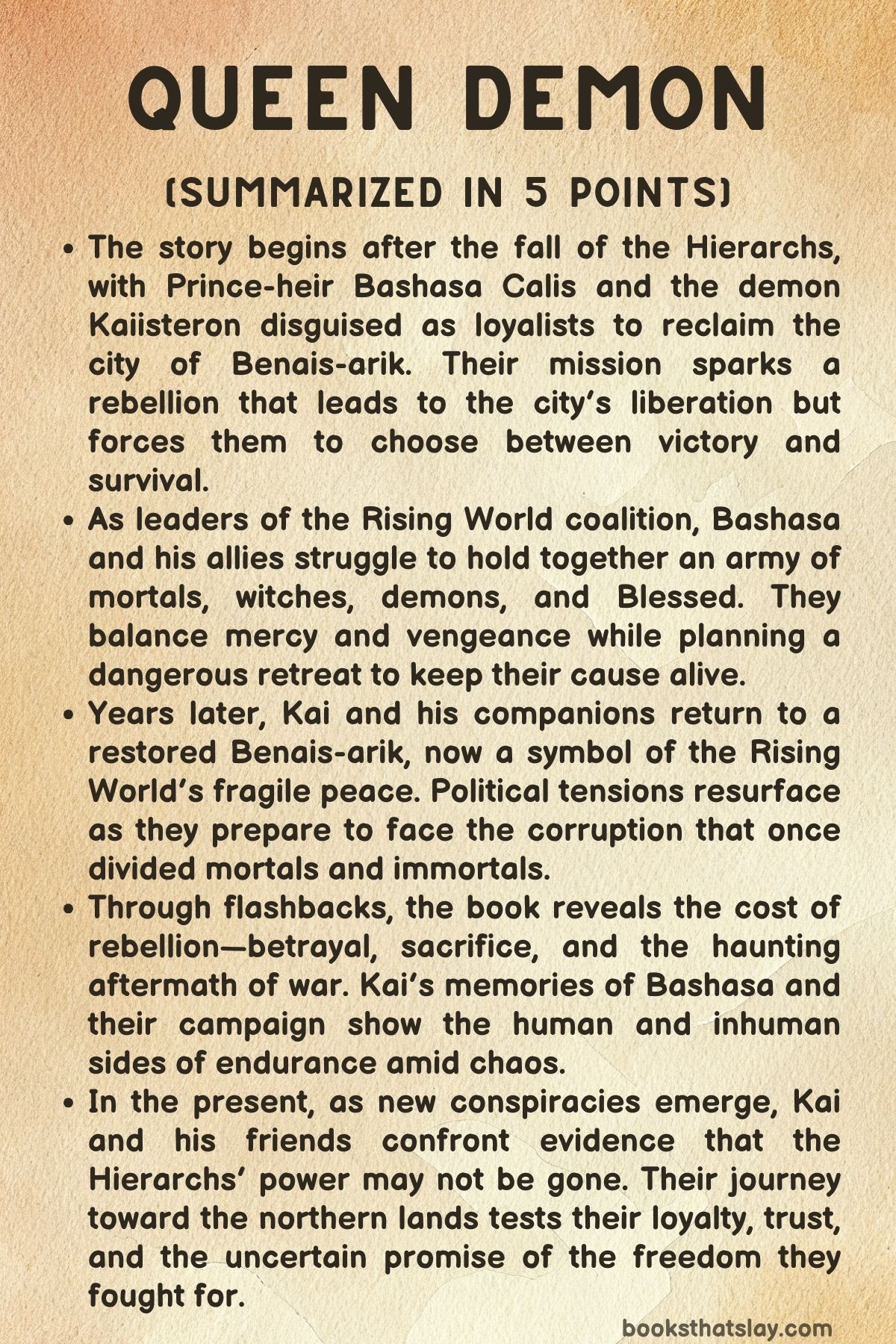
The novel begins in the chaotic days following the collapse of the Hierarchs, when the Rising World—a coalition of free peoples—begins to take shape. In a daring operation, the Arike prince-heir Bashasa Calis and the demon Kaiisteron infiltrate the occupied city of Benais-arik under false identities.
Their ruse sparks an uprising that sweeps through the city’s streets, with Arike soldiers and liberated civilians overthrowing the Hierarch garrison. Bashasa’s leadership unites the city, but he knows they cannot hold it against the Hierarchs’ inevitable counterattack.
He orders a mass evacuation, choosing survival over pride. This decision becomes the moral foundation of the Rising World—compassion over vengeance, unity over ruin.
Years later, Kai, Ziede the Witch, and the immortal Tahren travel toward Benais-arik aboard a Blessed ascension raft. The world is rebuilding, yet distrust remains between mortals and the Immortal Blessed, whose betrayal once almost destroyed the coalition.
Among their companions are Tahren’s estranged kin Saadrin and her younger sibling Dahin, a scholar struggling to prove his worth. The group’s return to Benais-arik is fraught with unease.
Kai persuades Tahren to face the Rising World council, believing her voice is essential to healing old divisions. They arrive in a city transformed—its canals busy, its domes gleaming—yet its past still lingers beneath the surface.
Kai and the young mortal Sanja visit the Cloisters, once a temple of the Hierarchs, now reclaimed by the Witches. Amid the ruins, Kai finds relics from his former life with Bashasa—maps, clothes, and tokens of a friendship that ended in tragedy.
Haunted by loss, he waits for word from the council as memories of war return to him.
The story then shifts back to the early campaigns of the Rising World. Kai and Bashasa’s army, composed of soldiers, witches, and refugees, travels north through burned villages toward the stronghold of Dashar.
They face hardship, internal conflict, and the knowledge that every victory brings them closer to confrontation with the surviving Hierarchs. In an abandoned caravanserai, Bashasa meets with allied leaders to plan their next move.
Despite reports of uprisings and rebellions elsewhere, he focuses on one crucial objective—taking Dashar, the Hierarch fort that guards vital trade routes. His vision of unity convinces his allies to continue the campaign.
That night, Kai confronts Bashasa about his growing dependence on drink. Their argument reveals the strain of leadership and the heavy toll the war exacts on both men.
Their bond—part loyalty, part love—is marked by both tenderness and pain. Soon after, chaos strikes.
The camp is attacked by rogue witches known as dustwitches, who enslave others and wield forbidden magic. Kai and Ziede fight through the storm to rescue survivors, uncovering the growing fragmentation among those touched by the Hierarchs’ corruption.
The narrative alternates again to the present. In Benais-arik, peace seems restored, but danger stirs beneath the surface.
Dahin’s research reveals unsettling truths: traces of the Hierarchs’ homeland may still exist in the far north. The group fears that remnants of their dark power could rise again.
Their suspicions deepen when the Rising World council receives reports of a mysterious delegation accompanied by Immortal Blessed. Kai, Ziede, Tahren, and Dahin decide to investigate, traveling to the university city of Ancartre.
The story returns once more to the war. Kai, now known as the Witch King, joins mortal vanguarders to locate the dustwitches’ camp.
Using illusion and pain-born magic—his only safe source of power—he infiltrates the enemy’s stronghold, freeing captive witches and mortals. The battle is fierce, revealing the lingering fanaticism of those still devoted to the Hierarchs’ cause.
Kai’s actions strengthen the Rising World, but his methods expose the dangerous edge of his demon nature. Bashasa, learning how Kai channels magic through self-inflicted wounds, promises to keep his secret, accepting the price of his companion’s strength.
In the present, the companions arrive at Ancartre to find the university alive with scholars and soldiers. There they encounter Arnsterath, a former enemy who claims to have surrendered.
The Chancellor reveals that explorers have discovered ruins resembling Hierarch fortresses in the southern lands—sites untouched for decades yet disturbingly well preserved. Artifacts found there suggest that servants or descendants of the Hierarchs may have survived.
Worse still, the ruins lie near the fabled Hierarchs’ Well, a source of limitless power thought destroyed. Fearing catastrophe, Kai insists they must reach the site before others awaken its magic.
They use anchor stones—ancient Blessed artifacts—to travel instantly to the region. There they find evidence of betrayal: the Immortal Highsun, once their ally, has been manipulating events, seeking to claim the Well’s power for himself.
When they reach the ruins, they confront a dying Hierarch who confesses that new constructs are being made from the dead. Highsun reveals his true intentions, turning on them and completing a forbidden ritual to become a new Hierarch.
A desperate battle follows as the chamber collapses around them. Arnsterath sacrifices herself, hurling her immortal essence into the Well to destroy it.
The explosion annihilates the site, ending Highsun’s power and sealing the Well.
In the aftermath, Kai, Ziede, and Tahren emerge alive but changed. The Hierarchs’ Well is gone, yet its echo remains.
Tenes, one of their companions, awakens with demon-black eyes—a sign that some fragment of the Well’s essence has taken root within her. The Rising World has survived another crisis, but its peace is uncertain.
The lines between mortal, immortal, and demon have blurred once again, and the fragile coalition must face the truth that victory does not end the struggle—it only changes its form.
Through alternating past and present, Queen Demon charts the ongoing fight to preserve freedom against the temptations of power. The story closes on a quiet but ominous note: as the survivors stand beneath the broken skies of Ancartre, they realize that the world they rebuilt after the Hierarchs’ fall may be only the beginning of another reckoning—one that will test their faith, loyalty, and the very nature of what it means to be free.
Characters
Kaiisteron
Kaiisteron, often called Kai, is the emotional and moral core of Queen Demon. Once a demon prince of the Underearth, he becomes bound in a mortal body—an act that defines his character’s struggle between power and humanity.
Kai is a being of contradictions: immensely powerful yet burdened by guilt and restraint, ancient in wisdom yet yearning for mortal connection. His loyalty to Bashasa Calis shapes much of his journey, turning from a demonic enforcer into a guardian of ideals and memory.
Kai’s relationship with pain—using it as a source of strength—symbolizes his transformation from a creature of destruction into one of protection. Even as he hunts enemies and faces conspiracies, his introspection reveals a deep empathy for both mortals and other fallen beings like himself.
Haunted by loss, Kai carries both the trauma of war and the hope of redemption, standing as a bridge between the world of demons and the new mortal order rising from the ruins.
Bashasa Calis
Prince-heir Bashasa Calis embodies the vision and tragedy of leadership in Queen Demon. Charismatic, intelligent, and fiercely principled, he leads the Arike people with a revolutionary spirit that values compassion as much as strength.
His decision to show mercy to enemies and conscripts is both a political and moral gamble, one that defines him as an idealist in a brutal world. Yet beneath his composure lies exhaustion and despair—symbolized by his growing dependence on drink and his moments of self-doubt.
Bashasa’s bond with Kai is more than alliance; it is a friendship built on mutual trust and pain, each balancing the other’s extremes. His tragic death, remembered through Kai’s eyes, turns him into a martyr for the Rising World’s dream—a leader whose flaws make him painfully human, and whose ideals echo long after his fall.
Ziede
Ziede the Witch represents the resilience and endurance of the persecuted. A survivor of the Witch massacres, she channels her grief into purpose, leading and protecting others with unwavering strength.
Her magic—commanding the wind-devils—reflects her fierce will and adaptability. Ziede’s relationship with Kai is one of understanding born from shared survival; both have endured loss and chosen compassion over vengeance.
Unlike many others in the story, Ziede balances practicality with faith. She distrusts the Blessed and Hierarchs alike, seeing in both the corruption of unchecked power.
In the present timeline, her patience and wisdom make her the steadying force within the group, guiding the younger Sanja and tempering Kai’s intensity. Through her, Queen Demon explores the endurance of women’s wisdom amid the collapse and rebirth of civilizations.
Tahren
Tahren, the immortal Marshall, stands as a symbol of duty complicated by immortality. Once a warrior of the Blessed, she carries the burden of eternal responsibility and fractured kinship, especially in her strained relationship with Saadrin and Dahin.
Tahren’s immortality is not a gift but a sentence—she has seen too many wars, betrayals, and failed empires. Her pragmatism often clashes with Kai’s emotionality, yet she shares his longing for balance between mortal and divine realms.
In council chambers and battlefields alike, Tahren acts as both strategist and moral compass, though her disillusionment sometimes veers into cynicism. Her leadership and loyalty to the cause anchor the Rising World’s ideals even when faith falters.
Dahin
Dahin, Tahren’s sibling and a Lesser Blessed, embodies the vulnerability of those caught between divine and mortal natures. Intelligent yet uncertain, Dahin struggles to define his worth outside of his immortal heritage.
His impulsive decision to enter the death well underscores both his courage and his recklessness—a desperate attempt to prove significance in a world of heroes. Dahin’s guilt and yearning for validation humanize him, especially in contrast to Tahren’s stoic control.
By the novel’s end, his scholarship and discoveries about the Hierarchs’ lingering presence make him pivotal to the Rising World’s survival. Dahin’s journey from insecurity to conviction mirrors the story’s broader theme of rediscovering purpose after devastation.
Saadrin
Saadrin, an Immortal Marshall and estranged kin to Tahren, serves as a mirror to her ideals gone astray. Where Tahren seeks redemption through service, Saadrin is consumed by righteousness and vengeance.
His rigid sense of justice blinds him to nuance, making him both ally and adversary. Through him, Queen Demon interrogates the dangers of immortality—how endless life can erode empathy and trap beings in cycles of control.
Saadrin’s clashes with Tahren and Kai highlight the ideological rifts within the Blessed, and his eventual cooperation shows a reluctant acknowledgment that the world must move beyond old hierarchies.
Sanja
Sanja, the mortal child rescued from the streets, represents the new generation of the Rising World—innocent yet resilient, a witness to both horror and hope. Through her eyes, the reader glimpses the transformation of a war-torn land into something that might one day be peaceful.
Her curiosity and trust in Kai reflect humanity’s potential to embrace the supernatural without fear. Though young, Sanja’s presence softens the hardened warriors around her, reminding them of the future they fight for.
In a world haunted by the remnants of gods and demons, she is the promise of continuity—the fragile but enduring proof that life persists.
Bashat
Bashat, Bashasa’s heir, embodies the corruption and ambition that threaten to undo the Rising World from within. Unlike his father, Bashat lacks compassion, seeing power as inheritance rather than responsibility.
His betrayal of Kai and manipulation of political factions mark him as a tragic reflection of the world’s inability to fully escape its past. Yet his confrontation with Kai in the present timeline reveals complexity: guilt, denial, and an unspoken yearning for absolution.
Bashat’s downfall is moral rather than physical—his inability to comprehend the ideals that guided Bashasa and Kai leaves him hollow, a remnant of the old order clinging to authority.
Arnsterath and Highsun
Arnsterath and Highsun serve as embodiments of opposing facets of Immortal corruption. Highsun’s ambition to recreate the Hierarchs exposes the seductive lure of forbidden power, while Arnsterath’s final sacrifice at the Well redeems her, proving that even the fallen can reclaim purpose through selflessness.
Their intertwined fates dramatize the eternal conflict between creation and destruction that defines the mythic layers of Queen Demon. Arnsterath’s death, giving life to Tenes, closes one chapter of evil while hinting that redemption may carry its own dark price.
Tenes
Tenes’s transformation at the novel’s end marks the unsettling transition between victory and uncertainty. Once a companion and warrior, she becomes something more—perhaps the vessel of a surviving spirit, perhaps a symbol of rebirth.
Her blackened eyes signal that even triumph over darkness may leave traces of it behind. Through Tenes, the story concludes not with resolution but with ambiguity, suggesting that the Rising World’s peace will always carry the shadow of its origins.
Themes
The Fragility and Reconstruction of Freedom
In Queen Demon, freedom is never presented as a triumphant or absolute state but as an unstable, constantly reconstructed condition. The liberation of Benais-arik marks an early victory for Bashasa Calis and his companions, yet that victory immediately collapses into an evacuation plan.
This paradox sets the tone for the novel’s treatment of freedom — a political ideal burdened by moral restraint, pragmatic compromise, and the trauma of previous oppression. Bashasa’s insistence that the Rising World not execute collaborators reveals a nuanced understanding that freedom devoid of mercy becomes another form of domination.
This moral stance, however, is tested as the coalition struggles to maintain unity amid betrayals and resurging hierarchic powers. The reconstruction of the city and the later reappearance of Benais-arik as a functioning metropolis show how freedom must be rebuilt materially and spiritually, not merely declared.
Every conversation, from Kai’s reflections on lost comrades to Tahren’s weariness of council politics, underscores that freedom is not a singular event but an ongoing negotiation between memory, justice, and survival. The tension between military necessity and moral conscience turns the Rising World into a fragile coalition of ideals rather than a stable government.
By the end, the rediscovery of the Hierarchs’ Well reminds readers that freedom’s enemies are not only external tyrants but also the seductive promise of control and power that lies within every liberated society.
The Ethics of Power and Corruption
Power in Queen Demon operates on both metaphysical and political levels, constantly threatening to corrupt those who wield it. From the demonic energies Kai channels through self-inflicted pain to the Immortal Blessed’s manipulation of magic and governance, the narrative examines power as an intoxicating and corrosive force.
Kai’s relationship with his own abilities encapsulates this theme most vividly. His use of pain to summon strength represents both resistance and vulnerability; it becomes a moral act precisely because he chooses suffering over domination.
In contrast, the Hierarchs’ use of the Well — enslaving demons and mortals alike — embodies the dehumanization that results when power becomes detached from empathy. Bashasa’s leadership reveals a different dimension: the burden of ethical command.
His compassion clashes with the military logic of survival, forcing him to balance mercy against the relentless need to act decisively. Later, when Highsun’s betrayal leads to his self-coronation as a new Hierarch, Wells’s narrative closes the circle of power’s temptation.
Highsun’s failure underscores that even those who begin with noble intent can succumb to the illusion that righteousness grants immunity from corruption. The repeated cycles of conquest, rebellion, and betrayal create a moral universe where every character is tested by the proximity of absolute power, and redemption is found only in restraint.
Memory, Loss, and the Persistence of the Past
The novel’s shifting timelines between the war and the present emphasize that the past is neither buried nor inert. Every character in Queen Demon carries fragments of loss — cities burned, friends buried, worlds undone — and those memories actively shape their choices in the present.
For Kai, returning to the Cloisters is an act of haunting as much as remembrance; the relics of Bashasa’s life become tangible reminders of promises unfulfilled. Memory, in this sense, is not merely recollection but a living presence that both guides and torments.
Ziede’s recollections of destroyed islands and Tahren’s fatigue with politics mirror a broader theme of postwar disillusionment, where rebuilding coexists with the fear that history might repeat itself. The Rising World’s councils, archives, and restored cities are acts of remembrance attempting to solidify meaning from ruin.
Yet Wells refuses to romanticize memory — instead, it becomes a moral testing ground. Kai’s confrontation with Bashat, the heir who betrayed him, exposes how memory can harden into bitterness or evolve into forgiveness.
Even the return of ancient artifacts, such as the Hierarchs’ badges, reveals that history’s remnants can reawaken catastrophe if misunderstood. The novel transforms memory into both a wound and a weapon — essential for identity, yet perilous when clung to as justification.
Reconciliation Between Mortal and Immortal Worlds
The coexistence of mortals, demons, Witches, and Blessed forms the spiritual and political backbone of Queen Demon, reflecting a world perpetually negotiating between divine and human dimensions. The Rising World coalition represents a fragile harmony where old hierarchies of race, power, and magic are dismantled and rebuilt through uneasy cooperation.
Kai and Tahren embody this tension: he as a once-demonic being bound in a mortal body, and she as an Immortal Marshal wearied by endless duty. Their alliance, fraught with distrust and mutual respect, questions whether peace between realms is achievable or merely temporary.
The Blessed, originally protectors turned oppressors, symbolize the failure of divinity when detached from human suffering. In contrast, the Witches’ quiet endurance and the mortals’ persistence highlight humility as the foundation for renewal.
Wells constructs a moral universe where divinity and mortality must learn to coexist through empathy rather than dominance. The emergence of Tenes, transformed by the Well’s destruction, signals a new hybrid state — neither demon nor divine, but something liminal — suggesting that reconciliation may lie in transcending old binaries altogether.
This blending of essences reflects the novel’s hope that harmony between worlds, like freedom itself, cannot be imposed by decree but must evolve through shared endurance and sacrifice.
The Nature of Sacrifice and Redemption
Throughout Queen Demon, sacrifice operates not as a singular heroic gesture but as a recurring condition of survival. Every victory in the Rising World demands a loss — of home, innocence, or comradeship.
Bashasa’s choice to abandon Benais-arik after liberating it, Kai’s willingness to endure physical torment to wield his magic, and Arnsterath’s ultimate self-immolation to destroy the Well all embody different forms of redemption through suffering. These sacrifices challenge traditional notions of heroism; they are acts grounded in necessity rather than glory.
The emotional weight of the narrative lies in the recognition that redemption rarely restores what was lost. When Kai and his companions confront Highsun, the cycle of destruction and renewal reaches its moral peak — the Well’s annihilation comes at the cost of Arnsterath’s life and Tenes’s transformation, proving that salvation often carries the seed of another tragedy.
Wells frames sacrifice as both the price and the proof of moral integrity in a world built on betrayal and power. Redemption is not granted by divine authority but earned through the characters’ refusal to abandon compassion, even when compassion endangers them.
In the end, the Rising World’s survival depends less on its triumphs than on the willingness of its people to bear loss without surrendering their humanity.