Quiet Ones Summary, Characters and Themes | Penelope Douglas
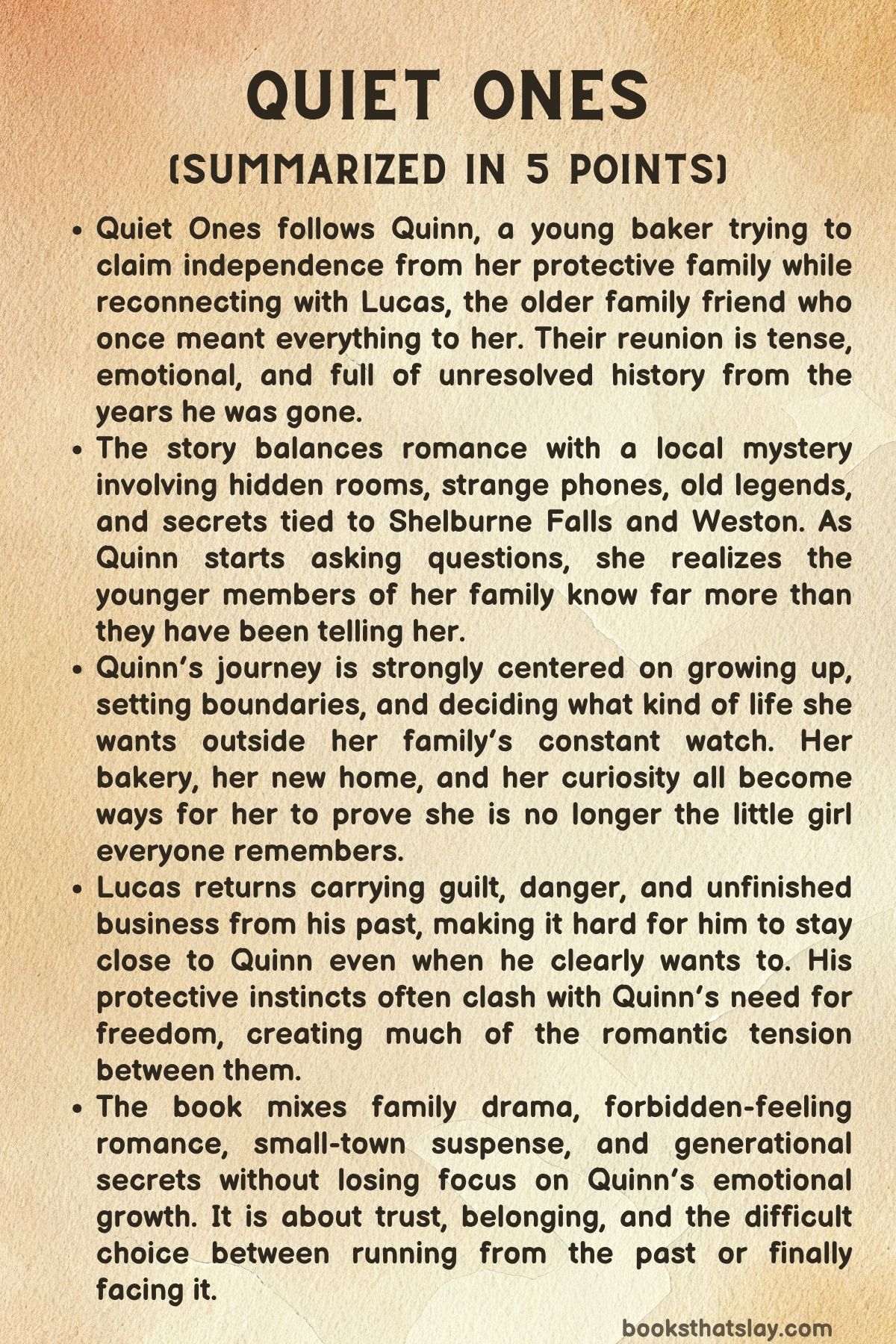
Quiet Ones by Penelope Douglas is a romantic suspense story about Quinn, a young baker trying to claim her independence, and Lucas Morrow, the man who once made her feel seen before leaving without explanation. Set between Shelburne Falls, Weston, Camp Blackhawk, and the hidden corners of family history, the book mixes second-chance longing, secrets, danger, and small-town legends.
At its center is Quinn’s struggle to stop being treated like someone who needs protection, while Lucas must face the past he ran from. The book is about love, guilt, loyalty, and the courage to stay. It’s the 3rd book of the Hellbent series.
Summary
Nine years before the main events of Quiet Ones, twelve-year-old Quinn hides in the false ceiling of the family lodge at Camp Blackhawk during a game of hide-and-seek with her niece and nephews. Even as a child, Quinn feels slightly outside the natural pairs and bonds around her.
While hidden, she overhears a painful conversation between her father and Madeline, his first wife, about betrayal, marriage, and old wounds. The moment teaches her that adults carry private pain children rarely understand.
The other kids search for Quinn and frighten her by mentioning Undergrove, a camp legend tied to the island in the lake. Lucas Morrow, an older family friend who was taken in by Madoc after his father died, discovers where Quinn is hiding but keeps her secret.
Instead of exposing her, he talks with her through the ceiling. He is working on plans for the ski resort he dreams of building, and Quinn asks about his designs.
Their easy conversation shows how safe she feels with him.
After Quinn wins the game, she finds Lucas near the lake. He pulls her into the water and hides with her under the dock while others pass above them.
For Quinn, the moment makes them feel like a pair. But a year later, Lucas leaves town without keeping in touch.
Quinn is left with his baseball cap, her memories, and the ache of believing he mattered far more to her than she ever mattered to him.
Nine years later, Quinn is twenty-one and running Frosted, her bakery in Shelburne Falls. She works too hard, trying to expand the shop and prove herself.
One night, a mysterious man leaves a burned flip phone behind. Dylan, Hunter, Hawke, and Aro rush into the bakery soon after and seem to recognize its importance, though they avoid explaining it.
Quinn realizes they are hiding something linked to a local mystery.
Her family still treats her as fragile. Jared and Jax stop her from jogging alone at night and push her into joining a gym.
There, Quinn unexpectedly sees Lucas, now thirty-three and back from Dubai, where he works as an architect. At first, he does not recognize her.
When he realizes who she is, their reunion is awkward and charged. Quinn returns his old Cubs cap, reminding him that he told her to keep it until he came back.
Lucas tells her to hold on to it a little longer.
Lucas has returned only to prepare his mother’s house for sale. He plans to leave quickly, but he is uneasy.
He still has Quinn’s compass, which she gave him years ago, and he carries guilt over secrets tied to Green Street, Drew Reeves, and a dangerous part of Weston’s past. A suspicious SUV near his mother’s house confirms that his return has not gone unnoticed.
Despite his plan to leave, Lucas visits Quinn’s bakery. Their old connection returns through teasing, shared memories, and unfinished feelings.
Quinn’s family notices, and Dylan and Aro even make signs encouraging her to seduce Lucas so he will stay. At the gym, Dylan sends Noah and Farrow to get Lucas’s attention, hoping jealousy will push him to act.
It works. Lucas grows possessive, especially when he sees Farrow’s Green Street tattoo and realizes dangerous people are close to Quinn.
Quinn becomes frustrated with everyone meddling in her life. At a party, she hides in an inflatable obstacle course and overhears the younger generation discussing Carnival Tower, a secret hideout beneath her bakery.
She learns about mysterious phones, Manas and Deacon, Winslet MacCreary, Rivalry Week, the Night Ride, and a black Dodge that may be following her. Realizing they have kept her outside a dangerous mystery, Quinn decides to investigate on her own.
Lucas tries to leave town but misses his flight after secretly seeing Quinn in his old house, where she admits aloud that she loved him for years. He realizes she wants him, not Noah or Farrow.
He stays, returns her compass, and tries to reconnect. Quinn, however, refuses to make it easy.
She has bought a house in Weston, not Lucas’s old house as he assumes, but a large abandoned property at 01 Knock Hill. It gives her the freedom she has wanted, though it is tied to local fear and old stories.
Quinn explores Carnival Tower and finds evidence about Winslet MacCreary, Conor Doran, Deacon, Manas, old mirror legends, a car pushed into the river, and possible revenge. Winslet’s diary suggests she may have survived an attack and hidden instead of dying.
The tower also gives Quinn ideas for expanding Frosted, making the hidden space both a mystery and a business opportunity.
Lucas’s attraction to Quinn grows harder for him to deny. He tells himself she is too young and nearly family, but jealousy keeps exposing the truth.
He researches Hugo Navarre, Drew Reeves, Green Street, Noah, Farrow, and the men connected to Quinn’s world. When he drives Quinn to her Weston house and sees how unsafe it is, he secretly installs security cameras.
Quinn finds out and becomes furious. Rather than confront him directly, she throws a party at the house.
Lucas sees it through the cameras and storms in, ordering everyone out. When he reveals a tattoo shaped like the river between Shelburne Falls and Weston, the Weston kids obey him, showing Quinn he has a hidden history there.
Their fight turns intimate. Lucas stops himself, but he tells Quinn no one will touch her except him.
Later, he visits a hidden grave near a train tunnel and remembers the night David Miller died. Drew Reeves had manipulated the situation, planted Miller in a trunk during a dangerous stunt, and then used the death to frame and blackmail Lucas.
Drew threatened Lucas’s family, making Lucas believe that silence and distance were the only ways to protect them. His shame made him run.
The Fourth of July brings more fear. Quinn sees suspicious figures, learns more about the Night Ride legend, and is followed by a dark car.
A chase leads to Camp Blackhawk, where Lucas catches her in the forest during the fireworks while Farrow and Noah stand guard nearby. Afterward, Lucas prepares for a larger confrontation.
With Farrow’s help, he digs up David Miller’s remains so the truth can eventually surface.
Lucas buys Quinn an old Jeep so she does not have to bike alone. Quinn is moved but remains angry that he keeps hiding the full truth.
At Fallstown, Hugo Navarre and his men watch Lucas, and the black Dodge appears again. A crash and confrontation follow, with Drew Reeves trying to push Lucas into killing Hugo.
Lucas nearly loses control but stops himself.
The next morning, Quinn takes Lucas into Carnival Tower and shows him what she has learned. Lucas finally tells her about Drew, Green Street, David Miller, and why he left.
Quinn tells him he needs his family, not isolation. Lucas initially still tries to handle things alone, but he soon realizes she is right.
Isobel finds records of guns registered in his name at 8 Green Street, reminding him of Drew’s hidden logbook of blackmail material. Lucas returns to Quinn, admits she was right, and they reconcile.
He finally tells her he loves her.
Their peace is broken when numbers are found written on Quinn’s back while they slept, proving someone entered the hidden room. Hawke, Hunter, and Kade discover Lucas and Quinn together, and the group joins forces.
With Tommy Dietrich’s help, they retrieve the ammo case from Green Street. Lucas confronts Hugo, burns Drew’s blackmail log, and offers control of the firehouse to Farrow if Hugo leaves.
Hugo’s power collapses when his own people refuse to follow him.
A final clue from Manas Doran leads the group to a storage unit filled with antiques, documents, deeds, and valuable land records. Lucas realizes the Dorans had quietly gathered property for a future railway corridor that could be worth millions and help rebuild Weston.
The group chooses to keep the discovery private while they decide how to use it for the town. By the end of Quiet Ones, Quinn has claimed her place, Lucas has stopped running, and their families face the future with dangerous secrets finally brought into the open.
Characters
The characters in Quiet ones are shaped by family history, buried secrets, local legends, and the tension between safety and freedom. Most of them are not simply “good” or “bad”; they are people trying to protect each other, control each other, escape the past, or prove that they are no longer children.
The story’s emotional weight comes from the way personal desire, family loyalty, and old guilt keep colliding.
Quinn
Quinn is the emotional center of the book, and her journey is built around the desire to be seen as her own person. As a child, she feels like the odd one out in a large family where everyone else seems naturally paired or understood.
Her bond with Lucas matters so deeply because he makes her feel chosen, noticed, and quietly protected. When he leaves without explanation, the wound he leaves behind becomes more than a childhood disappointment; it becomes proof, in Quinn’s mind, that the person who made her feel special could also abandon her without warning.
As an adult, Quinn is hardworking, restless, and determined to build a life that belongs to her. Frosted is not just a bakery; it is her claim to independence, adulthood, and usefulness.
She works too much because she is trying to prove that she can grow beyond the role her family keeps assigning her. Her decision to buy her own house, investigate Carnival Tower, and challenge Lucas shows that she is no longer willing to be managed by others.
Quinn’s courage is impulsive at times, but it comes from a genuine need to stop being protected into smallness.
Quinn is also emotionally honest, even when she tries to hide it. She can provoke Lucas, flirt with danger, and pretend she is moving on, but underneath that confidence is a girl who never stopped wondering why he left.
Her love for him is complicated by anger, pride, and hurt. She does not simply want Lucas to desire her; she wants him to admit the truth, stay, trust her, and treat her as an equal.
This makes her one of the strongest characters in Quiet ones, because her growth is not about becoming fearless. It is about demanding the right to know, choose, and belong on her own terms.
Lucas Morrow
Lucas is one of the most conflicted figures in the book. He returns as a man who appears controlled and successful, but beneath that surface he is full of shame, fear, guilt, and unfinished love.
His life in Dubai suggests escape rather than freedom. He has built a career and distance for himself, but he has not truly moved on from the people he left behind or the secret that drove him away.
His connection to Quinn’s compass shows that, even while absent, he carried a piece of her and of home with him.
Lucas’s greatest flaw is his belief that he must handle danger alone. Because Drew Reeves manipulated and blackmailed him, Lucas convinces himself that leaving was a form of protection.
He sees himself as someone contaminated by the past, someone who brings risk to the people he loves. This explains his secrecy, possessiveness, and constant urge to control situations around Quinn.
He installs cameras, watches from a distance, interferes with Noah and Farrow, and tries to keep Quinn away from Green Street’s threats. His intentions are protective, but his methods often deny Quinn the agency she is fighting to claim.
His relationship with Quinn drives much of the romantic and moral tension of Quiet ones. Lucas wants her, but he is frightened by the age gap, their family-like connection, and the emotional consequences of crossing that line.
He repeatedly tells himself she is too young or too close to family, yet his actions reveal jealousy, longing, and deep attachment. His arc becomes powerful when he finally stops hiding behind self-punishment and begins telling the truth.
By confronting Drew’s legacy, recovering David Miller’s remains, challenging Hugo, and admitting his love, Lucas begins to move from guilt-driven isolation toward real accountability.
Dylan
Dylan is playful, bold, and deeply involved in the younger generation’s investigations. She often acts as a meddler in Quinn’s romantic life, especially when she pushes Noah and Farrow into Quinn’s orbit to make Lucas jealous.
Her teasing has a comic edge, but it also shows how well she reads emotional tension. Dylan understands that Quinn and Lucas are not indifferent to each other, and she uses humor and pressure to expose what they refuse to say directly.
At the same time, Dylan is not merely a source of mischief. She is part of the group trying to decode Carnival Tower, the mysterious phones, the old legends, and the threats tied to Weston.
Her secrecy frustrates Quinn because it proves that the younger family members have built their own hidden world without including her. Dylan represents a new generation that is curious, fearless, and willing to dig into dangers the adults would rather bury.
Hunter
Hunter is part of the younger family circle that knows more than it first admits. He helps guard the secrets surrounding Carnival Tower, Deacon, Manas, the Night Ride, and the larger mystery connected to Winslet.
His role is protective, but like the others, his protectiveness can become exclusionary. He wants Quinn safe, yet he also withholds information from her, which only pushes her to investigate more aggressively.
Hunter’s dynamic with Quinn reflects the broader family problem in the book: everyone loves her, but many of them still treat her as someone who needs to be managed. When he, Kade, and Hawke confront Quinn at her new house, they are not simply being nosy.
They are worried because they understand that the places and people she is approaching carry real danger. Still, their failure to fully trust her judgment becomes part of what Quinn resists.
Kade
Kade has a quieter but important presence in the family group. As a child, his decision to forfeit the hide-and-seek game allows Quinn to emerge victorious, which subtly reinforces the early theme of Quinn wanting to be seen and included.
As an adult, Kade becomes part of the protective younger circle investigating the hidden dangers surrounding Frosted, Carnival Tower, and Weston.
Kade’s role is especially tied to family loyalty. He is one of the characters who reacts strongly when Lucas and Quinn’s relationship becomes impossible to ignore.
His concern is not only about romance; it is about boundaries, history, and the way Lucas’s return disrupts the family structure. Kade represents the instinct to defend the family unit, even when the family itself is changing.
Hawke
Hawke is another member of the younger generation who is deeply involved in the mystery. He is protective, alert, and suspicious of threats around Quinn.
Like Hunter and Kade, he knows pieces of the hidden story before Quinn does, which places him in the uncomfortable position of guarding secrets from someone he also wants to protect.
Hawke’s importance comes from his connection to both the family drama and the investigation. He is part of the group that understands the significance of Carnival Tower, the phones, the black Dodge, and the strange figures moving around the edges of the story.
His presence helps create the sense that Quinn is surrounded by people who know more than she does, even inside her own family.
Aro
Aro is perceptive, loyal, and emotionally sharp. She sees Quinn’s feelings for Lucas clearly and is willing to push her, tease her, and support her.
Her playful actions, such as adjusting Quinn’s hair and lipstick to test Lucas’s reaction, show that she understands attraction as something revealed through small gestures. Aro brings humor and energy to the story, but she is also one of Quinn’s most important confidantes.
Aro’s value lies in the way she listens. Quinn admits things to her that she does not easily say to others, including her excitement about buying a house and wanting space from her family’s supervision.
Aro recognizes that Quinn’s desire for independence is serious, not childish rebellion. She also helps connect Quinn to the younger group’s knowledge of the Night Ride and the local legends, making her a bridge between emotional insight and mystery-solving.
Farrow
Farrow is dangerous, watchful, and more emotionally intelligent than he first appears. His Green Street tattoo immediately signals that he is connected to Weston’s rougher world, which alarms Lucas.
Yet Farrow is not presented as simply threatening. He helps Quinn, gives her transportation, lives near her new house, and understands parts of the danger surrounding Green Street.
He becomes both a romantic provocation and a practical ally.
Farrow’s role in Lucas’s arc is especially important. He forces Lucas to confront the fact that Quinn is not a child and that other men see her as a grown woman.
He also helps Lucas during the recovery of David Miller’s remains, proving that he can be trusted in serious matters. By the time Lucas offers him control of the firehouse, Farrow represents a possible future for Weston: someone connected to its rough history but capable of using that position to build something better.
Noah
Noah serves as both a genuine friend to Quinn and a catalyst for Lucas’s jealousy. He is confident, flirtatious, and willing to play along with Dylan and Aro’s attempts to provoke Lucas.
His attention gives Quinn a way to test her own power and adulthood, especially when Lucas refuses to acknowledge what he feels. However, Noah is not only a tool for jealousy.
He also provides Quinn with companionship and helps her feel desired at a time when Lucas keeps pushing her away.
Noah’s role reveals Lucas’s possessiveness and fear. Lucas reacts to Noah not because Noah is cruel or dangerous, but because Noah represents the life Quinn could choose if Lucas continues to run.
In that sense, Noah becomes a mirror for Lucas’s hesitation. He shows Lucas that refusing to act does not preserve Quinn in some untouched state; it only leaves room for someone else to step closer.
Madoc
Madoc is a fatherly figure whose love for Lucas is one of the book’s emotional anchors. His speech about Lucas becoming like a son shows how deeply Lucas belongs to the family, even if Lucas himself feels unworthy of that belonging.
Madoc’s affection makes Lucas’s departure more painful because it proves that Lucas did not simply leave a town; he left people who had claimed him as their own.
Madoc also represents the older generation’s complicated history. His past with Madeline and the affair that damaged his first marriage show that adult relationships in the book are filled with consequences children only partially understand.
He is loving and charismatic, but he is not untouched by mistakes. His possible political future also raises the stakes around Lucas’s secret, because Drew’s blackmail once made Lucas believe that exposing the truth could destroy Madoc and the family.
Jared
Jared is protective, intense, and deeply rooted in the family’s instinct to guard its own. When he intercepts Quinn jogging at night and pushes her toward the gym, his concern is genuine, but it also demonstrates the suffocating side of the family’s love.
Jared sees danger quickly and reacts forcefully, which makes him both reassuring and frustrating from Quinn’s perspective.
His relationship with Lucas carries trust and history. When Lucas borrows Jared’s Boss Mustang and indicates he will be staying around, it signals a shift.
Jared is part of the adult male circle that Lucas once left behind and must now face again. His presence reminds the reader that Lucas’s return is not just romantic; it is a return to a network of men who once protected, challenged, and shaped him.
Jax
Jax is another protective adult presence in Quinn’s life. Like Jared, he treats Quinn as someone who must be watched over, especially when safety is at stake.
This contributes to Quinn’s frustration because the men around her often struggle to see the difference between caring for her and controlling her.
Jax also represents speed, risk, and family bonding through action. The Camaro scene at the track allows Lucas and Quinn to share physical closeness, adrenaline, and memory in a way that words cannot fully express.
Jax’s world is one of cars, loyalty, and masculine protectiveness, and that world forms part of the atmosphere Lucas must re-enter when he comes home.
Madeline
Madeline’s role is brief but emotionally significant. Through the conversation Quinn overhears as a child, Madeline becomes a symbol of adult pain that children are not meant to carry but often absorb anyway.
Her conversation with Quinn’s father reveals the long shadow of betrayal, divorce, and unresolved hurt.
Madeline helps establish one of the book’s deeper themes: family history does not stay neatly in the past. The pain between adults shapes the emotional world of the children around them, even when no one intends it to.
Quinn’s early realization that adults have wounds of their own prepares her for the larger pattern of hidden grief and buried truth that defines the story.
Quinn’s Father
Quinn’s father is important because his past choices help Quinn understand that adults are complicated long before she is ready to fully process that truth. His tense conversation with Madeline exposes betrayal, regret, and the emotional cost of family fracture.
For young Quinn, overhearing this moment is a loss of innocence.
He also represents the larger family structure that Quinn both loves and resists. The family is close, powerful, and protective, but it is also full of histories that younger members only discover in fragments.
Quinn’s father contributes to that sense of inherited emotional complexity.
Quinn’s Mother
Quinn’s mother sees how hard Quinn is pushing herself and worries that her daughter is rushing through life. Her concern is gentle but revealing.
She recognizes that Quinn’s bakery success may also be a form of escape, a way of proving maturity before Quinn has fully understood what she wants.
Her role highlights the difference between support and overprotection. She does not dismiss Quinn’s ambition, but she senses the exhaustion underneath it.
Through her, the book shows that Quinn’s struggle for independence is not only about romance or danger; it is also about learning how to grow without constantly racing.
Drew Reeves
Drew Reeves is one of the darkest forces in the book. He is manipulative, cruel, and skilled at turning other people’s fear into a weapon.
By tricking Lucas and using David Miller’s death as blackmail, Drew creates the trauma that shapes Lucas’s entire adult life. He does not simply threaten Lucas physically; he traps him psychologically by making him believe that the truth will destroy everyone he loves.
Drew’s power comes from corruption and control. His logbook of blackmail material shows that he collected secrets as a way to dominate people.
Even when he is not physically present, his influence continues through fear, hidden evidence, and the violent culture around Green Street. He is the kind of villain whose damage survives him because he teaches others to live in silence.
Hugo Navarre
Hugo Navarre is the current face of Green Street’s intimidation. He is dangerous, territorial, and eager to keep Lucas from interfering with the power structure in Weston.
His threats about a hidden body show that he understands the value of secrets and wants to use Lucas’s past against him.
However, Hugo’s authority is weaker than it first appears. When Lucas confronts him and offers the firehouse to Farrow, Hugo’s people refuse to obey him, revealing that his control depends more on fear than loyalty.
Hugo represents a decaying form of power: loud, violent, and threatening, but vulnerable once people stop believing he is untouchable.
David Miller
David Miller is more important in death than he appears to have been in life. His body becomes the physical evidence of the secret that drove Lucas away.
The tragedy of his death lies not only in the event itself, but in how Drew uses it to manipulate Lucas and distort the truth.
Lucas’s decision to recover Miller’s remains is a major act of moral reckoning. It shows that Lucas can no longer live by hiding what happened.
David Miller becomes a symbol of the buried past demanding acknowledgment, and his proper burial represents the beginning of Lucas’s move toward honesty.
Deacon Doran
Deacon Doran is mysterious, dangerous, and tied to the old secrets of Weston. He enters the story through phones, rumors, and hidden connections, making him feel almost like part of the town’s mythology before he becomes a more concrete presence.
Quinn’s contact with him shows her willingness to engage with danger directly rather than wait for others to explain it to her.
Deacon’s importance lies in ambiguity. He is connected to frightening stories, but the evidence Quinn finds complicates the idea that the Dorans are simply villains.
Through Deacon, the book blurs the line between criminal history, survival, revenge, and local legend.
Manas Doran
Manas Doran is one of the most enigmatic characters in the story. His messages, clues, and final envelope suggest that he has been guiding events from a distance.
He understands the hidden history of Weston and seems to know how to force the younger generation and Lucas toward discoveries they might not have made on their own.
Manas is connected not only to danger but also to inheritance. The storage unit he leads them to contains documents, antiques, deeds, and evidence of land that could change Weston’s future.
This makes him more than a mysterious figure; he becomes a link between the town’s violent past and its possible renewal.
Winslet MacCreary
Winslet MacCreary is a haunting presence in the book. Her diary turns her from a legend into a wounded, frightened, and possibly vengeful person.
The fragments Quinn reads suggest trauma, survival, displacement, and a desperate inability to return home. Winslet’s story complicates the myths surrounding the Night Ride, the river, the black Dodge, and the mirrors.
Winslet matters because she represents how women’s suffering can become distorted into legend. Instead of being remembered clearly, her pain becomes rumor, fear, and mystery.
Quinn’s investigation restores some humanity to Winslet by treating her not as a ghost story but as a person whose experience still matters.
Conor Doran
Conor Doran is tied to the old Weston mystery and the Doran family’s place in local legend. Though he is less developed than Deacon or Manas, his name helps widen the sense of a family history that stretches beyond the present conflict.
He belongs to the network of old stories that Quinn uncovers through Carnival Tower and Winslet’s diary.
His role helps show that the mystery is generational. The danger around Quinn and Lucas did not begin with Hugo or Drew; it grew from older conflicts, older secrets, and older families whose choices still shape the present.
Mace
Mace brings youthful observation and subtle provocation into the story. Her notice of Lucas at the track makes Quinn jealous, which reveals how intensely Quinn is still affected by him even when she tries to appear detached.
Mace’s presence helps expose Quinn’s emotions without requiring Quinn to confess them outright.
She also belongs to the lively younger circle around Quinn, Dylan, Aro, and the others. Through characters like Mace, the book creates a social world where teasing, loyalty, attraction, and danger constantly overlap.
Codi
Codi is part of the younger group at the track and contributes to the sense of community surrounding Quinn. While not as central as Dylan or Aro, Codi helps create the atmosphere of a generation that moves together, watches each other, and participates in the social energy of Fallstown and Weston.
Codi’s role is mainly supportive, but that support matters because the book relies heavily on group dynamics. Quinn’s choices are rarely made in isolation; she is constantly surrounded by people who observe, tease, protect, or interfere.
Isobel
Isobel is Lucas’s assistant and functions as a practical link to information outside the immediate family circle. When Lucas asks her to research Hugo, Drew, Noah, Farrow, and the Trent and Caruthers men, it shows his need for control and his fear that danger is closing in.
Isobel’s work helps Lucas understand the threats around him more clearly.
Her most important contribution comes when she discovers that firearms are registered in Lucas’s name at 8 Green Street. That information leads Lucas back to Drew’s gun cabinet and blackmail log, pushing the plot toward confrontation.
Isobel may not be emotionally central, but she is crucial to uncovering the mechanics of Drew’s old control.
Vanessa
Vanessa appears as a source of jealousy and misunderstanding for Quinn. When Quinn sees Madoc apparently introducing Lucas to another woman, it intensifies her insecurity and frustration.
Vanessa’s role is less about her own development and more about what she triggers in Quinn.
Through Vanessa, the book shows how easily Quinn’s hurt can resurface. Even after Lucas begins moving closer to her, Quinn still fears being overlooked, replaced, or treated as childish.
Vanessa briefly embodies that fear.
Tommy Dietrich
Tommy Dietrich is a young thief connected to Green Street, and his role shows how Weston’s dangerous world pulls in younger people. The group recruits him to retrieve the ammo case, which means his criminal skill becomes useful in dismantling Drew’s old system of blackmail.
Tommy represents the possibility that people shaped by rough environments can still choose where their loyalties go. He is not presented as innocent, but he becomes part of a plan that helps break a corrupt power structure.
His presence also reinforces the idea that Weston’s future depends on redirecting the talents of people who were once used or ignored.
Themes
Growing Up Under the Weight of Family
Quinn’s journey in Quiet Ones is shaped by the pressure of belonging to a family that loves deeply but often protects too tightly. From childhood, she feels like the person left outside every natural pair, watching others fit together while she searches for her own place.
As an adult, that same feeling continues through her family’s constant supervision, their doubts about her safety, and their attempts to manage her choices. Her bakery, her secret house, and her decision to investigate hidden dangers all become ways of proving that she is not simply someone’s younger sister, daughter, or niece.
Yet the theme is not only about rebellion. Quinn also learns that family protection often comes from old fear, guilt, and love that people do not know how to express clearly.
Her growth comes from demanding space without completely rejecting connection. She wants independence, but she also wants to be seen as capable within the family, not separate from it.
Love, Distance, and Emotional Timing
Quinn and Lucas’s relationship is built around the pain of missed timing. As a child, Quinn feels most understood by Lucas because he treats her as someone worth noticing, not as an afterthought.
His sudden absence leaves her with confusion, longing, and a sense of abandonment that follows her into adulthood. When he returns, their connection is still strong, but both of them are trapped by the past.
Quinn wants honesty and recognition, while Lucas hides behind guilt, age difference, loyalty to the family, and fear of hurting her. Their attraction is never simple because it carries years of silence, unfinished memories, and unequal emotional knowledge.
The romance becomes meaningful because it forces both characters to speak about what was avoided. Quinn has to stop proving she is grown through provocation alone, and Lucas has to stop using protection as an excuse for distance.
Love here depends on truth arriving at the right time.
Secrets, Guilt, and the Cost of Silence
The story shows how secrets grow heavier when people carry them alone. Lucas believes leaving town protected the people he loved, but his silence only keeps him trapped in shame and fear.
The hidden death, Green Street, Drew’s threats, and Hugo’s power all reveal how guilt can be used as a weapon when the truth remains buried. Lucas’s problem is not that he lacks loyalty; it is that he mistakes isolation for sacrifice.
Quinn’s investigation into Carnival Tower, Winslet’s diary, the phones, the Night Ride clues, and the Doran mystery creates a parallel pattern: the past keeps returning because no one has fully faced it. The theme becomes especially strong when Quinn refuses to reject Lucas after learning the truth.
Her response challenges his belief that confession will destroy everything. In Quiet Ones, silence protects people only for a short time; eventually, it gives fear more control than honesty ever would.
Reclaiming Power Through Place
Places in the story are more than backgrounds; they hold memory, fear, identity, and possibility. Camp Blackhawk preserves Quinn’s childhood loneliness and her first sense of closeness with Lucas.
Frosted represents her work ethic, ambition, and desire to build something that is truly hers. Carnival Tower turns her business into a doorway to buried history, making her part of a mystery that others tried to keep from her.
Her house in Weston is especially important because it represents freedom, danger, and self-definition all at once. By choosing to live there, Quinn refuses the safer role her family expects from her.
Weston itself also shifts from being a place marked by crime and legend into a place with hidden value and a possible future. The discovery of the Dorans’ land and documents changes the meaning of the town.
Power comes from understanding where one stands, what happened there, and what can still be rebuilt.