Rain of Shadows and Endings Summary, Characters and Themes
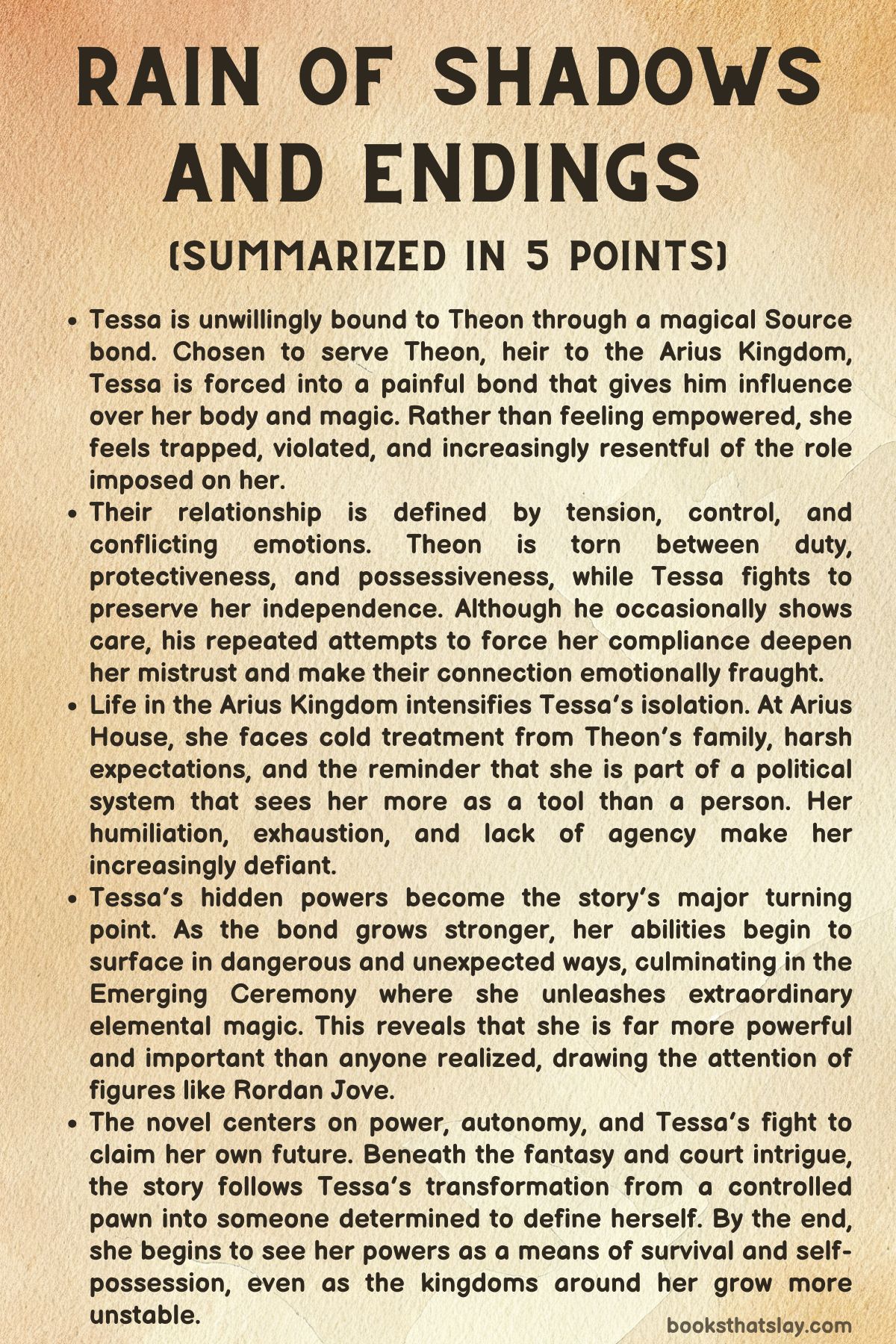
Rain of Shadows and Endings by Melissa K. Roehrich is a dark fantasy novel set in a world where magic, power, and political intrigue shape the fates of its characters. The story revolves around Tessa, a young woman who is chosen to be the Source for Theon, the heir to the Arius Kingdom.
The Source bond, a mystical connection that links them together, forces Tessa to submit to Theon’s control and magic, though she resists. As the bond intensifies, Tessa finds herself torn between her growing powers and the oppressive forces that try to control her. Theon, struggling with his own responsibilities, tries to balance his protective feelings for Tessa with his duties as the heir. Amidst their tumultuous relationship, Tessa’s latent powers begin to unravel, pulling her into a larger scheme that could affect the very fabric of the kingdoms.
Summary
Tessa’s journey begins when she is selected to become the Source for Theon, the heir to the Arius Kingdom. The Source bond is a magical connection that binds Tessa to Theon, but she is reluctant to accept it.
The bond requires her to ingest a tonic that will break down the barriers surrounding her own magic and make her vulnerable to Theon’s influence. Despite her resistance, Tessa drinks the tonic, but instead of feeling empowered, she feels trapped and powerless.
Theon, using his magic, forces her into submission, marking her with his magical signature. This marking ceremony is intense and painful for Tessa, and she begins to experience the overwhelming effects of the bond.
As Tessa struggles to adjust, she experiences physical pain and discomfort as the bond grows stronger. Her resentment toward Theon deepens, as he uses his power to control her actions.
Despite this, she cannot escape the bond, and even when she tries to escape during their journey, Theon catches her, forcing her back into submission. Tessa’s pain only worsens as they travel toward the Arius Kingdom, and she becomes increasingly emotionally drained by the constant control Theon exerts over her.
Upon their arrival at Arius House, Tessa is introduced to Theon’s family. His father, Valter, and mother, Cressida, show little kindness toward her, further isolating Tessa in an unfamiliar world.
She is subjected to formalities and disparaging remarks, while Theon’s behavior towards her fluctuates between possessiveness and care. He insists that she not kneel before his father, but this only adds to her sense of being controlled.
Tessa struggles with the weight of the expectations placed on her as Theon’s Source, knowing that the relationship is not one of mutual affection but of necessity.
As time goes on, Tessa’s physical and emotional exhaustion intensifies. She becomes more attuned to the fact that Theon, although protective, will eventually marry someone else, as arranged marriages are common in their world.
This knowledge deepens her sense of powerlessness, as she feels like a pawn in a political game she has no control over. Tensions between her and Theon escalate, with him increasingly trying to force her into compliance, while she fights to retain her autonomy.
During a family dinner, Tessa’s defiance peaks, and she breaks down in a storm, expressing her frustration and anger at the situation she is trapped in. Theon responds by attempting to care for her, but Tessa is resolute in her resistance to the bond.
She refuses to accept her role as the Source without a fight, even though the bond’s pull continues to grow stronger.
Theon and Tessa’s relationship becomes more strained, as the power struggle between them intensifies. Tessa tries to find solace in brief moments with others, like Tristyn, a mortal she meets along the way, but Theon’s possessiveness makes it clear that she is never truly free.
He becomes increasingly frustrated with her refusal to embrace her role, leading to a series of tense confrontations, each one more emotionally charged than the last. Tessa’s resistance to the bond, combined with the constant manipulation and control by Theon, leaves her feeling isolated and betrayed.
Tessa’s journey takes a darker turn when she is locked in a wine cellar, suffering from physical and emotional trauma. Theon and his ally, Luka, try to manage her injuries, especially the shards of glass embedded in her skin.
As she recovers, Tessa becomes more emotionally distant, no longer trusting Theon. She realizes that the powers within her are more dangerous than anyone realizes, including herself.
Meanwhile, Theon’s guilt over the way he has treated her grows, but he is conflicted by the political pressure surrounding their bond and the upcoming Emerging Ceremony.
During the Emerging Ceremony, Tessa’s powers manifest uncontrollably, shocking everyone present, including Theon and Axel. Her chaotic display of elemental magic reveals that she is not just a typical Source but someone with extraordinary abilities.
This revelation catches the attention of Rordan Jove, an Achaz Lord, who seems to know more about Tessa’s origins and potential than she does. The political tension rises as Tessa’s powers challenge the established power structures of the kingdoms, and her relationship with Theon becomes increasingly strained.
Despite Theon’s attempts to protect her, Tessa withdraws, feeling more like a pawn than ever.
As the power dynamics shift, Rordan’s interest in Tessa grows. He hints at her connection to the Achaz bloodline, a revelation that further isolates her from the Fae, the magical beings who are her supposed people.
Tessa realizes that her powers could change the balance of power in the kingdoms, but this realization comes with a heavy price. She begins to understand that she has the power to shape her own future, but the forces surrounding her, including Theon, want to control her fate.
As political intrigue escalates, Tessa becomes more determined to carve out her own destiny. She begins to see her powers not just as a curse but as a potential weapon that could be used to her advantage.
Despite the growing tensions between Theon and herself, Tessa refuses to conform to the expectations of the kingdom. She realizes that in order to survive in a world full of manipulation and betrayal, she must take control of her own fate.
In the end, Tessa faces the consequences of her actions and her powers, knowing that the world around her is changing. Theon, still conflicted about his feelings for her, watches as she takes her destiny into her own hands.
The future of the kingdoms is uncertain, and Tessa must navigate the treacherous waters of power, betrayal, and survival. Theon’s role in her life becomes more ambiguous, as she learns to trust herself and her abilities, leaving both of them to face an uncertain future.
Characters
Tessa
Tessa is a deeply complex and conflicted character in Rain of Shadows and Endings. She is chosen to be the Source for Theon, the heir to the Arius Kingdom, a role that requires her to accept a magical bond that will eventually make her and Theon feel like one entity.
However, Tessa is resistant to this bond, rejecting the idea of being tied to someone she doesn’t trust. This creates an ongoing internal struggle as she feels trapped by the bond’s demands and her growing physical discomfort.
The bond causes her immense pain, and her resentment toward Theon intensifies as she becomes more aware of her lack of agency and the control Theon exerts over her.
Throughout the story, Tessa’s resistance only grows stronger as she navigates the oppressive environment of the Arius Kingdom, where she is expected to conform to the role of Source and is subjected to Theon’s possessive and controlling behavior. Despite moments of tenderness between her and Theon, Tessa’s desire for independence is at odds with her unavoidable connection to him.
Her physical pain and emotional turmoil are compounded by the expectations placed upon her by Theon and his family, especially as she faces the humiliating demands of social formalities and the realization that Theon’s arranged marriage looms on the horizon.
Tessa’s character evolves as she becomes increasingly defiant and determined to assert control over her life. Her journey is marked by emotional outbursts, such as the storm scene, where she expresses her anger at the constraints placed on her.
Even as she struggles with the bond’s influence and the political intrigue surrounding her, Tessa begins to embrace the realization that she has power within her. Her chaotic elemental abilities, which manifest unexpectedly during the Emerging Ceremony, further highlight her potential and the growing control she has over her own destiny.
By the end of the story, Tessa comes to terms with her powers, understanding that they are both a gift and a curse, and she learns to navigate a world of manipulation and betrayal on her terms.
Theon
Theon is a character driven by a deep sense of duty and responsibility to his kingdom, but his actions often lead him into morally gray areas, especially in his relationship with Tessa. As the heir to the Arius Kingdom, he is bound by duty to maintain control over the Source bond with Tessa, which he believes will eventually become something that benefits them both.
However, Theon’s approach to their bond is one of control and possession, using his powers to force Tessa into obedience. He understands the burden of his role but does not fully grasp the emotional and psychological toll it takes on Tessa.
Throughout the narrative, Theon’s behavior alternates between protectiveness and possessiveness. While he is sometimes tender toward Tessa, attempting to soothe her discomfort, he also insists on her compliance, which only increases her resentment.
His actions are motivated by a mixture of political necessity and his own personal feelings toward Tessa, yet he often fails to consider her autonomy or the psychological strain the bond causes her. His relationship with Tessa is one of constant tension, as he seeks to bring her into alignment with his will, while she continuously pushes back.
Theon’s guilt over his treatment of Tessa and his growing emotional attachment to her complicates his actions, especially as political pressures mount and he realizes that Tessa’s powers may be far beyond what he can control.
By the end of the story, Theon is forced to confront the consequences of his behavior. His relationship with Tessa becomes strained as her powers grow uncontrollable, and the political ramifications of her abilities threaten the stability of the kingdom.
Theon’s internal struggle deepens as he is torn between his duty to the kingdom and his feelings for Tessa, ultimately realizing that his control over her may not be as strong as he once thought.
Luka
Luka plays a quieter but important role in Rain of Shadows and Endings, providing a counterbalance to Theon’s more forceful presence. While Luka’s actions are often more restrained, he is keenly observant and serves as a more empathetic figure to Tessa.
Unlike Theon, Luka seems to be more aware of Tessa’s emotional and physical struggles and attempts to offer her comfort and understanding. However, his role is still one of subjugation to Theon’s authority, and his influence over Tessa is limited compared to Theon’s overwhelming power.
Luka’s relationship with Tessa is complex. While he sympathizes with her, he is also bound by his loyalty to Theon and the expectations of the kingdom.
His presence often provides a brief respite from the intensity of Tessa’s conflict with Theon, yet Luka’s passive role in the unfolding drama highlights the limitations of those around Tessa in offering her true agency. As tensions rise and the stakes grow higher, Luka’s involvement becomes more prominent in attempts to manage the increasingly volatile situation.
Despite his quieter nature, Luka’s character demonstrates the struggle between loyalty and empathy, as he finds himself in a delicate position where he must navigate his relationships with both Theon and Tessa. His ability to understand Tessa’s emotional turmoil contrasts sharply with Theon’s more controlling approach, but Luka remains ultimately subordinate to the political dynamics at play, unable to fully intervene in Tessa’s plight.
Rordan Jove
Rordan Jove emerges as a key player in the political and magical intrigue that surrounds Tessa. As an Achaz Lord, Rordan’s interest in Tessa grows as her powers become more unpredictable and dangerous.
Unlike Theon, who is tied to the Arius Kingdom’s obligations, Rordan sees potential in Tessa beyond her role as a Source. His understanding of her powers is far more nuanced, and he believes that Tessa’s abilities could be central to the future of the kingdoms.
Rordan’s cryptic behavior and knowledge of Tessa’s origins create an air of mystery around his character, as he hints at a larger plan that involves her in ways she does not fully understand.
Rordan’s motivations are shrouded in ambiguity, and his intentions toward Tessa are unclear. He presents himself as both an ally and a manipulator, offering Tessa an alternative to the control imposed by Theon.
However, his true agenda remains uncertain, and his growing interest in her powers introduces a new layer of tension into the political landscape of the story. Rordan’s involvement in the aftermath of the Emerging Ceremony, where Tessa’s powers surge uncontrollably, signals his deepening connection to her fate, though it is unclear whether his interest is genuinely for her benefit or part of a larger, more self-serving strategy.
Themes
Power and Control
In Rain of Shadows and Endings, power is a central theme, explored through the complex dynamics between Tessa and Theon. Theon, as the heir to the Arius Kingdom, is both a figure of authority and a source of immense power.
His role as Tessa’s bondmate creates a fraught relationship where control becomes a constant struggle. From the moment the bond is initiated, Theon exerts his power over Tessa, forcing her to comply with his will through magic.
This power is not only physical but emotional and psychological as well, as Tessa finds herself trapped between the demands of the bond and her desire for autonomy. Throughout the story, Theon’s possessiveness intensifies, as he believes the bond is for Tessa’s own good, despite her deep discomfort.
The conflict is further exacerbated by Tessa’s growing resentment of his control. While Theon tries to soothe her, his actions reveal a deep need to dominate and possess her.
This sense of control shifts when Tessa begins to realize the full extent of her own power, especially during the Emerging Ceremony, where her unpredictable abilities unleash a chaotic storm of elemental energy. This event marks a turning point, as Tessa starts to challenge the very power dynamics that have controlled her life.
The theme of power is not just about external control but also about internal resistance. Tessa’s eventual understanding of her own powers symbolizes her growing autonomy, a stark contrast to the oppressive influence Theon continues to exert over her.
This evolution highlights the complexity of control in relationships, particularly when power is unevenly distributed, and the tension between submission and resistance is ever-present.
Identity and Autonomy
Tessa’s journey in Rain of Shadows and Endings is also deeply intertwined with the theme of identity and autonomy. As the Source for Theon, Tessa is constantly reminded of her subjugated position, forced to adhere to expectations and demands she did not choose.
Her identity is not her own; it is defined by the bond and her role as a tool for Theon’s power. The Marking ritual, which brands her with Theon’s magical signature, is a painful manifestation of this loss of self.
Tessa’s discomfort with the bond is not just physical but emotional, as she feels increasingly disconnected from her sense of identity. The pressures of being a Source, the expectations placed upon her by Theon and his family, and her growing realization that she is viewed as an object of power rather than a person further alienate her from herself.
Her internal struggle to retain control over her life, even as the bond pulls her deeper into Theon’s world, is a recurring conflict. The pressures of the bond make her feel like she is losing herself, and her attempts to resist it – such as trying to escape or defy Theon’s commands – reflect her desperate desire to maintain her autonomy.
As the story progresses, Tessa begins to challenge the identity that others have imposed upon her. When her powers manifest unpredictably during the Emerging Ceremony, it becomes clear that she is far more than just a Source.
The uncontrollable nature of her abilities symbolizes her defiance against the role others have cast for her, and her growing acceptance of her power becomes an act of reclaiming her identity. In a world where women are often expected to fit into predefined roles, Tessa’s journey is one of self-discovery and resistance against the limitations placed on her.
Societal Expectations and Gender Roles
The theme of societal expectations and gender roles is woven throughout Rain of Shadows and Endings, with Tessa constantly confronted by the rigid structures of her world. From the outset, her role as a Source is dictated by the needs of the kingdom and the powerful figures around her.
Women like Tessa are expected to fulfill certain duties without question, and their autonomy is often sidelined in favor of political and magical necessities. Theon’s family, particularly his father Valter, views Tessa with disdain, reinforcing her sense of worthlessness and reminding her of her subordinate status.
At the same time, Theon’s protective yet controlling behavior further complicates her position, as she is treated as both a possession and a tool to secure his power. The expectations of obedience and submission are inescapable, and Tessa is subjected to humiliating formalities and cruel treatment, especially during family dinners, where she is reminded of her lower status.
The pressure to conform to these gendered expectations takes an emotional toll on Tessa, and her internal conflict grows as she is forced to navigate a world that sees her as an object rather than a person with desires and agency. Her awareness of Theon’s impending arranged marriage only deepens her fear, as it highlights the transactional nature of her existence within this societal framework.
The theme of gender roles is particularly pronounced in Tessa’s struggles to retain her dignity and sense of self-worth in a world that seems intent on breaking her spirit. Yet, as Tessa’s powers grow stronger, she begins to understand the complexity of her position, and she ultimately challenges the societal structures that have long controlled her.
Her refusal to conform to the role others want her to play signals a rejection of the oppressive systems that govern her life.
Trust and Betrayal
Trust and betrayal are key themes in Rain of Shadows and Endings, as Tessa’s relationships with Theon and the other characters are shaped by shifting allegiances and broken promises. At the start of the story, Tessa’s mistrust of Theon is clear, and the bond only serves to deepen her feelings of betrayal.
Theon’s insistence on the bond, despite her objections, makes her feel trapped and powerless, as she is forced into a connection she never consented to. This lack of trust is further compounded by Theon’s actions, which, though protective at times, are often manipulative and controlling.
Theon’s inability to understand Tessa’s pain and resistance contributes to the growing rift between them, as she begins to see him not as a protector but as a source of her suffering. Betrayal also comes from those around her, particularly Theon’s family, who treat her with contempt and see her as little more than a tool to be used for their own gain.
Even the kingdom itself betrays her, as her role as a Source is dictated by the whims of power rather than her own desires or sense of worth. As Tessa grows more aware of her own abilities, she begins to recognize the full extent of the betrayals she has suffered, particularly when she learns of the true nature of her powers and their connection to the Achaz bloodline.
This revelation marks a turning point, as Tessa realizes that the people she trusted most may not have had her best interests at heart. In the face of these betrayals, Tessa becomes more resolute in asserting her independence, choosing to take control of her own destiny despite the many forces working against her.
The theme of trust and betrayal is central to her emotional and psychological growth, as it challenges her perceptions of loyalty and highlights the high stakes of the relationships she navigates.
Self-Discovery and Personal Growth
The final theme of Rain of Shadows and Endings revolves around Tessa’s journey of self-discovery and personal growth. From the moment she is selected as Theon’s Source, Tessa is thrust into a world that demands her compliance, yet she never stops questioning her place in it.
Her internal struggle against the bond and Theon’s control is at the heart of her personal growth, as she learns to balance her need for independence with the reality of her circumstances. Over time, Tessa becomes more aware of her own strengths, particularly her magical abilities, which evolve in unexpected ways.
The Emerging Ceremony, where Tessa’s powers spiral out of control, marks a significant moment in her journey. She realizes that her powers are not just a tool to be used by others; they are a part of her identity and a force she can learn to control.
This realization catalyzes her transformation from a passive participant in her own life to an active agent capable of shaping her future. As Tessa’s relationship with Theon becomes increasingly strained, she begins to understand that her own growth cannot be dictated by others.
She must take responsibility for her powers and her future, even if it means defying those who have tried to control her. Through her trials and tribulations, Tessa learns to embrace her true potential, finding the strength to challenge the oppressive forces that seek to define her.
Her journey of self-discovery is ultimately one of empowerment, as she rejects the role imposed upon her and embraces the chaos within, realizing that she has the ability to shape her own destiny.