Reckless by Lauren Roberts Summary, Characters and Themes
Reckless is the second book in Lauren Roberts’ The Powerless Trilogy, following Powerless and setting the stage for Fearless.
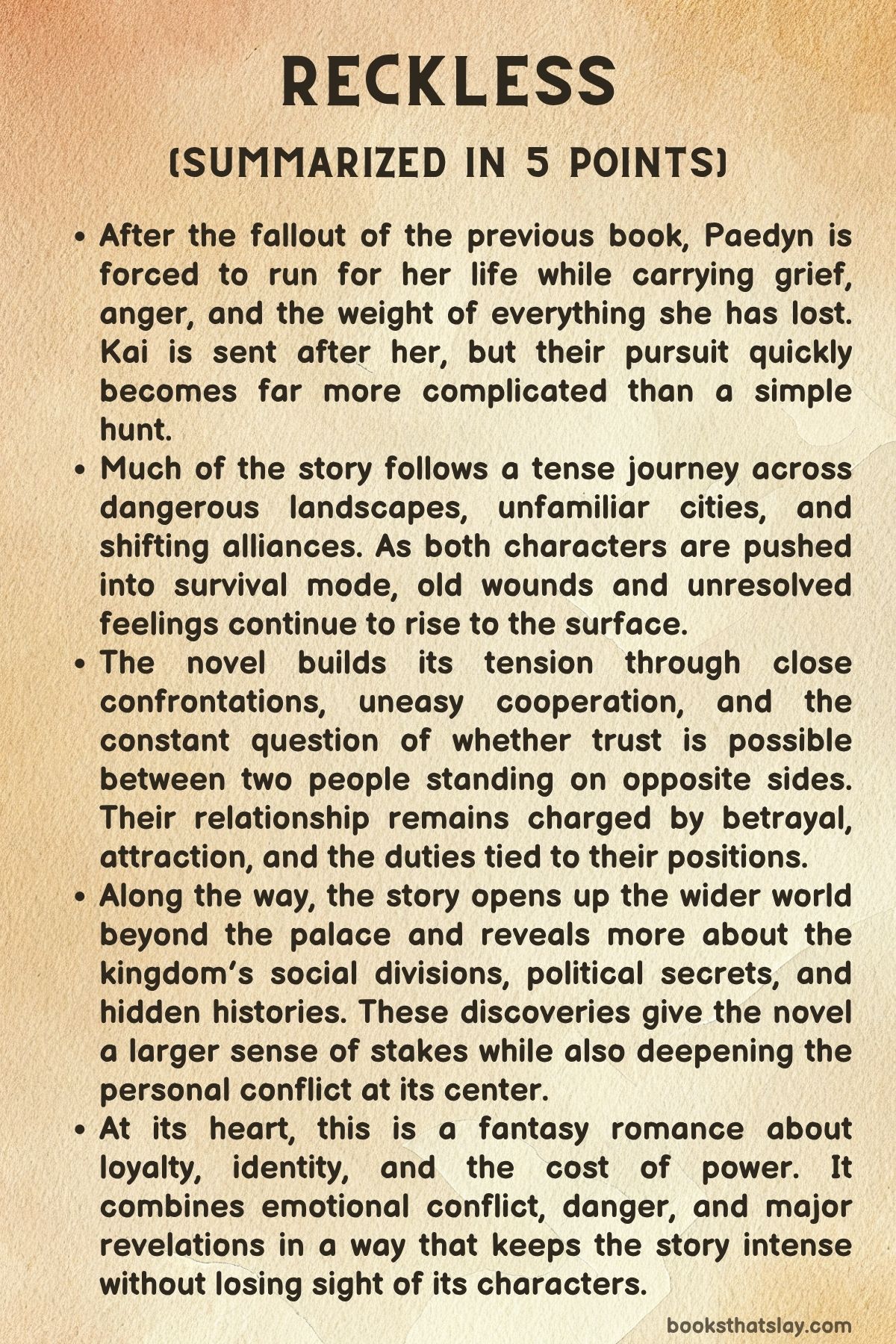
The story follows Paedyn and Kai after the deadly ending of the first book, when trust between them has been shattered but their connection refuses to disappear. On the surface, it is a chase story: a fugitive running from the prince sent to capture her. Under that, it is about power, class, loyalty, and the lies a nation tells itself to survive. It also asks whether love can exist between two people standing on opposite sides of violence, history, and duty.
Summary
The novel opens in the tense days after the death of the king. Kai Azer, now serving as Enforcer for his brother Kitt, moves through a palace changed by grief and power.
Kitt has taken the throne, but the weight of rule is already hardening him. Kai, still mourning and conflicted, marks the birthday of his dead younger sister Ava in private, revealing a tender side beneath his trained violence.
At the same time, Paedyn is wounded, alone, and hiding in the remains of the life she once knew. While searching her old home for supplies, she finds her father’s journal, a discovery that seems important though she has no time to study it.
Kai arrives with Imperials to capture her, and after searching the house, he burns it down. Paedyn escapes, but the fire makes clear that there is no home left for her now.
She flees into the desert known as the Scorches, hoping to reach Dor or Tando and disappear beyond Ilya’s reach. The journey nearly destroys her.
She suffers from hunger, heat, and injury, while carrying guilt for the blood already on her hands and pain over Adena’s death. Kai follows close behind with soldiers, driven by duty, anger, and the feelings he cannot sever.
He wounds her during the chase but still shows mercy in small, confusing ways, including burying a dead soldier because he knows death should be honored. That act matters to Paedyn more than she wants to admit.
When Paedyn finally reaches Dor, survival becomes her next battle. With little money and no protection, she enters an underground fighting ring under the name Shadow, hiding her silver hair and building a reputation through skill and nerve.
Meanwhile, Kai searches Dor for her and learns that the city distrusts Ilyans and especially despises Elites. His hunt becomes harder in a place where his title gives him more danger than power.
Fate brings them together in the fighting ring. Kai recognizes her immediately and joins the contest under a false name so he can force a confrontation.
Their reunion turns into a charged fight shaped as much by longing as by anger. Paedyn nearly defeats him, but he reveals her identity to the crowd, exposing her to people eager to cash in on the bounty on her head.
With the city suddenly turning against her, Paedyn has little choice but to let Kai pull her out alive. Outside, their argument cuts deeper than their weapons.
She tells him that he killed her father years ago, a fact that shakes him because it was one of his earliest killings, carried out under the king’s command and without knowing who the victim really was. He captures her again and takes her to an inn, where they talk through the night.
For the first time, some of the worst truths between them are spoken aloud. Kai admits he was forced into bloodshed by the king.
Paedyn explains that killing the king was an act of survival, not revenge alone. The wound between them does not close, but it becomes more human, more complicated.
Kai begins escorting Paedyn back toward Ilya with a group of Imperials. Their journey across the desert is filled with hostility, sarcasm, and constant attempts by Paedyn to find an opening for escape.
Yet closeness keeps breaking through. Kai tends her injuries.
They argue about the history of Ilya and the kingdom’s claim that Ordinaries are diseased. Paedyn insists the disease is a lie created to justify murder and control.
Kai resists her view because it would mean much of his life has been built on a lie. Their debate becomes one of the book’s central conflicts: not only what they feel for each other, but what kind of country they have been shaped by.
Before they reach home, Paedyn is rescued by Finn, Lenny, and Leena, survivors tied to the Resistance. Kai becomes the prisoner instead, and the group takes both him and Paedyn to a hidden refugee settlement led by Lenny’s mother, Meredith.
There Paedyn discovers a wider truth about the world beyond Ilya’s brutal categories. The community is made up largely of Mixes, descendants of Elites and Ordinaries whose weak abilities leave them excluded from the privileged ruling class.
Their existence challenges the rigid logic of the kingdom. Even Kai, despite being held captive, is drawn to what their lives reveal.
Plans are made to exchange Kai for Paedyn’s freedom, but before anything can happen, both are kidnapped by Rafael, the same man connected to the fighting ring in Dor. He wants to profit from both of them.
Chained together in a cell, Kai and Paedyn are forced into reluctant partnership. Their banter returns, but now it sits beside honesty.
They escape through the sewers, only to become trapped in rising floodwater. Facing what seems like certain death, they confess that they do not regret what passed between them.
In that desperate moment, they kiss, believing it may be their last. Instead, they survive by working together, with Kai pushing Paedyn to safety and Paedyn diving back to save him when he nearly drowns.
Their bond is no longer deniable.
Even then, Kai cannot fully choose love over duty. Once they are safe, he secretly shackles himself to Paedyn so she cannot run.
The choice wounds her trust, but the chain becomes a sharp symbol of their relationship: they are bound together by desire, betrayal, and necessity. As they travel again, pretending at times to be a couple in order to avoid notice, they share stories they have never told before.
Kai reveals the truth about Ava, the hidden younger sister he loved and lost, and Paedyn begins to see the softer history beneath his cruelty. He, in turn, admits more clearly that he never wanted to kill her father and almost refused before events forced his hand.
Their route takes them through dangerous land rather than back across the desert. In quiet moments, they ride together, dance together, steal shelter, and create small pockets of peace that feel painfully temporary.
Then Paedyn finally opens her father’s journal. What they find changes everything.
The kingdom’s central claim is false: the supposed sickness of the Ordinaries was manufactured through bribed Healers and royal manipulation. The king used that lie to justify killing powerless people and building an Elite society based on fear.
The journal also reveals that Paedyn’s father helped found the Resistance. Most shocking of all, Paedyn learns that she was adopted.
Her mother died in childbirth along with her baby, and another infant was left at her father’s door soon after. The truth unsettles her sense of self, but Kai reminds her that the man who raised her loved her fully, whatever her blood may be.
Soon after, bandits attack them. Paedyn kills several in self-defense, and the mounting weight of death nearly crushes her.
Kai protects her from killing one more attacker, and afterward she asks him to cut off her long braid, now stained with blood. The act becomes a release, a sign that she is shedding old burdens even if she cannot yet escape what she has done.
They continue toward Ilya with the journal and its proof, knowing that the truth could change the kingdom if it is allowed to surface.
As they near home, they give themselves one final stretch of freedom. In a field of poppies, they drop the chase and the masks for a little while.
They dance again. They make flower crowns.
Kai sees the scar above Paedyn’s heart, carved there by the king to mark her as an Ordinary, and he is furious on her behalf. He tells her it should stand as proof of strength, not shame.
By the time morning comes, both know what they feel. Kai admits that he is in love with her.
Paedyn admits that she loves him too. Their happiness lasts only moments before Imperials arrive, forcing them back into their roles.
Kai becomes the cold Enforcer again and tells her to pretend to be his prisoner.
They are taken to the palace, where a crowd waits in the throne room. Kitt, now transformed by grief, isolation, and the poisonous legacy of his father, sits on the throne.
He treats Kai with distance and presents Paedyn to the kingdom as an Ordinary, a traitor, and a murderer. She prepares herself for punishment.
Instead, Kitt reveals a shocking decision. Before the gathered court, he announces that Paedyn will become his bride.
The command is not a gesture of romance but a move loaded with power, politics, and possession. In one stroke, he claims the woman Kai loves, binds the kingdom’s most dangerous symbol to the crown, and leaves both of them trapped in a new kind of nightmare.
The book closes with Kai reeling from the loss, stunned by the brother he barely recognizes and by the future that has just been forced upon them all.
Characters
Paedyn
Paedyn is the emotional and moral center of the story, though she is far from being written as flawless. She begins in a state of injury, grief, and isolation, with every part of her life stripped down to survival.
What makes her compelling is that she is not only running from capture but also from the emotional wreckage left behind by betrayal, loss, and violence. She carries the memory of Adena, the burden of killing, and the collapse of everything she thought she understood about loyalty.
Her outward toughness is real, but it is constantly pressed against fear, exhaustion, and sorrow. That tension gives her a strong inner life.
She does not move through the story as an untouchable heroine. She falters, reacts impulsively, questions herself, and keeps going anyway.
One of the most important aspects of Paedyn’s characterization is her relationship with violence. She is capable, strategic, and dangerous when cornered, but she is never emotionally untouched by what she does.
Each act of killing leaves a mark on her. She does what she must to stay alive, yet she does not turn numb.
That distinction matters because it separates her from the ideology of the kingdom around her, where power is often tied to cruelty and emotional detachment. Paedyn does not romanticize what she has done.
She feels guilt, panic, and disgust at the blood on her hands, which makes her choices feel costly rather than convenient. Even when she proves herself in the fighting ring or protects Kai from danger, her strength is connected to fear and necessity, not to any enjoyment of power.
Her intelligence also defines her. Paedyn adapts quickly to changing circumstances, whether she is hiding in plain sight, bargaining for time, reading danger in a crowd, or using performance as protection.
In Dor, she understands that survival requires reinvention, so she becomes Shadow and enters the ring. Later, when she and Kai must pose as a couple, she understands the usefulness of appearance just as much as he does.
Her cleverness is practical rather than showy. She reads people well, spots weaknesses, and is willing to improvise.
At the same time, she is not all calculation. Her emotions often complicate her judgment, especially where Kai is concerned.
That blend of sharpness and vulnerability keeps her from becoming too controlled or predictable.
Paedyn’s identity arc is one of the strongest threads in Reckless. She starts the story already displaced socially and emotionally, but the revelations in her father’s journal destabilize her even further.
Learning that the kingdom’s founding lie was manufactured confirms what she suspected about injustice, yet the more personal discovery that she was adopted shakes her sense of self at a deeper level. Her life has been defined by labels placed upon her, especially the mark of being an Ordinary, and now even the story of her birth is uncertain.
That uncertainty does not weaken the character; it expands her. She becomes someone forced to build identity not from bloodline or social category, but from memory, love, and choice.
Her father’s love remains real regardless of biology, and that realization quietly reshapes her understanding of belonging.
Her relationship with Kai reveals another side of her character. Around him she is sharper, more exposed, and more conflicted than with anyone else.
She wants to hate him because hate would simplify the world, but her feelings keep resisting simplicity. She sees his violence and his role in her suffering, but she also sees his tenderness, his restraint, and the ways he is wounded by the same system that harmed her.
Their connection pulls out her anger, desire, grief, and longing all at once. She is never reduced to being only a love interest in those scenes; instead, the relationship becomes a place where her contradictions are most visible.
She can fight him, save him, distrust him, and love him in the same stretch of story, which makes her emotionally layered.
Paedyn also represents resistance in a broader sense. She pushes against the kingdom’s official narrative, questions inherited truths, and refuses to accept that power defines worth.
Even when exhausted or captured, she does not surrender her ability to challenge the ideas around her. Her conversations with Kai about Ordinaries, Elites, and the kingdom’s history show that her defiance is intellectual as much as physical.
She is not just rebelling against her own fate. She is rebelling against a worldview built on fear, hierarchy, and sanctioned killing.
By the end, she stands as someone trapped again by power, but no longer uncertain about the lies at the heart of that power. That gives her arc both pain and momentum.
Kai Azer
Kai is built around conflict. He is a prince, an Enforcer, a trained killer, a loyal brother, and a man whose deepest instincts often clash with the role he has been shaped to play.
His first scenes establish this divide clearly. He moves through the palace with authority, but there is grief in him, softness in private ritual, and unease about what his brother is becoming.
He is not simply a hardened soldier hunting a fugitive. He is someone trying to force himself into certainty while doubt keeps breaking through.
That internal split makes him more than a standard romantic hero. He has power, skill, and control, but those qualities are continually destabilized by memory, conscience, and love.
Kai’s relationship to duty defines much of his behavior. He has been raised to obey the crown and to believe in the system he serves.
Even when he begins to question parts of it, loyalty remains his first reflex. That is why he continues pursuing Paedyn even when his feelings for her have clearly not died.
He tries to frame the mission as justice for his father, but the story keeps exposing how unstable that explanation is. He is driven by grief, yes, but also by a need to prove to himself and to Kitt that he is still the man he was trained to be.
The tragedy of Kai is that he keeps reaching for tenderness and truth while still choosing structures of obedience that betray both.
His emotional restraint is one of his most striking traits. Kai is not emotionally empty, but he has learned to compress what he feels into action, sarcasm, ritual, and physical control.
He buries a dead Imperial because something in him refuses to let death become meaningless. He tends Paedyn’s wounds even while claiming to hate her.
He remembers Ava through small acts of remembrance rather than open mourning. This reserve makes his vulnerable moments more effective because they feel earned.
When he admits guilt over Paedyn’s father, when he speaks of Ava, or when he confesses love, those moments carry force because they come from someone who has spent much of his life surviving through containment.
Kai’s morality is complicated but not absent. He has committed terrible acts, including killing on royal command, and the story does not let him escape that history.
At the same time, he is not portrayed as someone comfortable with cruelty for its own sake. His horror after learning that the supposed illness of the Ordinaries was a lie becomes one of the most important shifts in his character.
That revelation forces him to confront the possibility that his loyalty has made him complicit in the slaughter of innocent people. The emotional impact of that truth matters because it reveals that his conscience was always there, even when buried under obedience and ideology.
He is not suddenly transformed into a different man. Rather, the story shows the painful breaking point of beliefs he has carried since childhood.
His dynamic with Paedyn is central to understanding him. Around her, his authority starts to fail in revealing ways.
He still tries to control outcomes, capture her, and return her to Ilya, but he cannot fully reduce her to an enemy. She forces him into emotional honesty because she knows both his violence and his vulnerability.
Their conversations strip away the certainty he performs for others. With her, he becomes more introspective, more protective, and more visibly torn.
Even the chain he fastens between them after the sewer escape says a great deal about him. It is an act of betrayal, but also of fear.
He wants her near him, wants his duty intact, and wants time that cannot otherwise be justified. His worst choices often come from this inability to choose clearly between love and role.
Ava’s memory deepens Kai substantially. Without that part of his history, he could be read too narrowly as a dangerous prince with hidden softness.
Ava gives shape to his grief, his tenderness, and his capacity for devotion. The fact that she was hidden due to illness also links his family’s private pain to the kingdom’s broader obsession with power, purity, and appearances.
Kai’s love for her reveals what he protects when he is at his most human. It also explains why Paedyn’s recklessness and boldness move him so deeply.
He does not merely desire her; he recognizes in her a spirit he once cherished and lost.
By the end, Kai becomes tragic in a more complete way. He finally says aloud what has been building throughout the story: he loves Paedyn and cannot hate her.
Yet he is too late to protect that love from the machinery of power. He returns her to the palace, trusting that truth and feeling might matter, only to watch Kitt claim her.
His final position is devastating because he has grown morally and emotionally, but not quickly enough to prevent catastrophe. He remains a man caught between what he has been trained to serve and what he has begun to understand.
Kitt
Kitt is one of the most unsettling characters because his arc shows how grief, insecurity, and inherited power can combine into something frightening. At the start, he is newly crowned and visibly deteriorating.
He is tired, bitter, isolated, and emotionally unstable after his father’s death. Yet the story does not present him as broken in a way that inspires simple pity.
Instead, it gradually reveals how his pain is feeding a dangerous transformation. He recognizes with bitterness that he is becoming the kind of man his father would admire, and that self-awareness does not stop the process.
In some ways it sharpens it.
His relationship with power is shaped by inferiority and comparison. He has grown up beside Kai, who seems naturally suited to action, command, and even their father’s harder expectations.
Kitt appears to have internalized the idea that he is less suited, less certain, perhaps even less respected. Once he takes the throne, he tries to compensate not by becoming wiser but by becoming harder.
The crown gives him authority, but not security. As a result, he begins performing kingship through distance, ruthlessness, and suspicion.
His doubts about Kai’s loyalty show that he feels threatened even by the brother who serves him most closely. That paranoia makes him easier to manipulate and more willing to use dramatic gestures of control.
Kitt’s isolation is crucial to his characterization. He hides in his office, refuses food, withdraws from ordinary human contact, and lets rumor grow around him.
This seclusion suggests not only grief but also a mind turning inward in unhealthy ways. He wants support, but he rejects some of the people who genuinely care for him, such as Andy and Gail.
Instead, he becomes receptive to Calum, whose influence appears far more dangerous. Kitt’s weakness is not simply sadness.
It is the desire to be guided by someone who can make kingship feel decisive and meaningful, even if that guidance leads him toward cruelty.
What makes Kitt especially compelling is that he is not a straightforward villain. He is emotionally fragile, burdened, and still trying to become someone equal to the role forced upon him.
Yet he repeatedly chooses control over compassion. He clings to the language and logic of his father’s rule even while suffering under that legacy himself.
The advice to be brave, benevolent, and brutal becomes a formula he seems eager to accept because it offers clarity. Brutality, in his case, becomes a way to hide uncertainty.
Rather than questioning the world he inherited, he starts to preserve it through increasingly calculated acts.
His connection to Paedyn is rooted in politics, desire, and symbolism. Even before the final proposal, she stands as a figure who complicates his authority.
She is tied to his father’s death, to public unrest, to his brother’s emotional conflict, and to the kingdom’s unstable myths. By making her his bride, he turns a person into a political statement.
The proposal is shocking precisely because it is not framed as love but as possession, spectacle, and strategy. It allows him to appear decisive before the court, claim control over a dangerous symbol, and wound Kai at the same time.
That act reveals how far he has moved from the hesitant new king seen earlier in the story. He has learned to use people as instruments.
Kitt also functions as a dark mirror to Kai. Both brothers inherit damage from their father.
Both are shaped by duty. Both carry grief.
But where Kai’s suffering gradually opens him toward truth, Kitt’s suffering closes him into power. That contrast sharpens both characters.
Kitt is what happens when insecurity and authority fuse without moral resistance. His final decision leaves him poised as one of the most volatile forces going forward.
Lenny
Lenny serves as both friend and political actor. He is not present throughout every stage of the story, but when he appears, he broadens the emotional and social world around Paedyn.
His rescue of her from the desert journey back to Ilya shows loyalty and courage, but also strategic thinking. He is not acting only out of affection.
He understands the political value of Kai and the danger of Paedyn’s situation. That practicality makes him feel grounded within the larger struggle rather than existing only as a supportive side character.
His leadership style seems shaped by care and realism. He guides the group to the hidden refugee settlement and helps bridge Paedyn into a larger community of displaced people.
He also develops a plan to exchange Kai for Paedyn’s freedom, which shows that he thinks in terms of leverage and survival. Unlike the crown, Lenny’s politics are rooted in protecting lives rather than asserting dominance.
His role helps connect personal loyalties to organized resistance.
Lenny also adds contrast to Kai. Where Kai comes from formal authority, Lenny comes from improvised resistance and community knowledge.
The difference matters because it shows Paedyn has ties to another kind of world, one not defined by palace structure. His presence reminds the reader that Paedyn is not alone and that alternatives to Ilya’s hierarchy exist, even if they are fragile and hidden.
Leena
Leena appears as part of the rescue group and stands as one of the surviving links to Paedyn’s earlier alliances. Though the summary offers less individual detail about her than about some others, her role still matters.
She represents continuity, the fact that not every bond from the past has been destroyed. In a story where Paedyn is often cut off and forced into isolation, Leena’s presence helps restore emotional connection and memory.
She also belongs to the network of those resisting the kingdom’s structure, which gives her significance beyond dialogue or action count. Characters like Leena help show that resistance is collective.
Paedyn may be central, but she is not carrying the whole burden alone. Even when the story’s focus returns to the central pair, figures like Leena help maintain the sense that a wider struggle continues around them.
Finn
Finn’s importance is immediate and practical. His arrow is the first sign to Paedyn that rescue has come, which turns him into a figure associated with precision, timing, and intervention.
He helps interrupt Kai’s control over her fate and signals that Paedyn still has people willing to risk themselves for her. In a narrative filled with pursuit and capture, Finn’s arrival changes the direction of events and restores momentum to the side opposing the crown.
Like Leena, Finn also helps keep the world from shrinking entirely into the romance and rivalry at the center. He stands for the ongoing fight beyond Paedyn and Kai’s personal conflict.
The survival of people like him suggests that the system they are all trapped in has not fully erased opposition.
Meredith
Meredith is important because she represents refuge, structure, and alternative authority. As the head of the hidden community in Dor, she provides a countermodel to the monarchy.
Her power is not theatrical or inherited. It is built through care, protection, and the gathering of the displaced.
She has created space for people the kingdom has failed or rejected, especially Mixes, whose existence challenges the official categories of society.
Through Meredith, the story shows that leadership can be communal and restorative rather than domineering. Her settlement expands the moral horizon of the narrative by demonstrating that survival can become community, not just hiding.
She also gives political meaning to the suffering around her. These people are not isolated exceptions; they are evidence of a social order built on exclusion.
Luna
Luna may not dominate the plot, but she plays an important symbolic role. As a young Mix who can produce only a limited form of flame, she embodies the blurred lines the kingdom tries to deny.
Her very existence disrupts the clean division between Elite and Ordinary. Because her power is small, she does not receive the status associated with ability, which reveals that the kingdom’s hierarchy is not only about gifts but about control and classification.
Luna helps make abstract injustice visible on a personal scale. Rather than discussing political categories in the distance, the story gives them a face.
Her presence deepens the social world and supports the theme that identity under this regime is shaped less by truth than by the needs of power.
Rafael
Rafael is a character of opportunism. He first appears connected to the fighting ring, where he profits from spectacle and violence.
Later, when he captures both Paedyn and Kai, he reveals himself even more clearly as someone motivated by personal gain rather than ideology. He is not invested in the kingdom’s myths, the resistance’s ethics, or the emotional stakes between the leads.
He sees value in bodies, names, and bounties.
That makes him useful in the narrative because he strips conflict down to greed. Around him, people become commodities.
His actions create one of the book’s most intense forced-proximity situations, pushing Paedyn and Kai into cooperation under threat of death. He functions less as a deeply layered psychological figure and more as a pressure point that exposes what the main characters feel and fear.
Even so, his role is effective because he reflects a world where violence is not only political but profitable.
Gail
Gail brings warmth, memory, and domestic history into a story otherwise crowded with fear and pursuit. As the cook who helped raise Kai and Kitt, she represents a kind of maternal steadiness within the palace.
Her care is shown in ordinary acts, especially the sticky bun tradition, which becomes linked to grief, remembrance, and family. Characters like Gail matter because they remind the reader that tenderness can survive even in corrupt places.
Her interactions with both brothers also reveal what they are losing. Around Gail, their titles fall back a little and their youth becomes visible.
She sees their pain in a way the court does not. Her concern for their well-being makes the palace feel not only like a center of power but also like a home damaged by the king’s cruelty and by death.
Calum
Calum is one of the more quietly alarming figures in the story. Once a leader of the Resistance, he now appears close to Kitt and able to influence him during a vulnerable period.
That shift alone makes him intriguing. Whether he is acting from pragmatism, manipulation, hidden strategy, or some mix of all three, he clearly understands Kitt’s weaknesses.
He offers counsel at exactly the moment Kitt is most isolated and most desperate for guidance.
His role complicates simplistic ideas of resistance and loyalty. A former rebel leader might be expected to oppose the crown directly, yet Calum is now shaping the king’s decisions from inside the palace.
That ambiguity gives him weight. He may be trying to influence power from within, or he may be serving his own agenda.
Either way, his presence marks him as a political operator rather than a transparent idealist.
Andy
Andy appears briefly, but her interaction with Kitt is revealing. She approaches him through a practical excuse, tries to reach him when he is withdrawing, and offers help without grand performance.
That makes her one of the few figures who responds to his deterioration with direct human concern rather than fear or manipulation. Her rebuff shows how far Kitt has retreated from those who might steady him.
She functions as evidence that healthier paths were available to him. He was not entirely abandoned.
He turned away from certain forms of care, which sharpens responsibility within his arc. Andy’s role is therefore small but meaningful.
Abigail
Abigail serves as a reminder that past actions echo forward in unexpected ways. Kai had spared her earlier, and when she reappears as a young thief in Dor, the moment reveals both continuity and consequence.
She is a survivor in a hard city, and her presence shows how ordinary lives continue at the edges of royal conflict. She also becomes the link that guides Kai toward the fighting ring and therefore back to Paedyn.
Her significance lies partly in what she reveals about Kai. The fact that he recognizes her and speaks with her rather than dismissing her helps preserve the sense that his humanity has always existed beneath the role of Enforcer.
Abigail is not central to the emotional plot, but she strengthens the world by giving it memory and social texture.
Francis
Francis appears in a smaller role as the vendor Paedyn tries to barter with in Dor. Though brief, the encounter helps establish the city’s harshness and Paedyn’s vulnerability.
Characters like Francis are useful because they show the texture of survival. Not every obstacle is dramatic or violent.
Sometimes the world simply refuses help. His reluctance helps underline how alone and resource-starved Paedyn has become after fleeing Ilya.
Slick
Slick functions primarily as a test of Paedyn’s ability and growing reputation in the fighting ring. As a large and formidable opponent, he helps establish the physical danger of the arena and the level of skill Paedyn must display to survive there.
He does not seem designed as a psychologically complex figure, but he is important structurally because his fight with her confirms that she can turn raw desperation into public competence.
Ava
Ava’s physical presence belongs to the past, but her emotional presence shapes Kai throughout the story. She is the lost sister whose memory still guides how he grieves, loves, and remembers innocence.
The fact that she was hidden because of illness ties her directly to the kingdom’s obsession with power and image. Even within the royal family, weakness had to be concealed.
Ava therefore becomes a quiet indictment of the values ruling the palace.
She also humanizes Kai in a lasting way. His tenderness toward her, his continued mourning, and the ritual connected to her birthday reveal a capacity for devotion that might otherwise stay hidden beneath violence and sarcasm.
Paedyn’s resemblance to Ava in spirit helps explain why Kai responds to her with such intensity. Ava is not merely backstory.
She is one of the keys to Kai’s inner life.
Paedyn’s Father
Paedyn’s father grows in importance after death through the journal he leaves behind. At first he is part of her emotional foundation, the parent she lost and still carries with her through memory and hidden supplies.
Later, the journal transforms him into a figure of political and moral significance. He was not just a father trying to protect his child.
He was connected to the beginnings of resistance and possessed knowledge that could expose the kingdom’s greatest lie.
What makes him especially moving is that his importance remains personal even after the larger revelations. Learning that Paedyn was adopted does not erase his role as her father.
In fact, it deepens it. He chose her, raised her, protected her, and loved her in a society built on bloodline, category, and exclusion.
His legacy therefore operates on two levels at once: he leaves behind proof that could shake a kingdom, and he leaves behind a model of love not determined by biology.
The Former King
Though dead before most of the action unfolds, the former king remains one of the strongest shaping forces in the novel. His cruelty lives on through institutions, scars, trauma, and the choices others continue making in his shadow.
He carved Paedyn’s body, ordered killings, maintained the lie about Ordinaries, and built a society organized around fear and manipulated biology. He is the architect of much of the suffering in the story, even when absent from the page.
His influence on his sons is especially significant. Kai has been weaponized by him, while Kitt is in danger of becoming him.
This makes the king more than a dead tyrant in the background. He is an inherited pattern, a system of thought and rule that survives him.
One of the central questions moving forward is whether that inheritance can be broken.
The Queen
The queen’s brief appearance adds another layer to the royal household. Secluded and ailing, she seems removed from power, yet her words to Kitt still matter.
Her assurance that he will make his father proud is revealing because it shows how deeply the old king’s values continue to shape the family even after his death. She does not appear to challenge the worldview that caused so much damage.
Instead, she reinforces it, perhaps gently, but still significantly.
Her presence helps show that the palace is full of people damaged by the system who may also help preserve it. She is not drawn as a central architect of cruelty, but neither is she a force of meaningful resistance.
Jax
Jax’s role is brief, but his warmth toward Kitt creates a contrast with the emotional coldness growing elsewhere in the palace. As an adopted younger brother, he also subtly echoes some of the story’s themes around family not being limited to blood.
Even in a political house built on hierarchy and image, chosen or extended bonds exist. His presence does not alter the plot sharply, but it adds texture to the family structure around Kitt.
The Imperials
The Imperials as a group matter because they show the machinery of the crown in motion. They are pursuers, guards, transport, and force.
Yet the narrative occasionally individualizes them just enough to complicate easy readings. Kai buries a fallen soldier, and Paedyn is affected by seeing that gesture.
Moments like that remind the reader that the apparatus of oppression is made up of people, some obedient, some fearful, some expendable. Even when not deeply individualized, they contribute to the moral atmosphere of the story.
The Bandits
The bandits mainly serve as a test of survival and as a trigger for deeper emotional exposure between Paedyn and Kai. Their attack matters less because of who they are individually and more because of what it forces the protagonists to confront.
Paedyn’s panic after killing more men, Kai’s need to comfort and protect her, and the aftermath in the cave all emerge through this confrontation. They act as a harsh reminder that even outside palace politics, danger remains constant.
Taken together, the characters create a world driven by grief, lies, desire, and power. The strongest among them are not defined by single traits but by contradiction.
Paedyn is fierce yet shaken, Kai is loyal yet morally divided, and Kitt is fragile yet increasingly dangerous. Around them stand figures who widen the social and political frame, from refugees and rescuers to manipulators and ghosts from the past.
That range is what gives Reckless its sense of emotional pressure and continuing instability.
Themes
Love Under the Pressure of Duty
Love in Reckless is never allowed to exist in a private, protected space. It grows in pursuit, captivity, argument, and fear, which gives the relationship between Paedyn and Kai its emotional force.
Their bond is not built in calm conditions where trust can develop naturally. Instead, it survives in a setting where each of them has practical reasons to reject the other.
Kai is responsible for bringing Paedyn back to the kingdom, while Paedyn knows that trusting him could destroy her freedom and possibly her life. The novel uses that tension to examine what love looks like when it is constantly interrupted by political responsibility, inherited loyalty, and personal grief.
What makes this theme especially effective is that love does not erase those pressures. It does not solve them.
In fact, the more clearly Paedyn and Kai admit what they feel, the more painful their situation becomes.
The story also refuses to present love as purity untouched by damage. Both characters are tied to acts that have wounded the other.
Paedyn killed Kai’s father. Kai killed Paedyn’s father under royal orders.
They meet again carrying those facts, and the relationship develops not by ignoring them but by circling back to them repeatedly. This gives their connection moral difficulty.
They are not simply star-crossed lovers separated by class or custom. They are people linked by real harm, and that makes every moment of tenderness feel unstable.
A kiss does not cancel the past. An admission of love does not create safety.
The novel is interested in the painful truth that emotional intimacy can coexist with anger, mistrust, and history that cannot be undone.
Duty gives this theme its sharpest edge. Kai keeps choosing the role he has been trained for even when his private self is moving in another direction.
He tends Paedyn’s wounds, protects her, and finally admits he loves her, yet he still keeps returning to the logic of obligation. He chains himself to her after they survive the sewer.
He continues the journey back to Ilya. He asks her to pretend to be his prisoner when the Imperials appear.
These actions show that love alone is not enough to free him from the system that formed him. Paedyn understands this, which is why her feelings remain tied to caution.
She wants to believe in him, but she cannot forget that he has repeatedly placed duty beside intimacy rather than beneath it. The novel therefore treats love not as escape from politics but as something shaped and often damaged by it.
This theme becomes even more devastating at the end. After Paedyn and Kai finally speak honestly about their feelings, they are dragged back into public roles almost immediately.
The final proposal from Kitt turns private emotion into a political weapon. Love, which had briefly seemed like a truth strong enough to stand on its own, is overwhelmed by the structures of monarchy and control.
That ending gives the theme its full weight. The relationship matters because it is real, but it exists in a world where power can still seize, redefine, and exploit real feeling.
The novel suggests that love can survive extraordinary strain, but it also insists that survival is not the same as freedom.
Power, Propaganda, and Manufactured Truth
The kingdom’s social order is built on a lie, and the novel spends much of its time exposing how deeply that lie has shaped every part of life. The belief that Ordinaries are diseased is not just a piece of background lore.
It is the central fiction used to justify hierarchy, exclusion, and murder. What makes this theme so strong is that the lie has been repeated so often and embedded so thoroughly that even people harmed by the system, or serving it directly, have structured their identities around it.
Paedyn has lived under the mark of imposed inferiority, while Kai has been trained to enforce the kingdom’s official worldview. The false narrative about disease is therefore not merely a political strategy.
It is a tool that controls perception, morality, and memory.
The journal discovered by Paedyn becomes the turning point in this theme because it provides proof that suspicion and resistance were justified all along. The king bribed Healers to support a fabricated story, using false medical authority to turn prejudice into policy.
This matters because propaganda in the novel is not shown as simple public messaging. It is institutional.
It borrows the language of health, safety, and necessity in order to make violence appear rational. The kingdom does not rule only by fear of punishment.
It rules by convincing people that cruelty is protection, and that inequality is the natural answer to a threat. That gives the system a chilling realism.
People are easier to control when they believe that injustice is survival.
Kai’s response to this revelation is central to the theme’s emotional depth. He has spent much of his life believing he was serving order and protecting his kingdom, even when he carried out brutal commands.
Once he learns that the basic premise behind that order was false, he is forced to reconsider not only the crown but himself. The damage is personal because propaganda does not only shape public opinion; it shapes conscience.
If the lie is false, then many of his actions become harder to excuse, and his understanding of loyalty begins to collapse. This is one of the novel’s most painful insights: systems of deception do not only create victims outside power.
They also morally deform those trained to defend them.
The existence of Mixes adds another dimension to this theme. Their presence undermines the kingdom’s rigid categories and exposes the artificiality of the divisions that support Elite status.
The social order depends on clean labels, but actual human life resists those labels. Mixed heritage, weak powers, secret histories, and hidden children all reveal that the kingdom’s structure has always relied on suppressing complexity.
The lie about disease is therefore part of a larger need to reduce people into categories that can be ruled, feared, or erased. By uncovering falsehood at both the public and personal level, the novel shows that power depends not only on force but on the successful management of what counts as truth.
Once truth starts to crack open, the legitimacy of the whole kingdom begins to crack with it.
Identity, Inheritance, and the Instability of Labels
Identity in the novel is presented as something fragile under systems that classify human worth from the outside. Paedyn’s experience gives this theme its strongest expression.
She has spent her life defined by labels that were forced upon her: Ordinary, outsider, target, survivor. Even before the revelation about her birth, she lives under a structure that tells her who she is supposed to be and what that means about her value.
The scar above her heart makes this visible in the most physical way. It is not enough for the kingdom to believe she belongs to a lesser class.
It must inscribe that belief on her body. Identity, in that sense, becomes both social judgment and violence.
The novel keeps returning to the gap between who Paedyn knows herself to be and how power has named her.
The discovery that she was adopted widens this theme considerably. Until that moment, Paedyn’s conflict has largely concerned political status and survival.
The journal changes that by destabilizing her private origin as well. She learns that the father she loved was not her biological father and that the story of her beginning is more uncertain than she imagined.
What makes this reveal meaningful is that it does not reduce her. Instead, it forces a deeper question: if bloodline, category, and official designation are all unstable, what actually makes a self?
The answer the novel moves toward is not ancestry in any narrow sense, but love, memory, and chosen loyalty. Her father remains her father because he raised and loved her.
That truth quietly resists the logic of a kingdom obsessed with inheritance, purity, and classification.
Kai’s arc also contributes to this theme because he is trapped inside an identity built by expectation. He is the Enforcer, the prince suited for violence, the son shaped by the late king’s demands.
Yet those roles do not contain all that he is. His grief for Ava, his care for Paedyn, and his growing horror at the kingdom’s lies reveal a self that does not fully fit the weaponized identity others recognize.
He has inherited a role before he has chosen a moral position, and much of his conflict comes from the gap between the two. Kitt reflects a darker version of the same problem.
Once crowned, he starts turning himself into a king he believes he must resemble, adopting harshness because he thinks authority requires it. In both brothers, identity is shown as performance under pressure as much as inner truth.
The theme becomes even richer through the existence of Mixes, who embody the failure of rigid categories. They stand as living proof that the kingdom’s social language cannot fully account for reality.
Their weak powers leave them suspended between recognized classes, which reveals that social labels are not neutral descriptions but tools of gatekeeping. The world is more complicated than the regime allows.
The same is true of family structures, as seen in adopted siblings, hidden children, and chosen communities. Again and again, the novel resists simple definitions.
It suggests that labels imposed by power are often designed to control rather than to understand. Identity, by contrast, emerges as something more complicated, emotionally grounded, and resistant to official naming.
Violence, Guilt, and the Cost of Survival
Violence in the novel is never treated as a clean expression of bravery or justice. It leaves emotional residue, moral confusion, and bodily evidence behind.
Paedyn’s journey makes this especially clear. She kills to protect herself, to escape, and to survive, but every act stays with her.
She does not move from one death to the next with growing ease. Instead, the accumulation of violence becomes part of her psychological burden.
She remembers the people she has lost, the blood she has shed, and the fear that she is becoming someone shaped by death. This matters because the novel does not allow survival to remain simple.
To live in this world often requires doing terrible things, yet necessity does not erase guilt.
That distinction is one of the novel’s strongest ethical choices. Paedyn is capable and dangerous, but she is not emotionally flattened into a pure action figure.
After killing more attackers, she panics at the number of people she has now taken from the world. Her response keeps the story focused on consequence rather than spectacle.
Violence is not presented as a dramatic skill alone. It is a force that enters the self and changes how a person sees their own body, memory, and future.
The scene in which Kai cuts off her blood-soaked braid becomes especially meaningful in this context. The braid is not only hair.
It has become a physical carrier of grief, blood, and symbolic weight. Cutting it off suggests a desperate attempt to release what violence has attached to her identity.
Kai’s relationship with violence gives the theme another layer. He has been trained into killing as duty, which means his guilt is delayed rather than absent.
For much of his life, violence has come wrapped in obedience, necessity, and royal command. Once the lies behind the kingdom begin to surface, that structure falls apart.
He can no longer rely so easily on the idea that he was protecting order or acting for the good of the realm. His first kill, Paedyn’s father, becomes far more painful in retrospect because it was not only a traumatic act but part of a larger machinery of wrongful death.
The novel shows that systems of authority often absorb personal guilt by calling violence service. Once that cover is removed, the moral damage returns to the individual with greater force.
The story also ties violence to social design. The arena in Dor turns pain into entertainment.
Rafael turns human lives into profit. The monarchy turns public fear into a justification for elimination.
Bandits, soldiers, rulers, and fugitives all operate in a world where violence has become ordinary, but the novel keeps asking what that ordinariness costs. It costs trust, because every relationship is touched by harm or threat.
It costs identity, because people start defining themselves by what they have endured or done. It costs innocence, because even moments of tenderness are shadowed by what each person carries.
Survival, then, is not a triumphant state reached after danger passes. It is ongoing, compromised, and emotionally expensive.
The novel’s power comes partly from refusing to hide that cost.