Red as Royal Blood Summary, Characters and Themes
Red as Royal Blood by Elizabeth Hart is a fantasy court thriller set in the kingdom of Lumaria, where power is fragile and survival depends on reading people faster than they can read you. Ruby is a castle housemaid who expects her life to stay small: early mornings, quiet errands, and secret moments of friendship with Prince Rowan.
Then the king dies, and a sealed edict makes Ruby the new queen. Thrown into politics, suspicion, and violent unrest, Ruby must learn to command a court that wants her controlled, discredited, or dead—while uncovering why the late king chose her at all.
Summary
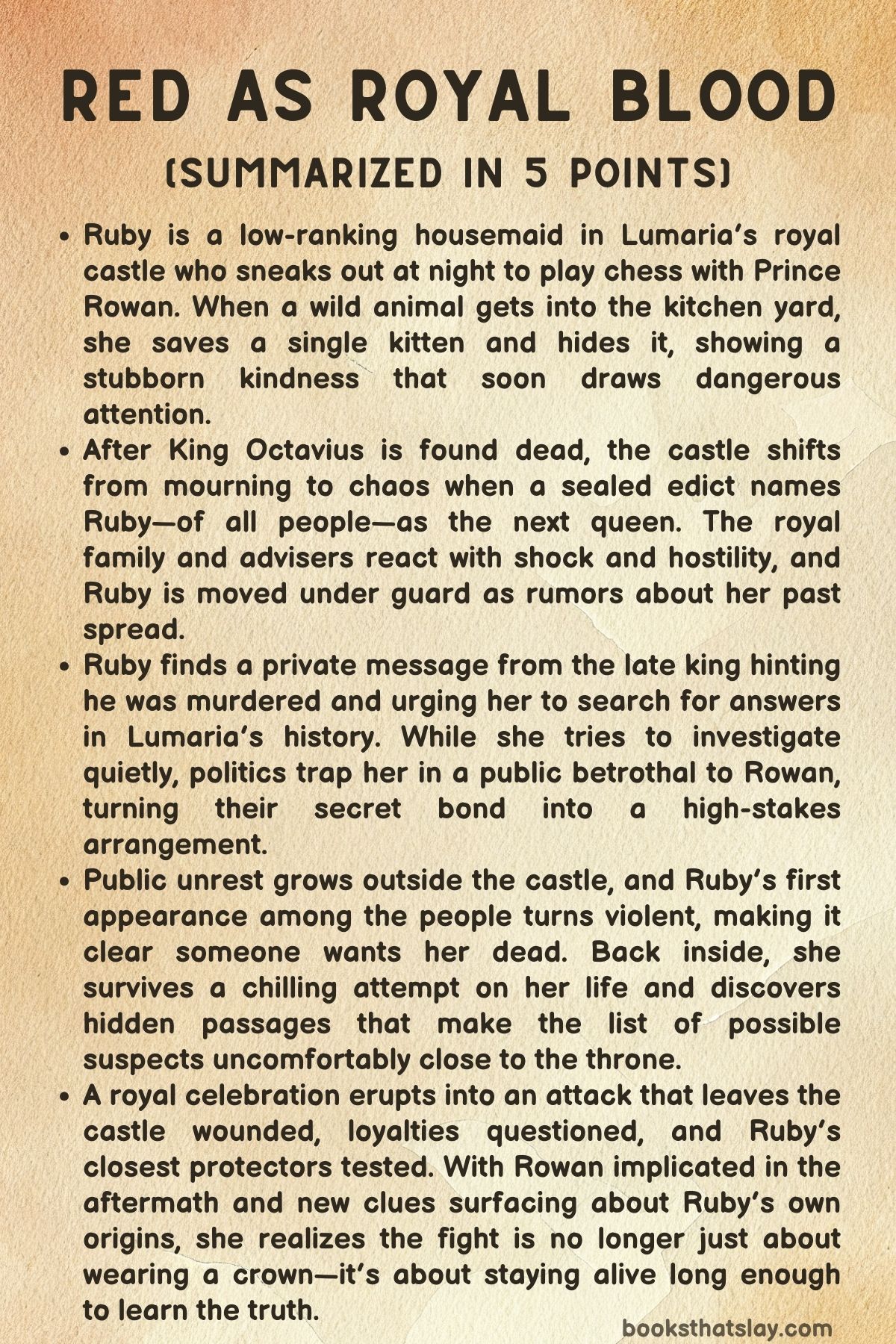
Ruby, a housemaid in Lumaria’s royal castle, is jolted awake by a late-night message that leads her to the stables. There she meets Prince Rowan in secret, and the two play chess by candlelight.
Their easy teasing hides real tension in the kingdom: Prince Sorren has been dead for six months, King Octavius has been sick and withdrawn, and protests beyond the castle walls are growing louder. As dawn nears, Ruby slips away to begin her day before anyone notices she’s gone.
Crossing the kitchen yard, Ruby finds the gate unlatched and discovers a coyote inside. It has killed the mouser cat and most of her kittens.
Ruby drives the animal off and rescues one kitten still breathing. Refusing to let another worker kill it, she cleans and feeds it, then hides it in her apron.
Moving through the corridors with a breakfast tray for the king, Ruby feels a strange chill and hears a distant giggle, but the guard, Drake, offers little explanation as he brings the tray into the king’s chambers.
Later, Ruby cleans the royal library and checks a chessboard that has become its own secret contest: someone has been moving pieces when she isn’t there, and she answers each move in return. While she’s there, Prince Asher arrives with his betrothed, Lady Rosaline.
Rosaline is delighted by the kitten and immediately talks about using it as a fashionable accessory. Ruby blurts a firm refusal and flees, terrified she has just signed her own punishment.
The castle shifts into mourning that same day. Black drapes go up; music carries through the Great Hall.
King Octavius has been found dead in his bed when breakfast arrived. Servants are dismissed to grieve, but Ruby barely has time to breathe before she is escorted to the throne room.
The queen and the royal siblings stand with the advisors as an edict is read aloud: King Octavius has named Ruby—an ordinary housemaid—as his heir and the next queen of Lumaria.
Shock turns into fury. Asher grabs Ruby by the throat, accusing her of seduction or espionage.
Ruby reacts on instinct, drawing a hidden knife and forcing him back. The advisors restore order, but Ruby is immediately moved into the late king’s chambers under guard.
Everyone warns her that many will want her dead.
Alone, Ruby discovers a hidden silver box engraved with her name. Her ruby pendant fits into it like a key.
Inside is a note from King Octavius: if Ruby is reading it, he was murdered by someone close. He tells her to find the killer and says the answer is in history.
Ruby’s grief hardens into purpose, even as she realizes she has no idea whom to trust.
At the first breakfast with the nobles, Rowan publicly welcomes Ruby and tries to steady her. Asher, in contrast, openly humiliates her.
Belle, the royal sister, gives Ruby blunt advice: never apologize, never show fear, and never act like a servant again, or she will be eaten alive. Ruby begins asking questions anyway.
Drake says no one entered the king’s chambers that night, and the physician, Sir Henry, claims the king refused care and seemed more broken than poisoned. Ruby does not believe the death was natural.
Politics closes in. Old law demands a queen have a prince consort, and the royal family’s status will change once Ruby is crowned.
The council chooses Rowan as the solution. Rowan proposes in front of the advisors, and Ruby accepts because refusing could cost her the crown and her life.
In private, she admits she truly was only a maid and does not understand why the king chose her. Rowan believes her, but their secret friendship is now a public arrangement.
The coronation preparations consume Ruby: etiquette lessons, gowns, rehearsals, and constant supervision. She learns the public ceremony will unfold in stages and that she and Rowan can delay the actual marriage vows for now.
During a parade through the city, Ruby rides in an open carriage with the royal family and sees the divided crowd—cheers mixed with jeers. Rotten fruit flies.
Then the mob surges. Hands grab Ruby, yanking at her hair and clothing.
Rowan fights them off, and Asher clamps an arm around Ruby to keep her from being pulled into the street. An arrow strikes the carriage, and the family escapes back to the castle.
Ruby is left bleeding and shaken, certain the arrow was meant for her.
Searching for the clue in Octavius’s note, Ruby finds a damaged history book with a hidden message directing her to look behind the shelf. She discovers the king’s concealed journal.
Around the same time, she notices her chess opponent makes a move that practically hands her victory, as if someone wants her to feel safe—or misled.
Threats follow quickly. During a bath, Ruby spots a snake in the plumbing.
When it threatens her kitten, she kills it with a thrown knife. Rowan bursts in through a hidden entrance, revealing a network of secret passages near the royal rooms.
Ruby later tests the passages and realizes they connect to the king’s chambers. That means any member of the royal family could have reached Octavius unseen.
Ruby continues watching and eventually follows a cloaked figure through a hidden exit into town. She sees Asher leaving a tavern with an older laborer.
When danger corners Ruby in the street, Asher steps in, stops her attacker with a thrown knife, and forces Ruby back to the tunnel. Ruby demands answers about Asher’s secret meetings; he refuses, warning her not to follow him again.
Violence explodes during the nobles’ ball. Rebels attack the castle, and Drake is fatally wounded while protecting Ruby in the underground passages.
Ruby is nearly killed by an assassin she recognizes from town, but Asher arrives in time and kills the man. In the aftermath, the Great Hall becomes an infirmary.
Ruby learns Rowan has been arrested, accused of coordinating with the attackers.
Ruby confronts Rowan in his cell. He admits he attended antiroyalist meetings and used his reputation to hide it, but insists he did not plan the deaths or the attack.
Ruby chooses a sentence of exile rather than execution, even as the betrayal cuts deep.
Still hunting the truth about Octavius’s death and her own identity, Ruby travels with Asher to meet Mellie, a former castle cook. Mellie reveals Ruby was brought to her as an infant by King Octavius.
Ruby’s mother was Esme, a woman Octavius loved, who later died under suspicious circumstances after her husband, Garrick, was accused of treason and sent away. Ruby visits Esme’s grave and sees evidence that she is tied to the royal family’s hidden history.
Back at the castle, the council pushes Ruby toward marrying Cedric instead. Ruby refuses to accept any arrangement without consent, but pressure rises.
In a moment of anger and confusion, Ruby and Asher cross a line and spend the night together. Soon after, Cedric warns Ruby that a “shadow” killed Sorren and their father and is coming for her too.
Before Ruby can act on this, her friend Sara disappears, and Lord Hayes traps Ruby, knocks her unconscious, and locks her in the Old Tower.
Hayes reveals his plan: poison Ruby and place Asher on the throne. Ruby escapes, rallies loyal guards, and storms the council meeting to order Hayes arrested for treason.
With Hayes contained, Ruby digs deeper into Sorren’s sealed room and finds his journal. It points to a hidden parentage scandal tied to Hayes.
Ruby forces a confrontation with Belle and learns the truth: Belle pushed Sorren when he confronted her, and Sir Henry helped cover it by drugging Cedric and poisoning the king to protect the family secret. When Belle attempts to kill Ruby to keep it buried, Asher saves Ruby, and Belle falls to her death.
Sir Henry is arrested. Hayes’s interrogation exposes even more: Garrick was framed, Esme was killed to silence her, and the rebellion was enabled to destabilize the crown.
With the plot unraveled, Ruby delays her coronation, clears Garrick publicly, and reshapes her court. When the coronation finally comes at the Towered Arches, Ruby is crowned Queen of Lumaria, with Asher named her prince consort.
In the quiet afterward, Ruby returns to the library chessboard, no longer a servant sneaking moves in secret, but a queen who understands the game—and intends to win it.
Characters
Ruby
Ruby is the central figure of Red as Royal Blood, and her transformation from a humble maid to the crowned Queen of Lumaria defines the novel’s core arc. Initially portrayed as diligent, curious, and quietly rebellious, Ruby’s character captures the resilience of someone who has lived under the weight of servitude yet possesses an innate sense of dignity.
Her compassion is vividly shown through her rescue of the injured kitten—a small act that mirrors her refusal to abandon those weaker than herself. When fate thrusts her into power, she does not succumb to arrogance; instead, her empathy deepens even as her resolve hardens.
Throughout the story, Ruby evolves into a sharp and strategic ruler, constantly forced to weigh mercy against survival. Her moral compass remains her guiding force, even while she navigates deceit, assassination attempts, and the crushing demands of political ascendance.
Her relationship with Prince Rowan reveals her longing for understanding and shared trust, while her eventual bond with Asher showcases her complexity—both emotional and moral. Ruby’s intelligence, courage, and deep humanity make her a queen not by birthright but by merit.
Prince Rowan
Prince Rowan emerges as both Ruby’s confidant and mirror—reflecting the tension between duty and desire. As a prince, he is gentle, introspective, and acutely aware of the kingdom’s unrest.
His secret chess games with Ruby serve as a metaphor for their intellectual and emotional connection, foreshadowing the strategic dance of loyalty and politics that will later define their lives. Rowan’s sympathy for antiroyalist movements highlights his moral conflict: he believes in justice for the oppressed, even if it contradicts royal expectations.
When his political sympathies entangle him in rebellion, Rowan’s integrity is tested to the breaking point. Despite his idealism, he becomes a tragic figure—caught between his love for Ruby and his guilt over inadvertently fueling the chaos that threatens her rule.
His imprisonment and confession mark him as both a victim of circumstance and an emblem of Lumaria’s fractured ideals. Through Rowan, the novel questions the price of conscience and the loneliness of those who try to bridge two irreconcilable worlds.
Prince Asher
Prince Asher is the story’s most volatile and complex figure. His initial hostility toward Ruby—accusing her of manipulation and deceit—reveals deep insecurity and resentment toward the power dynamics of the crown.
Fierce, proud, and impulsive, Asher embodies the soldier’s temperament, one forged in violence and loyalty to tradition. Yet beneath his anger lies a restless intelligence and a hunger for truth.
His evolution from antagonist to protector mirrors Ruby’s own transformation, and their growing intimacy blurs the line between alliance and passion. Asher’s moral ambiguity keeps readers uncertain: he can be cruel and controlling, yet also fiercely devoted and self-sacrificing.
His final choice to stand beside Ruby as her prince consort reflects his acceptance of love as strength, not weakness. Through Asher, Elizabeth Hart crafts a study of masculine vulnerability—the tension between power, pride, and the need to be seen beyond one’s armor.
King Octavius
Though King Octavius dies early in the narrative, his presence haunts every page of Red as Royal Blood. His secret decision to name Ruby as heir shapes the destiny of all who follow.
A ruler weighed down by illness and guilt, Octavius is portrayed through fragments—letters, memories, and revelations that gradually expose his humanity. His love for Esme and his remorse over Garrick’s downfall suggest a man torn between personal loyalty and political obligation.
The posthumous message he leaves for Ruby—urging her to find his killer—cements his role as both guardian and architect of the kingdom’s reckoning. Octavius symbolizes the decaying moral order of Lumaria, where truth and secrecy are indistinguishable.
Through him, the novel reflects on legacy and the haunting cost of kingship.
Queen Narissa
Queen Narissa is an embodiment of cold elegance and political calculation. Even as the matriarch of a crumbling dynasty, she retains a commanding presence.
Her outward composure conceals layers of resentment and fear—particularly as Ruby’s ascension threatens her children’s status. Narissa’s manipulation of council proceedings and her insistence on royal decorum demonstrate her understanding of power’s fragile veneer.
Yet beneath her icy demeanor lies a tragic awareness that she has lost control of her own legacy. Narissa is not heartless; she is a survivor molded by court politics and betrayal.
Her character stands as a study in the sacrifices demanded by monarchy—dignity sustained through denial.
Belle
Princess Belle is a sharp contrast to her brothers—a woman of poise, intelligence, and veiled ruthlessness. Her mentorship of Ruby initially appears as guidance, yet it is laced with warning and resentment.
Belle’s pragmatic lessons in power reveal her understanding of how femininity is weaponized in court. Her later confession—that she killed Sorren to protect the secret of their illegitimate parentage—transforms her into a tragic villain.
Driven by fear and loyalty, Belle’s downfall underscores the destructive nature of hidden truths. Her death from the Old Tower mirrors her moral collapse, turning her into both victim and perpetrator in Lumaria’s cursed lineage.
Cedric
Prince Cedric is the most fragile of the royal siblings, haunted by nightmares and the burden of knowledge he cannot bear. His visions of “shadows” and terror at unseen threats blur the line between madness and prophetic truth.
Cedric’s innocence contrasts sharply with his siblings’ ambition, making him the novel’s moral barometer. His revelations about Sorren’s death propel Ruby closer to uncovering the kingdom’s darkest secret.
Cedric’s psychological unraveling symbolizes the toll of generational deceit—a prince broken by the weight of royal sins he never committed.
Lord Hayes
Lord Hayes is the novel’s chief architect of deceit, representing the corruption festering within Lumaria’s aristocracy. Manipulative, composed, and outwardly loyal, Hayes orchestrates treason under the guise of governance.
His political cunning allows him to exploit Ruby’s inexperience and twist the council to his will. The revelation that he fathered the royal siblings exposes the kingdom’s foundational lie—an incestuous mix of power and secrecy.
Hayes’s final downfall, poisoned by his own ambition, completes his tragic arc as a man destroyed by the empire he tried to control. He is the embodiment of moral decay, a figure whose intellect curdled into tyranny.
Sara
Sara serves as Ruby’s closest friend and emotional anchor, grounding her amid the chaos of court life. A servant by birth but courageous in spirit, Sara bridges the world Ruby comes from and the one she inherits.
Her loyalty is unwavering, and her eventual rise as Ruby’s advisor illustrates the triumph of integrity over hierarchy. Sara’s secret relationship with Rosaline introduces a tender subplot that defies the kingdom’s rigid norms, highlighting the novel’s recurring theme of love as resistance.
Through Sara, Elizabeth Hart celebrates ordinary courage and the enduring strength of friendship in a world poisoned by power.
Lady Rosaline
Lady Rosaline begins as a symbol of aristocratic vanity—concerned with appearances, fashion, and status—but gradually evolves into a more complex figure. Her early fascination with Ruby’s kitten and her dismissive attitude mark her as shallow, yet her later relationship with Sara reveals depth, vulnerability, and rebellion.
Rosaline’s defiance of social expectations, especially in matters of love, parallels Ruby’s own challenge to Lumaria’s order. She transforms from a decorative noblewoman into a quiet revolutionary, demonstrating that courage can exist in gentleness.
Sir Henry
Sir Henry, the king’s physician, is a man torn between his medical ethics and his complicity in crime. Initially portrayed as cautious and loyal, he becomes one of the most morally ambiguous figures in the book.
His participation in poisoning the king and aiding Belle in her desperate cover-up exposes the corrupting influence of fear. Henry’s actions stem not from malice but from misplaced loyalty, making him a tragic instrument of the court’s decay.
His arrest marks the final unmasking of the rot within Lumaria’s highest ranks.
Garrick Donahue
Garrick Donahue, Ruby’s biological father and the falsely accused “Great Betrayer,” represents the story’s theme of redemption through truth. Though absent for much of the narrative, his legacy shapes Ruby’s identity and destiny.
Wronged by the court and exiled for crimes he did not commit, Garrick becomes a ghostly symbol of justice denied. His eventual vindication restores moral balance to Lumaria and allows Ruby to reclaim her lineage with honor.
Through Garrick, the novel explores the enduring power of truth to outlast corruption.
Esme
Esme, Ruby’s mother, is remembered more through others’ recollections than direct presence, yet her shadow defines Ruby’s life. A woman of passion and grace, she embodies both the purity and tragedy of love within royal confines.
Her relationship with King Octavius exposes the moral hypocrisy of the court—where affection becomes scandal and loyalty is punished. Esme’s death, and the mystery surrounding it, serves as the emotional heartbeat of Ruby’s journey toward identity.
She symbolizes lost innocence and the generational cost of forbidden love.
Themes
Power and Legitimacy
In Red as Royal Blood, the question of who deserves to rule stands at the center of every political and personal struggle. Ruby’s sudden rise from servant to queen shatters Lumaria’s long-standing hierarchy and forces the kingdom to reconsider the meaning of royal legitimacy.
Her appointment challenges the assumption that birthright defines authority, showing instead that courage, intelligence, and empathy can legitimize a ruler more effectively than lineage. Through Ruby, Elizabeth Hart dismantles the illusion of inherited power as moral entitlement.
Every interaction—from her confrontation with Asher’s scorn to her assertive command before the council—highlights how authority is earned through moral strength and self-discipline rather than noble ancestry. Yet legitimacy in Lumaria is fragile; it depends not only on legal decrees but on the public’s belief.
The riots, assassination attempts, and relentless court gossip expose the political machinery that props up monarchies—rumor, spectacle, and fear. Even as Ruby grows into her role, the threat of rebellion and manipulation reminds readers that power is never secure.
It must be maintained through constant vigilance and truth-seeking. The book therefore transforms the traditional “chosen one” motif into an examination of systemic inequality, suggesting that the legitimacy of rulers—and the stability of nations—rests on integrity rather than bloodline.
Identity and Self-Discovery
Ruby’s journey in Red as Royal Blood is not only a political transformation but an intimate exploration of selfhood. Her discovery of her true parentage—daughter of Esme and Garrick Donahue, victims of royal conspiracy—turns her identity into a battlefield of truth and deception.
Having lived as a servant, she must now embody a queen while reconciling both versions of herself: the humble girl who cleaned floors and the sovereign destined to reshape Lumaria. This duality defines her internal struggle; every act of courage is shadowed by the fear of being an impostor.
Hart portrays identity as fluid and forged through action, not heritage. Ruby’s defiance in refusing to abandon the injured kitten mirrors her later defiance in facing nobles who see her as unworthy—it is the same instinct for compassion and survival, merely magnified by circumstance.
Her self-discovery is gradual, unfolding through choices that test her moral boundaries: investigating the king’s murder, sparing Rowan’s life, confronting Hayes, and choosing love on her own terms. These moments craft a portrait of identity that transcends labels.
Ruby learns that self-knowledge is not inherited but earned, and that embracing every part of her past—both servitude and royalty—gives her the strength to rule authentically.
Corruption and Betrayal
The royal court of Lumaria operates under the polished veneer of decorum, but beneath it lies a network of deceit. Elizabeth Hart exposes the rot within power structures through betrayals both personal and political.
King Octavius’s murder, Lord Hayes’s manipulation, and Belle’s fatal guilt over Sorren’s death all point to a recurring truth: corruption thrives where ambition and secrecy meet. Betrayal in this novel is rarely simple; it is often justified by fear or loyalty to the wrong cause.
Hayes betrays his king in the name of ambition, while Belle’s betrayal is born from shame and terror. Even Rowan’s involvement with antiroyalist rebels complicates the idea of treachery, suggesting that rebellion can be both moral resistance and dangerous naivety.
Through these intertwined acts of deceit, the novel reveals how corruption feeds on silence and privilege. Ruby’s relentless pursuit of the truth—despite the risks—serves as moral resistance against a culture built on concealment.
Her insistence on confronting lies, even when they implicate those she loves, becomes the novel’s most profound act of rebellion. The theme underscores how moral clarity, not innocence, defines integrity, and how confronting betrayal becomes the only path toward genuine justice.
Gender and Power Dynamics
Gender operates as an invisible hierarchy within the palace walls of Red as Royal Blood, shaping how authority is perceived and contested. Ruby’s rise exposes the fragile masculinity of Lumaria’s patriarchy—men like Asher and Hayes react with aggression to the idea of a woman commanding them.
The kingdom’s laws even demand she marry to legitimize her crown, reducing queenship to a dependent status. Yet Hart turns these constraints into instruments of subversion.
Ruby uses the expectations placed on her—obedience, grace, silence—as weapons, turning etiquette into strategy. Her alliance with Belle, though fraught, shows how women navigate male-dominated politics by mastering social performance.
Even Narissa’s cruelty stems from years of being sidelined by men who underestimated her. Through these figures, Hart presents femininity not as weakness but as a coded language of resistance.
Ruby’s eventual assertion of independence—refusing to let marriage define her power—reimagines queenship as agency rather than inheritance. The theme reveals how power dynamics between genders are maintained through tradition and perception, and how dismantling them requires not brute force but conviction and intelligence.
Love, Loyalty, and Moral Choice
Love in Red as Royal Blood is rarely romantic in the simple sense; it is bound to loyalty, sacrifice, and moral conflict. Ruby’s relationships—with Rowan, Asher, Sara, and even King Octavius—each demand choices that test her values.
Her affection for Rowan grows from trust, yet his political affiliations force her to confront whether love can survive deception. Her connection with Asher evolves from hostility to intimacy, complicated by guilt, desire, and the weight of duty.
Through these entanglements, Hart illustrates that love within power is never free; it carries political consequences. Loyalty, meanwhile, is the novel’s emotional currency.
Characters like Drake, who dies protecting Ruby, embody devotion untainted by ambition, while others twist loyalty into justification for betrayal. Ultimately, Ruby’s love—both romantic and platonic—anchors her humanity amidst corruption.
Her ability to forgive, to grieve, and to keep faith in those who remain true to her distinguishes her from those who view affection as weakness. The novel thus turns love into a moral test: it demands strength without cruelty, conviction without blindness.
In a world defined by ambition and fear, love becomes the final measure of integrity—the force that humanizes power and redeems the crown Ruby inherits.