Red River Road Summary, Characters and Themes
Red River Road by Anna Downes is a psychological thriller set against the stark, unforgiving backdrop of the Australian outback. The novel explores themes of identity, memory, trauma, and survival through intersecting stories of women running from their pasts and a family haunted by violence and loss.
When Katy sets out to retrace her missing sister’s journey across Western Australia, her path crosses with a mysterious stranger hiding secrets of her own. Their encounter sparks a chain of events that expose lies, hidden connections, and chilling truths buried deep in the desert. Downes crafts a tense narrative of deception, grief, and redemption, where every mile uncovers another layer of fear and fragility.
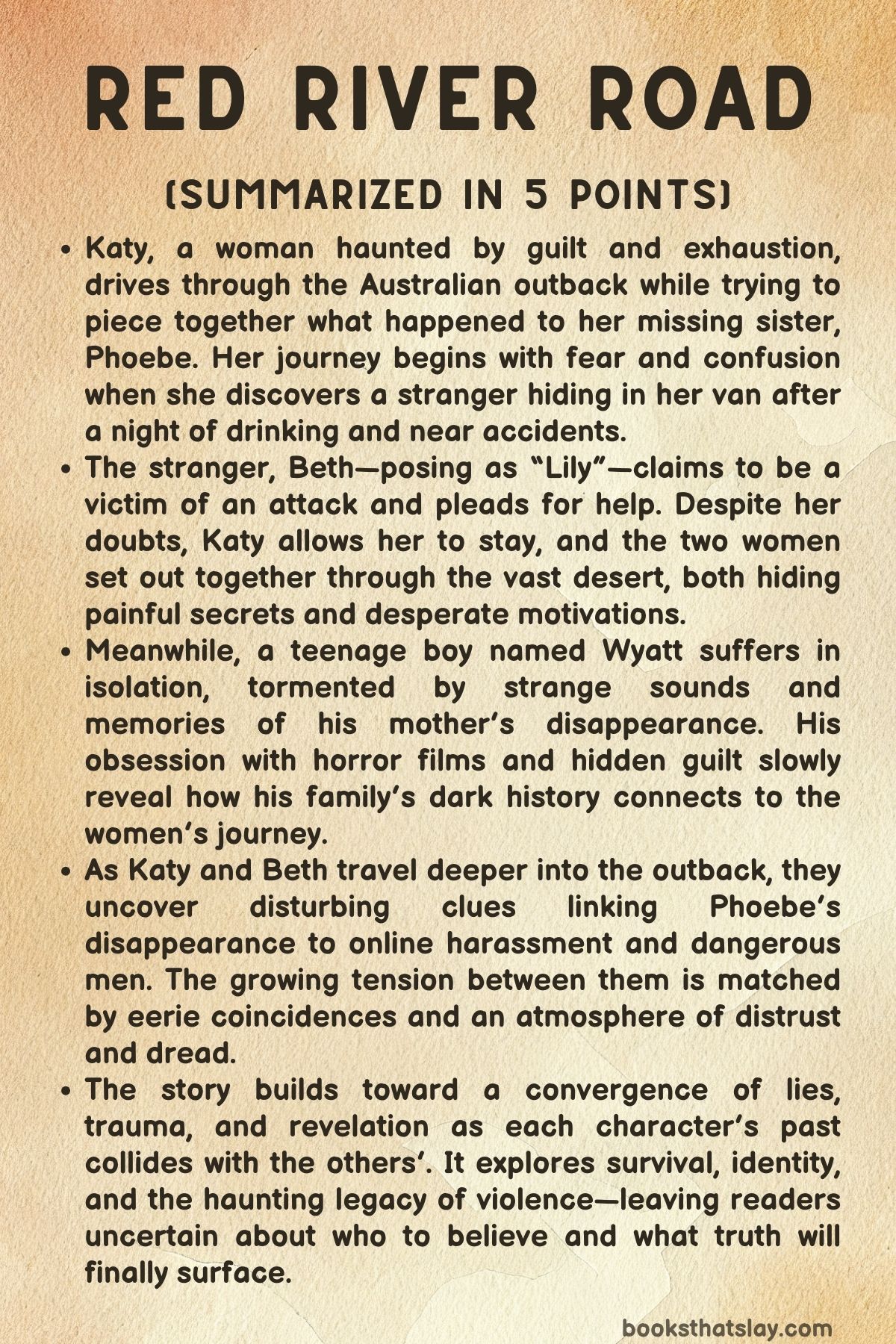
Summary
The novel opens with Katy, a woman driving alone through the vast, empty roads of the Australian outback. She’s exhausted, disoriented, and realizes she has been drinking.
A strange car follows her, its headlights flashing and swerving dangerously close. Panic drives her off the main road into darkness, where she narrowly avoids a crash.
She stops to rest, haunted by the eerie silence and the feeling that someone is watching. When she steps out, she sees a woman in a yellow dress—someone who looks like her missing sister, Phoebe.
Desperate to reach her, Katy follows the apparition into the bush, calling Phoebe’s name, but the figure disappears into the night. Alone again, Katy clings to her memories of her sister to keep from breaking down.
Inside the van, she senses movement and discovers, to her horror, a woman hiding under the blankets. The stranger is Beth Randall, injured and terrified, who claims she had been attacked and was only hiding for safety.
Unsure what to believe, Katy confronts her, but pity wins out. Beth, using the false name “Lily,” weaves a story about being a lost traveler whose belongings were stolen.
Katy reluctantly agrees to let her stay for the night, and the two uneasy companions begin their journey together.
Parallel to their story, a sick teenage boy named Wyatt lies in his home far away, listening to strange sounds in the walls and losing himself in horror movies. His mother, Nova, vanished years ago while traveling in a van called Lola.
Wyatt’s father insists she left, but Wyatt and his brother Lucas know otherwise. The family’s secrets echo through the desert like whispers waiting to be unearthed.
The next morning, Katy wakes to find “Lily” gone but soon learns she’s just nearby, cleaning up. As they travel together, Katy confides that she’s retracing her sister Phoebe’s route to find out what happened when she vanished a year ago.
Through Phoebe’s old Instagram posts, Katy follows the same coastline, comparing her sister’s joy to her own growing dread. Meanwhile, Beth keeps up her lies, hiding the truth about her abusive relationship with Lucas and the criminal schemes she once took part in.
At a campground, Katy encounters a man who claims they met before when she was drunk and grieving. He reminds her of the night she talked endlessly about Phoebe.
Though she doesn’t remember, flashes of memory return. The man’s casual reference to Phoebe being “dead” enrages her.
When he leaves, Katy is shaken and suspects he’s following her. Beth, watching from the van, panics when she spots a silver Airstream trailer nearby—it’s connected to her dark past.
In flashbacks, it’s revealed that she and Lucas used to rob wealthy travelers, and the Airstream was part of their last job before she fled him in terror.
Katy and Beth continue north, their fragile companionship deepening amid mistrust and fear. Katy struggles with guilt over drinking and driving, while Beth hides her bruises and memories of abuse.
They arrive at Pink Lake, where Katy finds a coral-colored bobby pin—one identical to Phoebe’s. It feels like a message from her sister.
She leaves another message for Detective Dust, who hasn’t returned her calls, and begins to believe that Phoebe’s disappearance and Beth’s sudden arrival are somehow linked.
Elsewhere, Wyatt’s story grows darker. Isolated and ill, he obsesses over the noises in his house and his mother’s disappearance.
His father’s temper and evasive behavior suggest he knows more than he admits. Wyatt begins to suspect the truth lies locked in the family’s garage.
Meanwhile, Katy and Beth reach Quobba Coast—the last place Phoebe was seen. There they find traces of her online life, including disturbing comments from a follower called “lonewanderer66,” whose obsession turned threatening.
Katy believes this man is behind her sister’s disappearance. In the quiet isolation of their van, Katy attempts to hypnotize Beth to recover memories from her “attack,” but it instead unlocks fragments of her real trauma with Lucas.
Beth’s panic during the session terrifies them both, but the moment creates a fragile bond between them.
Katy hacks into Phoebe’s social media accounts using a childhood password. She finds private messages from “lonewanderer66,” now identified as Chris Craig—a man who stalked Phoebe across her route.
Convinced he’s the killer, Katy vows to find him. But Beth spots another familiar name: Lucas Cleary, her abusive ex.
She realizes Lucas and Phoebe knew each other online and that Lucas had been manipulating both women. Soon after, a note appears under their van’s wiper: Are you safe?
As the women head toward Gracious Bay, the tension escalates. They uncover more evidence of Phoebe’s contact with Lucas, including messages directing her to a specific address—141 South Beach Street.
At a hotel, Katy finds an old photograph of Lucas, confirming his presence in the area. The boundaries between fear and madness blur for both women.
Katy begins to unravel mentally, haunted by hallucinations and convinced she’s being hunted. Beth realizes that Lucas and his family—especially his father, Rory—are behind multiple disappearances.
The story builds toward a violent climax at the dunes near the coast. Wyatt, now fully aware of his father’s crimes, confronts him as Rory attacks Beth on the beach.
In the chaos, Wyatt kills Rory in self-defense with a broken wineglass. Beth, battered but alive, finds “Katy” unconscious nearby and sees a tattoo on her back—a compass symbol that belonged to Phoebe.
The revelation hits her: the woman she’s been traveling with isn’t Katy at all. It’s Phoebe herself, alive but lost in a fugue state, living under her sister’s name without realizing it.
Phoebe awakens in a hospital, disoriented and unable to remember the past weeks. Doctors diagnose her with dissociative fugue—a form of amnesia caused by trauma.
Evidence reveals she had assumed her sister’s identity and retraced her own vanished journey. Police question her about human remains found near the dunes and about the Cleary family’s crimes.
Lucas has been found dead in a nearby vehicle, likely from injuries inflicted during Beth’s escape.
Beth, hiding from authorities, learns the truth through news reports and a letter from Wyatt. He confesses that he catfished Phoebe online using his brother’s name, lured her to the house, and accidentally set in motion the violence that followed.
Phoebe’s disappearance, Lucas’s death, and Rory’s crimes are all connected through the same cycle of obsession, abuse, and deceit.
One year later, Phoebe, Beth, and a recovering Wyatt meet again at Vlamingh Head Lighthouse for a memorial to the women lost to violence along Australia’s roads. Wyatt scatters shells for his mother, Nova, and others who never made it home.
The survivors have rebuilt their lives—Phoebe back in Sydney, Beth studying psychology, and Wyatt training as a dive instructor. As they watch whales breach in the distance, Phoebe posts on Instagram for the first time since her ordeal, promising to embrace life again.
But a final comment appears beneath her post, from “lonewanderer66,” hinting that some questions still remain unanswered on the red road that stretches endlessly ahead.
Characters
Katy (Phoebe Sweeney)
Katy, who is later revealed to be Phoebe Sweeney living under an assumed identity due to dissociative fugue, stands at the emotional and psychological core of Red River Road. At first, she appears as a grief-stricken sister retracing the trail of her missing sibling, Phoebe.
Her loneliness, guilt, and fixation on finding answers define her existence on the desolate Australian highways. Through her, Anna Downes explores the crushing impact of trauma, memory loss, and the human mind’s ability to fracture as a coping mechanism.
Katy’s behavior—her obsessive attention to safety rituals, her erratic recollections, and her oscillation between empathy and paranoia—mirrors a psyche caught between survival instinct and self-destruction. Her assumed identity is not simply a plot twist but a manifestation of her fractured self, symbolizing both her attempt to atone for the past and her subconscious need to protect herself from unbearable truth.
In the end, her rediscovery of her true self, Phoebe, becomes a haunting metaphor for reclaiming identity through the ashes of trauma.
Beth Randall (Lily / Jess)
Beth is one of the most layered figures in Red River Road, embodying both guilt and redemption. Initially introduced as a frightened fugitive hiding in Katy’s van, she evolves from a deceptive survivor into a complex woman haunted by the crimes and abuses of her past.
Her transformation—from Lucas’s manipulated accomplice to a protector of Phoebe—represents a moral resurrection born of suffering. Beth’s intellect, shaped by her psychology background, is often her shield; she dissects others’ behaviors to anticipate threats, yet she cannot fully decode her own vulnerability.
Her trauma at the hands of Lucas Cleary reveals the cyclical nature of control and violence, while her eventual honesty and compassion signify her break from that cycle. In helping Phoebe reclaim her identity, Beth also begins her own path to healing, showing that survival and empathy can coexist even in those marked by guilt.
Phoebe Sweeney
Phoebe, the missing sister whose absence propels the entire narrative, emerges not only as a character but as a haunting presence throughout Red River Road. In the public eye, she is the adventurous travel influencer—vibrant, fearless, and admired—but her disappearance exposes the peril that can lurk beneath online perfection.
Phoebe’s journey through dissociation, as she unconsciously becomes “Katy,” transforms her into a study of psychological fragmentation and endurance. Her fugue state is both a tragic consequence of trauma and a subconscious strategy for survival after assault and abduction.
When she awakens in the hospital with no memory, she must reconcile two selves—the woman who vanished and the woman who lived on. Her recovery, culminating in her participation in a memorial for victims of gendered violence, signifies rebirth and reclaiming agency, both personal and symbolic.
Wyatt Cleary
Wyatt is the silent, haunted observer of Red River Road, embodying the inherited trauma that festers within the Cleary family. His illness, isolation, and obsession with horror films serve as metaphors for his entrapment in a reality scarred by violence.
Wyatt’s disturbing fascination with fear, along with his guilt over catfishing Phoebe as “Lucas,” paints him as both victim and unwilling perpetrator of harm. His struggle to reconcile his complicity and his father’s monstrous acts reveals a child suffocating under generational abuse and moral confusion.
Yet, Wyatt’s eventual confession and desire for redemption mark him as one of the few characters capable of breaking free from his family’s toxic legacy. By the novel’s end, his fragile optimism and connection with Phoebe and Beth suggest that even the most broken can rebuild their sense of humanity “little by little.
Lucas Cleary
Lucas is the sinister thread linking the novel’s victims. Charismatic yet cruel, he personifies coercion and exploitation, manipulating both Beth and Phoebe under the guise of intimacy.
His duality—protective older brother to Wyatt, violent predator to women—illustrates how abusers often conceal their nature behind emotional masks. Through Lucas, Downes dissects the psychology of control: his charm is a weapon, his violence a ritual of dominance.
Even after his death, Lucas’s shadow looms over every survivor, showing how abusers continue to occupy mental and emotional space long after their physical presence is gone.
Rory Cleary
Rory Cleary, the patriarch of the Cleary family, stands as the monstrous culmination of generational violence. His brutality, manipulation, and eventual exposure as Phoebe’s attacker reveal the darkness festering within ordinary domestic facades.
Rory’s delusions—his belief that Phoebe is his lost wife, Nova—collapse the boundaries between obsession and psychosis. His garage shrine and hidden crimes make him a grotesque echo of patriarchal control, treating women as possessions to be preserved or punished.
Rory’s death brings an end to a cycle of violence but leaves behind psychological ruins in his sons, demonstrating how abusers destroy not only their victims but also their families and themselves.
Nova Cleary
Nova, though largely absent from the physical narrative, exerts a powerful spectral presence over Red River Road. Her disappearance years before the main events becomes the catalyst for everything that follows.
She represents the silenced women whose stories are erased by the men who claim to love them. Through Wyatt’s fragmented memories and the relics found in Rory’s shrine, Nova transforms from a missing mother into a symbol of endurance and memory.
The memorial statue built in her honor stands not just for her, but for all the women who vanished into the wilderness of violence and neglect.
Detective Dust
Detective Dust serves as the pragmatic but emotionally distant representative of institutional failure. His interactions with Katy/Phoebe expose the frustrating gap between personal grief and bureaucratic indifference.
Though he embodies law and order, his inability—or unwillingness—to truly engage with the emotional urgency of the case underscores the broader critique of systemic apathy toward missing women. Through him, the novel highlights how justice often arrives too late, if at all, leaving individuals to seek truth through their own perilous means.
Jesse
Jesse appears as a fleeting yet vital figure, offering Beth the compassion and assistance she needs to survive after Lucas’s death. His presence provides contrast to the manipulative men in her life, proving that kindness and protection can exist without control.
Jesse’s quiet humanity becomes a bridge toward Beth’s healing and symbolizes the potential for trust in a world scarred by betrayal.
Chris Craig (lonewanderer66)
Chris Craig, the menacing stalker behind the username “lonewanderer66,” personifies the digital age’s hidden predators. Though his role blurs between red herring and real threat, his obsession with Phoebe reveals the dangers of hypervisibility and performative identity online.
He embodies voyeurism turned violent—a man who consumes women’s curated images until he believes he owns them. In Chris, Downes portrays the modern monster born from screens and solitude, emphasizing how technology magnifies predation under the illusion of anonymity.
Themes
Trauma and Memory
The narrative of Red River Road is fundamentally shaped by the interplay between trauma and memory. The novel presents a haunting exploration of how the mind fragments under unbearable psychological pressure, and how those fragments reform in unexpected, often self-protective ways.
Phoebe’s dissociative fugue stands as the most striking manifestation of this theme—her mind’s response to extreme fear and violence. Through the disjointed structure and shifting perspectives, Anna Downes captures the way trauma distorts perception and erases continuity, leaving her protagonist stranded between past and present.
Memory, in this context, becomes both an enemy and a lifeline. Katy, who is later revealed to be Phoebe, spends much of the novel chasing recollections that might lead her to her sister, not realizing she is in fact searching for herself.
The dissonance between what she remembers and what she invents reveals how trauma rewrites identity. Beth’s story parallels this struggle, showing how guilt and abuse shape selective memory, eroding her sense of truth.
Even Wyatt, trapped in a house of secrets and haunted by sounds in the walls, embodies the inheritance of trauma through generations. Memory in Red River Road functions as a moral and psychological battlefield—a place where the past resists being forgotten but cannot be faced directly.
Downes portrays memory not as a faithful record but as a fragile survival mechanism that conceals as much as it reveals, turning remembrance into both punishment and salvation.
Female Solidarity and Survival
Across its harsh outback setting, Red River Road portrays the complex bonds between women who have suffered violence and loss. The relationship between Katy (Phoebe) and Beth begins in fear and suspicion but gradually transforms into a form of fragile solidarity.
Both women are running—from men who have hurt them, from systems that have failed them, and from their own guilt. Their alliance grows out of shared vulnerability rather than trust, revealing how survival often demands uneasy compromises.
Downes refuses to romanticize female friendship; instead, she presents it as a tense negotiation between fear and compassion. Yet, by the novel’s end, this connection becomes a site of redemption.
Beth’s choice to protect Phoebe, despite her own complicity in past crimes, demonstrates a moral awakening rooted in empathy. The story expands this theme through its treatment of the broader network of women—Nova Cleary, Vivi Green, and the unnamed victims—whose disappearances and deaths become symbols of gendered violence.
Their stories converge in the memorial at the novel’s conclusion, turning grief into collective resistance. Downes’s portrayal of female solidarity is neither sentimental nor simple; it acknowledges that healing is not born from shared suffering alone but from the courage to witness and support one another despite shame and fear.
Identity and Reinvention
Identity in Red River Road is a shifting, unstable construct, continually remade through trauma, deception, and survival. The novel’s central mystery—Katy’s search for her missing sister—becomes a psychological puzzle about who Katy really is.
Phoebe’s assumption of a false identity after her disappearance highlights how the self can fracture and reinvent itself when faced with unbearable truth. Her transformation into “Katy” is not an act of deceit but of preservation; the new persona becomes a shield against a reality too horrific to confront.
Beth’s use of multiple names—Beth, Lily, Jess—mirrors this process, suggesting that identity is less a fixed truth than a series of adaptive masks. Each persona serves a purpose, reflecting what the character needs to survive in a given moment.
The novel questions whether reinvention is liberation or denial. While Phoebe’s fugue state allows her temporary escape from trauma, it also prevents her from integrating her past, forcing her to relive her suffering in disguise.
The recovery of her true name, and with it her memory, marks both an end and a beginning: the painful reconciliation of fractured selves. Downes thus portrays identity as both mutable and essential, shaped by circumstance yet haunted by the persistent question of authenticity—who are we when everything we know about ourselves is stripped away?
The Cycles of Violence and Inherited Corruption
Through the Cleary family’s history, Red River Road exposes the perpetuation of violence across generations. Rory Cleary’s brutality toward Nova and later Phoebe represents not just personal cruelty but the systemic entrenchment of misogyny and control.
His sons, Lucas and Wyatt, inherit this darkness in different ways—one as perpetrator, the other as witness and victim. Wyatt’s gradual recognition of his father’s crimes and his attempt to break the cycle becomes one of the novel’s most poignant arcs.
The physical landscape of the outback mirrors this moral desolation; it is vast, empty, and scarred by human cruelty. Downes links personal violence with environmental and societal neglect, suggesting that isolation breeds both danger and silence.
The crimes along the highways are not isolated incidents but symptoms of a culture that normalizes male dominance and female disposability. Even the victims’ attempts at freedom—traveling, exploring, reclaiming independence—become ensnared within this structure of predation.
The ending, where a memorial is built to honor the women lost to violence, gestures toward accountability but also acknowledges the persistence of threat, as the final ominous comment from “lonewanderer66” reminds readers that such cycles are never fully broken. Downes’s exploration of violence is not sensational but systemic, portraying how power corrupts, silence enables, and trauma perpetuates itself through generations until confronted and named.
The Search for Redemption
Every major character in Red River Road is marked by guilt and yearning for redemption. Beth seeks to atone for her crimes and for her complicity in Lucas’s schemes.
Phoebe, though blameless in her victimhood, carries the weight of surviving when others did not. Wyatt’s confession and care for Phoebe represent an attempt to reclaim moral clarity after deceit and horror.
Redemption in the novel is never clean or complete; it arrives through small, imperfect acts of courage. Downes suggests that forgiveness must be earned through accountability and empathy rather than denial.
The story’s conclusion, where Phoebe, Beth, and Wyatt gather to honor the dead and celebrate survival, symbolizes the possibility of renewal without erasure. The whales breaching at the end evoke continuity and grace—life persisting after devastation.
Yet the return of the online predator’s comment undercuts the serenity, reminding readers that redemption is a process, not a final state. By entwining confession, truth-telling, and shared mourning, Downes frames redemption not as escape from the past but as the ongoing labor of confronting it.
In this way, the novel closes where it began—with the open road, not as a route to oblivion but as a path toward fragile, hard-won hope.