“Repent, Harlequin!” Summary, Characters and Themes
“Repent, Harlequin!” Said the Ticktockman by Harlan Ellison is a short work of speculative fiction set in a future society ruled by strict adherence to time. In this world, punctuality is enforced through technology that deducts minutes from a person’s lifespan for every infraction.
The story follows a rebellious figure known as the Harlequin, who disrupts the rigid order through public pranks and open defiance. Ellison presents a sharp critique of conformity, mechanized living, and the surrender of conscience to systems of control. The narrative challenges readers to question whether efficiency and order are worth the cost of individuality and moral freedom.
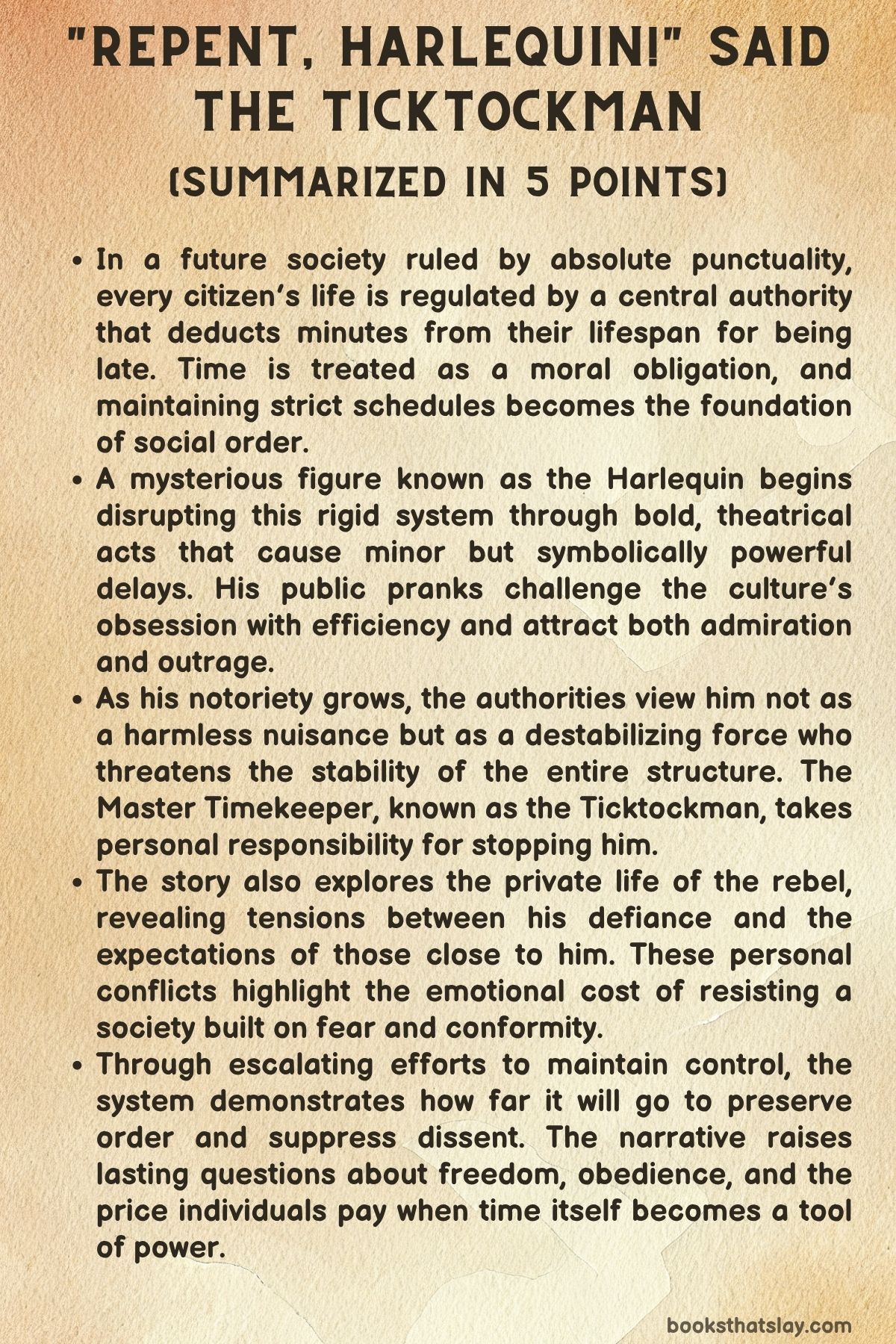
Summary
The story takes place in a highly regulated future where society functions with mechanical precision. Every citizen’s life is organized by schedule.
People rise, work, eat, travel, and rest according to exact timetables. Being late is not a minor inconvenience but a punishable offense.
Time is treated as the highest authority, and the system exists to preserve efficiency above all else.
This rigid order is maintained by a powerful figure known as the Ticktockman, formally called the Master Timekeeper. He oversees a system that ensures punctuality through technological enforcement.
Each citizen carries a cardioplate linked to a central authority. If someone is late, even by a few minutes, those minutes are deducted from their lifespan.
Repeated tardiness results in greater losses. Eventually, if a person runs out of allotted time, the Ticktockman can “turn them off,” stopping their heart instantly.
The punishment is swift and irreversible.
The society justifies this harsh structure as necessary. There is always a war, always a crisis, always a reason why schedules must be maintained.
Citizens accept that order is patriotic. They obey because they fear losing time, and because they believe that chaos would destroy their civilization.
Over time, the worship of schedules has replaced individual judgment. People no longer question whether the system is moral; they focus only on staying on time.
Into this world steps the Harlequin, a colorful and disruptive figure. He dresses like a jester and behaves like a mischievous performer.
His real name is Everett C. Marm, but most people know him only by his theatrical persona. Unlike others, he does not accept the authority of the clock.
He is chronically late, and he refuses to treat punctuality as sacred. More than that, he actively sabotages the smooth functioning of society.
One of his most famous acts involves dumping a massive quantity of jelly beans onto factory workers commuting along automated slidewalks. The candy clogs the machinery, halts transportation, and causes widespread delays.
Workers laugh and break formation as jelly beans rain down on them. For a brief moment, the rigid order of the system collapses into chaos and childish delight.
However, the disruption throws schedules off across multiple industries. A delay of seven minutes creates a chain reaction, affecting production quotas and economic planning.
In a society obsessed with precision, this is treated as a serious offense.
The Harlequin does not limit himself to one act. He frequently announces public appearances at specific times, only to arrive late or manipulate expectations.
At one event, authorities prepare to capture him, assuming he will arrive late. Instead, he shows up early, catching them unprepared and humiliating them in front of a crowd.
His actions are theatrical, mocking, and intentionally disruptive. He uses humor as a weapon against the system.
Public reaction to the Harlequin is divided. Many middle-class citizens view him as vulgar and irresponsible.
They see him as a threat to stability. Others laugh at his antics but do not support him openly.
Among the lower levels of society, however, he becomes something of a folk hero. People who feel trapped by the system admire his refusal to conform.
He represents a kind of freedom they no longer believe possible.
Despite this admiration, fear dominates daily life. The story includes an example of a man named Marshall Delahanty who receives notice that his time has run out.
His family reacts with terror. When the moment of termination arrives, even running into the forest cannot save him.
His cardioplate is remotely deactivated, and he dies instantly. This incident demonstrates the absolute power of the Ticktockman and the helplessness of ordinary citizens.
The Harlequin’s private life reveals another dimension of his character. He has a relationship with a woman called Pretty Alice.
Unlike him, she wants stability and acceptance within society. She is frustrated by his constant lateness and rebellious acts.
She urges him to stop, to stay home, to behave normally. He seems to care about her, but he cannot abandon his resistance.
He feels compelled to continue challenging the system, even though he often apologizes reflexively and shows signs of guilt.
As the disruptions continue, the Ticktockman becomes increasingly determined to capture the Harlequin. He views the rebel not merely as a nuisance but as a threat to the ideological foundation of society.
If one person can disrupt the system and survive, others may follow. The Ticktockman orders extensive measures to locate and apprehend him.
Surveillance, informants, and various enforcement techniques are employed.
Eventually, the authorities succeed. The Harlequin is captured, and his real identity is exposed as Everett C. Marm.
He is brought before the Ticktockman for confrontation. The Ticktockman lists the total amount of time Everett has lost through repeated lateness, an absurdly large span that exceeds a normal lifespan.
According to the rules, he should already be dead.
During their exchange, the Harlequin remains defiant. He insults the Ticktockman and condemns the system as tyrannical.
The Ticktockman accuses him of being unable to conform, of refusing to adjust to the world as it is. He reveals that Pretty Alice betrayed Everett, providing information that led to his capture.
This betrayal underscores the strength of social pressure and fear. Even those close to a rebel may choose safety over loyalty.
Instead of immediately turning him off, the Ticktockman decides on a different punishment. Everett is sent to a place called Coventry, where psychological conditioning techniques are used to break resistance.
The methods resemble brainwashing. Over time, Everett’s individuality is systematically dismantled.
Eventually, the Harlequin reappears on public communication screens. He looks cheerful and composed.
He announces that he was wrong to resist, that the system is good, and that punctuality is virtuous. He encourages others to conform and obey.
The citizens watching feel reassured. They interpret his transformation as proof that rebellion is foolish.
Order remains intact.
The story concludes with a subtle suggestion that even the Ticktockman is not immune to error. A minor discrepancy in his own schedule hints at a crack in the flawless system.
The implication is that no structure based entirely on mechanical precision can be perfectly maintained.
Through the rise and fall of the Harlequin, the narrative explores themes of conformity, control, and the cost of obedience. The society values efficiency over conscience, and those who challenge it are silenced.
The Harlequin’s rebellion brings moments of joy and disorder, but it ultimately fails to dismantle the system. The world returns to its steady rhythm of ticking clocks, while individuality is sacrificed in the name of order.
Characters
The Harlequin (Everett C. Marm)
Everett C. Marm, known publicly as the Harlequin, functions as both a person and a deliberate disturbance inserted into a society that survives by eliminating surprises. His clown persona is not just costume but strategy: it turns protest into spectacle, making defiance portable, repeatable, and hard to frame as a conventional political threat until it spreads.
He is driven less by a structured ideology than by a stubborn insistence that life must be lived at a human pace, with room for choice, mood, and spontaneity. That insistence shows up in his signature “crime”: lateness, treated by the state as moral failure.
His pranks are carefully chosen to attack the system’s dependency on timing rather than its architecture—he doesn’t bomb buildings; he causes delays, jams routines, and proves that a few minutes of disorder can ripple into widespread institutional panic. Yet he is not presented as a flawless hero.
He can be petty, performative, and reckless with other people’s safety even when he tries not to be, and his constant apologies and impulsive exit lines suggest a man who knows he causes harm but cannot stop himself from pushing back. The story also shows his limits: for all his confidence in public, he is vulnerable in private, dependent on relationships, and ultimately unprepared for the state’s capacity to reshape identity itself.
His defeat is not merely physical capture but the forced rewriting of the self that once said no.
The Ticktockman (The Master Timekeeper)
The Ticktockman represents authority that has stopped needing justification because its power is built into daily existence. He is not described as a loud tyrant; he is controlled, quiet, and confident, which makes him more alarming than a ranting dictator.
His defining trait is administrative omnipotence: he can revoke time, which in this world is the same as revoking life. That power makes him the visible face of the system’s moral logic—if order is sacred, then punishment for disorder becomes “reasonable,” even when it is lethal.
He speaks in the language of categories, reducing people to “what” rather than “who,” and this is central to his psychology: individuality is a problem to be solved, not a value to respect. His pursuit of the Harlequin is not personal revenge so much as system maintenance.
A society built on punctual obedience cannot tolerate a figure who makes lateness look joyful and survivable. Importantly, he is also bound to the ideology he enforces.
His insistence that he is “just doing his job” reveals a self-image that avoids moral responsibility by hiding behind function, while his final moment of being a few minutes off hints that even the enforcer is subject to the imperfections and strain created by absolute control. He is a person trained to think like a mechanism, and the story treats him as both villain and symptom: the end product of a culture that has replaced conscience with timing.
Pretty Alice
Pretty Alice is the most intimate lens on what the system does to ordinary emotional life. She is not a uniformed authority figure, but the pressures of the world live inside her.
Her frustration with Everett is partly personal—his lateness disrupts domestic stability and exposes her to danger—but it is also ideological, shaped by the constant threat of punishment and the promise of safety through conformity. She wants to belong, and belonging in this society requires correct timing, correct behavior, and correct attitudes.
Her repeated irritation at Everett’s apologies and his unreliable promises shows a relationship corroded by unequal stakes: he treats rebellion as necessary; she experiences it as an escalating risk that could end with death. Her betrayal, when it happens, is therefore less a twist of villainy than a grim demonstration of how fear recruits people into compliance.
She chooses the system over the person because the system has engineered conditions where that choice feels like survival rather than moral failure. At the same time, the story does not paint her as empty or cruel.
She reads as someone who has learned to manage anxiety by aligning herself with the rules, and Everett’s unpredictability threatens the coping structure she depends on. In that sense, she embodies the tragedy of controlled societies: even affection becomes conditional when the cost of nonconformity is catastrophic.
Marshall Delahanty
Marshall Delahanty is a brief but crucial figure because he shows the system’s violence without metaphor. His “turn-off” notice and his death demonstrate that time revocation is not an abstract threat used for intimidation; it is a routine instrument of governance.
His attempt to run exposes the reach of the state: physical distance and personal effort are meaningless when control is embedded in the body through the cardioplate. Marshall’s role is to ground the story’s humor and spectacle in consequence.
The Harlequin’s disruptions can look playful until Marshall appears, reminding the reader that people are being killed for schedule violations. In narrative terms, Marshall is the ordinary citizen made disposable by a system that claims to protect society.
He isn’t targeted for rebellion or ideology—he is simply consumed by the rules. That normality is the point: the threat isn’t reserved for enemies of the state; it is built for everyone.
Georgette Delahanty
Georgette Delahanty is presented in the immediate aftermath of state violence, and her reaction captures how control extends beyond the punished individual to the family unit. Her horror and relief arriving together—relief that it is not her, horror that it is her husband—shows how the system forces people into survival calculations that feel shameful but unavoidable.
She becomes a person whose life is suddenly reorganized by policy: her name is entered onto assistance rolls, and her future is implicitly routed toward remarriage, as if grief were another administrative category to process. Georgette’s presence shows that “turn-off” is not only execution; it is social management, turning households into paperwork and widows into economic problems to be reassigned.
Through her, the story emphasizes that the state does not just end lives; it dictates what the living are allowed to become afterward.
The Ticktockman’s Staff (Ferrets, Loggers, Finks, Commex, Mineez)
The staff around the Ticktockman are less individualized characters and more a portrait of institutional anatomy. Each label suggests a specialized function—tracking, recording, informing, communicating, delivering notices—and together they form a human surveillance network that makes the system practical.
Their significance is that they are ordinary workers in the machinery of oppression, not grand architects. They illustrate how authoritarian control is maintained by many small roles carried out daily, often without visible cruelty in the moment.
The mineez, who deliver termination notices with a rehearsed expression of sorrow, are especially revealing: the performance of empathy becomes part of the procedure, turning compassion into a uniform. These groups also highlight the central irony of the world: a society that treats people as replaceable parts still needs people everywhere to watch, report, and enforce.
The system cannot run on clocks alone; it requires human participation trained into obedience.
The Factory Workers and the General Citizenry
The workers on the slidewalks and the crowds who watch the Harlequin are not given individual names, but they operate as a collective character that reflects the population’s emotional contradictions. They can laugh, break ranks, and enjoy the jelly beans, showing that the desire for spontaneity is still alive.
Yet the same people quickly return to fear about being late, revealing how deeply the system has conditioned them to value safety over freedom. They admire the Harlequin as entertainment more easily than as a model to follow, because following would demand personal risk.
As a result, the crowd becomes a mirror of the society’s central weakness: widespread private dissatisfaction paired with public compliance. Their brief joy is real, but it is not enough to become sustained resistance, and that gap—between wanting relief and choosing obedience—helps explain why the Ticktockman’s world endures.
The Authorities Sent to Capture the Harlequin
The enforcement teams dispatched against the Harlequin are portrayed as both threatening and oddly vulnerable. They are trained to control citizens, yet they are repeatedly embarrassed by unpredictability, which the system discourages them from understanding.
Their traps assume the Harlequin will behave according to patterns, particularly the pattern of lateness, and he defeats them by changing the timing. This makes them symbolic of a rigid institution trying to fight improvisation with procedure.
When they are publicly humiliated, the moment matters because it reveals that authority relies heavily on the perception of competence. Still, their eventual success underscores the imbalance of power.
The state can afford mistakes because it has endless resources, time, and tools; the rebel can win a thousand moments and still lose the war once captured.
Themes
Tyranny of Time and Mechanized Living
In “Repent, Harlequin!” Said the Ticktockman, time is no longer a neutral measurement but the central instrument of political control. The society depicted in the story has elevated punctuality into a moral absolute.
Schedules dictate not only work and travel but also worth and survival. Being late is treated as a violation against the collective, and the punishment is literal subtraction from one’s lifespan.
This conversion of minutes into biological currency reveals a world in which efficiency has replaced ethical reflection. Citizens do not ask whether the system is just; they ask only whether they are on time.
The tyranny lies not merely in the penalties but in the internalization of discipline. People hurry automatically.
They scold one another for lateness. They fear small delays as though they are criminal acts.
The mechanical rhythm of society becomes psychological conditioning. Individuals start to experience time as an external master rather than a tool.
Language itself reflects this shift: citizens do not manage their time; time manages them. The cardioplate system ensures that obedience is not voluntary but enforced through the body.
In this structure, technology is not liberating but restrictive, turning daily life into a monitored transaction.
The Harlequin’s disruptions expose how fragile this mechanized order truly is. A few minutes of delay create cascading failures across industries.
This fragility shows that a system built entirely on precision has little tolerance for humanity. Spontaneity becomes sabotage.
Leisure becomes irresponsibility. The theme suggests that when a culture values productivity above all else, it risks stripping life of unpredictability and reducing human beings to extensions of machinery.
Conformity Versus Individual Conscience
The conflict between the Harlequin and the Ticktockman represents a larger struggle between individual conscience and collective conformity. The society demands adjustment, obedience, and synchronization.
To fit in is to survive. Nonconformity, once perhaps eccentric or rebellious, has become criminal.
The Ticktockman’s accusation that the Harlequin “can’t adjust” frames deviation as pathology. In this world, difference is treated as malfunction.
The Harlequin’s rebellion does not center on overthrowing the government through force. Instead, it insists on personal autonomy.
He wants the right to be late, to laugh, to disrupt monotony. His pranks are symbolic gestures that question why punctuality must define morality.
The story suggests that conscience, not compliance, is what makes a person fully human. The quoted reference to civil disobedience reinforces this idea: systems often rely on individuals who follow orders without moral scrutiny.
Pretty Alice’s betrayal illustrates the cost of choosing conscience over belonging. She prefers safety within the system to loyalty to a rebel.
Her decision highlights how conformity is reinforced by emotional ties and fear of isolation. The broader population admires the Harlequin from a distance but rarely joins him.
They want the comfort of order more than the uncertainty of freedom.
The forced reconditioning of the Harlequin demonstrates the ultimate danger to conscience. The state does not only punish dissent; it rewrites the dissenter.
By transforming him into a public supporter of punctuality, the system sends a warning: individuality will be corrected. The theme emphasizes how fragile personal conviction becomes when confronted with institutional power determined to eliminate deviation.
Surveillance, Control, and Dehumanization
The story portrays a society structured around surveillance and categorization. Citizens are tracked through cardioplates.
Officials analyze disruptions with technical precision. Informants and enforcement units operate as extensions of the Ticktockman’s will.
The language used by the authorities reduces people to data points, files, and accumulated minutes lost. Individuals are discussed in terms of “what” rather than “who,” reflecting a bureaucratic mindset that erases personality.
Dehumanization appears most starkly in the practice of turning people off. Marshall Delahanty’s death shows how impersonal the system has become.
His life is extinguished remotely, and the event is recorded as an adjustment in a sector map. Grief becomes paperwork.
His widow is placed on assistance rolls, her future administratively reassigned. The state handles death as routine correction rather than moral tragedy.
Even the staff members who enforce the rules are shaped by this structure. They perform tasks within a hierarchy that normalizes punishment.
The mineez deliver termination notices with rehearsed expressions of sympathy, demonstrating how emotion itself can be institutionalized. Compassion becomes part of procedure rather than a spontaneous human response.
The Ticktockman embodies the ultimate consequence of dehumanization. He speaks softly, methodically, as though he himself is an instrument of time.
His authority rests on the premise that order justifies any cost. By treating life as a measurable resource subject to deduction, the society transforms existence into inventory.
The theme exposes how surveillance combined with technological power can erode the distinction between governance and domination.
Resistance, Performance, and the Limits of Rebellion
The Harlequin’s rebellion is theatrical. He dresses in motley, stages dramatic entrances, and turns protest into spectacle.
His methods rely on humor, embarrassment, and surprise. By showering workers with jelly beans or arriving early to trap his pursuers, he uses performance to challenge seriousness and ritual.
Laughter becomes a political act, a refusal to accept that order must always be solemn and unquestioned.
Yet the story also questions the effectiveness of such resistance. The Harlequin can delay schedules and inspire momentary joy, but he cannot dismantle the infrastructure of control.
The public enjoys his antics without committing to sustained defiance. This separation between admiration and action limits the scope of his influence.
His rebellion thrives on visibility, but visibility also makes him vulnerable to capture.
When he is finally subdued and reconditioned, the system demonstrates its superior endurance. Institutional power outlasts individual courage.
The transformation of the Harlequin into a supporter of punctuality serves as a cautionary example to others. Rebellion becomes proof of the system’s strength once it is absorbed and neutralized.
However, the final suggestion that even the Ticktockman may be slightly off schedule introduces ambiguity. Absolute precision is difficult to maintain indefinitely.
The theme implies that resistance, though suppressed, reveals cracks in rigid authority. The limits of rebellion are real, but so are the limits of control.
In this tension lies the enduring question raised as to which whether the human desire for freedom can ever be permanently extinguished by a system built on fear and timing.