Ruins by Amy Taylor Summary, Characters and Themes
Ruins by Amy Taylor explores the fragility of relationships, desire, and identity against the backdrop of modern disconnection. The novel follows Emma and Julian, a London couple whose holiday in Greece exposes the emotional fractures beneath their seemingly stable life.
As they navigate grief, shifting sexual boundaries, and questions of fulfillment, their bond begins to unravel. Through vivid settings—from sun-drenched Corfu beaches to the restless streets of Athens—Taylor examines how loss and longing reshape intimacy and self-understanding. The story unfolds with psychological precision, revealing how ordinary choices can spiral into unexpected consequences.
Summary
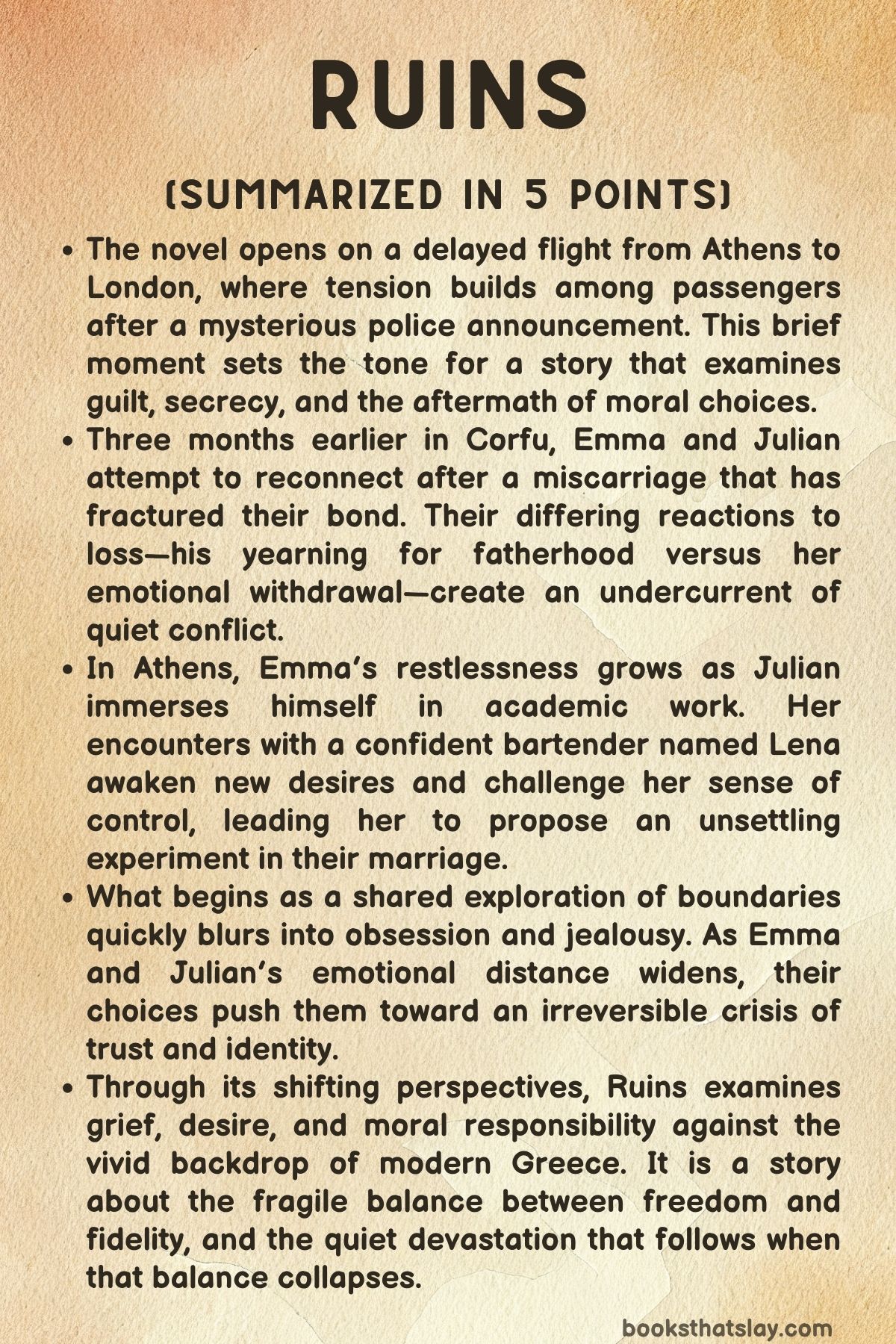
The novel opens on a delayed flight from Athens to London. As passengers wait impatiently, an announcement calls two individuals to meet with a police officer, arousing curiosity among those onboard.
The narrative then rewinds three months earlier to Corfu, where Emma and Julian, a couple from London, are vacationing. Their peaceful days by the sea are shadowed by emotional tension.
Emma, recovering from a miscarriage, feels estranged from Julian, who has since developed a strong desire for fatherhood. Once aligned in their rejection of parenthood, they now face a growing rift—his longing clashes with her ambivalence and detachment.
While Emma attempts to relax, she burns her scalp and finds herself preoccupied by the young families around her, especially one that reminds her of what she has lost. During an evening of Greek dancing, she watches Julian dance with another woman and experiences an unsettling mix of jealousy and arousal.
Their intimacy later that night takes on a charged, unfamiliar intensity, and Emma becomes fascinated by the idea of seeing her husband with someone else. When she openly tells Julian she wants to watch him sleep with another woman, he reacts with shock and confusion.
Although disturbed, he senses her sincerity, and the proposition lingers unspoken between them.
After leaving Corfu, the couple travels through Greece and settles temporarily in Athens in an apartment borrowed from Julian’s friend Alistair. Julian immerses himself in his research, while Emma spends her days exploring the city’s streets and ruins, finding comfort in solitude.
She reflects on her past career in advertising, where she excelled professionally but felt empty inside. Her miscarriage, which occurred during a client meeting, forced her to confront her disconnection from her own life.
The experience left her uncertain about everything—motherhood, work, and love—but also opened a space for self-examination.
In Athens, Emma secretly begins writing an investigative article for a friend exposing corporate pollution by British water companies, though she hides this from Julian. Their relationship becomes defined by silence and philosophical distance.
At dinner, they debate fate and free will, revealing opposing worldviews: Emma believes in destiny’s inevitability, while Julian insists on agency and choice. Their quiet evenings, set against the ancient city’s hum, highlight the emotional gulf widening between them.
Julian later organizes a dinner party for his academic peers. He obsesses over details, desperate to appear competent and cultured while concealing his privileged background.
Emma feels alienated among the intellectual guests, particularly during a tense discussion about The Society of the Spectacle. Overwhelmed, she slips out under the excuse of buying ice.
Her wanderings lead her into a dim bar, where she meets Lena, a striking young bartender whose confidence and sensuality captivate her. Their brief exchange leaves Emma intrigued, and when she returns home, she confesses her encounter to Julian.
The conversation circles back to her earlier suggestion—that he sleep with another woman—an idea he still cannot comprehend but also cannot dismiss.
Julian’s insecurities deepen as he grapples with writer’s block and envy toward a successful former classmate. Meanwhile, Emma cannot stop thinking about Lena.
Drawn by curiosity and desire, she returns to the bar to observe her. Eventually, Emma proposes to Julian that they both visit Lena’s bar.
When they do, Emma introduces him to Lena and later invites her back to their apartment. The night unfolds in hesitant conversation, flirtation, and, ultimately, sex.
Emma encourages Lena to seduce Julian, watching as her fantasy becomes reality. The encounter leaves all three unsettled—Emma exhilarated and disturbed, Julian confused and guilty, Lena intrigued but wary.
In the days that follow, Emma feels transformed by the experience. She imagines herself liberated from convention, free to define her own boundaries.
Julian, however, feels burdened by guilt and longing for emotional stability. When Emma suggests inviting Lena again, he reluctantly agrees.
Their second meeting evolves into another night of drinking and sexual play. This time, Emma participates more freely, though she senses Julian’s growing discomfort.
Their connection, once rooted in love, now feels like a social experiment spiraling beyond their control.
Julian’s academic frustrations culminate in a quiet breakdown. He begins to fantasize about abandoning scholarship for a simpler, family-centered life.
But before he can voice this to Emma, she insists on going clubbing with Lena and her friends. At the club, Emma feels invisible and envious of Lena’s effortless magnetism.
When Lena invites herself back to their apartment, Julian consents without consulting Emma. Back home, as Julian and Lena kiss, Emma quietly withdraws to the shower, emotionally and physically stepping out of the triangle she created.
Time passes. Emma learns Lena is pregnant.
The news shocks both Emma and Julian, forcing them to confront the consequences of their choices. Lena, struggling financially, accepts their offer of help, and the three begin to discuss an unconventional arrangement: Emma and Julian will support Lena and share in raising the child.
Yet a dangerous presence soon enters their lives—Darius, Lena’s volatile ex-boyfriend, recently released from prison. When Emma witnesses him kidnapping another woman in Athens, she tells Julian, who insists they avoid involvement with police to protect themselves.
Their fragile plan to bring Lena to London unravels as Darius resurfaces, demanding money.
During a violent confrontation in their apartment, Darius attacks Emma and holds her hostage. In the ensuing chaos, Lena fights back, and Julian manages to disarm Darius.
In the struggle that follows, Lena falls from the balcony to her death. Darius flees, leaving Emma and Julian traumatized but alive.
They give statements to the police and are permitted to return to London, though the tragedy lingers over them.
Back home, they attempt to rebuild. Emma’s writing career flourishes, while Julian retreats into teaching, disillusioned and subdued.
Their relationship quietly dissolves. A year later, Julian is living peacefully in the countryside with a new partner, and Emma is on her way to Paris for an interview.
As she rides the Eurostar, she drafts a message to Julian about the anniversary of Lena’s death but deletes it before sending. Watching the French countryside blur past, she feels a quiet release—the past has loosened its hold, and she chooses silence as her final act of freedom.
Characters
Emma
Emma stands at the emotional core of Ruins, embodying a restless, introspective, and morally complex protagonist. Once a high-performing publicity manager in London, her miscarriage becomes the axis upon which her inner world turns.
Rather than breaking her, the loss exposes the hollow machinery of her former life—her unfulfilling career, her uncertain relationship with Julian, and her uneasy relationship with the notion of motherhood. What defines Emma most is her existential curiosity; she seeks meaning not through societal structures but through raw experience, even when that experience borders on danger or self-destruction.
Her fascination with watching her husband with another woman stems less from eroticism than from a need to rupture the numbness within her. In Athens, she transforms from a woman confined by expectation into one willing to confront her contradictions.
Her interactions with Lena and Darius mirror her oscillation between desire and detachment, freedom and fear. By the novel’s end, Emma’s silence—her refusal to message Julian on their shared anniversary—marks a completion of her arc: she has learned to define herself outside the gaze of others, choosing solitude over emotional dependence.
Julian
Julian is both a foil and a mirror to Emma. An academic whose intellectualism masks deep insecurities, he clings to structure and achievement to maintain a sense of worth.
His privileged upbringing haunts him; he is perpetually torn between wanting to appear self-made and fearing mediocrity. The miscarriage destabilizes his sense of identity, awakening in him a longing for family and stability that Emma no longer shares.
His relationship with her becomes a quiet battlefield between control and vulnerability. Though initially shocked by Emma’s sexual experimentations, he becomes complicit, not from shared desire but from a need to hold onto her.
His intellectual paralysis in Athens reflects a broader spiritual exhaustion—his inability to reconcile thought and feeling, ambition and authenticity. By the novel’s close, Julian’s retreat to a rural, simple life underscores his transformation: having lost Emma, he finally finds peace not in achievement or possession, but in ordinariness and acceptance.
Lena
Lena, the young bartender, represents vitality, chaos, and the allure of uninhibited freedom. She is both muse and catalyst, an embodiment of what Emma simultaneously desires and fears.
Her confidence and sexual autonomy unsettle the boundaries of Emma and Julian’s marriage, pushing their relationship into moral and emotional uncharted territory. Lena’s power lies in her ambiguity—she is never simply victim or manipulator, lover or opportunist.
Her pregnancy introduces a layer of vulnerability that contrasts with her earlier control, revealing how easily freedom can give way to dependence. Lena’s tragic death is the inevitable collapse of the erotic triangle she helped create, the moment when fantasy meets violence and power dissolves into ruin.
Through her, the novel interrogates questions of class, gender, and agency—whether women can truly control their narratives in a world that commodifies both their bodies and choices.
Darius
Darius serves as the embodiment of menace and moral decay within Ruins. Charismatic yet predatory, he operates on the margins of legality and morality, manipulating others with charm that quickly turns coercive.
His relationship with Lena exposes the darker side of dependency and exploitation, as he preys on her vulnerability and ambition. For Emma, Darius becomes a reflection of her own repressed impulses—the destructive potential of desire unbound by ethics.
His interactions with both Emma and Julian escalate from psychological manipulation to physical violence, culminating in the chaotic confrontation that leads to Lena’s death. Darius is not merely an antagonist; he is a thematic force, representing the social and emotional rot underlying the couple’s intellectual and erotic pursuits.
His presence reminds the reader that ruin is not only emotional or moral but deeply human—an inevitable outcome of unchecked power and desire.
Alistair
Alistair, though a peripheral figure, anchors the novel’s setting and provides a subtle commentary on privilege and detachment. By lending his Athenian apartment to Emma and Julian, he facilitates their journey into both physical and emotional displacement.
He symbolizes the intellectual class that hovers above consequence—academics and expatriates who use places and people as temporary stations in their pursuit of meaning. Alistair’s absence throughout much of the narrative accentuates the couple’s isolation, yet his unseen presence lingers as a reminder of the comfort and distance afforded by privilege.
Frederik
Frederik appears briefly but plays a crucial role in highlighting Emma’s growing alienation from the world of intellect and academia. His dismissive demeanor during the dinner party underscores her estrangement from Julian’s circle and, by extension, from her former self.
Through Frederik, the novel critiques the coldness of intellectual discourse that prizes abstraction over empathy. His interaction with Emma deepens her longing for authenticity and spontaneity, pushing her further toward Lena and the unpredictable life that follows.
Desi
Desi functions as a stabilizing influence and moral anchor, particularly for Julian. A friend grounded in empathy and reason, Desi helps Julian navigate the aftermath of trauma and separation.
While not central to the plot’s tension, Desi represents the possibility of recovery and forgiveness in a world marked by emotional chaos. Her encouragement for Julian to reconnect with Emma highlights the enduring threads of compassion that survive even in the wake of ruin.
Themes
Grief and Emotional Disconnection
Grief in Ruins is not expressed through open mourning or sentimental breakdown but through silence, withdrawal, and estrangement. Emma’s miscarriage creates a fissure in her sense of identity, leaving her detached from both Julian and herself.
The physical loss becomes a symbol of emotional depletion—a life interrupted before it could begin. Her inability to perform conventional grief manifests in her fascination with other people’s lives, her restless wandering, and her fixation on observing intimacy from a distance.
Instead of catharsis, she experiences numbness, a void that distorts her desires and sense of morality. Julian, on the other hand, responds to grief by idealizing stability and domesticity.
His longing for a family becomes a way to restore order, while Emma’s rejection of that dream feels like an act of defiance. Their conflicting responses to loss expose how grief isolates rather than unites, how mourning can drive people inward rather than toward empathy.
The tragedy of their relationship lies in this imbalance—while Julian seeks healing through connection, Emma seeks it through detachment and control. The narrative portrays grief not as an event to overcome but as a lingering condition that reshapes perception, relationships, and sexuality.
Every subsequent decision Emma makes—from her voyeuristic fantasies to her alliance with Lena—is filtered through this numbness, showing how unresolved pain erodes both trust and intimacy until only disconnection remains.
Power, Control, and Sexuality
Sexuality in Ruins is portrayed as a medium for control rather than connection. Emma’s desire to watch Julian with another woman is not born out of conventional lust but out of an urge to reclaim agency in a relationship where emotional clarity has collapsed.
Sex becomes an arena for negotiation, a way to explore dominance, vulnerability, and the unsettling intersections between pleasure and pain. Lena’s character amplifies this tension—her unapologetic sexual confidence both intimidates and fascinates Emma.
Through her, Emma experiences a vicarious empowerment, mistaking transgression for liberation. Yet the power she seeks remains elusive; every act of sexual experimentation only deepens her sense of alienation.
Julian’s compliance, though framed as open-mindedness, reveals his own insecurities and need for validation. Their erotic encounters blur emotional boundaries, turning intimacy into performance and desire into surveillance.
By transforming sex into spectacle, Taylor exposes the illusion of empowerment within acts that are meant to defy convention. What begins as a search for freedom devolves into moral ambiguity and emotional chaos, suggesting that control over one’s body or partner cannot substitute for emotional truth.
Sexuality, instead of bridging the distance between Emma and Julian, becomes the language through which their alienation is articulated—raw, performative, and ultimately destructive.
Identity, Freedom, and Self-Discovery
Emma’s journey in Ruins reflects a broader struggle with identity and freedom. Her professional past in advertising symbolizes a life built on performance—manufacturing meaning for others while losing her own.
The miscarriage acts as a rupture, forcing her to confront the emptiness of both her career and her relationship. Her decision to quit her job and embrace unstructured days in Athens represents not apathy but rebellion against a system that equates productivity with purpose.
Yet this newfound “freedom” is uncertain and fragile. Emma’s idleness often feels like drifting rather than liberation, her autonomy shadowed by guilt and the lingering expectations of domestic and societal norms.
Her relationship with Lena embodies an experimental approach to selfhood—a flirtation with alternate versions of herself that defy moral boundaries. However, the pursuit of freedom without emotional grounding leaves her unmoored.
Julian’s discomfort with her choices underscores a clash between two philosophies: his belief in structure and legacy versus her yearning for impermanence and reinvention. By the end, Emma’s self-discovery is not triumphant but ambiguous.
The silence she chooses at the novel’s conclusion signals acceptance of solitude rather than resolution, suggesting that freedom often comes at the cost of connection, and that true self-knowledge may exist only in the ruins of what once provided certainty.
Class and Privilege
Class consciousness shapes every interaction in Ruins, subtly dictating how characters perceive themselves and others. Julian’s privileged background underlies his intellectual ambition and his anxiety about authenticity.
His attempts to conceal his wealth from colleagues and his desperate need for academic validation reveal how privilege can breed both entitlement and insecurity. Emma, raised in modest circumstances, carries a different kind of burden—an acute awareness of social hierarchies and a quiet resentment of Julian’s ease within them.
Their differing attitudes toward work, ambition, and failure stem from this divide. Athens becomes the perfect backdrop for exploring these tensions: a city layered with historical grandeur yet marked by economic struggle, reflecting the couple’s imbalance.
Even their encounters with locals—Lena’s working-class life and Darius’s criminal desperation—highlight how economic instability shapes morality and choices. Money, in this context, becomes both a weapon and a seduction.
Emma and Julian’s offer to “help” Lena financially blurs into exploitation, turning compassion into control. Taylor uses class not just as social commentary but as an emotional fault line—privilege magnifies guilt, while poverty exposes vulnerability.
The narrative suggests that love and power cannot exist outside of class dynamics; every gesture of generosity carries the shadow of dominance, and every moral compromise reveals how privilege distorts intimacy and ethics.
Fate, Choice, and Moral Ambiguity
The tension between fate and choice runs quietly but persistently through Ruins, shaping both character psychology and moral conflict. Emma’s fascination with Greek tragedy underscores her belief that human lives are governed by inevitability rather than will.
Her detachment after the miscarriage, her decision to remain passive during moments of crisis—especially the abduction she witnesses—reveal her conviction that events unfold beyond her control. Julian, conversely, represents the illusion of agency.
His faith in rationality, career, and family is constantly undermined by his inability to influence outcomes, whether in his academic work or his marriage. Their philosophical disagreements mirror their lived realities: Emma surrenders to chaos while Julian resists it, and both suffer from their extremes.
The novel’s violent climax crystallizes this ambiguity. The confrontation with Darius and Lena exposes how human actions, whether impulsive or calculated, often lead to unintended catastrophe.
Emma’s silence in the aftermath and her later choice not to contact Julian signal a reconciliation with uncertainty—a recognition that moral clarity is impossible. Fate, in Taylor’s vision, is not divine but psychological: the accumulation of choices avoided, moments deferred, and truths suppressed.
Ruins ultimately portrays morality not as a fixed compass but as a shifting landscape shaped by desire, fear, and the fragile illusion of control.