Rules for the Summer Summary, Characters and Themes
Rules for the Summer by Meghan Quinn is a contemporary romantic comedy about two people whose lives collide because of a drunken misunderstanding.
Renley Gossage is fighting to save a beloved candy store and prove that she can rise above her family’s reputation, while Theodore Williams is an English aristocrat desperate to escape a future controlled by his father. A mistaken online match brings Theo to Renley’s doorstep expecting a fiancée, but rejection only makes him more determined. Their unusual financial agreement, written relationship rules, shared renovation work, and growing attraction turn one chaotic summer into a test of trust, independence, family loyalty, and personal choice.
Summary
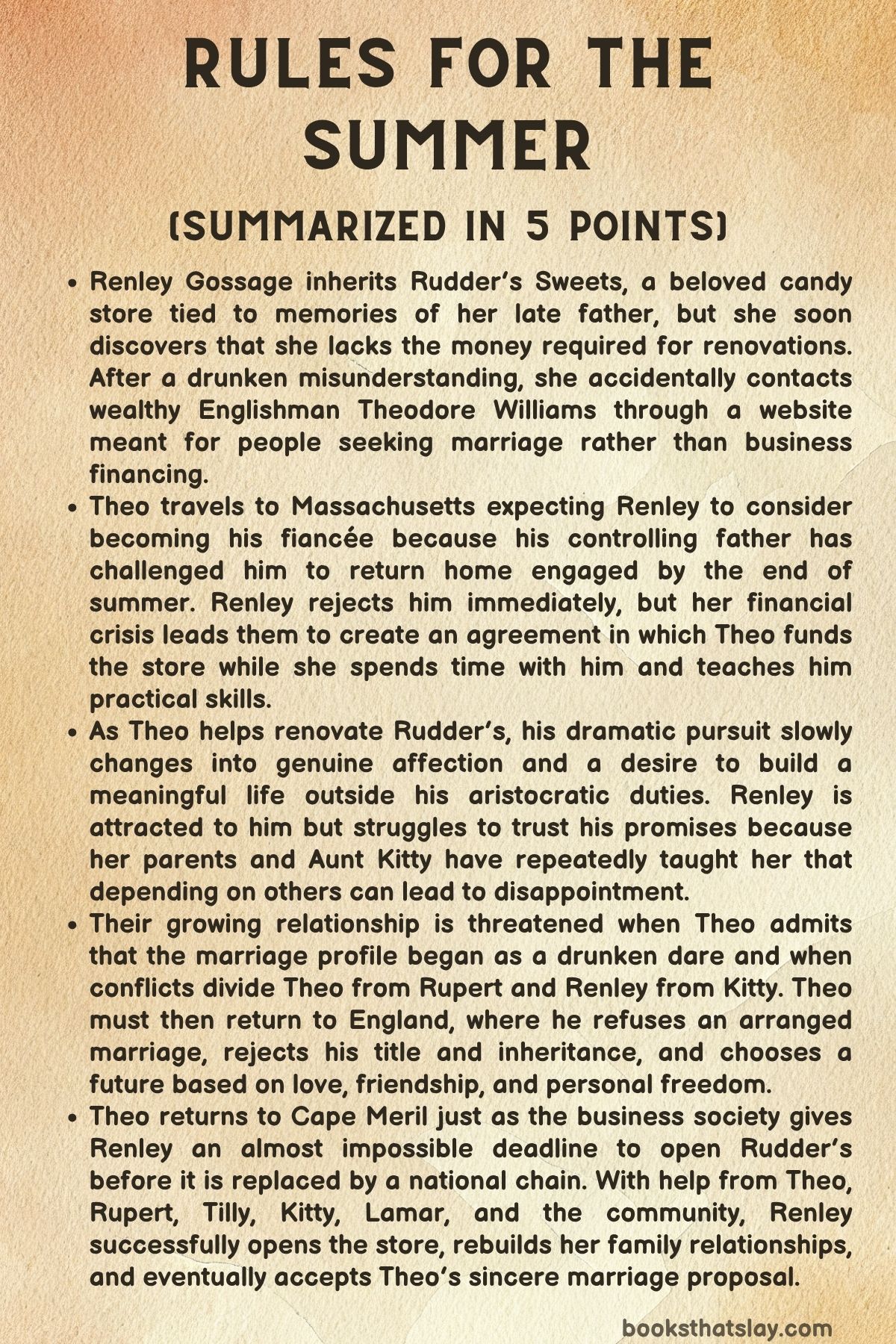
Theodore “Theo” Williams and his closest friend, Rupert, spend a drunken evening causing trouble inside the grand office of Theo’s aristocratic father. Their jokes and reckless behavior reveal Theo’s resentment toward the wealthy, carefully planned existence he is expected to inherit as the future Lord Dunebary.
Rupert creates a profile for Theo on Fiancé-er, a website connecting people interested in marriage, and dares him to activate it. Because the friends have a long-standing rule against refusing dares, Theo accepts without considering the consequences.
In Cape Meril, Massachusetts, Renley Gossage receives ownership of Rudder’s Sweets, a historic candy store filled with memories of her late father. She sees the business as an opportunity to preserve something meaningful while proving that her family is capable of stability and success.
Her celebration ends when she discovers that she must personally provide twenty thousand dollars for renovations. Renley believed her eccentric Aunt Kitty had confirmed that the money was available, while Kitty mistakenly assumed the town would supply it.
Renley and Kitty attempt to obtain a bank loan but encounter Marjorie, a hostile member of the local business community. Marjorie reveals that Renley was chosen because influential townspeople expect her to fail, allowing them to replace Rudder’s with a profitable national chain.
That evening, Renley and Kitty drunkenly search online for a financier. Because Kitty’s tablet is cracked and they misunderstand the website, they believe Theo’s marriage profile belongs to a wealthy investor and send him a match request.
Meanwhile, Theo’s father discovers the public profile and accuses his son of humiliating the family. Angry at being called irresponsible and disappointing, Theo claims that he genuinely intends to marry an American woman who might love him rather than his title.
His father challenges him to return engaged by the end of the summer. Failure will result in an arranged marriage to Walinda, the daughter of one of the family’s associates.
Theo and Rupert examine his matches and select Renley because she appears ambitious, attractive, practical, and relatively normal. Theo accepts her request and flies to Massachusetts, convinced that she is expecting a potential husband.
Renley learns the truth shortly before Theo arrives. Her friend Tilly examines the website and explains that it has nothing to do with financing, leaving Renley horrified that she has accidentally invited a British stranger to discuss marriage.
Theo and Rupert arrive early and enter the house after finding the door open. Once the misunderstanding is explained, Renley throws them out, but Theo asks her to reconsider after getting to know him.
Theo has rented the house next door for the entire summer. Pressure from his father, combined with the lack of suitable alternatives, convinces him that he must somehow persuade Renley to accept him.
His early attempts are ridiculous. He stages an accident beneath a fallen branch, sends an expensive margarita basket, follows her around town, and publicly acts as though they are involved.
Renley finds his persistence infuriating, particularly because his arrival has destroyed her hope of obtaining an investor. Her financial situation becomes increasingly desperate as the deadline for renovating Rudder’s approaches.
Theo eventually learns that money is preventing her from opening the store. He offers to provide the necessary funds, but Renley refuses to accept charity or allow herself to be bought.
They negotiate an agreement in which Theo will finance the renovation while Renley spends time with him and gives him a chance to prove that he is more than an unwanted fiancé. She also agrees to help him purchase practical shoes and teach him basic skills.
During their first shopping trip, Theo discovers that ordinary conversation with Renley is far more difficult than making dramatic declarations. His wealth, title, and confidence cannot compensate for his nervousness when her opinion genuinely matters to him.
Renley becomes angry when Theo purchases additional items for her, seeing the gesture as another attempt to buy affection. To prevent further problems, they create written rules controlling how often he can visit, what behavior is permitted, and how their arrangement will operate.
Theo is forbidden from flirting, proposing again, or using money to impress her. Renley agrees to teach him practical skills, while Theo adds a rule preventing her from dating anyone else during their agreement.
The rules are intended to preserve distance, but they instead create regular opportunities for them to spend time together. Theo begins joining the restoration work at Rudder’s, despite having no experience with tools, cleaning, plumbing, or physical labor.
The store becomes important to him because it represents something built through effort rather than inherited through privilege. He admires Renley’s determination to protect its old shelves, signs, candy containers, and memories instead of replacing everything with modern fixtures.
Renley gradually notices that Theo remembers details about the renovation and consistently asks about her progress. His attention begins to feel less like a strategy and more like genuine interest in her dreams.
Rupert and Kitty arrange a romantic evening for them inside the store. Although Renley initially resists, she eventually sits with Theo over wine and strawberries, allowing their teasing to become a serious conversation about family, responsibility, and loneliness.
Theo discusses his sister Elizabeth, who appears happier while traveling with her girlfriend, Hannah, than she ever did under their father’s expectations. Renley describes the strain of loving Kitty while frequently being forced to manage her aunt’s unfinished projects and impulsive decisions.
Afterward, Theo walks Renley home and persuades her to hold his hand. They lie beneath the night sky watching for shooting stars, and Theo admits that Cape Meril makes him feel more alive than the predetermined life waiting for him in England.
Renley begins wanting him despite her determination to remain emotionally protected. Frightened by the closeness developing between them, she repeatedly revises their rules and attempts to create stronger boundaries.
Theo continues helping at Rudder’s and becomes one of the few people who fully supports Renley’s vision. When she explains how her mother left, how her father became a source of local ridicule, and how the town expects the Gossage family to fail, Theo responds with sympathy rather than judgment.
Their attraction finally leads to a kiss on the beach. Renley responds intensely but retreats the following morning because Theo’s uncertain future reminds her of the broken promises that shaped her childhood.
Theo travels briefly to Boston with Rupert, where he attends a baseball game, explores the city, and seeks advice from their rideshare driver, Lamar. Even while away, he remains in constant contact with Renley, praising photographs of her renovation work and discovering that she is the first person with whom he wants to share every experience.
When he returns early, their physical attraction becomes harder to resist. Renley admits that she wants him but fears depending on someone who may leave when the summer ends.
Theo begins questioning whether he actually wants to return to England. Rupert points out that Theo has been trained to obey duty without ever deciding what kind of life would make him happy.
Working beside Renley gives Theo purpose, while his emotional support teaches her that accepting help does not require surrendering independence. He learns practical tasks, including repairing the bathroom and replacing a toilet, while she slowly allows herself to laugh, rest, and enjoy his company.
Their relationship becomes physical after several emotionally charged encounters at a hidden pond. The intimacy is built on trust, communication, humor, and growing affection rather than the marriage challenge that originally brought Theo to America.
Renley increasingly recognizes that Theo respects her work instead of competing with it. He encourages her to rest, protects her when Marjorie insults her, and proves through his actions that he wants to contribute rather than simply make promises.
Conflict develops when Renley realizes that Kitty has once again neglected the store after promising to help. Kitty’s inconsistency reminds Renley of her father, strengthening the belief that relying on others will always lead to disappointment.
Theo listens as Renley explains this fear and supports her without trying to solve everything immediately. His ability to remain present during uncomfortable moments helps her see that emotional dependence does not always result in abandonment.
Theo eventually reveals the complete truth about the Fiancé-er profile. He admits that Rupert created it during a drunken dare and that he originally selected Renley because she seemed like the most suitable match for satisfying his father’s challenge.
Renley is deeply hurt that their relationship began as a game. Theo insists that his feelings are now entirely genuine and that the woman he has come to love has replaced every concern about titles, appearances, or winning.
At the same time, Theo’s friendship with Rupert begins to fracture. Rupert feels that Theo takes his loyalty for granted and treats him as a permanent companion rather than a man entitled to an independent future.
During a tense Sunday dinner, the hidden conflicts among the group become public. Renley confronts Kitty about abandoning responsibilities, Rupert confronts Theo about suppressing him, and Kitty discovers that Renley and Theo have been secretly involved.
Theo apologizes to Rupert and explains that he considers him a brother rather than a servant or follower. Renley flees to the pond, where Theo finds her and finally admits that he wants a lasting future with her.
Their plans are interrupted by news that Theo’s father is ill. Theo and Rupert return to England, leaving Renley uncertain whether family duty will permanently pull Theo away from Cape Meril.
Back at his family estate, Theo learns that his father has arranged his marriage to Walinda. Elizabeth warns that refusing the title might cause their father to punish her and Hannah, making Theo consider sacrificing his happiness to protect his sister.
Elizabeth and Rupert refuse to accept his surrender. They remind him that allowing his father to control everyone will never create safety and that Theo cannot build a meaningful life through fear.
Theo confronts his father, rejects the arranged marriage, and gives up the title of Lord Dunebary. He accepts the possibility of losing his inheritance, wealth, and place within the estate because he would rather build a modest life based on love and purpose.
While Theo is away, the business society gives Renley only five days to finish Rudder’s and open it to the public. With inspections incomplete, supplies missing, and renovations unfinished, Renley begins believing that the town has finally defeated her.
Theo and Rupert return to Cape Meril intending to remain permanently. When they learn about the deadline, they join Tilly, Lamar, Kitty, and other townspeople in an emergency effort to complete the store.
Theo remembers the details Renley shared about the candy, stickers, displays, and equipment she wanted. Rupert handles promotion and technology, Tilly organizes permits, Lamar attracts television attention, and Kitty finally takes responsibility for helping.
Renley is stunned when she discovers the work they have completed. She apologizes for withdrawing and tells Theo that she loves him because he consistently believed in her abilities, even when she could no longer believe in herself.
Kitty also apologizes for forcing Renley to manage her behavior and for failing to participate in the renovation. Renley forgives her, allowing their relationship to begin moving toward greater honesty and balance.
Rudder’s opens successfully with restored displays, nostalgic decorations, local artwork, branded products, and a large crowd. The business society is forced to watch Renley succeed in the place where they expected her to fail.
Renley and Theo move into the apartment above the store. Theo finds purpose in the community, Rupert builds a successful promotional campaign, and the renovated shop becomes both a tribute to Renley’s father and evidence of the future she created for herself.
After closing the store, Renley and Theo return to the pond where much of their relationship developed. Renley tells him that she loves him and suggests that she might someday welcome another proposal.
Theo turns the moment into one final truth-or-dare challenge and dares her to marry him. This time Renley accepts, completing their transformation from mistaken strangers into partners who have consciously chosen each other.
Characters
Renley Gossage
At the center of Rules for the Summer, Renley is hardworking, guarded, practical, and deeply motivated by the need to prove herself. Rudder’s Sweets is not merely a business opportunity for her; it represents her happiest memories with her father, her struggle against the town’s judgment, and her desire to build something dependable.
Renley has learned to associate love with instability because her mother left, her father frequently disappointed her, and Kitty often abandons projects after making enthusiastic promises. These experiences have made her capable and resilient, but they have also convinced her that accepting help will eventually lead to disappointment.
Her written rules reveal her need to control emotional risk. She repeatedly creates boundaries whenever her feelings for Theo become stronger because rules seem safer than trusting another person’s intentions.
Renley’s development comes from learning that independence does not require complete isolation. By accepting assistance from Theo, Tilly, Kitty, Rupert, Lamar, and the community, she becomes stronger rather than less capable.
Her romantic growth is equally important. She moves from rejecting Theo as an intrusive stranger to recognizing that he respects her ambitions, understands her fears, and supports her without demanding that she abandon her identity.
Theodore “Theo” Williams
Theo gives Rules for the Summer much of its humor, energy, and emotional conflict. He initially appears spoiled, impulsive, dramatic, and overly confident, but his exaggerated personality conceals years of frustration, loneliness, and fear.
His humor functions as a defense against the life his father has designed for him. Instead of confronting his unhappiness directly, Theo drinks, jokes, rebels, and performs recklessness because open resistance seems impossible.
The marriage challenge begins as another act of defiance, and Renley is initially treated as a convenient solution. However, working beside her forces Theo to develop patience, practical ability, emotional honesty, and a genuine sense of responsibility.
His transformation is visible through his actions at Rudder’s. The man who once mocked responsibility eventually cleans neglected rooms, repairs plumbing, confronts pests, stocks shelves, organizes support, and takes pride in creating something through effort.
Theo’s final rejection of his title completes his development. He stops defining freedom as rebellion against his father and begins defining it as the courage to choose love, meaningful work, friendship, and personal integrity.
Aunt Kitty
Aunt Kitty is affectionate, eccentric, impulsive, and frequently irresponsible. She genuinely loves Renley and played an important role in caring for her after her mother left and her father died, yet her support often requires Renley to manage the consequences of her behavior.
Her enthusiasm creates both opportunity and chaos. The accidental Fiancé-er match begins because of her misunderstanding, while her habit of switching interests contributes to Renley’s fear that no one will consistently remain beside her.
Kitty’s hobby-horse obsession and attraction to Rupert make her entertaining, but the comedy does not erase the pain caused by her unreliability. Renley’s confrontation forces Kitty to recognize that loving someone is not enough when that person must constantly compensate for broken commitments.
Her apology near the end represents meaningful growth. She accepts responsibility without demanding immediate forgiveness and begins contributing to the store as a dependable family member rather than merely a source of enthusiasm.
Rupert
Rupert initially functions as Theo’s mischievous companion, adviser, and comic partner. He creates the Fiancé-er profile, accompanies Theo to America, invents ridiculous schemes, and supports the pursuit of Renley even when Theo’s behavior becomes absurd.
Beneath the humor, Rupert possesses emotional intelligence and understands Theo’s unhappiness before Theo can admit it. His decision to travel to America is partly motivated by concern that his friend is slowly being damaged by an empty, predetermined life.
Rupert’s conflict with Theo reveals his own insecurity. He fears that their friendship has prevented him from forming an identity beyond being Theo’s companion, and he becomes sensitive to the possibility that his loyalty is being treated as an obligation.
Their reconciliation is based on honesty rather than habit. Theo acknowledges Rupert as a brother and equal, while Rupert accepts that some of his resentment came from his uncertainty about his own future.
Tilly
Tilly is Renley’s reliable friend, creative collaborator, and source of honest advice. She quickly identifies the true purpose of the Fiancé-er website, preventing the misunderstanding from becoming even more dangerous.
Her contribution to Rudder’s goes beyond friendship. She provides artistic ideas, creates signs, assists with planning, helps secure permits, and supports Renley whenever the renovation appears impossible.
Tilly also encourages Renley to examine her feelings without forcing a decision. Unlike Kitty, she does not turn the relationship into a spectacle, and unlike Theo, she does not challenge Renley’s defenses through persistence.
Her dependability provides an important contrast to the unreliable figures in Renley’s past. Tilly proves that consistent support can be quiet, practical, and respectful.
Theo’s Father
Theo’s father represents inherited authority, emotional control, and the destructive use of family duty. He views Theo primarily as the future holder of a title and judges his son according to appearances, obedience, and tradition.
His criticism contains some truth because Theo has been reckless and unfocused. However, the father ignores how his controlling behavior contributed to Theo’s lack of direction by denying him opportunities to make meaningful choices.
The arranged marriage to Walinda exposes his belief that personal happiness is less important than lineage. Even illness does not soften his need to control his children’s futures.
Theo’s rejection of him is therefore more than a disagreement about marriage. It is a refusal to continue a family system in which wealth and status are used to demand emotional surrender.
Elizabeth Williams
Elizabeth is Theo’s sister and one of the clearest voices of courage in the story. Her travels with Hannah show that she has already begun creating a life beyond the rigid expectations of their family.
She understands the dangers of opposing their father because her own relationship could be targeted. Even so, she refuses to let Theo sacrifice himself in the belief that doing so will protect her.
Elizabeth challenges Theo to respect her ability to make her own choices. Her support helps him understand that self-sacrifice can become another form of control when it denies others the right to face their own struggles.
Her presence also expands the meaning of chosen family. She sees Rupert, Hannah, Renley, and Theo as people capable of supporting one another without repeating their father’s conditions.
Lamar
Lamar enters the story as a rideshare driver but becomes an unexpectedly valuable friend and adviser. He listens to Theo’s romantic confusion without being distracted by the absurd details surrounding it.
His advice emphasizes honesty over strategy. Lamar recognizes that Theo’s elaborate plans cannot create trust if he refuses to communicate openly about his motives and future.
Later, Lamar contributes directly to saving Rudder’s by contacting a television program and sharing Renley’s story. His actions show how quickly genuine friendship can form when people choose to become involved in one another’s lives.
Although his role is smaller than those of the central characters, he strengthens the story’s emphasis on community. Help often comes from people who have no obligation to provide it.
Marjorie
Marjorie represents the hostility Renley faces from Cape Meril’s established business community. She is dismissive of Kitty, openly doubts Renley’s abilities, and participates in the plan to replace Rudder’s with a national chain.
Her behavior is shaped by prejudice against the Gossage family. Instead of judging Renley according to her actual work, Marjorie assumes that past family failures determine what Renley deserves.
She also exposes how local authority can disguise cruelty as business logic. The impossible deadline and repeated insults are designed to create failure rather than fairly evaluate Renley’s progress.
Marjorie’s eventual defeat is important because Renley succeeds without gaining her approval. The store’s opening proves that hostile judgment loses power when the person being judged no longer accepts it as truth.
Renley’s Father
Renley’s father is absent from the present action but remains one of the strongest influences on her decisions. Her memories of visiting Rudder’s with him give the store its emotional importance.
He was imaginative, loving, and capable of creating joyful experiences, but he was also unreliable and frequently failed to keep promises. Renley has difficulty separating his warmth from the instability he caused.
For much of the story, she believes she must prove that she is nothing like him. This belief creates enormous pressure because every mistake feels like confirmation of the town’s opinion of her family.
By restoring Rudder’s, Renley learns to accept the valuable qualities she inherited from him without repeating his failures. She can preserve his imagination and appreciation for small joys while building the stability he could not provide.
Mayor Sheffield and the Business Society
Mayor Sheffield and the business society represent institutional pressure rather than personal support. They grant Renley ownership of Rudder’s while privately expecting her to fail, turning what appears to be an opportunity into a trap.
Their preference for a national chain demonstrates how financial profit can be valued above local history and personal meaning. They see the candy store as outdated because they cannot measure its cultural and emotional importance.
The group also relies on Renley’s damaged reputation. By assuming that a Gossage will inevitably fail, they justify deadlines and demands that would be unreasonable for another owner.
Their defeat comes through public success rather than direct revenge. Once the community and media support Rudder’s, the society can no longer quietly control the outcome.
Hannah
Hannah does not occupy much direct space in the action, but her relationship with Elizabeth carries significant meaning. She represents the loving life Elizabeth has chosen outside her father’s restrictive expectations.
The possibility that Theo’s father might target Hannah becomes part of Theo’s moral conflict. Theo briefly considers accepting an arranged marriage because he fears that choosing freedom could expose Elizabeth and Hannah to punishment.
Elizabeth’s refusal to allow this sacrifice demonstrates the strength of their relationship. Hannah is part of the chosen family that helps the Williams siblings imagine a future built on support rather than obedience.
Walinda
Walinda is treated by Theo’s father as an acceptable bride because of family connections rather than emotional compatibility. Her proposed marriage to Theo demonstrates how little personal choice matters within the aristocratic system.
Theo’s fear of marrying her is partly comic, especially when Rupert invents alarming stories about her past relationships. However, Walinda is also placed in an unfair position because the arrangement reduces her to a tool for preserving family expectations.
She is not developed as a villain, and the true problem is not her personality. The conflict comes from a system that assumes marriage can be commanded as a business or dynastic decision.
Theresa
Theresa is a local business owner whom Renley considers approaching for financial assistance. Her interaction with Theo and Renley shows how quickly gossip spreads through Cape Meril.
Theo’s public suggestion that he and Renley are romantically involved distracts Renley from requesting a loan. Kitty later argues that Renley could have used Theresa’s interest in the romance to create goodwill.
Although Theresa has a minor role, the scene demonstrates Renley’s discomfort with using personal relationships for financial advantage. It also shows how Theo’s presence begins changing the way townspeople view her.
Ira Rudd
Ira Rudd’s death creates the opportunity for Renley to take ownership of the candy store. Although he is not present in the action, his decision to leave Rudder’s to the town ensures that its future becomes a public question.
The store bearing his name contains decades of memories, traditions, signs, sweets, and childhood experiences. Ira’s legacy represents the value of preserving a local institution rather than treating every business solely as a source of profit.
Renley’s restoration honors that legacy while also reshaping it. Rudder’s remains connected to its history but becomes capable of serving a new generation.
Themes
Choosing a Life Instead of Inheriting One
Theo’s conflict in Rules for the Summer centers on the difference between receiving a privileged future and actively choosing a meaningful one. His title, wealth, estate, marriage prospects, and social role have all been arranged before he has the maturity to decide whether he wants them.
His early rebellion is immature because he damages property, drinks excessively, and creates public embarrassment without addressing the source of his anger. These actions resist his father temporarily but do not free him from the system controlling him.
Cape Meril gives Theo his first experience of building rather than inheriting. Repairing a bathroom, cleaning a storage room, stocking shelves, and supporting Renley’s dream give him satisfaction because the results depend on his choices and effort.
Rejecting the title becomes meaningful only after Theo discovers what he wants in its place. He is not simply abandoning wealth; he is selecting work, love, friendship, community, and a modest home above a candy store.
Elizabeth faces a related struggle because her father can use succession and family pressure against her relationship with Hannah. Her refusal to accept Theo’s sacrifice shows that freedom must be shared rather than purchased through another person’s surrender.
Trust, Dependability, and Fear of Abandonment
Renley’s resistance to Theo comes from a history in which affection and dependability rarely existed together. Her mother left, her father mixed wonderful memories with repeated disappointments, and Kitty’s sincere love is weakened by unfinished promises.
These experiences teach Renley to believe that needing someone gives that person the power to hurt her. She therefore relies on work, planning, financial independence, and written rules to reduce uncertainty.
Theo initially appears to confirm her worst expectations because he arrives through deception, pursues her for selfish reasons, and cannot explain what will happen when the summer ends. His dramatic promises mean little to Renley because she has already heard promises from people who failed to keep them.
Trust begins developing through repeated actions rather than romantic declarations. Theo remembers details about Rudder’s, performs unpleasant work, listens when Renley cries, defends her publicly, respects her ambition, and returns when she expects him to remain in England.
The temporary separation forces both characters to confront their deepest fears. Renley must decide whether uncertainty automatically means abandonment, while Theo must determine whether love is strong enough to justify changing his entire future.
Their final commitment feels believable because it follows evidence of dependability. Theo chooses Cape Meril permanently, and Renley chooses to believe that accepting love does not require ignoring risk.
Independence and the Courage to Accept Help
Renley believes self-sufficiency is the only reliable form of safety. Because she has repeatedly handled the consequences of other people’s choices, she sees accepting assistance as the beginning of another burden.
Her refusal of Theo’s initial financial offer reflects both pride and emotional caution. She does not want charity, control, or a situation in which wealth allows someone else to claim ownership over her dream.
The negotiated arrangement preserves her agency, yet the renovation gradually reveals the limits of doing everything alone. Physical exhaustion, financial pressure, town hostility, family conflict, and emotional strain eventually become too much for one person to manage.
Theo’s support changes Renley’s understanding of partnership because he does not demand that she surrender leadership. He follows her plans, learns from her instructions, respects the store’s history, and takes satisfaction in helping her vision become real.
The emergency effort before opening day expands this lesson beyond romance. Tilly, Rupert, Lamar, Kitty, Theo, and the townspeople each contribute different skills, proving that collaboration does not erase Renley’s achievement.
Renley remains the person who imagined, fought for, and restored Rudder’s. Accepting help allows her work to survive, showing that independence is strongest when it includes the wisdom to recognize trustworthy support.
Reputation, Community, and Reclaiming Identity
Cape Meril has reduced the Gossage family to a collection of failures, scandals, and abandoned promises. Renley is judged according to this reputation before the business society evaluates her talent, discipline, or renovation plans.
The decision to give her Rudder’s is therefore not entirely generous. Influential residents expect her to fail and believe her failure will justify replacing a local landmark with a profitable national chain.
Renley initially responds by trying to become the opposite of everything associated with her family. She works without rest, refuses assistance, hides emotional needs, and treats every obstacle as a test of whether she deserves respect.
Restoring the candy store allows her to redefine what the Gossage name represents. Instead of rejecting her father completely, she preserves his imagination, affection for Rudder’s, and ability to find joy in small experiences while refusing to repeat his irresponsibility.
The community also changes as people move from observers to participants. Tilly provides creativity, Lamar attracts media support, Rupert builds public interest, Theo supplies labor and determination, and Kitty finally accepts responsibility.
The successful opening does more than defeat the business society. It transforms Rudder’s into proof that identity is created through choices, relationships, and sustained work rather than permanently determined by inherited reputation.