Rumors & Whiskey Summary, Characters and Themes
Rumors & Whiskey by Victoria Wilder is a romantic suspense novel about survival, desire, family loyalty, and the difficult choices people make when formal systems fail to protect the vulnerable.
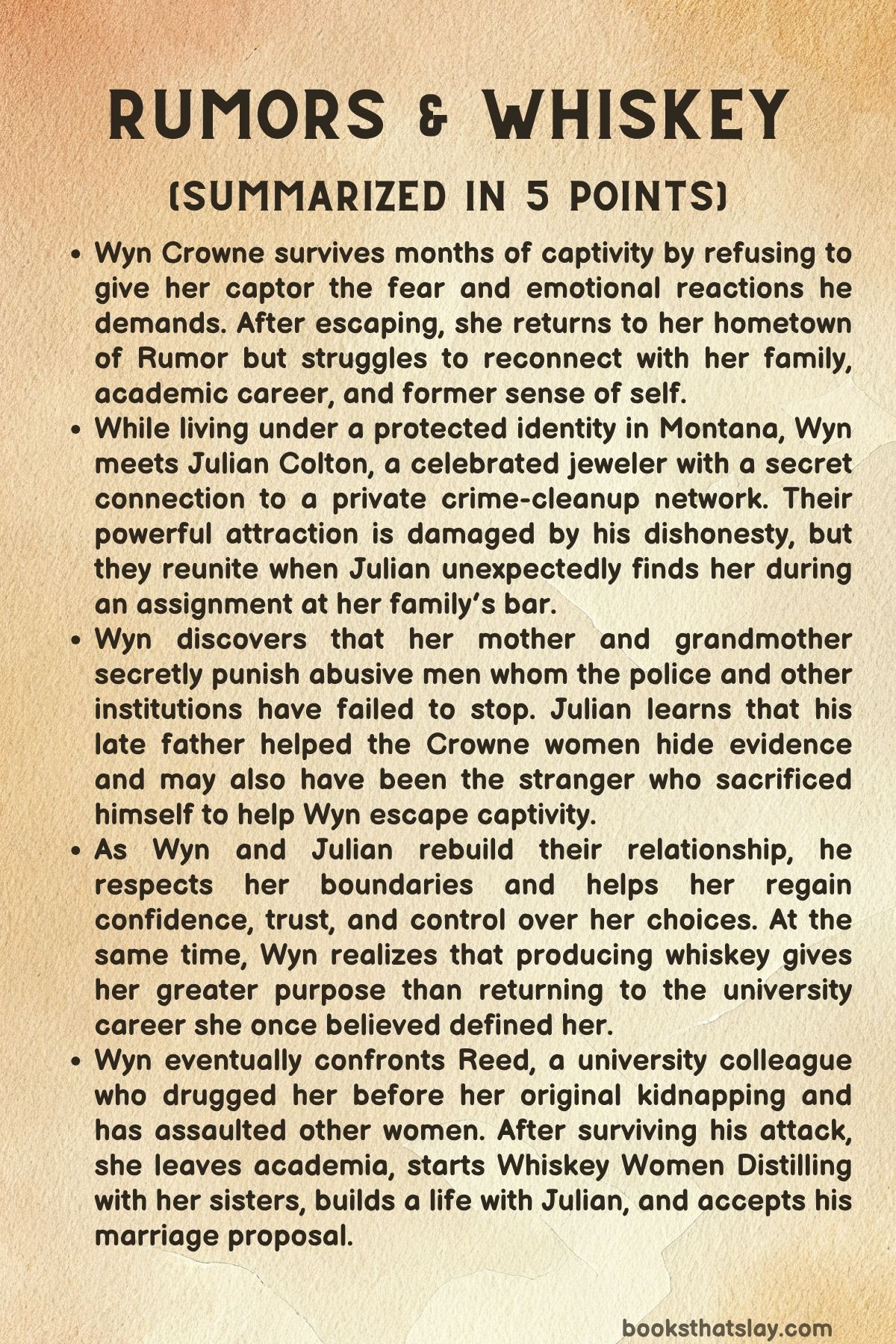
Wyn Crowne returns to her Tennessee hometown after years of captivity, carrying physical scars, lost ambitions, and an identity she created while living under protection. Her reunion with Julian Colton, an artist connected to her family’s hidden activities, forces both of them to confront inherited secrets. Their relationship develops alongside revelations involving vigilantism, corruption, abuse, and a shared tragedy that links their families more closely than either imagined. It’s the 1st book of The Whiskey Women series.
Summary
Wynona Crowne survives more than four months of captivity by refusing to give her captor the emotional responses he wants. He calls her Professor, tortures other women in front of her, and attempts to turn her fear into entertainment, but Wyn protects the last part of herself she can still control by remaining silent.
Her chance to escape arrives when the captor brings an older man into the storage facility. The stranger fights back, pins the killer down, calls Wyn by name, and repeatedly orders her to run, allowing her to escape through an unlocked door.
Years later, Wyn has returned to Rumor, Tennessee, and resumed her position in a university chemistry department. Although her family celebrates her return, she feels separated from the woman she used to be and finds the academic career that once defined her strangely empty.
After a university gathering, Wyn enters her family’s bar, The Whispering Fool, and discovers blood, discarded clothing, chemicals, and equipment associated with cleaning a crime scene. A large man catches her, injects her with a sedative, and is horrified to recognize her as the woman he once knew as Naomi Nash.
Ten months earlier, Wyn had been living under the name Naomi in Hideaway, a secret Montana community for survivors. She worked in a remote bar, conducted whiskey tastings, and listened to her sister Stevie’s true-crime podcast because hearing Stevie’s voice allowed her to remain connected to the family that believed she was missing or dead.
Julian Colton entered the bar claiming to be lost, though his questions about Hideaway immediately made Naomi suspicious. He was a successful jeweler and goldsmith, and his flirtation awakened attraction, confidence, and curiosity that Wyn had believed captivity had permanently taken from her.
When Julian returned weeks later, their attraction developed into a consensual encounter in which Naomi maintained control over what he could see and touch. Julian respected every limit, but the moment ended when she learned that he had deliberately searched for Hideaway and discovered a map revealing its location.
In the present, Julian explains that he was sent to The Whispering Fool through a private network that arranges the removal of bodies and evidence. He inherited this work from his father, Sam, although he intended the assignment in Rumor to be his last.
Birdie Crowne, Wyn’s grandmother, recognizes Julian as Sam’s son and takes both him and the unconscious Wyn to her house. Julian soon discovers that his father had a long history with the Crowne family, though Sam had never told him about Rumor or the people he served there.
Wyn’s family quickly learns that Julian knew her while she was living as Naomi. His presence exposes a part of her recovery that she had not yet shared, but he also reminds her of the confident woman she became in Montana, someone capable of expressing desire without feeling powerless.
As Julian stays in Rumor, he learns that the body removed from the bar probably belonged to Deputy Stan Billings. Stan had abused his wife, sold drugs, misused his authority, and avoided consequences because the local sheriff’s department protected its own.
Lu and Birdie eventually reveal that the Crowne women have spent years protecting women whom the law ignored. Through garden meetings, tarot readings, prayer requests, and coded conversations, they identify violent men who continue harming others despite complaints, evidence, and public knowledge.
When no legal solution remains, Lu and Birdie sometimes kill the abuser and arrange for the evidence to disappear. The exaggerated rumors surrounding the Crowne family help conceal their actions because outsiders dismiss stories about witchcraft, alligators, poison, and dangerous women as local gossip.
Wyn is horrified by the revelation, yet her own experiences prevent her from rejecting her mother and grandmother completely. She understands that people such as Stan flourish when institutions value reputation and authority over the testimony of frightened women.
Julian admits that he originally searched for Hideaway on behalf of someone else but chose not to expose the community once he understood its purpose. He also confesses that he returned to Montana looking for Naomi and remained in Rumor because finding Wyn changed his plans.
Their relationship develops through conversations about honesty, control, work, family, and loss. Wyn sets clear physical boundaries, sometimes taking complete control and at other times choosing to surrender it, while Julian consistently asks what she needs rather than deciding for her.
Julian’s willingness to respect her body allows Wyn to reveal the scars left by her captor. Instead of pitying her, he admires her survival and accepts that trust must be established through repeated choices rather than dramatic promises.
Wyn also begins reconsidering her professional life. Chemistry still interests her, but teaching and university politics no longer satisfy her, while experimenting with whiskey at the family distillery gives her energy, purpose, and genuine pleasure.
Julian faces a similar conflict involving his inheritance. Jewelry became his true passion even though it began as a cover for his family’s cleanup work, and he starts imagining a permanent studio in Rumor rather than continuing a life shaped entirely by Sam’s secret obligations.
A hidden workshop at The Rackhouse reveals that Sam spent significant time in Rumor. Julian finds his father’s tools, unfinished jewelry, paper airplanes, and a photograph showing Sam in an affectionate relationship with Birdie.
Birdie confesses that she and Sam loved each other for nearly thirty years. Their relationship did not follow conventional expectations, but they understood each other’s dangerous responsibilities and provided a place where neither had to hide.
She also reveals that Sam disappeared after she asked him to find Wyn. Wyn recognizes him as the man who fought her captor and created the opportunity for her escape, meaning Sam sacrificed his life while carrying out Birdie’s request.
Wyn initially believes that she caused his death, but Julian refuses to blame her. Learning the truth restores his faith in his father and transforms Sam’s unexplained death into an act of courage that saved the woman Julian would eventually love.
Julian takes Wyn to Kentucky, where a visit to Foxx Bourbon allows her to discuss whiskey production with master distillers and industry professionals. She feels professionally alive for the first time since returning home and begins imagining a women-run distillery with her sisters.
During the visit, Wyn unexpectedly reunites with Laney Foxx, another woman who escaped from the storage facility and later killed their captor. Seeing Laney pregnant, loved, and surrounded by family gives Wyn proof that survival can eventually become a full life rather than a permanent state of fear.
Wyn decides to resign from the university and establish Whiskey Women Distilling with Stevie and Jo. Stevie will contribute promotion, events, podcast connections, and business development, while Jo will handle branding, visual identity, and artistic design.
Before Wyn can begin her new life, the university’s corruption becomes personal. Reed Andrews, her former teaching assistant and old romantic interest, drugs her at The Whispering Fool and attempts to abduct her while another impaired student, Andi, sits nearby.
Wyn remembers that Reed also drugged her on the night of her original disappearance. His actions left her helpless outside the university event, where her captor found and kidnapped her, making Reed indirectly responsible for the circumstances that led to years of trauma.
This time, Wyn refuses to remain silent. She screams, fights, uses a self-defense weapon, and receives immediate support from Julian, Lu, and Birdie.
Lu and Birdie reveal that Reed has drugged and assaulted several students while the university and Sheriff Fury ignored the accusations. They poison Reed with a dangerous product from the distilling process and push him into the river, leaving local wildlife and Rumor’s gossip to erase the remaining evidence.
Afterward, Julian asks Wyn what she needs instead of treating her as helpless. Their intimacy becomes another expression of chosen control, trust, and safety, and Wyn finally tells him that she loves him.
Sheriff Fury questions Wyn, but the family’s carefully limited account and the absence of a body leave him unable to act. Rumors soon offer several explanations for Reed and Stan’s disappearances, while Andi and other survivors prepare to make formal reports.
Wyn resigns from her tenured position and officially asks Stevie and Jo to become her business partners. Their acceptance gives each sister a meaningful role in a future shaped by cooperation rather than inherited expectations.
Three months later, Julian has moved permanently to Rumor and is developing a public gallery and jewelry workshop beside Jo’s studio. He has not completely abandoned his father’s secret profession, but he now accepts only carefully selected cases in which his skills can protect people rather than merely preserve a hidden tradition.
Whiskey Women Distilling is developing through the combined efforts of Wyn, her sisters, Tommy, and their new industry partners. Wyn finds satisfaction in experimentation, production planning, and the knowledge that her scientific abilities now serve a life she deliberately chose.
Julian completes a garden beside their home, gives Wyn a puppy, and proposes with an emerald ring he designed for her. Surrounded by the home, family, career, and love she once believed she had lost, Wyn accepts the future they have created together.
Characters
Wynona “Wyn” Crowne
Wyn is the emotional and psychological center of Rumors & Whiskey, and her development is built around the difference between surviving an experience and reclaiming ownership of a life. Her silence during captivity is not passive submission but a calculated defense that denies her captor the fear, approval, and emotional participation he demands.
After escaping, Wyn struggles with the expectation that returning home should restore her former identity. Her university position, intellectual reputation, and family relationships remain available to her, but she no longer experiences them in the same way because trauma has changed what she values.
The identity of Naomi allows Wyn to experiment with freedom outside the expectations attached to her family name. As Naomi, she can speak openly about whiskey, flirt with Julian, establish physical rules, and discover that desire does not have to place her in danger.
Her relationship with Julian supports her growth because he does not claim the right to determine what healing should look like. He allows her to set limits, change those limits, take control, surrender control, and reveal information at her own pace.
Wyn’s decision to leave academia is not a rejection of intelligence or achievement. It is an acknowledgment that her knowledge can be used in a setting that gives her creativity, connection, independence, and pleasure.
Her confrontation with Reed completes a major part of her transformation. She refuses silence, calls for help, fights back, and prevents another man from deciding what will happen to her body.
Wyn does not become fearless by the end of the novel. She becomes willing to act while fear is present, which gives her courage a realistic and lasting quality.
Julian Colton
Julian is introduced as both a threat and a source of safety, creating the moral tension that shapes his role throughout Rumors & Whiskey. He drugs Wyn during a cleanup assignment, hides his intentions in Montana, and participates in a secret profession involving bodies and evidence, yet he consistently demonstrates a personal code built around consent, loyalty, and protection.
His profession reflects the conflict between inheritance and individual choice. Julian respects his father and values the skills Sam taught him, but he no longer wants every decision in his life to be governed by obligations he never consciously accepted.
Jewelry represents the part of Julian’s inheritance that became genuinely his. Unlike cleanup work, which depends on secrecy and destruction, his art creates objects meant to be seen, remembered, worn, and passed between people.
His treatment of Wyn reveals patience beneath his confidence. Julian desires her intensely, but he never treats access to her body or history as something he has earned through attraction, protection, or romantic commitment.
Learning that Sam died while rescuing Wyn changes Julian’s understanding of both his father and his own relationship. Rather than resent Wyn, he recognizes that Sam’s sacrifice brought meaning to an unexplained death and allowed Julian to meet the woman who would transform his future.
Julian’s final decision is not to reject his family legacy completely but to redefine it. He chooses public art, permanent community, selective responsibility, and a relationship based on mutual honesty.
Birdie Crowne
Birdie is the strategist and keeper of the Crowne family’s most dangerous knowledge. Her public identity as an eccentric older woman interested in gardens, palmistry, alcohol, and local gossip allows her to collect information without appearing threatening.
She understands that communities often reveal their darkest truths indirectly. Women approach her through social gatherings, coded requests, spiritual language, and seemingly harmless conversations because they trust that she will recognize danger without demanding public exposure.
Birdie’s willingness to arrange the deaths of violent men makes her morally difficult to categorize. She is neither careless nor motivated by pleasure; she acts after concluding that legal and social institutions have abandoned the people asking for help.
Her relationship with Sam shows a private tenderness hidden beneath her commanding exterior. Their long partnership survives because they understand one another’s secrets and never require the other to pretend to be less complicated.
Birdie also carries guilt over Sam’s death because she sent him to find Wyn. Her guilt reflects the burden of leadership: she makes decisions intended to protect others, but she cannot control every consequence.
Although she withholds information from Wyn and her sisters, her secrecy comes from fear rather than contempt. She wants to protect the younger women from criminal responsibility, even when that protection creates emotional distance.
Lu Crowne
Lu initially appears to Wyn as a mother associated with baking, family chaos, and the traditions Wyn once wanted to escape. The discovery that Lu also kills abusive men forces Wyn to recognize that her mother possesses anger, discipline, courage, and moral certainty that have long remained hidden.
Lu’s actions are rooted in the failure of ordinary protection. She does not believe violence is automatically virtuous, but she refuses to accept that a uniform, professional title, or respected reputation should shield a predator.
Her conflict with Wyn is shaped by mutual misunderstanding. Wyn assumes that Lu is disappointed in her choices, while Lu feels intellectually intimidated by her daughter and fears being judged as ignorant or monstrous.
Their reconciliation does not occur through calm speeches or sentimental gestures. They smash bottles, express rage, reveal painful truths, and begin rebuilding their relationship through directness.
Lu’s work at the distillery during Wyn’s absence also reveals the depth of her grief. She maintains the place because it allows her to feel close to the missing daughter whose interests she never fully understood before.
Her relationship with Tommy demonstrates that she also needs a place where she is not required to explain or defend herself. He gives her companionship without forcing labels, allowing Lu to exist outside her roles as mother, daughter, protector, and avenger.
Stevie Crowne
Stevie is expressive, confrontational, fiercely loyal, and unwilling to soften the truth for the comfort of powerful people. Her true-crime podcast investigates missing women, ignored assault reports, corruption, and institutional neglect, making her public work an extension of the Crowne family’s private commitment to protection.
While Wyn is missing, Stevie’s voice becomes an invisible connection between them. Wyn listens to the podcast in Montana because it allows her to remain emotionally close to her sister without compromising Hideaway’s secrecy.
Stevie often uses humor, teasing, and public performance to manage fear. Her jokes about Wyn and Julian may appear intrusive, but they are also attempts to restore ordinary sisterhood after years of uncertainty.
Her confrontation with Sheriff Fury shows that she is willing to risk arrest and public ridicule to expose misconduct. Unlike Birdie and Lu, who operate through secrecy, Stevie challenges power through documentation, accusation, and public attention.
She also contributes a practical vision to Whiskey Women Distilling. Her skills in promotion, events, storytelling, music, and audience engagement make her essential to transforming Wyn’s scientific ideas into a recognizable business.
Jo Crowne
Jo is an artist whose confidence and humor conceal a sharp understanding of other people. She notices Julian’s interest in Wyn, tests his intentions, and encourages her sister to act on desire rather than retreat into caution.
Her artistic identity parallels Wyn’s eventual professional decision. Both sisters possess abilities that become meaningful when they stop measuring success solely by conventional standards.
Jo contributes energy to The Whispering Fool through games, performance, and visual spectacle. These activities are not meaningless entertainment; they create a social world where the Crowne women control the atmosphere and define the rules.
Her role in the future distillery is especially appropriate because branding and visual design allow her to turn family identity into something chosen and public. She helps transform the Crowne reputation from a collection of suspicious stories into a creative commercial identity.
Jo’s loyalty is expressed through direct involvement rather than emotional speeches. She brings Wyn supplies, offers practical support, tests Julian, and accepts partnership when she recognizes that her sister genuinely needs her.
Reed Andrews
Reed initially appears familiar, helpful, and professionally respectable, which makes his eventual exposure especially disturbing. He uses his position within the university and his history with Wyn to present himself as a safe person while hiding a pattern of drugging and assaulting women.
His behavior demonstrates how predators benefit from social credibility. Reed does not resemble the obvious monster who held Wyn captive, yet his actions make that captivity possible by leaving her drugged and vulnerable.
He also exploits institutional silence. Rumors circulate about his behavior, students show signs of fear, and accusations exist, but the university and law enforcement fail to intervene.
Reed’s interest in Wyn is rooted in entitlement rather than affection. He expects access to her time, professional help, attention, and body, and he responds aggressively when she begins rejecting those expectations.
His final attempt to abduct Wyn repeats the conditions of her original disappearance, but the outcome changes because she now recognizes him, fights back, and has people prepared to believe her immediately.
Sam Colton
Sam remains physically absent from most of the story, yet his choices influence Julian, Birdie, Wyn, and the entire moral structure of the novel. He trained Julian in both jewelry and cleanup work, leaving his son an inheritance built from creativity, secrecy, responsibility, and danger.
His long relationship with Birdie reveals that he possessed an emotional life Julian never knew. Sam found someone who understood his hidden work and accepted him without demanding that he choose between duty and intimacy.
His final mission gives his character its greatest significance. After Birdie asked him to locate Wyn, he followed the available evidence to New York, became a captive himself, fought the killer, and created the opportunity for Wyn to escape.
Sam’s death is therefore not meaningless or shameful. It becomes the final expression of the protective code that shaped his life, and Julian’s discovery allows him to mourn with pride rather than confusion.
The paper airplanes associated with Sam also connect memory, art, childhood, and rescue. They become a symbol of what parents leave behind, including unfinished questions as well as enduring love.
Jameson Bishop
Jameson occupies a difficult position as a homicide detective connected to a family that sometimes operates beyond the law. He understands professional responsibility, but he also recognizes that the institutions he serves are capable of protecting corrupt officers and ignoring vulnerable women.
His suspicion of Julian is reasonable rather than malicious. Julian arrives near the time of Stan’s disappearance, has unexplained connections to the Crownes, and possesses skills that could easily conceal a crime.
Jameson’s protectiveness toward Wyn does not prevent him from observing her choices. Once Julian demonstrates sincere intentions, Jameson gradually accepts him and includes him in the family’s social world.
His eventual response to the disappearances of Stan and Reed shows a carefully managed form of loyalty. He likely understands that official explanations are incomplete, but he refuses to force evidence into existence when doing so would protect men who caused serious harm.
Jameson represents the possibility of ethical judgment within a compromised system. He does not openly abandon the law, but neither does he pretend that legality and justice are always identical.
Tommy
Tommy is a steady source of practical support within the Crowne family. He manages spaces, protects family secrets, offers Julian accommodation, and observes relationships without demanding control over them.
His connection with Lu is based on safety rather than convention. He provides companionship that does not require her to explain every choice, define their relationship publicly, or repay his patience.
Tommy also helps Wyn reconsider the family distillery. He recognizes that the building has always belonged to her emotionally and encourages her to ask questions rather than continue making assumptions about Lu.
His warning to Julian is firm but fair. Tommy does not threaten him merely for dramatic effect; he makes clear that remaining near Wyn requires genuine intentions and respect for the damage she has already survived.
Tommy’s value lies in consistency. He does not dominate scenes, yet his reliability allows more volatile characters to take risks because they know he will remain present.
Laney Foxx
Laney is connected to Wyn through one of the most terrifying periods of their lives. She is the other survivor present near the end of Wyn’s captivity and later kills the man responsible for their suffering.
Her reappearance in Kentucky gives Wyn a vision of survival that extends beyond escape. Laney is loved, pregnant, professionally connected, and surrounded by people who know her history without defining her entirely by it.
She demonstrates that survivors can build futures without erasing what happened. Her happiness does not cancel trauma, but it proves that trauma does not have to control every later experience.
Laney also confirms Wyn’s memories and removes any remaining uncertainty about the captor’s fate. Their reunion offers recognition between two people who understand an experience that outsiders could never completely share.
Andi
Andi represents the students failed by both the university and local law enforcement. Her fear, impaired condition, and private conversations with Birdie indicate that she has been carrying knowledge she does not feel safe revealing publicly.
Her character shows why predators such as Reed continue operating. Victims face professional risk, disbelief, shame, and institutions more concerned with reputation than accountability.
Birdie’s willingness to listen gives Andi an alternative path to protection, but the novel does not leave her entirely within secrecy. After Reed disappears, Andi and other women prepare to report their experiences formally.
That decision suggests movement from isolated fear toward collective testimony. Andi’s courage may appear quieter than Wyn’s physical resistance, but speaking within a hostile system also requires considerable strength.
Sheriff Fury
Sheriff Fury represents institutional authority emptied of moral responsibility. He protects the reputation of his department, questions people who challenge corruption, and fails to respond meaningfully to reports involving abuse, assault, drugs, and disappearances.
His treatment of Stevie reveals his priorities. He is more willing to detain a woman for publicly criticizing law enforcement than to confront the accusations she is raising.
Fury’s suspicion of Julian is not entirely irrational, but it is selective. He focuses investigative energy on an outsider while overlooking the long-term behavior of Stan and Reed.
His character demonstrates how corruption can operate through refusal rather than direct participation. Fury does not need to commit every crime himself; his inaction, intimidation, and protection of respected men allow harm to continue.
Stan Billings
Stan uses his position as a deputy to protect his own violence. He abuses Cora, sells drugs, and depends on professional authority to discourage anyone from challenging him.
His public role makes his private behavior more dangerous because victims understand that reporting him may place them in further danger. The same institution that should investigate him is composed of colleagues who are motivated to defend their department.
Stan’s disappearance begins the chain of revelations surrounding Julian and the Crowne women. His death demonstrates the family’s belief that a man who repeatedly escapes legal consequences may eventually face another form of judgment.
Although the novel presents reasons for his punishment, Stan’s death also forces readers to confront the danger of private execution. His character therefore supports both the emotional justification and the moral uncertainty surrounding the Crownes’ actions.
Cora Billings
Cora is a visible example of the damage caused by institutional neglect. Her bruises, intoxication, fear, and evasive language reveal an abusive marriage long before the full truth about Stan is explained.
Her failure to report Stan missing suggests relief rather than indifference. She understands that his absence may be the first genuine safety she has experienced in years.
Cora’s warnings about Fury and Reed show that she observes the local network of dangerous men more clearly than authorities do. Her knowledge comes from lived experience rather than official evidence.
She also illustrates why victims may not behave in ways outsiders consider appropriate. Alcohol, secrecy, contradiction, and emotional numbness are presented as survival responses rather than proof that she is unreliable.
Nash
Nash provides innocence and warmth within a story filled with violence and secrecy. His presence reminds the adults that the future they are protecting includes ordinary family life, creativity, and emotional safety.
His interactions with Julian help bring Julian into the Crowne family. Nash responds to him without suspicion, allowing Julian to experience acceptance that is not conditioned on explanations about his past.
The stone Nash gives Julian also becomes part of Julian’s jewelry work, connecting childhood generosity with artistic creation. Their paper-airplane scenes extend Sam’s memory into a younger generation.
Nash does not understand the family’s darkest actions, and that ignorance is intentional. The adults’ secrecy is partly motivated by their determination to preserve his innocence for as long as possible.
Theo
Theo serves as one of the people who helps Julian understand the Crowne family’s customs and the social world surrounding The Whispering Fool. His explanations make the bar’s chaotic games and traditions more accessible to an outsider.
He also contributes to the sense that the Crownes operate as a broad protective network rather than a collection of isolated individuals. Even family members who are not involved in every secret help maintain stability, humor, and belonging.
Theo’s presence supports the contrast between Rumor’s public disorder and its private loyalty. What appears unruly from outside often follows clear internal rules based on trust and mutual defense.
Mickey
Mickey demonstrates how Rumor protects information through performance. He recognizes Julian as Sam’s son and understands Sam’s history in town, yet he quickly behaves as though they have never met when secrecy becomes necessary.
His restaurant functions as a location where rumors circulate, identities are tested, and local knowledge is exchanged without direct confession. Mickey understands that survival in Rumor often depends on knowing when to speak and when to pretend ignorance.
His memories of Sam also give Julian evidence that his father felt genuine affection for him. Sam’s pride in his son existed even within the hidden parts of his life.
Boss and Viv
Boss and Viv manage the Montana bar and help preserve the security of the survivor community. Their willingness to employ Wyn without demanding her history gives her a structured environment in which she can begin rebuilding confidence.
They understand that privacy is not merely a preference for the people living near Hideaway. Exposure could place survivors at risk from former partners, abusers, criminal networks, or anyone seeking control over them.
The bar also provides Wyn with her first opportunity to turn whiskey knowledge into communal experience. Through tastings and conversations, she discovers that her expertise can create pleasure rather than remain connected only to academic expectations.
Boss and Viv therefore support Wyn’s recovery without attempting to direct it. They provide boundaries, work, protection, and enough freedom for Naomi to become more than an assumed name.
Rhodes Donovan and Julian’s Creative Circle
Rhodes Donovan and Julian’s other wealthy or artistic contacts represent the world Julian built outside his family’s secret profession. They recognize his talent, collect his work, exchange favors, and provide access to rare materials and professional opportunities.
Their presence confirms that Julian’s public career is not a minor cover. He has earned genuine respect as an artist and possesses the network required to establish an independent studio.
The group also helps connect Rumor with opportunities beyond the town. Investments, collaborations, and introductions support both Julian’s gallery and Wyn’s developing whiskey business.
These relationships show that choosing a permanent home does not require either protagonist to abandon ambition. Rumor becomes a base from which they can create, travel, collaborate, and build careers on their own terms.
Themes
Trauma, Silence, and Reclaimed Agency
Silence first appears as Wyn’s only effective defense against a captor who wants emotional participation in her suffering. By refusing to scream, praise him, or visibly break, she protects an internal territory that he cannot completely reach, making her apparent stillness an act of resistance rather than weakness.
After her escape, however, the same instinct becomes limiting. Wyn withholds information from her family, suppresses dissatisfaction with her career, avoids discussing her scars, and struggles to distinguish genuine caution from habits created by fear.
Rumors & Whiskey traces her movement from enforced silence toward chosen expression. This change occurs through many decisions rather than a single recovery moment: she tells her sisters part of the truth, confronts Lu, reveals her body to Julian, resigns from the university, asks for partnership, and finally screams when Reed attacks her.
Her progress does not require her to become publicly transparent about everything. Reclaimed agency means deciding what to reveal, what to protect, when to fight, when to leave, and when to trust.
The distinction between control and agency is especially important. Wyn cannot control every memory, rumor, danger, or consequence, but she can determine her response and select the people permitted to stand beside her.
By the end, bravery is not presented as the absence of terror. It is the ability to choose action, love, work, and connection without allowing terror to make every decision.
Justice Beyond Failed Institutions
The Crowne women operate in the space created when universities, law-enforcement agencies, and respected professionals protect abusers rather than victims. Stan and Reed continue harming women because complaints are ignored, authority is treated as proof of innocence, and frightened victims are expected to carry impossible evidentiary burdens.
Birdie and Lu answer this failure with lethal private justice. Their actions are emotionally understandable because the men they target are dangerous, yet the secrecy surrounding their decisions prevents public scrutiny, legal review, or the possibility of correction.
This moral tension is never completely resolved. The story allows readers to feel relief when Stan and Reed can no longer hurt anyone while also recognizing the risk of allowing individuals to decide who deserves death.
Rumor itself becomes part of the family’s defense. Exaggerated stories about poison, witchcraft, violence, alligators, and immoral women make the truth appear too theatrical to believe, allowing gossip to conceal actions that direct silence might expose.
The theme also distinguishes legality from ethical responsibility. Sheriff Fury represents legal authority without justice, while Jameson represents a law officer capable of recognizing that official procedures can be manipulated to protect the powerful.
The novel does not offer vigilantism as a simple universal solution. Instead, it asks what desperate communities may do when every recognized path has repeatedly failed and whether society can condemn their answer without confronting the failure that produced it.
Identity, Work, and Self-Determination
Wyn’s professional crisis is closely connected to her struggle over identity. Before her kidnapping, academic success allowed her to separate herself from the Crowne reputation and demonstrate that she belonged to a respectable intellectual world.
Returning to the university reveals that the identity no longer fits. She remains intelligent and capable, but her lectures, grants, departmental conversations, and responsibilities feel like obligations to a person she no longer is.
Whiskey gives her a different relationship with chemistry. It combines scientific knowledge with experimentation, sensory experience, family history, agriculture, storytelling, hospitality, and collaboration.
Her decision to create Whiskey Women Distilling is therefore not an abandonment of education. She transfers her expertise into work that reflects her present values and allows her sisters to contribute their own talents.
Julian faces a parallel decision regarding his father’s legacy. He must determine whether being loyal to Sam requires repeating every inherited responsibility or whether he can preserve selected parts while rejecting others.
Jewelry becomes his chosen expression because it turns memory and material into visible creation. His public studio allows him to build a life that does not depend entirely on concealment.
Both characters learn that identity is not a debt owed to the past. Family, education, talent, trauma, and inheritance influence them, but none of these elements must dictate a permanent role.
Love, Consent, and Chosen Vulnerability
Wyn and Julian’s relationship is defined less by attraction than by the repeated negotiation of trust. Physical desire matters to both of them, but their intimacy becomes meaningful because Julian understands that permission must remain active, specific, and capable of changing.
He does not assume that affection gives him access to Wyn’s body, scars, history, home, or future. Even when she asks him to take control, he confirms that she is safe and that surrender is something she is choosing rather than a response produced by panic.
This approach allows Wyn to experience vulnerability without helplessness. She can establish rules, request distance, invite touch, change direction, or seek intensity while remaining certain that her words will be respected.
Their emotional honesty develops through the same process. Neither reveals every secret immediately, but both gradually replace strategic half-truths with admissions about fear, guilt, professional dissatisfaction, family obligations, and love.
Julian also refuses to treat Wyn as damaged or inspirational. He acknowledges the reality of her trauma while responding to her as a scientist, distiller, lover, family member, business owner, and equal partner.
Their eventual commitment is supported by ordinary acts as much as dramatic ones. Coffee, cake, gardening, travel plans, artistic work, shared meals, and family gatherings show that love is not only protection during crisis.
Chosen vulnerability becomes possible because both characters remain free to say yes, no, not yet, or something different. Their relationship succeeds because commitment expands their agency rather than replacing it.