Ruthless Titan Summary, Characters and Themes
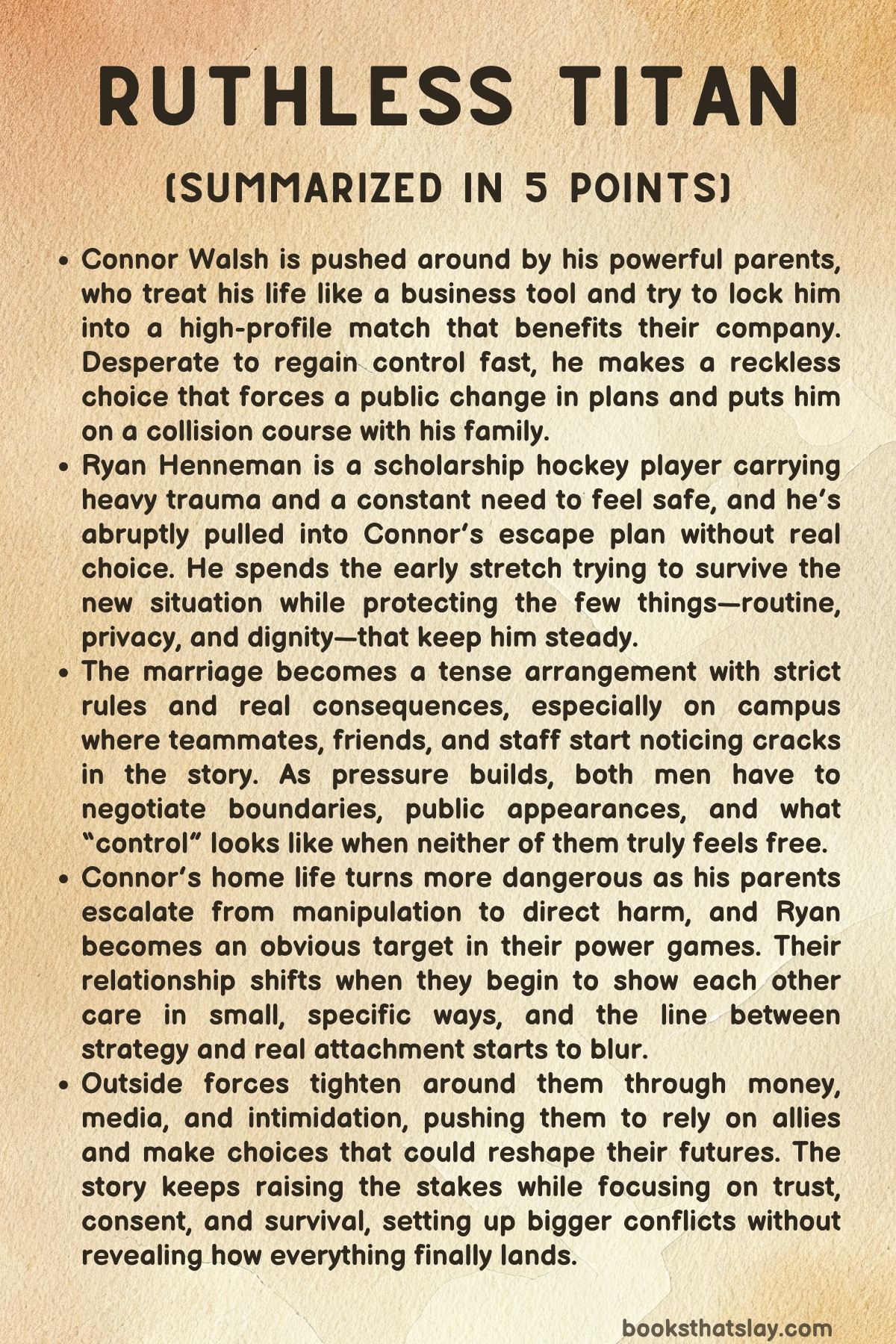
Ruthless Titan by EV Olsen is a contemporary romance set in the high-pressure worlds of elite college hockey and ruthless corporate power. Connor Walsh is an heir being steered like an asset, while Ryan Henneman is a scholarship athlete carrying severe trauma and a hard-won sense of self.
When Connor panics under his parents’ control, he makes a shocking decision that binds them together overnight. What begins as coercion and survival turns into a complicated partnership as they face public scrutiny, private boundaries, and threats from Connor’s powerful family. The story follows their uneasy marriage as it shifts toward trust, safety, and chosen family.
Summary
Connor Walsh wakes up to a crisis: his passport is missing, and he’s meant to fly to Austria for his friends’ wedding. His mother, Cordelia, treats his panic like childish noise and orders him to play his assigned role instead—go to dinner with Veronica Callahan, the woman his parents have pushed him to date as merger talks tighten between their families.
When Connor protests that his friends matter, Cordelia slaps him and makes it clear affection has no value unless it increases the Walsh empire.
Connor storms to his father’s office to demand the passport. His father admits he has it locked away and adds another chain: Connor is expected at a Washington Capitals training camp date that will funnel him toward the NHL on the family’s terms.
Connor argues for finishing his degree, and his father grants it with a cold smile—then delivers the real trap. Connor will marry Veronica on Labor Day weekend to secure the corporate alliance.
Connor refuses, is threatened with financial and personal consequences, and realizes direct defiance will only tighten the cage. He chooses a different approach: he agrees on the spot, pretending compliance while planning to sabotage the arrangement from the inside.
His father still keeps the passport, ensuring Connor can’t escape before the public plan is set.
Across campus, Ryan Henneman, a scholarship hockey player, is doing a favor for Coach Harper—feeding Harper’s cat while Harper attends the Austria wedding. Ryan moves through the apartment with practiced vigilance, checking locks and listening for every sound.
His body holds old fear, and even ordinary noises can send him into panic. When he hears a door slam, he assumes danger has arrived.
He creeps out and finds Connor Walsh in the apartment.
Connor points a gun at him and orders him to get dressed. Ryan freezes, shaking, humiliated as Connor insults him and makes it clear he can destroy Ryan’s scholarship with a phone call.
Connor forces Ryan to drink water; Ryan realizes too late it has been drugged. Connor announces they’re going on a day trip to Connecticut because they’re getting married.
Ryan’s thoughts fracture into fear and memory, and he loses consciousness.
Connor hauls Ryan across Long Island Sound on a ferry, irritated by the physical effort and by the calls he ignores from friends who expected him at the wedding. He tells himself Connecticut is the simplest solution: easy paperwork, no waiting period, no witnesses required.
His plan is blunt—if he’s already married, his parents can’t announce an engagement to Veronica. He chooses Ryan because Ryan is isolated, vulnerable, and, in Connor’s mind, controllable.
Ryan wakes disoriented and furious, calling it kidnapping. Connor calls it “problem-solving” and lays down rules: in public, affection for appearances; in private, distance and obedience.
No dating. No defiance.
Connor threatens Ryan’s scholarship and hints at darker consequences if Ryan resists.
They get a marriage license at town hall and meet a Justice of the Peace. Under pressure and exhaustion, Ryan says “I do.” Connor says it too, then seals it with a brief kiss that feels more like a signature than a promise.
Connor pockets the certificate and claims Ryan as his husband. On the ride back, Connor informs him they’ll share a dorm room.
Three days later, Ryan moves into a new room with two beds. Coach Harper helps and senses something wrong, offering to find Ryan a single room, but Ryan refuses.
Connor’s threats have taught him that honesty is dangerous. Left alone, Ryan clings to small comforts—family photos, an old teddy bear—trying to steady himself.
Connor arrives, starts unpacking, and mocks the bear. Ryan snaps, pins Connor to the wall, and warns him not to touch it.
He releases Connor before he goes too far, then collapses into shaking fear when Connor crowds him again with reminders of control. Connor leaves, and Ryan sobs, certain his weakness will be used against him.
At the first hockey practice, Connor is tense and sick from days at home. Friends confront him for missing the wedding and disappearing.
Ryan shows up distracted on the ice. Connor needs Ryan compliant, and Ryan’s unstable performance threatens the leverage Connor thinks he has.
Then Viktor reveals pet cameras in Harper’s apartment recorded everything—gun, drugs, threats—meaning Connor’s circle knows more than Connor intended. Cornered, Connor admits the truth: he married Ryan to avoid marrying Veronica, and he chose Ryan because he believed he could own him.
Connor brings Ryan to a press conference at Walsh International Holdings, where the merger with the Callahan Group and Connor’s expected engagement are supposed to be announced. Connor instructs Ryan to stay silent and compliant.
In front of reporters, Connor hijacks the moment: he announces he and Ryan eloped. He kisses Ryan for the cameras while Ryan trembles.
Shock ripples through the room—Cordelia, Connor’s father, Patrick Callahan, and Veronica all stunned. Behind closed doors, Connor’s parents strike him and demand an annulment, threatening his trust fund and future.
Ryan overhears the Callahans discussing strategy, including the suggestion of using Veronica’s younger brother Ben. Veronica refuses to sacrifice Ben, but the conversation reveals how disposable people are in this world.
Outside, Veronica confronts Connor, slaps him, calls Ryan a puppet, and warns them to stay away from her brother. Connor, furious, threatens Ryan again in the car—stay in line, keep the story consistent, stop vanishing at night.
Ryan, shaken by seeing Connor bruised by his father, offers a deal: they remain married until Connor is free from his father, and afterward Ryan gets his life back and Connor stops using threats. Connor doesn’t like being negotiated with, but he accepts.
Connor returns to his friend group bruised and guarded. They treat him like family, but they also demand he stop lying to them.
Ryan, meanwhile, starts building a support network. Merci and Eli approach him, making it clear they know he was forced into the marriage and offering a place to talk.
Ryan admits the gun and threats; they’re furious that others knew and did nothing sooner, but they give him their numbers and insist he isn’t alone.
At a bar, Connor tracks Ryan and finds him with a loud crowd, including Ryan’s friend Kai and a girl pressed close. Connor watches, unsettled by how easily Ryan seems to laugh when Connor isn’t there.
Ryan climbs onto the bar and dances, drawing attention from everyone. Connor tries to distract himself, but when Ryan pulls him away and loudly calls him “my husband,” it’s partly protection—Veronica is nearby—and partly a warning that Connor’s behavior can create public damage too.
They argue about recklessness and secrecy, and Connor storms out.
Back in the dorm, drunk courage turns Ryan sharp. A heated confrontation leads to a kiss, but when Connor touches Ryan in a way that triggers memories, Ryan’s body reacts with panic.
Connor backs away, returns Ryan’s teddy bear, and leaves him space. Ryan breaks down and finally calls his foster father, Larry, admitting pieces of the truth.
Hockey pressure rises. Ryan gets boarded hard in practice, and Connor attacks the teammate responsible.
Later, Connor’s friends create privacy so Ryan can shower safely, guarding the locker room door while Connor stays close. That night, Connor brings Ryan to a hostile family dinner at Connor’s mansion.
Connor’s parents interrogate Ryan’s background and imply he’s unworthy. They demand an annulment and push Connor toward marrying Benedict Callahan instead.
Ryan refuses to discuss their sex life, shuts down insinuations about Connor’s sexuality, and ends the dinner early. As they leave, Ryan takes Connor’s hand.
Connor lets him.
In their room, the power dynamic shifts again. Ryan blocks the door while showering and locks Connor out, not to punish him, but to keep himself safe.
Connor reacts with surprising restraint. He notices scars on Ryan’s leg, learns they’re from the crash that killed Ryan’s family, and asks questions without mocking.
Ryan pushes Connor to confront what’s fueling his anger—attraction, confusion, fear. Connor admits he’s attracted to Ryan and to men, and it terrifies him because it collides with everything his parents demand.
They talk about boundaries, consent, and what safety looks like. For the first time, intimacy happens carefully and by agreement, and Ryan doesn’t spiral afterward.
Both of them are startled by how good “care” feels.
Then Connor’s family escalates. After a game, Ryan sees fresh marks on Connor’s neck from his father choking him.
Connor tries to run; Ryan physically stops him and carries him back to the dorm. Connor claims the merger is off and he doesn’t need Ryan anymore.
Ryan refuses to let the promise break. In their room, Connor falls apart in anger and shame.
Intimacy happens again, messy and intense, and afterward Ryan shakes with panic, haunted by memories of assault in group-home showers and the cruelty he endured about his scars. Connor stays close without forcing touch, reads to ground him, and privately decides anyone who hurt Ryan will pay.
A threat arrives by text from Connor’s mother. Soon after, Ryan receives a notice that his athletic scholarship has been rescinded immediately, with payment demanded within days.
Ryan panics and disappears. Connor tears through campus looking for him, fighting with Zach and others who blame him for Ryan’s suffering.
He learns his parents likely targeted Ryan to punish Connor.
Ryan runs to Erie, to Larry. He confesses the marriage, the blackmail, the scholarship loss, and the shame of caring for Connor.
Larry refuses to see Ryan as ruined. He feeds him, steadies him, and helps him survive the approaching anniversary of the crash that killed Ryan’s family.
Ryan visits the graves in the rain, collapsing in grief. Connor finds him there, bruised and concussed from fights while searching, and brings the teddy bear.
Connor swears he didn’t take the scholarship—his mother did—and admits he’s in love with Ryan. Ryan admits he loves Connor too.
Connor reveals he paid Ryan’s tuition for the next three years so the scholarship can’t be used as a weapon again. Ryan tells the full story of the crash on his eleventh birthday—his mother and sister died instantly; his father died later.
Connor stays beside him, not trying to fix grief, just refusing to leave.
Connor tries to outmaneuver his parents, even looking for leverage because he doesn’t believe authorities will act against his father’s influence. He and Ryan reconnect, with Connor insisting on protection and checking Ryan’s wellbeing afterward.
Connor takes Ryan to a Joan Jett concert as a rare moment of freedom. Ryan goes to the bathroom and doesn’t return.
Then Connor’s father calls and implies Ryan is “collateral damage.” Connor understands: Ryan has been taken because he is Connor’s weakness.
Ryan wakes restrained, gagged, and drugged. Connor’s parents and their security chief, Donovan Blake, tell him Connor is no longer useful and that Ryan is a loose end.
Ryan braces for Connor to arrive.
Connor drives to the Walsh estate, coordinating with friends who infiltrate the property. In a tense standoff, allies neutralize guards.
Ryan bursts into the office, wrists bloodied from restraints, and Connor reaches him. Then an unknown shooter takes out Cordelia through a window—no one in Connor’s group claims the shot.
Gunfire erupts. Connor’s father ends up dead.
Ryan shields Connor and is hit in the shoulder. Connor gets him to a hospital while others handle the scene, and Connor orders the remaining traces of his parents’ power burned away.
At the hospital, Connor spirals until a doctor confirms Ryan’s surgery went well. A new player appears: Ben Callahan admits he helped disable surveillance and hired someone to take out the Walshes, intending Connor to die too, but Ryan’s kidnapping disrupted the plan.
Ben offers leverage and suggests controlling the public narrative, tied to his own fight against abuse connected to Veronica’s fiancé. Connor warns him to work through trusted channels if he wants help.
After recovery, Ryan returns to campus with his arm in a sling while Connor faces media fallout and business pressure. Ryan hints he knows Veronica from counseling but refuses details.
Connor then makes a choice that cuts his last tether to the Walsh name: he legally changes his surname from Walsh to Henneman, choosing Ryan and a new family over the one that tried to break him.
Months later, Connor and Ryan, now both Henneman, play in a championship hockey game. They rally, force overtime, and win in dramatic fashion when Viktor scores an unexpected goalie goal into an empty net.
Connor celebrates with Ryan in public without shame, focused on the future—Ryan’s healing, their life together, and Connor’s plan to start law school.
In the epilogue, the violence isn’t finished. A man named Mr. Bristow meets Benedict Callahan and confirms he killed Connor’s mother to secure payment for a contract.
Benedict hands over a micro-SD card filled with incriminating financial records connected to a senator and an elite sex-party network called the Obsidian Rabbit. Benedict also reveals he uncovered Bristow’s real identity, then directs him toward a job at South Shore University to get close to a hockey player tied to the senator: Raiyne Augustus Rua.
Characters
Connor Walsh
In Ruthless Titan, Connor is introduced as a man raised to be an asset, not a person, and everything he does is shaped by that violent premise. He moves through the world with entitlement and sharp control because those are the only tools that ever worked inside the Walsh household, and the story is honest about how ugly that makes him at the start: he weaponizes power, money, reputation, and fear with practiced ease.
Yet the same control that makes him dangerous is also a shield for someone who has been managed, threatened, and physically harmed his whole life; his panic over the passport, his forced public “relationship,” and his father’s escalating coercion show that Connor’s freedom has always been conditional. The marriage to Ryan begins as a calculated act of sabotage—Connor trying to outmaneuver his parents with a legal fact they can’t easily erase—but the arc pushes him into confronting the difference between possessing someone and protecting someone.
As Connor’s affection turns real, he starts choosing discomfort over denial: he admits attraction he never allowed himself to name, learns to slow down, checks consent, and eventually shifts from using Ryan as a human barricade to treating him as a partner whose safety matters more than Connor’s pride. The most meaningful evolution is not just romantic; it is Connor’s gradual refusal to remain his family’s product, culminating in him taking Ryan’s last name as a public severing from the Walsh identity and an active decision to be someone else.
Ryan Henneman
Ryan is built around survival—quiet, vigilant, rule-following not because he is meek, but because he learned the cost of being seen. His scholarship, accommodations, and routines are not “quirks”; they are scaffolding that keeps him functioning after layered trauma: the childhood car crash that killed his family, foster care instability, and sexual violence that left his body wired for threat in intimate spaces.
The early scenes emphasize how trauma lives in the senses—sounds, showers, locked doors, being watched—and Ryan’s shame about his scars becomes a symbol of how he has been taught to associate his own body with punishment. What makes Ryan compelling is that the narrative does not reduce him to victimhood; even while terrified, he bargains, sets terms, protects himself where he can, and slowly rebuilds support systems through Eli and Merci.
Ryan’s anger is especially important because it’s the first sign of reclaimed agency: when he snaps over the teddy bear, when he challenges Connor’s threats with a conditional contract, and when he refuses to be interrogated at the Walsh dinner, he is choosing dignity over compliance. His intimacy arc is not “healed by love”; it is negotiated, messy, consent-forward, and realistic—he can want closeness and still be triggered afterward, and the story treats that as a nervous system reality rather than a moral failure.
By the time the scholarship is revoked and he runs to Larry, Ryan’s central fear is exposed: that every good thing is temporary and will be taken, so he tries to disappear before he can be abandoned again. His eventual decision to accept help—tuition paid, counseling reconsidered, staying in the marriage because it is now chosen—marks his transformation from merely surviving to building a life with room for joy.
Cordelia Walsh
Cordelia is the embodiment of reputation as religion, and she enforces the Walsh empire with emotional coldness and physical violence that mirror her husband’s tactics. She dismisses Connor’s bonds as useless, treats marriage as a business stitch, and punishes dissent not just to win an argument but to remind Connor who owns the narrative.
Her later escalation—using Ryan’s scholarship as a lever and turning Ryan into collateral—shows a strategic cruelty that is arguably more frightening than Connor’s father’s blunt brutality, because it is calculated, deniable, and aimed at destroying hope. Cordelia’s role is not simply “evil mother”; she represents a system that values control over legacy, and she is willing to target a powerless outsider to keep her son compliant.
Even when the estate standoff turns deadly, the image of her reaching for a gun reinforces that she sees violence as an acceptable tool of governance, not a last resort.
Mr. Walsh
Connor’s father functions as the story’s primary architect of coercion: he decides Connor’s career timeline, locks away documents, dictates marriages, and uses physical harm as punctuation. He treats Connor not as an heir with autonomy but as a corporate instrument whose purpose is alliance-building, and his insistence that love and friendship are irrelevant “assets” reveals a worldview where human attachment is a liability to be cut out.
His most defining trait is not rage but certainty—he believes he is entitled to reshape Connor’s life, and that belief authorizes everything from threats to choking. The collapse of the merger does not soften him; it makes him more dangerous, because the loss of external leverage pushes him toward direct dominance.
His death during the estate confrontation reads less like narrative comeuppance and more like the violent endpoint of a man who built his whole identity around force and assumed no one could ever outgun the Walsh name.
Veronica Callahan
Veronica begins as the polished “chosen” match meant to seal a merger, but she complicates quickly as someone also trapped in her family’s strategy. She is sharp, status-aware, and cruel toward Ryan in the moment she feels publicly undermined, yet the story also shows her resisting the use of her younger brother as a bargaining chip, which suggests her loyalty has boundaries even inside a ruthless environment.
Veronica’s slaps and insults are an attempt to regain control of her social standing, but her fear around Ben hints that she understands exactly how predatory these alliances can become. She is not written as a simple rival; she is a product of the same elite machinery as Connor, reacting to humiliation with the only tools her world respects—threats, reputation warfare, and defensive aggression.
Patrick Callahan
Patrick operates as the corporate face of the Callahan side: calm, strategic, and willing to redirect blame to preserve the deal. His reaction to Connor’s public announcement is less emotional than tactical, and his immediate pivot toward “using” Ben underscores how families like his treat children as movable pieces on a board.
Patrick’s significance grows in the background as a symbol of how such dynasties survive scandal: by absorbing the shock, identifying the weak point, and applying pressure elsewhere. Even when the later conspiracy emerges, Patrick still reads as the kind of man who expects the world to bend back into profitable shape.
Benedict “Ben” Callahan
Ben is one of the story’s most volatile contrasts: he appears outwardly younger and more “protected,” yet he’s capable of the coldest long-game planning in the book. The early hints that others want to use him, and that Veronica tries to shield him, are reframed later when Ben reveals he has been building his own counterplot—hiring outside violence, manipulating surveillance, and attempting to steer blame to his father while also sacrificing Connor if necessary.
He is motivated by a personal grievance tied to Veronica and Damien, but the method he chooses is not heroic; it is surgical, ego-driven, and willing to create mass collateral. Ben’s offer of leverage to Connor is less an apology than a negotiation: he expects to be useful enough to avoid being destroyed.
As a character, he represents the next generation of elite cruelty—smarter, more covert, and more comfortable outsourcing brutality.
Larry (Ryan’s foster father)
Larry is the emotional anchor Ryan never had in childhood, and his presence clarifies what real care looks like in a story full of transactional “love.” He does not interrogate Ryan’s choices with judgment; he stabilizes him with routine, food, and unconditional reassurance, which is exactly what Ryan’s nervous system needs when the scholarship collapse reactivates abandonment terror. Larry’s importance is also thematic: he proves that family can be chosen and protective without being possessive, and he models a masculinity based on steadiness rather than dominance.
When Ryan calls him “Dad,” it lands as a hard-earned naming of safety—one that directly challenges the Walsh model of parenthood as ownership.
Coach Harper
Coach Harper occupies a morally complicated space: he is a caretaker figure in the team ecosystem, but the story uses his apartment and the cat-sitting to show how easily “safe” places can be violated. Harper is also part of the adult world that notices something is wrong and offers help, yet Ryan’s fear keeps him from taking it, which highlights how coercion works even when support exists.
The later reveal that “Mr. Harper” is tied to Bristow’s identity introduces an unsettling shadow over the name, intentionally blurring whether institutional trust is ever truly clean in this world. Even without that twist, Harper represents a pressure point: someone close enough to see fractures, not powerful enough to fully shield the players from the families funding their lives.
Novotny
Novotny is mostly a functional presence early—connected to the Austria wedding and the chain of events that gives Connor the opening to grab Ryan. What matters about Novotny is what he indirectly symbolizes: the existence of healthier community outside the Walsh sphere, the kind Connor is denied when his passport is stolen and his choices are overwritten.
Novotny’s absence during the critical early crisis reinforces how isolation enables abuse; when the normal guardians are gone, predators move freely.
Viktor
Viktor is the group’s razor: observant, sarcastic, and often the first to pierce through Connor’s half-truths. He plays comic foil in banter, but his real narrative function is accountability—he confronts Connor about disappearing, pushes him to explain, and reveals the pet camera recordings that remove Connor’s ability to rewrite events.
Viktor also becomes operational muscle during the estate crisis, participating in infiltration and cleanup with a competence that suggests he has his own history with violence or survival. Importantly, Viktor is not sentimental about Connor’s transformation; he demands honesty and treats “family” as a standard Connor must earn, not a comfort Connor automatically deserves.
Zach
Zach is raw loyalty without softness, and the story uses him to show how protectiveness can become possessive and violent. He is capable of terrifying brutality when he believes Ryan has been harmed, and his attack on Connor is fueled by a sense of ownership that echoes the very power dynamics Connor is trying to outgrow.
At the same time, Zach also participates in practical protection—clearing the locker room so Ryan can shower safely—showing that he can choose care when the situation calls for it. Zach’s contradictions make him feel real in this world: he wants justice, but his instincts lean toward punishment, and that line is always dangerously thin.
Eli
Eli functions as the group’s stabilizer and conscience, the one who pulls people back from the edge when chaos escalates. His response to Connor’s injuries after the fight at home shows a kind of love Connor is not used to: concern without strings and accountability without humiliation.
Eli also becomes a bridge for Ryan through the lunch scene, where Ryan is finally offered support without coercion. In conflicts, Eli repeatedly positions himself between violence and harm—literally at times—making him the character most committed to keeping “family” from becoming another version of control.
Alexei
Alexei is intensity sharpened into precision: he does not joke about betrayal, and he is often the most openly furious about Connor’s secrecy and damage. In the estate confrontation, his marksmanship and calm under pressure suggest a capacity for lethal action that the group usually keeps offstage, turning him into a frightening but necessary counterweight to the Walsh security apparatus.
Alexei’s loyalty reads as absolute once given, but he demands integrity as the price of belonging, which is why he presses Connor harder than most. He represents the part of the friend-group that will protect you—but will also break you if you endanger the vulnerable.
Merci
Merci is one of the most significant catalysts for Ryan’s recovery arc because he approaches Ryan with an unexpected blend of casualness and direct truth. He names what happened without forcing Ryan into a confession, offers a place to vent, and gives Ryan contact information—small acts that counter the isolation Connor intentionally relied on.
Merci’s own disclosure about being kidnapped and restrained complicates the moral landscape of the friend-group, exposing that coercion has existed in their circle before, normalized as “extreme love” or “messy history.” His fury at Connor is not performative; it is protective, and the fork-to-the-hand moment captures his willingness to enforce boundaries when intimidation shows up at his door.
Kai
Kai represents the life Ryan has outside Connor’s control: friends, a social identity, laughter, and the reckless relief of being treated like a normal college kid. Connor’s jealousy at the bar is less about romance at first and more about losing monopoly—Kai is proof that Ryan is not actually isolated, and that threatens Connor’s original plan.
Later, Kai becomes physically violent toward Connor when Ryan is missing, which frames him as fiercely loyal but also impulsive, someone whose version of protection can become harm. Kai’s presence forces the story to ask whether love that “defends” can still be dangerous when it refuses nuance.
Jenkins
Jenkins is a smaller but pointed character: he embodies how sports environments can amplify aggression and vulnerability simultaneously. His boarding of Ryan triggers Connor’s protective rage, but what matters is the power dynamic it reveals—Ryan is physically at risk on the ice at the same time he is psychologically at risk off it.
Jenkins’ role underscores that threats to Ryan are not only the Walsh family; they also exist in the everyday culture of competition, masculinity, and cheap shots disguised as “part of the game.”
Donovan Blake
Donovan Blake is the Walsh machine given a human face: head of security, loyal enforcer, and facilitator of kidnapping and intimidation under the guise of “handling problems.” He moves like someone who is used to operating outside the law because the Walsh name makes consequences negotiable. His presence in the captivity scene positions him as the practical danger—Cordelia and Mr. Walsh are the strategists, but Blake is the one who turns strategy into restraints and needles.
In the estate standoff, Blake’s attempt to regain control fails because the story introduces forces even he can’t predict, suggesting that professional violence always carries the risk of being outmatched by other professionals.
Damien
Damien is mostly offstage, but he matters because he is the alleged engine of Veronica’s crisis and Ben’s motive. His label as abusive fiancé turns him into a symbol of what the Callahan alliance system can produce: relationships that are not partnerships but cages with expensive locks.
Even without many direct scenes, Damien’s presence warps decisions around him, showing how one controlling man can become the gravitational center of multiple people’s desperation and plotting.
Raiyne Augustus Rua
Raiyne appears as a final hook rather than a developed on-page character, positioned as the next target in a broader conspiracy involving a senator and the Obsidian Rabbit network. The choice to name him explicitly at the end signals a world that extends beyond Connor and Ryan’s personal war: exploitation, political leverage, and predatory networks that feed on access to young athletes.
Raiyne’s function is to widen the scope and suggest that even after Connor and Ryan secure their own peace, the machinery that threatened them is still hunting elsewhere.
Themes
Power, Control, and Coercion
Power in Ruthless Titan operates as something enforced rather than earned, and it is shown most clearly through the ways institutions, families, and wealth override individual choice. Connor’s parents do not simply pressure him; they remove his passport, dictate his career timeline, arrange his marriage, and use physical violence to ensure compliance.
Their authority is built on money, reputation, and fear, and the narrative repeatedly shows how these tools are used to limit Connor’s ability to choose even basic aspects of his life. This same dynamic is mirrored when Connor turns that learned behavior onto Ryan.
Connor kidnaps Ryan, drugs him, threatens his education, and weaponizes Ryan’s isolation to force a marriage. The story does not soften these actions; it presents them as deliberate, calculated acts rooted in Connor’s understanding that control is how problems are solved.
What complicates this theme is how power shifts over time. Ryan begins with almost none—his scholarship, housing, and safety are all vulnerable.
Yet as Connor’s parents escalate their abuse, Ryan becomes the one drawing boundaries, negotiating terms, and ultimately refusing to disappear. Power stops being about dominance and becomes about endurance and moral ground.
The contrast between Connor’s parents’ rigid, punitive control and Ryan’s quieter resistance exposes how coercion corrodes relationships and identity. Even when Connor later uses his wealth to protect Ryan by paying tuition, the narrative stays alert to the danger of unequal power, forcing Connor to confront whether protection can ever be clean when it comes from the same systems that caused the harm.
Power in the book is never neutral; it always leaves marks, and the story insists on showing the cost of both wielding it and surviving under it.
Trauma, Memory, and the Body
Trauma in Ruthless Titan is not treated as a single past event but as something that lives in the body and resurfaces without warning. Ryan’s fear responses—his hypervigilance, his difficulty with showers, his dissociation during intimacy—are physical before they are verbal.
The story repeatedly shows how memory does not require conscious thought to activate; a touch, a tone, or a sense of being restrained is enough to pull Ryan back into earlier harm. These moments are not framed as weakness but as learned survival responses shaped by foster care abuse, the loss of his family, and institutional neglect.
Connor’s trauma operates differently but with similar persistence. His father’s violence, public humiliation, and lifelong manipulation have trained Connor to expect pain as a consequence of disobedience.
His anger, recklessness, and need to dominate are shown as symptoms of that conditioning rather than inherent cruelty. The book places both characters in bodies that remember harm even when the mind wants to move forward.
Healing, when it appears, is slow and uneven. It comes through grounding actions, reading aloud, respecting limits, and choosing presence over fixing.
The narrative also refuses to romanticize recovery; moments of intimacy can feel good and still trigger fear afterward. By keeping trauma visible even during moments of closeness, the book emphasizes that love does not erase damage, but it can create space where damage is acknowledged without shame.
The body becomes a record of survival, not something that needs to be overcome to deserve care.
Chosen Family Versus Blood Loyalty
Family in Ruthless Titan is defined less by blood and more by behavior. Connor’s biological family represents obligation without care, loyalty without safety, and legacy enforced through violence.
His parents frame their actions as necessary for the empire, but the story consistently exposes how this logic strips Connor of agency and humanity. In contrast, Connor’s friends—Viktor, Eli, Alexei, Merci, and later Ryan—form a network built on protection, confrontation, and emotional honesty, even when messy.
They argue, fight, and make mistakes, but they also show up physically and emotionally when it matters.
Ryan’s understanding of family further deepens this theme. His bond with his foster father Larry is grounded in patience and unconditional support rather than control.
Larry does not demand strength or success; he offers pancakes, space to grieve, and reassurance that survival is enough. This stands in stark contrast to the Walsh household, where love is transactional and punishment is routine.
The narrative frames chosen family as something actively built through care, consent, and shared risk. Connor’s decision to take Ryan’s last name is the clearest rejection of blood loyalty as a moral obligation.
It is not presented as symbolic romance but as a deliberate severing from a lineage that caused harm. By the end, family is defined by who stays, who listens, and who refuses to use power as a substitute for love.
Consent, Autonomy, and Relearning Intimacy
Intimacy in Ruthless Titan is inseparable from consent, especially after the forced marriage that begins Connor and Ryan’s relationship. The story does not rush forgiveness or pretend that desire cancels out coercion.
Instead, it tracks the difficult process of renegotiating autonomy after it has been violated. Ryan’s needs lead the pace: discussions of boundaries, pauses, verbal check-ins, and aftercare become essential rather than optional.
These moments are often awkward and emotionally heavy, reinforcing that safety is something practiced, not assumed.
Connor’s growth is measured by his willingness to surrender control rather than assert it. His repeated checks, his acceptance of stopping, and his readiness to listen mark a departure from how he was raised.
The narrative also complicates consent by acknowledging power imbalance. Connor’s wealth, status, and past actions never disappear, and the story keeps that tension present even in moments of mutual desire.
What changes is Connor’s recognition that wanting someone does not entitle him to them.
The book also resists the idea that healing intimacy must be linear. There are moments where connection feels grounding and others where it triggers panic.
Both are treated as valid. By centering communication and accountability, the story frames intimacy not as conquest or cure, but as an evolving negotiation between two people learning how to exist safely together.
Consent becomes the foundation through which autonomy is rebuilt, making love something chosen daily rather than enforced once.