Sandwich by Catherine Newman Summary, Characters and Themes
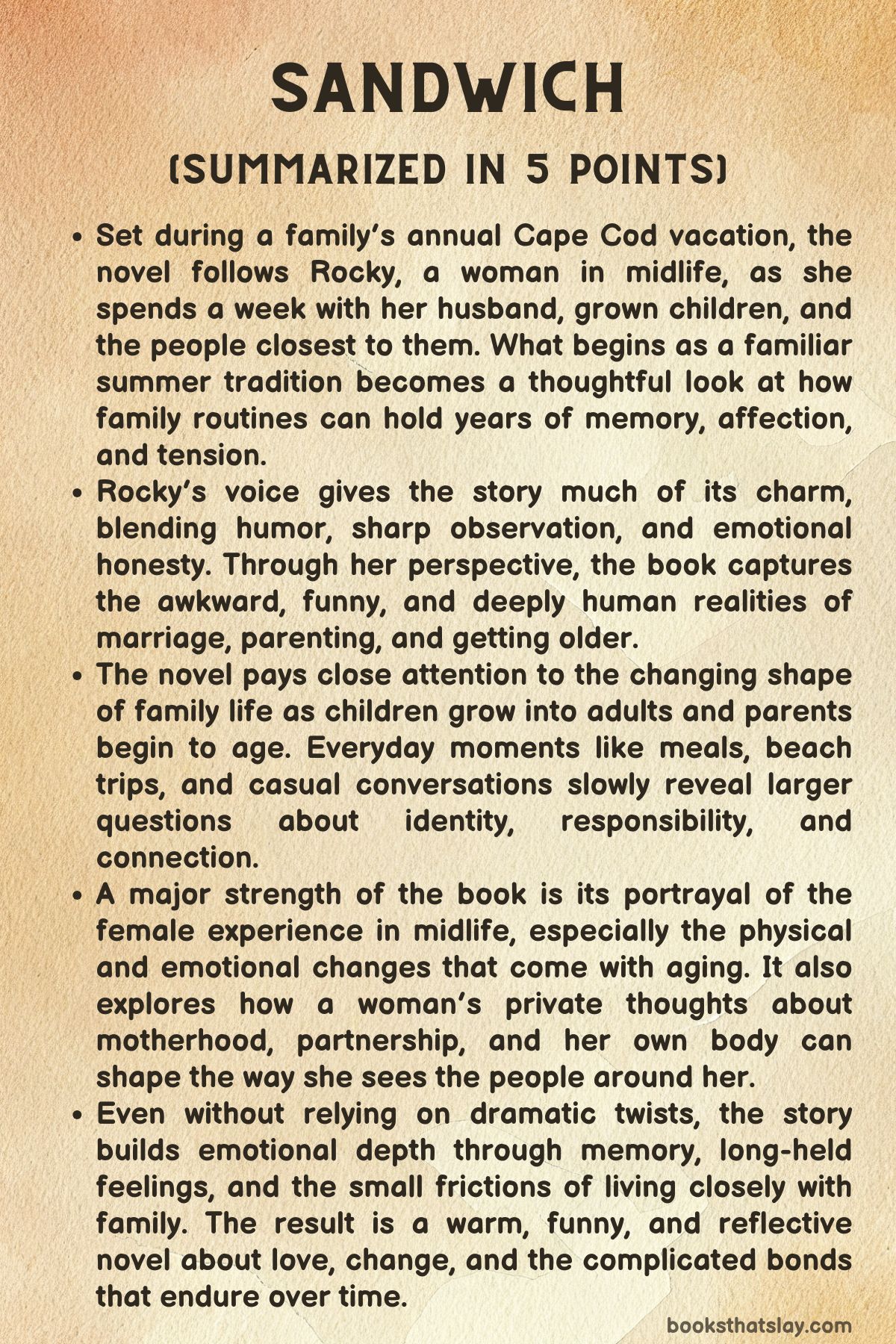
Sandwich by Catherine Newman is a compact, observant family novel set during a summer vacation on Cape Cod. At first glance, it follows an ordinary week at a familiar beach rental, full of sandwiches, swimsuits, family jokes, and minor irritations.
Beneath that easy surface, though, the book becomes a sharp and tender study of middle age, marriage, motherhood, memory, and the private histories people carry even inside long relationships. Through Rocky’s lively, restless perspective, Newman shows how one family holiday can hold decades of love, resentment, grief, humor, and change, capturing the strange way everyday life can contain both comfort and emotional upheaval at once.
Summary
The novel takes place over the course of a family’s annual summer trip to Cape Cod, where Rocky and her husband Nick reunite with their grown children, Willa and Jamie. Jamie’s girlfriend, Maya, joins them as well.
The family has spent many summers in the same modest rental cottage, and the place is loaded with memory. From the beginning, the trip is shaped by habit and familiarity: the old plumbing acts up, the family shops for swimsuits after leaving theirs behind, and they visit the bakery, candy shop, and beach spots that have become part of their seasonal routine.
These simple events establish the emotional frame of the story. This is not only a vacation but also a return to an earlier version of family life, even though everyone has changed.
Rocky, now in her mid-fifties, is the center of the novel’s emotional life. She moves through the week with quick intelligence, humor, irritation, and a constant stream of reflection.
She is dealing with perimenopause, which affects her body, sleep, mood, and sense of self. Small frustrations with Nick quickly grow larger in her mind, especially when she feels unseen or misunderstood.
Yet the novel does not present their marriage as broken. Instead, it shows a long marriage under pressure from age, habit, and accumulated difference.
Nick is steady, practical, forgiving, and often calm in moments when Rocky feels full of anger or pain. Rocky appreciates his gentleness, but she also feels burdened by the fact that he is able to stay at a remove from the emotional intensity of family life while she carries so much of it herself.
As the family settles into the rhythm of the trip, Rocky becomes increasingly aware of time passing. She looks at Willa and Jamie, now adults, and remembers them as children.
She thinks about how exhausting early motherhood was and how impossible those years sometimes felt. At the same time, she sees that life with adult children has brought a new kind of joy.
She is able to talk with them, joke with them, and enjoy their company in ways that were not possible when she was consumed by caregiving. Willa in particular shares an easy, funny closeness with her mother.
Their conversations move from slang to body image to family history, and through them the novel shows both generational change and real affection.
The week begins to deepen when Rocky starts to suspect that Maya may be pregnant. She notices how little Maya eats and how unwell she seems.
Eventually Maya confirms this in a quiet nighttime conversation with Rocky. Maya reveals that she is unsure what to do.
She has had an abortion before and does not regret it, but this pregnancy feels different because she is in a loving relationship with Jamie and does not feel especially young. Rocky responds with care rather than judgment.
She tells Maya the choice is hers and supports her uncertainty rather than trying to direct it. This moment becomes one of the novel’s central turning points, because Maya’s pregnancy stirs Rocky’s own buried memories and forces her to revisit parts of her past she has kept hidden.
As Rocky reflects on Maya’s situation, the narrative opens into her history with pregnancy, motherhood, and loss. She remembers the years when Willa and Jamie were very young and she was stretched thin by the demands of raising them.
During that period, she became pregnant again. Outwardly, she later described this pregnancy as a miscarriage, and Nick believed that was what had happened.
In truth, Rocky chose to end the pregnancy because she felt overwhelmed and incapable of caring for another child. She made that decision alone and carried the secret for decades.
The memory still holds both relief and sorrow for her. She believes in the right to choose, yet her own experience was emotionally complicated, full of grief, exhaustion, and isolation.
The novel also recalls another pregnancy that did end in actual loss. After moving to western Massachusetts, Rocky learned she was pregnant again, and this time Nick was delighted.
But at a follow-up appointment they discovered that the fetus had died. The grief from that experience remains vivid in Rocky’s memory.
She remembers the physical and emotional pain of losing the pregnancy, the terrible experience of her body passing the remains, and the exhaustion of continuing to parent two small children while carrying that private devastation. These memories have never fully left her, and the presence of Maya’s pregnancy brings them back with fresh force.
Meanwhile, the vacation continues with its mix of humor and friction. Rocky and Nick bicker over pastries, sandwiches, timing, and tone.
The family goes to the beach, makes meals together, shops, and talks. Rocky’s aging parents, Mort and Alice, arrive for part of the trip, bringing new energy but also new stress.
Their visit highlights another transition in Rocky’s life: she is no longer only a mother worrying about children but also a daughter worrying about elderly parents. She notices their fragility, their forgetfulness, and the uncomfortable fact that they do not always disclose important information.
When Alice later faints at the beach and is taken to the hospital, Rocky learns that her parents had known about a heart issue and had not told her. This infuriates her and confirms how unstable this new phase of family life feels.
She is caught between generations, still trying to care for everyone.
During her parents’ stay, another emotional shock arrives when Willa asks about their family history and Rocky learns that several relatives died at Treblinka. She is stunned that she never fully understood this part of her family’s Jewish past.
The revelation leaves her feeling both ignorant and newly aware of how much can remain hidden inside families, even across generations. This idea echoes the larger structure of the novel: love does not automatically produce full knowledge.
Parents conceal things from children, spouses conceal things from one another, and even ordinary family stories contain gaps, silences, and assumptions.
The central crisis comes when Rocky finally tells Willa the truth about her pregnancies. Willa asks direct questions, and Rocky decides to answer honestly.
She explains that in addition to the miscarriage, she also had an abortion after Willa and Jamie were born. Willa responds with compassion.
She does not condemn her mother and instead recognizes how overwhelmed Rocky must have been. But Nick overhears enough of the conversation to realize that Rocky lied to him for years.
He is shaken less by the abortion itself than by the secrecy. In his eyes, Rocky has long accused him of emotional distance while hiding a life-changing truth from him.
Their confrontation is painful but not final. Rocky explains that she felt alone, that she believed he processed difficulty in ways she could not share, and that the pressure placed on women around reproduction had been crushing.
Nick listens. He is hurt, but he is also able to see how isolated she was.
At the same time, Jamie learns about Maya’s pregnancy, and the family waits to see what the young couple will decide. The tension resolves when Jamie and Maya announce that they are going to get married.
The news brings joy and celebration, even as uncertainty still surrounds the future. This happiness is set alongside sorrow and fatigue, exactly in keeping with the book’s emotional pattern.
Rocky worries about her mother’s health, argues with Nick, remembers old wounds, and still finds herself laughing, eating ice cream, and watching the people she loves gather around the table.
As the vacation ends, Rocky feels the familiar sadness of departure. Another family week has passed, and she knows these moments are finite.
Her children will keep building their own lives. Her parents are visibly nearing the end of theirs.
Her marriage remains imperfect but intact, sustained by honesty, forgiveness, and long practice. In the epilogue, some months later, Jamie and Maya are getting married.
Rocky’s mother has died, and the family is carrying that grief into the wedding day. Even so, Rocky feels grateful.
The novel closes on her recognition that life is never made of pure joy or pure pain. It is both at once: ordinary and momentous, comic and painful, full of irritation, memory, tenderness, loss, and love.
Characters
Rocky
Rocky is the emotional and intellectual center of Sandwich, and the entire family week is filtered through her restless, observant, often funny mind. She is in midlife, dealing with perimenopause, changing desire, physical discomfort, sudden anger, and a growing sense that her body has become unfamiliar to her.
What makes her especially compelling is that she is never presented as calm, wise, or neatly self-aware in the way mothers of adult children are sometimes written. She is sharp, loving, irritable, nostalgic, sensual, defensive, generous, and ashamed, often all within the same scene.
Her mind moves quickly from a clogged toilet to the passage of time, from a swimsuit to the loss of youth, from a family joke to a buried wound. That quality gives her character unusual depth because she feels like someone living several emotional realities at once rather than someone arranged around a single trait.
Her role in the family has long been that of emotional carrier. She remembers, anticipates, notices, interprets, and absorbs.
She knows who likes what in a sandwich, who is quietly upset, who is under the weather, who is avoiding a subject, and what each family interaction means beneath its surface. This care is loving, but it also leaves her drained.
One of the clearest tensions in her character is that she wants to be seen and supported, yet she is also so practiced at managing everyone’s feelings that she makes it harder for others to reach her fully. She accuses Nick of emotional distance, and she is not wrong, but she also carries private truths for years, which means that her longing to be known is complicated by her own instinct toward concealment.
Her inner life is shaped by memory. The vacation cottage is not just a setting for her but a place where past and present sit side by side.
As she moves through the week, memories keep rising into the ordinary flow of family life. These memories are not sentimental decorations.
They are active pressures on her present, especially the memory of her abortion and her later pregnancy loss. These experiences help explain why Maya’s pregnancy affects her so deeply.
Rocky believes in a woman’s right to choose, yet her own choice remains emotionally difficult for her, not because she thinks it was wrong, but because it was lonely and painful. The later miscarriage adds another layer of grief.
Together, these experiences reveal that her history with motherhood is neither simple devotion nor simple regret. It is marked by love, exhaustion, fear, bodily suffering, and choices made under pressure.
Rocky is also a portrait of a woman caught between generations. She is still a mother, though her children are grown, and she is still a daughter, though her parents are now fragile and secretive in ways that force her into a caretaking role.
She is trying to adjust to adult children who no longer need her in the same way, while also facing the decline of the people who raised her. That double movement gives her character much of her sadness.
She is standing in the middle of family life, looking forward and backward at once. Even when she is comic, her wit carries strain.
Even when she is happy, she knows how vulnerable happiness is. By the end, she emerges as a woman who has not solved herself but has become more honest about the fact that love, grief, resentment, desire, and gratitude can all exist together.
Nick
Nick is an essential counterweight to Rocky. Where she is volatile, associative, and emotionally immediate, he is steady, practical, patient, and often disarmingly calm.
At first, he may seem like the simpler partner because he does not narrate the story and because Rocky often experiences him as someone who forgets, misses things, or stays one step removed from emotional complexity. But his character is more layered than that impression suggests.
He is not cold or uncaring. In fact, one of his defining qualities is grace.
He repeatedly meets Rocky’s difficult moods with patience rather than retaliation, and he often chooses humor or softness in moments that could easily harden into bitterness.
At the same time, Nick’s calm is not neutral. It is both his strength and his limitation.
He can stabilize situations, but he can also seem absent from the emotional labor that sustains family life. Rocky feels this acutely.
She experiences him as someone who manages the practical side of things while leaving her to hold the invisible burden of moods, relationships, anxieties, and unspoken tensions. The novel does not fully condemn him for this, because it also suggests that some of Rocky’s emotional overfunctioning creates its own strain.
Still, Nick benefits from a family structure in which he is allowed to be the reasonable one while Rocky becomes the one who appears difficult.
His marriage to Rocky is built on real affection and durability rather than fantasy. He knows her patterns, forgives her quickly, and often responds to conflict without escalation.
Yet the discovery of her long-hidden abortion exposes the limits of what he has understood about his wife. His pain in that moment is not rooted in control over her body or outrage at her decision.
It comes from realizing that a defining experience in her life remained hidden from him for decades. That reaction makes him more sympathetic because it shows that what he wanted was not authority but intimacy.
He is wounded by the fact that Rocky did not feel able to trust him with the truth.
Nick also represents a certain kind of masculine practicality that the novel views with both skepticism and respect. He is useful, competent, and stable.
He performs the tasks that keep life moving. But when he argues that much of the emotional labor Rocky performs may be unnecessary, he touches on something uncomfortable and partly true.
He sees that she often magnifies burdens for herself. She sees that his practicality can become a way of staying uninvolved.
Their marriage rests in the uneasy space between those truths. He is not the villain of her life, nor the perfect husband.
He is a decent man whose way of loving does not always match the form of care his wife most wants.
In the end, Nick’s importance lies in the fact that he remains present. He is hurt, irritated, and sometimes left out, but he stays in the conversation.
He listens. He reconsiders.
He does not withdraw from the marriage when it becomes difficult. That endurance gives his character quiet force.
In a story full of changing bodies, old griefs, and unstable family roles, he stands for continuity, though not without cost.
Willa
Willa brings light, speed, intelligence, and emotional openness to the family dynamic. As Rocky’s daughter, she shares her mother’s wit and verbal energy, but she expresses herself with more freedom and less inhibition.
She belongs to a younger generation that feels more comfortable with sexuality, identity, style, and direct speech, and Rocky responds to that with admiration as much as amusement. Their exchanges are among the liveliest in the novel because Willa can joke with her mother while also pushing her toward greater honesty.
She does not merely play the role of the cool daughter. She is also one of the few people who instinctively understands that truth matters more than comfort.
Her relationship with Rocky is especially rich because it moves beyond a simple mother-daughter bond into something that resembles friendship without losing the deeper weight of family. Willa teases Rocky, argues with her, shares language with her, and asks difficult questions.
She is affectionate but not overly reverent. That quality allows her to become the person who finally receives Rocky’s hidden history.
When Rocky tells her about the abortion, Willa does not react with judgment or melodrama. Instead, she responds with curiosity, compassion, and moral maturity.
She is able to hold complexity, which is precisely what Rocky has needed. In that sense, Willa becomes not just a daughter but also a witness.
Willa’s sexuality is also important to her characterization, though it is not treated as her only defining feature. She is gay, and this fact shapes certain family conversations, especially around Rocky’s relief that Willa will not have to fear accidental pregnancy in the same way.
Willa quickly corrects that assumption, reminding Rocky that the world is more varied and fluid than older categories allow. This moment captures her intelligence and her refusal to let her mother settle into simplistic thinking.
She is not presented as preachy or symbolic. She is just more mentally agile about the social world she inhabits, and that difference highlights the novel’s interest in generational shifts.
At the same time, Willa is not only forward-looking. She is deeply engaged with family history.
Her curiosity about genealogy and ancestry opens one of the book’s most startling revelations about the family’s past. This interest shows that she is not detached from inheritance or tradition.
On the contrary, she wants to know where she comes from. She has the courage to ask, and that courage becomes transformative.
Through her, hidden histories rise to the surface, whether they concern Jewish ancestry, old trauma, or her mother’s reproductive past.
Willa also reflects one of the book’s quietest themes: that adult children can become companions in a new phase of family life. Rocky looks at her and sees both the little girl she once raised and the grown woman who can now understand her.
That dual vision gives Willa great emotional importance. She represents continuity, change, and the possibility that intimacy between parent and child can deepen rather than fade as both people age.
Jamie
Jamie is less verbally dominant than Willa, but he is deeply important as a son, partner, and future father. He carries a gentler, somewhat quieter energy within the family, and his presence often reveals Rocky’s maternal tenderness in a different register.
She still sees him through layers of memory, recalling the little boy he once was even as she watches him move through adult relationships. That tension between the remembered child and the current man is central to how he is portrayed.
One of Jamie’s most notable qualities is his emotional decency. When Maya’s pregnancy becomes known to him, he does not react with panic, blame, or selfishness.
He appears open to both possibilities, whether that means becoming a parent or supporting a different decision. Rocky is relieved and proud of how steady he is.
His response suggests a maturity that may not always have been visible to her when she was still thinking of him as her son before thinking of him as an adult in his own right. He may feel hurt that Maya told Rocky first, but that hurt is understandable and human, not controlling.
He wants to be included, and that desire reflects investment rather than entitlement.
Jamie’s place in the family also reveals how Rocky’s role as mother is changing. She can no longer direct his life in the old way, and the novel repeatedly shows her learning to stand beside rather than above her children.
Jamie’s relationship with Maya forces that adjustment. Their pregnancy, uncertainty, and eventual plan to marry all mark a transfer of generational weight.
Jamie is no longer primarily someone who is cared for. He is becoming someone who will build a household of his own.
That transition is thrilling and painful for Rocky, and Jamie’s character carries much of that emotional shift.
He is also important as a contrast to Nick. Jamie is not identical to his father, but the novel quietly asks what forms of masculinity are being handed down and revised.
Jamie seems more verbally connected than Nick in some ways and more aware of emotional nuance, especially in his relationship with Maya. At the same time, his initial frustration about not being told first reveals how easily men can still expect access to emotional information without recognizing the private fears women may be holding.
He is sympathetic because he is learning rather than fixed.
By the end, Jamie stands at the threshold of a new life stage. His engagement to Maya gives the family a celebratory future to move toward even while other parts of family life are marked by illness and death.
He represents continuation in the most literal sense, but he is not reduced to that function. He is loving, somewhat understated, and capable of meeting uncertainty with more steadiness than drama.
That calm presence makes him one of the novel’s quieter sources of hope.
Maya
Maya enters the family as Jamie’s girlfriend, but she quickly becomes one of the most important figures in the story because her pregnancy sets so much else in motion. She is young, observant, and thoughtful, and she fits into the family with surprising ease.
She is not treated as an outsider whose presence threatens the family unit. Instead, she is absorbed into its rhythms while still remaining distinct enough to unsettle old patterns.
Rocky watches her closely, partly out of affection and partly because Maya’s situation brings Rocky face to face with her own hidden past.
Maya’s significance lies in the way she embodies reproductive choice without flattening it into a slogan or a lesson. She has already had an abortion before and does not regret it.
That fact establishes her as someone with experience, agency, and a practical understanding of her own life. But when she becomes pregnant again, her feelings are less settled.
She is in love, she is older, and she can imagine more than one future. Her uncertainty is not weakness.
It is evidence that context matters, timing matters, and the same person can experience similar decisions in very different emotional ways. Through Maya, the novel shows that choice does not always arrive with clarity.
Her decision to confide in Rocky before telling Jamie is especially revealing. It suggests that she senses in Rocky someone who will understand complexity without rushing to judgment.
It also places her, for a time, in an intimate female space that excludes the men around them. That choice indirectly brings Rocky’s long-buried secret to the surface.
Maya does not force that revelation, but her presence makes silence harder to maintain. In this way, she becomes a catalyst without ever feeling like a mere plot device.
Maya is also characterized by her composure. Even when she is sick, uncertain, and carrying major news, she does not become melodramatic.
She remains warm, polite, and emotionally accessible. She asks sincere questions, especially about parenting and family life, and these questions show that she is trying to imagine adulthood rather than simply drifting into it.
She is not naive, but she is still in the process of forming a vision of what kind of life she wants.
Her eventual plan to marry Jamie suggests commitment, but it does not erase the earlier complexity of her situation. What makes her character effective is that she is allowed to be both young and serious, vulnerable and capable.
She joins the family during a week in which hidden truths, old griefs, and aging parents are all pressing into the present, and yet she never disappears inside those larger dramas. She remains fully herself.
Through her, Sandwich shows how a younger woman’s private crossroads can awaken unresolved feelings in an older one, creating one of the book’s strongest emotional parallels.
Mort
Mort, Rocky’s father, is difficult, intelligent, abrasive, and oddly lively even in old age. He belongs to the category of parent who can be both funny and infuriating in the same breath.
His behavior often pushes Rocky’s patience to its limit. He makes inappropriate comments, resists help, withholds important medical information, and carries himself with the stubborn authority of someone who does not want to be managed by his adult child.
Yet he is not written as a simple irritant. He has sharpness, comic timing, and a force of personality that makes him feel fully alive on the page.
One of Mort’s most important functions is to show Rocky what aging looks like from the other side. She worries about him, but he does not want to become an object of worry.
He still wants independence, dignity, and the freedom to define himself. This clash creates many of their tensions.
Rocky sees risk, fragility, and denial. Mort sees interference.
Their conflict is therefore not only personal but structural: it is built into the painful shift that occurs when children begin to care for parents who still insist on their own authority.
Mort also carries hidden history. His revelation about family members murdered at Treblinka shakes Rocky deeply, not only because of the subject itself but because he assumes she already knew.
This moment exposes the gaps in family storytelling and the ways silence can harden into inheritance. Mort is part of a generation for whom certain histories may have remained partially unspoken, not always from malice but from habit, pain, or cultural reticence.
His certainty that Rocky should have understood what was never clearly said is both maddening and revealing.
His flaws are plain, but he is not stripped of humanity because of them. He remains witty, engaged, and in some ways more vivid because of his roughness.
He frustrates Rocky precisely because he still has force. He is not fading into softness or passivity.
Even as age makes him more vulnerable, it does not make him easier. That refusal to become manageable is part of what makes him realistic.
In the broader family structure, Mort represents the persistence of difficulty within love. Rocky loves him, worries about him, and is repeatedly angered by him.
Those responses coexist without resolving into a clean feeling. Through him, the novel acknowledges that parents do not become simpler as they age.
They may become more fragile, but they often remain as complicated, irritating, and formative as ever.
Alice
Alice, Rocky’s mother, appears softer and more physically vulnerable than Mort, but she too is more complex than first impressions suggest. Her presence carries the unmistakable sense of age and decline, and Rocky’s response to her is full of protectiveness, worry, and anticipatory grief.
When Alice faints at the beach and is later found to have a heart issue, she becomes the clearest sign that the family is entering a new and painful stage. For Rocky, this is not just a medical event.
It is a warning that her mother may be moving toward the end of life.
Alice’s character is shaped by a mix of frailty and stubbornness. She does not present herself dramatically as ill or needy, which makes her in some ways harder for Rocky to care for.
Like Mort, she withholds information, minimizes risk, and resists the level of concern her daughter thinks is appropriate. That resistance intensifies Rocky’s frustration because it leaves her feeling shut out of the very care she wants to provide.
Alice’s behavior suggests a generation that values privacy, endurance, and not making too much fuss, even when that approach becomes dangerous.
At the same time, Alice contributes to the atmosphere of ordinary family life that the novel values so much. She is part of the breakfast confusion, the shared meals, the little conversations, and the domestic mess of a crowded house.
Her presence is not solely defined by illness. This matters because it allows her to remain a person rather than a symbol of decline.
She is still someone who eats, comments, rests, listens, and exists inside the family’s texture.
Her importance grows even further in retrospect because the epilogue reveals that she has died by the time of Jamie and Maya’s wedding. That knowledge casts her earlier scenes in a softer, sadder light.
The vacation becomes one of the last family gatherings in which she is still present, still moving through rooms, still part of the noise and disorder of shared life. The novel does not turn this into a grand tragedy.
Instead, it emphasizes what is often truest about family loss: a person who was recently part of everyday clutter and conversation is suddenly gone, and the ordinary scenes become precious in hindsight.
Alice therefore becomes a figure of quiet transience. She reminds Rocky, and the reader, that family life is never static.
Parents become old. Bodies fail.
Chances to ask questions or offer care can narrow quickly. Through her, Sandwich gives one of its clearest expressions of how love is sharpened by impermanence.
Themes
Family Life as Ordinary Ritual and Emotional History
A great deal of meaning in Sandwich comes from the way family life is shown through repetition. The annual trip to Cape Cod is built from familiar acts: packing the car, stopping at local stores, buying pastries, making lunch, going to the beach, sharing bathrooms, managing aging appliances, and returning to places the family has known for years.
None of this is presented as grand or glamorous. The point is that family identity is created through repeated habits that seem small while they are happening.
The cottage, the bakery, the candy store, the medicine cabinet, even the arguments over food and timing all become containers for memory. Every ordinary object and routine carries the weight of earlier summers, earlier versions of the children, and earlier versions of Rocky herself.
What makes this theme especially rich is that routine is never empty. These rituals are comforting because they preserve continuity, but they also sharpen awareness of change.
The children are no longer children. Rocky and Nick are no longer young parents.
Rocky’s parents are no longer sturdy elders who exist outside the realm of serious decline. The vacation repeats, but the people inside it keep shifting, and that contrast gives the novel much of its emotional power.
A sandwich on the beach is not just lunch; it recalls years of beach meals when Rocky was overwhelmed by sand, mess, hunger, and childcare. A trip to buy swimsuits is not just shopping; it becomes a confrontation with age, beauty, nostalgia, and bodily discomfort.
Family tradition therefore functions as a record of time passing.
The novel also suggests that families are not sustained by dramatic speeches or perfect understanding. They are sustained by showing up again and again for the same rituals, even when those rituals are messy or irritating.
The family bickers, miscommunicates, forgets things, and offends one another, but they still make dinner together, sit under umbrellas at the beach, and stop for ice cream on the way home. The emotional truth of the book lies in the fact that love is not separate from annoyance or fatigue.
It lives inside them. Family life is shown not as a polished ideal but as a structure built from clutter, repetition, memory, and survival.
This theme matters because it explains the title’s larger logic. A sandwich is layered, practical, ordinary, and assembled from humble parts.
In the same way, family life here is built from daily pieces rather than from extraordinary events alone. The result is a portrait of intimacy that feels durable precisely because it is rooted in the everyday.
The Female Body, Reproduction, and the Cost of Being Known Through Biology
The novel gives unusual attention to the female body as a site of both identity and distress. Rocky’s experience of perimenopause shapes nearly every part of her week.
Her sleep is disrupted, her emotions are volatile, sex has changed, and her body feels less cooperative than it once did. She notices hot flashes, shifting desire, dryness, weight, hair changes, medication, and a general sense of betrayal by the body she has inhabited for decades.
What is striking is that these realities are not treated as side notes or private embarrassments. They are central to how Rocky understands herself and the life she is living.
The body is not a background fact. It is an active presence that shapes mood, marriage, memory, and self-worth.
At the same time, the book refuses any simple narrative of bodily decline. Rocky is frustrated by what perimenopause is doing to her, but she is also more accepting of her appearance than she was when she was younger.
In earlier years she felt trapped by shame and by the pressure to hide herself. Now comfort matters more than display.
That shift complicates easy assumptions about aging. There is loss, certainly, but there is also a certain freedom.
The body causes suffering, but it also becomes less governed by the gaze of others. The result is a portrait of embodiment that includes grief, humor, irritation, and relief all at once.
This theme deepens through the novel’s treatment of pregnancy, miscarriage, abortion, and sexual life. Rocky’s reproductive history is central not only to the plot but to the moral world of the novel.
Her abortion was a choice she believed she had to make, yet it left her with pain and secrecy. Her later pregnancy loss was not chosen, yet it carried grief of a different kind.
The novel does not flatten either experience into a slogan. Instead, it insists that reproductive life is emotionally complicated and deeply personal.
A woman may support reproductive freedom and still feel sorrow about a decision. She may lose a wanted pregnancy and still feel ambivalent about motherhood.
The point is not to tidy these contradictions but to honor them.
The body in this story is also social. Rocky feels judged by the culture around women’s age, sexuality, fertility, and emotional response.
Medical care is expensive or inadequate. Menopause is under-discussed.
The burdens of reproduction are treated as ordinary even when they are physically and psychologically consuming. By placing Rocky’s bodily experience at the center of the novel, the book argues that a woman’s interior life cannot be separated from the systems, expectations, and silences attached to her body.
That is one of the reasons the story carries so much force. It does not treat the body as metaphor alone; it treats it as lived reality.
Secrets, Partial Knowledge, and the Limits of Intimacy
One of the most powerful ideas in the novel is that people can love one another for decades and still remain partly unknown. Rocky’s marriage to Nick is long, affectionate, and deeply shared, yet one of the defining facts of her life has been hidden from him for years.
That revelation changes the emotional temperature of the story because it shows that closeness does not automatically produce full knowledge. Rocky has felt unseen by Nick in many everyday ways, but Nick discovers that she has also kept a profound secret from him.
The novel does not use this to accuse one person and excuse the other. Instead, it shows how hiddenness can grow inside ordinary life, not because love is false, but because fear, shame, loneliness, and emotional mismatch make truth difficult to speak.
This theme appears in other relationships as well. Rocky is shocked to learn more fully about her family’s history of relatives murdered at Treblinka.
The information was present in fragments, but it was never told in a complete and explicit way. Her father assumes she should have known.
She feels blindsided. That gap reveals how families often pass down trauma in incomplete forms.
Silences are inherited alongside facts, and what one generation thinks is obvious may be obscure to the next. In the same way, Rocky’s parents withhold important information about Alice’s health, leaving Rocky angry and frightened when the truth surfaces during a medical emergency.
Their secrecy is not exactly malicious, but it is still damaging.
Maya’s pregnancy extends the theme in a different direction. She chooses to tell Rocky before Jamie, which shows that intimacy is not distributed evenly even within loving relationships.
At a moment of uncertainty, she turns toward the person she believes can hold complexity without immediate reaction. This decision is understandable, but it also leaves Jamie feeling excluded.
The novel is very good at showing that secrecy may protect one person while hurting another, and that no clean formula resolves this tension.
What emerges from all of this is an understanding of intimacy as partial, fragile, and constantly renegotiated. Family members assume they know each other because they share a house, a history, a marriage, or a bloodline.
Yet the novel keeps exposing the limits of that assumption. People carry private grief, incomplete memory, untold medical information, hidden ancestry, and emotional realities that do not fit easily into family conversation.
At the same time, the book does not become cynical about closeness. It suggests that being known is never complete, but it can still deepen through honesty, patience, and the willingness to endure discomfort.
Truth does not guarantee peace, yet without it, intimacy remains thinner than love alone can make it.
Aging, Time, and the Uneasy Mixture of Joy and Loss
Time is present everywhere in the novel, not as an abstract idea but as a pressure felt in the body, in family roles, and in the structure of the vacation itself. Rocky is old enough to look back with vivid memory on the years when her children were little, yet young enough to still feel the shock of becoming the middle generation.
She is caring upward and downward at once, thinking about adult children who are starting independent lives and parents who are slipping into fragility. This position gives the story much of its emotional texture.
She is not simply remembering youth or fearing old age. She is living the moment when both directions of time become impossible to ignore.
Aging is explored with unusual honesty. Rocky’s perimenopause is not only a private medical condition; it is part of a broader recognition that life is changing in irreversible ways.
Sex is different. Energy is different.
Patience is different. Her parents’ arrival shows aging from another angle.
Their bodies are more vulnerable, their judgment is less reliable, and serious illness now sits close to ordinary family gatherings. Alice’s collapse at the beach and the later revelation of a heart condition confront Rocky with the fact that parental decline is no longer theoretical.
By the epilogue, her mother has died, and that loss confirms what the vacation had already been teaching her: family life is finite, and even annual rituals that feel permanent are moving toward endings.
At the same time, the novel refuses to treat aging as only tragic. There is relief in no longer parenting small children.
There is pleasure in adult conversation with one’s children. There is humor in shared generational misunderstanding.
There is tenderness in seeing a son become ready for marriage. There is even a kind of earned wisdom in Rocky’s growing willingness to admit that life never settles into purity, either happy or sad.
The best moments in the book are often inseparable from awareness of their passing. That is why the final family scenes carry so much feeling.
They are joyful precisely because Rocky knows they cannot be guaranteed.
This theme also shapes the emotional philosophy of the novel. The story does not promise healing in the sense of erasure.
Some losses remain active for years. Rocky’s old wounds still affect her marriage, her memory, and her understanding of herself.
Her mother’s death arrives beside the happiness of Jamie and Maya’s wedding. The family’s future includes celebration, but it does not cancel grief.
By holding these truths together, the novel presents time as something that gives and takes continuously. People become themselves through accumulation, but accumulation also means carrying sorrow forward.
The result is a mature vision of life in which gratitude is meaningful because nothing lasts unchanged.