Save Me by K.A. Tucker Summary, Characters and Themes
Save Me by K.A. Tucker is a contemporary romance novel that blends emotional conflict, personal growth, and the fight for belonging against the backdrop of coastal redevelopment. It continues the world of the Wolf Hotel series while focusing on new characters—Sloane Parker, a fiercely independent woman trying to protect her seaside home and business, and Ronan, a hotel manager torn between his loyalty to his employer and his love for her.
Their story explores themes of integrity, forgiveness, and love’s power to heal amidst greed and corruption. Tucker crafts a story about second chances, redemption, and the courage to choose what truly matters. It’s the 2nd book in The Wolf Hotel Mermaid Beach series.
Summary
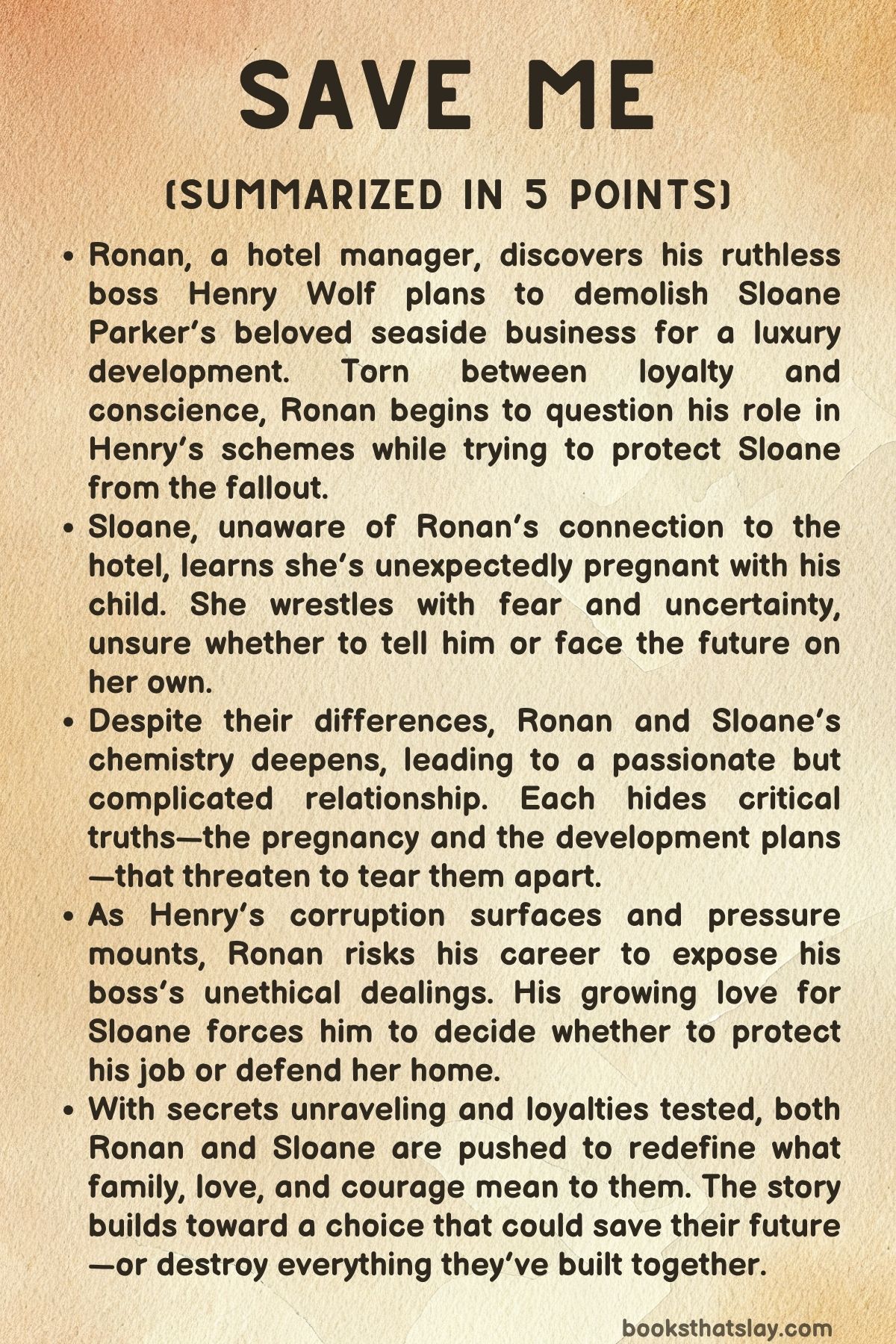
Ronan, an employee of the powerful and domineering Henry Wolf, finds himself in a moral dilemma when he learns about Henry’s ruthless plan to demolish Sloane Parker’s small coastal business, the Sea Witch. The new harbor project promises to bring luxury developments to Mermaid Beach but at the cost of destroying the local community.
During a tense confrontation, Henry accuses Ronan of sleeping with Sloane and threatens to destroy his career if he exposes the plans. Caught between duty and conscience, Ronan realizes he must choose between protecting his job and warning the woman he cares for.
Sloane, meanwhile, faces her own crisis after discovering she is pregnant. Shocked, she hides the truth from everyone, including Ronan, and tries to continue running her business as though nothing has changed.
Her fear and uncertainty are balanced by moments of humor and support from her close circle of friends, including Rebel and her beloved grandmother, Gigi. When Ronan appears at her home, the chemistry between them reignites, and though their attraction is undeniable, Sloane remains wary of trusting him.
Ronan’s world grows increasingly chaotic as professional pressures mount. The hotel’s grand aquarium malfunctions just before a major event, and he must manage both the crisis and his growing emotional turmoil.
When he visits Sloane, their connection deepens, but she conceals her pregnancy, afraid of how he might react. Determined to protect her, Ronan secretly seeks help from Abbi, Henry Wolf’s wife and his longtime friend.
Confiding in Abbi about Henry’s corrupt project, he hopes she can persuade her husband to stop the redevelopment. Abbi agrees to help, despite knowing it may strain her marriage.
Encouraged by Gigi, Sloane reluctantly agrees to attend a dinner at the Wolf Hotel with Ronan. She knows Henry Wolf will be there, but she chooses courage over fear.
Before the dinner, Sloane calls a mutual acquaintance to ask about Ronan’s past, hoping to confirm whether he can be trusted. She learns he is a loyal man who has been emotionally lost since a painful breakup, which gives her some reassurance.
At the dinner, the social tension is thick. Ronan’s colleague Belinda, still smarting from his rejection, watches Sloane with open hostility.
When Connor, Ronan’s best friend, joins in with his usual teasing, the moment turns awkward, and Ronan’s jealousy flares. To ease the discomfort, he takes Sloane for a walk along the beach, where they share stories about their families and backgrounds.
The simple honesty between them draws them closer. Yet Ronan hides the truth about Henry’s plans, and guilt weighs on him.
Their growing intimacy culminates in a passionate encounter at the Sea Witch, where they briefly forget the storm around them.
Ronan’s conflict reaches a boiling point after he punches Henry Wolf during an argument. Surprisingly, Henry does not fire him, perhaps out of pride or strategy.
Ronan’s affection for Sloane strengthens as they grow closer, though she continues to struggle with the secret of her pregnancy. Their time together is filled with warmth and humor, but underneath, both know they are standing on fragile ground.
When Ronan joins Henry and his business partners for a golf game, he realizes Henry still intends to move forward with his redevelopment plans, no matter who gets hurt.
At the Sea Witch, Sloane’s loyal crew—Frank, Skye, and Lara—rally around her, gossiping about Ronan’s confrontation with Henry. The camaraderie gives her strength.
Meanwhile, Ronan’s work brings him into contact with influential clients, including Olivia McEowan, whose candid honesty impresses him. When he learns about Henry’s political manipulations and bribes to push the harbor project through, his resentment deepens.
That same evening, Sloane’s beach bonfire is disrupted by police responding to a noise complaint—an act of petty revenge orchestrated by Belinda. Furious, Sloane vows to retaliate.
Ronan confronts Belinda, threatening to expose her secret relationship with Connor if she harms Sloane again. Afterward, he drives to the Sea Witch, where Sloane and her friends are hanging protest signs mocking the Wolf Empire.
The sight of her defiance fills him with pride. Despite knowing the risks, he joins her, and their shared act of rebellion strengthens their bond.
Later, Frank tells Ronan that Sloane is pregnant. The revelation shocks him, but it also solidifies his commitment.
Determined to prove himself, Ronan goes to Sloane, who admits her fears—of losing her home, her livelihood, and raising a child alone. Ronan promises he will stand by her and support whatever decision she makes.
Their reconciliation marks a turning point, transforming uncertainty into unity.
Driven by love and desperation, Ronan confronts Henry Wolf once more, begging him to cancel the development. In a rare moment of humility, Ronan kneels before him, admitting that Sloane is pregnant and that destroying her home would ruin her life.
Though Henry storms off, his wife Abbi quietly takes note of Ronan’s sincerity.
In time, Sloane’s life regains balance. She and her Sea Witch crew rebuild their fire pit and celebrate together, with Connor now part of their group.
Laughter fills the night as they toast to loyalty and friendship. Yet, the peace is interrupted when Henry and Abbi appear at the beach.
In a private conversation, Henry tells Ronan that the harborfront project has been canceled. The state governor’s involvement and corruption allegations have forced a halt to all construction.
Henry’s tone is begrudging but sincere—Sloane has won, for now. Her home and business are safe.
Weeks later, Sloane and Ronan visit Gigi to share their news. Gigi, delighted, welcomes Ronan as part of the family.
Time passes, and by autumn, Sloane’s pregnancy is well along. The Sea Witch thrives, Ronan manages the business expansion, and together they build a life defined by peace and love.
Their friends remain close, teasing and loyal as ever. In the final scene, the crew watches Connor fulfill a lost bet by running down the beach in a ridiculous swimsuit, laughter echoing over the waves.
Sloane reflects on how far she has come—from a woman terrified of loss to someone surrounded by love and stability. She realizes that despite every hardship, she found the family she didn’t know she was missing.
With Ronan beside her and a new life on the way, she finally feels safe—not because everything is perfect, but because she no longer has to face it alone.
Characters
Sloane Parker
Sloane Parker stands at the heart of Save Me, embodying resilience, emotional depth, and an unwavering sense of identity. A fiercely independent woman, Sloane runs the Sea Witch—a tiki cruise business that doubles as her home and symbol of freedom.
When faced with Henry Wolf’s plans to demolish her property, she refuses to yield, demonstrating courage in the face of corporate greed. Her discovery of an unplanned pregnancy marks a turning point in her journey, revealing her internal conflicts—fear, uncertainty, and the heavy weight of responsibility.
Despite these struggles, Sloane’s strength never falters. She navigates her crisis with raw honesty, balancing vulnerability and defiance.
Her love for Ronan grows organically from tension and mistrust into genuine affection, but even in love, she maintains her autonomy. Deeply loyal to her friends and community, Sloane reflects the novel’s core theme of fighting for what truly matters—home, love, and self-respect.
By the end, she evolves into a woman grounded in acceptance and hope, finding peace in both motherhood and partnership.
Ronan
Ronan’s arc in Save Me is defined by internal conflict and redemption. A man trapped between loyalty to his corrupt employer and his conscience, he begins as a reluctant enforcer for Henry Wolf but gradually becomes Sloane’s protector and partner.
His relationship with Sloane forces him to confront his moral ambiguity—choosing integrity over ambition. Ronan’s compassion is matched by impulsiveness; his tendency to act out of emotion, as seen in his fight with Henry, mirrors both his passionate nature and his growing moral backbone.
His transformation is most visible when he defies Henry, risking his career to safeguard Sloane’s home and future. Beneath his confident exterior lies a man haunted by mistakes and longing for meaning beyond power or pleasure.
His rejection of past superficial relationships in favor of love and responsibility marks a powerful maturation. By the novel’s end, Ronan emerges as a figure of redemption—a man who rebuilds not only Sloane’s world but also his own sense of purpose.
Henry Wolf
Henry Wolf is the embodiment of arrogance, power, and entitlement. As the head of Wolf Hotels, he manipulates systems and people alike to expand his empire, justifying his corruption as ambition.
Yet beneath his polished exterior, Henry is a man consumed by ego and the need for control. His interactions with Ronan and Sloane reveal his emotional detachment and cold pragmatism—he sees people as assets or obstacles.
However, Henry’s eventual decision to halt the harbor project hints at buried complexity. Whether driven by grudging respect for Ronan or a sense of debt, his concession humanizes him briefly, though it does not absolve his manipulation.
Henry represents the dangerous intersection of wealth and moral decay, serving as both antagonist and cautionary figure in the novel. His presence forces every other character—especially Ronan—to define what kind of person they want to become when confronted with corruption cloaked in civility.
Abbi Wolf
Abbi Wolf serves as a counterbalance to her husband’s ruthlessness. Graceful and empathetic, she stands as a quiet force of integrity within the Wolf empire.
Pregnant and perceptive, Abbi becomes Ronan’s confidante and moral ally, helping him see that compassion can coexist with courage. Her decision to assist Ronan in opposing Henry’s redevelopment plan showcases her inner strength and loyalty to justice over privilege.
Through her, the narrative highlights how goodness can persist even within corrupted spaces. Abbi’s calm wisdom and moral clarity provide emotional grounding amidst the chaos of ambition and betrayal.
She is the novel’s moral compass—soft-spoken yet influential, embodying the idea that strength doesn’t always need to roar to make change.
Frank
Frank represents the steadfast heart of Sloane’s world. As her friend, mentor, and surrogate father figure, he embodies loyalty and community spirit.
His grounded personality and unwavering support contrast sharply with the deceit and ambition surrounding the Wolf Hotel. Frank’s insight often pierces through Sloane’s fears, offering humor and perspective when she most needs it.
His role extends beyond mere comic relief—he symbolizes generational wisdom, the voice of reason that reminds others of what truly matters. His protective instincts toward Sloane and later toward her unborn child reveal his quiet heroism.
Frank’s presence roots the story in authenticity, reminding readers that love and family are often built, not born.
Belinda
Belinda serves as a reflection of corporate toxicity—ambitious, manipulative, and vindictive. Once involved with Ronan, she symbolizes the emptiness of transactional relationships built on power rather than affection.
Her jealousy toward Sloane and subsequent acts of sabotage expose her insecurity beneath the professional façade. Belinda’s downfall is not dramatic but moral; her manipulations alienate her allies and strip her of influence.
She acts as both obstacle and mirror, showing Ronan what kind of emotional void he risks returning to if he abandons authenticity. Though antagonistic, Belinda adds crucial tension to the story’s emotional and ethical dynamics.
Gigi
Gigi, Sloane’s grandmother, is the emotional bedrock of Save Me. Wise, witty, and nurturing, she offers unconditional love and guidance when Sloane’s world begins to unravel.
Her acceptance of Sloane’s pregnancy and faith in her strength restore balance to the younger woman’s turmoil. Gigi’s optimism, even from her nursing home, radiates warmth and humor.
She embodies legacy—passing down lessons of resilience, forgiveness, and hope. In a novel rife with conflict and deceit, Gigi’s kindness anchors the emotional narrative, symbolizing continuity and the enduring power of family.
Connor
Connor, Ronan’s best friend, injects levity and loyalty into the tension-filled narrative. Brash, irreverent, and charmingly reckless, he balances Ronan’s seriousness with humor.
Yet his loyalty runs deep—he risks humiliation to protect Ronan and Sloane, even facing Belinda’s wrath with self-deprecating humor. Connor’s growth is subtle but meaningful; his shift from carefree playboy to a man who values loyalty over lust mirrors Ronan’s evolution.
His presence also underscores one of the book’s lighter but essential truths—that friendship, even messy and imperfect, can be redemptive.
Bailey
Bailey arrives later in the story but quickly becomes a symbol of resilience and new beginnings. Her confidence, humor, and quick wit make her a perfect addition to the Sea Witch crew.
She helps Sloane rediscover joy amid uncertainty and proves that community can heal personal wounds. Her defense of Sloane against Cody, her mischievous nature, and her loyalty reinforce the theme of chosen family.
Bailey represents youthful courage and renewal—an echo of Sloane’s younger self, full of defiance and heart.
Themes
Love and Redemption
In Save Me, love emerges not as a fleeting attraction but as a force of moral and emotional restoration. Ronan and Sloane’s relationship begins amid deception, guilt, and personal turmoil, yet it becomes the foundation through which both characters rediscover trust and purpose.
Ronan, initially defined by his loyalty to the corrupt Wolf Hotel and his own history of emotional detachment, finds in Sloane a chance to reconnect with empathy and integrity. His affection for her pushes him to defy Henry Wolf, risking his career and reputation to do what is right.
This transformation illustrates love as an act of courage and redemption—an opportunity to rewrite one’s past mistakes by standing on the side of truth. Similarly, Sloane’s guarded heart and fear of abandonment soften through Ronan’s persistence and sincerity.
Her unexpected pregnancy initially represents loss of control, yet as her bond with Ronan deepens, it becomes a catalyst for acceptance and healing. Their romance is not idealized but grounded in conflict, forgiveness, and sacrifice, mirroring the imperfect nature of real love.
By the end, their connection restores not only their faith in each other but also their belief in self-worth and resilience. Through their relationship, Tucker portrays love as the most transformative human experience—one capable of dismantling walls built by trauma, fear, and betrayal.
Power and Corruption
The story draws a stark line between personal morality and institutional greed, exposing how unchecked ambition corrupts even the most glamorous facades of success. Henry Wolf, the domineering hotel magnate, personifies the destructive nature of power when wielded without conscience.
His development projects—masked as “revitalization”—threaten to erase entire communities like Mermaid Beach, exploiting wealth and influence to manipulate public systems. Ronan’s journey within this environment reflects the moral decay embedded in such corporate hierarchies.
He begins complicit, silently enabling corruption to preserve his career, but witnessing the human cost through Sloane forces him to confront the rot from within. The scenes involving local officials, bribery through donations, and the forced evictions underscore a social critique of capitalism’s ability to justify exploitation under the banner of progress.
Yet Tucker also presents a nuanced view of power: Henry’s eventual concession to halt the project suggests that even dominance has limits when faced with integrity and persistence. The theme ultimately argues that real authority lies not in wealth or status but in the courage to act ethically despite the risks.
Through the downfall of corruption and the triumph of conscience, the narrative insists that personal integrity remains the only antidote to systemic abuse.
Home, Heritage, and Identity
Sloane’s fight to protect the Sea Witch and Mermaid Beach is far more than a battle against demolition; it is a struggle to preserve identity, memory, and belonging. Her property is not just a business but a living testament to family history, community resilience, and the unpretentious life she values.
Tucker uses the conflict between the Sea Witch and the Wolf Hotel as a symbolic clash between authenticity and artificiality—between spaces built by love and those built for profit. Through Sloane’s attachment to her home, the novel highlights how physical spaces carry emotional weight, grounding people in a sense of self.
Her resistance against corporate takeover represents defiance against erasure—of culture, of personal narrative, and of independence. The Sea Witch becomes an emblem of freedom and stability amid chaos, especially as Sloane faces single motherhood and uncertainty.
For Ronan, too, the idea of home evolves. Once disconnected and transient, he begins to associate home with Sloane and her world of sincerity, warmth, and imperfection.
The closing scenes, where they rebuild and expand the Sea Witch together, affirm that home is not simply where one resides but where one chooses to belong. In reclaiming their place in the world, both characters reaffirm that identity is rooted not in possession, but in shared purpose and love.
Fear, Vulnerability, and Emotional Growth
Throughout Save Me, fear operates as both a barrier and a motivator. Sloane’s terror of repeating her mother’s tragic fate—abandonment, loneliness, and hardship—shapes her reluctance to trust Ronan or embrace her pregnancy.
Her inner conflict between self-preservation and openness underscores the emotional cost of vulnerability. Yet Tucker portrays vulnerability not as weakness but as a necessary step toward freedom.
Every time Sloane confides in Gigi, Frank, or eventually Ronan, she sheds another layer of fear, learning that strength lies in connection, not isolation. Ronan’s emotional growth follows a similar trajectory: haunted by past failures and defined by obedience to corrupt authority, he initially hides behind stoicism.
Loving Sloane forces him to confront the discomfort of honesty and the fear of inadequacy. Their shared experiences—betrayal, loss, defiance—forge an emotional intimacy that matures them both.
The narrative suggests that healing requires courage to face what one fears most: rejection, change, or truth. By the novel’s end, their acceptance of love, family, and uncertainty marks not a perfect resolution but a profound emotional evolution.
Tucker’s portrayal of vulnerability serves as the story’s emotional anchor, reminding readers that genuine strength grows only when one dares to be seen fully and without armor.
Resistance and Moral Courage
At its heart, Save Me celebrates the defiance of ordinary people against the machinery of exploitation. Sloane’s protests, her refusal to sell out, and her insistence on preserving her community symbolize the moral bravery that comes from conviction rather than power.
Even when faced with financial ruin or social ridicule, she acts on principle, embodying a grassroots form of heroism. Ronan’s arc reinforces this theme—his eventual rebellion against Henry Wolf’s empire represents a reclaiming of conscience over compliance.
His choices show that moral courage often begins with small acts of defiance, such as speaking the truth or standing by those who cannot fight alone. Tucker presents resistance not as a dramatic revolution but as a daily act of integrity.
The supporting characters—Gigi’s wisdom, Frank’s loyalty, Bailey’s spirited defense—collectively highlight the strength of community solidarity. By contrasting the corrupt hierarchy of Wolf Hotels with the humble, united spirit of Mermaid Beach, the novel makes a broader social statement: true progress cannot come at the expense of humanity.
The resolution, where justice is achieved not through force but through persistence and compassion, leaves readers with an enduring message—moral courage is the quiet, unrelenting heartbeat of change.