See You at the Sunset Summary, Characters and Themes
See You at the Sunset by Susan Lee is a contemporary romantic comedy about unexpected love, personal reinvention, and discovering a sense of belonging.
The novel follows Jia Chung, a young woman struggling with professional rejection, and Henry Shin, an ambitious corporate lawyer whose carefully controlled life leaves little room for emotional connection. When circumstances bring them together at a Palm Springs retirement community, their complicated past threatens their growing attraction. Surrounded by lively grandparents, supportive neighbors, and an unusual matchmaking scheme, they begin questioning their definitions of success. Through humor, romance, and family relationships, the story explores independence, self-worth, and the courage to pursue happiness.
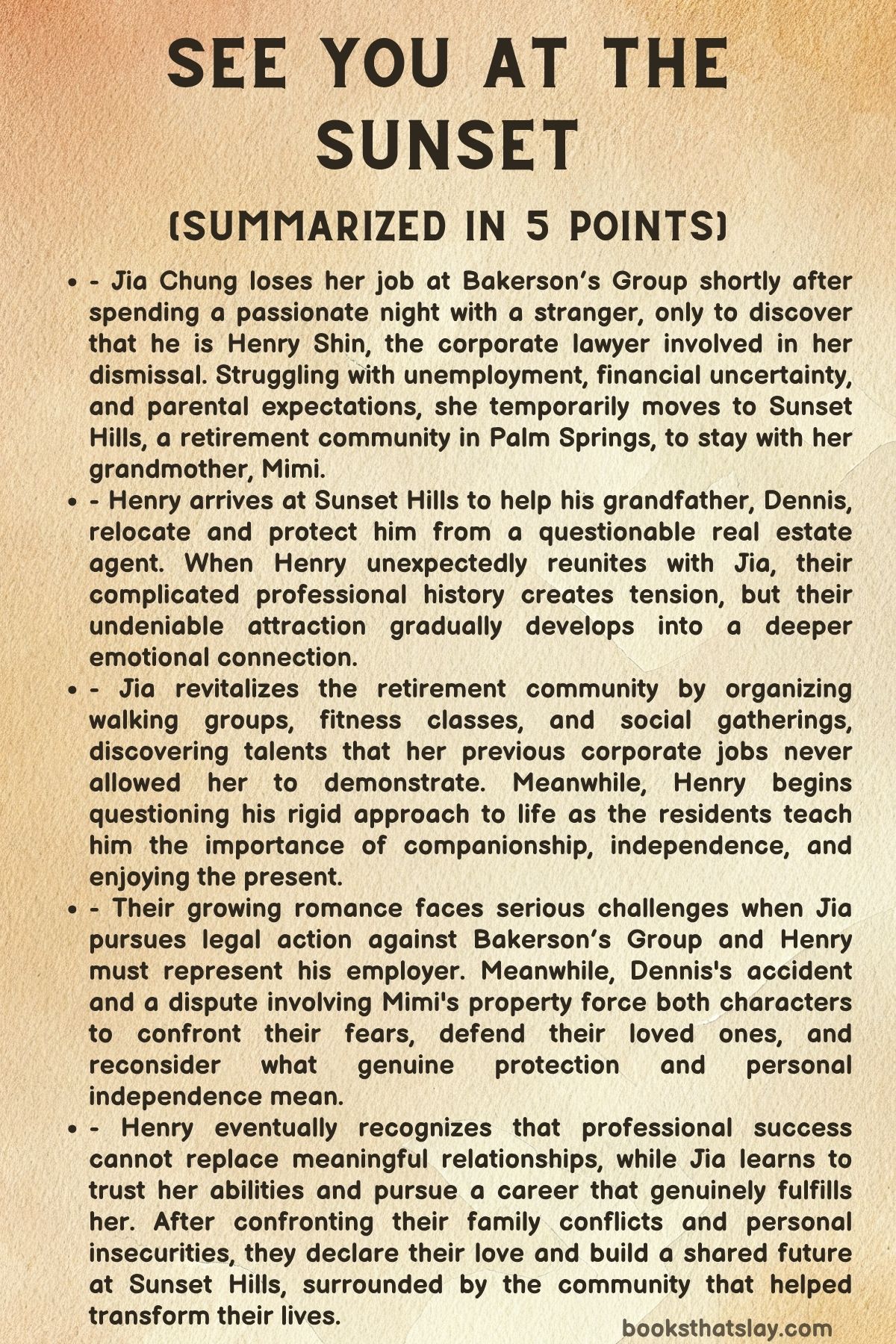
Summary
Henry Shin believes his life is finally progressing according to plan. As a successful lawyer at Bakerson’s Group in New York, he has earned recognition from powerful executives and anticipates a promising professional future.
His boss, Steven Sword, entrusts him with an important assignment, reinforcing Henry’s belief that dedication and obedience will eventually secure the professional standing he desires.
Meanwhile, Jia Chung expects equally encouraging news from the same company. After receiving an invitation to meet with human resources, she assumes her hard work is finally being rewarded.
She persuades her best friend, Lizzy, to celebrate at an expensive bar called Willow. Henry happens to visit the same establishment, and the two strangers immediately develop a strong attraction.
Their spontaneous evening leads to an intimate night together. Jia leaves early the following morning, never having learned Henry’s name.
Her optimism disappears when Genevieve Gordon, the human resources manager, informs her that she has been terminated. The company cites performance concerns, including an expense-report discrepancy and an anonymous complaint, but offers little explanation.
Devastated, Jia discovers that senior counsel Henry J. Shin authorized the legal documents supporting her dismissal. She has no idea that he is the man she recently met.
Henry, meanwhile, knows that Jia’s former supervisor, Edison Wainwright, has dismissed several young female assistants. Although Genevieve questions the suspicious circumstances, Henry refuses to investigate beyond his assigned professional responsibilities.
For Jia, unemployment creates an immediate crisis. She has little money, her parents are disappointed by another unsuccessful job, and Lizzy’s decision to move in with her boyfriend means Jia must also find somewhere else to live.
Her parents, both accomplished lawyers, insist that she return to Florida. Jia instead negotiates thirty days to establish a new direction.
Remembering childhood visits to her grandmother Mimi in Palm Springs, she decides to stay with her at Sunset Hills, a retirement community affectionately called The Sunset.
Mimi welcomes Jia without judgment. Unlike her parents, she does not regard unemployment as proof that her granddaughter lacks ability.
At approximately the same time, Henry receives concerning news from his grandfather, Dennis. Dennis plans to sell his Palm Springs property and relocate to Sunset Hills, but Henry distrusts the real estate agent handling the transaction.
Henry’s concern reflects his difficult family history. His unreliable parents have repeatedly exploited Dennis’s generosity, leaving Henry determined to protect the grandfather who provided him with childhood stability.
He travels to Palm Springs to supervise the move, intending to remain for two weeks while working remotely.
Jia begins rediscovering the happiness she associated with her grandmother’s neighborhood. However, she notices that the community has become quieter and that its recreational facilities are underused.
She organizes a walking club and starts planning social activities. Her enthusiasm soon inspires residents to reconnect through exercise classes, gatherings, and shared projects.
For the first time in months, Jia experiences genuine satisfaction in her work. Although she continues applying for conventional jobs, organizing community activities makes her feel capable and useful.
Her growing confidence suffers an unexpected complication when she encounters Henry in Palm Springs. They recognize each other from their night in New York and soon discover their professional connection.
Jia learns that Henry helped terminate her employment. Henry realizes that the woman he found so attractive is the former employee whose dismissal he approved.
Their reunion becomes even more uncomfortable when they discover that they are staying directly across the street from each other.
Henry initially suspects the coincidence might be deliberate. Jia resents his distrust and his insistence that he merely fulfilled his professional duties.
Nevertheless, avoiding each other proves impossible.
Henry attends the activities Jia organizes because Dennis enthusiastically participates in them. He gradually witnesses qualities that contradict the unfavorable assessment he received from Wainwright.
Jia demonstrates creativity, compassion, organizational ability, and a remarkable talent for helping people feel included.
During an adapted Zumba class, Henry reluctantly joins the residents and discovers that allowing himself to look foolish can actually be enjoyable.
A swimming-pool gathering similarly challenges his controlling instincts. Dennis participates in a cannonball competition, and Henry must confront the difference between protecting his grandfather and preventing him from enjoying life.
Meanwhile, Jia becomes acquainted with Matthew Singleton, a charming real estate agent who invites her to dinner.
Their evening becomes uncomfortable when Matthew explains his business strategy of purchasing older residents’ properties and reselling them to younger buyers.
Henry unexpectedly appears at the restaurant and warns Jia about Matthew. He identifies him as the agent whose dealings with Dennis originally prompted his visit.
Although Jia dislikes Henry’s assumption that she might be easily manipulated, she recognizes that his concerns deserve attention.
Their attraction becomes increasingly difficult to ignore.
Mimi and Dennis, encouraged by several enthusiastic neighbors, secretly establish a matchmaking campaign called Operation Hookup. Their efforts create opportunities for Jia and Henry to spend time together.
During an evening watching the sunset, Jia and Henry finally acknowledge their emotional connection through a kiss.
The relationship continues developing as they discover how much they share beneath their contrasting personalities.
Jia recognizes that Henry’s controlling behavior emerges partly from fear and childhood insecurity. Henry begins understanding how Jia’s confidence has been damaged by professional rejection and relentless family expectations.
Their growing intimacy is accompanied by practical cooperation. Jia provides creative ideas for neighborhood celebrations, while Henry contributes organization and attention to detail.
At a successful community party, Henry thanks Jia for transforming the residents’ lives.
His praise affects her deeply because she has spent years believing that she disappoints everyone.
Their romantic relationship becomes more open, and the neighbors enthusiastically celebrate their happiness.
However, serious disagreements remain.
Jia discovers that Matthew is pressuring elderly homeowners to sell their properties. She asks Henry to investigate, but he initially refuses, citing professional limitations and his lack of authorization to practice law in California.
Jia interprets his response as another example of his preference for rules over people.
Their professional conflict also resurfaces when former Bakerson’s Group assistants challenge the circumstances of their dismissals.
Jia joins Stephanie Novak and Taylor Ann Graff in pursuing legal action against the company.
Henry realizes that his responsibilities as corporate counsel may place him directly against the woman he is falling in love with.
Before returning to New York, he encourages Jia to make decisions according to her own needs rather than his preferences or her parents’ expectations.
Their separation is emotionally difficult, particularly because neither knows whether their relationship can survive the legal dispute.
Back in New York, Jia attends a meeting with her attorney, Helena Wimberley, and the other former assistants.
Henry represents Bakerson’s Group, while the company disputes the allegations and discusses a possible settlement.
Jia struggles with accepting financial compensation because she wants acknowledgment of the injustice she believes occurred.
Henry, meanwhile, begins reconsidering his professional conduct. He realizes that he noticed suspicious patterns surrounding Wainwright but failed to question them.
His dissatisfaction deepens when he receives affectionate messages from Sunset Hills residents. Their appreciation reminds him that relationships can provide something his professional achievements have never supplied.
An unexpected emergency brings the couple back to Palm Springs.
Dennis falls during Walking Club and breaks his wrist.
Jia immediately blames herself, fearing that encouraging his participation exposed him to unnecessary danger.
Henry rushes to his grandfather, terrified that the accident confirms his concerns about Dennis living independently.
However, he discovers the neighborhood residents surrounding Dennis with practical assistance and companionship.
The experience challenges Henry’s assumption that protecting someone requires personally supervising every aspect of their life.
Dennis also helps Henry through a panic attack and encourages him to acknowledge his emotional needs.
Another conflict emerges when Jia’s parents arrive in Palm Springs.
Influenced by Matthew, they want Mimi to sell her property and move to Florida, where they believe she can receive closer supervision.
Mimi firmly rejects their plans. She loves Sunset Hills and insists that growing older does not eliminate her right to make decisions.
Jia supports her grandmother, but her parents dismiss her judgment.
Mimi responds by expressing her trust in Jia and explaining that she wants her granddaughter to assume responsibility for her financial and medical affairs if necessary.
Her confidence helps Jia recognize that she is capable of handling responsibilities others have repeatedly suggested are beyond her.
The dispute culminates in a confrontation at Matthew’s office.
Henry joins Jia in supporting Mimi’s legal rights, demonstrating that he now understands the importance of protecting independence rather than simply managing risks.
Jia also confronts her parents about their treatment of her.
She explains that their constant criticism has made her feel inadequate and that she needs their support without surrendering control over her life.
The confrontation creates an opportunity for the family to establish a more respectful relationship.
Afterward, Henry takes Jia somewhere quiet overlooking Palm Springs.
He admits that his relentless pursuit of professional success was shaped by childhood insecurity and his fear of depending on others.
His experiences with Jia, Dennis, and the neighborhood have convinced him that he wants a different future.
He reveals that he has reconsidered his professional direction and intends to remain connected to Sunset Hills.
He also tells Jia about an employment opportunity that would allow her to continue using her talents within the community.
Jia realizes that she no longer needs to force herself into a career that makes her unhappy merely to satisfy other people’s expectations.
The couple finally declares their love.
As the desert sunset approaches, Henry proposes that they continue watching it together whenever possible.
The promise represents their decision to build a shared life founded on affection, independence, and mutual respect.
Several months later, Jia and Henry are happily settled into their new circumstances.
Jia finally retrieves the luggage that went missing when she originally arrived in Palm Springs. Its recovery humorously recalls the woman she was before finding her place at Sunset Hills.
She now possesses the confidence, meaningful work, and supportive relationships she previously lacked.
Henry has similarly learned to value companionship over constant professional advancement.
Together, they enjoy the lively community that helped them discover what they truly wanted from life.
Characters
Jia Chung
Jia Chung is the central female protagonist of See You at the Sunset, whose development revolves around overcoming self-doubt and recognizing her personal strengths. Her experiences demonstrate how repeated professional rejection and family criticism can distort a person’s understanding of their abilities.
At the beginning of the novel, Jia believes that securing a successful corporate career will finally earn her parents’ approval. Losing her job at Bakerson’s Group therefore damages more than her financial stability; it threatens her entire sense of worth.
Her colorful clothing reflects an individuality she has struggled to express within conservative professional and family environments. Although she wants to satisfy others, she also longs to live according to her own preferences.
Jia possesses considerable empathy, creativity, and enthusiasm. These qualities initially appear incompatible with the corporate positions she has repeatedly attempted to maintain.
At Sunset Hills, however, they become her greatest advantages. She organizes walking groups, fitness classes, social events, and community gatherings that restore the residents’ enthusiasm for everyday life.
Her success reveals that her previous failures were not necessarily evidence of incompetence. She had been pursuing professional opportunities that did not make effective use of her abilities.
Jia’s relationship with Henry also encourages her development. Although she is attracted to him, she refuses to abandon her principles merely to preserve their romance.
Her decision to pursue legal action against Bakerson’s Group demonstrates her growing willingness to defend herself. Rather than automatically accepting responsibility for unfavorable circumstances, she begins questioning the people and institutions that have judged her.
Her determination to protect Mimi’s independence similarly reflects her increasing confidence.
By the conclusion, Jia understands that personal success cannot be measured exclusively through prestigious employment or parental approval. Her transformation is rooted in discovering meaningful work, trusting her judgment, and allowing herself to pursue happiness.
Henry Shin
Henry Shin is the male protagonist of See You at the Sunset, characterized by ambition, emotional restraint, and an overwhelming need for control. His professional success conceals considerable anxiety and unresolved childhood insecurity.
Having grown up with unreliable parents, Henry learned to associate stability with independence and financial achievement. Dennis, his grandfather, provided the dependable support his parents could not offer.
Consequently, Henry approaches adulthood as an exercise in eliminating uncertainty. He believes that careful preparation, professional competence, and strict adherence to rules will protect him from disappointment.
His position at Bakerson’s Group reinforces these habits. He initially regards his participation in Jia’s dismissal as a routine legal responsibility, even though he recognizes suspicious circumstances surrounding her supervisor.
Henry’s arrival at Sunset Hills exposes the limitations of this approach.
His determination to supervise Dennis’s activities repeatedly creates tension because he confuses protection with control. He fears that allowing his grandfather independence will expose him to unnecessary danger.
Through Jia and the residents, Henry gradually discovers that meaningful relationships require trust rather than constant supervision.
His participation in fitness classes, social gatherings, and neighborhood celebrations reveals a playful personality beneath his restrained exterior.
His relationship with Jia also forces him to reconsider professional loyalty. Her experiences demonstrate that following established procedures does not automatically mean acting responsibly.
Henry’s panic attacks emphasize the emotional cost of his relentless pursuit of security.
His development becomes particularly evident when he accepts assistance from Dennis and the surrounding community rather than insisting that he must manage everything independently.
By the conclusion, Henry recognizes that achievement cannot compensate for emotional isolation. His decision to reconsider his career and build a future with Jia represents his willingness to pursue a more balanced and fulfilling existence.
Mimi
Mimi, Jia’s grandmother, is one of the novel’s most influential supporting characters. Her unconditional acceptance provides Jia with the emotional security she has rarely experienced within her immediate family.
Unlike Jia’s parents, Mimi does not regard unconventional choices or professional setbacks as evidence of failure.
She recognizes her granddaughter’s creativity and compassion long before Jia learns to appreciate these qualities herself.
Mimi also represents the importance of independence in later life.
Although her physical abilities have changed with age, she remains capable of expressing preferences, maintaining relationships, and making decisions about her future.
Her determination to remain at Sunset Hills becomes especially significant when Jia’s parents attempt to arrange the sale of her home.
Rather than accepting their assumption that age automatically diminishes judgment, Mimi insists upon her right to determine where and how she lives.
Her decision to entrust Jia with future financial and medical responsibilities demonstrates her confidence in her granddaughter.
Mimi’s playful personality provides much of the novel’s humor. Her enthusiastic involvement in Operation Hookup reveals that she enjoys romance, excitement, and social involvement rather than merely observing younger people’s lives.
Ultimately, Mimi functions as both a source of emotional reassurance and an example of independent living. She teaches Jia that love should encourage personal growth rather than demand unquestioning obedience.
Dennis
Dennis, Henry’s grandfather, provides a powerful contrast to his grandson’s anxious and highly structured personality.
Having served as Henry’s primary source of childhood stability, Dennis understands the emotional wounds that continue shaping his adult behavior.
He appreciates Henry’s concern but resists being treated as someone incapable of managing ordinary responsibilities.
At Sunset Hills, Dennis enthusiastically participates in fitness classes, parties, and recreational activities. His enjoyment challenges Henry’s assumption that avoiding every possible risk should become the central purpose of old age.
Dennis also recognizes that Henry’s professional ambitions have developed into an unhealthy measure of self-worth.
He encourages his grandson to understand that his parents’ failures do not determine his value.
When Dennis breaks his wrist, the incident initially appears to justify Henry’s fears. However, the support Dennis receives from his neighbors demonstrates that independence and community assistance can exist together.
Dennis’s response to Henry’s panic attack further establishes their relationship as one founded on reciprocal care.
He does not regard his grandson’s anxiety as weakness but instead helps him accept the support he needs.
His involvement in Operation Hookup reveals an affectionate, humorous side that balances his more serious guidance.
Dennis ultimately helps Henry recognize that love involves spending meaningful time together, not simply preventing problems.
Lizzy
Lizzy is Jia’s best friend and an important source of companionship during her professional and emotional difficulties.
Their friendship begins the novel on a celebratory note when Lizzy accompanies Jia to Willow, where she unexpectedly meets Henry.
Although Lizzy later announces that she is moving in with her boyfriend, Darcy, she remains concerned about Jia’s uncertain future.
Her changing living arrangements unintentionally intensify Jia’s crisis, forcing her friend to consider alternatives beyond her familiar New York existence.
Nevertheless, Lizzy does not abandon Jia emotionally.
She offers practical suggestions, listens to her frustrations, and supports her efforts to establish a new direction.
Following Jia’s legal meeting with Bakerson’s Group, Lizzy celebrates her courage and encourages her to recognize the value of her accomplishments.
Her friendship demonstrates that supportive relationships do not require constant agreement or the ability to solve every difficulty.
Lizzy’s significance lies in providing stability while allowing Jia the freedom to make independent decisions.
Darcy
Darcy is Lizzy’s boyfriend and a minor supporting character whose relationship with her influences Jia’s circumstances.
When Lizzy decides to move in with Darcy, Jia loses the housing arrangement that had provided her with stability in New York.
Although this development creates practical difficulties, Darcy is not presented as an antagonist.
Instead, his relationship with Lizzy represents an ordinary life transition that indirectly encourages Jia to reconsider her own future.
He later participates in celebrating Jia’s decision to confront Bakerson’s Group.
His limited role reinforces the presence of a supportive social circle outside Sunset Hills.
Genevieve Gordon
Genevieve Gordon, the human resources manager at Bakerson’s Group, represents the conflict between organizational procedures and personal conscience.
She informs Jia of her dismissal but offers little explanation beyond the company’s stated concerns.
Although she performs the responsibilities associated with her position, she privately questions the circumstances surrounding the termination.
Genevieve recognizes Jia as a pleasant employee and finds the urgency of management’s decision suspicious.
Her conversation with Henry reveals that concerns about the dismissal are not limited to Jia herself.
Genevieve’s position demonstrates how individuals within an institution may recognize questionable conduct without possessing sufficient influence to challenge it effectively.
She is not portrayed as the principal cause of Jia’s difficulties, but her participation illustrates how organizational decisions become harmful when employees follow instructions without obtaining satisfactory explanations.
Edison Wainwright
Edison Wainwright is Jia’s former supervisor and an important source of the professional conflict driving See You at the Sunset.
His negative assessment of Jia helps justify her termination, despite the positive qualities other employees recognize in her.
The revelation that several young female assistants have been dismissed after working for him raises questions about his conduct and managerial authority.
Jia’s recollection of a disputed restaurant expense further complicates the company’s explanation for her dismissal.
Wainwright represents the vulnerability of employees whose professional reputations depend heavily upon a supervisor’s judgment.
His position allows him to influence how others interpret Jia’s behavior, while she initially lacks the confidence and resources to challenge those interpretations.
The legal action brought by Jia and the other former assistants exposes the broader consequences of this imbalance.
Wainwright’s willingness to discuss financial settlement also illustrates the tension between resolving a corporate dispute and acknowledging the experiences of affected employees.
Steven Sword
Steven Sword is Henry’s superior at Bakerson’s Group and a representative of the demanding professional environment Henry has worked so hard to enter.
His confidence in Henry initially provides the recognition the younger man desperately desires.
By assigning him confidential responsibilities, Steven reinforces the belief that professional loyalty and unquestioning performance will lead to advancement.
However, the legal dispute involving the dismissed assistants reveals another dimension of their relationship.
Steven expects Henry to protect the company’s interests even when those responsibilities create personal difficulties.
His angry telephone call regarding the developing complaints demonstrates the pressure Henry faces within the corporate hierarchy.
Steven’s influence helps explain why Henry initially prioritizes organizational loyalty over independent moral judgment.
As Henry changes, the approval of powerful executives becomes less important than the relationships and personal values he has discovered outside work.
Matthew Singleton
Matthew Singleton is a real estate professional whose business activities create conflict within Sunset Hills.
Initially, he appears charming and attentive, successfully persuading Jia to accompany him on a date.
However, his explanation of purchasing older residents’ properties reveals a commercial perspective that troubles her.
Matthew views the neighborhood partly through its potential profitability, while Jia sees a community whose residents deserve stability and respect.
His involvement with Dennis’s proposed property sale prompts Henry’s original visit to Palm Springs.
Later, Matthew contacts Jia’s parents and encourages the sale of Mimi’s home.
His actions introduce an important question concerning the treatment of older homeowners.
Although property sales may sometimes serve residents’ interests, Matthew’s pressure raises concerns about whether individuals are being allowed to make informed decisions independently.
His conflict with Jia and Henry demonstrates how commercial interests can clash with emotional attachment, community continuity, and personal autonomy.
Gladys
Gladys is Mimi’s close friend and an important participant in the revitalization of Sunset Hills.
She introduces Jia to the community center’s facilities and helps her understand the practical requirements of organizing successful activities.
Her familiarity with the neighborhood makes her a valuable source of information and assistance.
Gladys recognizes that Jia’s enthusiasm must be accompanied by attention to budgets, safety, and administrative responsibilities.
Rather than discouraging her, she helps transform her ideas into workable plans.
Gladys also participates in the neighborhood’s matchmaking efforts, showing her playful interest in Jia and Henry’s relationship.
Her interactions with Henry challenge his tendency to approach ordinary matters with excessive formality.
As a supporting character, Gladys demonstrates the importance of mentorship and collaboration.
She helps Jia recognize that her natural abilities can become the foundation of meaningful professional work.
Gordon
Gordon is a Sunset Hills resident whose establishment of a small coffee cart reflects the neighborhood’s renewed social energy.
His initiative demonstrates that Jia’s activities encourage residents to contribute their own ideas rather than simply attend organized events.
The coffee cart becomes an example of how small community projects can generate opportunities for interaction and companionship.
Gordon also participates in the affectionate messages sent to Henry, reinforcing the younger man’s growing sense of belonging.
Although his individual storyline is limited, his presence helps establish Sunset Hills as a community sustained by the participation of many different residents.
Betty
Betty is another member of the Sunset Hills community who contributes to its lively social atmosphere.
Her participation in the postcard sent to Henry demonstrates that the residents have developed affection for him despite his initially reserved behavior.
Alongside Mimi, Dennis, Gladys, and Gordon, she represents the collective warmth that gradually transforms Henry’s understanding of relationships.
Betty’s role is relatively small, but her inclusion reinforces the idea that belonging emerges through repeated acts of friendship and acceptance.
Elliot
Elliot, Henry’s father, represents the family instability that has influenced Henry’s entire adult life.
His repeated requests for financial assistance reveal a pattern of dependence that places emotional and practical pressure on both Henry and Dennis.
When Elliot telephones Henry seeking money for another questionable undertaking, the interaction revives the younger man’s anger and mistrust.
Henry fears that his parents will continue exploiting Dennis’s generosity, which partly explains his determination to supervise his grandfather’s affairs.
Elliot’s behavior also contributes to Henry’s belief that depending on others is dangerous.
Rather than providing security, his parents have repeatedly demonstrated unreliability.
His role therefore helps explain Henry’s emotional restraint, professional ambition, and controlling instincts.
The character’s importance lies less in personal development than in revealing the difficult family experiences Henry must learn to move beyond.
Jia’s Mother
Jia’s mother is a successful lawyer whose expectations have profoundly influenced her daughter’s self-image.
She believes that professional stability, financial independence, and respectable employment are essential measures of adulthood.
Her repeated disappointment in Jia’s employment difficulties reinforces the younger woman’s belief that she is incapable of meeting expectations.
Although her concern emerges from a desire to protect her daughter, she frequently expresses it through criticism and attempts to direct Jia’s decisions.
Her insistence that Jia return to Florida demonstrates her difficulty accepting an unconventional path.
The conflict becomes more serious when she supports Matthew’s proposal to sell Mimi’s property.
Her assumption that she knows what is best for both generations reveals how protective intentions can become controlling.
Jia’s eventual confrontation forces her mother to recognize that love cannot be expressed exclusively through supervision.
Their relationship begins moving toward greater understanding when Jia explains that she needs encouragement rather than constant judgment.
Jia’s Father
Jia’s father shares his wife’s professional values and concern for family stability.
As an accomplished lawyer, he approaches Jia’s employment difficulties through a conventional understanding of career development and personal responsibility.
His expectations contribute to the pressure Jia feels to establish a respectable professional identity.
Although his intentions are protective, his willingness to support plans for Mimi’s relocation demonstrates a limited appreciation of individual preferences.
He initially treats financial security and practical supervision as sufficient reasons to alter his mother-in-law’s living arrangements.
The confrontation over Mimi’s property challenges this assumption.
His role illustrates how parents may confuse their own understanding of security with the wishes of the people they love.
The developing family reconciliation requires him to acknowledge that Jia and Mimi possess the right to make decisions even when those choices differ from his preferences.
Helena Wimberley
Helena Wimberley is the attorney representing Jia and the other former assistants in their legal dispute with Bakerson’s Group.
Her involvement provides Jia with the professional assistance necessary to challenge an institution considerably more powerful than herself.
Helena organizes the women’s complaints, questions the company’s position, and attempts to establish the legitimacy of their experiences.
During the legal meeting, she confronts the company’s representatives and considers the possibility of a negotiated settlement.
Her role highlights the difference between Jia’s emotional desire for acknowledgment and the practical mechanisms available through legal proceedings.
Helena does not eliminate that conflict, but she helps Jia approach it from a position of greater confidence.
As a supporting character, she represents the importance of professional advocacy when individuals face complicated institutional disputes.
Stephanie Novak and Taylor Ann Graff
Stephanie Novak and Taylor Ann Graff are former assistants whose experiences connect them to Jia’s dispute with Bakerson’s Group.
Like Jia, they worked under Edison Wainwright and subsequently lost their positions.
Their involvement establishes that Jia’s dismissal may belong to a broader pattern rather than an isolated workplace disagreement.
By joining the legal action, Stephanie and Taylor help challenge the company’s account of the dismissals.
Their participation also provides Jia with reassurance that questioning her former employer does not mean she is simply refusing to accept personal responsibility.
Although the novel provides comparatively limited details about their individual personalities, their collective role is significant.
They demonstrate how employees facing similar treatment can gain confidence and practical strength by supporting one another.
Martin
Martin is the contractor whose disagreement with Mimi over renovation expenses becomes an important learning experience for Jia.
He claims that an item was omitted from an invoice and that additional payment is required.
Jia initially assumes she must have made a mistake, reflecting the self-doubt she developed through earlier professional criticism.
Mimi encourages her to examine the paperwork instead of automatically accepting the accusation.
Their investigation establishes that the disputed marble charge was already included in the original purchase.
Martin’s claim therefore becomes an opportunity for Jia to reconsider her habitual acceptance of blame.
Although his involvement is brief, he contributes to an important stage of her development.
The incident teaches Jia that confidence and authority do not necessarily establish factual correctness.
Themes
Personal Identity and Redefining Success
Professional achievement initially dominates Jia and Henry’s understanding of personal worth, although they experience its consequences differently. Jia feels unsuccessful because she cannot maintain the conventional career her parents expect, while Henry has attained professional recognition without achieving emotional satisfaction.
Jia’s dismissal from Bakerson’s Group intensifies her fear that she lacks the abilities necessary for adulthood. Her previous employment difficulties have convinced her that each unsuccessful position reflects a fundamental personal deficiency.
At Sunset Hills, she discovers that her natural enthusiasm, creativity, and compassion possess considerable practical value. Her ability to organize activities and encourage participation transforms the neighborhood while providing her with genuine satisfaction.
Henry experiences a parallel awakening from the opposite direction. Although his career appears successful, his relentless dedication has left him isolated and anxious.
His desire for advancement originates partly from childhood insecurity and his determination to establish a stable existence. He consequently measures his value through competence, financial achievement, and the approval of powerful professionals.
The community challenges these assumptions by appreciating him for his companionship rather than his qualifications.
See You at the Sunset demonstrates that success becomes personally meaningful when it reflects individual values rather than externally imposed expectations. Jia learns that an unconventional career can be fulfilling, while Henry discovers that professional achievement cannot replace emotional connection.
Their transformations also emphasize that personal reinvention does not require abandoning existing strengths. Instead, both characters learn to apply their abilities in ways that support the lives they genuinely want.
Love, Vulnerability, and Emotional Healing
Henry’s relationship with Jia challenges his conviction that emotional independence provides the safest foundation for adulthood. His parents’ unreliability has taught him to anticipate disappointment, making trust and intimacy especially difficult.
His initial suspicion about their unexpected reunion demonstrates how thoroughly he has learned to question other people’s intentions. Even when he recognizes Jia’s kindness, he struggles to believe that their connection might develop without hidden complications.
Jia faces a different emotional obstacle. Repeated criticism has made her uncertain that she deserves admiration, particularly from someone whose professional judgment once contributed to her humiliation.
Their romance develops as each begins recognizing the other’s insecurities without reducing the relationship to those difficulties.
Henry’s praise helps Jia appreciate abilities she previously dismissed as insignificant. Her genuine concern, meanwhile, encourages him to acknowledge emotional needs he has spent years suppressing.
The relationship also requires them to respect their differences.
Henry cannot automatically impose his preference for caution upon Jia, while Jia must recognize that his professional responsibilities sometimes create legitimate limitations.
Their separation and the legal dispute demonstrate that affection alone cannot eliminate conflicting obligations. Their eventual reconciliation becomes meaningful because both have reconsidered how they want to live.
The novel presents emotional vulnerability as an essential component of intimacy rather than evidence of weakness.
By allowing themselves to depend upon others without surrendering their independence, Jia and Henry discover that love can provide security without becoming another form of control.
Independence, Aging, and the Right to Choose
Sunset Hills challenges assumptions that growing older necessarily involves surrendering independence, ambition, or opportunities for enjoyment. Its residents possess different physical abilities, but they continue seeking companionship, recreation, and meaningful participation.
Dennis’s enthusiasm for exercise classes and swimming becomes particularly significant because Henry initially interprets his behavior through the possibility of injury.
Henry believes that protecting his grandfather requires anticipating and preventing potential dangers. Dennis, however, values the freedom to participate in activities that make his life enjoyable.
Their disagreement reveals the limitations of defining care exclusively through risk prevention.
The same conflict emerges when Jia’s parents attempt to arrange Mimi’s relocation.
They believe that moving her to Florida would provide greater supervision and financial security. Mimi insists that her existing relationships and emotional attachment to Sunset Hills are equally important considerations.
Matthew’s property dealings introduce an additional dimension by demonstrating how commercial interests can influence decisions concerning older homeowners.
See You at the Sunset emphasizes that age does not automatically eliminate a person’s ability to exercise judgment. Although practical assistance may become necessary, it should not be confused with unrestricted authority over someone else’s life.
Jia’s defense of Mimi also reflects her struggle for independence from parental expectations.
Both generations must establish that receiving love and support does not require surrendering personal autonomy.
The novel ultimately distinguishes genuine protection from controlling behavior. Meaningful care involves understanding another person’s wishes, recognizing their capabilities, and offering assistance without unnecessarily restricting their freedom.
Community, Belonging, and Intergenerational Relationships
Sunset Hills develops into a place where meaningful relationships emerge through ordinary acts of participation, generosity, and shared enjoyment. Jia initially arrives seeking temporary refuge from professional disappointment, but her presence helps restore the neighborhood’s social energy.
Her walking groups, exercise classes, and celebrations create opportunities for residents to reconnect.
These activities offer more than entertainment. They encourage people to remain physically active, exchange ideas, and recognize that they continue to possess valuable roles within their community.
The residents respond by contributing their own abilities and initiatives.
Gladys assists with organization, Gordon establishes a coffee cart, and Mimi and Dennis enthusiastically participate in social activities.
Their involvement demonstrates that community development depends upon cooperation rather than the efforts of a single individual.
The neighborhood also transforms Henry’s understanding of belonging.
He initially regards frequent interruptions and unsolicited advice as inconveniences. Gradually, however, he recognizes that the residents’ involvement reflects genuine affection.
Dennis’s accident provides the clearest illustration of this collective support.
Rather than facing his recovery alone, he receives assistance and companionship from neighbors who willingly share responsibility for his well-being.
The intergenerational friendships are equally important.
Jia and Henry contribute energy and professional knowledge, while the older residents offer experience, encouragement, and emotional guidance.
Operation Hookup humorously reverses conventional expectations by presenting the grandparents as active participants in the younger generation’s romantic future.
Through these relationships, the novel portrays belonging as something created through mutual care. Its characters discover that a supportive community can become an enduring source of identity, security, and happiness.