Seeing Other People Summary, Characters and Themes
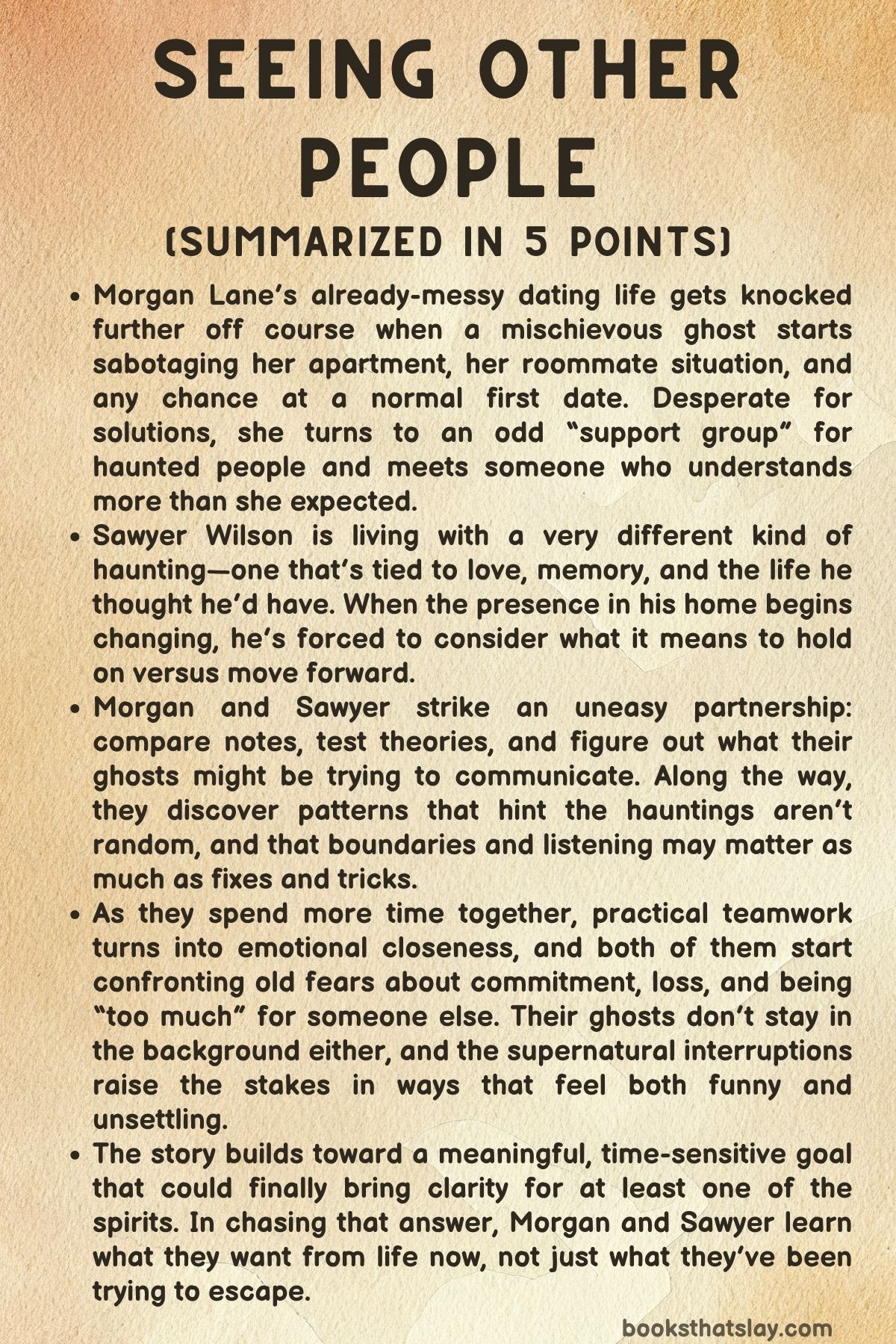
Seeing Other People by Emily Wibberley and Austin Siegemund – Broka is a contemporary romantic comedy with a paranormal twist, set in Los Angeles. Morgan Lane can’t keep a date, mostly because she’s being followed by the ghost of a man she barely knew.
Across town, Sawyer Wilson is still living with the presence of Kennedy, the fiancée he lost years ago, and he’s stuck between devotion and letting go. When Morgan and Sawyer meet at a support group for the haunted, they strike an uneasy partnership: figure out what their ghosts want, fix what’s unfinished, and reclaim their lives—if their hearts don’t complicate the plan first.
Summary
Morgan Lane is running late for a first date at a climbing gym when her apartment acts up again. Her closet rattles, hangers clack like teeth, and the simple task of grabbing her climbing shoes becomes a fight with the invisible.
Her roommate Savannah has had enough; after a night of strange laptop behavior and doors slamming on their own, she announces she’s leaving for her parents’ house and won’t return unless Morgan handles the haunting by the end of the month. Morgan can’t afford the rent alone, can’t break the lease, and feels the pressure closing in from every direction.
The source of the chaos appears soon after: Zach, a ghost tied to Morgan ever since a single disappointing date three months earlier. He is cocky, irritating, and strangely familiar, as if he’s been in her life much longer than he has any right to be.
Morgan doesn’t even know his last name, and Zach himself can’t remember much beyond fragments and the fact that his last living night ended with Morgan. He claims he can’t fully control the disturbances, but Morgan doesn’t believe him—especially when her date, Dan, shows up early, overhears her talking to “Zach,” and bolts after Morgan tries to explain that Zach is dead.
Furious and cornered, Morgan decides she needs a solution fast. She attends a “Support and Resource Group for the Haunted” hosted in a crystal shop, expecting practical advice.
Instead, she finds a messy mix of hobbyists, gossipers, and people selling paranormal-themed businesses. Still, one attendee stands out: Sawyer Wilson, quiet and guarded, who admits he’s been haunted for five years.
When Morgan describes her experience—especially the way a specific pop song gets forced into her head—Sawyer recognizes it. He is clearly dealing with something real, even if he speaks about it with a calm that makes Morgan want to scream.
Sawyer’s ghost is Kennedy, his fiancée, who died five years ago from an undiagnosed heart condition. Sawyer has tried to keep life going inside the haunted house they once built together, but the haunting has shifted.
Kennedy has become distant, fading in and out more than before, and Sawyer can’t decide whether that change is mercy or punishment. Morgan wants her ghost gone.
Sawyer isn’t sure he wants his to leave at all.
After the meeting, Morgan chases Sawyer down, convinced he’s her best lead. Their conversation is interrupted when Sawyer’s tire blows out violently, as if something punched the rubber from within.
Sawyer senses Kennedy’s cold presence and realizes she caused the damage to force him to keep talking to Morgan. With Sawyer stranded, Morgan suggests they get food at a paranormal-themed bar called Serving Spirits.
Over burgers and gimmicky gadgets, Morgan and Sawyer compare details. Morgan’s ghost is reactive, petty, and intrusive.
Sawyer’s is domestic and quiet, once folding blankets and putting away dishes, like someone still trying to care for the home.
A new idea emerges: the ghosts aren’t staying because the living can’t move on; they are staying because something is unfinished. Morgan latches onto the thought like a lifeline.
Sawyer, reluctant but worried about Kennedy’s fading, agrees to test the theory. When Morgan later follows Sawyer home, she finds a beautiful Silver Lake house with a yard that’s gone dead and wild.
Sawyer admits Kennedy always wanted the landscaping done after renovations, but grief stopped him. He offers Morgan an unexpected deal: she can live rent-free in a detached studio on his property if she helps revive the yard at her own pace.
Morgan, desperate for stability and unable to keep her current apartment, accepts.
Living on Sawyer’s property changes everything. Morgan throws herself into yard work, spending dawn hours pulling dead plants and clearing space.
Sawyer begins repairing his home again, and the two settle into a tentative routine that feels safer than either expected. Zach tags along, commenting, teasing, and occasionally sabotaging.
Morgan learns that Zach’s memories can be triggered by familiar objects and places; in the garage, he suddenly knows how to relight the pilot on a water heater, as if his past is stored inside everyday knowledge.
Morgan and Sawyer search online and discover Zach’s full name: Zach Harrison. There’s an upcoming celebration of his life at Harrison’s Hardware.
Morgan is terrified of meeting his family, but Sawyer goes with her. At the hardware store, they meet Zach’s father, Bill Harrison, who can’t see Zach but feels the weight of his absence.
Sawyer speaks honestly about grief—how it turns a home into a set of rooms where you keep expecting someone to appear. Morgan helps by describing small details Zach points out, like the shape of his thumbnails and a scar, giving Bill a sudden, precious recall.
Bill invites them to sit, drink coffee, and share stories, and the encounter leaves Morgan shaken in a new way: Zach had a life full of people, and she’s the one who’s been stuck with him.
As weeks pass, Morgan and Sawyer grow closer. They text even though they live a few steps apart.
Sawyer buys Morgan a plant she admired, a quiet gesture that lands harder than grand romance ever did. He returns to pottery, setting up a wheel in Morgan’s studio, and for a moment it feels like both of them are choosing life again.
Then Zach’s haunting spikes. The studio shakes, pottery shatters, a pipe bursts, and the chaos is so violent that Sawyer is cut—yet seconds later the room snaps back into normal as if nothing happened, leaving only splattered clay and Sawyer’s bleeding wound as proof.
Zach appears pale and unstable, confused and frightened by what he’s doing. They realize they’re running out of time; if Zach doesn’t resolve what he needs, someone will get hurt.
To draw out Zach’s missing memories, they use a Ouija board at Serving Spirits. The pointer spells “A-N-A,” again and again.
Sawyer connects it to Zach’s sister, Ariana. Morgan messages her, but days pass without a reply.
During that silence, Sawyer spirals. He tries to lure Kennedy’s presence with her favorite song, movie, and wineglasses set out like an altar.
Morgan finds him wrecked on the couch and sits with him, insisting he can’t keep being engaged to someone who isn’t alive. In the closeness, Sawyer kisses Morgan—brief, charged, and immediately terrifying to him.
The house goes cold, the music cuts, and Sawyer panics, convinced Kennedy is angry.
That night, Kennedy appears to Morgan. She explains she has been avoiding Sawyer on purpose, hoping distance will push him to move forward.
She admits she still loves him, but their relationship is over, and her remaining task is to get Sawyer to let her go. Morgan, stunned, understands that helping Sawyer may mean stepping into the role Kennedy can’t fill anymore.
Ariana finally replies and invites them to her home. They arrive expecting an interview about Zach and instead walk into a child’s birthday party—Ariana’s son, Henry, celebrating with a dragon theme.
Morgan brings the ceramic dragon-head mug Zach kept clinging to and gives it to Henry, saying Zach wanted him to have it. The gift hits like a match to dry kindling: Henry is ecstatic, Ariana cries, and Zach believes this act should free him.
But nothing happens. His frustration kicks up a storm of small disasters, and as they leave, Morgan notices Zach’s van in the driveway.
The “A-N-A” clue suddenly points somewhere else.
Inside the van, they find a hidden surfboard marked with doodles and signatures. Zach remembers a tradition with his old friends: “The Perfect Weekend,” an annual reunion at San Onofre where they surfed, camped, and promised not to let adulthood erase them.
The tradition is scheduled for the last weekend of August—this weekend. Zach’s unfinished task is clear: one last Perfect Weekend.
Morgan agrees to drive the van south, and Sawyer insists on coming, terrified of losing Zach and, by extension, everything that has changed since Morgan arrived. On the road, tension erupts when Zach reveals Morgan has plans to move to Massachusetts.
Morgan and Sawyer fight until Zach forces a terrifying near-crash by messing with the van’s controls, making them stop and face what’s happening. He doesn’t want to leave them broken.
They agree to hold their arguments until Zach gets his goodbye.
At San Onofre, Zach’s friends welcome Morgan and Sawyer without hesitation. They surf, share meals, trade stories, and sit by a bonfire while Morgan finally feels part of something steady.
Sawyer admits to the group that Zach pushed him toward Morgan, trying to make them happy. Later, alone by the van, Morgan confesses her fear of never staying anywhere long enough to matter.
Sawyer tells her he wants her here, alive and present, not as a memory. He says he loves her, and they choose each other while Zach watches, satisfied.
In the morning, Morgan gives Zach letters she gathered from everyone who loved him. Zach asks her to look after his family and Sawyer.
Morgan turns away so her last image is his smile. As he reads, he glows and disappears, and the wind carries the letters outward.
Morgan collapses into Sawyer’s arms, and they drive home with the radio crackling into “Call Me Maybe,” laughing through their grief.
Two months later, Morgan and Sawyer live together in Los Angeles. Sawyer is making pottery again and rebuilding connections he abandoned.
Together, they plant lilies in the garden with Kennedy’s ashes, and a soft wind and distant music suggest that letting go doesn’t erase love—it just makes room for living.
Characters
Morgan Lane
Morgan is defined by motion—she’s always hustling, always improvising, always trying to outrun the feeling that her life can collapse if she stops moving. In Seeing Other People she enters the story as someone who treats dating like a low-stakes distraction and treats stability like a trap, yet the haunting forces her into the exact kinds of conversations she’s spent years dodging: money, commitment, family, and the emotional cost of leaving.
Her “perpetually unlucky” dating history isn’t just bad luck; it’s a pattern of self-protection shaped by a past engagement that taught her how fast a future can solidify around her until she can’t breathe. The presence of Zach exposes how fragile her coping strategies are—she can’t ghost her way out of this one—and the threat of losing Savannah as a roommate turns her fears into practical urgency.
As she moves into Sawyer’s guesthouse and takes on the yard, Morgan’s growth is visible in her willingness to stay, to be accountable, and to build something slowly even when it overwhelms her. What makes her compelling is the contradiction she carries: she insists she doesn’t do seriousness, but she is fiercely loyal once she chooses to show up—whether that means advocating for Sawyer’s health insurance, facing Zach’s grieving father, or collecting letters from the people who loved Zach so his goodbye can be full and true.
By the end, Morgan’s arc isn’t about becoming fearless; it’s about choosing presence over escape, learning that intimacy doesn’t have to be a cage, and realizing she can be someone who stays.
Zach Harrison
Zach is the chaos engine of the haunting, but he’s also the story’s most surprising emotional mirror—he arrives as an annoyance and becomes a catalyst for everything that heals. His ghosthood is marked by limitation: he can’t fully control the phenomena, he can’t remember his own death, and his identity is reduced to fragments of childhood and a single “shitty date.” That amnesia isn’t just a plot device; it makes him painfully human, because he’s stuck with the same question the living characters are wrestling with—who am I when the relationship I thought defined me is gone?
Zach’s prankish tormenting of Morgan reads like immaturity at first, but over time it becomes clearer that it’s also panic, loneliness, and a desperate need to be acknowledged as real. The more Morgan and Sawyer treat him like a person rather than a problem, the more his personality sharpens: funny, impulsive, emotionally perceptive, and oddly protective.
His haunting intensifies into something dangerous during the “earthquake” episode, revealing that unresolved need can turn grief into violence even when the person doesn’t want harm; that moment reframes him from mischievous to frightening and raises the stakes of his unfinished business. Yet Zach’s deepest trait is care—he pushes Morgan and Sawyer toward honesty, he nudges Sawyer back to pottery, and he tries (in his messy, extreme way) to make sure they won’t fall apart when he leaves.
His unfinished business ultimately isn’t about an object or a single message; it’s about belonging—getting one last Perfect Weekend where he is remembered among friends, where love for him is spoken aloud, and where he can depart knowing the living will keep living. His final release—glowing, disappearing, letters scattering—lands because he earns it not by “fixing” everything, but by being fully seen.
Sawyer Wilson
Sawyer begins as a man practicing emotional stasis: he lives in a beautiful house that’s slowly turning into a monument, and he treats his haunting not as a crisis but as a continuation of the only relationship he’s been able to tolerate since loss. His grief is structured, domestic, almost ritualistic—anniversary dinners, favorite songs, carefully preserved spaces—because routine is the closest thing he has to intimacy with Kennedy now.
That makes him initially resistant to Morgan’s urgency; where she sees the haunting as sabotage, he experiences it as proof of love. But his attachment also contains fear: if Kennedy fades, he worries it means he’s failing her, forgetting her, or letting her die a second time.
Sawyer’s sharpness and irritability often come from that fear, especially when Morgan threatens to change the yard or disrupt the house’s frozen state. His relationship with Morgan forces him to confront a truth he’s avoided for five years: love cannot be sustained as a ghost story without shrinking the living person who remains.
The most important shift in him is not romantic—it’s existential: he starts reentering life. He cleans and prepares a space for Morgan, he returns to pottery (a craft tangled with the impossible task of making an urn), and he begins to imagine a future that includes desire and creativity rather than only memorialization.
The kiss with Morgan exposes the tension between longing and guilt, but Sawyer’s real progress comes when he accepts Kennedy’s love without using it as a reason to stop moving forward. By the end, Sawyer isn’t “over” grief; he is integrated with it—planting lilies with Kennedy’s ashes is not an erasure of their bond, it’s a transformation of it into something that can coexist with Morgan and with a life that continues.
Kennedy
Kennedy’s presence in Seeing Other People is shaped by a paradox: she is both the comfort Sawyer clings to and the barrier he must move through. Unlike Zach, her haunting is initially gentle and caregiving—mail collected, blankets folded—suggesting that love persists through habit and care even after death.
But her increasing distance becomes the story’s most painful haunting mechanism, because it weaponizes absence: Sawyer feels punished, abandoned, and terrified that his grief is either too much or not enough. When Kennedy finally speaks plainly, she reveals her complexity—she still loves Sawyer, but she refuses to let love trap him in a life that is effectively already over.
Her “unfinished business” isn’t a task to complete in the world; it’s a boundary to establish in the heart of the person she left behind. By appearing to Morgan, Kennedy shows agency and clarity: she chooses the person who can reach Sawyer in ways she no longer can, and she does so not out of jealousy but out of acceptance.
There’s also vulnerability in her—she admits fear of fading when she doesn’t manifest, which turns her from an idealized memory into a frightened consciousness trying to let go without disappearing too soon. Kennedy functions as a kind of emotional truth-teller in the narrative: she forces the story to say out loud that devotion can become self-harm, that love can be real and still be over, and that release is not betrayal.
Her final influence remains as a tenderness rather than a chain, hinted at through wind and music that feel less like possession and more like blessing.
Savannah
Savannah is the story’s pressure valve—the character who refuses to normalize the supernatural chaos and, by doing so, exposes the real-world consequences Morgan tries to laugh off. She isn’t just a roommate inconvenienced by a haunting; she is a boundary-setter who demands safety, rest, and basic dignity in a home, and her ultimatum forces Morgan to confront the fact that “handling things later” is no longer an option.
Her fear feels grounded: the laptop that won’t close, the door that slams, the sense of being watched—these are violations of privacy that make the apartment unlivable, and Savannah’s decision to leave is a rational act of self-preservation. Narratively, she represents the life Morgan is about to lose if she can’t change—financial stability, companionship, and the ordinary comfort of sharing burdens.
Even when she exits the main action, her impact continues, because her departure is what pushes Morgan into the support group, into Sawyer’s orbit, and into a living arrangement that becomes transformative. Savannah’s role is brief but essential: she’s the voice that says this isn’t quirky, it’s harmful—and that insistence becomes the first step in Morgan finally taking her own situation seriously.
Dan
Dan appears for a short time, but he’s important because he functions as the “normal world” reacting to Morgan’s abnormal reality. He is not portrayed as cruel; he is simply outmatched by a situation no one prepares for on a Tinder date.
His suspicion that Morgan is hiding an ex reflects the ordinary framework people use to interpret discomfort, and his exit highlights how isolating Morgan’s haunting has become—she can’t even access casual romance without the supernatural turning it into humiliation. Dan’s quick departure also sharpens Morgan’s sense of grief and rage: she isn’t mourning Dan specifically, she’s mourning the possibility of an uncomplicated connection.
As a character, he underscores the theme that people leave when things get strange, and that Morgan’s real work is not convincing strangers to stay but learning how to face the strangeness directly.
Michael
Michael exists mostly in backstory, but his shadow is large because he is the origin point of Morgan’s fear of commitment and her belief that she is a “liability.” The failed engagement functions as emotional evidence Morgan carries: proof that when things become serious, she runs, and proof that she can hurt people by vanishing. Even without direct scenes, Michael’s significance lies in how Morgan interprets that history—not as a youthful mismatch, but as a verdict on her character.
That internal narrative drives many of her choices: keeping relationships casual, minimizing her needs, and avoiding long-term planning. As Morgan grows closer to Sawyer, Michael’s role becomes clearer as the formative wound that Morgan must reframe; she doesn’t have to erase the past or pretend the engagement didn’t matter, but she does have to stop treating it as destiny.
Michael is less a person on the page than a key to Morgan’s psychology: the reason she equates staying with suffocation and leaving with survival.
Mr. Bill Harrison
Zach’s father is the novel’s most direct embodiment of active grief, and his scenes give the haunting moral weight by anchoring it in a real family’s loss. He initially resists engagement not because he is unkind, but because speaking about Zach risks re-opening a wound he’s been trying to cauterize just to function.
His confession—struggling to picture his son’s thumbs—captures the terror of bereavement: not just missing someone, but losing the sensory details that made them specific. When Morgan describes Zach’s hands and the scar, she gives him something grief has been stealing, and the moment becomes an exchange of care across the boundary between living and dead.
Mr. Harrison’s openness afterward—inviting them for coffee, offering stories—also shows what healing can look like: not “moving on,” but keeping the person present through memory shared with others. He matters because he transforms Zach from an annoying ghost into a beloved son, and that shift changes how the reader understands what’s at stake in Zach’s unfinished business.
Ariana Harrison
Ariana is both clue and counterpoint: she provides a link to Zach’s life while also demonstrating how grief looks different across a family. Her initial non-response and later invitation to the party suggest someone who is busy surviving—parenting, managing logistics like a van in the driveway, and carrying loss in the background of daily life.
The birthday party setting is crucial, because it shows grief existing alongside celebration; Zach is absent, but life is still happening, themed with dragons, full of noise and children. Ariana’s reaction to the dragon mug—tears, emotion, recognition—reveals the depth beneath her practical surface, and it also validates Morgan’s role as a messenger for Zach’s love.
Ariana is important not only for the mystery thread (the A-N-A clue and the van) but for the emotional one: she helps demonstrate that unfinished business is often relational, tied to the people left behind and the objects that still carry a person’s imprint.
Henry
Henry represents innocence and continuity, and his presence makes the transfer of Zach’s dragon mug feel like more than a plot beat—it becomes a small act of legacy. Henry’s joy is uncomplicated, which creates a stark contrast to the adults’ grief and tension; he receives the mug not as a symbol of death, but as a magical, thrilling dragon treasure.
That matters because it reframes remembrance as something that can be light as well as heavy. Henry also becomes a test of Zach’s assumptions: Zach thinks this gift might free him, but it doesn’t, teaching him (and the story) that love expressed once isn’t always the whole unfinished business.
Henry’s role is brief, but emotionally potent: he is proof that Zach’s life touched future generations, and that meaning can pass forward even when the person cannot.
Themes
Grief as a daily environment rather than a single event
Loss in Seeing Other People shows up less like a dramatic moment and more like weather that changes the temperature of everything around it. Sawyer’s life is organized around absence that still behaves like presence: a dinner set for two, a song that comes on at the wrong time, a living room arranged like a shrine.
His ghost, Kennedy, does not simply represent sadness; she represents the way grief can keep routines running while quietly taking away the future that routine once pointed toward. The haunting forces him to confront how much he has been using familiarity as a substitute for living.
He is not only mourning Kennedy’s death; he is mourning the version of himself who expected a shared adulthood, and the house becomes proof of a plan that stalled. Morgan’s situation looks different because her ghost is tied to a near-stranger, but the emotional mechanics rhyme: she is being followed by something unresolved, something that insists on being acknowledged even when she wants to keep moving.
In both cases, grief becomes social. Sawyer’s isolation is understandable, yet it also reduces Kennedy into the only relationship he trusts.
Morgan’s loneliness is loud and chaotic, and the haunting makes ordinary connection feel impossible, so she defaults to avoidance and jokes. The story treats grief as something that can distort love in opposite directions—one person clinging so hard that life narrows, another person fleeing so hard that life never deepens.
The pressure of the ghosts gradually pushes both toward a more honest relationship with what they have lost: not a “getting over it” message, but a shift from worshiping the loss to carrying it with integrity. By the end, the small acts—planting, returning to craft, telling stories out loud—matter because they show grief becoming integrated into life rather than replacing life.
Boundaries, consent, and the right to be a person again
The hauntings in Seeing Other People constantly test where one person ends and another begins. Morgan’s experience is especially invasive: music forced into her head, objects moved to embarrass or sabotage her, a closet that refuses to cooperate at the worst moment.
Even when the haunting is played for humor, the emotional point is serious: she has no control in her own home, and that lack of control bleeds into her ability to date, work, and feel safe. Sawyer’s haunting begins as something gentler—helpful domestic touches that mimic partnership—but that gentleness is precisely what makes it complicated.
He has treated Kennedy’s ghost as a continuation of their relationship, but the story steadily challenges whether comfort can become a trap when it prevents honest consent and mutual growth. Kennedy cannot fully participate like a living partner, and Sawyer cannot fully grieve while acting as if the relationship still functions.
Morgan, meanwhile, is forced to learn that “getting rid of” Zach is not the only possible response; she has to negotiate terms of coexistence long enough to solve what he needs. That negotiation becomes a training ground for her broader life: stating needs clearly, refusing to be bullied by someone else’s moods, and accepting that her discomfort is valid even if another person’s pain is real.
The theme expands beyond ghosts into romance. Morgan’s habit is to disappear when intimacy asks for responsibility; Sawyer’s habit is to stay loyal past the point where loyalty starts erasing him.
Their connection grows once they stop treating boundaries as cruelty. Morgan has to accept that staying is a choice she can make without guaranteeing a perfect outcome.
Sawyer has to accept that moving forward is not betrayal. The story’s emotional spine is that love without boundaries turns into captivity, and boundaries without love turn into isolation.
The ghosts externalize these pressures so the characters can finally practice being fully human again—present, accountable, and allowed to want things.
Avoidance, self-protection, and the fear of being “too much”
Morgan’s choices are shaped by an old belief that she is a liability: someone who ruins plans, disappoints people, and leaves before she gets left. Her history—dropping out, a failed engagement, perpetual bad dating—has trained her to treat seriousness like danger.
The haunting amplifies that reflex because it makes her look unstable to others; even a simple Tinder date becomes a scene where she sounds like she is hiding secrets. Instead of receiving support, she gets suspicion and exit lines, which confirms her worst assumptions about herself.
Her instinct is to manage pain by keeping everything light and temporary. What the story does well is show that avoidance can look like independence while functioning like fear.
Morgan’s minimal possessions, her readiness to relocate, her joking tone—these are not only personality traits; they are strategies to reduce attachment so that loss will hurt less. Sawyer’s avoidance is quieter but equally strong.
He avoids the yard, avoids pottery, avoids dealing with insurance, avoids the support group’s implications, avoids telling the truth about how lonely he is. He presents stability, but he is also stuck.
The ghosts function as a forced confrontation with what each person has been refusing to touch. Zach’s escalating poltergeist moments mirror Morgan’s internal panic: when emotions rise, her system tries to blow the room apart and then pretend nothing happened.
Sawyer’s refusal to remove a dead tree mirrors his refusal to accept that something in his life has ended. Over time, each character becomes a mirror for the other’s coping style.
Morgan’s directness challenges Sawyer’s polite stagnation; Sawyer’s steadiness challenges Morgan’s impulse to vanish. The narrative insists that self-protection can become self-erasure if it is never questioned.
Morgan has to learn that being “too much” for the wrong people is not proof she is broken, and Sawyer has to learn that being “fine” is not proof he is coping. When they finally speak honestly—about fear, about leaving, about wanting—connection becomes possible without pretending pain does not exist.
Memory, identity, and the work of being remembered accurately
Zach’s situation turns identity into a mystery with emotional weight. He is present but incomplete, reduced to scraps: a first name, a song, the sensation of climbing, random knowledge of a water heater.
His complaint that Morgan does not know his last name is not just a funny detail; it underlines how easily a person can become a blur in someone else’s story, especially in modern dating where people pass through each other’s lives quickly. The haunting becomes an argument against that blur.
Zach’s unfinished business depends on being recognized as a full person—someone with family, friends, routines, and traditions. The visit to his father highlights how grief can erase details even as love remains.
Mr. Harrison cannot picture Zach’s thumbs, and that small missing image becomes devastating because it represents the fear that memory will keep dissolving until the person feels unreachable. Morgan’s description of the scar and the shape of the nails matters because it restores specificity.
The story treats memory as something you actively preserve rather than passively keep. Sawyer’s regret about not talking about Kennedy is part of the same theme: silence is not respectful if it makes the person fade from conversation and therefore fade from shared reality.
Memory becomes relational labor—telling stories, naming details, returning objects to the people who can hold them with meaning. The surfboard signatures, the “Perfect Weekend” tradition, the dragon mug, the letters gathered from friends—all of these objects work like anchors.
They confirm that Zach existed beyond the final moment of his death and beyond Morgan’s single awkward date. At the same time, the theme challenges the idea that remembering means holding on forever.
Kennedy’s fading suggests that memory can remain even after presence goes away; what matters is whether the living allow the dead to have a complete story rather than a frozen role. By helping Zach reunite with the people who know him, Morgan also redefines herself: she becomes someone capable of responsibility and care, not just someone who escapes.
Memory, in this book, is not nostalgia; it is a form of respect that heals both the remembered and the rememberers.
Love after loss and the tension between loyalty and a future
Sawyer’s engagement to Kennedy complicates the usual romantic arc because it forces the question of what loyalty means when the person you love is gone but not gone enough to disappear from your home. His yearning is understandable: he wants signs, conversations, the illusion that the relationship still has a rhythm.
But the story refuses to romanticize that stasis. Kennedy herself makes the ethical argument that love does not require Sawyer to stop living.
Her presence becomes painful not because she stops caring, but because she cares and still cannot be his partner in a way that allows growth. That creates a tension where Sawyer’s devotion starts to resemble a refusal to accept Kennedy’s autonomy—even in death—because he needs her to stay for him.
Morgan’s role is not to “replace” Kennedy; instead, she becomes a catalyst that reveals what Sawyer has postponed: human touch, conflict that can be resolved, plans that move forward. Their developing relationship is messy precisely because Sawyer’s grief is not finished business and Morgan’s fear of commitment is not cured.
The kiss that triggers panic shows that new love does not arrive as a clean chapter; it arrives while old bonds still carry power. Morgan’s blunt line—he cannot be engaged to a ghost—cuts because it is true and because it exposes how socially acceptable it is to celebrate loyalty even when loyalty becomes self-harm.
The story also makes room for the guilt that often follows new love after loss. Sawyer worries he is betraying Kennedy; Morgan worries she is benefiting from tragedy.
The resolution does not come from pretending Kennedy did not matter. It comes from reframing: Kennedy’s unfinished business is not revenge or romance, but Sawyer’s return to life.
When Sawyer begins pottery again, enrolls in health insurance, and allows himself to want, that is not a rejection of Kennedy’s memory; it is evidence that her love helped shape a person who can keep going. The final gestures—gardening, ashes, shared home—show love after loss as something built with tenderness and honesty, where the past is acknowledged without being allowed to control the future.
Community, chosen family, and the healing power of shared witnessing
Isolation is one of the quiet antagonists in Seeing Other People. Morgan begins alone in a practical sense—financially stressed, roommate leaving, dating failing—and also alone in the deeper sense of not feeling understood.
Sawyer’s isolation is more polished but more entrenched, protected by a house that looks nice from the street and dead from the yard. The haunted support group initially appears ridiculous and commercial, which makes sense: when people are desperate, industries form around their desperation.
Yet even that imperfect space provides a crucial function—it introduces the possibility that haunting is not a private shame. Morgan and Sawyer meeting there is significant because it starts as a pragmatic alliance and becomes the first real companionship either has had in a while.
The story then expands that companionship into wider circles. Zach’s friends at San Onofre welcome Morgan and Sawyer without requiring credentials, because grief has already taught them that what matters is showing up.
They treat strangers as part of the weekend because the weekend is, at heart, a ritual of remembering. That welcome gives Morgan a corrective experience: staying somewhere does not always mean being trapped; it can mean being held.
It also gives Sawyer a model for love that includes other people rather than excluding them. The letters Morgan collects are another form of community healing.
They turn private pain into shared tribute, and they relieve the living from the burden of pretending they are fine. Even the humor—teasing, chanting, ridiculous bar gimmicks—serves a purpose: it reminds the characters that joy can exist alongside loss without disrespecting the dead.
By the end, the community is not an accessory to the romance; it is part of what makes romance sustainable. Morgan and Sawyer do not heal by becoming each other’s entire world.
They heal by letting more people, memories, and responsibilities into their world. The book’s emotional logic suggests that haunting becomes dangerous when it collapses a life into one relationship, and it becomes bearable when it is witnessed, spoken about, and carried together.