Sense and Suitability Summary, Characters and Themes
Sense and Suitability by Pepper Basham is a delightful and heartwarming tale set in Regency England, where societal expectations and personal desires collide. The story follows Emmeline Lockhart, a young woman with a secret: she is the anonymous author of sensational novels, full of pirates and daring adventures.
Emmeline’s life takes a turn when she becomes entangled with Simon Reeves, a man of higher social standing whose future is clouded by family obligations and his own heart’s desires. Through twists of fate, misunderstandings, and emotional struggles, both Emmeline and Simon must navigate the complexities of love, duty, and self-discovery, all while facing the pressures of society’s rigid norms.
Summary
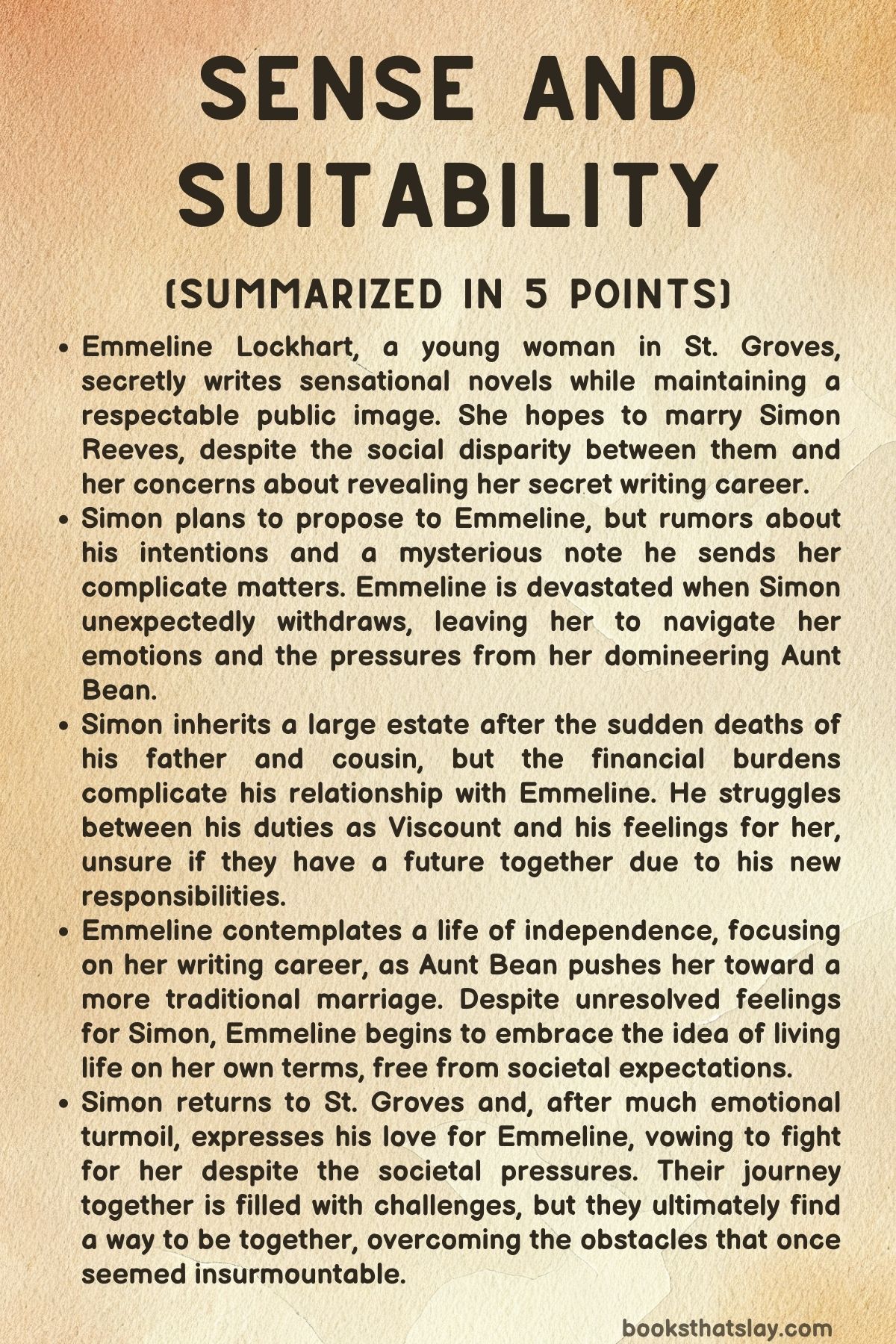
Emmeline Lockhart lives in the spa town of St. Groves, hiding a secret from her family and society: she is the anonymous author of scandalous novels about pirates, kidnappings, and adventures. Despite her lack of wealth and social standing, she dreams of a future with Simon Reeves, a man she believes will propose to her at the grand ball hosted by Lord and Lady Ruthton.
Simon, cousin to the newly inherited Viscount of Ravenscross, has promised to propose, but their engagement would be a surprising match due to their different social statuses and Emmeline’s secret writing career.
Emmeline’s hopes are dashed when she receives a note from Simon at the ball, telling her that “everything has changed” and asking for her forgiveness. This leaves her heartbroken and confused.
The next day, her life is further complicated by the arrival of her Aunt Albina, a domineering woman who insists on finding a wealthy husband for Emmeline. Emmeline’s father, a quiet man, avoids confrontation and lets Aunt Bean take control.
While Emmeline struggles with the loss of Simon, her cousin Thomas, a clergyman, encourages her to reveal her writing career to her father, as her novels are doing well financially.
Meanwhile, Simon’s life has become increasingly difficult. After the deaths of his father and cousin, Simon inherits the title of Viscount of Ravenscross and a massive estate burdened with debts.
As the head of the family, he feels the pressure to marry someone wealthy in order to restore the estate. Despite his deep feelings for Emmeline, his new responsibilities force him to push her aside.
His emotional turmoil grows as he faces the challenges of his new life, torn between his duty to his family and his love for Emmeline.
At a ball in St. Groves, Simon and Emmeline briefly reconnect, but their interaction is strained. Emmeline is hurt by Simon’s earlier abandonment, and rumors of his flirtations with other women cause her to question his true intentions.
Simon, meanwhile, is torn between his responsibilities and his feelings for Emmeline. He struggles with the notion of marrying for convenience to secure his family’s future, but his heart still longs for her.
Their brief reunion only complicates their emotions further.
Emmeline, determined to protect herself from further heartbreak, begins to consider independence as a writer. As Aunt Bean continues to push her toward marriage, Emmeline contemplates her future and whether it lies in a traditional marriage or in pursuing her own career.
Simon, struggling with his feelings for Emmeline and his obligations to his family, becomes increasingly conflicted. The societal pressures on both of them only add to their emotional turmoil.
In a chance encounter at the theater, Simon finds himself conflicted over his feelings for Emmeline, especially when he sees her spying on him with Miss Clayton, a woman his family is encouraging him to marry. Simon realizes that he still loves Emmeline but is unsure how to reconcile his feelings with the practicalities of his responsibilities.
Meanwhile, Emmeline prepares to leave St. Groves and travel to Yorkshire in an attempt to move on from her heartache. She also learns that her father has known about her writing career all along and supports her.
Simon’s emotional journey continues as he grapples with his desire for Emmeline and his need to secure a financially advantageous marriage. He becomes resolute in his decision to marry Emmeline, regardless of the financial challenges it may bring.
He realizes that his love for her is real and that he must act on it, despite the pressure from society and his family.
As the tension between them reaches its peak, Simon confesses his love for Emmeline and apologizes for his past mistakes. He vows to fight for a future with her, and Emmeline begins to reconsider her decision to leave.
She acknowledges the depth of her own feelings for Simon but remains hesitant, unsure if his love is enough to overcome the social and financial obstacles in their way.
Simon’s aunt, Agatha, initially resistant to the match, eventually relents and acknowledges the strength of their bond. With her reluctant approval, Simon prepares to propose to Emmeline, fully aware of the challenges they will face as a couple.
As Simon reads one of Emmeline’s books, he is struck by her talent and the way she has portrayed his own struggles. He realizes how well she understands him and is even more determined to marry her.
However, Emmeline’s secret as a writer is revealed, and she faces public scrutiny. She confesses her writing career to Simon, who is initially shocked but reassures her that he loves her despite her past.
Emmeline, feeling the weight of her secret and its potential consequences for Simon, decides to leave, believing that her presence will only complicate his life further.
Simon, unable to let go of Emmeline, races to find her just as she is about to leave. He expresses his unwavering love for her and his willingness to face any challenge to be with her.
Moved by his commitment, Emmeline agrees to marry him, and they embark on a life together, despite the uncertain future ahead.
In the end, Simon and Emmeline marry, overcoming the societal pressures that once threatened to keep them apart. Their love, based on mutual respect, understanding, and sacrifice, allows them to build a future together.
Simon restores the Ravenscross estate, and the couple begins their married life with renewed hope, knowing that love will guide them through any challenges they may face.
Characters
Emmeline Lockhart
Emmeline Lockhart is a deeply complex character, caught between her love for Simon Reeves and her desire to maintain her independence. As the daughter of a country gentleman, Emmeline holds a respectable position in society, yet her secret career as a writer of sensational novels places her at odds with the traditional expectations for women of her class.
Her novels, filled with adventure and excitement, starkly contrast the demure image that society expects of her. Despite this, she harbors a deep vulnerability regarding her secret, knowing that its exposure could ruin her reputation.
Emmeline’s emotional journey is largely defined by her tumultuous relationship with Simon, a man she believes to be her true love, though she is constantly plagued by doubts about his commitment and their future together. Her heart is torn between her longing for a future with Simon and the pressure to live up to society’s expectations.
Her growth throughout the novel is marked by her increasing realization that she does not need to rely on Simon—or any man—to secure her happiness. She starts to embrace her writing as a means of personal empowerment, taking the first steps towards independence.
Emmeline’s internal struggle between love and self-preservation forms the core of her character arc, ultimately leading her to a path where she chooses to forge her own future, guided by her heart and her ambitions.
Simon Reeves
Simon Reeves, who later becomes the Viscount of Ravenscross, is a man of conflicting desires and responsibilities. At the beginning of the novel, he is portrayed as a charming, carefree gentleman with a growing affection for Emmeline.
However, his inheritance of the viscountcy, coupled with the estate’s significant debts and his new obligations to his family, forces him to reconsider his romantic choices. Simon feels the weight of societal expectations, which push him toward a financially advantageous marriage, and he struggles to reconcile this with his feelings for Emmeline.
Throughout the story, Simon’s character evolves from a man swept up in romantic infatuation to someone who understands the heavy burden of duty and responsibility. His love for Emmeline is genuine, but his growing sense of duty toward his family and estate complicates his feelings.
As the novel progresses, Simon’s internal conflict deepens, and he finds himself torn between following his heart and making pragmatic decisions for the future. His struggles highlight the tension between love and duty, as he must navigate the social pressures surrounding him, ultimately finding the courage to defy expectations and pursue his happiness with Emmeline.
Aunt Bean (Albina Lockhart)
Aunt Bean, or Albina Lockhart, is a formidable and overbearing presence in Emmeline’s life. She represents the societal pressures that Emmeline faces as she attempts to navigate her own desires with the expectations of her family and society.
Aunt Bean’s primary concern is securing a suitable marriage for Emmeline, and she is relentless in her pursuit of this goal. Her interference in Emmeline’s love life and personal choices is a source of constant frustration for Emmeline, as Aunt Bean continuously criticizes her niece’s previous failed attempts at marriage and scolds her for not securing a wealthy and advantageous match.
Despite her harsh approach, Aunt Bean’s actions stem from a desire to protect Emmeline from the precarious social position she finds herself in. However, her approach ultimately reveals the rigid and often stifling nature of societal expectations, making her an antagonistic figure in Emmeline’s search for autonomy and love.
While Aunt Bean’s intentions may be rooted in concern, her inability to understand Emmeline’s need for independence and her disregard for Emmeline’s personal desires create tension, pushing Emmeline to assert more control over her own future.
Thomas Lockhart
Thomas Lockhart, Emmeline’s cousin, is a clergyman who provides a source of support and counsel for Emmeline during the novel. While he is a well-meaning character, his advice to Emmeline to reveal her writing career to her father underscores his more traditional views on family and duty.
Thomas’s character functions as a stabilizing force in Emmeline’s life, offering her moral guidance in times of confusion and heartache. His suggestion that Emmeline reveal her writing to her father highlights his belief in transparency and honesty, values that contrast with Emmeline’s secretive nature.
Though Thomas is a source of emotional support, he is less attuned to Emmeline’s need for independence and self-expression, often focusing more on the familial expectations placed upon her. His character is a reminder of the pressure that Emmeline faces to conform to social norms, but his underlying affection for her is evident in the care he takes in looking out for her.
Aunt Agatha (Simon’s Aunt)
Aunt Agatha, Simon’s aunt, represents the social pressures that Simon faces as he navigates his responsibilities as the new viscount. She insists that Simon marry a woman of wealth and good reputation to secure the future of Ravenscross and restore the family’s financial standing.
While Aunt Agatha’s pragmatic approach to marriage is rooted in her concern for the estate and Simon’s future, she is blinded by her narrow view of what constitutes a suitable match. Her resistance to Emmeline as a potential bride for Simon reflects the class divisions and financial concerns that dominate much of Simon’s internal conflict.
Despite her initial opposition to their match, Aunt Agatha eventually softens and offers her reluctant approval, acknowledging the depth of Simon’s feelings for Emmeline. This shift marks a pivotal moment in the novel, illustrating how the power of love and emotional connection can transcend societal barriers, even for someone as rigid and conservative as Aunt Agatha.
Mr. Rushing
Mr. Rushing is an unwanted suitor who pursues Emmeline at the ball, further complicating her emotional turmoil. His persistent advances are unwelcome, and his actions serve to highlight the societal pressures placed on women like Emmeline to secure a marriage, even if it is with someone less than desirable.
Mr. Rushing’s role in the novel emphasizes the contrast between genuine love and the more superficial, transactional nature of other relationships in Emmeline’s world. His pursuit of Emmeline, though it causes her discomfort, also pushes Simon to intervene, sparking a pivotal moment in the relationship between him and Emmeline.
Through Mr. Rushing, the novel critiques the social pressures to marry for convenience rather than love, reinforcing the theme of true love versus societal expectations.
Selena Hemston
Selena Hemston is a character who embodies the pragmatic, calculated approach to marriage that Simon must contend with. Her proposal to Simon is cold and self-serving, as she sees marriage as a solution to both her ambitions and Simon’s financial troubles.
Her character is a foil to Emmeline, as Selena represents a world where love is secondary to financial and social stability. Simon’s rejection of her proposal underscores his internal struggle between duty and desire, as he ultimately chooses love over convenience.
Selena’s character serves as a reminder of the societal expectations placed on Simon to marry for wealth and status, and her rejection by Simon further highlights his devotion to Emmeline, despite the obstacles they face.
Themes
Love and Social Expectations
In Sense and Suitability, love is often at odds with societal norms, creating significant tension throughout the narrative. Emmeline’s love for Simon, and vice versa, is complicated by their social status differences.
Emmeline is the daughter of a country gentleman with limited wealth, while Simon, despite his genuine affection for her, is burdened by his duties as the new Viscount of Ravenscross. The pressures of class and wealth are ever-present in their relationship.
Simon feels the responsibility to marry someone of higher status to secure his family’s future, even though his heart belongs to Emmeline. This conflict forces Simon to question his values, as he is torn between societal expectations and his desire for genuine love.
Emmeline, on the other hand, navigates her position as a woman with little wealth or status, and she worries that her writing career—a secret she keeps hidden—might ruin her prospects in society. Despite these pressures, both characters grapple with their emotions and realize that love, in its truest form, cannot be constrained by social status.
Ultimately, Sense and Suitability explores how true love often requires individuals to go beyond social expectations and embrace personal desires, regardless of the external judgments they face.
Identity and Self-Discovery
Emmeline’s journey toward self-discovery plays a central role in the narrative. From the very beginning, she struggles with her secret identity as a writer of sensational novels.
Her work, often considered scandalous by societal standards, is something she must keep hidden from her family and potential suitors. This duality of living a public life while hiding her true self creates internal conflict.
Throughout the story, Emmeline’s interactions with Simon force her to confront who she is and what she wants from life. The tension between her desire for love and the pressure to conform to societal norms of marriage and reputation is a key aspect of her emotional growth.
As the plot unfolds, Emmeline comes to realize that she does not need to rely on marriage to secure her future. Her writing becomes a means of independence, offering her the freedom to define her own path outside of traditional gender roles.
The theme of self-discovery is also explored through Simon, who must reconcile his own identity as a nobleman with his longing for a life driven by love and personal fulfillment rather than duty alone. Their shared struggles highlight the importance of self-acceptance and staying true to one’s values despite external pressures.
Sacrifice and Duty
Sacrifice and duty are recurring themes in Sense and Suitability, particularly through Simon’s character. Simon inherits the title of Viscount of Ravenscross after the sudden death of his father and cousin, along with the immense financial burdens of the estate.
Faced with the weight of his new responsibilities, Simon initially believes that marrying a wealthy woman is the only way to ensure his family’s survival and the future of the estate. His deepening feelings for Emmeline complicate this decision, as he knows that marrying her, with her modest dowry and questionable reputation, will not be enough to alleviate his financial woes.
This sense of duty, both to his family and his inherited title, forces Simon to push Emmeline away, despite his love for her. For Emmeline, the theme of sacrifice is intertwined with her identity as a writer.
She must decide whether to keep her writing career a secret to maintain her social standing or embrace her work and risk scandal. Throughout the novel, both characters make sacrifices, weighing personal desires against their perceived responsibilities.
Ultimately, their journey highlights how personal happiness often requires sacrifices, but also how the pursuit of true love can be an act of defiance against the duties imposed by society.
Reputation and Scandal
The importance of reputation is a constant source of tension in Sense and Suitability. In a society where class and wealth dictate one’s social standing, the fear of scandal looms over Emmeline’s and Simon’s relationship.
Emmeline, in particular, struggles with the potential for her secret writing career to be exposed, as it could damage her reputation and ruin any chances of a respectable marriage. As a woman in a restrictive society, she must balance her passion for writing with the need to preserve her family’s respectability.
Simon, too, is caught in the delicate balance between his personal feelings for Emmeline and the public’s expectations of him as a nobleman. The rumors surrounding his flirtations with other women further complicate their relationship, as Emmeline becomes uncertain of his intentions.
In the end, Emmeline’s revelation about her writing career creates a scandal, but it also forces Simon to reconsider his values and the kind of future he wants. The theme of reputation and scandal reveals how the rigid social structures of the time stifle personal expression and how individuals, particularly women, are often forced to navigate a complex web of societal expectations.
Ultimately, the novel suggests that true love and personal happiness often require defying these social constraints and embracing one’s authentic self, regardless of the potential for public judgment.
Resilience and Personal Growth
Throughout Sense and Suitability, resilience and personal growth are central to Emmeline’s character development. At the beginning of the novel, Emmeline is deeply invested in the hope that Simon will propose to her, despite the growing uncertainty and rumors surrounding their relationship.
Her heartbreak when Simon unexpectedly withdraws, combined with the pressure from her Aunt Bean to marry for convenience, leads her to question her future. However, instead of succumbing to despair, Emmeline begins to take control of her own life.
She embraces her secret career as a writer, finding in it not only financial independence but also the opportunity for self-expression and autonomy. This shift in Emmeline’s mindset represents a significant moment of personal growth, as she realizes that her worth does not lie in securing a marriage but in her ability to carve out a path for herself.
Simon’s journey also reflects themes of resilience, as he grapples with the expectations placed upon him as a viscount. His love for Emmeline remains steadfast, even as he feels the weight of his new responsibilities and his family’s financial troubles.
Through their struggles, both characters learn that resilience does not mean ignoring personal challenges, but rather confronting them and growing stronger as a result. By the end of the story, Emmeline’s decision to pursue a life with Simon, despite the obstacles, and Simon’s determination to make her his wife demonstrate their mutual growth and resilience, as they reject societal expectations in favor of their own happiness and love.