Separation of Church and Hate Summary and Analysis
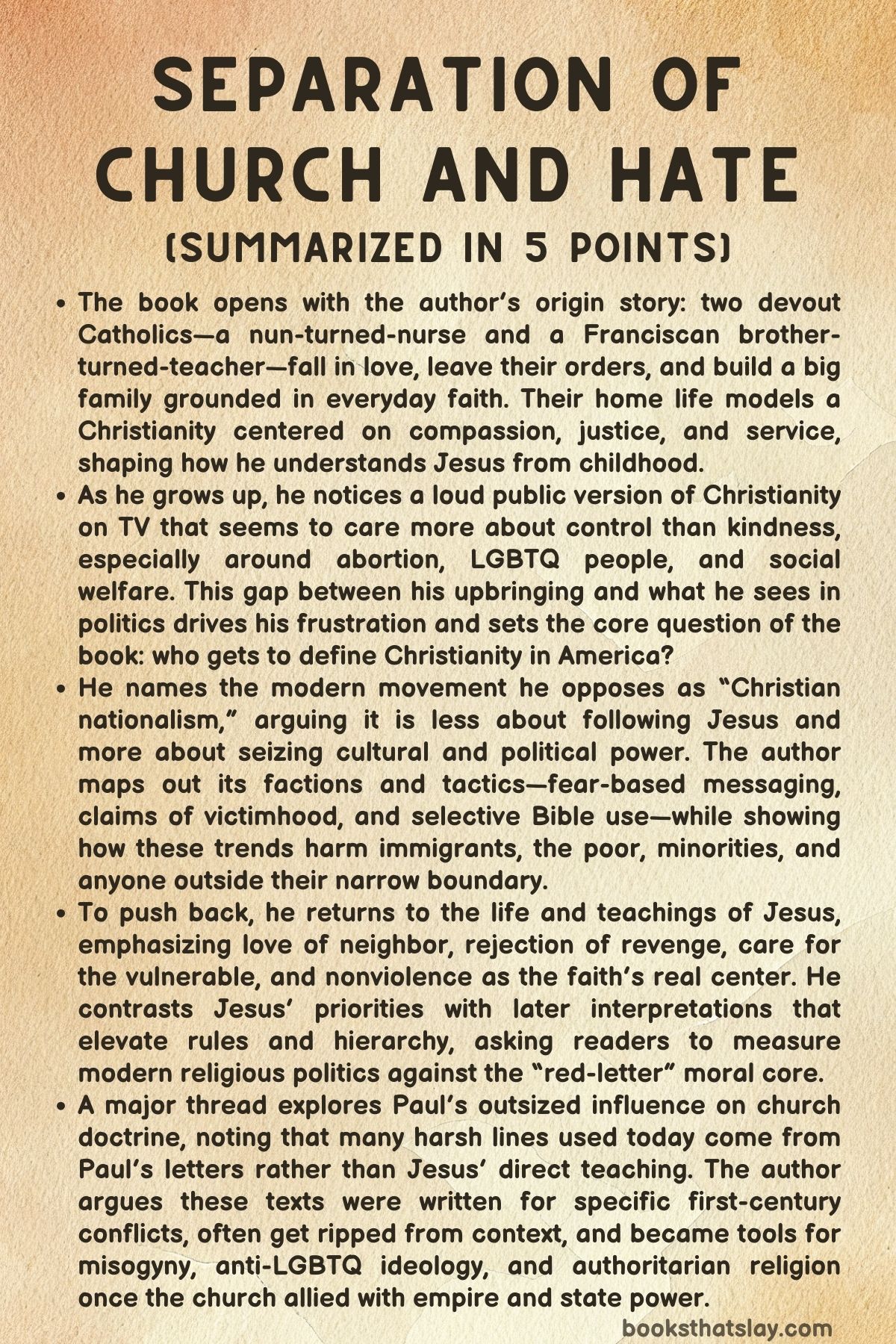
Separation of Church and Hate by John Fugelsang is a contemporary nonfiction work that mixes memoir, biblical commentary, and political critique. Fugelsang begins with his own unusual Catholic upbringing—born to two former religious who left their vows for love—and uses that personal lens to explore what Christianity originally meant versus how it is often practiced in American public life today.
Writing as a comedian and cultural observer rather than a theologian, he argues that the core of Jesus’s message is radical compassion, humility, and justice. The book pushes back against Christian nationalism and religiously branded cruelty, offering readers language and scripture-based tools to challenge hate presented as faith.
Summary
The book opens with the author describing how his very life began with a rupture in tradition. His mother, Mary Margaret “Peggy,” grew up poor in Virginia’s Blue Ridge Mountains during the Depression.
After high school she joined the Daughters of Wisdom convent, becoming Sister Damien. Trained as a nurse, she served first in Africa among leprosy patients and later in a village hospital in Malawi.
Before leaving the United States, she worked briefly at Holy Family Hospital in Brooklyn. There, she met a young Franciscan brother named Boniface—a Brooklyn-born teacher and basketball coach who had devoted himself to a celibate religious life.
He was being treated for tuberculosis. Though they came from worlds that barely overlapped—she quiet, Southern, shaped by segregation; he outgoing, urban, and passionate about civil rights—friendship formed quickly.
When Sister Damien returned to Malawi, Brother Boniface began writing her long letters about American politics, culture, and daily life. In a village with no media access, these letters were read aloud in her convent and became a shared window into the outside world.
Years later, when she came back to the U. S.
, he encouraged her to leave the convent and step into ordinary life. She agreed, they went on a date, and within two months they married in a small chapel on a Virginia Army base.
They moved to Long Island and raised a large family. Their home was intensely Catholic in practice: Mass every week and holy day, constant prayer, religious relatives nearby, and nuns regularly visiting because the author’s mother ran nursing care at a convent facility.
Fugelsang explains that his parents’ faith was not defined by fear or hierarchy but by Jesus’s stated priorities: service to others, forgiveness, care for the poor, defense of the marginalized, nonviolence, and a stubborn commitment to justice. Politically they looked Republican on paper, but their values aligned with social safety nets and civil rights.
One formative memory is his father waking him in the night to watch Jimmy Carter sign the Camp David Accords, presenting it as a living example of peacemaking rooted in faith. For Fugelsang, Christianity as a child meant believing that moral strength showed up in mercy, humility, and solidarity with those who were pushed aside.
As he grew into adolescence during the 1980s and 1990s, he encountered a very different Christianity on television. Public figures like Jerry Falwell and Pat Robertson framed faith around abortion, condemnation of gay people, hostility to welfare, feminism, and people living with AIDS.
This version felt alien to what he knew at home. It seemed less focused on what Jesus taught and more on policing behavior, building political power, and collecting money.
Fugelsang argues that this media-driven movement warped national perception so that to many Americans “Christian” became shorthand for anti-abortion activism and anti-LGBTQ politics. He describes the loneliness of watching a religion he loved publicly reshaped into something he couldn’t recognize.
He names this shift as Christian nationalism: a well-funded, mostly white political coalition that insists America is meant to be a Christian nation governed by their specific biblical rules. He describes its many faces—authoritarian preachers, culture-war moralists, end-times obsessives, politicians who use Jesus as branding, gun-culture “alpha” believers, white supremacists, and activists who target immigrants, the poor, Muslims, Jews, LGBTQ people, and anyone outside their boundary of “real Americans.
” Fugelsang argues that this movement aims for dominance, not discipleship, and that its constant claim of being persecuted is a strategic story used to stir fear, gain donations, and win votes. In his view, modern political leaders, including Donald Trump, have exploited this grievance narrative to cement loyalty.
From there, the book lays out its purpose: to recover Christianity through the teachings of Jesus and to help readers challenge fundamentalist arguments using scripture itself. Fugelsang emphasizes that he is not clergy or a scholar, but a layperson speaking to others who have felt pushed away from faith by cruelty presented as doctrine.
He frames his approach around the “red-letter” sayings of Jesus—what Jesus actually said and did—arguing that these are the measuring stick for any Christian claim.
To set that foundation, Fugelsang retells the life and message of Jesus in clear historical terms. Jesus is presented as a first-century Jewish preacher living under Roman occupation, whose public ministry lasted about three years.
He traveled with male disciples and also with women who supported and learned from him. He taught in parables, re-centered Jewish law around love of God and neighbor, welcomed social outcasts, refused revenge, and warned against hypocrisy and wealth without compassion.
His challenge to both religious and imperial power led to his execution by Roman authorities. Fugelsang highlights central teachings from the Sermon on the Mount and Matthew 25: feed the hungry, care for the sick, welcome strangers, reject violence, forgive repeatedly, and love enemies.
These are treated not as side notes but as the core definition of Christian life.
The narrative then introduces Paul, arguing that much of what people assume Jesus taught actually comes from Paul’s letters. Paul began as Saul of Tarsus, a strict Pharisee and Roman citizen who persecuted early Christians and approved of their arrests and killings.
On the road to Damascus he experienced a blinding vision and heard Jesus question him. He was led into the city blind, healed by a believer named Ananias, baptized, and transformed into a missionary.
Fugelsang credits Paul with expanding Christianity beyond Judaism by arguing that Gentiles could join without following Jewish law such as circumcision or dietary rules. This opened the door for explosive growth across the Roman world.
At the same time, Fugelsang says Paul’s influence shifted Christianity toward a structure centered on doctrine, hierarchy, and salvation by faith, often over Jesus’s stress on care and action.
He notes that Paul’s letters contain both inspiring passages and severe cultural rules, especially about women and same-sex behavior as understood in that era. These harsher lines have been repeatedly used to defend misogyny and anti-LGBTQ attitudes, often overshadowing Jesus’s more welcoming posture.
Yet Paul also worked alongside women leaders and praised them as coworkers, complicating simple readings and suggesting context and later editing matter. Fugelsang argues that Paul was writing to specific communities facing specific conflicts, and that treating every line as universal timeless law ignores history—and lets people dodge Jesus’s harder demands about love, wealth, and mercy.
The book traces how Christianity, once a persecuted minority movement, became entangled with empire. After Constantine legalized Christianity and later rulers made it the state religion, the faith shifted from being oppressed to enforcing control.
Temples were destroyed, dissent punished, and spiritual authority fused with political power. Fugelsang sees this marriage between church and state as the seedbed for later authoritarian Christian movements, including the modern nationalist form he critiques.
In the present day sections, Fugelsang applies Jesus’s teachings to contested issues. He argues that firing lesbian teachers or condemning same-sex love rests on shaky biblical ground, pointing out that the Bible never directly condemns lesbian relationships and that Jesus never addressed homosexuality as a moral target.
He defends transgender people by stressing that the command to love one’s neighbor leaves no space for ridicule or exclusion, and by showing that early Christian stories include welcome for people whose bodies and identities fell outside social norms.
On abortion, he argues that scripture does not treat abortion as murder and that opposition to it as the defining Christian issue is historically recent in the U. S., tied to political strategy after the civil rights era. He examines commonly cited passages and claims they either do not address abortion or imply that fetal life was not given the same legal status as born life in biblical law.
He contrasts this with the Bible’s repeated demands to protect women, children, and the vulnerable. He also describes the harms created by modern abortion bans: dangerous delays in miscarriage care, forced travel, and increased health risks.
Fugelsang rejects the death penalty using Jesus’s rejection of vengeance and the story of Jesus refusing to allow a woman to be stoned, presenting mercy as the Christian response to wrongdoing. He critiques gun culture among right-wing Christians, arguing that verses used to justify violence are misread and that Jesus consistently forbade harming others.
He expands outward to confront anti-Semitism, Islamophobia, and white supremacy, tracing how each has been dressed in Christian language over time and insisting each one violates the central command to love.
The book closes by drawing a line between people who claim Christianity as an identity weapon and those who try to follow Jesus’s example. Fugelsang doesn’t argue for abandoning faith; he argues for refusing to let faith be captured by hate.
He calls readers to challenge authoritarian religion with calm, informed confidence rooted in Jesus’s words, while still keeping compassion for those trapped in fear. The overall message is that Christianity, at its heart, is meant to be a force for healing and justice—and that separating church from hate is both a spiritual and civic responsibility.
Key People
John Fugelsang
The narrator—who is also the author, John Fugelsang—speaks as a comedian-turned-commentator shaped by an intensely Catholic upbringing and a lifelong tension between the Jesus-centered faith he learned at home and the punitive, politicized Christianity he later saw on television. His voice is personal, confessional, and argumentative: he positions himself as someone who loves Christianity enough to critique how it has been weaponized.
He is defined by moral clarity rooted in “red-letter” teachings, and by a sense of betrayal when public Christianity drifts toward dominance, fear, and scapegoating. Rather than claiming ecclesiastical authority, he leans on lived experience, scripture, and humor to reach readers who feel alienated by authoritarian religion.
Across the summary, his character functions as both witness and challenger—someone who insists that faith must be measured against compassion, justice, and nonviolence, not identity politics or power.
Mary Margaret “Peggy” / Sister Damien
Peggy begins as a Depression-era mountain girl whose life is marked by sacrifice, discipline, and a quiet courage. Her decision to join the Daughters of Wisdom right after high school shows an early pull toward service and spiritual intensity, and taking the name Sister Damien signals a willingness to subsume personal identity into vocation.
As a nurse in Africa—first among lepers, later in Malawi—she embodies a Christianity of proximity to suffering rather than distance from it. Even after leaving the convent, she remains spiritually serious and practically nurturing, bringing the habits of communal care into her family life as head nurse at a convent nursing home.
Her character represents faith as action: she is not loud or ideological, but her choices express a deep belief that holiness is found in tending to the sick, the poor, and the forgotten.
The Father / Brother Boniface
The narrator’s father is portrayed as warm, sociable, and morally awake, with a strong sense of justice that contrasts with the segregation-formed worldview of Peggy’s childhood. As Brother Boniface, he lives the rhythm of Franciscan life—teaching history, coaching basketball, embracing celibacy—and this gives him a grounded, communal spirituality.
His letters to Peggy in Malawi reveal him as intellectually engaged and socially empathetic, treating faith as inseparable from politics, civil rights, and human dignity. When he persuades Peggy to leave religious life and marry him, the act is framed not as betrayal of God but as a re-routing of devotion into family, suggesting a man who trusts love and conscience even when it breaks formal vows.
In the narrator’s memory, he is the anchor of a humane Christianity, explicitly tying faith to peace-making and moral hope, as symbolized by waking his child to watch Jimmy Carter sign the Camp David Accords.
Jesus (Yeshua)
Jesus is the book’s moral center and the standard against which all other Christian claims are judged. He is presented as a first-century Jewish teacher living under Roman occupation, whose ministry is short but revolutionary in spirit.
His defining traits here are radical empathy, nonviolence, and refusal to cooperate with systems that degrade people: he speaks through parables that invert hierarchy, reinterprets law through love, and makes community with outcasts, women, the sick, and the despised. He is portrayed less as a distant divinity and more as a disruptive neighbor who insists on forgiving enemies, rejecting revenge, and prioritizing the vulnerable.
His execution by empire becomes the ultimate exposure of state violence and religious complicity, and his teachings remain, in the narrator’s view, the clearest blueprint for authentic Christianity.
Paul / Saul of Tarsus
Paul is depicted as a brilliantly complex and historically consequential figure whose transformation reshapes the trajectory of Christianity. As Saul, he is zealous, authoritarian, and certain—an “ultra-orthodox” Pharisee who persecutes believers and embodies the dangers of religious certainty tied to power.
His Damascus conversion is framed as both rupture and rebirth: a violent enforcer becomes a missionary architect, driven by new conviction and immense organizational energy. Paul’s character after conversion is double-edged—capable of soaring moral insight about love, unity, and generosity, yet also the source of restrictive cultural opinions that later Christians weaponize against women and LGBTQ people.
The summary emphasizes that he is less a spiritual poet than an institution-builder; his gifts are pragmatic, strategic, and doctrinal, which helps Christianity spread globally but also opens the door for hierarchy, dogma, and selective morality. Paul thus becomes the central tension of the book: admirable in passion and reach, but also a figure whose authority can eclipse Jesus when read without context.
Ananias
Ananias appears briefly but symbolically as the human doorway through which Saul becomes Paul. His role is courageous and compassionate: he approaches a feared persecutor, heals him, and baptizes him, acting against instinct and community suspicion.
In the narrative logic, Ananias represents early Christianity’s willingness to risk mercy, to believe that enemies can change, and to practice inclusion before it becomes institutional policy. His presence underscores the theme that redemption is an act of community as much as an individual conversion.
Philip
Philip functions as a model of early Christian openness, a messenger who follows divine prompting without letting law-based exclusion override compassion. By baptizing the Ethiopian eunuch—someone barred by older religious rules—Philip shows a character instinctively aligned with welcome and equality.
He is portrayed not as a theologian debating fine points, but as a practitioner of the faith’s most expansive impulse: if someone seeks God sincerely, barriers should fall rather than harden.
The Ethiopian Eunuch
The eunuch is presented as both outsider and spiritual pioneer. Socially and religiously excluded by bodily status, nationality, and geography, he nonetheless pursues scripture and asks directly for inclusion.
His character embodies the longing to belong and the courage to ask for dignity in a world that denies it. His joy after baptism becomes a quiet rebuke to any Christianity that defines itself by who it keeps out; he represents the people Jesus consistently centered—those on the margins who are ready for grace long before institutions are.
Carla Hale
Carla Hale emerges as a contemporary figure of quiet integrity harmed by institutional cruelty. She is portrayed as devoted to her students and stable in her long-term relationship, but vulnerable to surveillance and punishment from a system that prioritizes moral policing over human decency.
The way her firing happens—during grief, through anonymous accusation—casts her as a person caught in the machinery of fear-based religion. Her character is not explored through personal quirks but through what her story symbolizes: the lived cost of doctrinal certainty when it targets real people, and the gap between Jesus’s ethic of mercy and the church’s bureaucratic enforcement of exclusion.
Jerry Falwell
Falwell appears as a representative of televised fundamentalism, a figure who rebrands Christianity into a political weapon. In the narrator’s framing, Falwell’s defining traits are moral narrowness and power-seeking: he channels faith into culture-war obsessions, especially abortion and LGBTQ condemnation, while sidelining Jesus’s priorities of poverty care and peacemaking.
He functions as a catalyst for the narrator’s alienation, symbolizing the moment Christianity becomes publicly associated with control rather than compassion.
Pat Robertson
Like Falwell, Robertson is used less as an individual personality and more as a type: the media-savvy religious nationalist who profits from fear, certainty, and political mobilization. The narrator presents him as part of a movement that replaces spiritual humility with ideological dominance.
Robertson’s character in the summary stands for Christianity turned into brand and leverage, where scripture is mined for authority rather than guidance.
Jimmy Carter
Carter serves as a moral counter-image to right-wing fundamentalism. In the narrator’s childhood memory, Carter appears as a symbol of faith expressed through diplomacy and reconciliation, not public condemnation.
The father’s reverence for the Camp David Accords elevates Carter into a character of hopeful Christianity—imperfect but aligned with peace-making and ethical seriousness.
Donald Trump
Trump is framed as a political figure who exploits Christian victimhood narratives for power. The narrator’s portrait is not about personal spirituality but about performative alliance: Trump uses the claim that Christianity is “under attack” to energize Christian nationalists, even when his own life and rhetoric clash with Jesus’s ethic.
As a character, he represents the fusion of religious identity with authoritarian politics, showing how fear can turn faith into a tribal badge.
Jeff Sessions
Sessions appears as an example of scripture being conscripted for harsh policy. By citing Romans 13 to defend punitive border actions, he embodies the kind of selective, power-protecting biblical use the narrator condemns.
His character illustrates how religious language can legitimize cruelty when severed from the broader moral arc of hospitality and neighbor-love.
Peter
Peter is presented through the lens of Jesus’s teaching on forgiveness and on rejecting violence. He functions as the eager disciple who sometimes misunderstands, needing correction toward mercy.
When told to forgive repeatedly and when rebuked for using a sword, Peter becomes a mirror for Christians tempted toward vengeance or force: his journey highlights how discipleship means unlearning instinctive retaliation.
Pope John Paul II
John Paul II appears as an institutional voice aligning Catholic teaching with the narrator’s anti-death-penalty argument. His role is to demonstrate that opposition to state killing can be rooted in tradition as well as theology.
As a character, he represents the possibility that even large religious institutions can evolve toward a more mercy-centered ethic.
Pope Francis
Francis is depicted as a continuation and intensification of that merciful trajectory, especially through revising the Catechism to declare capital punishment inadmissible. He functions as a living reminder that Christianity can choose compassion over retribution even in modern political climates.
His character signals reform, humility, and a renewed emphasis on human dignity.
The Narrator’s Grandfather
The grandfather is a personal, intimate figure used to explore how prejudice and love can coexist in one human life, and how transformation remains possible. He is described as racist yet loving, which makes him morally complicated rather than villainous.
His acceptance of last rites from a Filipino priest becomes an emblem of grace breaking through ingrained bigotry. As a character, he grounds the book’s critique in family reality: hatred is not only a public ideology but a private inheritance that can still be interrupted.
The “Christian Nationalists” and “Holy Haters” (Collective Character)
Though not a single person, the movement functions like a composite character that shapes the book’s conflict. This collective is described as white, well-funded, fear-driven, and dominance-oriented, gathering authoritarians, supremacists, conspiracy believers, and politicians who treat Jesus as a mascot rather than a teacher.
Their personality, in the narrator’s telling, is defined by certainty, grievance, and hierarchy; they weaponize scripture to justify exclusion, violence, and social control, and they measure faith by enemies made rather than neighbors loved. As an antagonistic force, they are the negative mirror of the narrator’s home faith—what Christianity becomes when it chooses empire over the Sermon on the Mount.
Themes
Faith as lived compassion versus public religion as ideology
The opening family story sets a standard for what Christianity can look like when it grows out of service rather than status. The narrator’s parents leave vowed religious lives not to reject God but to follow a human love that sits comfortably beside their previous commitments to healing, teaching, and community.
Their household on Long Island is presented almost like a training ground in practiced mercy: prayer, sacraments, and discipline are not shown as performance but as habits that support the poor, forgive enemies, welcome outsiders, and resist cruelty. The spiritual education the narrator receives is therefore inseparable from the moral texture of everyday life.
Christianity, in this framing, is not a badge for belonging to a tribe, but a daily argument for tenderness, justice, and restraint.
That early formation becomes the measuring stick against which the narrator later judges the televised Christianity of his adolescence. He encounters celebrity preachers and political activists who treat faith as a tool for culture war, with moral obsession narrowed to policing abortion, sexuality, and punishment, while ignoring hunger, racism, and violence.
The contrast is not simply between liberal and conservative politics; it is between two different definitions of devotion. One definition sees religion as a call to imitate Jesus’s priorities, even when that costs social comfort.
The other treats religion as a way to secure dominance, purity, or national control. The narrator’s growing alienation comes from watching a word that once meant compassion get publicly rebranded as judgment.
Separation of Church and Hate keeps returning to this tension to show how a faith rooted in concrete love can be distorted into an ideology of resentment, and how that distortion harms believers as much as it harms those they target. The theme matters because it makes hypocrisy not a minor flaw but the core crisis: when religion ceases to produce mercy, it becomes something else entirely, even if it keeps the same label.
Christian nationalism and the hunger for dominance
The book treats Christian nationalism not as a fringe curiosity but as a coherent political project that uses sacred language to justify control. The narrator describes a movement that imagines America as a possession of a specific kind of Christianity—white, patriarchal, certain of its own innocence—and then frames any challenge to that possession as persecution.
This claim of being “under attack” functions like a machine: it generates fear, fear generates money and votes, and those resources reinforce the movement’s reach into courts, schools, media, and policy. The movement’s power is explained through its coalition of groups that may look different on the surface—authoritarians, conspiracists, gun-culture believers, supremacists, and opportunistic politicians—but share a desire to rule rather than serve.
The narrator’s list is meant to show that the glue holding them together is not theology but entitlement.
This theme also draws energy from historical argument. The book pushes back on nationalist mythology by pointing to the Constitution’s refusal to establish Christianity, the founders’ Deist tendencies, and the explicit legal barriers against religious tests for office.
Those details are not included as trivia; they are used to expose how nationalism rewrites history to make its ambitions feel inevitable and holy. When the movement insists that bringing Christianity into state power is a return to origins, the narrator argues it is actually a betrayal of both American design and Jesus’s teachings.
The warning is twofold. First, merging church and government corrodes democracy by treating dissent as rebellion against God.
Second, it corrodes Christianity by turning a message about love into a program for domination. The theme gains weight through examples of how nationalist rhetoric shields cruelty toward immigrants, the poor, and minorities, and how it can excuse violence when done “for God’s side.
” By mapping the movement’s tactics and its emotional economy of fear, the book frames Christian nationalism as a spiritual problem that expresses itself politically: a refusal to accept equality with others, disguised as fidelity to God.
Who gets to define Christianity: Jesus’s words versus later authority
A sustained argument in the book is that Christianity drifted when its center of gravity moved from Jesus’s direct teachings to later interpretive systems. The narrator does not deny Paul’s importance; he acknowledges Paul as the organizer who carried a Jewish Jesus movement into a global Gentile religion.
But he insists that the moral heart of the faith lies in Jesus’s own priorities—love of neighbor and enemy, care for the vulnerable, rejection of revenge, humility—rather than in any later doctrinal architecture. By tracing how Paul’s letters became scripture centuries after being written, the book shows how authority can be retroactively amplified.
The misunderstanding of “all Scripture is God-breathed” becomes a symbol for this process: a line meant for Hebrew scriptures is later heard as Paul endorsing himself, and that hearing changes history.
This theme matters because it explains why modern Christians can justify exclusion or hierarchy while still claiming loyalty to Jesus. If Paul’s culturally bound advice is treated as timeless and equal to Jesus’s moral demands, believers can cherry-pick rules that reinforce patriarchy or condemn LGBTQ people while ignoring Jesus’s constant defense of outcasts.
The narrator highlights the internal tensions within Paul’s legacy—his praise of women leaders alongside restrictive passages, his vision of unity alongside condemnations—so that readers see scripture not as a single flat voice but as a library shaped by context, rhetoric, and later editing. The call is not to discard Paul, but to read him historically and subordinate him to Jesus ethically.
In Separation of Church and Hate, recovering Christianity means recovering a hierarchy of meaning where Jesus is not a mascot for doctrine but the standard by which doctrine is judged. The theme therefore pushes readers toward interpretive responsibility: faith is not passive acceptance of inherited power, but active allegiance to the compassion Jesus actually taught.
Inclusion of marginalized people as the real moral test
Across discussions of lesbian teachers fired from Catholic schools, transgender rights, immigration, and poverty, the book treats the treatment of marginalized groups as the clearest indicator of whether Christianity is being faithfully practiced. The Carla Hale story is not presented as an isolated injustice; it is an emblem of how institutions can weaponize “moral law” to punish love that threatens their social boundaries.
By arguing that the Bible contains no clear condemnation of lesbian relationships and by offering alternative readings that affirm women’s devotion to each other, the narrator undercuts the idea that exclusion is required by scripture. The same logic appears in the discussion of transgender people: the narrator counters fear-based claims with medical consensus and with Jesus’s refusal to link human difference to sin.
The point is that neighbor-love is not an abstract command but a demand with social consequences.
The theme broadens from sexuality and gender to other targets of religious hostility. The book makes the case that abortion became a defining wedge issue not because of biblical urgency but because of political strategy tied to segregation and party realignment.
By combing through Old Testament legal material and narrative episodes, the narrator argues that claims of a consistent biblical “pro-life” absolutism collapse under scripture’s own complexity. This is not to trivialize moral difficulty, but to show how selective reading turns a complicated issue into a loyalty test while ignoring the Bible’s louder and more frequent calls to protect the poor, the foreigner, and the sick.
Immigration is treated similarly: ancient commandments to love foreigners are placed next to modern politicians citing isolated verses to justify harsh borders. The theme insists that Christianity’s credibility rises or falls on whether it shelters the vulnerable rather than scapegoating them.
In Separation of Church and Hate, inclusion is not a modern add-on to faith; it is presented as the oldest core of Jesus’s ethic, and rejecting it is shown as rejecting him.
Nonviolence and mercy versus sanctified punishment
The book repeatedly returns to the question of what Christians do with power over life and death. The death penalty section anchors this theme in Jesus’s refusal to endorse execution even of the guilty.
The story of the adulterous woman becomes a kind of moral case law: Jesus does not deny wrongdoing, but he blocks the machinery of state killing and redirects the crowd toward self-examination and mercy. The narrator then ties this to Jesus’s larger pattern of teaching forgiveness without limits and of dying as a victim of capital punishment while praying for his executioners.
The moral implication is sharp: if Christians worship someone executed by the state, they cannot celebrate state execution without betraying their own story.
The theme widens to gun culture, where certain American Christians recast Jesus as a warrior to baptize political militancy. The narrator argues that partial readings of verses about swords are used to construct a fantasy of armed discipleship, even though Jesus forbids using weapons against people and rebukes violence at the moment of his arrest.
By placing these debates beside statistics about gun deaths and the marketing of assault rifles as identity symbols, the book frames the issue as a spiritual deformation: fear and dominance override Jesus’s teaching that peacemakers are blessed. The same moral lens is used to criticize any religious justification for revenge, cruelty, or supremacy.
Nonviolence here is not presented as naïve softness, but as the disciplined refusal to let hatred set the terms of public life. The narrator’s claim is that mercy is the only coherent Christian response to wrongdoing, precisely because every believer depends on mercy themselves.
This theme pushes readers to see punishment-centered religion as a form of self-protection masquerading as holiness, and to reclaim forgiveness as the harder, more faithful path.
Repentance, historical reckoning, and the possibility of change
Another thread running through the book is the insistence that faith must face its own history honestly. The narrator traces how Christianity moved from a persecuted minority to an imperial institution that suppressed pagans, punished heretics, and replaced simple moral teaching with hierarchy and control.
This is not offered to shame Christianity out of existence, but to demonstrate that institutions can drift and that drift has consequences. The exploration of anti-Semitism follows the same logic.
By naming how Christians blamed Jews for Jesus’s death, then carried that blame into crusades, expulsions, and modern propaganda, the book argues that hatred can become tradition unless deliberately resisted. The parallel rejection of Islamophobia and contempt for atheists extends this reckoning: public Christianity has often defined itself through enemies, and this habit contradicts the command to love neighbors.
What keeps the theme from turning into despair is the narrator’s emphasis on transformation. The personal story about his grandfather is strategically placed to show that prejudice is not a permanent identity.
A man shaped by racist norms can still soften, still receive grace from the very people his culture taught him to demean. That possibility is crucial to the book’s tone.
The narrator does not call readers to annihilate their opponents; he calls them to oppose hateful systems while refusing to become hateful themselves. Repentance, in this framing, is both individual and collective: it means admitting where Christianity has failed, refusing to defend those failures as sacred, and choosing a truer form of discipleship now.
Separation of Church and Hate uses history to remove excuses and uses personal change to preserve hope, arguing that the only way Christianity survives with integrity is by continually correcting itself toward mercy, justice, and humility.