Servant of Earth Summary, Characters and Themes
Servant of Earth by Sarah Hawley is a richly imagined fantasy about power, survival, and identity in a world divided between mortals and immortals. The novel follows Kenna Heron, a young woman from a destitute village whose defiance of ancient traditions thrusts her into the treacherous realm of the Fae.
There, she becomes both servant and player in the immortal courts’ dangerous games. As Kenna grapples with her humanity and the strange magic bound to her, she discovers truths about sacrifice, friendship, and rebellion that could reshape both worlds. Hawley builds a vivid, perilous universe where loyalty and freedom demand painful choices.
Summary
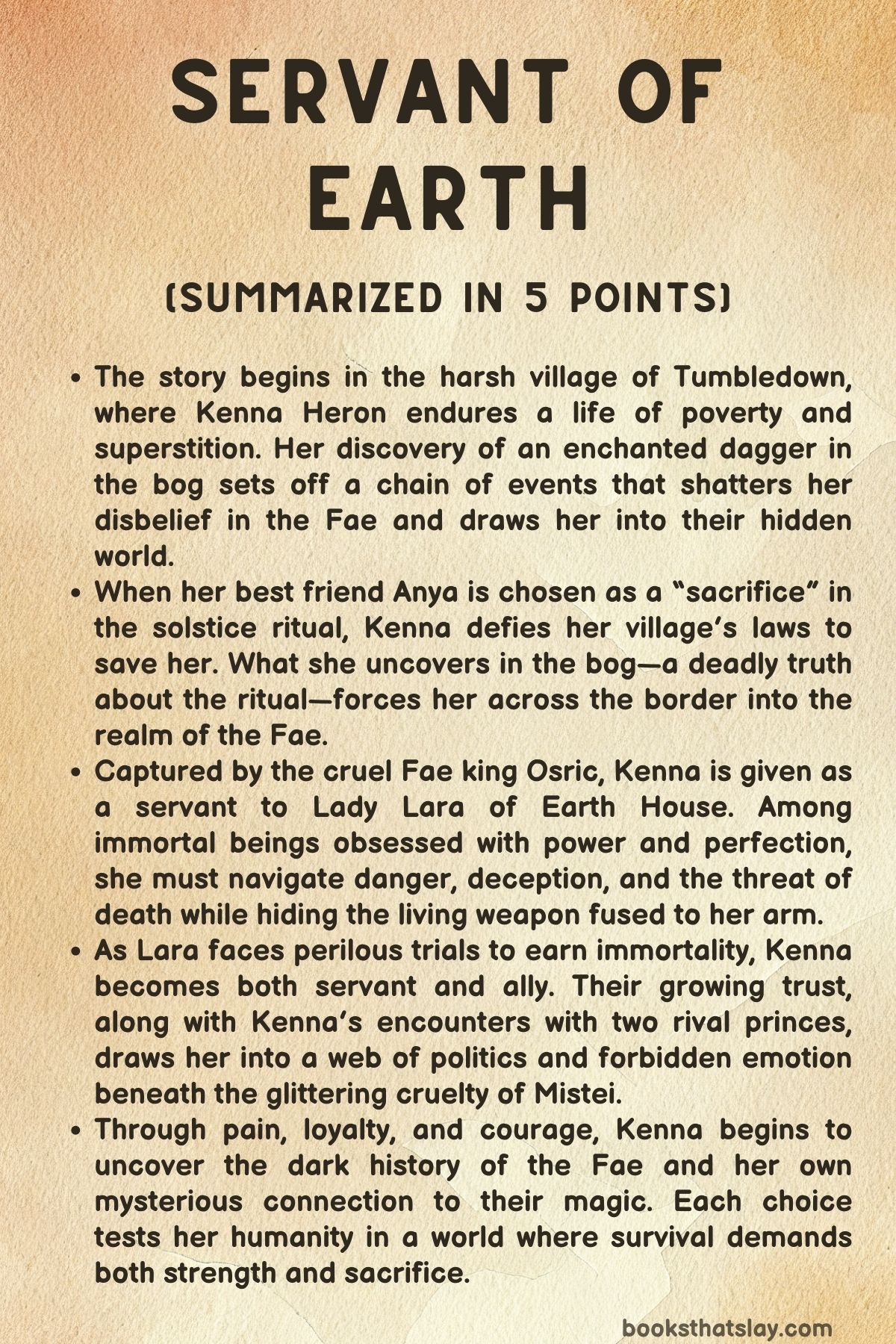
The novel begins on a bleak winter solstice in the impoverished northern village of Tumbledown, where Kenna Heron wakes to another day of cold and hardship. Each year, the solstice marks a grim ritual in which four young women are chosen as “blessed sacrifices” to the Fae.
The villagers believe they are taken to a paradise called Mistei, but Kenna, hardened by poverty and her mother’s death, sees only cruelty in the superstition. Her mother’s faith in the Fae had ruined them, and Kenna now views the ritual as a way to disguise the abduction and loss of innocent women.
While scavenging in the bog near her village, Kenna discovers a gleaming dagger embedded in the mud—a weapon untouched by rust and crowned with a red jewel that seems to absorb light. When she pricks her finger, her blood vanishes into the blade, revealing its enchantment.
Hoping to sell it at the solstice market, Kenna dreams of escape from her miserable life. There she meets her best friend Anya Hayes, who is also eligible for selection.
Though Kenna mocks the ceremony, Anya secretly hopes to be chosen, seeing it as a way out of ruin. During the ritual, three names are called before the final one—Anya Hayes.
Kenna’s world collapses as her friend is taken. She vows to save her, no matter the cost.
That night, Kenna secretly follows the chosen women into the bog during the ceremony. The will-o’-the-wisps that guide the way reveal their monstrous nature—predators, not protectors.
One by one, the women are killed or vanish, and Kenna narrowly escapes by using the dagger, which lights a glowing path. Wounded and terrified, she stumbles across the border into the realm of the Fae.
Before fainting, she sees a talking goat comment that her arrival is “unexpected.
Kenna awakens in the underground kingdom of Mistei, surrounded by strange, coldly beautiful Fae. She is presented before their cruel king, Osric, who takes amusement in her defiance and curiosity about the enchanted dagger fused to her arm.
Amused by her survival through the deadly bog, he gifts her to Princess Oriana of Earth House as a mockery, making her the servant of Oriana’s daughter, Lady Lara. Thus begins Kenna’s servitude among the Fae—a world of impossible beauty, power, and danger.
In Earth House, Kenna learns of the upcoming immortality trials—tests that determine whether noble Fae earn eternal life and full magic. Failure means disgrace or death.
Her mistress, Lady Lara, resents having a human servant but is soon forced to accept her when Oriana commands it. Oriana, a shrewd politician, orders Kenna to act as a spy during the trials, using her humanity as cover.
Terrified but determined, Kenna obeys, trying to survive in a world where even kindness can kill.
As Kenna explores Mistei, she learns about the five great Houses—Earth, Fire, Light, Illusion, and Void—and the long-vanished sixth House of Blood, destroyed after rebellion. She meets Drustan, the charming Fire prince who warns her of the kingdom’s treacherous politics, and Kallen, the mysterious and feared prince of Void, known as the King’s Vengeance.
Her interactions with them spark curiosity, fear, and conflicted emotions, drawing her deeper into the realm’s intrigues. Despite her lowly position, Kenna begins to form a fragile bond with Lady Lara, who hides her own pain and fears behind pride.
Months later, during the spring equinox festival, Kenna and Lara are permitted aboveground for the first time. The celebration is breathtaking—an explosion of light, magic, and life.
Yet beneath the joy lies oppression. Kenna witnesses the renewal of Osric’s magical ward that prevents any Fae from harming him, confirming that rebellion by violence is impossible.
During the festivities, Drustan flirts and dances with Kenna, awakening feelings of freedom and attraction. But her moment of happiness ends when Kallen’s probing questions remind her of the constant danger surrounding her.
Soon after, Lara faces her first immortality trial at Light House, which tests endurance and silence. The candidates must lie on broken glass while enduring magical potions that cause agony and hallucinations.
To share her mistress’s suffering, Kenna secretly drinks the same potions, nearly dying but helping Lara succeed. Their friendship deepens as they recover together.
Kenna begins to see Lara not as a spoiled noble but as a trapped soul much like herself.
Amid political unrest, Kenna becomes entangled in espionage. Kallen orders her to spy on Drustan, while Drustan confides his hatred of the king and hints at rebellion.
Torn between them, Kenna must navigate lies and shifting loyalties. At a royal banquet, she witnesses Osric’s brutality firsthand when he punishes a Light House woman for bearing a mixed-blood child, declaring such unions forbidden.
The baby is transformed into a changeling, and the mother is whipped. The horror deepens Kenna’s hatred for Osric and sympathy for Drustan, who reveals his own tragic history—his friend once loved an Earth prince and died for it.
Tensions build as the nobles grow restless. During a picnic, Kenna is assaulted by cruel Fae nobles, but Kallen intervenes, saving her and revealing a rare hint of compassion.
Their relationship grows complicated, filled with mistrust and a strange pull neither understands.
The final trials arrive, culminating in the Blood House test—a forbidden rite involving confession and the acknowledgment of one’s darkest self. Kenna secretly helps Lara complete it, but in doing so, the Blood Tree recognizes Kenna’s essence.
The power that has been bound to her dagger stirs, revealing its true nature as Caedo, the relic of the lost Blood House.
At the grand finale, the immortality ceremony turns into chaos. Osric unveils a sack containing the severed head of a rebel leader, revealing he has crushed an uprising.
To save himself, Drustan accuses Selwyn, Lara’s brother, of treason. Selwyn accepts blame to protect his family and is executed.
Osric then exposes Kenna’s deception, accusing her of cheating in the trials. Lara loses her magic and title, and Kenna is thrown into the Shard maelstrom—a vortex where the virtues of the Fae judge worthiness.
Instead of dying, Kenna is chosen by the six Shards. The lost Blood Shard claims her, restoring the extinct House and granting her immortality.
Reborn as the Princess of Blood, she rises amid the chaos as rebellion erupts in the palace. Nasties, Fire soldiers, and Earth forces clash against Osric’s army.
Kallen aids her, and together they face the king. Using Caedo, Kenna confronts Osric and kills him, ending his centuries of tyranny.
The wards break, and the kingdom’s power structure collapses.
In the aftermath, Drustan calls for a new ruler, but factional divides remain. Kallen, Drustan, and Oriana each seek control.
Kenna, newly crowned and bearing the magic of Blood, refuses to choose sides. Instead, she demands equality and freedom for all beings—Fae, humans, and Underfae alike—before any new rule begins.
Her defiance stuns the court.
As the dust settles, Kenna finds Anya alive, though broken and enslaved by Osric. With Lara’s loyalty unshaken despite losing her power, the three women unite.
Kenna invites Lara to join her as the first lady of the restored Blood House and vows to protect Anya and all who suffered. Together, they walk out of the shattered throne room toward an uncertain but self-forged future, reclaiming power, friendship, and identity in a world that once denied them both.
Characters
Kenna Heron
Kenna is the fierce moral engine of Servant of Earth—a pragmatic survivor whose poverty-hardened skepticism is slowly reshaped into purpose and power. She begins as a bog-scavenger who distrusts Fae myths because faith ruined her mother; that cynicism becomes fuel for courage when she witnesses the “sacrifice” for what it is: predation.
The sentient dagger binds to her body and, symbolically, to the parts of herself she tries to deny—rage, hunger, a readiness to do harm when harm is all the world offers. As handmaiden to Lara, she learns the etiquette of power without surrendering empathy, sharing pain during the Light trial and insisting that friendship is a form of resistance.
By the climax, Kenna embraces the truth that she has already undertaken every virtue test; the Shards’ recognition of Blood in her is less a coronation than an acknowledgement of what she has been practicing all along: disciplined violence in defense of the vulnerable. Her refusal to crown a king and her demands for rights make her not just an empowered heroine but a political actor who understands that victory without justice repeats the old cycle.
Caedo (the Blood Dagger)
Caedo operates as a character in its own right: a whispering conscience that tempts and warns, a mirror for Kenna’s darkest impulses. It drinks blood, unveils hidden paths, and vibrates with sentience—functions that externalize Kenna’s intuition and anger.
Its bonding to her arm literalizes an inconvenient truth: she cannot outsource violence to an object and stay morally clean. When she uses it to end Osric, she does not lose herself to bloodlust so much as claim agency over the force that has always shadowed her.
Caedo’s arc, from tool to companion to herald of a reborn House, reframes “monster” instincts as survivorship sharpened into purpose.
Anya Hayes
Anya embodies the peril of comforting stories. She accepts the selection as “blessing” because belief offers relief from grief and ruin, and that faith almost costs her everything.
Her reappearance as Osric’s brutalized “pet” exposes the lie at the ritual’s heart and shatters any illusion that innocence protects the innocent. Yet Anya’s end state—as a traumatized friend Kenna refuses to abandon—matters thematically: survival is communal, and healing requires a world where the vulnerable are not transactional.
Anya’s journey re-centers the stakes around ordinary human lives, not just Fae politics.
Lady Lara of Earth House
Lara begins brittle and status-conscious, a study in defensive hauteur. Beneath it is grief (a dead brother, an exacting mother) and terror of failing the immortality trials.
Kenna’s stubborn loyalty chips at her shell, and their bond becomes the book’s emotional spine: two young women practicing competence and care in a court that treats both as weaknesses. Lara’s mixed success—passing trials with help, then losing magic and being disowned—reframes worth away from the Fae’s metrics.
Her choice to join Blood House signals a shift from inherited identity to chosen community, and her gift of the emerald pendant marks friendship as a political alliance as consequential as any treaty.
Princess Oriana of Earth House
Oriana is the consummate survivor of imperial systems: cold-eyed, strategic, unwilling to bleed for ideals. She weaponizes Kenna’s humanity as a spy while preaching composure to her children, even when cruelty targets a baby.
Yet Oriana’s neutrality after Osric’s fall is not simple cowardice; it is worldview. She believes Houses are maintained by distance and discipline, and she will trade anything—including her daughter’s dignity—to preserve Earth’s position.
Oriana clarifies the book’s moral contrast: stability purchased by complicity versus a riskier justice forged through solidarity.
Prince Drustan of Fire House
Drustan is charisma with edges: rescuer, dancer, flirt, and plotter. He mentors and tests Kenna at once, offering warmth that is also a recruitment drive for rebellion.
His confession about changelings adds depth to his politics—he has witnessed love destroyed by Osric’s laws—but his betrayal of Selwyn under pressure reveals the fault line in his character. Drustan wants a freer world, but he has learned to use the master’s tools, even when they cut allies.
The tension between his tenderness and expedience keeps him compelling and dangerous.
Lord Kallen of Void House
Kallen wears menace like armor, the “King’s Vengeance” who has learned that detachment is safety. His interventions—stopping Garrick, sparing Kenna, admitting he avoids cruelty—hint at a man policing his own humanity to survive proximity to power.
Interrogations become dances; threats carry the ache of someone who has pledged himself to the darkness and now resents the bill. In Kenna he recognizes a rival philosophy: power tied to care.
His choice to shield her during the uprising is less a heel-face turn than a revelation of a line he will not cross, even for the crown.
King Osric
Osric personifies structural violence smiling behind aesthetics. He performs power through spectacle—casual executions, public punishments, and a ward that makes him untouchable—because terror, ritualized, trains the imagination to accept dominance as natural.
His obsession with blood purity is not just prejudice but governance strategy: divided Houses cannot unite against him. That the Shards’ loophole—Blood lies outside his ward—undoes him is poetic justice; he cannot imagine a power he has erased.
Osric’s demise underscores a theme: tyrannies are weakest at the blind spots their ideology creates.
Selwyn of Earth House
Selwyn is gentleness in a world that mocks it. He thanks servants, worries for his sister, and ultimately confesses to treason to shield his family.
His death—sacrificed to Osric’s theatrics and Drustan’s accusation—exposes the human cost of both tyranny and rebellion. Selwyn’s legacy is a question posed to every ambitious character: what is victory worth if it demands betraying those who make you decent?
Hector of Void House
Hector is ruthless ambition distilled. Rumored patricide and an appetite for power place him as Void’s hardline center, the counterweight to Kallen’s conflicted conscience.
After Osric’s fall he challenges Fire for the crown, proving that the vacuum will not birth utopia by itself. Hector’s presence keeps the stakes sharp: removing a tyrant is chapter one; preventing the next is the real plot.
Una of Void House
Una passes the final judgment and emerges empowered, a reminder that Void’s house style—discipline, silence, endurance—can produce terrifying excellence. She is less developed than her brothers, but her success functions as atmospheric pressure: competence without compassion can thrive under Osric, and might again if unchecked.
Aidan (Fire servant)
Aidan offers the worker’s-eye view of palace politics. Through him, Kenna learns the theology of Shards and the street rules of survival.
His caution—trust is deadly in Mistei—contrasts with Kenna’s insistence on chosen bonds, highlighting how oppression fractures solidarity by making companionship dangerous. Aidan’s friendship is modest yet crucial; information and kindness are both contraband goods.
Alodie (Earth steward)
Alodie embodies the bureaucracy of enchantment—efficient, imperturbable, and occasionally subversive. She ushers Kenna through protocols, delivers the puzzle box before the Blood trial, and later assigns guards to Anya.
Alodie’s steadiness shows how institutions are staffed by people who keep the machine running, sometimes oiling its gears, sometimes quietly redirecting them.
Pol (the goat steward)
Pol is the story’s wry chorus, the first to remark “This is unexpected” at Kenna’s crossing. With him, levity becomes a survival strategy, a way to acknowledge the absurdity of glamorized cruelty.
His presence in key threshold moments—welcoming, dancing, witnessing—frames Kenna’s passage from quarry to player.
Elder Holman
Holman personifies the village’s fatal credulity. As priest-mayor, he sanctifies abduction and converts poverty into piety, making violence feel holy.
He is not a central villain like Osric, but he is essential to the pipeline that feeds the court: a local authority who launders harm through ritual.
Prince Roland of Light House
Roland’s trial—endurance in silence across broken glass—reveals Light’s ethic: virtue as stoic performance. He gives form to an ideology that treats pain as purification, a theology that rewards those who can suppress screams.
The spectacle forces Kenna to decide whether solidarity means sharing suffering, and her choice to drink the potions reframes “service” as sacrament rather than subservience.
Garrick of Light and Markas of Light
Garrick and Markas are the gilded banalities of evil: bullies furnished with titles. Their harassment of Kenna and taunting of Lara expose how systems license petty cruelty from men who mistake impunity for superiority.
Markas’s survival in the Shard judgment underscores the unsettling truth that competence and decency are not the same metric.
Maude (Underfae)
Maude’s quiet delivery of Kallen’s note is a small act that opens a large moral tangle. She represents the Underfae who grease the corridors of power while bearing its heaviest burdens.
Through her, the narrative acknowledges layers of servitude beneath the noble drama, widening the circle of those Kenna’s new politics must include.
Edric of Fire, Karissa of Light, Talfryn (candidate), and Lothar (rebel)
These figures sketch the edges of the rebellion’s ledger. Edric’s fiery success dramatizes the seduction of spectacle; Karissa and Talfryn’s deaths remind us that meritocracy in Mistei is a euphemism for acceptable casualties; Lothar’s severed head is the price of being early and visible in a revolution.
Together they prove that transformation requires more than courage—it requires timing, solidarity, and a strategy that survives contact with a tyrant’s theater.
The Nasties and the Underfae (as social forces)
While not single characters, they shape the moral weather. Labeled “monsters” and laborers, they are conscripted, punished, and finally unleashed as the rebellion’s tide.
Their alignment with freedom at the end vindicates Kenna’s thesis: when the lowest are treated as allies rather than tools, the foundations of power crack. Their presence turns Kenna’s closing demand—rights for humans, Underfae, and Nasties—into the book’s political north star rather than a sentimental epilogue.
Themes
Power and Corruption
Throughout Servant of Earth, Sarah Hawley constructs a world in which power operates as both a tool of survival and an instrument of oppression. From the very beginning, the hierarchical divide between humans and Fae establishes an unyielding system where strength and magic dictate worth.
King Osric embodies the corruption that festers within unchecked authority—his reign sustained through fear, spectacle, and the dehumanization of both humans and lesser faeries. His blood rituals and the rigid control over the noble Houses reveal that dominance in Mistei is not maintained by virtue or intellect, but through violence and manipulation.
The immortality trials, too, serve as a symbolic reflection of this corruption; they masquerade as sacred tests of worth while functioning as cruel performances that reinforce Osric’s control. Kenna’s journey through these trials exposes how those at the bottom of society must compromise morality to survive in a structure designed to exploit them.
Yet, her eventual transformation into the Princess of Blood overturns this power structure from within. By seizing control of the forbidden magic and rejecting Osric’s tyranny, she exposes the fragility of power that depends on fear.
Hawley thus presents a layered exploration of power—its seduction, its destructiveness, and its potential for rebirth when guided by empathy rather than dominance. The novel’s conclusion suggests that true strength lies not in hierarchy or divine right but in one’s ability to confront corruption and redefine the meaning of rule itself.
Survival and Resilience
Kenna’s life, from her bleak existence in Tumbledown to her rise as the reborn Blood Princess, is defined by endurance. Survival in Servant of Earth is not limited to physical persistence but extends to the endurance of dignity and selfhood under relentless subjugation.
In Tumbledown, poverty teaches Kenna pragmatism, distrust, and a fierce independence. Once taken into Mistei, her survival depends on her ability to adapt to the alien customs and dangers of the Fae world.
She must learn silence, restraint, and strategic compliance—skills that conceal the defiance burning beneath her surface. Each trial tests not only Lara’s endurance but Kenna’s emotional resilience; her choice to drink the potions meant for her mistress represents a moral resistance against apathy.
The more she suffers, the more she understands survival as an act of rebellion—refusing to surrender empathy even when cruelty dominates. Hawley contrasts Kenna’s tenacity with Anya’s fate, whose faith and innocence crumble under captivity, illustrating that survival demands both emotional flexibility and inner steel.
The narrative insists that survival is not mere endurance but transformation; Kenna evolves by integrating the pain and loss that once defined her, channeling it into purpose. Her final act—demanding equality and justice rather than seizing the throne—transforms survival into moral agency.
Hawley portrays resilience not as stoic endurance but as the refusal to allow suffering to dictate identity.
Identity and Transformation
Kenna’s evolution from a destitute scavenger to the embodiment of forbidden Blood magic encapsulates the novel’s meditation on identity. Servant of Earth treats identity as fluid, something forged through suffering, memory, and choice rather than birthright.
In a society that defines individuals through lineage and magical power, Kenna’s human origin marks her as lesser, yet her journey subverts these boundaries. Her humanity—empathy, guilt, and emotional depth—becomes her strength amid the detachment of the Fae.
The dagger, Caedo, symbolically merges with her body, fusing her mortal fragility with ancient magic, a physical manifestation of dual identity. Hawley uses this fusion to question the meaning of purity and corruption; the same blood that taints Kenna in Fae eyes grants her transcendence.
Her transformation into the Blood Princess is not a simple ascension but a reckoning—she must confront her own capacity for violence, vengeance, and moral ambiguity. Through her choices, the text argues that identity is not inherited but earned through conscious defiance against those who seek to define it.
By the novel’s end, Kenna embodies both human compassion and Fae power, bridging the two worlds. This synthesis signals a new kind of being—one whose strength arises from embracing contradiction rather than erasing it.
Friendship and Loyalty
The emotional heart of Servant of Earth rests in the relationships that anchor Kenna through her ordeals. Her friendship with Anya begins as a fragile bond born from shared hardship and evolves into the emotional core driving her early actions.
Anya’s disappearance becomes the wound that shapes Kenna’s determination to survive and resist. Later, her loyalty to Lara transforms that personal grief into solidarity.
Their bond defies class and species divisions, demonstrating that loyalty can flourish even under coercion. While the Fae world thrives on deceit and rivalry, Kenna’s steadfastness offers a moral counterpoint to its cold pragmatism.
Her willingness to share Lara’s pain during the trials blurs the line between servant and friend, showing that loyalty grounded in compassion rather than obedience can become a radical act. Hawley also complicates loyalty through Kallen and Drustan, both potential allies and threats.
Their conflicting motives test Kenna’s ability to trust without surrendering autonomy. By the conclusion, her loyalty expands beyond individuals to encompass broader ideals—freedom, equality, and the protection of the vulnerable.
In a realm where betrayal is the norm, loyalty becomes revolutionary. Hawley’s portrayal of friendship suggests that bonds formed in shared struggle hold more power than any oath of magic or bloodline.
Freedom and Choice
Freedom in Servant of Earth is portrayed not as a physical state but as a moral and psychological struggle. Every major character grapples with the illusion of control—whether through servitude, duty, or immortality.
The humans in Mistei exist as property, denied even the autonomy of speech, while the Fae themselves remain imprisoned by Osric’s wards and rigid hierarchies. This irony underscores the universality of bondage.
Kenna’s pursuit of freedom evolves from the desire to escape Tumbledown’s poverty to the yearning for agency within a system designed to crush individuality. Her choices—risking punishment to protect Lara, defying orders, and ultimately rejecting the throne—define her liberation.
Hawley contrasts her moral freedom with Osric’s tyranny: he wields absolute power yet is enslaved by paranoia and cruelty. The immortality trials further interrogate freedom by revealing how ambition enslaves the noble Houses; their quest for eternal life strips them of moral will.
Kenna’s final decision to refuse the crown epitomizes the novel’s redefinition of freedom—not as dominance, but as self-determination rooted in compassion. True freedom, Hawley suggests, lies in choosing one’s path even when bound by circumstance.
Kenna’s journey transforms her from a victim of fate into its author, illustrating that liberation begins not in escape but in the reclamation of choice.